Controversial Features of Granular Superondutors
Studied Through the Magneti Properties of
2D-Josephson Juntion Arrays
W. Malufand F. M. Araujo-Moreira
DepartmentofPhysis,
MultidisiplinaryCenter forDevelopmentofCeramiMaterials-MCDCM
UniversidadeFederaldeS~ao Carlos
CaixaPostal676,S~aoCarlosSP,13565-905, Brazil
Reeivedon28February,2002
WehaveshownthattheParamagnetiMeissnerEet(PME)isdiretlyassoiated withpinning,
and not neessarily related to the presene of -juntions. Through the study of the magneti
properties of two-dimensional Josephson juntion arrays (2D-JJA) in the present work we show
that, among the systems exhibiting PME, only those with suÆiently low dissipation and high
apaitane will show dynamis reentrane. The onept of a ritial state and its use in the
interpretationof ACmagnetization dataintermsof aritial urrentdensity wereintrodued to
derivethemagnetipropertiesofhardtype-IIsuperondutors. Intheritialstatemodelproposed
byBean,uxlinespenetrateintothesampleand,duetothepreseneofdisordertheygiverisetoa
steadyuxgradient. Hereweshowthatin2D-JJAthistypialpitureisvalidonlyinshort-range
distanes. Forlong-range distanes, the piture of uniformux fronts, as desribedby a ritial
statemodel,breaksdownandthepenetrationofthemagnetieldtakesplaethroughthegrowth
of magnetidendrites. De Gennesoriginally omparedthe slope of a pile of vorties to a
sand-pile, withtheslopebeing proportional tothe loalmagnitude ofthe ritial urrent. Dynamial
properties ofthesand-pile problemhaveattrated newattentionsine itonsists ofamarginally
stablesystemdisplayingself-organizedritiality (SOC).Inthisase,whenasuperondutorisin
the Bean ritial state, the addition of vorties oursby inreasingthe external magnetield.
This proedure is analogous to the introdution of newgrains to a sand-pile and is expetedto
produeanavalanhe ofgrainsofsand(or,equivalently,vorties)ofallsizestomaintainaonstant
gradient inthegrain(or, magnetiux)density. Weshowinthis workstrongevidenespointing
outthat,forsomespeionditions,magnetieldpenetrates2D-JJAinuxavalanhes.
I Introdution
Granularsuperondutorsanbeonsideredasa
olle-tion of superonduting grains embedded in a weakly
superonduting - or even normal - matrix. For this
reason, granularityis atermspeiallyrelatedto
high-temperature superondutors (HTS), where magneti
and transportpropertiesofthesematerialsareusually
manifestedbyatwo-omponentresponse.Therstone
representstheintragranular ontribution,assoiatedto
thegrainsexhibitingordinarysuperonduting
proper-ties. Theother omponentoriginatesfrom
intergranu-lar material, and is assoiated to the weak-link
stru-ture, thus, to the Josephson juntions network. From
this piture, intragranularproperties would be
intrin-trinsi, generating proessing dependent eets. For
granularsamplesinthemarosopisale,thefration
f
g
,isameasureofthenormalizedsuperonduting
vol-ume. Forsingle-rystalsandothernearly-perfet
stru-tures,granularityisafeaturethatanbeonsideredas
theresultofasymmetrybreak. Thus, onemighthave
granularityin thenanometersale,generatedby
loal-ized defets like impurities, oxygen deieny,
vaan-ies, atomi substitutions and the genuinely intrinsi
granularityassoiatedwiththelayeredstrutureof
per-ovskites. On themirometer sale, granularityresults
from the existene of extended defets, as grain and
twin boundaries. Fromthis piture, granularityould
havemanyontributions,eahonewithadierent
vol-umefration. Intransportand magnetiexperiments,
preseneofdierentplateaus [1 4℄
.
The small oherene length of HTS implies that
anyimperfetionmayontributetoboththeweak-link
properties and the ux pinning. This leads to many
interestingpeuliaritiesandanomalies, manyofwhih
havebeententativelyexplainedovertheyearsinterms
ofthegranularharaterof HTSmaterials.
Artiial Josephson juntion arrays onsist of
su-peronduting islands arrangedon a symmetrial
lat-tie(Fig. 1),oupledbyJosephsonjuntions,whereis
possibletointrodueaontrolleddegreeofdisorder. In
thisase,aJJAwithdisorderanbeonsideredasthe
limitingaseofan extremeinhomogeneoustype-II
su-perondutor,allowingits studyin samples where the
disorderisnearlyexatlyknown.
Nb-island
Proximity effect junction
Nb-island
Tunnel
junction
Shunt
resistor
Figure1.PhotographsofJosephsonjuntionarraysofdierenttypes: (I)SIS/unshunted,(II)SIS/shunted,and(III)SNS.
SineJJAareartiialstrutures,theyanbevery
wellharaterized. Theirdisretenature,togetherwith
the verywell-know physisof the Josephson juntion,
allowsthenumerialsimulationoftheirbehavior. The
details of the physial properties of two dimensional
Josephson juntion arrays have been reently
exten-sivelydisussed byNewroket al. [5℄
, and Martinoliet
al. [6℄
.
In this paper we present our results on the
mag-netipropertiesofshuntedandunshuntedSISarraysof
Josephsonjuntions (JJA),and theirrelation to some
interestingandintriguingfeaturesofgranular
superon-dutingsystemsliketheso-alledParamagneti
Meiss-ner Eet (PME) and the inuene of the weak link
sultsrelatedtotheourreneofaritialstate(CSM)
and the vortex avalanhe phenomena (VA), all them
observedingranularsuperondutingsystems.
II Experimental proedures
Wehaveperformedexperimentsof
AC
(T),for
dier-entxedvaluesofh
AC ,
AC (h
AC
)fordierent
temper-atures(forbothexperimentsH
DC
=0)andexperiments
ofsanningSQUIDmirosopy.
Oursamplesonsistedof100150shuntedand
un-shuntedtunneljuntions,similartothoseshowninFig.
1. Theunitellhadsquaregeometrywithlattie
spa-inga=andajuntionareaof55m 2
eah loop was about 64 pH. Theritial urrent
den-sityforthejuntionsformingthearrayswasabout600
A/m 2
at4.2K,givingI
C
=150Aforeahjuntion.
5x5
µ
m
2
46
µ
m
Figure 2. Theunitell ofoneof ourunshuntedJJA with
squaregeometrywithlattiespainga=46manda
jun-tionareaof55m 2
.
(a) AC suseptibilitymeasurements
Complex AC magneti suseptibility is a powerful
low-eldtehniquetodeterminethemagnetiresponse
of manysystems [7℄
,like granular superondutorsand
Josephsonjuntionarrays. Ithasbeensuessfullyused
to measureseveral parameterssuhasritial
temper-ature,ritialurrentdensityandpenetrationdepthin
superondutors. Tomeasure samples in the shapeof
thin lms,theso-alledsreeningmethod hasbeen
de-veloped. In thereetion onguration [8℄
, bothset of
oils (primary and seondaries) are at the same side,
and the sample is positioned as lose as possible to
the setofoils,to maximizetheinduedsignalonthe
pik upoils (Fig. 3). An alternate urrent suÆient
to reate a magneti eld of amplitude h
AC
and
fre-queny f is applied to the primary oil. The output
voltage of the seondaryoils, V, is afuntion of the
omplex suseptibility,
AC
= ' + i", and is
mea-sured through the usual lok-in tehnique. If wetake
theurrentontheprimaryasareferene,V anbe
ex-pressedbytwoorthogonalomponents. Therstoneis
the indutiveomponent,V
L
(inphasewith the
time-derivativeoftherefereneurrent)andtheseondone
thequadratureresistiveomponent,V
R
(inphasewith
the referene urrent). This means that V
L and V
R
are orrelatedwith theaveragemagnetimomentand
the energylossesofthe sample,respetively. The
sus-eptometerwaspositionedinsideadoublewall-metal
shield, sreeningthe sampleregion from Earth's
mag-netield.
δ
V
THIN FILM SAMPLE
Primary coil
Secondary
coils
Figure 3. Sreening method in the reetion tehnique,
whereanexitationoil(primary)oaxiallysurroundsapair
ofounter-woundpikupoils(seondaries).
(b)SSM - SanningSQUID mirosopy
Tostudythespatialdistributionofmagnetiuxin
JJA,we haveused asanning superonduting
quan-tuminterferenedevie(SQUID)mirosope(SSM)
us-ingatehniquesimilartothatdevelopedbyKirtleyand
ollaborators [9℄
. TheSSM providesspatially resolved
magnetizationimagesofthesample. Thesampleis
uni-formlyattahedtothethermalbath,eliminating
ther-malgradientsarossthesampleduringooling.
The array is plaed in a SSM sample stage [10℄
sit-tingat the end of asapphire rod of 10mm diameter,
aroundwhihasolenoidhasbeen. Toavoidinteration
with sample, and before olleting data, we removed
possiblemagnetiux trappedwithin thepikuploop
oftheSQUID [11℄
. Also,themagnetieldbakground
hasbeenmeasuredandorreted.
Thebasi experimental proedure onsists in
ool-ingdownthesampleto4.2Kfollowingtworoutes: (a)
withnoappliedmagnetield(ZFCexperiments),and
(b)inaxedexternalmagnetield(FCexperiments).
Afterthesamplereahedthenaltemperature,weuse
the SSM to measure the magneti ux threading the
SQUID from the sample,
TOT
, as a funtion of the
position. Thespatial resolution of theSSM is limited
by the separation distane SQUID-sample, whih has
been estimated to be in the interval 40-60 m. The
external magneti ux,
EXT
, is diretly determined
from an SSM image of the sample at a temperature
III Numerial simulations
We have found that all the experimental results
ob-tainedfromthemagnetipropertiesofJJAanbe
qual-itativelyexplainedbyanalyzingthedynamisofa
sin-gleunit ellin thearray [12;13℄
.
In ourexperiments,theunit ell isaloop
ontain-ingfourjuntionsandthemeasurementsorrespondto
ZFC AC magneti suseptibility. We model a single
unit ellas havingfour idential juntions, eah with
apaitaneC
J
,quasi-partile resistaneR
J
and
riti-alurrentI
C
. Weapplyanexternaleldoftheform:
H
ext =h
AC
os(!t) (1)
Intheaseofanosillatoryexternalmagnetield
oftheformofEq. [1℄,themagnetizationisgivenby:
M= LI 0 a 2 (2) Here, 0
isthevauumpermeability,I isthe
iru-lating urrent in the loop, L is the indutane of the
loopandais thelattiespaing. Mmaybeexpanded
asaFourierseriesintheform:
M(t)=h
AC 1 X n=0 [ 0 n os(n!t)+ 00 n sin(n!t)℄ (3) We alulated 0 and 00
through this equation.
Both Euler and fourth-order Runge-Kuttaintegration
methods provided the samenumerial results. In our
model we do not inlude other eets (suh as
ther-mal ativation) beyond the above equations. In this
ase,thetemperature-dependentparameteristhe
rit-ialurrentofthejuntions,giventogood
approxima-tionby [14℄
:
I
C (T)=I
C (0) r 1 T T C tanh " 1:54 T C T r 1 T T C # (4) Wealulated 1
asafuntionof T.
1
dependson
theparameter
L
,whihisproportionaltothenumber
of ux quanta that anbe sreened by themaximum
ritialurrentinthejuntions,andtheparameter
C ,
whihisproportionaltotheapaitaneofthejuntion:
L (T)=
2LI C (T) 0 (5) C (T)=
2I C C J R 2 J 0 (6)
Byusing theequationsabove,weansimulatethe
magnetibehaviorofapartiularJJAwithspei
pa-rameters , ,andI (T). Thislastparametergives
the temperature dependeny of the simulated
proper-ties.
IV Results and disussion
(a) The ParamagnetiMeissner Eet
TheparamagnetiMeissnereet(PME)measured
in high T
C
granular superondutors [15℄
has been
at-tributed to the presene of -juntions between the
grains [16℄
. Here we present measurementsof omplex
AC magneti suseptibility from two-dimensional
ar-rays of onventional (non ) Nb-AlO
x
-Nb Josephson
juntions. WemeasuredtheACsuseptibilityasa
fun-tion of the temperature T, the AC amplitude of the
exitation eld, h
AC
, and theexternal magneti eld,
H
DC
. The experiments show a strong paramagneti
ontributionfromanymulti-juntionsloop,whih
man-ifestsitselfasareentrant sreeningatlowtemperature,
forvaluesofh
AC
higherthan50mOe. Thehighly
sim-plied model desribed before, based ona single loop
ontaining four juntions, aounts for this
paramag-netiontributionandtherangeofparametersinwhih
it appears. This model oers an alternative
explana-tionof PMEwhihdoesnotinvolve-juntions. This
paramagneti response wasin striking ontrastto the
usualdiamagnetiMeissner eet,wherethemagneti
eld is exludedfrom superondutors. ThePME
ap-pearedsystematiallyunder spei experimental
on-ditionsand depended onsample preparationand
mor-phology. Braunish et al. [15℄
found that, after ooling
the same samples following a zero external eld
pro-edure(ZFC),themeasuredsuseptibilitywas
diamag-neti. TheauthorsattributedPMEtotheourreneof
spontaneous urrents, owing in diretion opposite to
ordinary Meissner sreening urrents. They proposed
thatanomalousJosephsonjuntionsbetweenthegrains
mayberesponsiblefortheexisteneofsuhurrents. In
these juntions (-juntions)theCooperpairsaquire
a phase shift equalto in the tunneling proess and
theJosephsonurrenthasdiretionoppositeto
onven-tional juntions. -juntions may be the onsequene
of magneti impurities in the juntion, or non-s wave
pairingsymmetry [16℄
.
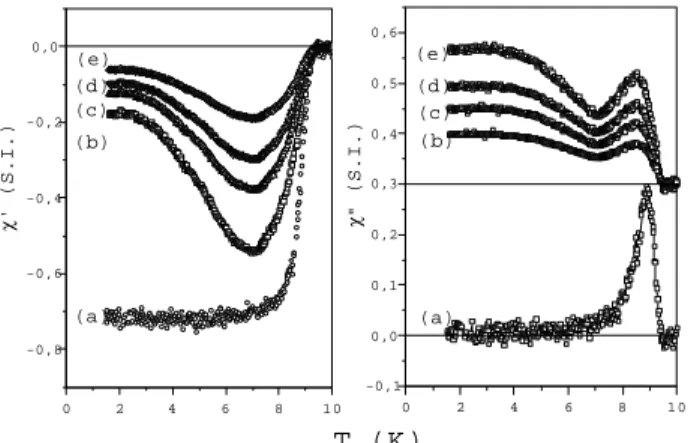
Fig. 4showstheresultsfor
AC
(T),obtainedfrom
ZFC experiments, for dierent amplitudes of the AC
magneti eld. For h
AC
smaller than about50 mOe,
thebehaviorofbothomponentsof(T)isquitesimilar
to typial superonduting samples. The real
ompo-nent, 0
(T), whih is a measure of the sreening
ur-rent,beomesmorenegativeatlowertemperatures,
in-diatingstrongersuperondutivitythroughthe
ompo-nent"(T)peaks,indiatingamaximuminthelosses,
aroundtheritialtemperature,T
C
. Notiethat 0
-0.7 (SI) for h
AC
= 10mOe, at low temperature. The
sampleanonlypartiallysreentheexternalmagneti
eld. Outside the Meissner-like regime, for values of
h
AC
>50mOe, 0
(T)isreentrant. It rstinreasesin
modulusasthe temperature is loweredfrom the
riti-altemperatureT
C
,thendereasesatalower
tempera-ture. Theminimumin 0
(T)appearsatT7.0K.For
allthetemperatures,ataxedvalueofT,themodulus
of 0
(T)dereasesbyinreasingh
AC
. Theout-of-phase
omponent,"(T),isorrelatedwiththereentrane
ob-servedin 0
(T),showinginreasinglossesasthe
sreen-ingdereases, indiatinganapparentweakeningofthe
orderparameteratlowtemperatures.
0
2
4
6
8
1 0
-0,8
-0,6
-0,4
-0,2
0,0
(e)
(d)
(a)
(c)
T (K)
(b)
χ
' (S.I.)
0
2
4
6
8
1 0
-0,1
0,0
0,1
0,2
0,3
0,4
0,5
0,6
(e)
(d)
(c)
(b)
(a)
χ
" (S.I.)
Figure 4. Curvesof AC(T)for(a)hAC=10, (b)hAC=80,
()h
AC
=96,(d)h
AC
=144and(f)h
AC
=320mOewithno
appliedexternalmagnetield.
We havesimulated 0
1
(T) and
1
"(T) for dierent
valuesofh
AC
byfollowingtheequationsdeveloped
be-fore. The obtained results are shown in Fig. 5. For
values ofh
AC
smallerthan 47mOe (orrespondingto
0 a 2 h AC 5 0 ), 0 1
(T)dereaseswithdereasing
tem-perature, and
1
"(T) is lose to zero. By inreasing
h
AC
above 47 mOe, reentrane at low temperature
learlyappearsandthesreeningbeomesweakerinall
thetemperaturerange. Thisisonsistentwiththe
ex-periment,wherethemagnitudeof 0
(T)dereaseswith
inreasingh
AC
. Notethat atthese highvaluesofh
AC
the simulated
1
"(T) inreases signiantly, i.e. the
simulation reprodues the dramati inrease of losses
at lowtemperaturethatisfoundin theexperiment.
Thus, phenomena ausing the reentrane we
ob-served in Josephson juntion arrays should also exist
in granular superondutors. This has been reently
experimentallyreportedbyPassosetal. [17℄
whereHTS
samples with ontrolled granularity, have shown
reen-trane. The reentrane behavior, as expeted from
our work, appears either as PME, in the ase of DC
suseptibility measurements, or as an anomalous
in-ofACsuseptibilitymeasurements. Numerial
simula-tionsof two-dimensional Josephson juntion networks
withadistributionofharateristiparameters
L and
C
wouldbeveryusefulforfurther theoretial
investi-gationsofthese phenomena,asweexplorein thenext
Setion.
4
5
6
7
8
9
-1,0
-0,9
-0,8
-0,7
-0,6
-0,5
-0,4
-0,3
-0,2
-0,1
0,0
0,1
0,2
(d)
(c)
(b)
(a)
χ
1
' (S.I)
T (K)
4
5
6
7
8
9
0,0
0,2
0,4
0,6
0,8
1,0
1,2
1,4
χ
1
'' (S.I.)
(d)
(c)
(b)
(a)
Figure5. Curvesfor the simulated 0
1
(T) and 1"(T) for
(a)h
AC
=5 mOe,(b)29mOe, () 69mOe, (d)118mOe.
Inall ases
L
(T = 4:2K) =30 and
C
(T = 4:2K) =60.
Curvesfor 1"(T) havebeenvertiallyshifted by 0.4 (SI)
forlarity.
(b)The Stewart-MCumberparameter and the
ourreneof PME
In thepreeding setion we show that the
Param-agneti Meissner Eet is diretly assoiated to
pin-ning, and not neessarily related to the presene of
-juntions. However, it is still unlear whih are
the parameters ontrolling the ourrene of PME in
granular systems. Besides those works from
Brau-nish and o-workersmentionedbefore, PMEhas also
beenobservedinertainsamplesofYBa
2 Cu 3 O [18℄ 7 d ,and Nd 2 x Ce x CuO [19℄ y
. Theparametersto ontrolthe
ap-pearaneofthePMEingranularsystemsarestilltobe
determined. One of the main problems in ontrolling
PMEisthediÆultytoreprodueidentialparameters
in dierentsamples, evenfollowingthe same
prepara-tionproedure. Amongsamplesproessed in idential
way, just afewof them showPME. This isonsistent
withexperimental evidenesindiatingthat thiseet
isdiretlyrelatedtotheweaklinknetworkpresentinall
granularsystems [15℄
. Manyauthorshaveveriedthat
thesurfaeofthesampleplaysanimportantrollinthe
appearane of PME [20℄
. Both, the weak link network
and the sample surfae are, up to now, hardly
repro-duiblefromonesampletoanotherinasuÆientwayto
guaranteetheontrolofalltheproperties,inludingthe
appearaneof thePME.Other authorshaveproposed
alternativemodelstoexplainit,basedonuxtrapping
magnetiimpuritiesinthejuntionornon-s-wave
sym-metryare not neessarilyrelated to the ourreneof
this eet. Wehave shown that PME manifests itself
asareentraneoftheACmagneti suseptibilityas a
funtionoftemperature. Oneunsolvedquestionstill
re-mainswithinthesenariowehavepreviouslyproposed:
whythedynamisreentranein
AC
(T)hasneverbeen
measured in standard-prepared high temperature
su-perondutors?Weproposeananswertothisquestion,
showingthat,amongthesystemsexhibitingPME,only
thosewithsuÆientlylowdissipationandhigh
apai-tanewillshowdynamisreentrane.
As we have shown PME manifests itself in
two-dimensional unshunted Josephson juntion arrays as
reentraneinthetemperaturedependentACmagneti
suseptibility. However, reentrane is not observed
in shunted arrays, where the value of the
Stewart-MCumber parameter,
C
, is very low ompared to
unshunted arrays. We have observed this absene of
thereentrantbehaviorinthreesetsofshuntedsamples
withdierentparametersandgeometries.
ThereentraneintheACmagnetisuseptibilityis
extremelyunusualingranularsystemswhoseweaklinks
haveabroaddistributionoftheirharateristi
param-eters. Thedependeneofthereentraneonthevalueof
C
isonsistentwiththesystematiofPMEingranular
superondutors. This result explains whyreentrane
- therefore PME - is hardly observed in granular
su-perondutorsbesidesthosewithontrolledgranularity.
These experimental ndingsare onrmedby
numeri-al simulationsof the samesimplied model basedon
aloopontainingfourjuntions.
Toverify theinuene oftheparameter
C onthe
reentrane, we have performed numerial simulations
ofthesamefourjuntions modelpreviouslydesribed.
Again, as in the PME situation, this model gives an
exellentsemi-quantitativedesriptiontoallour
exper-imentalndings.
Weshowtheresultsofthe simulated
1
(T),
orre-sponding to
C
(T = 4:2K) = 30 (unshunted arrays)
and
C
(T = 4:2K) = 1 (shunted arrays). In all
nu-merialsimulationswehaveused
L
(T =4:2K)=30,
in agreementwith thereal values of these parameters
forbothtypesofsamples. Fromthedenitionofthese
parameters, we ansee that even for thease of high
valuesof theritialurrentI
C
,verylowvaluesofthe
resistaneandtheapaitaneofthejuntion(R
J and
C
J
,respetively),andeterminelowvaluesof
C .
Typ-ialbehavior of this parameterin twoextreme
ondi-tionsare
C
=0and
C
!1,orrespondingto
negli-gibleand dominantapaitane,respetively. The
pa-rameter
C
anbeassoiatedtothequality oftheweak
link,i.e. the Josephsonjuntion. Therefore,a
Joseph-sonjuntionwithalow
C
value,isassoiatedtoa
low-quality weaklink,andan bemodeledbyaJosephson
juntioninparallelwitharesistorR.Inspiteof
C and
haveneverbeendeterminedfor granular
superon-dutors,theirIVharateristisshowthat theyan
beonsidered as
low-C
systems [21 23℄
.
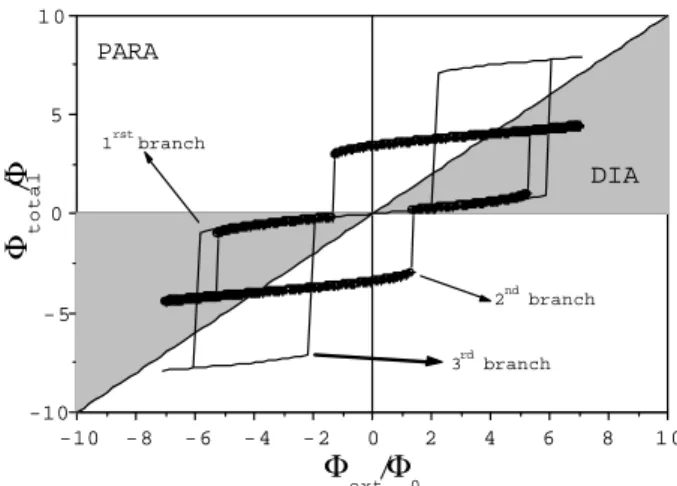
Tofurtherunderstandtheinuene ofthedierent
values of
C
in the reentrane, it is essential to
on-sider the urve
TOT
vs.
EXT
for a shunted
sam-ple (Fig. 6). Similarly to unshunted samples [12;13℄
,
for a xed temperature, this urve is very hystereti,
showingmultiples branhesinterseting theline
TOT
= 0 whih orresponds to diamagneti states. For
all theother branhes,their intersetion with theline
TOT
=
EXT
orresponds to theboundary between
diamagnetistates(negativevaluesof 0
(T))and
para-magnetistates(positivevaluesof 0
(T)),asexplained
inSetionV.Forunshuntedarrays,atthetemperatures
ofT=5 Kand T=7.6K,theappearaneoftheseond
branhandthethirdbranhesrespetivelyadda
para-magneti ontribution to the average value of 0
(T).
The analysis of these gures, shows why there is no
reentrane in low temperatureswhen
C
is small. In
this aseof low
C
, the seond branh appears to be
stable, givingan extra diamagneti ontribution
over-whelming the paramagneti ontribution from
subse-quent branhes. When
C
is large (unshunted arrays
ase), the seond branh is unstable, and the average
response ofthe sample in low temperatures is
param-agneti.
-10
- 8
- 6
- 4
- 2
0
2
4
6
8
1 0
-10
- 5
0
5
1 0
1
rst
branch
2
nd
branch
3
rd
branch
Φ
total
/
Φ
DIA
PARA
Φ
ext
/
Φ
0
Figure6. NumerialresultsforthesimulationofT
OT vs.
EXT foraxedtemperature.
Forunshuntedarrays,PMEourswhensomeweak
links have a suÆiently large ritial urrent.
There-fore,theeet oursaboveaorrespondingminimum
value of
L
. However, experiments show and
simula-tions onrm that, even for large values of
L ,
reen-trane does not our when
C
is of the order of 2
or smaller. In this ase, the urve
TOT vs.
EXT
is veryhystereti,appearing extrabranhesgiving an
average diamagneti behavior. For low
C
, when the
samplesareZFCandthenmeasuredatsmallvaluesof
the magneti eld, most of theloopswill bein states
orresponding tothediamagneti states,andno
samples are FC in small magneti elds, ux quanta
an not get trapped into the loops. In this situation,
the sampleremains diamagnetieven at highervalues
of theexitation magnetield. WhenPME doesnot
appearasaonsequeneoflowvaluesof
C
,thereisno
rossover from paramagneti to diamagneti response
by inreasing the applied magneti eld, as we
mea-sured forthe unshunted arrays. Thus, the grains and
thejuntionswill havethe samediamagnetiresponse
andthe measuredvalueof themagneti suseptibility
willbenegative,i.e.,diamagneti.
1 0
1 0 0
- 0 , 7 0
- 0 , 6 5
- 0 , 6 0
- 0 , 5 5
h
AC
( m O e )
χ
AC
(SI)
1 0
100
0,000
0,025
0,050
h
AC
( m O e )
χ
AC
(SI)
0,1
1
1 0
1 0 0
-0,8
-0,7
-0,6
-0,5
-0,4
-0,3
-0,2
-0,1
0,0
h
AC
( m O e )
χ
AC
(SI)
χ
'
0 , 1
1
10
1 0 0
- 0 , 1
0 , 0
0 , 1
0 , 2
h
AC
( m O e )
χ
AC
(SI)
χ
"
(a)
(b)
Figure7.Curvesfor(h
AC
),forbothomponentsoftheACmagnetisuseptibility;theontinuouslineisthettingtothe
exponentialritialstatemodel(a)T=4.2K,(b)T=8.0.
0
10
20
30
40
-0,5
-0,4
-0,3
-0,2
-0,1
0,0
0,1
χ
1
' (S.I.)
µ
0
h
A C
a
2
/
Φ
0
0 10 20 30 40
-0,05
0,00
0,05
0,10
0,15
0,20
0,25
χ
1
'' (S.I.)
0 10 20 30 40
-0,05 0,00 0,05 0,10 0,15 0,20 0,25
0 10 20 30 40
-0,5 -0,4 -0,3 -0,2 -0,1 0,0 0,1
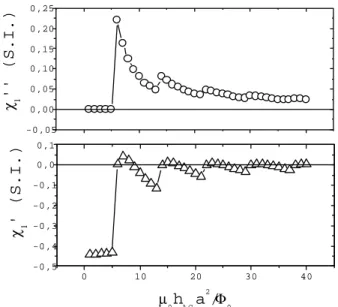
Figure8. Numerialresultfor(hAC)forT=4.2 K,using
the four-juntions model. Asan be observed, there is a
sharpinreaseinboth 0
and",aroundhAC=50mOe.
Thus, wehave shown that only high values of the
ritialurrentoftheweaklinksarenotenoughtoause
reentrane (i.e., PME) in agreement with the
experi-mental results proposed by other groups. Our results
also indiate that thedissipation and the apaitane
of the weak links, and not only the indutane, play
themoreimportantroleintheappearaneofthe
reen-trane. Wehavealsoveriedthat,evenforlargevalues
of
L
, reentrane does not our if
C
is very small.
Thisexplainswhyreentraneisunommonandhardly
reproduible in granular high temperature
superon-dutors,sinethesematerialsareassoiatedtolow
val-ues of the parameter
C
, when prepared by following
standardproedures.All ourexperimentalndingsare
inperfetagreementwiththeresultsobtained
numeri-allyfromthesimplemodelbasedonaloopontaining
four juntions. It is straightforwardto onludethat,
ontrolling the weak link oupling in granular
super-onduting samples, would be possible to ontrol the
appearaneofthereentrane,and,in onsequene,the
() Critialstate modelin 2D-JJA
The onept of a ritial-state and its use in the
interpretation ofACmagnetization datain termsof a
ritial urrent density were introdue by both Bean
[24;25℄
and London [26℄
in a suessful eort to derive
the magneti properties of hard type-II
superondu-tors. However, the relation between loal and global
quantitiesismoreomplexinHTSthaninLTS.Bean's
original model is inadequate for polyrystalline HTS
superondutors, manly beause of their strong
mag-netielddependeneoftheritialurrentwhihleads
to urrentlimitation in a marosopi wireaused by
themagnetiself-eld [27℄
. Theritial-statemodel
pro-posedbyBeanprovidesamehanismforharmoni
gen-erationintheomponentsofthemagnetizationof
type-IIsuperondutors,whenimmersedinanACmagneti
eld.
Dierentritialstatemodels [27 29℄
assumingthat
superurrentsowinsidethesamplewitharitial
den-sity J
C (H
i
) (where H
i
is the internal magneti eld),
havebeenusedtostudythemagnetiresponseof
type-II superondutorsto anexternaleld [30 35℄
. In
par-tiular,Chenetal. [31℄
haveshownthattheexponential
law,rstintroduedbyFietzetal. [29℄
,isveryusefulto
interpretACsuseptibilitydataofHTS.
In spite of allthe numerial evidene bringing out
theequivalenebetweenritial-statesinJJAandHTS,
to our knowledge there are no diret experimental
proofs supporting suh relation. In this Setion, we
present ournumerial andexperimental results
study-ing the penetration of themagneti eld and its
rela-tionwitharitial-stateinunshunted two-dimensional
Josephson juntion arrays. We havenumerially
sim-ulated the dependene of 0
and " on h
AC . We
haveobtainedexperimental resultsby usingtwo
teh-niques, mutual-indutane measurements, and
san-ningSQUIDmirosopy.
Fromthe mutual-indutaneexperiments, we have
obtainedtheAC magnetisuseptibility asafuntion
of the AC magneti eld, (h
AC
), for dierent
tem-peratures. Inthese experiments,wekeeponstantthe
temperature and the external DC magneti eld, and
sweep theACmagneti eld,h
AC
. Fig. (7a-b)shows
the measured
AC
(T)vs. h
AC
in our arrays, at T =
4.2KandT=8.0K.Weobservethatthereisasharp
in-reasein both 0
and",aroundh
AC
=50mOe. The
amplitude of this jump dereases as we inrease the
temperature, untilT 5.0K. ForT >5K there isno
longer adisontinuity. Thisdisontinuityin theurve
is a signatureof thetransition from the Meissner-like
regimetothereentrantregime.
We have also numerially determined the
depen-dene of 0
and " on h
AC
, by onsidering the
four-juntionsmodeldesribedin previoussetions. Inthis
ase we have used
L
= 30 e
C
= 60.This results is
qualitativelyin agreementwiththatshownin Fig. 8.
unshuntedSISsamples,wehaveperformedseveral
ex-perimentsby using a sanning SQUID mirosope, as
desribedbefore.
In the rst SSM experiment (Fig. 9), we indue
uxintothearrayusingthefeedbakoilpatternedon
theSQUID hip. Thesamplewasheated aboveT
C , a
small urrent was put through the feedbak oil, and
thesamplewasooledto4.2K.Thenweheatedupthe
sampleand observedhowthetrapped uxbehavedas
it warmed. The y-axisis about0.5 mm long and the
x-axis is about 1.5 mm long. The SQUID output is
in volts from the eletronis. To get the normalized
ux inthearray,theonversionis: 1.72volts=1ux
quantum in SQUID and 1ux quantum in SQUID =
(4.7) 2
=22.09 ux quanta in the array. Fromimages
showninFig. 9,weobservednoorderin themagneti
uxdistribution,asweexpetforaritialstateaswe
inreasethetemperature.
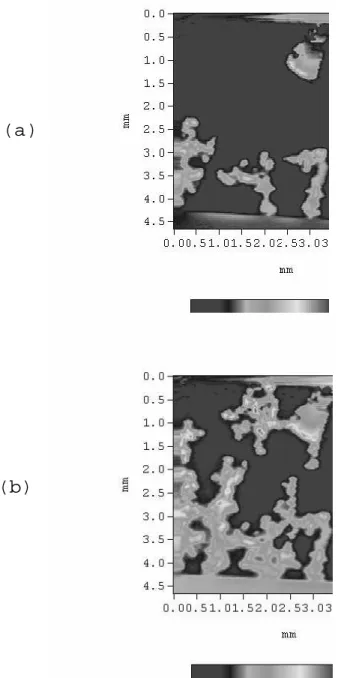
Inthe seond SSM experiment (Fig. 10) we made
images of suessive sans of a largearea of the
sam-ple, for T = 4.2 K, as the external magneti eld is
inreased. These imagesshowthat forlargeareas,the
magneti eld penetrates via dendriti growth, as
ob-servedbyDuranetal [36℄
.
Inthe third SSM experiment(Fig. 11), theimage
wastaken from a small setion of the sample. It was
zeroeld ooled(ZFC),and externaluxis zero. The
saleontheimageisnormalizedto/
0
inthearray,
where the x and y axes are in millimeters. From this
image, weobserved the typialorder in the magneti
ux distribution,asweexpetforaritialstate.
Thus, we have shown that, in priniple, there is
some long-rangeorder in the distribution of magneti
ux, as required to establish a ritial state. As
pre-dited by Chen et al., rst it is established a vortex
state whih hangesto aritialstate astemperature
(or,alternatively,themagnetield)isinreased. From
largeimages,wehaveobservedthatmagnetiux
pene-tratesdesamplesfollowingdendritigrowing,as
estab-lishedbeforebyDuranet al. forNbthinlms,usinga
magneto-optialtehnique.
(D) Vortex avalanhes in 2D-JJA
The magnetization properties of type-II
superon-dutors have been studied for many deades. The
in-terest about this problem has been renewed after the
disoveryof HTS. Magneti ux penetratesthese
ma-terialsin theform of quantized vortiesthat movevia
over-damped dynamis. They are subjeted to
repul-siveinterationsfromothervortiesandtorandom
pin-ning fores due to the inhomogeneities alwayspresent
in polyrystallinesamples. Vortiesanmovewhenan
eletrialurrentisappliedandtheirmovementreates
an eletrialresistanethat andestroythe
superon-duting state. In this way, strutural defets an pin
Figure 9 - SSM images for (a) T=4.2 K, (b) T=7.0 K, and (c) T=8.0 K
(a)
(b)
(c)
The magnetization proess is usually desribed in
terms of a ritial-state model providing a
onsis-tent piture about the average magnetization
prop-erties suh as the hysteresis loop and thermal
relax-ation eets [28℄
. InBean's model, ux lines penetrate
into the sample and, due to the presene of disorder,
they give rise to a steady ux gradient. Therefore,
the distribution of vorties entering asuperondutor
is nothomogeneousandthenite gradientin the
vor-tiesdensitybuildsuptoreateadrivingfore inward
balaned by pinning fores opposing vorties
move-ment. De Gennes [37℄
originally ompared the slopeof
this pile of vorties to a sand-pile, with the slope
be-ing proportional to the loal magnitude of the
riti-alurrent. Dynami propertiesofthe sand-pile
prob-lemhaveattratednewattentionsineitonsists ofa
marginallystablesystemdisplayingself-organized
riti-ality(SOC) [38℄
. Inthisase,whenasuperondutoris
intheBeanritial-state,theadditionofvortiesours
by inreasing theexternal magnetield. This
proe-dureis analogousto theintrodutionof newgrains to
asand-pileandisexpetedtoprodueanavalanhe of
grainsofsand(or,equivalently,vorties)ofallsizes to
(a)
(b)
Figure10. Largesweep SSMimagesas the external
mag-neti eld is inreased for T = .2K; xand y axesare in
millimeters, for (a) I
oil
=0.10 mA, and (b) I
oil = 0.25
mA.
ux)density. However,Bean'smodeldoesnotaount
for those loal spatio-temporal utuations. Reently,
ithasbeenexperimentalandnumeriallyveriedthat
vorties an move intermittently in time as they are
fored in or out of a superondutor [39 41℄
(as the
avalanhes mentionedbefore),andthatux frontsare
notsmooth [42 44℄
.
The interest in the dynamis of systems that an
beslowlydriventothethresholdofinstability,likethe
sand-pile,hasbeeninreasedovertheyears. Thishas
Figure11. SSMimagesofasmallsetion ofthesample
af-terZFC andfor noexternalmagnetiux. Dimensionsof
sannedareaare showninmillimeters.
ourredmainlybeauseofthelargenumberand
diver-sityof physial systemsharaterizedby suh
dynam-is,whereweaninludeharge-densitywaves,pinned
Wignerrystals,earthquakefaults,granularassemblies,
besides those related to superonduting vorties, as
shortly desribed before. However, to experimentally
study vortexavalanhephenomena,goodquality
sam-ples and extremely low temperatures (of the order of
mK) areneessary. Onthe otherside, toperform the
samestudybyusingnumerialproedures,like
mole-ulardynamisorMonteCarlomethods,largemahine
times are neessary. It would be of great interest if
vortexavalanhephenomenaouldbestudy in
highly-ontrolled artiial strutures like Josephson juntion
arrays, whose study is muh simpler than those
men-tionedbefore.
Experimentaldatashowingthatunshunted
Joseph-son juntion arrays exhibit vortex avalanhe-like
phe-nomena. We show in Fig. 12 AC magneti
susepti-bilitymeasurementsthat,presentasuessionofsteps
as temperature is inreased. These steps appear
be-forethereentrantbehaviorwelldesribedinpreeding
setions. We anobserve in Fig. 13 that these steps
are equally spaed in temperature. As the
tempera-ture is raised up, the ritial urrent of the juntions
hanges aordinglyto eq. [4℄. Therefore, the
meha-nism assoiated to the appearane of the steps seems
to berelatedto amathing betweenthepresentvalue
oftheparameter
L
(whihalsodependsontheritial
urrent, so the temperature, as stated by eq. 5) and
theavailableexternalmagneti eld. The
L
parame-ter anbedesribedastheapaityofthesystem(or,
theritialurrentofthearray)tosreentheexternal
magnetield. Thus,whenthismathinghappens,the
sampleletsmagnetiuxtoenterthesample,following
2
3
4
5
6
7
8
9
10
-1,0
-0,8
-0,6
-0,4
-0,2
0,0
χ
' (SI)
Nb thin film (5000 Å)
0 . 9 3 m O e
1 . 8 6 m O e
3 . 7 2 m O e
7 . 4 5 m O e
Temperature (K)
2
3
4
5
6
7
8
9
10
-1,0
-0,8
-0,6
-0,4
-0,2
0,0
χ
"(SI)
96.7 mOe
78.2 mOe
59.6 mOe
41.0 mOe
31.7 mOe
22.3 mOe
Figure12. ACmagnetisuseptibilitymeasurementsfordierentexitationelds,obtainedfromanunshuntedJJA,showing
asuessionofstepsasthetemperatureisinreased.
3
4
5
6
7
8
9
10
-0,40
-0,35
-0,30
-0,25
-0,20
-0,15
-0,10
-0,05
0,00
0,05
h
ac
= 67 mOe
f = 1 KHz
Temperature (K)
χ
' (SI)
6,6
7,2
7,8
-0,350
-0,325
-0,300
-0,275
(b)
Penetrated region
(a)
Figure14. SSMimagesofalargeregionofsample,astheexternalmagnetieldisinreasedatT=2Kfor(a)Ioil=0.190
mA,and(b)I
oil
=0.210mA.
ThisstrikingresultisonrmedbysanningSQUID
mirosopyimages. Thesesuessivefollowingimages,
taken at T=4.2 K, demonstrate that ux enters into
thearrayin sort ofatastrophi events. Asthe
exter-naluxisinreased,nothinghappensfortherststeps.
streamsintothearray,followingaatastrophievent.
Wedonotobserveanydependenyofthestepson
theooling/warmingrate. Therefore,theappearaneof
thestepsdoesnotseemtobeaphenomenonrelatedto
some kindofdelayresponse of thesample. Moreover,
we onsider that the magneti ux enters the sample
when the ritial urrent (the only one temperature
dependent parameter) allows to have a mathing
be-tweenthegeometryoftheloops(throughtheparameter
L
)andanintegernumberofuxonsfromtheexternal
availablemagnetiux.
Further study should be neessaryto undoubtedly
onrmiftheobservedstepsheredesribedanbe
on-sidered as ux avalanhes related to a self-ritiality
mehanism. Inpartiular,experimentsforaxed
tem-perature should be neessary to onrm our ndings.
If so, it is obvious the enormous advantage to study
these interestingphenomena inhighly ontrollable
de-vies suh JJA insteadof HTS single rystalsin
tem-peraturesoftheorderofsomemK.
Aknowledgments
WethankM.G.Forrester,A.W. Smithand C.B.
Whan for theirtehnialhelp in the experiments. We
also thankS. Sergeenkov,E.Granato,A.Sanhezand
D. X.Chenforusefuldisussions.
We gratefully aknowledge nanial support from
U. S. Air Fore OÆe of Sienti Researh, through
grant no. F496209810072and from the National
Si-ene Foundationthroughgrantno. 9510464.
F.M.A.M. also gratefully aknowledges nanial
supportfromBrazilianAgenyFAPESP,undergrants
96/7704-6 and 98/12809-7. W.M.J gratefully
a-knowledges nanial support from Brazilian Ageny
FAPESP,under grantsand98/12593-4.
Referenes
[1℄ F.M.Araujo-Moreira,O.F.deLima,andW.A.Ortiz,
PhysiaC,240-245,3205(1994).
[2℄ F.M.Araujo-MoreiraO.F.deLima,andW.A.Ortiz:,
J.Appl.Phys.80,6,3390(1996).
[3℄ F.M.Araujo-MoreiraO.F.deLima,andW.A.Ortiz,
PhysiaC311,98-106(1999).
[4℄ W. A.C.Passos,P.N. Lisboa-Filho, R.Caparroz, C.
C.deFaria,P.C.Venturini,F.M.Araujo-Moreira,S.
Sergeenkovand W.A.Ortiz; PhysiaC 354,189-196
(2000).
[5℄ R. S.Newrok, C.J.Lobb, U. Geigenmuller,and M.
Otavio,SolidStatePhysis54,263(2000).
[6℄ P.MartinoliandC.Leeman,J.Lowtemp.Physis118,
699(2000).
[7℄ R. B. Goldfarb M. Lelental, and C. A. Thomson, in
Magneti Suseptibility of Superondutors and Other
SpinSystems,p.49, editedbyR.A.Hein,T.L.
Fran-avillaandD.H.Liebenberg,PlenumPress,NewYork
[8℄ J.L. Jeanneret, G.A. Gavilano, A. Raine,Ch.
Lee-mann, and P. Martinoli, Appl. Phys. Lett. 55, 2336
(1989).
[9℄ J.R.Kirtley,A.C.Mota,M.Sigrist, andT.M. Rie,
J.Phys.Condens.Matter10,L97(1998).
[10℄ R.C.Blak,A.Mathai,F.C.Wellstood,E.Dantsker,
A. H.Miklih,D. T. Nemeth, J. J.Kingston, and J.
Clarke;Appl.Phys.Lett.62,2128(1993).
[11℄ A. Mathai, D. Song, Y. Gim, and F. C. Wellstood,
Appl.Phys.Lett. 61,598(1992).
[12℄ F.M. Araujo-Moreira, P. Barbara,A. B.Cawthorne,
andC.J.Lobb,Phys.Rev.Lett.78,4625(1997).
[13℄ P.Barbara, F.M. Araujo-Moreira, A. B.Cawthorne,
andC.J.Lobb,Phys.Rev.B60,7489(1999).
[14℄ T. Wolf and A. Majhofer, Phys. Rev. B 47, 5383
(1993).
[15℄ W. Braunish, N. Knauf, S. Neuhausen, A. Grutz,
A.Koh,B.Roden, D. Khomskii,and D. Wohlleben,
Phys. Rev. Lett. 68, 1908 (1992); W. Braunish, N.
Knauf,G. Bauer,A. Koh,A. Beker, B.Freitag, A.
Grutz,V.Kataev,S.Neuhausen,B.Roden,D.
Khom-skii,andD.Wohlleben,Phys.Rev.B48,4030(1993).
[16℄ L. N. Bulaevskii, V. V. Kuzii, and A. A. Sobyanim,
JETPLett. 25,290(1977); F.V. Kusmartsev, Phys.
Rev.Lett. 69, 2268 (1992); H. Kauamura and M. S.
Li,Phys.Rev.B54,619(1996);D.Dominguez,E.A.
Jagla, and C. A. Balseiro, Phys.Rev.Lett. 72, 2773
(1994).
[17℄ W.A.C.Passos,P.N.Lisboa-Filho,andW.A.Ortiz;
PhysiaC341-348,2723(2000).
[18℄ R.Luht,H.v.Lohneysen,H.Claus,M.Klaser,andG.
Muller-Vogt,Phys.Rev.B52,9724(1995);S.Riedling
etal.,Phys.Rev.B49,13283 (1994).
[19℄ G.S.Okram,D.T.Adroja,B.D.Padalia,O.Prakash,
andP.A.J.deGroot,J.Phys.C9,L525(1997).
[20℄ P.Kosti,B.Veal,A.P.Paulikas,U.Welp,V.R.Todt,
C.Gu, U.Geiser, J.M. Williams,K.D. Carlson, R.A.
Klemm,Phys.Rev.B53,791(1996).
[21℄ I.Takeuhi, S.N. Mao, X. X. Xi, K.Petersen, C. J.
Lobb,andT.Venkatesan,Appl. Phys.Lett. 67,2872
(1995).
[22℄ I. Takeuhi, C. J. Lobb, Z. Trajanovih, P. A.
War-burton,andT.Venkatesan;Appl.Phys.Lett.68,1564
(1996).
[23℄ T.Hashimoto,M.Sagoi,Y.Mizutani,J.Yoshida,and
K.Mizushima;Appl.Phys.Lett.60,1756(1992).
[24℄ C.P.Bean,Phys.Rev.Lett.8,250(1962)
[25℄ C.P.Bean,Rev.Mod.Phys.36,31(1964).
[26℄ H.London,Phys.Lett.6,162(1963).
[27℄ H. Dersh and G. Blatter, Phys. Rev. B 38, 11391
(1988).
[29℄ W.A.Fietz,M.R.Beasley,J.Silox,andW.W.Webb,
Phys.Rev.136,A335(1964).
[30℄ M.Xu,D.Shi,andR.F.Fox,Phys.Rev.B42,10773
(1990).
[31℄ D. X. Chen, and R. B. Goldfarb, J. Appl. Phys. 66,
2489(1989).
[32℄ D. X. Chen, A. Sanhez, and J. S. Mu~noz, J. Appl.
Phys.67,3430(1990).
[33℄ J.L.ChenandT.J.Yang,PhysiaC224,345(1994).
[34℄ J.R.Clem,PhysiaC153,50(1988).
[35℄ M. Tinkham and C.J. Lobb, in Solid State Physis,
edited by H. Ehrenreih and D. Turnbull, Aademi,
vol.42,p.91, NewYork(1989).
[36℄ C. A. Duran, P. L. Gammel,R. E. Miller, and D. J.
Bishop,Phys.Rev.B52,75(1995).
[37℄ P. G. de Gennes, inSuperondutivity of Metals and
Alloys,Ed.byW.A.Benjamin,NewYork(1966).
[38℄ P.Bak,C.Tang,andK.Weisenfeld,Phys.Rev.Lett.
59, 381(1987); P. Bak,C. Tang, and K.Weisenfeld,
Phys.Rev.A38,364(1988).
[39℄ S.Field,J.Witt,F.Nori,andX.Ling,Phys.Rev.Lett.
74,1206(1995).
[40℄ C.M.Argenter,Phys.Rev.E58,1438 (1998).
[41℄ K.Behnia,C.Capan,D.Mailly,andB.Etienne,Phys.
Rev.B,61,3815(2000).
[42℄ R.Surdeanu,R.J.Wijngaarden,E.Visser,J.M.
Hui-jbregtse,J.H.Retor,B.Dam,andR.Griessen,Phys.
Rev.Lett.83,2054 (1999).
[43℄ R. Surdeanu,R. J.Wijngaarden, B.Dam,J. H.
Re-tor,R.Griessen,C.Rossel,Z.F.Ren,andJ.H.Wang,
Phys.Rev.B58,12467(1998).
[44℄ S.S.James, S.B.Field, S.Seigel, andH.Shtrikman,