Preparation and General Physial Properties of
Polyrystalline PrBa
2 Cu
3 O
7 y
Obtained
From Sol-Gel Preursors
V. A. Meza, X. Gratens,R. F. Jardim,
Institutode Fsia, UniversidadedeS~aoPaulo
CP66318, 05315-970,S~aoPaulo,SP,Brazil
and L. Ben-Dor
Department ofInorganiandAnalytialChemistry,
Hebrew University,Jerusalem,91904,Israel
Reeivedon28February,2002
PolyrystallinesamplesofPrBa2Cu3O7
y
werepreparedthroughtwodierentroutes: (a)mixing
Pr
6 O
11 , BaCO
3
,and CuO;(b)sol-gel preursors. Thesampleswereheat-treatedinthe
temper-aturerange 700 T 930 o
C and underdierent atmospheres, (Argonand air). Oxidation of
theseompounds,basedontheresultsofthermogravimetrianalysis,TGA,wasperformedatlow
temperatures, from300to 400 o
C,for timeintervalsas longas 120h. Therystalstruturewas
determinedby measurementsof X-raypowder dirationand revealedthat samplesheat-treated
at 810 o
C inAr and for 130hhavea tetragonal struturewith lattie parameters 11.88
A.
Oxygenated PrBa2Cu3O7
y
samples were found to have an orthorhombi struture with lattie
parameterrangingfrom11.72to11.75
A.Eletrialresistivity(T)measurementsperformedon
theseompoundsrevealedasemiondutor-likebehaviorinthetemperaturerange77T 300
K.The magnetisuseptibility (T) datashowed a paramagneti-like behavior from5 to 300 K
andalearontributionof therystallineeletrialeld (CEF)below150K.Wehavealsofound
anantiferromagnetiorderingassoiatedwiththePrsub-lattieatTN17K.Evideneof
super-ondutivitywasnot observedonoursamples,inagreementwithmost ofthe resultsreportedin
theliterature.
I Introdution
Reent investigations on members of the family
REBa
2 Cu
3 O
7 y
; RE =rare earth; revealed that only
PrBa
2 Cu
3 O
7 y
(Pr123) exhibits physial properties
similar to onventional insulators [1℄. While most of
the membersof this family display superondutivity
below the ritial temperature T
90 K, the Pr123
isaninsulatorwithantiferromagnetiorderingduethe
Pr sub-lattiebelowT
N
15K[2,3℄. Severaltheories
wereputforwardin ordertoexplainthereasonofthis
failure suh as hole-lling [4℄, exhange between Pr +3
and Ba +2
in theirsites [5℄, hybridizationbetween
2p-O and 4f-Pr orbitals [6℄, and magneti pair breaking
due an intermediary valene state of Pr +3
and Pr +4
[7℄. However,ten years after thedisoveryofthe rst
member of the family RE123, someresults raised
im-portantquestionsabouttheabseneof
superondutiv-ityinPr123. First,Blaksteadet al. [8℄produedthin
surfaeresistane below 90 K, whih is an indiation
of superondutivity in this system at relatively high
temperatures. Followingtheirresults,Zouetal. [9,10℄
were apable to produe single rystal of Pr123 that
showed a lear transition to zero resistivity state and
appreiableMeissnereetbelow85K.Oneofthe
sig-niant features showed in those Pr123singlerystals
wastherelativelylargelattieparameter11.85
A,a
lengthlargerthanthoseusuallyfoundin theliterature
forthesameompound. Suhalargerlattie
parame-ter resultsin anappreiableseparationof theCuO
2
planes from eah other, dereasing possible eets of
hybridization between theorbital 2p-O and 4f-Pr[11,
12℄. Infat,aslightontrationofthelattieparameter
promotesthenon-metalli/non-superondutor
har-aterofthePr123,astruturalonstraintnotobserved
in other members ofthis family [13℄. Theontration
their original sitepositions in thePr123 unit ell due
to similar ioni radii. However, an oxidizing
environ-mentneartheCuOhainsanstimulatethisexhange
and promote aontration of the lattieparameter,
followedbyanorthorhombi-tetragonaltransitionO-T
[5, 14℄. Therefore, it seems important to ontrol the
absorption ofoxygeninto thelattie, in order to have
a rystal struture with a robust lattie parameter,
whihansupportsuperondutivity. Besides,the
ma-terial should maintain its high quality, that is, ahigh
degreeofhomogeneityandabseneofadditionalphases
[8℄. AspointedoutbyParketal. [14℄ andfollowedby
Zouetal. [9,10℄, therstproeduretoavoid
inhomo-geneity and multiphase material is through annealing
ininertatmospheresavoidinganoxidizingenvironment
nearCuOhainsandthuslimitapossibleexhange
be-tween Pr and Ba from their original rystallographi
sites. This would result in an inrease of the lattie
parameter andonsequently obtaining
superondu-tivitybelowT
90K[9,10℄.
The aim of this work is to ontribute to this
dis-ussionbysearhingforpossibleinterrelationsbetween
strutureandsuperondutivityinpolyrystalline
sam-plesofPrBa
2 Cu
3 O
7 y
(Pr123).Theroleofproessing
onditionswasdeterminedbyvaryingthestarting
ma-terials,sinteringtemperature,andatmosphereusedfor
heattreatments. Thiswasdoneinpolyrystalline
spe-imens of Pr123preparedthroughtwodierentroutes:
reatingoxides and arbonatesand sol-gelpreursors.
The samples were sintered at dierent temperatures
and under dierent atmospheres and their properties
wereharaterizedbyX-raydirationanalysis,
eletri-alresistivity,andmagnetisuseptibility. Ourresults
strongly suggest that PrBa
2 Cu
3 O
7 y
is an
antiferro-magnetiinsulatorand theabseneof
superondutiv-ityin thisseriesisbrieydisussed.
II Experimental Proedure
Polyrystalline samples of PrBa
2 Cu
3 O
7 y
were
pre-pared by two dierent routes: reating binary
ox-ides and arbonates [15℄ and through sol-gel
preur-sors [16, 17℄. For the latter, appropriate amounts of
the nitrates (all from Alfa Aesar with 99.99%purity)
Pr(NO
3 )
3 .6H
2
O,Ba(NO
3 )
2
,andCu(NO
3 )
3 .6H
2 Owere
dissolvedin 100mlof distilled waterin a beaker.
Af-ter omplete dissolution of all nitrates, 50%exess of
soliditri aidand ethyleneglyolwereadded tothe
mixture. This solutionwas plaedon ahotplate and
stirredmagnetially. The solutionwas heated until it
initiatesaproessofpolymerizationthrougha
transfor-mationintoagreengelwhihwastransferredtoan
alu-minaruibleanddriedonthehotplate. Theruible
was transferred to a mue furnae, the temperature
raisedto400 o
C,andkeptfortwodays. Fora
system-atistudyoftheformationkinetisofPrBa Cu O ,
samplesobtainedfrom thesol-gelpreursorwere
heat-treatedinbothairandAratmosphereattemperatures
ranging from 700 to 820 o
C for time intervals aslong
as130 h. Similar heat treatments were performedfor
samplespreparedbyreatingbinaryoxidesand
arbon-ates.
Thermogravimetrianalysis(TGA)ofsamples
heat-treatedinArwasemployedinordertoobtainthe
tem-peraturerangeinwhihoxygenisabsorbedbythe
sam-ples. AnnealinginO
2
atmospherewasperformedinthe
temperature range 300 T 400 o
C. Phase purity,
rystalstruture,andlattieparameterswereobtained
bymeansofpowderX-raydirationusingCuK
ra-diation on aBruker D8Advaned diratometer. All
samples were measured between20 2 80 o
with
angular sanning steps of 0.02 o
for 10 s. The lattie
parameterswereobtainedbythemethodofleastsquare
renementafter thepeak positions wereorreted
us-ingMgOasaninternalstandard. Eletrialresistivity
and magneti measurements were also performed on
seleted samples. Four-wire resistivity measurements
wereperformedusingaKeithley urrentsouremodel
224and aKeithleynanovoltmetermodel 182. Copper
eletrialleadswereattahedonparallelepiped-shaped
samplesusingsilverepoxy. Typialexitation urrents
were 1 mA. Magneti suseptibility measurements
wereperformed in aQuantum DesignSQUID
magne-tometer. Zero-eld-ooled(ZFC)andeld-ooled(FC)
urveswereobtainedfrom4.2to300Kinapplied
mag-neti eldsupto7T.
III Results and disussion
Formation kinetis of Pr123sinteredin air
InordertofollowtheformationkinetisofthePr123
phase,thesol-gelpreursorwassubjetedtoheat
treat-mentsin airat severaltemperaturesrangingfrom 700
to930 o
C.Thekinetisofthephaseformationwas
a-ompanied by measurementsof X-ray powder
dira-tionXRD.Typialresultsofsuhakinetiofthephase
formation is shown in Fig. 1. This gure displays
X-ray patterns of two polyrystalline samples of Pr123.
The X-ray pattern of the heat-treated sample at 850
o
Cfor48hisdisplayedin Fig. 1(a). Theresultsshow
thepreseneofadditionalphasesasPrBaO
3
andCuO,
as the main phases in the diratogram. The
begin-ningofthePr123formationisalsoobservedduetothe
preseneoftheBraggplane(103)ofthisphase,as
indi-atedbyanarrowinFig. 1(a). Inreasingthesintering
temperature to 930 o
C results in appreiable hanges
in the material, as shown in Fig. 1(b). This gure
displays the X-ray diratogram for the samesample
heat-treatedfor60hat930 o
C.ThemainBragg
ree-tionsbelongingtothePr123phaseanbeidentiedbut
phasesfoundinFig. 1(a). These X-rayresultssuggest
that the temperature and time of sintering were not
enoughtopromote materialswithasingle-phase
har-ater. Furthermore,theatmosphereemployedseemsto
beunsuitableforproduingsingle-phasematerials.
20
30
40
50
60
70
80
0
200
400
600
800
20
30
40
50
60
70
80
0
400
800
1200
*
+ +
*
(b)
(033
)
(026
) (22
0)
(116
)
(213
)
(006
)
(200
)
(113
)
(103
) (01
3)
(003
) (10
0)
2
θ
(º)
* PrBaO
3
+ CuO
^ MgO
^
+ +
^
*
*
*
*
*
In
te
n
s
ity
(Arb
. U
n
its
)
(a)
Figure 1. X-ray diagrams of polyrystalline samples of
PrBa
2 Cu
3 O
7 y
preparedfromasol-gelpreursorand
heat-treated at dierent onditions inair: (a)850 o
C for 48h;
(b) 930 o
C for 60 h. The additional phases PrBaO3 (*),
CuO (+)are markedin the gure. Reetions belonging
toMgO(^),usedasaninternalstandard,arealsomarked.
ThemostintensereetionbelongingtothePrBa2Cu3O7
y
phaseisindiatedbyanarrowin(a).
AlthoughthedesiredphasePr123wasobtained,its
rystallographistruturewasfarfromthatonsidered
astheonethatouldsupportsuperondutivity,based
on the arguments raised by Zou et al. [10℄. In their
Pr123single rystals,bothtetragonaland
orthorhom-bistrutureswerefoundto havelargerlattie
param-eters = 11.85
A and 11.75
A, respetively. Suh a
lattieparameter=11.85
A ismuh largerthanany
reportedinliterature. Ourrenementsofthelattie
pa-rametersrevealedmaterialswithastrutureessentially
tetragonalandshorterlattieparameters11.70
A.
Therefore, heattreatmentsin airat930 o
Calways
re-sulted in materials with extra phases and lattie
pa-rametersmallerthan11.75
A,asshowninFig. 1(b).
These resultsindiatedthat theatmosphereemployed
produingsinglephasematerialswithdesired
rystallo-graphifeatures. Itisalsoimportanttonotethat
sim-ilarresultswerefoundinsamplespreparedbyreating
binaryoxidesandarbonates. Thus,thekinetisof
for-mationofPr123wasstudiedinsamplesheat-treatedin
Aratmosphere,asdesribedbelow.
Formation kinetis of Pr123 sintered in Ar
at-mosphere
AsobservedbyParketal. [14℄andZouetal. [9,10℄,
to avoid site exhange betweenPr +3
and Ba +2
in the
PrBa
2 Cu
3 O
7 y
struture,aninertatmospheremustbe
employedduring thesintering proess ofthe material.
This, aordingto these authors, would guaranteethe
formationof singlephasePr123withlargerlattie
pa-rameter,viz. 11.85
A.In ordertoverifythese
state-ments, powdersobtained from sol-gel preursors were
heat-treated following the same steps as desribed in
thelastsetion,butin anAratmosphere. Someofthe
mainresultsareshownanddisussedbelow.
First,thepowderwasheat-treatedat700 o
Cfor48
h and the X-ray diagram of this material is shown in
Fig. 2(a). Itislearfromthepatternthatthematerial
is omprised of several phases suh as PrBaO
3 , CuO
andBaCO
3
andit wasnotpossibletoidentify any
re-etionbelongingtothedesiredPr123phase.
Inreas-ingsinteringtemperatureto 780 o
Cfor60h resultsin
appreiablehangesintheXRDdiagramofthepowder,
asshown inFig. 2(b). Therstrelevanthange isthe
appearane ofwell-denedBragg reetionsbelonging
tothePr123phase,asindiatedinthegure.
Althoughthetemperaturewasslightlyinreased,a
heat treatment in an inert atmosphere results in
de-ompositionofthebinaryompoundPrBaO
3
and
pro-motes the formation of the Pr123 phase. This result
also indiates that the sol-gel preursor, when
prop-erlyheat-treated,promotestheformationofthePr123
phase at temperatures at least 200 o
C below the one
ommonlyusedinmixtureofbinaryoxidesand
arbon-ates[1,2℄. Inreasing furtherthesinteringtemperature
to 810 o
C resultsin drasti hanges in the XRD
dia-gramofthematerial,asshowninFig. 2(). Insamples
heat-treatedfor35h,thedominantphaseisPr123,but
reetionsbelonging to extraphases, suh asPrBaO
3
and BaCuO
2
, were still observed. This implies that
the sintering time was insuÆient to promote
single-phase materials. Considering this sintering time, the
rystalstrutureofthesampleisessentiallytetragonal,
asexpeted formaterialssubjetedto annealingin an
inertatmosphere. Thealulatedlattieparametersa,
b, and were found to be 3.903, 3.901, and 11.73
20
30
40
50
60
70
80
20
30
40
50
60
70
80
20
30
40
50
60
70
80
(102)
In
te
n
s
ity
(A
rb
. U
n
its
)
(d)
Mg
O
Mg
O
(033)
(220)
(026)
(107)
(213)
(116)
(210)
(200)
(006)
(114)
(113)
(104)
(110)
(103)
(100)
(003)
(c)
* PrBaO
3
BaCuO
2
...
*
(a)
* PrBaO
3
+ CuO
^ MgO
# BaCO
3
*
*
#
*
*
^
*
+
+
*
#
Pr123
2
θ
(º)
(b)
Figure2. X-raydiagramsof polyrystalline samplesof PrBa
2 Cu
3 O
7 y
heat-treatedinArgon atmosphere: (a)700 o
C for
48 h; (b)780 o
Cfor 60h; () 810 o
C for 35 h; and (d)810 o
Cfor 50h. Theadditional phases PrBaO
3
(*), CuO (+),
BaCO
3
(#),andBaCuO
2
()aremarkedinthegure. ThemostintensereetionbelongingtothePrBa
2 Cu
3 O
7 y phase
isindiatedbyanarrowin(b). ThereetionsbelongingtothetetragonalPrBa
2 Cu
3 O
7 y
phaseareindexedin(d).
By maintaining the sintering temperature 810 o
C
andinreasingfurtherthesinteringtimeto50h,
dras-tihangesoursinthematerial,asshownintheXRD
of Fig. 2(d). The most pronouned hange observed
in this XRD diagram is related to the absene of
ex-tra peaks belonging to any additional phase suh as
PrBaO
3
, BaCuO
2
, or oxides. However, we have
ob-servedfewextrapeaks,withratherlowintensities,
o-urring in the 2 interval, ranging from 25 to 30 o
of
theXRDdiagram. Ananalysisofthepeakpositionsof
thesereetionsrevealedthattheyorrespondtoBragg
reetionsof the tetragonalstruture Pr123phase, as
for example the reetion (102) ourring near 27 o
.
Also,the reetionnear 29 o
orrespondsto theCu
k
ontributionrelatedto thereetions(103)and(110),
probablyduethehighdegreeofrystallinityofthe
ma-terialobtained.
Althoughthelattieparameterissmall,inreasing
sintering timein aninertatmosphereleadsto larger
value. Renementofthelattieparametersperformed
inPr123samplessubjetedtodierentannealingtimes
revealed that the lattie parameter inreases
appre-iably with inreasingsintering time from 11.73
A,
forasampleheat-treatedfor50h,to11.88
A,for130
h. This lattieparameter11.88
A issimilartothe
oneobtainedbyZhouetal. [9,10℄ insinglerystals.
From the above results we onluded that Ar
at-phasePr123ompoundsandseemstoavoidaloal
ox-idizing environment lose to CuO hains. This
indi-atesthatbothBa +2
andPr +3
ionsaremaintainedin
their originalrystallographi sites,in a rystal
stru-ture similar to theone found byZhou et al. [9,10℄, i.
e., a tetragonalstruture with largelattie parameter
.
Oxygen absorption by Pr123 at low
tempera-tures
ItiswellknownthatmembersofthefamilyRE123
exhibit superondutivity when the samples are
an-nealedin oxygenattemperaturesbelow400 o
C[10℄.
Someimportantfeaturesofthisannealingproesswere
thetetragonaltoorthorhombitransitionTO,followed
by a ontration of the lattie parameter , and the
ourrene of superondutivity below T
90 K in
ompounds with oxygen ontent of 7 y 6.93, for
instane, in YBa
2 Cu
3 O
7 y
[18℄. The optimal
anneal-ingtemperatureanbeobtainedbyperforming
termo-gravimetrianalysis (TGA) of the materials in an O
2
environment.
Based onthese arguments, TGA measurements in
anO
2
atmospherewereperformedonpowdersderived
fromasamplepreviouslysubjetedtoaheattreatment
in Ar at 810 o
C for 130 h. These results indiated
thatthemaximumoxygenabsorptionoursina
aounttheresultsobtainedinTGAanalysis,wehave
subjetedsingle-phase,tetragonalPr123samplesto
an-nealinginanO
2
atmospherein thetemperaturerange
300T 400 o
C.Twoimportantfeaturesobservedin
these samplesanbesummarized, asfollows: (a)
sam-plesannealedattemperaturesT >400 o
Cwerefoundto
exhibitadditionalphases,asinferredfromXRD
analy-sis;and(b)appreiablehangesintherystallographi
strutureofsamplesannealedintemperaturesbetween
300and400 o
Cwereobservedusinganaurate
analy-sisofspeiregionsoftheirXRD diagrams. Changes
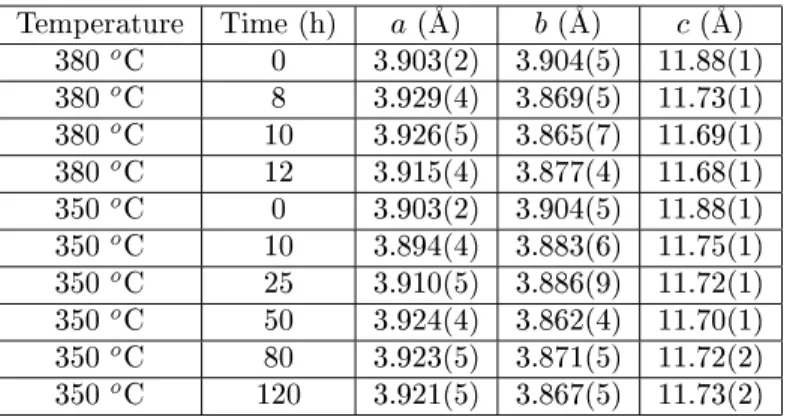
in thetetragonalstruturearesummarizedin Table1,
whih displays the alulated lattie parameters a, b,
andofseveralPr123sampleswhihweresubjetedto
dierenttimeintervalsand temperaturesin anO
2
en-vironment. Thedata reveal that inreasingannealing
timeresultsinaninreaseofthelattieparameteraand
adereaseofbothlattieparametersbandinsamples
annealedat380 o
C.Inaddition,thelattieparameters
aandbstarttodeviatefromthoseexpetedina
tetrag-onalstruture a=b,after thesample issubjetedfor
afewhoursin anO
2
environment. Thiswouldbethe
expetedbehavior,assumingthat inreasingannealing
timeresultsin moreabsorptionof oxygen in theCuO
hains. However,the mostimportant resultis related
to the behavior of the lattie parameter . For heat
treatmentsperformedat380 o
C,wehaveobservedthat
annealingfor8hseemstobeenoughtopromotean
ap-preiabledereaseofthelattieparameter,from11.88
to11.73
A. Thisannealing temperatureof 380 o
Cwas
onsideredtoohightoavoidthisdereaseinthelattie
parameter,as indiatedby thedata shownin Table
I. In this stage of the annealing proess, the rystal
strutureof Pr123reahesanorthorhombiharater.
Inaddition, thelattieparametersaand bwere found
to beunaltered for prolonged annealing times. Thus,
other samples from the same bath were annealed at
350 o
C.
Table1: Lattieparametersa;b,andofthePrBa
2 Cu
3 O
7 x
annealedin O
2
atmosphereatdierenttemperatures
andtime intervals.
Temperature Time (h) a(
A) b(
A) (
A)
380 o
C 0 3.903(2) 3.904(5) 11.88(1)
380 o
C 8 3.929(4) 3.869(5) 11.73(1)
380 o
C 10 3.926(5) 3.865(7) 11.69(1)
380 o
C 12 3.915(4) 3.877(4) 11.68(1)
350 o
C 0 3.903(2) 3.904(5) 11.88(1)
350 o
C 10 3.894(4) 3.883(6) 11.75(1)
350 o
C 25 3.910(5) 3.886(9) 11.72(1)
350 o
C 50 3.924(4) 3.862(4) 11.70(1)
350 o
C 80 3.923(5) 3.871(5) 11.72(2)
350 o
C 120 3.921(5) 3.867(5) 11.73(2)
The lattie parameters of samples annealed at
350 o
Cwere foundtoexhibit similarbehavioras
om-pared to the ones annealed at 380 o
C. This indiates
thatthesesampleshavearystalstruturewhihseems
to be inompatible with superonduting properties,
basedontherystalstrutureandtheargumentsgiven
in Refs. 9and10. However,itis possiblethat asmall
volumefrationofthesesamplesisomprisedof
super-onduting phases. Thus, theourreneof
superon-dutivity in this series would beinferred from
maro-sopi measurements,as disussedbelow.
Transport Properties of Pr123
All superondutingmembersofthe familyRE123
exhibittwoimportantfeatures: (i)metalli-like
behav-ioraboveT
,oraninreasingeletrialresistivityR (T)
with inreasing temperature; and (ii) a transition to
the superonduting state below T
90 K. Within
thermetalli-likenorsuperondutivityinalargerange
of temperature [1, 2℄. These two features are
onsis-tent with the mehanisminvolvinghigh hybridization
of2p-O and4f-Pr orbitals, as desribed elsewhere[6℄.
Suh a mehanism aounts for the non-metalli-like
behavior of R(T) above T
and theabsene of
super-ondutivitybelowT
. However,experimental results
on Pr123 obtained by Blakstead and o-authors [8,
19℄ suggested that Pr123 is a superondutor with a
verysmall superonduting volumefration (SVF). It
wasargued that suh a small SVF is hardly deteted
byonventionaltehniquesaseletrialresistivityR(T)
andmagnetization M(T). Thus, surfaeresistaneR
S
measurements,atehniqueverysensitivetosmallSVF
[20℄,wereemployedtodetetsuperondutivityinthin
lmsofPr123[19℄. Infat,Blaksteadand o-authors
[8,19℄observedasmalldereaseinthemagnitudeofR
S
just below90 Kin thin lmsof Pr123and attributed
suh aderease to theonset ofsuperondutivityin a
results,wearguethat ifsuhasmallSVFisrelatedto
superondutivity, both transport and magneti data
should reveal hanges lose to T
as well. Following
this disussion, somegranularsuperondutors,whih
areomprisedof anintimatemixtureof
superondut-ingandinsulatingomponents,exhibitsimilarfeatures
asonventionalsuperondutors(dereaseofR (T)just
below T
and appreiable drop of M(T) at T
) even
when the SVF is rather low. Let us onsider, for
in-stane, the eletron-doped systemSm
2 x Ce
x CuO
4 y ;
x0.17;inwhihhangesinbotheletrialresistivity
and magnetization are observed below T
even when
theSVFisratherlow,i. e.,5%[21℄.Basedonthese
arguments,ifourPr123sampleshaveaverysmallSVF,
measurementsofR(T)orM(T)wouldshowmeasurable
hangeslosetoT
. Therefore,wehaveperformed
mea-surements of eletrial resistivity in our samples in a
largerangeoftemperatureandapplied magnetield,
asdesribedbelow.
Startingwiththesamplessubjetedtoannealingin
O
2 at380
o
C,theirtemperaturedependeneofthe
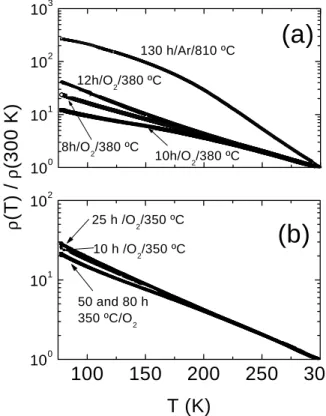
nor-malizedeletrial resistivityat 300K,(T)/(300 K),
isdisplayedinFig. 3(a). Inthisgurethe(T)/(300
K) data belonging to the pristine sample (sintered in
Ar at810 o
Cfor 130h)is also shown foromparison.
A areful inspetion of these urves reveals that
an-nealing in O
2
alters the magnitude of the (T)/(300
K) data appreiably. In fat, it seems that annealed
samplesinO
2
havemorehargearriers,whihare
be-lievedtobeintroduedbyinreasingoxygenontentof
thematerial. Thisresultsinanappreiabledereaseof
(T),asinferredfromthetwoordersofmagnitudedrop
of(T)/(300K) at77Kbetweenthepristinesample
and thesample annealedin O
2
for 10h. However,all
samples exhibit a semiondutor-like behavior in the
whole range of temperature investigated. Inaddition,
noappreiablehangesin the(T)/(300K) behavior
lose to 90 K was observed in all samples, suggesting
the absene of superondutivity in these Pr123
om-pounds. All the samplessubjetedto lowerannealing
temperature,i. e.,350 o
C,exhibitedsimilarbehavioras
showninFig. 3(b). Basedontheseresultsof
tempera-turedependene of theeletrialresistanethereisno
evideneofsuperondutivityinallthePr123samples
investigated.
However, it is possible that the annealing
proe-dure employed for inreasing the O
2
ontent in these
sampleswasnotadequate. Byhekingthispartiular
point, we have prepared a sample of NdBa
2 Cu
3 O
7 y
Nd123 following the same steps desribed above and
anadditionalannealing in O
2 at 350
o
C for80 h. We
haveobservedthatsuhaNd123sampleexhibited
zero-stateeletrial resistivityandappreiableMeissner
ef-fet just below T
90 K. Therefore, the
experimen-tal proedure for preparing these Pr123 an be
on-sidered as adequate. Thus, based on the results of
even inasmallvolumefration,was observedin these
Pr123samples. However,it isalso possiblethat
mag-neti measurementswould reveal evenasmall SVF in
these ompounds. Therefore, a detailed
harateriza-tionthroughmagnetization measurementswasarried
out in the samples mentioned above, asdisussed
be-low.
100
150
200
250
300
10
0
10
1
10
2
10
0
10
1
10
2
10
3
(b)
25 h /O
2
/350 ºC
50 and 80 h
350 ºC/O
2
10 h /O
2
/350 ºC
ρ
(T
) /
ρ
(3
0
0
K
)
T (K)
(a)
10h/O
2
/380 ºC
8h/O
2
/380 ºC
12h/O
2
/380 ºC
130 h/Ar/810 ºC
Figure 3. Normalizedeletrial resistivity urvesof Pr123
heat-treated underdierent onditions: (a)inAr, 810 o
C
for130hand380 o
C,inO2 for8,10and12h;(b)350 o
C,
inO2 for10,25, 50,and80h.
Magneti properties ofPr123
SuperondutorsdisplaydiamagnetismorMeissner
eetintemperaturesbelowT
. Themagnitudeofthis
diamagneti ontribution anbe onsidered robust as
omparedtoaparamagnetimaterial. While10 5
emu for the latter, superondutors reveal a
diamag-neti signalabout 10 3
emu. Therefore, ifPr123
would have a SVF of about 5%, magnetization data
wouldshowhangesloseto90Korevenatlower
tem-peratures. Thus, wehaveperformed measurementsof
magnetization in oursamplesofPr123in alarge
tem-peraturerangeandunderappliedmagnetieldsupto
0.0
0.5
1.0
1.5
0
50 100 150 200 250 300
0.0
0.5
1.0
1.5
Free Ion
T
N
(a)
χχχχ
Pr
Experimental data
Free Ion
T
N
χ
-1
(10
5
em
u /
g O
e
)
(b)
T (K)
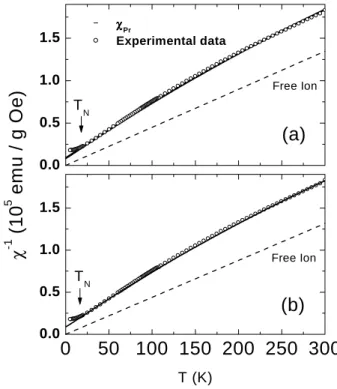
Figure4.Temperaturedependeneof 1
ofpolyrystalline
samplesofPrBa2Cu3O7
y
heat-treatedunderdierent
on-ditions: (a)380 o
Cfor 10h,inO
2 ;b)810
o
Cfor130h,in
Ar. The expeted Curie behavior for the free ion is
rep-resentedbydashedlines. ThetemperatureT
N
17Kin
whihPr +3
ionsorderantiferromagnetiallyisindiatedby
arrows. TheP
r
urveis thebestresultof thesimulation
oftheparamagnetisuseptibilityofPr123inludinga
on-tributionoftheCEF.
Thegureshowsthetemperaturedependeneofthe
inverseofthemagnetisuseptibility 1
(T)fortwo
se-letedsamples: (a)annealedat380 o
Cfor10hinanO
2
environment(Fig. 4(a));and (b)asamplesinteredat
810 o
CinArfor130h(Fig. 4(b)). Therstsampleis
onsidered astheonewith thehighestoxygenontent
and thelowest magnitudeof (T)at 77 K(seeFig. 3
(a)). Theseondsample,whihwassinteredat810 o
C
inArfor130h,orrespondstotheonewiththelowest
oxygenontentandthehighestmagnitudeof(T)at77
K(seeFig. 3(a)). Thegurealsoshowstheexpeted
behavior for a simple Curie law suseptibility for the
free ion of Pr +3
(J = 4 and g
J
= 4=5): The overall
magneti behaviorof both samples is similar and
ex-perimentalurvesexhibitaonvexityomparedto the
Curie lawtrae. In addition,at temperaturesloseto
T
N
17 K, a usp in the 1
(T) data wasobserved
and assoiated with the antiferromagnetiordering of
thePrsub-lattie. However,noappreiablehangesin
1
(T)were observed lose to 90 K in both samples,
suggestingabseneofsuperondutivityinthese
mate-rials. This is orroborated by the data sine, at least
forthesampleannealedinO
2
,aSVFloseto5%would
produeasmallhangeinthebehaviorof 1
(T)lose
to T ,duetotheappreiablemagnitudeofits
diamag-netisignal. Ontheotherhand,theobserveddeviation
from the Curie-Weisslaw maybe assoiated with the
onset of superondutivity. This point requires
addi-tional onsiderationof themagneti behaviorof these
RE123ompounds. Asfarasthispointisonerned,it
isimportanttonotiethatpreviousworks[22-24℄have
shownthattheparamagnetisuseptibilityofPr123is
strongly inuened by the J = 4 state splitting due
torystallineeletrield(CEF). Inorderto gain
fur-therinformationofour 1
(T)data,theparamagneti
suseptibilityofPr123wassimulatedfollowingthe
pro-eduremade inRef. 23. The best resultsofthe
simu-lationdisplayedinFig. 4(a)and(b)areforthetriplet
3
as a ground state of the system [24℄. The rystal
eldparametersforwhihthebestmath ofthe
simu-lation andthe experimental urveis foundare similar
to those determined in Refs. 22 and 23. Indeed, the
CEF eet makes the searh for superondutivity in
Pr123moredeliate. Inanyevent,ouranalysisof the
1
(T)datasuggestedtheabsene of
superondutiv-ityinPr123andanappreiableontributionoftheCEF
totheparamagnetibehavioroftheseompounds.
Insummary,wehaveproduedpolyrystalline
sam-ples of PrBa
2 Cu
3 O
7 y
through dierent routes. The
sampleswere subjetedto dierent sintering
tempera-turesand annealingtimes inbothO
2
andAr
environ-ments. From the results of X-ray powder diration
wehaveobtainedsingle-phasematerialsonlywhenthe
samples are heat-treated in Ar at 810 o
C for 130 h.
These samples were found to have atetragonal
stru-ture and lattie parameter as large as 11.88
A. In
addition, we have found that annealing these
materi-alsinO
2
at relativelylowtemperatures(T <400 o
C)
results in a derease of the lattie parameter ,
driv-ingthesystemtoanorthorhombi struture. Suh an
annealinginO
2
alsoresultedinappreiablehangesin
both transport and magnetipropertiesof these
om-pounds. However,measurementsofeletrialresistane
and magnetization revealed no evidene of
superon-dutivity in these polyrystalline materials. Also, we
havefound that a preise desription of the magneti
suseptibilitydataofPr123requiresanadditional
on-tribution of therystalline eletrial eld at
tempera-turesbelow150K.
This work was supported by the Brazilian ageny
Funda~ao de Amparo a Pesquisa do Estado de S~ao
Paulo (FAPESP) under Grant No. 99/10798-0. Two
of us V.A.M. and X.G. are FAPESP fellows under
Grant Nos. 01/03938-2 and 98/11522-6, respetively,
andR.F.J.isaConselhoNaionaldeDesenvolvimento
Ciento e Tenologio (CNPq) fellow under Grant
No. 304647/90-0. L.B-D. aknowledges support from
FAPESP under Grant No. 00/07362-5 and from the
Sabbatial Fund of the Hebrew University during her
Referenes
[1℄ J.M.Tarason,W.R.Mkinnon,L.H.Greene,G.W.
Hull,B.G.Bagley,E.M.Vogel,andY.LePage,Adv.
Ceram.Mat.2,498(1987).
[2℄ M.B.Maple,C.C.Almasan,C.LSeaman,S.H.Han,
K.Yoshiara,M.Buhgeister,L.M.Paulius,B.W.Lee,
D.A.Gajewski,R.F.Jardim,C.R.Finher,Jr.,
Gra-ielaB.Bhanhet,andR.P.Guertin,J.
Superondu-tivity7,97(1994).
[3℄ V.N.Narozhnyi,D.Ekert,K.A.Nenkov,G.Funhs,
T.G.Uvarova,andK.H.Muller,PhysiaC312,233
(1999).
[4℄ J. J. Neumeier, T. Bjrnholm, M. B. Maple, J. J.
Rhyne,andJ.A.Gotta,PhysiaC166,191(1990).
[5℄ W.H.TangandJ.Gao,PhysiaC315,66(1999).
[6℄ R.FehrenbaherandT.M.Rie,Phys.Rev.Lett.70,
3471(1993).
[7℄ A. A. Abrikosov and L. P. Gor`kov, Zh. Eksp. Teor.
Fiz.39,1781(1961).
[8℄ H.A.Blakstead,D.B.Chrisey,J.D.Dow,J.S.
Hor-witz,A.E.Klunzinger,andD.B.Pulling,Phys.Lett.
A207,109(1995).
[9℄ Z.Zou,K.Oka,T.Ito,andY.Nishihara,Jpn.J.Appl.
Phys.36,L18(1997).
[10℄ Z. Zou, J. Ye, T. Ito, and Y. Nishihara, Phys. Rev.
Lett.80,1074 (1998).
[11℄ J. Ye Z. Zou, , K. Oka, Y. Nishihara, and T.
Mat-sumoto,J.AlloysComp.288,319(1999).
[12℄ K.Oka,Z.Zou,andJ.Ye,PhysiaC300,200(1998).
[13℄ T.A.VanderahandC.K.Lowe-Ma, J.
Superondu-tivity7,107(1994).
[14℄ M.Park,M.J.Kramer,K.W.Dennis,andR.W.
Cal-lum,PhysiaC259,43(1996).
[15℄ See,forinstane,R.F.Jardim,E.A.Early,andM.B.
Maple,J.AlloysComp.221,1(1995).
[16℄ R.F.Jardim,L.Ben-Dor,andM.B.Maple,J.Alloys
Comp.199,105(1995).
[17℄ M. T.Esote, A.M. L. Silva,J.R.Matos, andR.F.
Jardim,J.SolidStateChem.151,298(2000).
[18℄ V. A. Meza, L. Ben-Dor, and R. F. Jardim, private
ommuniation.
[19℄ W.L.Hults,J.C.Cooley,E.J.Peterson,J.L.Smith,
H.A.Blakstead,andJ.D.Dow,Intern.J.Mod.Phys.
B12,3278(1998).
[20℄ H. A. Blakstead,R.F. Jardim, D. B.Pulling,A. E.
Klunzinger,andP.Beeli,Phys.Rev.B57,3683(1998).
[21℄ M.J.R.Sandim,P.A.Suzuki,S.Spagna,S.C.Tripp,
R. E. Sager, and R. F.Jardim, PhysiaC 289, 265
(1997).
[22℄ A.T.Boothroyd,S.M.Doyle,andR.Osborn,Physia
C217,425(1993).
[23℄ Y.Takano,S.I.Yokoyama,andK.Sekizawa,Physia
C252,61(1995).
[24℄ L. Soderholm,C.-K. Loong, G.L. Goodman,and B.