Cop
yright
© ABE&M t
odos os dir
eit
os r
eser
vados
.
Adrenal ganglioneuroma
Ganglioneuroma de adrenal
Roberta Magalhães Tarantino1, Adriano Machado de Lacerda1, Silvio
Henriques da Cunha Neto2, Alice Helena Dutra Violante3, Mário Vaisman4
SUMÁRIO
Incidentalomas adrenais (IA) são massas descobertas ao acaso na investigação de distúrbios não relacionados a patologias das glândulas adrenais e tem se tornado cada vez mais frequen-tes. A maioria dos casos é constituída por adenomas não secretores, embora possa também representar uma neoplasia maligna primária ou metastática. Porém, no diagnóstico diferencial, doenças menos prevalentes não podem ser esquecidas. Relatamos um caso de massa adrenal em mulher jovem, sem sinais de hiperfunção clínica ou laboratorial. O diagnóstico foi feito após episódio de pielonefrite aguda, em que o exame de imagem foi realizado para excluir complica-ções locais. Durante a abordagem cirúrgica, o aspecto em carne de peixe da lesão fez suscitar a hipótese de uma lesão de origem neural, a qual foi prontamente deinida pelo exame histopa-tológico. A paciente se apresentava com a manifestação mais comum do ganglioneuroma de adrenal, um incidentaloma. Arq Bras Endocrinol Metab. 2012;56(4):270-4
SUMMARY
Adrenal incidentalomas (AI) are unsuspected adrenal masses discovered during investigation of unrelated diseases, and are increasing in frequency. The majority of the AI is non-secretory adenomas, although it can also represent primary or metastatic malignant neoplasia. However, less frequent diseases should not be forgotten in the differential diagnosis. We describe a case of a young woman with an adrenal mass without clinical or laboratorial signs of hormonal hyperfunction. Diagnosis was performed after an episode of acute pyelonephritis in which the imaging study was carried out in order to exclude local complications. During the surgical pro-cedure, the ish lesh aspect of the mass raised the suspicion of a neurogenic tumor, which was diagnosed in the histophatological analysis. The patient presented the most common manifes-tation of adrenal ganglioneuroma, an incidentaloma. Arq Bras Endocrinol Metab. 2012;56(4):270-4
1 Medical Service of Endocrinology,
University Hospital Clementino Fraga Filho (HUCFF), Universidade Federal Rio de Janeiro (UFRJ), Rio de Janeiro, RJ, Brazil
2 UFRJ, Rio de Janeiro, RJ, Brazil 3 School of Medicine, UFRJ,
Rio de Janeiro, RJ, Brazil
4 School of Medicine, UFRJ,
Department of Endocrinology, HUCFF, Rio de Janeiro, RJ, Brazil
Correspondence to:
Roberta Magalhães Tarantino Rua Professor Rodolpho Paulo Rocco, 255,9º andar Secretaria de Endocrinologia
21941-913 – Ilha do Fundão, RJ, Brazil [email protected]
Received on June/19/2011 Accepted on May/22/2012
INTRODUCTION
A
drenal incidentalomas (AI) are masses discovered by chance in imaging investigations of disorders unrelated to adrenal disease. This unexpected diagnosis has become increasingly frequent and a common pro blem in clinical practice with increasing availability of highresolution imaging procedures, such as computed tomography (CT) and magnetic resonance imaging (MRI) (1).AI is uncommon below the age of 30 and its fre quency increases progressively in adults and the elderly (2). The prevalence approaches 0.2% in young patients, 3% in people over 50 years of age, and reaches 7% in those over 70 years of age (1,2). In a Brazilian study
(3), AI was found in 2.5% of patients undergoing chest and abdomen CT.
The vast majority of cases consists of nonsecretory adrenocortical adenomas, although the disorder may also represent primary or metastatic malignancy neo plasm, or be manifested in the form of subclinical hyperfunction at diagnosis (1,46). However, as oc curred the case reported here, less prevalent diseases should not be forgotten in differential diagnosis.
CASE REPORT
Cop
yright
© ABE&M t
odos os dir
eit
os r
eser
vados
.
for acute pyelonephritis was initiated after urine culture. Hours after admission, an ultrasound of the abdomen showed a heterogeneous, welldeined mass, measuring 12.2 x 7.6 x 7.8 cm, located near liver and right kidney.
After initiating the antibiotic therapy, without fever and improvement of laboratory results, the patient un derwent a computed tomography of the abdomen and pelvis which showed of expansive mass (11 x 8.5 x 8.2 cm) with central thin calciications and welldeined ed ges on the topography of the right adrenal. After pyelo nephritis treatment, the patient was referred to the Ser vice of Endocrinology, University Hospital Clementino Fraga Filho, Universidade Federal Rio de Janeiro (UFRJ HUCFF) for further investigation of the adrenal mass.
In her past medical history, the patient denied co morbidities, as well as signs/symptoms of hypercortiso lism and virilization, high blood pressure levels or paro xysms of headache, palpitations or sweating. She denied previously hospital admissions, except for a Caesarean section. Her periods were regular and she was a mother of a healthy 18monthold baby girl (GI/PI/A0). She denied smoking, alcohol consumption and recent trips.
Physical examination upon admission at HUCFF was absolutely normal, except for the abdomen, where a hardened, undeined and painless mass was palpable in the right lank. The thyroid was normal at palpation. She had gynecoid distribution of hair, and no viola ceous striae.
During hospitalization at the HUCFF, the study was complemented with laboratory examination, which
showed no changes; and magnetic resonance imaging (MRI) of the abdomen (Figure 1). The MRI revealed the presence of a large expansive heterogeneous forma tion measuring about 9.0 x 7.5 x 7.7 cm, located in the topography of the right adrenal.
The investigation was negative for Cushing’s syn drome and subclinical pheochromocytoma (Table 1). Primary aldosteronism was not investigated due to the absence of hypertension.
Surgery was indicated for a higher diagnostic accuracy.
DIAGNOSIS
The patient underwent an exploratory laparotomy with right adrenalectomy without complications (Figure 2). The frozen biopsy raised the suspicion of either gan glioneuroma or anomalous sympathetic ganglion due to retrocaval injury. The histopathological report sho wed that right adrenal weighed 475 g, and measured 15.5 x 8.5 x 7.5 cm. The surface was light brown, so metimes covered by a thin transparent capsule, some times with attached membranous and adipose tissue of 10 x 5 cm. The sections were light brown, with a leshy appearance, showing nodules with gelatinous areas. A cystic area of 3 x 2 cm was observed. Glandular tissue of usual aspect and measuring 2 x 7.5 x 0.2 cm was observed in the gap between this area and the lesion. Final diagnosis was adrenal ganglioneuroma, mature type (Figure 3).
Figure 1. Picture of T1 MRI of the abdomen before (A) and after (B) contrast: large expansive heterogeneous formation measuring about 9.0 x 7.5 x 7.7 cm, located in the topography of the right adrenal, with predominantly hypointense signal on T1-weighted sequences, hypertense signal on T2-weighted sequences, and heterogeneous uptake of the contrast media, restricted diffusion, as well as cystic areas/necrosis. The tumor previously rejected the liver, without well-deined cleavage plane with this organ, and the kidney moved inferiorly on this side.
The arrow points to the damage repel liver anteriorly and kidney inferiorly.
The arrow points to the voluminous expansive formation with heterogeneous uptake of the contrast media.
Cop
yright
© ABE&M t
odos os dir
eit
os r
eser
vados
.
Figure 2. Picture of the specimen in anatomical position (A) and sagittal section (B). Right adrenal with 475 g, measuring 15.5 x 8.5 x 7.5 cm. A cystic area of 3.0 x 2.0 cm was observed.
Figure 3. Microscopical view of adrenal tissue stained by hematoxylin and eosin (HE). (A) HE 10x – adrenal next to the tumor; (B) HE 40x – pattern of nerve bundles in the neoplasm; (C) HE 40x – diffuse fusiform pattern with interposed ganglion cells; (D) HE 40x – ganglion cells in detail.
Light-brown surface, sometimes covered by a thin transparent capsule, sometimes with adhered adipose and membranous tissue.
Light brown appearance, leshy appearance, showing areas with gelatinous nodules (arrow).
A B
Table 1. Results of hormone tests for pheochromocytoma and Cushing’s syndrome
Tests Result Reference range Unit
1-mg overnight
Dexamethasone suppression test
< 1 < 1.8 μg/dL
Urinary catecholamines Norepinephrine
58.2 < 200 μg/24 h
Urinary catecholamines Epinephrine
7.1 < 60 μg/24 h
Urinary catecholamines Dopamine
339.7 65-400 μg/24 h
Urinary metanephrines Total
148.8 < 1000 μg/24 h
Urinary metanephrines Metanephrine
15.2 < 400 μg/24 h
Urinary metanephrines Normetanephrine
133.6 < 600 μg/24 h
A
C
B
Cop
yright
© ABE&M t
odos os dir
eit
os r
eser
vados
.
DISCUSSION
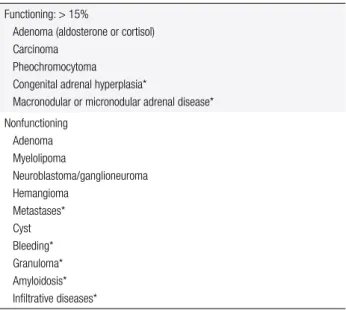
We report the case of an adrenal bulging mass without signs of clinical or laboratory hyperfunction. Differen tial diagnoses include nonfunctioning adenoma, for its high prevalence, even if it does not present the clas sical radiological aspect, and even adrenal carcinoma, because of its massive size. However, a large number of diagnostic hypotheses is possible (Table 2).
tients with adrenal incidentaloma should be evaluated with hormonal screening tests. Cushing’s syndrome (urinary free cortisol, latenight salivary cortisol, and 1mg overnight dexamethasone suppression test) and pheochromocytoma (urinary catecholamines and meta nephrines) should always be excluded. If there is hyper tension, screening for primary hyperaldosteronism is also mandatory (plasma aldosterone/renin ratio). SDHEA dosage is also recommended by some authors, since it is a marker of adrenal androgen secretion.
Adrenal carcinoma is rare, especially in patients who have no history of malignancy. The size seems to be a strong predictor of malignancy, and a lesion smaller than 4.5 cm is considered at low risk for malignancy. These patients can be followed up with annual abdo minal CT and hormonal tests. However, there is no consensus on how to follow up nonsurgical patients. For masses that seem to be benign in the imaging study (< 10 Hounsield Units – HU; contrast washout > 50%), small (< 3 cm) and nonfunctioning, biochemi cal and imaging revaluation can be done every 1 to 2 years, and later assessment if clinical changes. For indeterminate masses, it is prudent to perform ima ging tests again in three months to one year to assess growth (7). Many authors recommend annual scree ning for Cushing’s syndrome and pheochromocytoma over a period of four years. However, this strategy does not appear to be costeffective (8). Even lesions larger than 5 cm are more likely to be benign than malignant, but due to the increased risk of malignancy, most cen ters recommend a surgical approach (9). Other features on CT or MRI, such as heterogeneity, irregular edges, increased density (> 20 HU), and low contrast washout (7,10) may indicate surgery regardless of size.
The ish lesh appearance of the tumor raised the hi pothesis of an injury of neural origin, which was con irmed by histopathology. Ganglioneuroma is a benign neo plasm that arises from neural crest cells of sym pathetic ganglia or adrenal medulla. It represents the most welldifferentiated tumor in the neuroblastoma ganglioneuroblastomaganglioneuroma spectrum, and may be primary or differenciate from a neuroblastoma or ganglio neuroblastoma (11). It occurs more often in adults between the ages of 4050 years. The main lo cations are the posterior mediastinum, retroperitoneum, adrenal gland, and neck. Twenty percent of the ganglio neuromas are located in the adrenal medulla. The charac teristics in the histopathological examination are mature ganglion cells and Schwann cells among a ibrous stroma.
Table 2. Causes of adrenal mass
Functioning: > 15%
Adenoma (aldosterone or cortisol) Carcinoma
Pheochromocytoma Congenital adrenal hyperplasia*
Macronodular or micronodular adrenal disease*
Nonfunctioning Adenoma Myelolipoma
Neuroblastoma/ganglioneuroma Hemangioma
Metastases* Cyst Bleeding* Granuloma* Amyloidosis* Iniltrative diseases*
* Bilateral involvement.
Adapted from Nieman LK. Approach to the patient with an adrenal incidentaloma. J Clin Endocrinol Metab. 2010;95(9):4106-13.
The patient described in this case presented the most common manifestation of adrenal ganglioneuro ma, an incidentaloma. The mass was diagnosed after an episode of acute pyelonephritis, in which the ima ging study was done to exclude local complications and compression. It is even possible that the retroperitoneal mass had some implications in the onset of the kidney infection by compressing the genitourinary tract.
Cop
yright
© ABE&M t
odos os dir
eit
os r
eser
vados
.
At imaging studies, it appears as a relatively homo geneous, encapsulated mass, with welldeined edges and without invading nearby structures. Calciication occurs in 40%60% of cases (12). Just as in cases of pheochromocytoma, they can have a strong/bright T2 signal (13). The 18Flabeled luoro2deoxyglucose positron emission tomography (FDGPET) may help distinguish between adrenal carcinoma and ganglio neuroma, based on the lowest standard uptake value, when compared to adrenal carcinoma (14). The main features of adrenal ganglioneuroma are summarized in table 3.
Acknowledgments: we would like to thank the physicians who looked after the patient and that contributed to the resolution of the case.
Disclosure: no potential conlict of interest relevant to this article was reported.
REFERENCES
1. Barzon L, Sonino N, Fallo F, Palu G, Boscaro M. Prevalence and natural history of adrenal incidentalomas. Eur J Endocrinol. 2003;149(4):273-85.
2. Grumbach MM, Biller BM, Braunstein GD, Campbell KK, Carney JA, Godley PA, et al. Management of the clinically inapparent ad-renal mass (“incidentaloma”). Ann Intern Med. 2003;138(5):424-9. 3. Ferreira EV, Czepielewski MA, Faccin CS, Accordi MC, Furtado AP.
Prevalence of adrenal incidentaloma at computed tomography (chest and abdominal) in a general hospital in Brazil. Arq Bras Endocrinol Metabol. 2005;49(5):769-75.
4. Caplan RH, Strutt PJ, Wickus GG. Subclinical hormone secre-tion by incidentally discovered adrenal masses. Arch Surg. 1994; 129(3):291-6.
5. Mantero F, Arnaldi G. Management approaches to adrenal inci-dentalomas. A view from Ancona, Italy. Endocrinol Metab Clin North Am. 2000;29(1):107-25, ix.
6. Young WF Jr. Management approaches to adrenal incidentalo-mas. A view from Rochester, Minnesota. Endocrinol Metab Clin North Am. 2000;29(1):159-85, x.
7 Arnaldi G, Masini AM, Giacchetti G, Taccaliti A, Faloia E, Mantero F. Adrenal incidentaloma. Braz J Med Biol Res. 2000;33:1177-89. 8. Young WF Jr. The incidentally discovered adrenal mass. N Engl J
Med. 2007;356:601-10.
9. Melmed S, Polonsky KS, Larsen PR, Kronenberg HM. Williams Textbook of Endocrinology. 12th ed. Philadelphia: Elsevier – Saunders; 2011.
10. Nieman LK. Approach to the patient with an adrenal incidentalo-ma. J Clin Endocrinol Metab. 2010;95(9):4106-13.
11. Lora MS, Waguespack SG, Moley JF, Walvoord EC. Adrenal gan-glioneuromas in children with multiple endocrine neoplasia type 2: a report of two cases. J Clin Endocrinol Metab. 2005;90(7):4383-7. 12. Lonergan GJ, Schwab CM, Suarez ES, Carlson CL.
Neuroblas-toma, ganglioneuroblasNeuroblas-toma, and ganglioneuroma: radiologic--pathologic correlation. Radiographics. 2002;22:911-34.
13. Johnson GL, Hruban RH, Marshall FF, Fishman EK. Primary adrenal ganglioneuroma: CT indings in four patients. AJR. 1997;169:169-71.
14. Rondeau G, Nolet S, Latour M, Brachi S, Gaboury L, Lacroix A, et al. Clinical and biochemical features of seven adult adrenal gan-glioneuromas. J Clin Endocrinol Metab. 2010;95(7):3118-25. 15. Geoerger B, Hero B, Harms D, Grebe J, Scheidhauer K, Berthold F
Metabolic activity and clinical features of primary ganglioneuro-mas. Cancer. 2001;91:1905-13.
Table 3. Main characteristics of adrenal ganglioneuromas
Clinical Incidentaloma/compressive symptoms may occur
Radiology Homogeneous, encapsulated mass, with well-deined edges and without invasion of nearby structures/calciication (40%-60%)/intense signal on T2-bright
Laboratory Nonfunctioning/Rare: secretion of catecholamines, vasoactive polypeptides and androgens
Microscopy Mature ganglion cells and Schwann cells among a ibrous stroma
Although they are not metabolically active, there may be an increase in catecholamine secretion and uptake of metaiodobenzylguanidine (57%) (15), and this fact is re lated to the degree of the immaturity of the tumor.
Clinically, the majority of these tumors is asympto matic and hormonally nonsecretory (incidentalomas). However, in some cases, secretion of catecholamines, vasoactive polypeptides and androgens have been des cribed (in association with pheochromocytomas) (14). Compressive symptoms may occur. The prognosis is very good with surgical removal (11).
There has only been 41 cases reported in the litera ture in English from 1961 to 2009, 22 involving wo men and 19 involving men, with a mean age of 44 years and with incidentaloma as the initial presentation.