Article
*e-mail: [email protected]
Extractive Resolution of Racemic Mandelic Acid through a Bulk Liquid Membrane
Containing Binary Chiral Carrier
Ling Yang, Xiao Qing Chen* and Fei Peng Jiao
School of Chemistry and Chemical Engineering, Central South University, Changsha, 410083, China
Um método empregando “bulk liquid membrane” (BLM) e o complexo ácido di(2-etilhexil) fosfórico (D2EHPA) e ácido O,O’-dibenzoil-(2R, 3R)-tartárico (L-(-)-DBTA) foi desenvolvido para a separação por extração do ácido mandélico racêmico (rac MA). Os efeitos de tempo de resolução, concentração de D2EHPA na fase orgânica, concentração de rac MA na fase doadora, velocidade de agitação e temperatura sobre a separação por extração foram estudados. Os resultados experimentais evidenciaram que o maior fator de separação (α) 2,74 e o valor do excesso enantiomérico
(ee, %) 46,47% foram obtidos quando o tempo de resolução foi de aproximadamente 4 h, a razão de concentração molar de rac MA, D2EHPA e L-(-)-DBTA foi 0,05:0,2:0,3, a velocidade de agitação, 400 r min-1 e a temperatura, 35 °C. O método desenvolvido é útil para a otimização do transporte
de sistemas BLM e para a produção em grande escala de enantiômero puro.
A method of bulk liquid membrane (BLM) using complex of di(2-ethylhexyl) phosphoric acid (D2EHPA) and O,O’-dibenzoyl-(2R, 3R)-tartaric acid (L-(-)-DBTA) was developed for the extractive resolution of racemic mandelic acid (rac MA). The effects of resolution time, concentration of D2EHPA in the organic phase, concentration of rac MA in the feed phase, stirring speed and temperature on extractive resolution were studied. The experimental results have shown that the greatest separation factor (α) 2.74 and the enantiomeric excess value (ee, %) 46.47% were obtained when the resolution time was about 4 h, the molar concentration ratio of rac MA, D2EHPA and L-(-)-DBTA 0.05:0.2:0.3, the stirring speed 400 r min-1 and the temperature 35 °C. The developed method is helpful for optimizing the transport of BLM systems and for large-scale production of pure enantiomer.
Keywords: D2EHPA, L-(-)-DBTA, bulk liquid membrane, extraction resolution, mandelic acid
Introduction
The production of single-enantiomer drugs is one of the hot-topics in the world.1-3 Extractive separation of liquid membrane, a new type of extractive separation technology,4 originated in the 1960´s is widely used in chiral separation process5,6 due to their cost effectiveness, low energy demand, set-up simplicity and the possibility to be used in continuous mode. Bulk liquid membrane (BLM) is one of the types of liquid membranes. In a BLM, a relatively thick layer of immiscible luid is used to separate the feed and strip phases. There is no means of support for the membrane phase and it is kept apart from the external phases only by means of its immiscibility. A recent development of chiral resolution in bulk liquid membranes is the incorporation of single enantioselective carrier within
the liquid membrane phase, chemically facilitating the transport of a speciic compound across the membrane.7-11 However, the enantioselectivity of the single carrier is somehow low, therefore the use of binary chiral carrier was introduced while looking for new unitary chiral carrier with high separation capacity and large separation scale. Binary chiral carrier12 is the complexation of two kinds of carriers and produces coordinated effect, they generate complementary action to obtain high chiral separation effect because of their different characteristics and ways of action. Tan et al.13 introduced the complex of D2EHPA and tartaric acid derivatives as a new binary chiral carrier for the separation of rac amino acids by extraction, which showed
good enantioselectivity and a high distribution ratio.
L-(-)-DBTA (Figure 1) has been known as a chiral selector of enantiomers, such as ephedrine, chiral alcohols,14 N-methylamphetamine15 and amino acids.13 Although
enantioselectivity is still relatively low, especially its extraction capacity is also very low. These performances are not helpful to the industrial application. The cationic carrier D2EHPA (Figure 1) has been reported to be one of the most promising carriers for liquid membrane formulation.16,17 Particular advantages of D2EHPA are its chemical stability, high complexing ability, extremely low solubility in aqueous solutions, versatility and high extraction capacity17 in the extraction of many amino acids, and its availability in commercial quantities.
Mandelic acid (MA) is a chiral molecule and its two single enantiomers have a signiicant difference in pharmacological effects. It is a intermediate, which is used to synthesize vasodilator cyclandelate, urinary tract disinfectant urotropine, etc.18,19 Extraction techniques have been used for the resolution of d,l-MA.20 α-Cyclohexyl-mandelic acid, a derivative of MA, also has been studied by extraction.21 But a single chiral selector is generally used for the resolution of MA and its derivatives, the enantioselectivity of these selectors are somehow low.21 Based on the previous works, this paper investigated the extractive resolution of racemic MA (Figure 1), through a BLM by the complex of D2EHPA
and L-(-)-DBTA as the binary chiral carrier, and tried to
obtain the optimal conditions of extractive resolution. So far, this is the irst use of binary chiral carrier in the ield of extraction resolution of rac MA by BLM. The results may be extrapolated for realizing large-scale application of chiral resolution through the BLM.
Experimental
Chemicals
Rac MA and L-phenylalanine were purchased from
Guangfu Institute of Fine Chemicals (Tianjin, China). CuSO4•5H
2O was obtained from Kemiou chemical reagents
Co. Ltd (Tianjin, China). D2EHPA was supplied by Chemical reagent Sinopharm Group Co.Ltd (Shanghai, China). L-(-)-DBTA with a purity > 99% was obtained
from Lingxing & Co.Inc. (Zhejiang, China). n-Octanol
was produced by Lingfeng Chemical reagent Co. Ltd (Shanghai, China). All other chemicals were of analytical reagent grade.
Analytical method
The quantiication of MA in the aqueous phase was performed by HPLC using a UV detector (Shimadzu, Japan). The column was Lichrospher C18, 5 μm particle size of the packing material, 250 mm × 4.6 mm I.D. (Hanbon Sci. Technol. Co. Ltd, China). The mobile phase for MA enantiomers was 3 mmol L-1 CuSO
4 and 6 mmol L-1
L-phenylalanine aqueous solution : methanol (85:15, v/v)
at a low rate of 0.6 mL min-1, the UV spectrophotometer was operated at 300 nm, the column temperature was kept at 30 °C. The retention time of the (D)-enantiomer is lower
than that of the (L)-enantiomer (Figure 2).
Procedure for the enantioselective transport
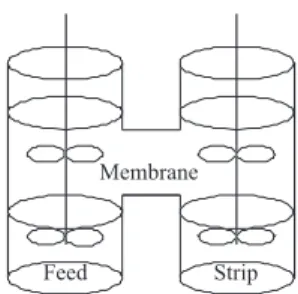
The experimental studies were carried out applying the BLM technique (Figure 3). The left aqueous feed Figure 1. Structure of MA, D2EHPA, L-(-)-DBTA.
Figure 2. HPLC chromatogram of mandelic acid enantiomers. 1: D-mandelic
solution (50 mL) consisted of MA aqueous with different concentration. The strip solution (50 mL), which consisted of deionized water, was located in the right part of the vessel. The organic membrane phase (100 mL), prepared by dissolving L-(-)-DBTA and D2EHPA with different
concentration ratio in n-octanol, was added above of the
aqueous phases. The contact area between the feed phase and membrane and the membrane and strip phase of the single BLM system were all 12.56 cm2. The experiments were carried out at 30 ˚C by using a thermostated apparatus. The feed solution and the strip solution were stirred at 400 r min-1. The process of enantioselective transport is shown in Figure 4. In each experiment, 10 μL sample was withdrawn at ixed interval time from the feed phase and strip phase in order to allow the HPLC analysis.
The average lux (J) of each enantiomer was calculated by equation 1, the enantioselectivity was calculated by
equations 2 and 3 in terms of the separation factor (α) and the percentage enantiomeric excess (ee, %):
VS∆CS
J = –––––– (1)
At
Jd
α = ––– (2)
J1
Jd – J1
ee,% = –––––– ×100 (3)
J1 + Jd
where t is the time of resolution, ∆Cs, is measured in the strip, Vs the volume of the strip solution and A the effective membrane area. This is the average lux from the start of the experiment till time t.
Results and Discussion
Effect of resolution time
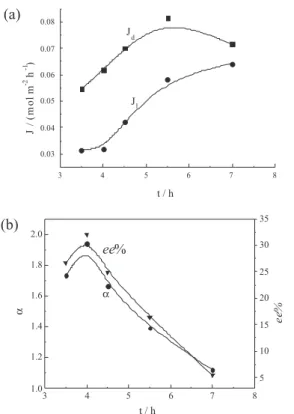
Using 26.28 mmol L-1 MA in feed phase, 0.2 mol L-1 D2EHPA and 0.3 mol L-1L-(-)-DBTA in organic phase, the effect of resolution time on lux and enantioselectivity was studied at 30 °C, keeping stirring speed 400 r min-1. Figure 5a shows that lux of each enantiomer increases with the increasing time at the initial stage, then after 5.5 h Jl still increase slowly while Jd begins to decrease. The possible reason is that the chiral carrier in organic phase prefers combining with D-(+)-MA and then transports
it from the feed phase to the strip phase. Therefore, the time of maximum Jd occurs before than that of maximum Jl, then Jd decreases with the decreasing concentration gradient between feed and strip phases. It can be seen in Figure 5b that α and ee, % have similar patterns, i.e. both
reach maxima of 1.94 and 31.95%, respectively, at 4 h, thenceforth declining all along till the equilibrium.
Effect of D2EHPA concentration in membrane phase
The effect of various D2EHPA concentrations on lux and enantioselectivity was investigated under the same conditions as above except that analytical sampling undergoes 4 h from the beginning. Figure 6a shows that the flux of enantiomer monomer decreases with the increasing D2EHPA concentrations, and reaches minimum at 0.2 mol L-1 (D2EHPA concentration), then increases with the increase of D2EHPA concentrations. As the complexes which D2EHPA forms with L-(-)-DBTA at
low concentrations only improve the enantioselectivity to enantiomer, with increasing D2EHPA concentration, excessive D2EHPA reacts on extraction and accordingly Figure 3. Transport cell of bulk liquid membrane.
speed up the transport of enantiomer monomer. Figure 6b shows that, the enantioselectivityof L-(-)-DBTA increases
with the increase of D2EHPA concentrations up to 0.2 mol L-1 and then decreases with the increase of D2EHPA concentration. As D2EHPA is a type of acidic phosphoric extraction solvent without any enantioselectivity, excessive D2EHPA only reacts on extraction, yet reduces the ennatioselectivity of chiral carrier. Therefore, with CD2EHPA:CDBTA = 2:3, the formed complex has the best enantioselectivity.
Effect of MA concentration
The effect of MA concentration on resolution was investigated under the same conditions as adopted for the effect of resolution time, except that analytical sampling undergoes 4 h from the beginning. As shown in Figure 7, the lux of enantiomeric monomer increases with the increase of MA concentration, however, α and ee, % increase with the increasing MA concentration up
to 52.56 mmol L-1, and then decrease with the increase of MA concentration. As Jd and Jl both increase with the increasing MA concentration, and Jl increases faster than Jd does, which results in the ratio of them, α getting smaller and smaller. Therefore, with CMA:CD2EHPA:CDBTA = 0.05:0.2:0.3, the generated complex has the best enantioselectivity to rac MA.
Figure 5. (a) Effect of time on low J. (b) Effect of time on enantioselectivity
for MA. Figure 6. (a) Effect of concentration of D2EHPA in the organic phase on
low J. (b) Effect of concentration of D2EHPA in the organic phase on enantioselectivity for MA.
Effect of stirring speed
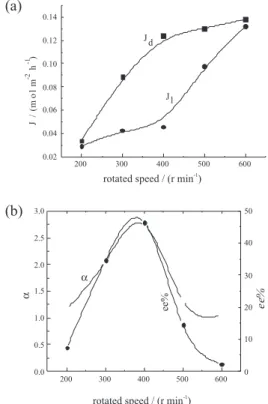
Taking into account the effect of MA concentration, the best resolution result was obtained with MA concentration of 52.56 mmol L-1. The effect of stirring speed on lux and enantioselectivity was investigated under the same conditions as adopted for resolution time, except that analytical sampling undergoes 4 h from the beginning and the MA concentration 52.56 mmol L-1. As shown in Figure 8a, the luxes of two enantiomeric monomers increased with the increase of stirring speed and presented the greatest difference at 400 r min-1. It is consistent with the result of Figure 8b, at which α and ee, % reached maximum
at 400 r min-1. However, with further increase of stirring speed to 500 r min-1, the feeding, membrane and stripping phases were mixed which lead to erratical variation of enantioselectivity.
Effect of temperature
By ixing the MA concentration in 52.56 mmol L-1, the effect of temperature on lux and enantioselectivity was investigated under the same conditions as adopted for resolution time, except that analytical sampling undergoes 4 h from the beginning. As shown in Figure 9, the lux and enantioselectivity of enantiomer increases with the increasing temperature up to 35 °C, and then decrease,
which may be related tothe stability of the complex formed by D2EHPA and L-(-)-DBTA. The higher temperature of
BLM system could inluence the stability of chiral carrier.
Conclusions
A complex of D2EHPA and L-(-)-DBTA was found to
be a useful chiral carrier for the extractive resolution of rac
MA in a BLM transport system. The enantioselectivity of
L-(-)-DBTA is somehow low, and D2EHPA has no chiral
resolution ability. But the enantioselectivity is greatly improved through the formation of a new complex by
L-(-)-DBTA with D2EHPA. It was found that the optimal
extractive resolution conditions were the separation time of 4 h, concentration ratio of MA, D2EHPA to L-(-)-DBTA of
0.05:0.2:0.3, stirring speed at 400 r min-1 and temperature of the BLM system kept at 35 °C. Adopting these conditions, a separation factor of 2.74 and an enantiomeric excess value of 46.47% were obtained. The enantioselectivity was appreciably improved using binary chiral carrier in BLM, compared to single chiral carrier in BLM.
Acknowledgments
This work was supported by the Natural Science Foundation of China (20805058).
Figure 8. (a) Effect of rotation speed on low J. (b) Effect of rotation speed on enantioselectivity for MA.
References
1. Michael, J.; Chem. Ind.1996, 53, 74.
2. Subramanian G.; Chiral Separation Techniques, Wiley-VCH,
Verlag GmbH: Weinheim, 2001.
3. Jiao, F. P.; Huang, K. L.; Ning, F. R.; Hu, W. G.; Yu, J. G.; Sep.
Sci. Technol.2006, 41, 1893.
4. Wang, J. D.; Chen, J. Y; Solvent Extraction Handbook, 1st ed.,
Chemical Industry Press: Beijing, China, 2001.
5. Way, J. D.; Noble, R. D.; Flynn, T. M; J. Membr. Sci.1982, 12,
239.
6. León, G.; Guzmán, M. A.;Desalination 2005, 184,79.
7. Marek, P.; Malgorzata, K.; Oksana, P.; J. Membr. Sci. 1998,
138,109.
8. Henning, M. K.; Jeanette, L.; Klaas, K.; Jaco, C. B.; J. Membr. Sci.2000, 167, 33.
9. Ma, M.; Chen, B.; Luo, X. B.; Tan, H.; He, D. S.; Xie, Q. J.;Yao, S. Z.; J. Membr. Sci.2004, 234, 101.
10. Jiao, F. P.; Chen, X. Q.; Hu, W. G.; Yang, L.; Huang, K. L.;
J. Braz. Chem. Soc.2007, 18, 804.
11. Jiao, F. P.; Chen, X.Q.; Wang, Z.; Hu, Y. H.; Lat. Am. Appl. Res.
2008, 38, 267.
12. Pavel, A.. Levkin.; Volker, Schurig.; J. Chromatogr., A 2008,
1184, 309.
13. Tan, B.; Luo, G. S.; Qi, X.; Wang, J. D.;Sep. Purif. Technol.
2006, 49, 186.
14. Kassai, C.; Juvancz, Z.; BaÂlint, J.; Fogassy, E.; Kozma, D.;
Tetrahedron2000, 56, 8355.
15. Nemák, K.; Acs, M.; Jászay, Z.M.; Kozma, D.; Fogassy, E.;
Tetrahedron1996, 52, 1637.
16. Hong, S.A.; Yang, J.W.; J. Membr. Sci.1994,86,181. 17. Teramoto, M.; Yamashiro, T.; Inoue, A.; J. Membr. Sci.1991,
58, 11.
18. Choi, W. J.; Lee, K. Y.; Kanga, S. H.; Sep. Purif. Technol.2007,
53, 178.
19. Yadav, G. D.; Sivakumar, P; Biochem. Eng. J.2004, 19, 101.
20. Tang, K. W.; Chen, Y. Y.; Huang, K. L.; Tetrahedron: Asymmetry
2007, 18, 2399.
21. Zhou, D; Tang, K. W.; Liu, J. J.; J. Instrum. Anal. (China)2006,
25, 49.