Eetive Condutivity of Two-Dimensional
Heterostrutures with Non-Sreened Potential
F. T. Vasko 1;2
and G.-Q.Hai 1
1
InstitutodeFsiadeS~aoCarlos,Universidadede S~aoPaulo,13560-970S~aoCarlos,SP, Brazil
2
Instituteof SemiondutorPhysis,NAS,45 Pr. Nauky,Kiev,03650,Ukraine
Reeivedon23April,2001
The eetive magnetoondutivity tensorof seletively dopedheterostrutureswithnon-sreened
potentialisevaluatedforhigh-frequenyregime.Thelateralinhomogeneityofthedonordistribution
inthestrutureresultsinalarge-salevariationoftheenergylevels. Theontributionduetosuh
inhomogeneity takes plaein additionto the standard Drudemehanism of absorptionand this
mehanismisdominantforthehigh-frequenyregime.
I Introdution
Inhigh-frequenyregime,ifthephotonfrequeny! or
the ylotron frequeny !
exeed the relaxation
fre-queny (but orresponding energies are smaller than
themeaneletronenergy), thelinearresponse of
ele-tronsshowstheDrudedispersion,i.e. theondutivity
is found to be proportional to ! 2
or ! 2
. This
gen-eraldependenyappearstobeviolatedin
semiondu-tor heterostrutureswith non-sreenedpotential. The
sreening is not eetive on a random potential due
interfae roughness or due to in-plane non-uniform
Æ-dopinginQWwithtwooupiedsubbands[1℄orin
mul-tipleseletivelydopedQWs[2℄.
In the present paper, we desribe the response of
the 2D high-mobility eletrons in seletively doped
heterostrutures taking into aount anin-plane
ele-tron redistribution under non-sreened random
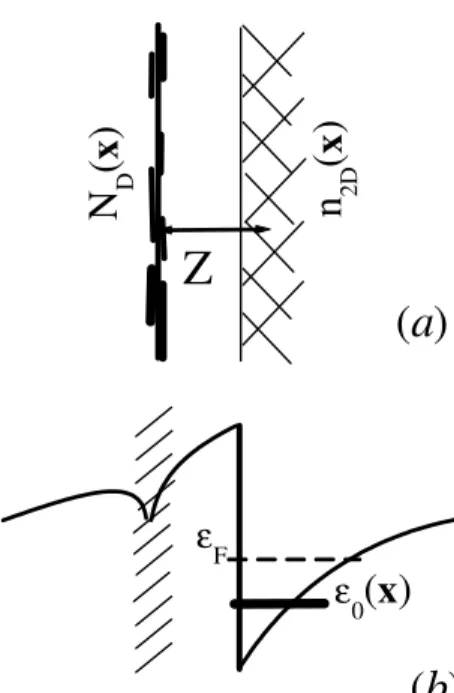
po-tential due to lateral inhomogeneity of Æ-doping (see
Fig.1). Based on an eletrostati desription of the
non-sreened variation of the potential, the eetive
ondutivity tensor ofthe non-uniform eletrongas is
obtained from the linearized kineti equation in Se.
II.TheinterplaybetweentheDrudefrequeny
disper-sion,duetothestandardrelaxationproesses,andthe
additional ontribution, due to the planar large-sale
inhomogeneity,isdesribedinSe. III.Thisfrequeny
dependenyoftheeetiveondutivityisanalyzedfor
theaseofaoustiphonon sattering. Our numerial
resultsdemonstrateanessentialmodiationonthe
re-sponse. The onluding remarks are presented in the
(
b
)
(
a
)
ε
F
ε
0
(
x
)
n
2D
(
x
)
N
D
(
x
)
Z
Figure1. Shemativiewof(a)theheterojuntionwith
Æ-dopingN
2D
(x)and(b)thebanddiagramalongzaxis,with
non-uniformgroundlevel"o(x).
II Eetive Condutivity Tensor
The self-onsistent desription of the 2D eletrons in
seletively-dopedstrutureswith large-salevariations
of donor distribution over the 2D plane is based on
theShrodingerandthePoissonequations. Withinthe
rstorderapproximationtotheinhomogeneous
poten-tialw
x
, theeletrononentration n
xz
an bewritten
in the form n
xz =
2D ("
F w
x )
2
z
, where
2D is the
2D density of states,"
F
the Fermi energy, and
variationofthepotential(undertheonditionl a B , wherel
isthelateralorrelationlengthofnon-uniform
donordistribution anda
B
istheBorh radius), the
so-lution ofthePoissonequationisofasimpleform[2℄:
w q ' Æn q 2D e qZ ; (1) where Æn q
is the Fourier omponent of the 2D donor
onentrationandZistheaveragedistanebetweenthe
2D eletrons and the Æ-layer. Thus, the non-sreened
potentialis suppressed if Z l
. For further
numer-ial estimations we assume a Gaussian orrelation of
variation of the donoronentration. Within the
se-ond order auray, the orrelation funtion W(q) =
R
d(x)exp ( iqx)hw
x w
x
0iisgivenby
W(q)=l 2 Æn 2D 2 exp[ (ql =2) 2 2qZ℄; (2)
where Ænis thetypialvariationof the2D
onentra-tionandn
2D = 2D " F .
Inalateraleletrield E
x
exp( i!t)anda
trans-versemagneti eld HkOZ, thelinearresponse of the
2D eletronswithin the dispersionlaw "
px = " p +w x (" p =p 2
=2misthekinetienergyandmistheeetive
mass)isdesribedbytheeld-induedontributionto
thedistributionfuntion: (
"q +
pq
)exp( i!t+iqx).
Separating the symmetri and non-symmetri partof
thedistributionfuntion,
"x and
pq
,respetively,we
write thelinearized kinetiequationas follows(see [3℄
fordetails): i!+ b J nel "q
=if( qv )
pq
g; (3)
b
R
q
pq
if(qv )
pq g=
pq
i(qv )
"q : (4) Here b J nel
isthenon-elastiollisionintegral,v=p=m,
and fg R
2
0
d'()=(2) standsfor the average
over the in-plane angle '. The ollisionless evolution
operator b
R
q
and the non-homogeneous term
pq are givenby b R q
=fi(qv !)+
e +[!
p℄r
p g 1 ; and pq = X q 0 (eE q 0v) Z dx L 2 e i(q q 0 )x Æ(" Fx " p ); respetively, where e
is the momentum relaxation
frequeny orresponding to the short range
satter-ingmehanism,!
=jejH=(m)theylotronfrequeny,
E
q
the Fourier omponent of the eletri eld, and
" Fx = " F +w x
the non-uniform Fermi energy. The
non-symmetri part of the distribution is determined
byEq. (4)andanbeexpressedthrough
f(qv )
pq g=
f(qv ) b
R
q
pq
g f(qv ) b
R
q
(qv )g
"q
1 if(qv ) b
R g
:
Thesymmetri partof distribution is given by
"q w
f(qv )
pq
g=! forthehigh-frequenylimit.
The Fourier omponents of the indued harge
q
and urrent j
q
are introdued through the
stan-dard relations: q = (2e 2 =L 2 ) P p "q
, and j
q = (2e 2 =L 2 ) P p v pq
. Theaverageinduedurrentis
ex-pressedthrough h
"q
iandh
pq
i,wherehistandsfor
theaverageovertherandompotential. Sinethe
aver-agevaluesareproportionaltoÆ
q0
;weobtainhj
q i=Æ
q0
j. After the summation over p we transform the
in-duedurrentinto
j= e 2 2mL 2 X q ihn q E q ik (+) ! + ! hn q E q i ! k ( ) ! ; (5) with k () ! = 1 !+! +i e 1 ! ! +i e ;
wheretherightsideiswrittenthroughtheFourier
om-ponentoftheonentrationn
q =n 2D + 2D w q .
Sepa-ratingthe uniformand potentialparts ofeletrield
(under the ondition urlE
x
= 0), we write E
q as E q = EÆ q0 iq q
with E the homogeneous eletri
eld. Therandom Fourieromponentofthe potential
q
is determined from the Poisson equation with the
high-frequenyhargedensity
q
. Withintherstorder
approximationtotherandomontribution,itssolution
appears tobeproportionalto (qE)w
q
. Substituting
therandomeldinto Eq. (5)andaveragingaording
toEq. (2),weobtainjthroughtheeetive
ondutiv-ity tensoras j=b eff
!
E. The diagonal(non-diagonal)
omponent of the ondutivity eff
d (
eff
?
) is written
as eff d;? = d;? "
1+L 2 X q W(q) " F A d;? (q) # ; (6) where d;?
orresponds to the uniform ase. Sine
A
d
(q)andA
?
(q)dependon! and!
,theabove
equa-tiondesribesthefrequenydispersionof theeetive
magnetoondutivity (inluding the ase of ylotron
resonane). It also appears to be temperature
depen-dentthroughtherelaxationfrequeny
e
. Ageneal
ex-pressionfor eff
d;?
maybeobtainedaftertheevaluation
ofA
d;?
(q)andtheintegrationoverqinEq. (6).
III Spetral Dependenies
Weonsider now,in theabseneofmagnetield,the
modiation on the Drude spetral dependeny eff
!
resultfrom theseond addendumtoEq.(6). Usingan
expliitexpression for
q
overnon-sreened randompotential,wetransformthe
non-uniformontributionas follows:
A
d (q)=
(dB
"q =d")
"F
a
B q+B
"q ;
with
B
"q =
qv
qv ! i
e
1+
i
e
qv ! i
e 1
:
Further, performing the integral over q we nd
the eetive ondutivity in the form eff
! =
(e 2
n
2D =m
e
)F(;)withthedimensionlessfuntion:
F(;)= i
+i "
1+
2
Æn
n
2D
2
Z
1
0
dxexp x 2
x
x 3
V
(x)[ V
(x) i℄[(1+x)(V
(x) i) ℄ #
;
where = !=
e
, =2l
F =l
, =4Z =l
, =a
B =l
,
andV
(x)=
q
( +i) 2
(x) 2
.
ThenumerialalulationisperformedforÆ-doped
AlGaAs/GaAs heterojuntionwith Æn=n
2D
0:3. We
have used 1
e
76 ps and l
F
14:7 m in
agree-ment with theexperimental data[4℄ forthe strutures
with high mobility. Figure 2 shows the frequeny
de-pendene ofReF(;) fordierent and . The
pa-rameter is determinedthrough by =(a
B =2l
F ).
The Drude dispersion for the ideal struture is given
by the dotted urve in the gure. One an see that
the random-indued absorption is omparable (or up
to10timesgreater)totheDrudeontributionandthe
hump-typedispersiontakesplaeforthehigh-frequeny
region. Theonsidered frequenyorresponds to GHz
frequenyrange.
IV Conlusion
In this work, we havestudied the eetive
ondutiv-itytensoroftheseletively-dopedheterostrutureswith
non-sreened large-sale random potentialindued by
theinhomogeneityofthedopinglayer. Thepreseneof
suh apotential leadsto alateral variationof the
en-ergylevelsand,onsequently,modiesqualitativelythe
haraterofthefrequenyresponseofthesystemdueto
theontributionofnon-uniformeletrield. Thisnew
mehanism of the frequenydispersion is essentialfor
thespetralregion !&v
F =l
and theobtained
ontri-bution isproportionaltothemean squarevariationof
thelevelintheweakdisorderregime. SinetheDrude
absorptionissuppressed as! 2
athigh frequeny,the
proposedmehanismappearstobeafewtimesgreater
thanthestandardresult(seeFig.2).
Toonlude,theobtainedspetral(ortemperature)
experimental study of high-frequeny response taking
into aount the lateral inhomogeneity of
seletively-doped strutures. Along with thefrequeny
measure-mentsofeletronresponse,otherharateristisof
non-homogeneousstrutures,like2Dplasmondispersionor
ylotron resonane, are also inuened by the
non-sreened variation ofthe levels. In addition, the
tem-peraturedependeneofmobilityandthestati
magne-totransportphenomenashould bemodieddue to the
analogous mehanism. In the stati ase we need to
nd
"q
taking into aountthenon-elasti ollisions.
These phenomenarequireaspeialonsideration.
50
100
0.000
0.001
50
100
150
200
Ω
0.000
0.002
0.004
Re
F(
Ω,η)
η=1
2
4
8
16
γ=0.1
0.5
1.0
Figure 2. The real part of eff
!
versus the dimensionless
frequeny = !=
e
at = 0:1 for dierent = 2l
F =l
.
InsetshowsReF(;)for dierent=4Z =l
at=4.
Aknowledgments
This work was supported by FAPESP and CNPq
(Brazilianagenies).
Referenes
[1℄ O.G. Balev, F.T. Vasko, F. Aristone, and N. Studart,
Phys.Rev.B62,10212(2000);F.T.Vasko,O.G.Balev
andN.Studart,Phys.Rev.B62,12940(2000).
[2℄ F.T. Vasko,andG.-Q.Hai,Phys.Rev.B,submitted.
[3℄ E.M. Lifshitz and L.P. Pitaevskii, Physial Kinetis,
PergamonPress, Oxford(1981).
[4℄ P.J.Burke,I.B.Spielman,J.P.Eisenstein,L.N.Pfeier,