Transport and Optial Properties of
Resonant Tunneling Strutures
A. Verik, Y. Galv~aoGobato,
Departamentode Fsia, UniversidadeFederalde S~aoCarlos,
CP676,13560-970, S~aoCarlos,SP,Brazil
M. Mendoza, and P.A. Shulz
DFESCM,InstitutodeFsiaGlebWataghin,
CP6165, Campinas-SP,13083-970, Brazil
Reeivedon23April,2001
TransportpropertiesofaGaAs/AlAssuperlattie-likedoublebarrierdiodearestudiedinthiswork
as a funtionof the sample temperature. An ativationenergy of about 60meV obtained from
the Arrhenius plot is ingood agreement with the onned level in the entral well. Numerial
simulations also onrm the importane of bound levels in the and X bands for the resonant
tunnelingproess. Theenhanementofphotolumineseneasthetemperatureis inreasedisalso
studied. This behavior is assoiated to the transport properties ofholes inthe olletor ontat,
whihontrol thesupplyof minority arriers, whihtunnelinto the well. Thedesription ofthe
observed results requires the modiation of simpleknownmodels to take into aount the two
ontributions tothepairgenerationrateinthewell, responsibleofthe photolumineseneat zero
andnitebias.
Resonant tunneling in semiondutor
heterostru-tures[1℄ontinuestodeserveinterestduetoopen
ques-tions onerning tunneling dynamis and ompetition
with othertransport mehanisms. On theotherhand,
sineeahsamplemayshowspeingerprintsinthe
transportproperties, resonanttunneling together with
thermoioniemission[2,3℄areusefulspetrosopi
teh-niquesfor omplexpotentialproles.
Theuseofoptialmeasurementssuhas
ontinuous-wavephotoluminesene (PL) has led to a deeper
in-sightonthearrierdynamis,whihtakeplaein
res-onant tunneling diodes (RTD) [4℄. However, there is
littleinformationabouthowthetransportproessesin
theontatsaetthephotoluminesenespetra.
In this work, we have investigated the transport
and optial properties of a GaAs/AlAs
superlattie-like double barrier diode. Thermoioni emission and
tunnelingphenomenaareanalyzed. Theobtained
ati-vation energyvalueagreeswiththealulatedvalueof
the onned level in the quantum well. The modied
Rihardsononstantvalueanbeexplainedintermsof
thetunneling assistedthermoioniemissionproess.
Anenhanementofthephotoluminesenewith
in-reasing temperatures isreported forthe rsttime to
thetemperaturedependentmobilityofholesinthe
ol-letorspaer layer,whih ontrols the supplyof holes
thataumulatein theolletor/barriersurfae.
The samples used in our experiments were grown
by moleular beamepitaxy (MBE) on a doped GaAs
substrate. The ontat layers onsist of a 500nm
n +
-GaAs (210 18
m 3
) buer layer, a 50nm n-GaAs
(210 16
m 3
)layer and a 2.5nmi-GaAsspaerlayer.
Eahsuperlattie-likebarrier ofthesandwihed
stru-tureonsistsofthree0.85nmlayersofi-AlAs,separated
by 0.85nm i-GaAs layers, with a 5nm well of i-GaAs
between both barriers. Two dierent mesa areas of
3.60710 5
m 2
(mesa A) and 2.54010 3
m 2
(mesa
B) onthe samesubstrate havebeenused. An optial
windowonthetopontatwasdenedonmesaB,in
or-dertoperformoptialmeasurements.The
superlattie-likedoublebarrierdiodeisrepresentedinFig.1,where
the ondution band edges, for the and X minima,
aredepited.
Transmissionprobabilityalulations,withinthe
ef-fetive mass and Transfer matrix approximations [1℄,
reveal resonanes assoiated to quasi-bound states at
thestruturein Fig. 1,wherethelowestone(62meV)
Figure 1. Condution band edges for the and X
min-imaforthesuperlattie-likedoublebarrierdiode. The
low-est quasi-boundstate (E
0
) is also shown. A transmission
bandresults fromresonanesduetoquasi-boundstatesat
thesuperlattie-likebarrierandexitedstatesoftheentral
well.
rier, as well as exited states of the entral well, fall
in the energy range also indiated in Fig. 1,
build-ingupinfat awideresonanttransmissionband. The
transmissionprobabilitiesareusedfor alulating
ur-rentdensityasafuntion of applied voltage and
tem-peraturein analready known textbook proedure [1℄.
Current-voltageharateristisin therange 20K-300K
were measured on mesas with smaller area ontats
(mesa A) to avoid ontat series resistaneorleakage
urrents. An Arrhenius-like plot [ln(J/T 2
) vs. 1/T℄
wasonstrutedwiththemeasuredurrents,aording
totheusualexpressionforthermoioniemission[2℄:
J =A
T 2
exp
KT
(1)
where T is the absolute temperature, k is the
Boltz-mann onstant, A
is the Rihardson onstant and f
is the ativation energy. Fig. 2 shows the Arrhenius
plotforseveralvoltageslowerthantheresonaneonset
(0.3V approximately) together with alulated result
forV=1mV.Fittingthelinearpartoftheseurves,the
ativationenergyandpre-fatoranbedetermined.
Figure 2. Arrhenius plot for dierent voltages (0.02, 0.2
and0.3 V),obtainedfromtheurrentsmeasuredat
dier-enttemperatures,andalulated at1mV.
Experimental andmodelalulationresultsshowa
reasonableagreement,espeiallyfor theativation
en-ergy. Undoubtedly,the ativated transportis through
the lowest bound state in the entral well (Fig. 1).
The ativation energy dereases as the applied
volt-ageisinreased, beausethebound levelis loweredas
voltageisapplied. Theextrapolatedvalueforzero
ap-pliedvoltageis60.9meV.Thepre-fatorvaluesatzero
biasobtainedfrom measurementsand alulationsare
orders of magnitude lower than the Rihardson
on-stant (10Am 2
K 2
)givenby Eq. (1). This
disrep-anyisexpetedsineEq. (1)isvalidforunstrutured
andwidebarriersandnotforpotentialproleslikethe
presentone.
Continuous-wavephotoluminesenewas measured
on mesas B at dierent temperatures. At zero bias,
weakPLspetra,due toeletron-holepairsreated
di-retlyin thewell, whihreombine radiatively,exhibit
the expeted temperature dependeny: dereasing
in-tensities forinreasingtemperatures,due to more
eÆ-ientnon-radiativereombinationmehanismsas
tem-peraturerises.
Whenbias is applied, eletronsare eletrially
in-jeted from the emitter into the well. Holes
photo-reatedin theolletor (near thetop ontatsurfae)
driftanddiuse, aumulatingin theolletor/barrier
surfae and nally tunneling into the well. The
hole-tunnelingurrentisproportionaltothedensityofholes:
when laserintensityis inreased,higherPLintensities
are expeted. The photoluminesene spetraat 20K
asa funtion of theapplied voltage areshown in Fig.
3. Current-voltageharateristismeasuredat 20Kin
darkandunderilluminationonditionsarealsoshown
in theinsetofFig. 3.
Figure3. Photoluminesenespetrameasuredatdierent
bias. Dark(thinline)andilluminated(thik line)
urrent-voltageurvesareshownintheinset.
Measurements were performed with dierent laser
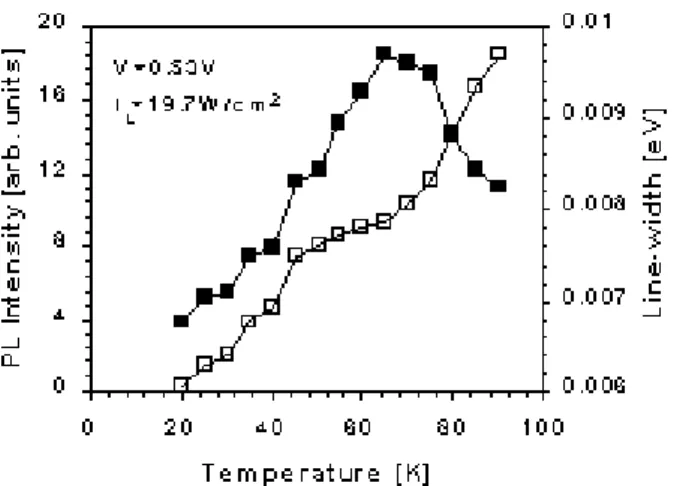
intensities. Fig. 4 shows the dependene on
temper-ature of PL intensity and line-width at the
19.7W/m 2
. Instead of the expeted derease in PL
intensity with inreasing temperatures, due to more
eÆient non-radiative reombination mehanisms, an
anomalous inrease ofthe PLintensity with
tempera-tureisobserveduptotemperaturesof about60K.
Figure 4. PL intensities (blak squares) and line-widths
(open squares) as a funtionof temperature measured at
V=0.53V,withalaserintensityI
L
=19.7W/m 2
.
In the non-radiative limit [5℄, the PL intensity is
proportionalto thesheeteletrondensityin the
quan-tumwell,whihinreaseslinearlywithappliedvoltage.
Higherlaserintensitiesare assoiatedtoalarger
num-berof holesavailable fortunneling, whih will
reom-bine radiativelyin thewell.
Theline-widthandtheurrentdensityasfuntions
of appliedvoltageseemto beindependent onlaser
in-tensity;bothurvesexhibitsimilar spreadoutfor
dif-ferent laser intensities. Thus, a relationship between
line-with and urrent,whih doesnotdependon laser
intensity,reetsthefat thattheline-widthisa
fun-tionofeletrondensityinthewellonly,i.e.,itdoesnot
dependontheholesdensityinthewell.
Therefore,itispossibletodisriminatethedierent
behaviorsofbotharrierspeies. As shownin Fig. 4,
theline-widthandonsequentlytheeletrondensityin
thewellaremonotoniallyinreasingfuntionsof
tem-peratureforagivenvoltage. However,thisdependene
ontemperatureistooweaktoexplainthePLbehavior,
whihanbealsoattributedtothetransportproperties
ofholes.
The PL intensity is proportional to the total rate
of generation of holesin the quantum well and to the
quantum eÆieny, [5℄. Two dierentontributions
to thetotalgeneration rateinthewellmust be
distin-guished: holes diretlygenerated in the well, g p
w , and
injetion of holes from the inversion layer by
tunnel-ing mehanisms. In steadystate, the urrentof holes
tunnelingfromtheinversionlayerequalstheurrentof
holesgenerated in thespaer,j
p
. Thus, thePL
inten-I
PL =A( g
p
w +j
p
) (2)
Atzerobiastheseond termin braket in Eq. (2)
iszero,andthePLspetraisonlyduetothe
reombi-nationofpairsdiretlygeneratedin thequantumwell.
Inthisase,thePLintensitydereasesastemperature
inreases,beauseofthedereasingquantumeÆieny.
Whenvoltageisapplied,holesphoto-reatedinthe
ol-letororiginatej
p
. Thisurrentdependsontheeletri
eld,andholemobilityin theolletor[6℄. The
mobil-ityistemperaturedependent,andatlowtemperatures,
thereisarangeinwhih itinreaseswithtemperature
[6℄. In thisase, it is expetedthat the urrent j
p
in-rease also with temperature as well as PL intensity
fromEq. (2),resultingintheobservedbehavior.
Transportpropertiesof aGaAs/AlAs
superlattie-likedoublebarrierdiodehavebeenstudiedinthiswork.
Theenergy ativation of about 60meV obtainedfrom
theArrheniusplot isin good agreementwiththe
on-ned level in the entral well. Numerial simulations
also onrm the importane of bound levels in the
andXbandsfortheresonanttunnelingproess.
Theenhanementofphotolumineseneasthe
tem-peratureisinreasedwasalsostudied. Thisbehavioris
assoiatedto thetransportprosperitiesofholesin the
olletorontat,whih ontrolthesupplyofminority
arriers,whih tunnelintothewell. Thedesriptionof
theobservedresultsrequiresthemodiationofsimple
known models to take into aount the two
ontribu-tionstothepairgenerationrateinthewell,responsible
ofthephotolumineseneat zeroandnonezerobias.
Aknowledgments
TheauthorsaregratefultoJ.Nagle,B.Vinter,and
Y.Guldner forprovidingthesamples. CNPq,CAPES
andFAPESPare also aknowledged for nanial
sup-port.
Referenes
[1℄ H.MizutaandT.Tanoue,ThePhysisandAppliations
of Resonant Tunneling Diodes, (Cambridge University
Press,1995).
[2℄ M. Rossmanith, J.Leo, and K.vonKlitzing, J.Appl.
Phys.69,3641(1991).
[3℄ P.Gueret,C.Rossel,E.Marlay,andH.Meier,J.Appl.
Phys.66,278(1989).
[4℄ M.S.Skolnik,etal.,Phys.Rev.B41,10754(1990).
[5℄ M.S.Skolnik,etal.,Phys.Rev.B42,3069(1990).
[6℄ S.M.Sze,PhysisofSemiondutorDevies,2ndedition