YU Hong-Liu
[email protected] Institute of Biomechanics & Rehabilitation Engineering University of Shanghai for Science and Technology 200093 Shanghai, ChinaZHAO Sheng-Nan
[email protected] Institute of Biomechanics & RehabilitationEngineering University of Shanghai for Science and Technology 200093 Shanghai, China
XU Zhao-Hong
[email protected] Institute of Biomechanics & Rehabilitation Engineering University of Shanghai for Science and Technology 200093 Shanghai, ChinaStudy on the Usability Evaluation of
Prosthetic Leg Products Based on
Ergonomics
The prosthetic leg (PL) is a typical human-machine system in which the dynamic interaction between the human body and PL (machine) determines a high requirement of ergonomics design for PL and consequently needs to consider an indicator of usability indicating the performance of gait biomechanics. How to evaluate the indexes of usability for PL products is critical to the design technology of PL based on ergonomics.The gait symmetry of PL products, which is a core usability index, was experimentally analyzed by using a specially designed testing device in this paper. The test results show that the swing speed symmetry for intelligent prosthetic leg (IPL) is high up to 96.5%, which indicates a high performance for gait tracking. Then, a comprehensive evaluation was made for the usability of PL products with the analysis method of Grey Correlation Degree. Three types of PL product, including ordinary PL, IPL and Gait-following IPL (GL-IPL), were used in the evaluation. The evaluation results show that the GL-IPL product is the best in usability while both of IPL and GF-IPL products based on ergonomics are obviously better than the ordinary PL.The method of usability evaluation studied here is expected to help directing the design of prosthetic leg products.
Keywords: ergonomics, prosthetic leg, usability, evaluation
Introduction1
At present, the number of people with limb disabilities in China has reached up to 24,000,000. How to rehabilitate these people with disabilities has become an important and urgent challenge for the government and society. In the terms of ergonomics, it is of great significance to improve the life quality for those with disabilities and help them go back to society by providing prostheses with high usability, including safety, comfort, efficiency, etc.
The traditional prosthetic leg (PL) with a locking device or a load-bearing self-lock in the knee joint can neither stimulate the body’s normal gait nor well adapt to complex environment due to the difficulty in changing its states of motion during walking. The intelligent prosthetic leg (IPL) with microprocessor control can approximately simulate body normal gait by automatically adjusting the damping of the knee (Kaufman et al., 2007; Wuhr et al., 2007). So IPL should have high usability, including user satisfaction, effectiveness, safety and efficiency, etc. How to enable IPL to simulate a normal gait automatically and at full-time, and integrate with the people with disabilities to form an efficient and comfortable human-machine system so as to adapt to the patient’s individual needs (such as adapting to changes in patient parameters, step speed and environment, etc.), is now still a research direction for advanced IPL (Hafner et al., 2007).
The prosthetic system designed based on ergonomics will be able to improve the safety, comfort and efficiency of prostheses. The gait phase symmetry based on intelligent control can save the energy consumption for the patients, and improve the performance of walking. These goals relevant to product usability are all pursued by the design methods based on ergonomics of prosthetic limbs. To improve the personalization adaptation of prosthetic leg design, we need to improve the usability of prosthetic leg products under the premise of ensuring products competitive advantages in cost, quality and so on. Therefore, how to evaluate the usability of prosthetic products is critical for artificial leg design based on ergonomics. Here the gait symmetry, which is one of the core usability indexes of prosthetic leg, was tested through a dedicated experimental evaluation device. Based on the above studies, the Grey Correlation Degree analysis was used to comprehensively evaluate the usability of prosthetic leg. The main objective of the paper is to try to
Paper received 8 November 2010. Paper accepted 21 March 2011. Technical Editor: Fernando Rochinha
establish a method of evaluating the usability for prosthetic legs that is expected to help directing the design or development of prosthetic leg products.
Nomenclature
E
= the swing speed error of IPL, dimensionlessL = the length of the leg, m
M = the extending torque at amputation side, N mi
P
= the axial force in load direction, NS = Gait symmetry index, dimensionless
T
= the gait cycle time, sZ
= the ratio of gait cycle time in a support phase N mi Greek Symbolsx = the offset distance of the knee instance center of rotation to the load line, m
xi(k) = initial values of factors for a scheme, dimensionless xi = vectors composed of xi(k), dimensionless
y = a component of the distance between the knee center and heel in the direction of load line, m
θ = angular velocity, rad ( )
i k
ζ = coefficients for GCD analysis, dimensionless
γ
= Grey Correlation Degree, dimensionless Subscriptsave = relative to average h = relative to hip joint k = relative to knee joint
p = relative to the peak value of swing angle
max
h = relative to angular maximum of the healthy leg
Determination of the Usability Indexes for PL products Based on Ergonomics Design
A. Gait Symmetry
range of users, to complete a specific range of tasks through specific training and user support in a particular environment scenario.” Usability contains various components, and actually has no uniform specific indexes. In tradition, the usability of products is most closely related to the following five usability attributes: learn-ability, efficiency, convenience for memory, low error ratio and user satisfaction. It can be seen from the above that the usability of product is actually used to evaluate the products for meeting comfort, efficiency and other demands from users, which are consistent with the design goals of ergonomics.
Figure 1. Time proportion of support/swing phases during one gait cycle.
Prosthetic leg is a typical man-machine system. The dynamic interactivity between the human body and the prosthetic leg (machines) brings about higher requirements for ergonomics design of prosthetic leg, in particular, proposes a special usability indicator of gait symmetry. However, currently it has not been established uniform standards for ergonomics evaluation of prosthetic leg
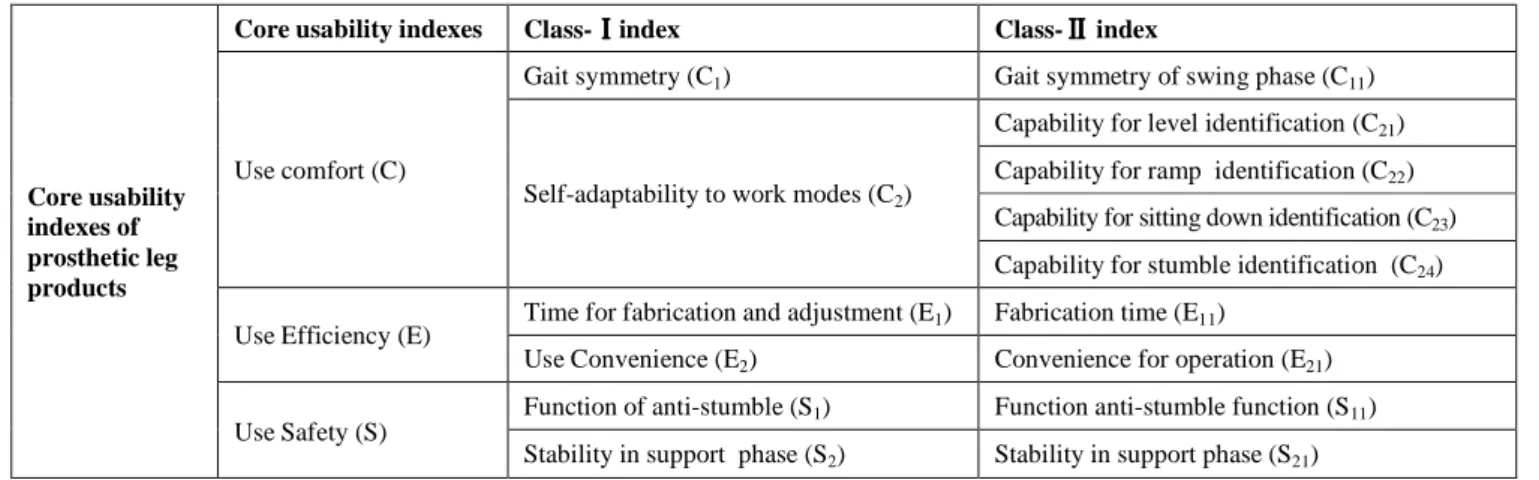
function. According to the design mechanism of human engineering and prosthetic leg bionics, three major usability indexes, including comfort, safety and efficiency are generally used for ergonomics design evaluation. Therefore, the same three indexes presented in Table 1 are employed as the core usability indexes of prosthetic leg. Among the core usability indexes, the index of Use Comfort is composed of two class-Ⅰindexes called as Gait Symmetry (C1) and Self-adaptability to Work modes (C2); the index of Use Efficiency is composed of two class-Ⅰindexes called as Time for Fabrication and Adjustment (E1) and Use Convenience (E2); and the index of Use Safety is composed of two class-Ⅰindexes called as Function of Anti-stumble (S1) and Stability in Support Phase (S2). Each Class-Ⅰindex is composed of several mayor sub-indexes called as Class-Ⅱ indexes showed in Table 1. We can basically evaluate the usability of PL products by comprehensively analyzing the Class-Ⅱ indexes.
As an index of assessing walking function, the symmetry discussed here is generally used to evaluate the levels of abnormal walking when wearing prosthesis. Gait symmetry index can be calculated by the following formula (Jin et al., 1997):
0.5
r ( / ) (z r 0.62 r 0.38)
S =T T Z × + ×M (1)
r
T
——
the cycle time of normal gait;T ——
the gait cycle time; rZ
——
the right / left ratio of gait cycle time in a support phase;r
M
——
the right / left ratio in a swing phaseB. Self-adaptation to work modes
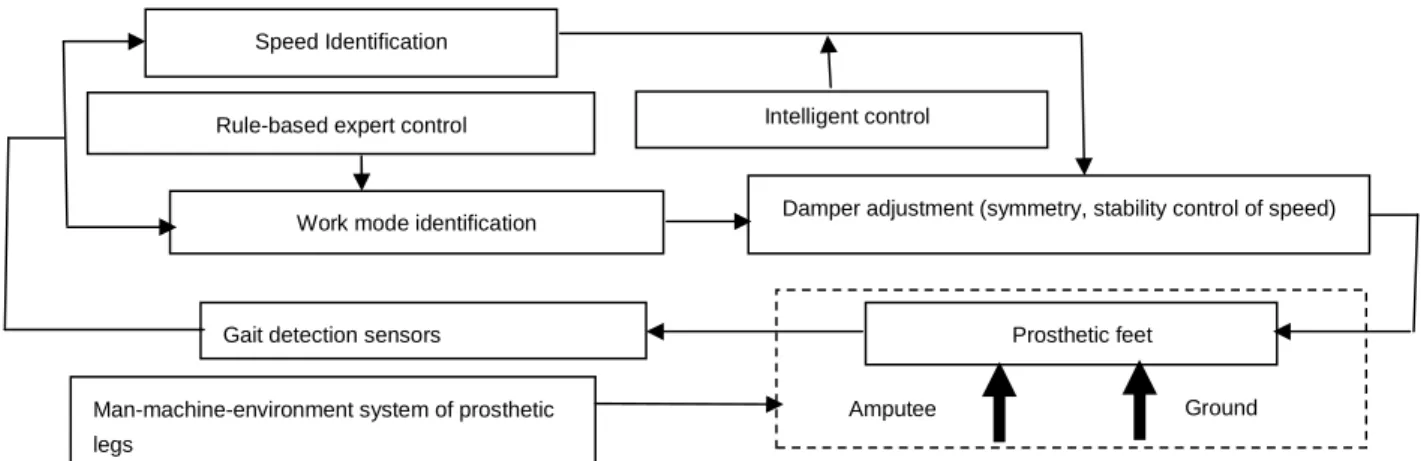
Healthy legs can automatically identify a variety of work modes or road environments during walking, such as level walking, standing, sitting down, stumbling, descending ramp/stairs, etc. Therefore, the capacity of self-adaptation to road conditions for the prostheses is also an important indicator determining its performance. To design the man-machine system of prosthetic leg, the intelligence of prosthetic leg control should be taken fully into account, and coordinated with the body's own sensory systems (Fig. 2), so as to automatically output the corresponding control signals to change the damping values of prosthetic leg knee joint under all kinds of work modes.
C. Stability of support phase
The stability of lower-limb prosthesis is closely related to the body's center of gravity, load line position; therefore, it is necessary to pay attention to the alignment of load line in the process of design, fabrication, training and gait analysis for lower limb prostheses (Zhang et al., 1998).In Fig. 3, P is the axial force in load direction, Mh is the extending torque of hip joint at amputation side, Mk is the damping torque at the knee joint. y is a component of the distance between the knee center and heel in the direction of load line. x is the offset distance of the knee instance center of rotation to the load line. Then, we have the following Eq. (2) (Zhang et al., 1998).
Table 1. Characteristics of the different surfaces and basic experimental conditions.
Core usability indexes of prosthetic leg products
Core usability indexes Class-ⅠⅠⅠⅠindex Class-ⅡⅡⅡⅡ index
Use comfort (C)
Gait symmetry (C1) Gait symmetry of swing phase (C11)
Self-adaptability to work modes (C2)
Capability for level identification (C21)
Capability for ramp identification (C22)
Capability for sitting down identification (C23)
Capability for stumble identification (C24)
Use Efficiency (E) Time for fabrication and adjustment (E1) Fabrication time (E11)
Use Convenience (E2) Convenience for operation (E21)
Use Safety (S)
Function of anti-stumble (S1) Function anti-stumble function (S11)
Figure 2. Control mode of human-machine system of the IPL adapted to EPL.
) )(
/
( k
h L y Px M
M = − (2)
Figure 3. Analysis of the Load on stance phase in unit-axial knee joint.
If there is no damping device providing the moment at knee joint, that is, in the case of
h
M = 0 when the stability is guaranteed only by the moment of hip joint, the Eq. (3) becomes (Zhang et al., 1998):
) / (x y PL
Mh = (3)
It can be seen from the above equation that stability of prosthetic leg should take account of the eccentric position between the rotation center and load line.
Referring to a lot of associated studies for the above-knee prostheses (Hafner et al., 2007; Segal et al., 2006; Buckley et al., 2006; Datta et al., 2005; Craig, 2003), the phase symmetry of gait is a core characteristic parameter among all functional requirements of PL. Therefore, we primarily focus on gait symmetry control. The other requirements of functions, such as stability of support phase, self-adaptation to work modes, appearance verisimilitude, can be easily met through intelligent control program and structure design of IPL.
According to many years of researches done by the prosthetics scholars (Chin et al., 2003; Datta et al., 1998; Heller et al., 2000; Henrik et al., 2007), it is generally acknowledged that the Gait Symmetry (C1), especially in the swing-phase, is the most critical index, for it is the main factor influencing the energy consumption
when walking, and is also the key factor affecting the comfort of PL wearing.
Measurement and Evaluation of Gait Symmetry for IPL Product
In order to evaluate the gait symmetry of IPL, a simulation testing device was specially designed for testing and evaluating the performance of a prosthetic leg following the gait of healthy leg (Fig. 4).
Figure 4. Simulation testing device for prosthetic leg.
A simulating leg simulating the healthy leg and a special connector for fitting the PL were designed on the testing device. Angular sensors were respectively mounted in the knee units of the two simulating legs. With an IPL being fitted with the testing device, the gait symmetry between the healthy leg and IPL during swing phase can be tested by measuring and comparing the angular speeds at the knees of two legs.
IPL is a kind of PL controlled with a microprocessor which can better adapt to the human gait and work modes, automatically distinguishing the terrain and coordinating the symmetry of walking gait. Generally, an intelligent controller is used for fast learning and following the walking speed through establishment of controlling relationship between the inputs and outputs of microprocessor, so as to change knee joint damping (resistance torque) at knee for real-time tracking of walking speed. The main IPL parameters were set in Table 2.
Man-machine-environment system of prosthetic
legs
Intelligent control
Work mode identification Rule-based expert control
Speed Identification
Damper adjustment (symmetry, stability control of speed)
Gait detection sensors Prosthetic feet
Table 2. Main IPL parameters.
Description
Total mass of prosthesis and
socket m1
Mass of shank
m2
Length of thigh
l1
Length of shank
l2
Unit kg kg m m
Value 3.72 2.85 0.435 0.412
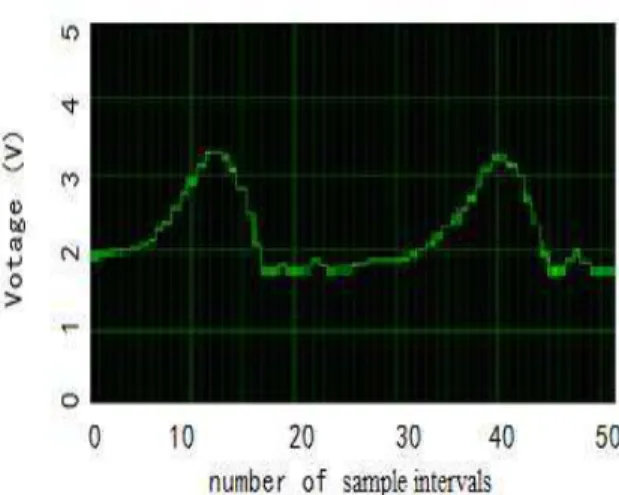
With the stimulation evaluation system, the testing experiments for the swing speed of a self-made IPL were carried out through setting the test data of healthy leg and opening values of digital needle in damper acquired by computer stimulation (YU et al., 2010). Rotation angle curves of knee joint of healthy leg and IPL leg simulated through data acquisition microcomputer are shown in Fig. 5. It can be seen from the data curve that the time of knee joint taken for completing a swing phase is about 12 sample intervals, so the time of a swing phase is:
h
Τ
= 12.0 × 50 = 600(ms) = 0.6(s).
Figure 5. Knee joint angle curve measured at the healthy leg side.
The peak value of swing angle is about 1.50v, as a circle measuring range of precise potentiometer is ± 5.0v, so it can be converted to the maximum swing angle:
max 1.50
180 54.0 5.0
h
θ
= × °= °Hence, the average angular velocity of the healthy leg in a swing cycle can be calculated as below:
θ
′
have= 2 =180.0( /s) =3.14(rad/s)T
θ
× hmax °
According to the dynamics modeling and control simulation curves of the IPL, damper needle opening obtained by the knee angular velocity is X = 0.42 mm. The needle valve opening X of IPL is set 0.42 mm for testing, and the knee joint rotation angle curves of IPL measured by data detecting computer are shown in Fig. 6. We can see from the figure that the swing cycle of IPL knee is about 12 sampling periods. That is, the swing cycle time is as follows.
Figure 6. Knee joint angle curve of IPL measured at prosthetic leg side.
p
Τ
= 2.0 × 50 = 600(ms) = 0.6(s)From Fig. 5, the swing angle peak of IPL knee is shown as 1.55v which can be converted to the angle value:
max
o o
1.55
180 55.8
5.0 p
θ
= × =Then, we can conduct the swing average angular velocity of IPL:
ave
p
θ
′
= 3.25(rad /s).Therefore, the swing speed error of IPL in tracking the healthy leg gait is:
100%
ave ave ave
p h
h
E
θ
θ
θ
′
−
′
=
×
=
ɺ
3.50%.
That is, the symmetry of gait speed in swing-phase is 96.5%. Obviously, after setting damper needle opening at knee joint according to the theoretical analysis results (YU et al., 2010), IPL can well track the healthy leg swing speed, the results of experiment and theoretical analysis are in a good accordance, the symmetry of swing speed is high up to 96.5%, and gait tracking results are satisfying.
Usability Evaluation of Prosthetic Leg Product Based on Ergonomics
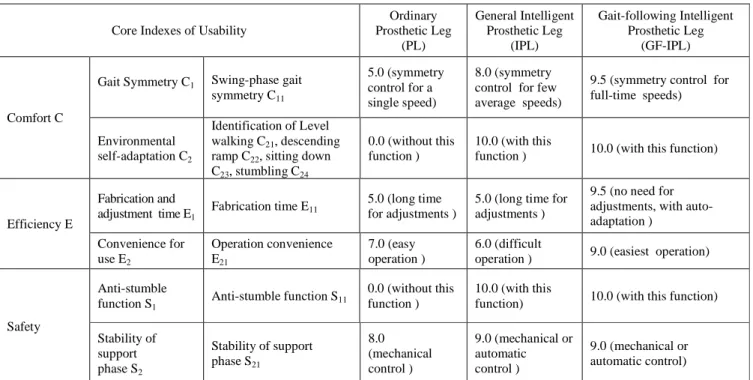
Values in Table 3 are the results of investigation for products performance by interviewing the experts from prostheses fabrication centers. According to the different indexes in Table 3, prosthetics
experts from P&O organizations were investigated for evaluating the values for each index which composes the primary index value of usability.
Table 3. Usability comparison of PL products based on ergonomics design.
A Grey Correlation Degree (GCD) analysis method was used to evaluate the three schemes here. GCD refers to uncertain association between things, or the uncertain association between system factors, or between the main acts and factors. GCD analysis is an important part of grey theory and the basic content of grey system (Deng, 2002). The basic task of GCD analysis is a macro-geometry approach based on behavior, so as to analyze and determine the influence degree between factors or the contribution of important factor to the main acts. The formula for calculating the correlation coefficients
ζ
i( )
k
for GCD analysis is equation (4) (Deng, 2002):0 0
0 0
min min
( )
( )
max max
( )
( )
( )
( )
( )
max max
( )
( )
i i
i m k n i m k n
i
i i
i m k n
x k
x k
x k
x k
k
x k
x k
x k
x k
∈ ∈ ∈ ∈
∈ ∈
−
+ ξ
−
ζ
=
−
+ ξ
−
(4) (i = 0,1,…,p ;k = 1, 2,…,n)
Where
x k
i( )
is initial values of factors for a scheme (here is a product) to be compared. In order to calculate the GCD of each product, the initial valuesx k
i( )
are listed in Table 4 on the basis of Table 3. To equalize the weights for the data of each scheme or product, we can use a formula (Deng, 2002):
Then, we can get the new initial values for each product with formula (5) as follows
:
(1) ( 2 ) ( )
( , , , )
( ) ( ) ( )
1 1 1
xi xi xi n
n n n
xi k xi k xi k
k k k
∑ ∑ ∑
= = =
=
⋯xi
(5)
(i = 0,1,…,p ;k = 1, 2,…,n)
1
x
= (0.167,0,0,0,0,0.167,0.233,0,0.266,0.167)2
x
= (0.093,0.116,0.116,0.116,0.116,0.058,0.071,0.116,0.105,0.093)
3
x
= (0.098,0.103,0.103,0.103,0.103,0.098,0.093,0.103,0.093,0.103)
Set the reference initial value as:
0
x
=
(0.1,0.1,0.1,0.1,0.1,0.1,0.1,0.1,0.1,0.1)Then we can calculate the maximum and minimum differences of initial values between each product:
(1)∆1(min)= 0.067,
∆
2(min)
=0.005,∆
3(min)
= 0.002 (min)∆ = 0.002 (2)
1(max)
∆ = 0.1,
2
(max)
∆
=0.042,3
(max)
∆
= 0.007 (max)∆ = 0.1 Core Indexes of Usability
Ordinary Prosthetic Leg (PL) General Intelligent Prosthetic Leg (IPL) Gait-following Intelligent Prosthetic Leg (GF-IPL) Comfort C
Gait Symmetry C1 Swing-phase gait symmetry C11
5.0 (symmetry control for a single speed)
8.0 (symmetry control for few average speeds)
9.5 (symmetry control for full-time speeds)
Environmental self-adaptation C2
Identification of Level walking C21, descending ramp C22, sitting down C23, stumbling C24
0.0 (without this function )
10.0 (with this
function ) 10.0 (with this function)
Efficiency E
Fabrication and adjustment time E1
Fabrication time E11 5.0 (long time for adjustments )
5.0 (long time for adjustments )
9.5 (no need for adjustments, with auto-adaptation )
Convenience for use E2
Operation convenience E21
7.0 (easy operation )
6.0 (difficult
operation ) 9.0 (easiest operation)
Safety
Anti-stumble function S1
Anti-stumble function S11
0.0 (without this function )
10.0 (with this
function) 10.0 (with this function)
Stability of support phase S2
Stability of support phase S21
8.0 (mechanical control )
9.0 (mechanical or automatic control )
9.0 (mechanical or automatic control)
Table 4. Initial Values of xi (k).
X(k) xi
CS11 (xi (1))
CS31 (xi (2))
CS32 (xi (3))
CS33 (xi (4))
CS34 (xi (5))
CE22 (xi (6))
CE31 (xi (7))
SE11 (xi (8))
SE12 (xi (9))
SE22 (xi (10))
PL(x1(k)) 5.0 0 0 0 0 5.0 7.0 0 8.0 5.0
IPL(x2(k)) 8.0 10.0 10.0 10.0 10.0 5.0 6.0 10.0 9.0 8.0
GF-IPL(x3(k)) 9.5 10.0 10.0 10.0 10.0 9.5 9.0 10.0 9.0 10.0
Hereto the correlation coefficient ζi( )k can be calculated with
formula (6) :
0
0.052 ( )
( ) ( ) 0.05 i
i k
x k x k
ζ
=− + (6)
Respectively, correlation coefficients of the three kinds of products of PL, IPL and GF-IPL are:
1
( )
k
ζ
=
(0.830, 0.570, 0.570, 0.570, 0.570, 0.830, 0.440, 0.570, 0.363, 0.830)2
( )
k
ζ
=
(7.503, 3.244, 3.244, 3.244, 3.244, 1.292, 1.843, 3.244, 11.230, 7.503)ζ
3( )
k
=
(25.270, 16.863, 16.863, 16.863, 16.863, 25.270, 7.256, 16.863, 7.256, 16.863)Thus, with the formula for calculating the correlation:
10
1
1
( ) 10
i i
k k
=
γ = ×
∑
ζ ,Grey Correlation Degree of the three products, PL, IPL and GF-IPL, are obtained as follows:
10 1 1
1
( )=0.614 10 k
k 1
=
γ = ×
∑
ζ ;10 2 1
1
( )=4.599 10 k
k 2
=
γ = ×
∑
ζ ;10 3 1
1
( )=16.623 10 k
k 3
=
γ = ×
∑
ζ .It can be seen from the results of GCD analysis that the usability of gait-following intelligent prosthetic leg (GF-IPL) is the best, for the usability can be determined by the GCD calculated here. Moreover, existing intelligent prosthetic leg (IPL) is also significantly better in usability than the ordinary prosthetic leg (PL).
Conclusion
The usability evaluation method of prosthetic leg (PL) products based on ergonomics was studied in this paper. On the basis of establishing usability evaluation system based on ergonomics of prosthetic leg, a testing device was specially designed and made to test the gait symmetry of prosthetic legs which is one of the most critical indexes of usability. Then, the usability evaluation for three
kinds of prosthetic legs was comprehensively made with the method of GCD analysis. The following major conclusions can be obtained from the above analysis:
(1) The testing results obtained with the specially designed testing device show that the swing speed symmetry is high up to 96.5% for IPL, which is well consistent with theoretical analysis and indicates a high performance in gait tracking as well as in usability.
(2) The excellent core usability of prosthetic leg product can be achieved through ensuring the index of gait symmetry of bio-mechanics on the basis of ergonomics. In particular, GF-IPL product can best track the swing speed of healthy leg compared with the PL and IPL products.
(3) IPL products which are designed on basis of ergonomics have obvious advantages in usability. The method of usability evaluation studied here is useful for directing the design of prosthetic leg products, and can also be used as a reference to effectively help improve other similar products with requirements of personalization.
Acknowledgement
Research supported by the Research Foundation of Shanghai Education Development (Grand No. 2007-CG-B02) and the Eastern Scholar Program at Shanghai Institutions of Higher Learning.
References
Brodtkorb, T.H., Henriksson, M., Johannesen-Munk, K., Thidell, F., 2008, “Cost-effectiveness of C-Leg compared to non microprocessor controlled knees: a modeling approach”, Archives of Physical Medicine and
Rehabilitation, 89(1), pp. 24-30.
Buckley, J.G., Spence, W.D., Solomonidis, S.E., 2006, “Energy cost of walking: comparison of "intelligent prosthesis" with conventional mechanism”, Archives of Physical Medicine and Rehabilitation, 78(3), pp. 330-333.
Craig, W.M., 2003, “Otto Bock C-leg: A review of its effectiveness”, WCB Evidence Based Group Report.
Chin, T., Sawamura, S., Shiba, R., 2003, “Effect of an intelligent prosthesis (IP) on the walking ability of young transfermoral amputees: Comparison of IP users with able-bodies people”, J. Phys. Med. Rehabil, 82(6), pp. 447-51.
Datta, D., Heller, B., Howitt, J., 2005, “A comparative evaluation of oxygen consumption and gait pattern in amputees using Intelligent Prostheses and conventional damped knee swing-phase control”, Clin
Rehabil, 6, 19(4), pp. 398-403.
Datta, D., Howitt, J., 1998, “Conventional versus microchip controlled pneumatic swing phase control for trans-femoral amputees: user's verdict ”,
Prosthet Orthot Int, 22(2), pp. 129-35.
Deng, J.L. , 2002, “Grey Theory Basis”, HUST press, Wuhan, China, pp. 122-154.
Hafner, B.J., Willingham, L.L., Buell, N.C., 2007, “Evaluation of function, performance, and preference as transfemoral amputees transition from mechanical to microprocessor control of the prosthetic knee”, Arch
Heller, B.W., Datta, D., Howitt, J., 2000, “A pilot study comparing the cognitive demand of walking for transfemoral amputees using the Intelligent Prosthesis with that using conventionally damped knees”, Clin Rehabil, 14(5), pp. 518-22.
Jin D.W., Zhang P., Wang R., 1997, “Gait symmetry analysis of above knee leg prosthesis”, Chinese Journal of Rehabilitation Medicine, 12 (3), pp. 112-115.
Kaufman, K.R., Levine, J.A., Brey, R.H., 2007, “Gait and balance of trans-femoral amputees using passive mechanical and microprocessor-controlled prosthetic knees”, Gait & Posture, 26, pp. 489-493.
Segal, A.D., Orendurff, M.S., Klute, G.K., 2006, “Kinematic and kinetic comparisons of transfemoral amputee gait using C- Leg ((R)) and Mauch SNS ((R)) prosthetic knees”, J Rehabil Res, 43(7), pp. 857-70.
Seymour, R., Engbretson, B., Kott, K., 2007, “Comparison between the C-leg microprocessor-controlled prosthetic knee and non-microprocessor control prosthetic knees: a preliminary study of energy expenditure, obstacle
course performance, and quality of life survey”, Prosthet Orthot Int., 1(1), pp. 51-61.
Wuhr, J., Veltmann, U., Linkemeye, L., 2007, “Influence of Modern Above-Knee Prostheses on the Biomechanics of Gait”, Advances in Medical
Engineering, 10, pp. 267-272.
YU H.L., Xu Z.H., JIAN Z., 2010, “Dynamics Model and Analysis for Hydraulic Intelligent Prosthetic Leg”, Journal of Prosthetics & Orthotics, 22(3), pp. 177-182.
Zhang P.Y., Jin D.W., 1998, “Evaluation on stability and kinematics function of above prosthetic leg”, Journal of Tsinghua University (Science
and Technology), 8, pp. 1-4.