IX
Radiol Bras. 2010 Mar/Abr;43(2):IX–XI
Marcelo Souto Nacif1
, Amarino Carvalho de Oliveira Junior2
, Ricardo Oliveira Falcão3
, Mauro Esteves
de Oliveira4
, David A. Bluemke5
, Carlos Eduardo Rochitte6
Study developed at the Unit of Radiology and Diagnostic Imaging of Hospital Pró-Cardíaco, Rio de Janeiro, RJ, at Hospital Universitário Antônio Pedro da Univer-sidade Federal Fluminense (HUAP-UFF), Niterói, RJ, and at Plani Diagnósticos Médicos por Imagem, São José dos Campos, SP, Brazil. 1. Professor at Radiology Departament, Faculdade de Medicina da Universidade Federal Fluminense, Niterói, RJ, Brazil, Fellow of Radiology and Imaging Sciences, Clinical Center of National Institutes of Health (NIH), Bethesda, MD, USA. 2. Coordinator for the Unit of Radiology and Diagnostic Imaging of Hospital Pró-Cardíaco, Rio de Janeiro, RJ, Brazil. 3. MD, Radiologist at Plani Diagnósticos Médicos por Imagem, São José dos Campos, SP, Brazil. 4. MD, Physician at Unit of Radiology and Diagnostic Imaging of Hospital Pró-Cardíaco, Rio de Janeiro, RJ, Brazil. 5. Director Radiology and Imaging Sciences, Clinical Center of National Institutes of Health (NIH), Bethesda, MD, USA. 6. Private Docent, Professor at Unit of Cardiovascular Magnetic Resonance Imaging and Computed Tomography, Instituto do Coração do Hospital das Clínicas da Faculdade de Medicina da Universidade de São Paulo (InCor/HC-FMUSP), São Paulo, SP, Brazil. Mailing address: Dr.Marcelo Souto Nacif. Cordell Avenue 4583, 20814 Bethesda, MD, USA. E-mail: [email protected]. Web site: www.msnacif.med.br
0100-3984 © Colégio Brasileiro de Radiologia e Diagnóstico por Imagem
Which is your diagnosis?
•
Qual o seu diagnóstico?
Nacif MS, Oliveira Junior AC, Falcão RO, Oliveira ME, Bluemke DA, Rochitte CE. Which is your diagnosis? Radiol Bras. 2010;43(2): IX–XI.
Female, 40-year-old, 1.67 m tall patient, weighing 71 kg, with cardiac frequency of 85 bpm, blood pressure 110 × 70 mmHg, reporting chest pain and dyspnea associ-ated with an apparent ST segment elevation at anterior wall ECG. Enzymatic curve
el-evation was not observed. The patient’s social history revealed a serious family ar-gument in the afternoon with the onset of pain early in the evening.
Echocardiogram demonstrated a left ventricular apical aneurysm, and coronary
computed tomography angiogram was nor-mal. The patient was referred to the Unit of Radiology and Diagnostic Imaging of Hos-pital Pró-Cardíaco for evaluation using cardiac magnetic resonance imaging.
Figure 3. ECG-gating acquisition of cine MRI – systole and diastole– and delayed enhancement in the three-chamber long axis view.
Figure 2. ECG-gating cine-MRI acquisition of two-chamber long axis and short axis from the base to the left ventricular apex during systole.
X Radiol Bras. 2010 Mar/Abr;43(2):IX–XI
Images description
Figure 1. Coronary CT angiogram. Coronary obstruction is not present.
Figure 2. ECG-gating acquisitions of cine-MRI at systole, long axis two-cham-ber view and short axis from the base to the left ventricular apex. Note the basal hyper-kinesia with increase in the parietal thick-ness and the middle-apical hypocontrac-tility of the left ventricle with ventricular ballooning during systole.
Figure 3. ECG-gating acquisitions of cine-MRI – systole and diastole – and de-layed enhancement on long axis three-chamber view (left ventricle output). No evidence of myocardial delayed enhance-ment is present that would otherwise be present following myocardial infarction.
Diagnosis: Stress-induced cardiomy-opathy (transient left ventricular apical bal-looning, broken-heart syndrome or Takotsubo syndrome).
COMMENTS
Firstly described by a Japanese group – Satoh et al.(1), early in the 1990’s decade –
as a condition affecting preferentially middle-aged women who, after going through high-degree stress, presented clini-cal findings similar to those of acute myo-cardial infarct (precordial pain, changes in cardiac enzymes, segmental involvement of the left ventricle), while the coronary vessels were normal(1,2).
In stress-induced cardiomyopathy (Takotsubo syndrome), either a single or both ventricles may be compromised. Ad-ditionally, the condition may present as a reverse syndrome with mid-ventricular akinesia, and hypercontractility of the basal and apical segments(1–3).
The precise physiopathology of this syndrome remains unknown; however the condition is associated with exaggerated sympathetic stimulation suggesting cat-echolamine release as a common pathway for this condition(3,4).
Regional differences in the adrenergic anatomy and enervation may explain the different clinical presentations and seg-mental functional changes(3–5).
The clinical presentation may be very similar to that of acute myocardial infarct because of (transient) left ventricular
dys-function, associated chest pain, electrocar-diographic changes and mild enzyme el-evation, mimicking an infarction(4,5).
In cases mimicking acute coronary syn-drome, catheterization is required but is negative for coronary occlusion. Cardiac ventriculography can identify left ventricu-lar ballooning. In clinical cases where the likelihood of acute coronary syndrome is low, coronary CT angiography may be per-formed along with cardiac enzyme evalu-ation, as in the present case(1,3,4).
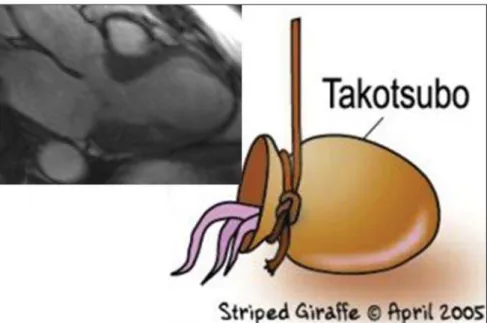
Echocardiography, left ventriculogra-phy, cardiac CT angiography and magnetic resonance imaging demonstrate apical bal-looning with hyperkinesia of the ventricu-lar basal segment, resembling a fishing pot for trapping octopus utilized in Japan (Takotsubo) (Figure 4)(5).
Takotsubo syndrome may be triggered by quite variable factors, including stress. Multiple factors have already been reported as triggering factors: psychological condi-tions, exacerbation of systemic, pulmonary, neurogenic, gastrointestinal and renal dis-eases, besides other non-specific factors. Patients with pheochromocytoma or those submitted to echocardiogram with dobu-tamine may also develop this cardiomyopa-thy(6–8).
Stress related syndrome is most fre-quent in women aged between 60 and 75 years of age. The most common symptom is retrosternal pain; however some clinical
presentations may mimic an acute coronary syndrome with dyspnea, increased cardiac enzymes (troponin) and electrocardio-graphic abnormalities. More severe cases may progress with cardiogenic shock and respiratory failure as a result of acute pul-monary edema(2,3,6).
Absence of significant coronary ob-struction and reversibility of left ventricu-lar dysfunction constitute relevant concepts to be taken into consideration for the diag-nosis, with recovery of the ventricular func-tion on average in up to 18 days, although it may take up to three months from the symptoms onset(1,3,4,7).
Although the actual prevalence of this condition is still to be defined, retrospec-tive surveys suggest that 2% of cases as-sisted as acute coronary syndrome are di-agnosed as Takotsubo syndrome(1–3).
Cardiac magnetic resonance imaging
Cardiac magnetic resonance imaging with the delayed enhancement technique can characterize the absence of a signifi-cant myocardial lesion, allowing the detec-tion of a possible ischemic lesion/infarct and the exclusion of myocarditis as a dif-ferential diagnosis(9,10,11).
Magnetic resonance imaging can dem-onstrate changes in the ventricular contrac-tility and is useful as follow-up study be-cause of the absence of ionizing radiation or nephrotoxic contrast agent.
XI
Radiol Bras. 2010 Mar/Abr;43(2):IX–XI
Final considerations
Cardiac magnetic resonance imaging should be performed in all patients with diagnostic suspicion for a correct charac-terization of the absence of myocyte lesion and follow-up of the disease.
In the present case, the clinical and im-aging follow-up with resolution of the change in the segmental contraction con-firms the diagnosis. The condition manage-ment is based on hemodynamic support measures.
REFERENCES
1. Satoh H, Tateishi H, Uchida T, et al. Takotsubo-type cardiomyopathy due to multivessel spasm. In: Kodama K, Haze K, Hon M, editors. Clinical
aspects of myocardial injury: from ischemia to heart failure. Tokyo: Kagakuhyouronsya Co.; 1990. p. 56–64.
2. Lemos AET, Araújo Junior AL, Lemos MT, et al. Síndrome do coração partido (síndrome de Tako-tsubo). Arq Bras Cardiol. 2008;90:e1–e3. 3. Vasconcelos JT, Martins S, Sousa JF, et al.
Car-diomiopatia de Takotsubo: uma causa rara de choque cardiogênico simulando infarto agudo do miocárdio. Arq Bras Cardiol. 2005;85:128–30.
4. Ishikawa K. “Takotsubo” cardiomyopathy. A syn-drome characterized by transient left ventricular apical ballooning that mimics the shape of bottle used for trapping octopus in Japan. Intern Med. 2004;43:275–6.
5. Simões MV, Marin-Neto JA, Romano MMD, et al. Disfunção ventricular esquerda transitória por cardiomiopatia induzida por estresse. Arq Bras Cardiol. 2007;89:e79–e83.
6. Vasconcelos Filho FJC, Gomes CAM, Queiroz OA, et al. Síndrome do coração partido (síndrome
de Takotsubo) induzida por ecocardiograma de estresse com dobutamina. Arq Bras Cardiol. 2009;93:e5–e7.
7. Van de Walle SO, Gevaert SA, Gheeraert PJ, et al. Transient stress-induced cardiomyopathy with an “inverted Takotsubo” contractile pattern. Mayo Clin Proc. 2006;81:1499–502.
8. Sanchez-Recalde A, Costero O, Oliver JM, et al. Images in cardiovascular medicine. Pheochro-mocytoma-related cardiomyopathy: inverted Takotsubo contractile pattern. Circulation. 2006; 113:e738–9.
9. Teraoka K, Kiuchi S, Takada N, et al. Images in cardiovascular medicine. No delayed enhance-ment on contrast magnetic resonance imaging
with Takotsubo cardiomyopathy. Circulation.
2005;111:e261–2.