S
ho
rt
R
e
p
o
rt
J. Braz. Chem. Soc., Vol. 20, No. 3, 569-575, 2009. Printed in Brazil - ©2009 Sociedade Brasileira de Química 0103 - 5053 $6.00+0.00
*e-mail: [email protected]
Furanoditerpenes from Pterodon pubescens Benth with Selective in vitro
Anticancer Activity for Prostate Cell Line
Humberto M. Spindola,a,b João E. de Carvalho,a,b Ana Lúcia T. G. Ruiz,a Rodney A. F. Rodrigues,a Carina Denny,a,b Ilza M. de Oliveira Sousa,a Jorge Y. Tamashiro c and Mary Ann Foglio*,a,b
aCPQBA, Universidade Estadual de Campinas, CP 6171, 13083-970 Campinas-SP, Brazil
bDepartamento de Farmacologia, Anestesiologia e Terapêutica, Faculdade de Odontologia,
Universidade Estadual de Campinas, CP 52, 13414-903 Piracicaba-SP, Brazil
cInstituto de Biologia, Universidade Estadual de Campinas, CP 6109, 13083-970 Campinas-SP, Brazil
O fracionamento biomonitorado do extrato diclorometânico das sementes de Pterodon
pubescens Benth forneceu o 6α-acetóxi-7β-hidróxi-vouacapano 1 (inédito), além de quatro diterpenos furânicos (2, 3, 4 e 5). A atividade antiproliferativa dos compostos foi avaliada in vitro contra as linhagens de células tumorais humanas UACC-62 (melanoma), MCF-7 (mama), NCI-H460 (pulmão), OVCAR-03 (ovário), PC-3 (próstata), HT-29 (colon), 786-0 (rim), K562 (leucemia) e NCI-ADR/RES (ovário com fenótipo de resistência a múltiplos fármacos). Os
resultados foram expressos em três concentrações efetivas GI50 (concentração para que ocorra 50%
de inibição de crescimento), TGI (concentração que resulta em inibição total de crescimento) e
LC50 (concentração que resulta em 50% de morte celular). A citotoxicidade in vitro foi avaliada
também frente a uma linhagem de célula murina normal (3T3). Este é o primeiro relato de atividade anticâncer para os compostos 1, 4 e 5, que apresentaram grande seletividade, dependente da
concentração, para PC-3. O composto 1 foi 26 vezes mais potente para inibir 50% do crescimento
(GI50) de PC-3, 15 vezes mais citostático (TGI) e 6 vezes menos tóxico (LC50) quando comparado
com Doxorrubicina (controle).
Activity guided fractionation of Pterodon pubescens Benth. methylene chloride-soluble
fraction afforded novel 6α-acetoxi 7β-hydroxy-vouacapan 1 and four known diterpene furans
2, 3, 4, 5. The compounds were evaluated for in vitro cytotoxic activities against human normal cells and tumour cell lines UACC-62 (melanoma), MCF-7 (breast), NCI-H460 (lung, non-small cells), OVCAR-03 (ovarian), PC-3 (prostate), HT-29 (colon), 786-0 (renal), K562 (leukemia) and NCI-ADR/RES (ovarian expressing phenotype multiple drugs resistance). Results were expressed
by three concentration dependent parameters GI50 (concentration that produces 50% growth
inhibition), TGI (concentration that produces total growth inhibition or cytostatic effect) and LC50
(concentration that produces −50% growth, a cytotoxicity parameter). Also, in vitro cytotoxicity
was evaluated against 3T3 cell line (mouse embryonic fibroblasts). Antiproliferative properties of
compounds 1, 4 and 5 are herein reported for the first time. These compounds showed selectivity
in a concentration-dependent way against human PC-3. Compound 1 demonstrated selectivity 26
fold more potent than the positive control, doxorubicin, for PC-3 (prostrate) cell line based on GI50 values, causing cytostatic effect (TGI value) at a concentration fifteen times less than positive
control. Moreover comparison of 50% lethal concentration (LC50 value) with positive control
(doxorubicin) suggested that compound 1 was less toxic.
Keywords: Pterodon pubescens, leguminosae, furanoditerpenes, in vitro assay, prostate cell line, cytotoxicity
Intoduction
Throughout history, natural products have afforded a rich source of compounds that have found many applications in
Furanoditerpenes from Pterodon pubescensBenth with Selective in vitro J. Braz. Chem. Soc.
570
Among the many compounds identified for cancer treatment Taxol, isolated from Taxus brevifolia, has proven to be an important chemotherapeutic agent.1 Medicinal plants still play
an important role as source of new targets for drug discovery. The huge structural diversity of natural compounds and their bioactivity potential have meant that several products isolated from plants, marine flora and microorganisms can serve as “lead” compounds for improvement of their therapeutic potential by molecular modification.2,3
Pterodon genus compromises four species native to Brazil: P. abruptus Benth., P. apparucuri Pedersoli, P. pubescens Benth. (P. emarginatus Vog.) and P. polygalaeflorus Benth. Initially scientific studies of these plants were motivated by evidence that the seed’s oil had cercaricidal4 and anti-microbial activity.5
Pterodon pubescens Benth. (Leguminosae) known, as Sucupira Branca is widespread throughout Goiás, Minas Gerais and São Paulo states in Brazil. The seeds are commercially available in Brazilian medicinal flora market. Plant’s crude alcoholic extracts are used in folk medicine as anti-inflammatory, analgesic and anti-rheumatic preparations.5-7
Phytochemical studies of Pterodon genus have revealed the presence of alkaloids, isoflavones and diterpenes. Furan-diterpenes were identified and isolated from Pterodon fruits.8-11 Some authors have suggested that furan-diterpenes
possessing vouacapan skeleton are involved with anti-inflammatory properties of Pterodon pubescens seeds´ oil.5,12,13 Diterpenes 6α-hydroxyvouacapan-7β-17β-lactone
and 6α, 7β-dihydroxyvouacapan-17β-oate methyl ester, present in P. emarginatus and P. polygalaeflorus seeds, respectively, were previously found to be associated with anti-inflammatory activity of these species.12 Another
compound, acid 6,7-dihydroxyvouacapan-17β-oic, was suggested to be one of the possible compounds involved with anti-inflammatory activity, since this compound was identified in the active fraction that exhibited anti-edematogenic activity when tested in carrageenin-induced paw edema or in Croton oil-induced ear edema assays.13
Evidence of biogenic amines involved with antinociceptive effect of a vouacapans extracted from P. polygalaeflorus Benth was studied by Duarte et al.14
suggested that the pharmacological activity was triggered by catecholaminergic system.
Coelho et al.15 studied Pterodon seed extract’s
antinociceptive activity suggesting that both peripheral and central inhibitory mechanisms are involved.
In the present study we report the isolation by activity-guided fractionation, identification and in vitro anticancer activities of vouacapans from Pterodon pubescens Benth that are herein reported for the first time.
Results and Discussion
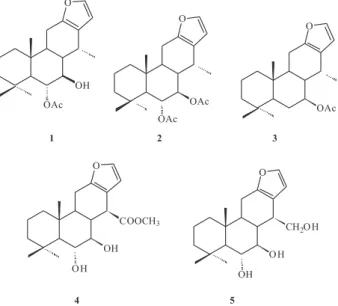
C o m p o u n d s 6α, 7β- d i a c e t o x y vo u a c a p a n 2, 7β-diacetoxyvouacapan 3, 6α,7β -dihydroxyvouacapan-17β-oate methyl ester 4, and 6α,7β -dihydroxyvouacapan-17β-methylene-ol 5 (Figure 1) were identified based on comparison of experimental 1H and 13C-NMR with reported
spectral data.9,10,16,17
Novel compound 1 was deduced as having an elemental formula C22H32O4,by HREI-MS (observed M+. = 360.23556, required M+. = 360.23010), which
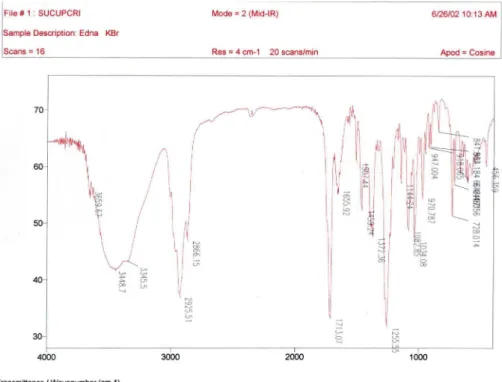
indicated seven insaturation sites. Infrared absorptions at 3449 (OH) and 1713 (C=O) cm-1 provided evidences
for hydroxyl and carbonyl functionalities. The 1H-NMR
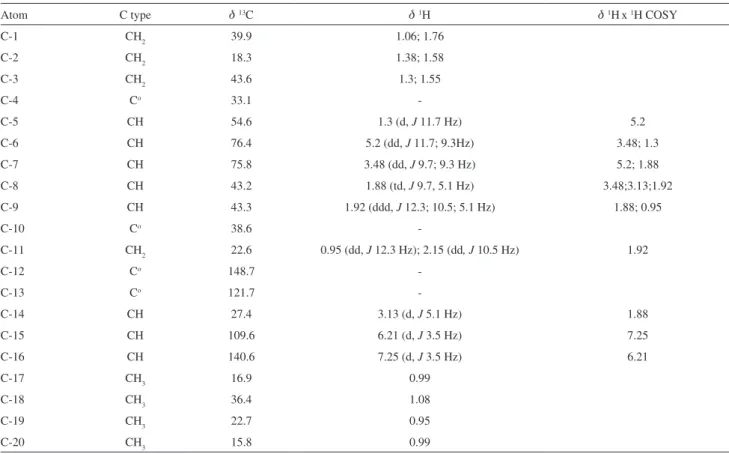
spectral data (Table 1) showed a signal at dH 3.48 (1H,
dd, J 9.7; 9.3 Hz, H-7) that presented correlations with hydrogens H-8 (dH 1.88) and H-6 (dH 5.2) in H-H
COSY experiment. This signal at dH 3.48 was attributed
to a proton geminal to the hydroxyl group at C-7. Signal at dH 5.2 (1H, dd, J 11.7; 9.3Hz) was attributed
hydrogen H-6, which was confirmed by correlations with hydrogens H-5 (dH 1.3) and H-7 (dH 3.48) in H-H
COSY experiment. The coupling constant of hydrogens H-6 and H-7 was observed as 9.3 Hz indicating a trans-diaxial relationship. When compound 1 was acetylated with excess acetic anhydride /pyridine, this compound showed identical 1H and 13C-NMR spectral data to
compound 6α,7β-diacetoxyvouacapane 29 (HREI-MS
402.2630), suggesting that compound 1 has the same relative configuration to 6α,7β-diacetoxyvouacapane 2 Figure 1. Chemical structures of vouacapans 1, 2, 3, 4 and 5 isolated from
Spindola et al. 571 Vol. 20, No. 3, 2009
with a hydroxy group attached β to C-7 whereas the acetyl group positioned α at C-6 (Table 1).
The activity-guided fractionation of methylene chloride soluble fraction was monitored by in vitro anticancer activity assay in UACC-62 (melanoma), MCF-7 (breast), NCI-H460 (lung, non-small cells), OVCAR-3 (ovarian), PC-3 (prostate), HT-29 (colon), 786-0 (renal), K562
(leukemia) and NCI-ADR/RES(ovarian expressing
phenotype multiple drugs resistance)cancer cell lines. A 48 h SRB (Sulforhodamine B) cell viability assay was performed to determine growth inhibition and cytotoxic properties of fractions and compounds. Cells were treated with at least four different concentrations levels (0.25 to 250 µg mL-1) with determination of three endpoints,
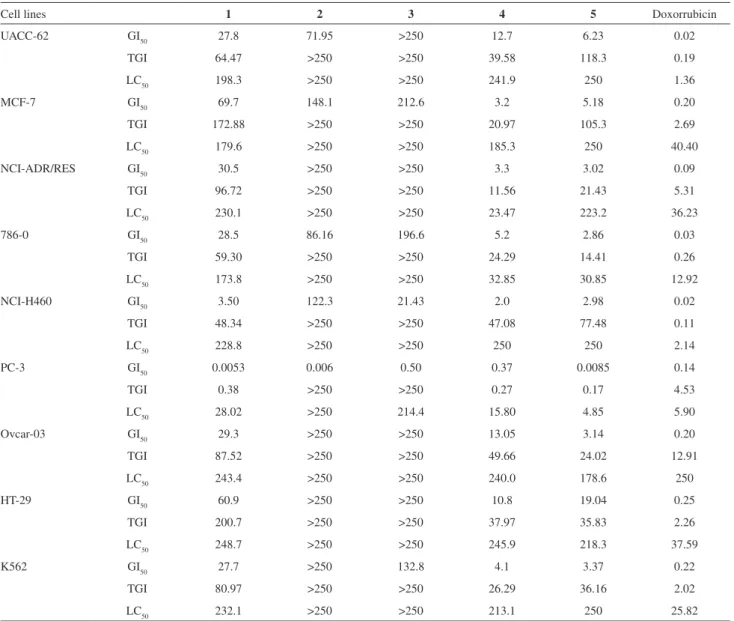
concentration inhibiting the growth of 50% of the cells (GI50), concentration for total growth inhibition (TGI) and concentration needed to kill 50% of the cells (Table 2).18
Compounds 2 and 3 were equally not potent based on GI50, TGI and LC50 values.
A mean graph for compounds 1-5 corroborated the selectivity of compounds 1, 4 and 5 for PC-3 human prostate cancer cell lines (Figure 2). The mean graph was developed by NCI emphasize differential effects of test compounds on various human tumor cell lines. This graph is generated from a set of GI50, TGI, or LC50 values.
Positive values project to the right of the vertical line and represent cellular sensitivities to the test agent that exceed the mean. Negative values project to the left and represent cell line sensitivities to the test agent that are less than the average value.19 Based on the three graphics, PC-3
cell line was high sensible to compounds 1, 4 and 5 . The interesting thing to notice is that compound 1 was more potent than 4 and 5 to inhibit cellular growth in 50% (GI50, Figure 2A), whereas compounds 1 and 5 showed almost same potency in causing cytostatic (TGI, Figure 2B). On the other hand, when cytotoxicity parameter (LC50, Figure 2C) was evaluated, compound 5 was more toxic whereas
1 and 4 were similarly toxics to PC-3 cell line. This high selectivity to PC-3 cell line suggests that furanoditerpenes
1, 4 and 5 may share a similar action mechanism, probably evolving androgenic receptors.
Compound 4 was able to reduce in 50% cellular growth of MCF-7 and NCI-H460 cell lines and also presented activity against NCI/ADR-RES cell line measured by all three parameters.
Compound 1 demonstrated selectivity 26 fold more potent than the positive control (doxorubicin) for PC-3 (prostrate) cell line based on GI50 values, causing cytostatic effect (TGI value) at a concentration fifteen times inferior than positive control (doxorubicin). Moreover comparison Table 1.1H and 13C NMR (11 Tesla, CDCl
3/TMS) data for diterpene 1 a
Atom C type d13C d1H d1Hx 1H COSY
C-1 CH2 39.9 1.06; 1.76
C-2 CH2 18.3 1.38; 1.58
C-3 CH2 43.6 1.3; 1.55
C-4 Co 33.1
-C-5 CH 54.6 1.3 (d, J 11.7 Hz) 5.2
C-6 CH 76.4 5.2 (dd, J 11.7; 9.3Hz) 3.48; 1.3
C-7 CH 75.8 3.48 (dd, J 9.7; 9.3 Hz) 5.2; 1.88
C-8 CH 43.2 1.88 (td, J 9.7, 5.1 Hz) 3.48;3.13;1.92
C-9 CH 43.3 1.92 (ddd, J 12.3; 10.5; 5.1 Hz) 1.88; 0.95
C-10 Co 38.6
-C-11 CH2 22.6 0.95 (dd, J 12.3 Hz); 2.15 (dd, J 10.5 Hz) 1.92
C-12 Co 148.7
-C-13 Co 121.7
-C-14 CH 27.4 3.13 (d, J 5.1 Hz) 1.88
C-15 CH 109.6 6.21 (d, J 3.5 Hz) 7.25
C-16 CH 140.6 7.25 (d, J 3.5 Hz) 6.21
C-17 CH3 16.9 0.99
C-18 CH3 36.4 1.08
C-19 CH3 22.7 0.95
C-20 CH3 15.8 0.99
Furanoditerpenes from Pterodon pubescensBenth with Selective in vitro J. Braz. Chem. Soc.
572
of 50% lethal concentration (LC50 value) with positive control (doxorubicin) demonstrated compound 1 to be less toxic.
Cytotoxicity in normal cell lines of compounds 1, 4,
5 were evaluated against 3T3 cell line (mouse embryonic fibroblasts) assessing mitochondrial functions by MTT reduction with succinate dehydrogenase in order to obtain cell viability. Compound 1 (IC50 = 34.33 µg mL-1)
demonstrated to be slightly less cytotoxic than compounds
4 (IC50 = 22.83 µg mL-1) and 5 (IC
50 = 23.55 µg mL -1). All
these values were higher than almost all GI50 and TGI obtained for promissory compounds.
Cyproterone, a steroid formed by the mevalonate pathway is a known drug used as anti-androgen for prostrate
cancer treatment.20 Cyproterone is a steroidal antiandrogen
agent that inhibits the action of adrenal and testicular androgens on prostate cells, seminal vesicles, testes, and the vas deferens. Additionally causes a centrally mediated reduction in testicular secretion of androgens. This drug is indicated for treatment of prostate cancer, androgen induced disorders of the skin (acne, seborrhoea, hirsutism, alopecia), precocious puberty and sexual disorders in men.21,22
Male rats treated during two weeks with 100 and 300 mg kg-1 doses of Pterodon pubescens dichloromethane
crude extract decreased body weight gain by 57 and 75% respectively.23 That difference in body weight gain may
have a relationship with antiandrogen activity of vouacapan type compounds found in the crude dichloromethane Table 2. Cytotoxic activity of compounds 1, 2, 3, 4 and 5
Cell lines 1 2 3 4 5 Doxorrubicin
UACC-62 GI50 27.8 71.95 >250 12.7 6.23 0.02
TGI 64.47 >250 >250 39.58 118.3 0.19
LC50 198.3 >250 >250 241.9 250 1.36
MCF-7 GI50 69.7 148.1 212.6 3.2 5.18 0.20
TGI 172.88 >250 >250 20.97 105.3 2.69
LC50 179.6 >250 >250 185.3 250 40.40
NCI-ADR/RES GI50 30.5 >250 >250 3.3 3.02 0.09
TGI 96.72 >250 >250 11.56 21.43 5.31
LC50 230.1 >250 >250 23.47 223.2 36.23
786-0 GI50 28.5 86.16 196.6 5.2 2.86 0.03
TGI 59.30 >250 >250 24.29 14.41 0.26
LC50 173.8 >250 >250 32.85 30.85 12.92
NCI-H460 GI50 3.50 122.3 21.43 2.0 2.98 0.02
TGI 48.34 >250 >250 47.08 77.48 0.11
LC50 228.8 >250 >250 250 250 2.14
PC-3 GI50 0.0053 0.006 0.50 0.37 0.0085 0.14
TGI 0.38 >250 >250 0.27 0.17 4.53
LC50 28.02 >250 214.4 15.80 4.85 5.90
Ovcar-03 GI50 29.3 >250 >250 13.05 3.14 0.20
TGI 87.52 >250 >250 49.66 24.02 12.91
LC50 243.4 >250 >250 240.0 178.6 250
HT-29 GI50 60.9 >250 >250 10.8 19.04 0.25
TGI 200.7 >250 >250 37.97 35.83 2.26
LC50 248.7 >250 >250 245.9 218.3 37.59
K562 GI50 27.7 >250 132.8 4.1 3.37 0.22
TGI 80.97 >250 >250 26.29 36.16 2.02
LC50 232.1 >250 >250 213.1 250 25.82
UACC-62 (melanoma), MCF-7 (breast), NCI-H460 (lung non-small cells), OVCAR-3 (ovarian), PC-3 (prostate), HT29 (colon), 786-0 (renal), K562 (leukemia) and NCI-ADR/RES (ovarian expressing phenotype multiple drugs resistance). GI50: concentration (µg mL-1)inhibiting the growth of 50% of the cells; TGI: concentration (µg mL-1)total growth inhibition; LC
50: concentration (µg mL
Spindola et al. 573 Vol. 20, No. 3, 2009
extract. Decrease of mean final body weight was also observed with cyproterone after 15 days treatment.24 This
data corroborates with the hypothesis that vouacapan type compounds interact with testosterone receptors. Further animal studies shall evaluate these findings.
Considering that compounds 1, 4 and 5, furan-diterpenoid, also originates from the mevalonate biosynthetic
pathway,20 PC-3 human tumor cell line inhibition observed
might arise by similar pharmacological mechanism such as Cyproterone. Therefore compounds 1, 4, 5 are interesting pharmacophores capable of providing new insights to the understanding of agonist versus antagonist properties of androgens, leading to the development of new anticancer chemotherapeutics agents.
Experimental
General experimental procedures
IR spectra: JASCO-FT/IR-410 spectrometer. 1H, 13C NMR and 2D experiments: Varian Inova-500
spectrometer (11 Tesla). Chemical shifts were recorded in CDCl3 solutions and quoted relative to TMS (d 0.0, 1H NMR)
and CHCl3 (d 77.0, 13C NMR). High-resolution electron
ionization mass spectroscopy (HREIMS) was recorded on a VG-AutoSpec High Resolution Mass Spectrometer (70 eV) using direct probe. Column chromatography (CC): silica gel (0.063 × 0.200 mm, Merck). TLC (thin layer chromatography): precoated plates (775554 Merck), UV detection and anisaldehyde solution.
Plant material
P. pubescens Benth. seeds were collected in Pedregulho (SP) and São Carlos (SP) cities, in march 2004. Prof. Dr. Jorge Yoshio Tamashiro from IB-UNICAMP (Department of Botany) identified the plant species. A voucher specimen was deposited at Universidade Estadual de Campinas (UEC) Herbarium, under numbers 1398 and 1402. Figure 2. Patterns of differential cytotoxicity toward human tumor cell
lines. A mean graph for compounds 1, 4 and 5 is shown. The midline of each portion represents the mean for GI50 (A), TGI (B) and LC50 (C) endpoint, calculated across nine cell lines: UACC-62 (melanoma), MCF-7 (breast), NCI-ADR/RES (ovarian expressing phenotype multiple drugs resistance), 786-0 (renal), NCI-H460 (lung, non-small cells), PC-3 (prostate), OVCAR-3 (ovarian), HT29 (colon), and K562 (leukemia). This mean value is then subtracted from the value for each individual cell line and plotted. Cell lines more sensitive are visualized as bars deflecting to the right, whereas more resistant cell lines have bars extending to the left of the mean.19
Furanoditerpenes from Pterodon pubescensBenth with Selective in vitro J. Braz. Chem. Soc.
574
Preparation of plant extract (EB) and fraction purification
Freeze-dried seeds (100g) were grinded prior to use on a Stephen mill (model UM 40 ) and extracted with dichloromethane three times during two hour periods, with 5:1 solvent/plant ratio, at room temperature. The extract was dried over anhydride Na2SO4 filtered and concentrated under vacuum (Buchi RE 120), with 32% yield of crude seed oil extract (EB).
This crude oil (18.2 g) was purified on pre-column chromatography using silica gel (Merck 7734) (5 × 60 cm) with hexane [FR1] (0-450 mL); hexane/ethyl acetate (95:5), [FR2] (500-900 mL); hexane/ethyl acetate 1(80:20) [FR3-4] (1000 x 1350 mL); hexane/ethyl acetate (60:40) (1400 x 1800 mL) [FR5-6]; hexane/ethyl acetate (40:60) (1900 x 2300 mL) [FR7]; rest flushed with methanol. The resulting fractions were monitored by thin layer chromatography (TLC), exposed with anysaldehyde reagent (50 mL acetic acid, 0.5 mL sulfuric acid and 0.5 mL anysaldehyde) followed by heating at 110 oC. According
to TLC profile the fractions were group and submitted to biological assay. The in vitro anticancer model on nine human cell lines determined the fractions that were further purified. Among the fractions isolated by column chromatography, Fraction 7 presented the best anticancer in vitro activity (data not shown).
Fraction 7 (10 g) was successively chromatographed by CC on silica-gel (70-230 mesh) (5 × 60 cm) and eluted with hexane/dichloromethane (7:3) (900-1800 mL) yielded
3 (333 mg, 3% yield); Rf 30.75; hexane/dichloromethane (6:4) (1900-2600 mL) yielded 2 (990 mg, 9.9% yield), Rf
2 0.56; hexane/dichloromethane (2:8) (2650-3100 mL) yielded 1 (963 mg, 9.63% yield), Rf 1 0.29; (3350-4100 mL) yielded 4 (1.2 g, 12% yield) Rf 4 0.17 and 5 (0.3g, 3% yield) Rf5 0.14.
6α-acetoxy-7b-hydroxy-vouacapan (1) White crystal; mp 168-171 ºC, [α]20
D: +39.4º (CHCl3;
c 0.0094); FTIR νmax/cm
-1: 3449, 1713; 1H and 13C NMR
(11 Tesla, CDCl3/TMS): see Table 1.
6α,7b-diacetoxyvouacapan (2)
White crystal; mp 167.3-168.0 ºC; FTIR, 1H and 13C
NMR data are in agreement with those reported in the literature.9,10,16,17
7b-acetoxyvouacapan (3)
White crystal; mp 125.6-127.2 ºC; FTIR, 1H and 13C
NMR data are in agreement with those reported in the literature.9,10,16,17
6a,7b-dihydroxyvouacapan-17b-oate methyl ester (4) Colorless oil; FTIR, 1H and 13C NMR data are in
agreement with those reported in the literature.9,10,16,17
6a,7b-dihydroxyvouacapan-17b-methylene-ol (5)
Colorless oil; FTIR, 1H and 13C NMR data are in
agreement with those reported in the literature.9,10,16,17
Chromatographic analysis
The GC/MS analysis were carried out using a HP-6890/5975 system equipped with a J&W Scientific DB-5 fused capillary column (25 m x 0.2 mm x 0.33 m). Temperature program: 60 °C (5 oC min-1)-300 °C (10 min),
injector 250 °C, detector 300 °C. Helium was used as carrier gas (0.7 bar, 1 mL min-1). The MS were taken at 70 eV.
Scanning speed was 0.84 scans s-1, from 40 to 550. Sample
volume was 1 µL. Split: 1:40.
In vitro anticancer activity assay
Human tumour cell lines UACC-62 (melanoma), MCF-7 (breast), NCI-H460 (lung, non-small cells), OVCAR-03 (ovarian), PC-3 (prostate), HT-29 (colon), 786-0 (renal), K562 (leukemia) and NCI-ADR/RES (ovarian expressing phenotype multiple drugs resistance) were kindly provided by National Cancer Institute (NCI). Stock cultures were grown in medium containing 5 mL RPMI 1640 (GIBCO BRL) supplemented with 5% fetal bovine serum. Gentamicine (50 µg mL-1) was added to experimental
cultures. Cells in 96 well plates (100 µL cells well-1) were
exposed to sample concentrations in DMSO/RPMI (0.25, 2.5, 25 and 250 µg mL-1) at 37 °C, 5% of CO
2 in air for
48 h. Final DMSO concentration did not affect cell viability. Afterwards cells were fixed with 50% trichloroacetic acid and cell proliferation determined by spectrophotometric quantification (540 nm) of cellular protein content using sulforhodamine B assay. Using the concentration-response curve for each cell line, GI50 (concentration that produces 50% growth inhibition), TGI (concentration that produces total growth inhibition or cytostatic effect) and LC50 (concentration that produces −50% growth, a cytotoxicity parameter) were determined through non-linear regression analysis (Table 2) using software ORIGIN 7.5 (OriginLab Corporation).18
In vitro cytotoxicity assay
Cell line 3T3 (mouse embryonic fibroblasts) was grown in medium containing 5 mL DMEM (glucose 4.5g L-1,
Spindola et al. 575 Vol. 20, No. 3, 2009
with 10% fetal bovine serum. Gentamicine (50 µg mL-1)
was added to experimental cultures. Cells in 96 well plates (100 µL cells well-1, 1 × 10⁴ cell mL-1) were exposed to
sample concentrations in DMSO/RPMI (0.25, 2.5, 25 and 250 µg mL-1) at 37 °C, 5% of CO
2 in air for 48 h before
MTT assay to access cell viability.25 Cells not exposed to
samples were used as control. Final DMSO concentration did not affect cell viability. IC50 (concentration reducing cell viability in 50%) was determined through non-linear regression analysis using software ORIGIN 7.5 (OriginLab Corporation).
Conclusions
C o n s i d e r i n g t h e d a t a p r e s e n t e d h e r e i n t h e chemotherapeutic potential of compounds 1, 4 and 5 were determined as possible candidates of new agents with high selectivity for prostate cancer. Further in vivo studies and in vitro assays are needed to establish pharmacological mechanism, toxicity and production viability.
Acknowledgments
The authors are grateful to Fundação de Amparo a Pesquisa do Estado de São Paulo, FAPESP, for financial support (02/10226-1, 05/54582-4 and 06/52454-1). C.D., M.E.Z. , M.C.E.A., J.E.C., and M.A.F. wish to thanks CAPES, FAPESP and CNPq respectively for research fellowship.
Supplementary Information
NMR spectral data of compounds 1-5 are available free of charge at http://jbcs.sbq.org.br, as PDF file.
References
1. Gordaliza, M.; Clin. Transl. Oncol.2007, 9, 767. 2. Newman, D. J.; J. Med. Chem.2008, 51, 2589.
3. Salatino, A; Salatino, M. L. F.; Negri, G.;J. Braz. Chem. Soc.
2007, 18,11.
4. Mors, W. B.; Pellegrino, J.; Santos Filho, M. F.; An. Acad. Bras. Cienc. 1966, 38, 325.
5. Carvalho, J. C. T.; Sertié, J. A. A.; Barbosa, M. V. J.; Patrício, K. C. M.; Caputo, L. R. G.; Sarti, S. J.; Ferreira, L. P.; Bastos, J. K.; J. Ethnopharmacol.1999, 64, 127.
6. Lorenzi, H.; Árvores Brasileiras. Manual de Identificação e Cultivo de Plantas Arbóreas Nativas do Brasil, vol. 1, 2nd ed.,
São Paulo, 1998.
7. Pio Correa, M.; Dicionário das plantas úteis do Brasil e das exóticas cultivadas, vol. III, Ministério da Agricultura, Instituto Brasileiro de Desenvolvimento Florestal: Rio de Janeiro, 1984.
8. Mahajan, J. R.; Monteiro, M. B.; Ferreira, G.; Pellegrino J.; An. Acad. Bras. Cienc.1972, 44, 429.
9. Fascio, M.; Mors, W. B.; Gilbert, B.; Mahajan, J. R.; Monteiro, M. B.; Dos Santos Filho, D.; Vichnewski, W.; Phytochemistry
1976, 15, 201.
10. Campos, A. M.; Silveira, E. R.; Braz-Filho, R; Teixeira, T. C.;
Phytochemistry1994, 36, 403.
11. Arriaga, A. M. C.; Castro, M. A. B.; Silveira, E. R.; Braz-Filho, R.; J. Braz. Chem. Soc.2000, 11, 187.
12. Nunan, E. A.; Carvalho, M. G.; Pilo-Veloso, D.; Turchetti-Maia, R. M. M.; Ferreira-Alves, D. L.; Braz. J. Med. Biol. Res.1982,
15, 450.
13. Silva, M. C. C.; Gayer, C. R. M.; Lopes, C. S.; Calixto, N. O.; Reis, P. A.; Passeas, C. P. B.; Paes, M. C.; Dalmau, S. R.; Sabino, K. C. C.; Todeschini, A. R.; Coelho, M. G. P.; J. Pharm. Pharmacol.2004, 55, 135.
14. Duarte, I. D. G.; Ferreira-Alves, D. L.; Veloso, D. P.; Nakamura-Craig, M.; J. Ethnopharmacol.1996, 55, 13.
15. Coelho, L. P.; Reis, P. A.; Castro, F. L.; Gayer, C. R. M.; Lopes, C. S.; Silva, M. C. C.; Sabino, K. C. C.; Todeschini, A. R.; Coelho, M. G. P.; J. Ethnopharmacol.2005, 98, 109. 16. Fascio, M.; Gilbert, B.; Mors,W. B.; Nishida,T.; An. Acad. Bras.
Cienc.1970, 42, 97.
17. Ortalo-Magne, A.; Culioli, G.; Valls, R.; Pucci, B.; Piovetti, L.;
Phytochemistry2005, 66, 2316.
18. Shoemaker, R. H.; Nat. Rev. Cancer2006, 6, 813.
19. Compare methodology, http://dtp.nci.nih.gov/docs/compare/ compare_methodology.html, accessed in August, 2008. 20. Dewick, P. M.; Medicinal Natural Products: A Biosynthetic
Approach, 2nd ed., Wiley: New York, 2001, 167.
21. Neumann, F.; Kalmus, J.; Exp. Clin. Endocrinol.1991, 98, 71.
22. Barradell, L. B.; Faulds, D.; Drug Aging1994, 5, 59. 23. Denny, C.; M. Sc. Dissertation, Universidade Estadual de
Campinas, Brazil, 2002.
24. O´Connor, J. C.; Frame, S. R.; Ladies, G. S.; Toxicol. Sci.2002,
69, 92.
25. Mosmann, T.; J. Immunol. Methods1983, 65, 55.
Received: January 30, 2008 Web Release Date: March 6, 2009
S
u
p
p
le
m
e
nta
ry
Inf
o
rm
a
ti
o
n
J. Braz. Chem. Soc., Vol. 20, No. 3, S1-S11, 2009. Printed in Brazil - ©2009 Sociedade Brasileira de Química 0103 - 5053 $6.00+0.00
*e-mail: [email protected]
Furanoditerpenes from Pterodon pubescens Benth with Selective in vitro
Anticancer Activity for Prostate Cell Line
Humberto M. Spindola,a,b João E. de Carvalho,a,b Ana Lúcia T. G. Ruiz,a Rodney A. F. Rodrigues,a Carina Denny,a,b Ilza M. de Oliveira Sousa,a Jorge Y. Tamashiro c and Mary Ann Foglio*,a,b
aCPQBA, Universidade Estadual de Campinas, CP 6171, 13083-970 Campinas-SP, Brazil
bDepartamento de Farmacologia, Anestesiologia e Terapêutica, Faculdade de Odontologia,
Universidade Estadual de Campinas, CP 52, 13414-903 Piracicaba-SP, Brazil
cInstituto de Biologia, Universidade Estadual de Campinas, CP 6109, 13083-970 Campinas-SP, Brazil
Figure S1. NMR1H (300 MHz, CDCL
Furanoditerpenes from Pterodon pubescensBenth with Selective in vitro J. Braz. Chem. Soc.
S2
Figure S2. NMR13C (75.45 MHz, CDCL
3) spectrum of 6α-acetoxy,7β-hydroxy vouacapan, 1.
Figure S3. NMR1H x 1H (500 MHz) (CDCL
Spindola et al. S3 Vol. 00, No. 00, 2009
Figure S4. NMR1H (300 MHz) x NMR13C (75.45 MHz, CDCL
3) spectrum by HSQC sequence of 6α-acetoxy,7β-hydroxy vouacapan, 1.
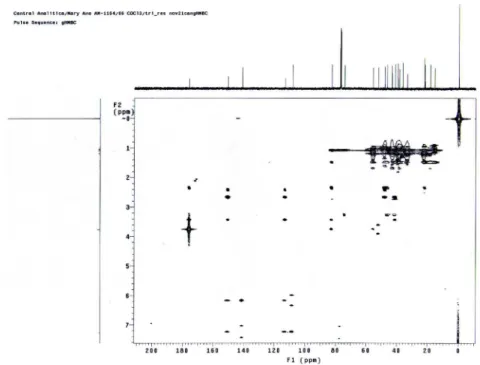
Figure S5. NMR1H (500 MHz) x NMR13C (125.7 MHz, CDCL
Furanoditerpenes from Pterodon pubescensBenth with Selective in vitro J. Braz. Chem. Soc.
S4
Figure S6. IR spectrum (Bomem MB Serie Hartmann & Braun-Michelson) of 6α-acetoxy,7β-hydroxy-vouacapan, 1.
Figure S7. NMR 13C (75.45 MHz, CDCL
Spindola et al. S5 Vol. 00, No. 00, 2009
Figure S8. NMR1H (300 MHz, CDCL
3) spectrum of 6α,7β-diacetoxyvouacapan, 2.
Figure S9. NMR13C (75.45 MHz, CDCL
Furanoditerpenes from Pterodon pubescensBenth with Selective in vitro J. Braz. Chem. Soc.
S6
Figure S10. NMR13C (75.45 MHz, CDCL
3) DEPT 135 and 90 spectrum of 6α,7β-diacetoxyvouacapan, 2.
Figure S11. NMR1H (500 MHz) x NMR13C (125.7 MHz, CDCL
Spindola et al. S7 Vol. 00, No. 00, 2009
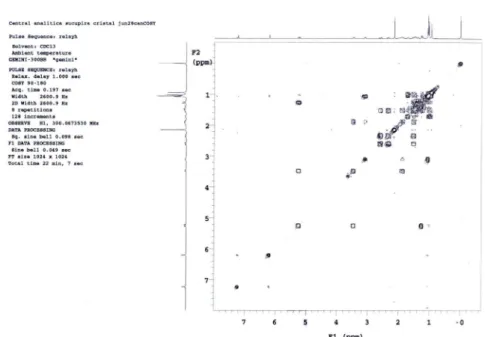
Figure S12. NMR1H x 1H (300 MHz) spectrum by COSY sequence of 6α,7β-diacetoxyvouacapan, 2.
Furanoditerpenes from Pterodon pubescensBenth with Selective in vitro J. Braz. Chem. Soc.
S8
Figure S14. NMR1H (300 MHz, CDCL
3) spectrum of 7β-acetoxivouacapano, 3.
Figure S15. NMR13C (75.45 MHz, CDCL
Spindola et al. S9 Vol. 00, No. 00, 2009
Figure S16. NMR13C (125.7 MHz, CDCL
3) DEPT 135 and 90 spectrum of 7β-acetoxivouacapano, 3.
Figure S17. NMR1H (300 MHz) x NMR13C (75.45 MHz, CDCL
Furanoditerpenes from Pterodon pubescensBenth with Selective in vitro J. Braz. Chem. Soc.
S10
Figure S18. NMR1H x 1H(300 MHz) spectrum by COSY sequence of 7β-acetoxivouacapano, 3.
Spindola et al. S11 Vol. 00, No. 00, 2009
Figure S20. NMR1H (500 MHz, CDCL
3) spectrum of compound 4.
Figure S21. NMR13C (125,7 MHz, CDCL