Editorial
J. Braz. Chem. Soc., Vol. 26, No. 3, 403-404, 2015. Printed in Brazil - ©2015 Sociedade Brasileira de Química
0103 - 5053 $6.00+0.00
e
http://dx.doi.org/10.5935/0103-5053.20150018Who is Reading and Who is Citing the JBCS?
On visiting the JBCS webpage, the following information will be easily found: “The Journal of the Brazilian Chemical Society embraces all aspects of chemistry except education, philosophy and history of chemistry. It is a medium for reporting selected original and significant contributions to new chemical knowledge. The JBCS is published monthly by the Brazilian Chemical Society without cost for the authors”. No fees for publication are charged and, since 2004, a free open access policy has been adopted.1
The JBCS goal is to be a platform for the dissemination of chemical knowledge for both the Brazilian community and abroad.
Despite not being obsessed about performance parameters, such as journal impact factors, we certainly want to increase our overall impact by assuring that we are serving the community who works with and learns about chemistry mainly by publishing relevant papers.
The Editors and the Editorial Office strive for reaching this target and our reflections generally bring some relevant questions, such as: who is reading the JBCS? Who is citing the JBCS papers? How could we improve the JBCS appeal to the community? How could we deliver a good service for building and spreading knowledge in chemistry?
Of course, these are hard questions to answer, but they are useful in trying to shed some light to produce at least partial responses. As a first and partial approach, we have searched for the citations to the top ten JBCS most cited papers. We know this is only a first glimpse of a complex landscape, but it may give us some indication on who is citing us.
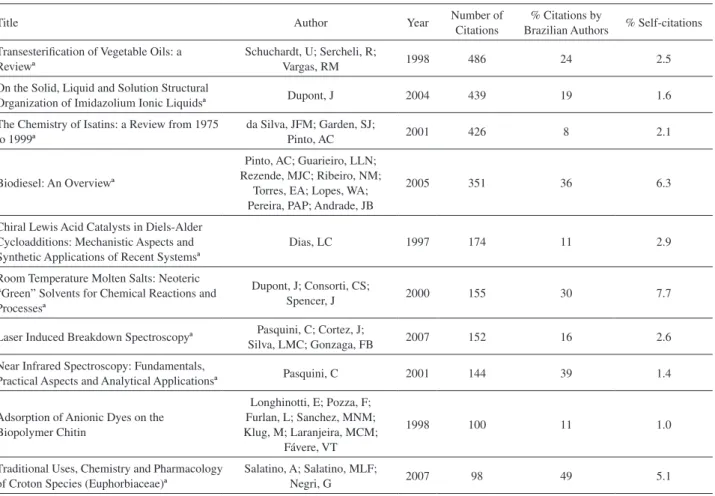
Table 1 shows the percentage of citations of each paper by authors from Brazil. This parameter allows us at least two preliminary inferences: how extensive the JBCS use by Brazilian authors is and, consequently, how extensive the JBCS use abroad is. The percentage of citations by
Table 1. Top ten most cited JBCS papers in the last 20 years
Title Author Year Number of
Citations
% Citations by
Brazilian Authors % Self-citations
Transesterification of Vegetable Oils: a Reviewª
Schuchardt, U; Sercheli, R;
Vargas, RM 1998 486 24 2.5
On the Solid, Liquid and Solution Structural
Organization of Imidazolium Ionic Liquidsª Dupont, J 2004 439 19 1.6
The Chemistry of Isatins: a Review from 1975 to 1999ª
da Silva, JFM; Garden, SJ;
Pinto, AC 2001 426 8 2.1
Biodiesel: An Overviewª
Pinto, AC; Guarieiro, LLN; Rezende, MJC; Ribeiro, NM;
Torres, EA; Lopes, WA; Pereira, PAP; Andrade, JB
2005 351 36 6.3
Chiral Lewis Acid Catalysts in Diels-Alder Cycloadditions: Mechanistic Aspects and Synthetic Applications of Recent Systemsª
Dias, LC 1997 174 11 2.9
Room Temperature Molten Salts: Neoteric “Green” Solvents for Chemical Reactions and Processesª
Dupont, J; Consorti, CS;
Spencer, J 2000 155 30 7.7
Laser Induced Breakdown Spectroscopyª Pasquini, C; Cortez, J;
Silva, LMC; Gonzaga, FB 2007 152 16 2.6
Near Infrared Spectroscopy: Fundamentals,
Practical Aspects and Analytical Applicationsª Pasquini, C 2001 144 39 1.4
Adsorption of Anionic Dyes on the Biopolymer Chitin
Longhinotti, E; Pozza, F; Furlan, L; Sanchez, MNM; Klug, M; Laranjeira, MCM;
Fávere, VT
1998 100 11 1.0
Traditional Uses, Chemistry and Pharmacology of Croton Species (Euphorbiaceae)ª
Salatino, A; Salatino, MLF;
Negri, G 2007 98 49 5.1
J. Braz. Chem. Soc.
404 Who is Reading and Who is Citing the JBCS?
Brazilian authors varies from 8 to 49% and this does not seem easily correlated with the paper topic. From these partial and preliminary data we may see once again that the internationalization process is evolving well, as recently pointed out in an editorial written by Meneghini.2
From these data we also confirm that the percentage of self-citations, i.e. a JBCS paper citing another JBCS
paper, is really low, varying from 1 to 7.7% for these ten papers. This is in agreement with earlier data showing that the JBCS, as a whole, has 8% of self-citations.3
Commenting about this number in another editorial we have mentioned that this figure could even be considered as too low. With this, an interesting question arises on why such a low figure? Is there any kind of self-prejudice against the JBCS?
Even with this partial picture, we may conclude that the JBCS use reflects a good combination of citations from Brazilians and foreigners as well and with your help we
will reach our goals of providing a good service for the advancement of the chemical sciences.
Please, feel free to share with us your thoughts about how we could increase our value for your work. A scientific journal is as strong as its readership and we are always open to learn from you. Sharing is caring. Thank you.
Joaquim A. Nóbrega
JBCS Editor
Watson Loh
JBCS Editor