DEVELOPMENT AND RELI ABI LI TY OF AN I NSTRUMENT TO MEASURE PSYCHOSOCI AL
DETERMI NANTS OF SALT CONSUMPTI ON AMONG HYPERTENSI VE PATI ENTS
1Mar ília Est ev am Cor nélio2 Mar ia Cecília Bueno Jay m e Gallani3 Gast on Godin4 Rober t a Cunha Mat heus Rodr igues3 Rober t o Dela Rosa Mendes2 Wilson Nadr uz Junior5
Cornélio ME, Gallani MCBJ, Godin G, Rodrigues RCM, Mendes RDR, Nadruz W Junior. Developm ent and reliabilit y of an inst r um ent t o m easur e psychosocial det er m inant s of salt consum pt ion am ong hyper t ensive pat ient s. Rev Lat ino- am Enfer m agem 2 0 0 9 set em br o- out ubr o; 1 7 ( 5 ) : 7 0 1 - 7 .
This st udy aim ed t o present t he cont ent validit y and reliabilit y analyses of an inst rum ent t o st udy t he det erm inant f act or s of salt con su m pt ion am on g h y per t en siv e su bj ect s, based on an ex t en sion of t h e Th eor y of Plan n ed Behavior. Cont ent validit y was assessed by 3 expert s and a pre- t est was carried out wit h 5 subj ect s. The final t ool, com pr ising 3 differ ent behav ior s r elat ed t o salt consum pt ion and cor r esponding psy chosocial v ar iables, was applied t o 32 subj ect s for int ernal consist ency and t em poral st abilit y ( 15- day int erval) analysis. Cronbach’s alpha coefficient s > 0. 70 and significant int r a- class cor r elat ion coefficient s w er e obser v ed for m ost v ar iables, indicat ing t he t em por al st abilit y of t he m easur ed concept s. The dev eloped inst r um ent ex hibit ed ev idence of bot h cont ent v alidit y and r eliabilit y .
DESCRI PTORS: diet , sodium - r est r ict ed; r epr oducibilit y of r esult s; nur sing
DESARROLLO Y CONFI ABI LI DAD DE UN I NSTRUMENTO PARA MEDI R LOS FACTORES
PSI COSOCI ALES DETERMI NANTES EN EL CONSUMO DE SAL ENTRE HI PERTENSOS
Est e est udio t uvo com o obj et ivo present ar el análisis de validez de cont enido y de confiabilidad de un inst rum ent o para est udiar los fact ores det erm inant es del consum o de sodio ent re hipert ensos, basado en la ext ensión de la Teor ía del Com por t am ient o Planificado. El inst r um ent o fue som et ido a v alidez de cont enido por 3 j ueces y a una prueba pilot o con 5 suj et os. El inst rum ent o final, com puest o por 3 com port am ient os relacionados al consum o de la sal y por las v ar iables psicosociales cor r espondient es, fue aplicado a 32 suj et os par a ev aluación de la consist encia int erna y de la est abilidad t em poral ( int ervalo de 15 días) . Fueron observados coeficient es alfa de Cr onbach> 0, 70 par a la m ay or ía de las v ar iables y coeficient es de cor r elación ent r a clases significat iv as, que apunt aron la est abilidad t em poral de los concept os m ensurados. El inst rum ent o desarrollado m ost ró evidencias de v alidez de cont enido y de confiabilidad.
DESCRI PTORES: diet a hiposódica; r epr oducibilidad de r esult ados; enfer m er ía
DESENVOLVI MENTO E CONFI ABI LI DADE DE I NSTRUMENTO PARA MENSURAÇÃO DOS
FATORES PSI COSSOCI AI S DETERMI NANTES DO CONSUMO DE SAL ENTRE HI PERTENSOS
Est e est u d o t ev e com o ob j et iv o ap r esen t ar a an álise d a v alid ad e d e con t eú d o e d a con f iab ilid ad e d e u m inst rum ent o para est udo dos fat ores det erm inant es do consum o de sódio ent re hipert ensos, baseado na ext ensão da Teor ia do Com por t am ent o Planej ado. O inst r um ent o foi subm et ido à v alidade de cont eúdo por 3 j uízes e pr é- t est e com 5 suj eit os. O inst r um ent o final, com post o por 3 com por t am ent os r elacionados ao consum o de sal e pelas v ar iáv eis psicossociais cor r espondent es, foi aplicado a 32 suj eit os par a av aliação da consist ência int erna e da est abilidade t em poral ( int ervalo de 15 dias) . Foram observados coeficient es alfa de Cronbach> 0,70 para a m aioria das variáveis e coeficient es de correlação int raclasse significat ivos, apont ando para a est abilidade t em por al dos conceit os m ensur ados. O inst r um ent o desenv olv ido m ost r ou ev idências de v alidade de cont eúdo e de confiabilidade.
DESCRI TORES: diet a hipossódica; r epr odut ibilidade dos t est es; enfer m agem
Faculdade de Ciências Médicas, Universidade Est adual de Cam pinas, Brazil: 1This research was support ed by FAPESP ( Process # 06/ 58789- 5) ; 2RN, Mast er’s St udent , e- m ail: m ar iliam ec@yahoo. com . br, t it odr m @yahoo. com . br ; 3 RN, Ph. D. in Nur sing, Associat e Pr ofessor, e- m ail: ceciliag@fcm . unicam p. br, r ober t ar @fcm . unicam p. br ; 5 Phy sician, Ph. D. in Medical Clinic, Facult y, e- m ail: w ilnj @fcm . unicam p. br. Univer sit é Laval, Canada: 4 Facult y, e- m ail: gast [email protected].
I NTRODUCTI ON
C
h a n g e s i n f o o d p a t t e r n s , w i t h l e s sv eget able con su m pt ion , in cr eased u se of m eet an d,
r ecen t l y, i n d u st r i a l i zed p r o d u ct s( 1 ), h a v e r esu l t ed
i n s a l t i n t a k e a b o v e r e c o m m e n d e d l i m i t s i n
d i f f er en t p o p u l a t i o n g r o u p s( 2 - 3 ). A r e ce n t st u d y( 3 )
f ou n d d aily salt con su m p t ion b et w een 1 3 an d 1 7 g
i n h y p er t en si v e p a t i en t s, w i t h 4 0 t o 5 5 % o f t h i s
con su m pt ion der iv in g f r om addit ion t o f oods du r in g
o r a f t e r t h e i r p r e p a r a t i o n , w h i l e co n su m p t i o n o f
h i g h - s a l t f o o d s w a s a l s o f r e q u e n t . Th i s i n t a k e
g r e a t l y e x ce e d s t h e r e co m m e n d e d l i m i t o f 6 g o f
salt / d ay f or n or m ot en siv e people or 4 g of salt / day
f o r h y p er t en si v e p er so n s( 4 ).
Excessive salt consum pt ion, in t urn, has been
associat ed w it h sev er it y of ar t er ial hy per t ension and
v en t r icu lar h y per t r oph y( 5 ), r esu lt in g in in t er n at ion al
r ecom m en d at ion s f or t h e u se of r ed u ced - salt d iet s
as an im por t ant non- phar m acological int er v ent ion in
h y p e r t e n s i o n p r e v e n t i o n a n d t r e a t m e n t( 6 ).
H y p e r t e n s i v e p a t i e n t s a r e f a m i l i a r w i t h
r e co m m e n d a t i o n s a b o u t t h e n e e d t o r e st r i ct sa l t
consum pt ion in t heir diet . Many report follow ing low
-salt diet s, as appoin t ed in ear lier r esear ch( 7 - 8 ). Th e
a c t u a l m e a s u r e m e n t o f t h i s b e h a v i o r, h o w e v e r,
i n d i c a t e s c o n t i n u e d h i g h c o n s u m p t i o n i n t h a t
populat ion, w hich confirm s t hat food pat t ern changes
are not easy t o achieve and m aint ain. There is growing
ev iden ce t h at edu cat ion pr ogr am s h av e t h e h igh est
ch an ce of su ccess if t h ey ar e aim ed at fact or s t h at
operat e on t he m ot ivat ion t o act( 9).
I n social p sy ch olog y, t h er e ar e con cep t u al
m od els t h at ser v e as a b ase t o u n der st an d an d t o
p r e d i c t h e a l t h b e h a v i o r s . I n g e n e r a l , s t r o n g
v ar iat ion s ar e f ou n d b et w een su b j ect s w h o ad h er e
o r n o t t o cer t ai n b eh av i o r s, p ar t i cu l ar l y i n t er m s
o f c o g n i t i v e f a c t o r s , d e s c r i b e d a s t h e m o s t
i m p o r t a n t d e t e r m i n a n t s o f t h e m o t i v a t i o n t o a ct
an d , con seq u en t ly, of b eh av ior( 1 0 ). Am on g t h eor ies
a i m e d a t u n d e r s t a n d i n g a n d p r e d i c t i n g h e a l t h
beh av ior s, t h e Th eor y of Plan n ed Beh av ior( 1 1 ) – TPB h a s b e e n w i d e l y u se d , i n cl u d i n g f o r f o o d - r e l a t e d
b e h a v i o r s( 1 2 - 1 3 ). Ac c o r d i n g t o TPB, t h e p r o x i m a l
det er m in an t of v olit ion al beh av ior is on e’s in t en t ion
t o en gage in t h at beh av ior. I n t en t ion is det er m in ed
b y t h r e e v a r i a b l e s : t h e a t t i t u d e r e l a t e d t o t h e
b e h a v i o r, s u b j e c t i v e n o r m s a n d p e r c e i v e d
b e h a v i o r a l c o n t r o l ( PB C)( 1 1 ). Fu r t h e r, f o r t h e
b e h a v i o r s t h a t a r e n o t c o m p l e t e l y v o l i t i o n a l l y
c o n t r o l l e d , t h e TPB i n c o r p o r a t e s p e r c e p t i o n s o f
co n t r o l o v e r p e r f o r m a n ce o f t h e b e h a v i o r a s a n
ad d it ion al b eh av ior p r ed ict or. Th e k ey id ea of t h e
m o d e l ca n b e e x p r e sse d b y t h e e q u a t i o n : B ≈ I
( + PBC) ≈ A + SN + PBC ( w h er e: B = b eh av ior ; I =
in t en t ion ; A = at t it u de; SN = su bj ect iv e n or m ; PBC
= p er cei v ed b eh av i o r al co n t r o l ) .
The applicat ion of t hese m ot ivat ional t heories
requires t he use of inst rum ent s based on psychom et ric
scales aim ed at m easur ing t he m agnit ude of fact or s
r e l a t e d t o t h e b e h a v i o r u n d e r a n a l y s i s a n d i t s
c o r r e l a t i o n s a n d , l i k e a n y o t h e r i n s t r u m e n t f o r
m e a su r e m e n t o f p sy ch o so ci a l v a r i a b l e s, n e e d t o
d em on st r at e ev id en ce of p sy ch om et r ic p r op er t ies,
such as r eliabilit y and validit y( 14).
Despit e r ecom m endat ions t o r est r ict diet ar y
sodiu m con su m pt ion an d t h e obser v at ion t h at h igh
salt consum pt ion is fr equent in differ ent populat ions,
n o scien t if ically solid in st r u m en t s w er e av ailable in
Br azilian and int er nat ional lit er at ur e w hich int end t o
assess d et er m in an t f act or s of sod iu m con su m p t ion
b eh av i o r. Hen ce, t h i s st u d y ai m ed t o p r esen t t h e
c o n t e n t v a l i d i t y a n d r e l i a b i l i t y a n a l y s i s o f a n
i n st r u m e n t t o st u d y t h e d e t e r m i n a n t s o f so d i u m
consum pt ion behav ior am ong hy per t ensiv e pat ient s,
based on an ext ension of t he TPB m odel.
METHOD
I n st r u m en t dev elopm en t
Th e i n s t r u m e n t w a s d e s i g n e d a f t e r a n
ex t en si v e l i t er at u r e r ev i ew o f r esea r ch t h a t u sed
sociocogn it iv e t h eor ies t o st u dy food beh av ior s an d
s p e c i f i c s t u d i e s o n f a c t o r s i n t e r f e r i n g i n s a l t
c o n s u m p t i o n . TPB w a s u s e d a s t h e t h e o r e t i c a l
fr am ew or k , in addit ion t o ot her v ar iables r elat ed t o
food behav ior ( self- efficacy, habit and env ir onm ent )
or specifically t o salt consum pt ion ( food pr efer ences,
h edon ic det er m in an t s an d diet qu alit y assessm en t ) .
Direct m easurem ent s of t he involved const ruct s w ere
car r ied out( 11).
Defin it ion of psy ch osocial v ar iables
Behav ior w as init ially defined as: consider a
a d i e t : - W i t h n o a d d i t i o n o f s a l t i n t h e f o o d preparat ion; No use of t able salt and - Not eat foods wit h high sodium cont ent ( snacks, indust rialized foods, cold cut s, salt ed m eat s and ot hers) - t he use of less t han 4g of salt ( corresponding t o 1 “ flat ” t easpoon of salt ) w hen cooking one of your usual recipes for any m eal ; - To avoid adding t able salt t o t he food you eat at m eals ( or sn ack s) ; an d also, - t o av oid t h e co n su m p t i o n o f f o o d w i t h h i g h sa l t co n t en t ( i . e. , sn a ck s, i n d u st r i a l i ze d f o o d s, sa l t y sp i ce s, e t c…), accor din g t o t h e follow in g elem en t s: act ion , t ar get ,
co n t ex t a n d t i m e( 1 1 ). St a r t i n g f r o m t h e b e h av i o r,
asser t ions w er e for m ulat ed t o m easur e int ent ion and
it s det er m inant s.
Con t en t v alidit y
Th e f i r s t v e r s i o n o f t h e i n s t r u m e n t w a s
su bm it t ed t o t h r ee j u dges w it h ex per t ise on h ealt h
b eh av ior r esear ch an d ex p er ien ce in m easu r em en t
i n st r u m e n t v a l i d a t i o n , w h o a sse sse d co n ce p t u a l
adequacy and clar it y of t he it em s. This v er sion w as
applied t o five subj ect s w it h charact erist ics sim ilar t o
t h e t ar get popu lat ion , in or der t o iden t if y w or ds or
q u e s t i o n s t h a t w e r e d i f f i c u l t t o u n d e r s t a n d o r
m isunderst ood( 15). Lit t le underst anding on t he generic
i ssu e o f so d i u m co n su m p t i o n w as v er i f i ed am o n g
s u b j e c t s w h o d i d n o t p r e p a r e t h e i r o w n m e a l s .
Mor eov er, a new discussion w it h t he j udges r ev ealed
t hat , as sodium consum pt ion is a behavioral cat egory
w it h differ ent act ions( 16), it cou ld n ot be defin ed by
one single quest ion, so t hat t he behavior was divided
int o t hr ee dist inct act ions, as follow s.
Beh av ior 1 – t h e u se of less t h an 4 g of salt ( cor r esp on d in g t o 1 “ f lat ” t easp oon of salt ) w h en co o k i n g o n e o f y o u r u su a l r eci p es f o r a n y m ea l ; Beh av ior 2 - To av oid ad d in g t ab le salt t o t h e f ood y ou eat at m eals ( or t h e sn ack s) an d Beh av ior 3 – t o a v o i d t h e co n su m p t i o n o f f o o d w i t h h i g h sa l t con t en t ( i.e., snacks, indust rialized foods, salt y spices, et c…) .
An o t h er r eco m m en d at i o n f r o m t h e j u d g es
w as t o in v est igat e beh av ior 1 am on g su bj ect s w h o
p r ep ar ed t h eir ow n m eal on ly, as it w ou ld n ot b e
coherent t o invest igat e det erm inant s of behaviors t he
subj ect does not perform . As a sm all num ber of m ale
pat ient s prepare t heir m eals, t he recom m endat ion was
t o r est r ict t he inv est igat ion of behav ior 1 t o fem ale
pat ient s, w ho ar e r esponsible for pr epar ing m eals.
S o m e i t e m s i n t h e h a b i t v a r i a b l e w e r e
m odif ied. On e it em con sider ed r edu n dan t (I d o n ot n eed t o t h in k in or d er t o d o it) w as w it h d r aw n an d p h r ases f or m u lat ed w it h “ n o” ( e. g . : I f eel w eir d if I d o n ’ t d o i t) w e r e r e f o r m u l a t e d f o r t h e sa k e o f e a si e r u n d e r st a n d i n g . Th e f i n a l i n st r u m e n t w a s
p r et est ed a g a i n , i n v o l v i n g f i v e su b j ect s f r o m t h e
t ar get popu lat ion , r ev ealin g t h at t h e u n der st an din g
o f b eh a v i o r s a n d r el a t ed v a r i a b l es h a d i m p r o v ed
c o n s i d e r a b l y , w i t h n o n e e d f o r a d d i t i o n a l
m o d i f i ca t i o n s.
I n st r u m en t
The inst r um ent consist ed of t hr ee behav ior s
r e l a t e d t o sa l t co n su m p t i o n a n d t h e i r r e sp e ct i v e
psy chosocial v ar iables: int ent ion, at t it ude, subj ect iv e
nor m , per ceiv ed behav ior al cont r ol, self- efficacy and
habit ( t he lat t er for behaviors 1 and 2 only) as well as
g e n e r a l v a r i a b l e s , t a k e n f r o m o t h e r m o d e l s o r
descr ibed as salt consum pt ion- r elat ed.
B e h a v i o r – Th e t h r e e b e h a v i o r s w e r e m easur ed t hr ough t he follow ing quest ion: in t he last 2 m o n t h s, w h i ch a l t e r n a t i v e b e st d e scr i b e s y o u r behavior of [ descript ion of behaviors 1, 2 or 3] ( 1) all day s of t he w eek s, ( 2 ) m ost day s of t he w eek , ( 3 ) som et im es, ( 4) rarely, ( 5) never. To calculat e t he final s c o r e , a n s w e r s c o r e s a r e i n v e r t e d t o m a i n t a i n
unifor m it y in t he int er pr et at ion of scor es ( t he higher
t he scor e, t he m or e fav or able t o t he behav ior ) .
I n t en t ion - in t en t ion w as m easu r ed b y six it em s on f iv e- poin t Liker t scales f or each beh av ior,
( e.g.: I int end t o [ descript ion of behavior] in t he next 2 m ont hs definit ely not [ 1] – definit ely [ 5] ) .
At t it ude - At t it ude w as m easur ed using five-poin t bipolar adj ect iv e scales t o an sw er on e sin gle
qu est ion f or each beh av ior ( e. g. : f or m e [ beh av ior descript ion] in t he next 2 m ont hs is: bad [ 1] – good [ 5 ] , h ar m f u l [ 1 ] – b en ef icial [ 5 ] , u n p leasan t [ 1 ] –
enj oy able [ 5 ] , bor ing [ 1 ] – pleasant [ 5 ] , silly [ 1 ] –
w ise [ 5] ) .
Subj ect iv e nor m – The subj ect iv e nor m w as assessed by four quest ions on five- point Likert scales
( e.g.: people im port ant t o m e t hink t hat I : definit ely sh o u l d n o t [ 1 ] – d e f i n i t e l y sh o u l d [ 5 ] [ b e h a v i o r
descript ion] in t he next 2 m ont hs) .
Perceived behavioral cont rol – The percept ion of behavioral cont rol was m easured by four quest ions
t he decision t o [ beh av ior descr ipt ion ] in t h e n ex t 2 m ont hs depends on m e only : I com plet ely disagr ee [ 1] – I com plet ely agree [ 5] ) .
Self - ef f icacy – Self - ef f icacy w as m easu r ed by t h r ee it em s, on a fiv e- poin t Lik er t scale ( e. g. : I t r u s t i n m y a b i l i t y t o [ b e h a v i o r d e s c r i p t i o n ] I com plet ely disagr ee [ 1] – I com plet ely agr ee [ 5] ) .
Hab i t – Hab i t w as m easu r ed b y 1 0 i t em s f o r b e h av i o r s 1 a n d 2 o n l y, t h a t i s, t h e h a b i t o f
addin g m or e t h an 4 gr am s of salt du r in g an d af t er
m eal p r ep ar at i o n s, an d al so u si n g t h e sal t sh ak er
on t h e t ab le. An sw er op t ion s w er e d isp lay ed on a
f iv e- p oin t Lik er t scale ( e. g . : [ ad d in g m or e t h an 4
g r am s of salt w h en p r ep ar in g f ood s] is som et h in g I d o f r e q u e n t l y : I c o m p l e t e l y d i s a g r e e [ 1 ] – I co m p l et el y ag r ee [ 5 ] ) .
Fo o d p r ef er en ces –f o o d p r ef er en ces w er e a ssessed b y t w o q u est i o n s o n a f i v e- p o i n t Li k er t
scale ( e. g . : in gen er al, I p r ef er f ood s t h at ar e: 1 -s a l t y, 2 – -s w e e t , 3 - b i t t e r, 4 – -s o u r, 5 – n o
p r e f e r e n c e ) .
H e d o n i c d e t e r m i n a n t s – Re l a t e d t o t h e p l e a s u r e o f e a t i n g a n d t h e p a l a t e , h e d o n i c
det erm inant s were m easured by t wo it em s, on a
five-p oin t scale ( e. g . : f or m e, low - salt f ood s ar e: v er y bland [ 1] – very t ast eful [ 5] ) .
Self- assessed diet qualit y – Diet assessm ent w as m easu r ed b y on e sin g le it em , on a f iv e- p oin t
sca l e (co n si d er i n g y o u r t r ea t m en t f o r h i g h b l o o d pr essu r e, h ow do y ou assess y ou r food in t er m s of salt consum pt ion? [ 1] ver y bad – [ 5] ver y good) .
Environm ent – The environm ent refers t o t he su bj ect s’ access t o h igh an d low - salt f oods. I t w as
m easured by m eans of t wo it em s on a five- point Likert
scale ( e. g. : in gener al, do y ou t hink y ou can easily g et l o w - sal t f o o d s? I co m p l et el y d i sag r ee [ 1 ] – I com plet ely agr ee [ 5 ] ) .
Reliabilit y assessm ent – The final v er sion of t he inst rum ent was applied t o 32 subj ect s for reliabilit y
a n a l y s i s , a c c o r d i n g t o h o m o g e n e i t y ( i n t e r n a l
consist ency) , using Cronbach’s alpha and t he st abilit y
crit erion, wit h t he t est - ret est . Alpha coefficient s above
0.70 were considered indicat ors of high consist ency( 17).
Fift een days aft er t he init ial applicat ion, t he inst rum ent
w as again applied t o t he sam e 32 subj ect s t o v er ify
agreem ent bet ween answers at bot h t im es, analyzing
t h e in t r a- class cor r elat ion coef f icien t ( I CC) an d t h e
w eight ed Kappa coefficient for one it em in t he food
pr efer en ces, a n om in al v ar iable.
Et h ical asp ect s – Th e p r oj ect an d t h e f r ee and inform ed consent t erm , which part icipant s signed
b ef o r e t h e i n t er v i ew , w er e ap p r o v ed b y t h e l o cal
Resear ch Et hics Com m it t ee ( CEP No 563/ 2006) .
RESULTS
St u d y p a r t i ci p a n t s i n t h i s p h a se w e r e 3 2
h y p e r t e n si v e p a t i e n t s w i t h a m e a n a g e o f 5 5 . 1 3
( ± 7 . 8 6 ) y ear s, 5 0 % of w h om w er e w om en , 5 3 . 1 %
m a r r i e d , w i t h a n a v e r a g e 7 . 2 ( ± 3 . 6 2 ) y e a r s o f
educat ion, and 14.7 ( ± 11.6) years as t he m ean lengt h
of h y per t en sion diagn osis.
I n t er n al con sist en cy
Ta b l e 1 s h o w s t h e m e a n t o t a l a n d i t e m
scor es, as w ell as Cr on bach ’s alph a coef f icien t s f or
each const ruct relat ed t o t he t hree behaviors. Scores
f o r m o st v a r i a b l e s w e r e a b o v e 4 . 0 f o r t h e t h r e e
b e h a v i o r s , s u g g e s t i n g t h a t t h e s t u d y g r o u p i s
favorable t o a low- salt diet . One except ion was habit
( behav ior s 1 and 2 ) , a v ar iable t hat obt ained low er
m ean scores t han t he ot her variables, suggest ing t hat
p ar t icip an t s w er e accu st om ed t o au t om at ically ad d
salt s w h en pr epar in g or t o alr eady pr epar ed f oods,
wit hout t hinking about it .
I n t he r eliabilit y analy sis, m ost v ar iables for
b e h a v i o r s 1 , 2 a n d 3 r e a ch e d Cr o n b a ch ’ s a l p h a
coefficient s above 0.70, except for subj ect norm , which
scored bet ween 0.58 and 0.67. For t he t hree behaviors,
r em ov in g it em fou r of t h e su bj ect iv e n or m r esu lt ed
in a subst ant ially bet t er coefficient .
St abilit y ( t est - r et est )
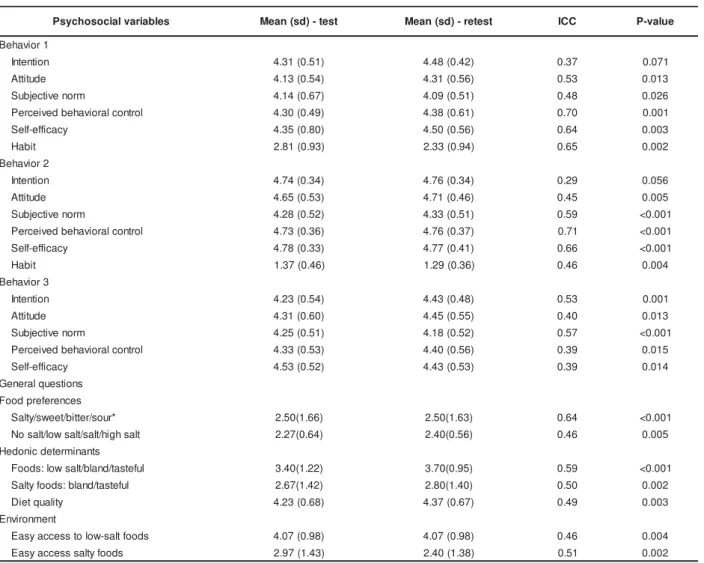
Ta b l e 2 p r e s e n t s I CC v a l u e s f o r e a c h
psy chosocial v ar iable r elat ed t o t he t hr ee behav ior s
and for t he addit ional general variables, as well as t he
Kap p a coef f icien t f or t h e n om in al v ar iab le. I CC f or
variables of behaviors 1 and 2 were > 0.44, indicat ing
t em p or al st ab ilit y. I n b ot h b eh av ior s, t h e in t en t ion
const ruct revealed a t rend t owards t em poral st abilit y.
I n b e h a v i o r 3 , a l l v a r i a b l e s p r e s e n t e d
sign if ican t coef f icien t s, in dicat in g t em por al st abilit y,
w h ich w as also obser v ed for t h e gen er al qu est ion s,
w it h I CC lev els of m or e t h an 0 . 4 5 an d a w eigh t ed
Table 1 - Mean, st andar d dev iat ion and Cr onbach’s alpha of var iables r elat ed t o t he t hr ee behav ior s e l b a i r a V ) 6 1 = n ( 1 r o i v a h e
B Behavior2(n=30) Behavior3(n=30)
) d s ( n a e
M Cronbach's a h p l A s ' h c a b n o r C m e t i f i ( a h p l A ) d e t e l e d s a w ) d s ( n a e
M Cronbach's a h p l A s ' h c a b n o r C m e t i f i ( a h p l A ) d e t e l e d s a w ) d s ( n a e
M Cronbach's a h p l A s ' h c a b n o r C m e t i f i ( a h p l A ) d e t e l e d s a w ) n o it n e t n I ( o ã ç n e t n I ) . . . o t d n e t n i I ( e d o ã ç n e t n i o h n e t u
E 4.19(1.11) 4.83(0.38) 4.17(0.70)
) . . . o t g n i n n a l p m a I ( o d n a j e n a l p u o t s
E 4.44(0.51) 4.67(0.48) 4.10(0.84)
) . . . y r t ll i w I ( r a t n e t u o v u
E 4.31(0.48) 4.73(0.45) 4.23(0.68)
) . . . t n a w I ( o r e u q u
E 4.31(0.79) 4.73(0.45) 4.30(0.65)
) . . . e p o h I ( o r e p s e u
E 4.38(0.50) 4.70(0.47) 4.30(0.53)
e h t s i t a h W ( e d a d il i b a b o r p a l a u Q ) . . . y t il i b a b o r
p 4.25(0.77) 4.80(0.41) 4.30(0.79)
) e r o c s l a t o T ( l a t o t e r o c s
E 4.31(0.51) 0.82 4.74(0.34) 0.87 4.23(0.54) 0.87
) " : s i . . . , e m r o f " : e d u t it t A ( " : é … , m i m a r a p : e d u t it A ) d o o g / d a B ( m o b / m i u
R 3.94(1.12) 4.73(0.58) 4.37(0.85)
) l a i c if e n e b /l u f m r a H ( o c if é n e b /l a i c i d u j e r
P 4.69(0.48) 4.90(0.40) 4.57(0.57)
l e v á d a r g a /l e v á d a r g a s e D ) e l b a y o j n e / t n a s a e l p n U
( 3.88(0.96) 4.47(0.82) 4.10(1.03)
) t n a s a e l p / g n i r o B ( o s o r e z a r p / o t a h
C 3.75(0.93) 4.47(1.01) 4.07(0.91)
) e s i w / y ll i S ( o t a s n e s / m e g a b o
B 4.38(0.50) 0.64 4.67(0.48) 4.43(0.57)
) e r o c s l a t o T ( l a t o t e r o c s
E 4.13(0.54) 0.58 4.65(0.53) 0.83 4.31(0.60) 0.82
) e m o t t n a t r o p m i e l p o e p : m r o n e v it c e j b u S ( m i m a r a p s e t n a t r o p m i s a o s s e p : a v it e j b u s a m r o N I k n i h t y e h T ( . . . o v e d o ã n / o v e d e u q m a h c A ) t o n d l u o h s I / d l u o h
s 4.44(0.81) 4.80(0.41) 4.60(0.56)
y e h T ( . . . m a v o r p a / m a v o r p a s e D ) e v o r p p a / e v o r p p a s i
d 4.19(0.98) 4.47(0.51) 4.67(0.48)
) … o t e m t n a w y e h T ( . . . u e e u q m e r e u
Q 4.50(0.82) 4.77(0.43) 4.53(0.57)
l a i c o s l e e f I ( . . . a r a p l a i c o s o ã s s e r p o t n i S ) … o t e r u s s e r
p 3.44(1.55) 0.93 3.07(1.66) 0.67 3.20(1.45) 0.83
) e r o c s l a t o T ( l a t o t e r o c s
E 4.14(0.67) 0.67 4.28(0.52) 0.58 4.25(0.51) 0.66
) l o r t n o c l a r o i v a h e b d e v i e c r e p ( o d i b e c r e p l a t n e m a t r o p m o c e l o r t n o C e m n o s d n e p e d … ( m i m e d ó s e d n e p e d . . . ) y l n
o 4.31(1.08) 4.53(0.82) 4.37(0.93)
h c u m w o H ( . . . m e t ê c o v e l o r t n o c o t n a u Q ) … t o g u o y e v a h l o r t n o
c 4.63(0.62) 0.66 4.90(0.31) 4.67(0.48) 0.62
I e r u s m 'I ( . . . a i r e d o p e u q a z e t r e c o h n e T ) … d l u o
c 4.38(0.50) 4.83(0.38) 4.33(0.84)
) … y s a e / d r a H ( . . .l i c á f /l i c í f i
D 3.88(0.81) 4.67(0.48) 3.97(1)
) e r o c s l a t o T ( l a t o t e r o c s
E 4.30(0.49) 0.53 4.73(0.36) 0.70 4.33(0.53) 0.46
) y c a c if f e -fl e s ( a i c á c if e o t u A n i t s u r t I ( . . . e d a d i c a p a c a h n i m a n o if n o C ) … o t y t il i b a y
m 4.31(0.87) 4.80(0.41) 4.57(0.68)
) … f o e l b a p a c m a I ( . . . e d z a p a c u o
S 4.38(0.81) 4.80(0.41) 4.53(0.51)
e r u s m a I ( . . . z a p a c u o s e u q a z e t r e c o h n e T ) … f o e l b a p a c m a
I 4.38(0.81) 4.73(0.45) 4.50(0.63)
) e r o c s l a t o T ( l a t o t e r o c s
E 4.35(0.80) 0.97 4.78(0.33) 0.70 4.53(0.52) 0.83
) tl a s f o s m a r g 4 n a h t e r o m g n i s u : t i b a H ( l a s e d s a m a r g 4 e u q s i a m r a s u : o t i b á H t a h t o d I … ( e t n e m e t n e u q e r f o ç a f . . . ) y lt n e u q e r
f 3.06(1.18) 1.27(0.45)
t a h t o d I … ( e t n e m a c it a m o t u a o ç a f . . . ) y ll a c it a m o t u
a 3.19(1.47) 1.30(0.47)
t a h t o d I … ( . . . r a r b m e l e u q r e t m e s o ç a f . . . ) … r e b m e m e r o t g n i d e e n t u o h t i
w 2.81(1.17) 1.33(0.48)
I f i … ( o h n a r t s e e m -o t n i s r e z if o ã n e s . . . ) d r i e w l e e f I t a h t o d t' n o
d 2.81(1.28) 1.33(0.55)
t u o h t i w t a h t o d I … ( r a s n e p m e s o ç a f . . . ) g n i k n i h
t 2.88(1.36) 1.33(0.48)
o d o t t o n t r o f f e … ( r e z a f o ã n a r a p o ç r o f s e . . . ) t a h
t 2.44(1.31) 1.67(1.12)
y m f o t r a p s 't i … ( a i d a a i d o d e t r a p z a f . . . ) e f il y li a
d 3.06(1.18) 1.37(0.49)
t r a t s I … ( r e b e c r e p m e s r e z a f o ç e m o c . . . ) g n i c it o n n e v e t u o h t i w t a h t g n i o
d 2.44(1.03) 1.30(0.65)
) o t t o n d r a h s 't i … ( r e z a f o ã n li c í f i d . .
. 2.06(0.85) 1.53(0.94)
) … g n i o d o t d e s u … ( . . . r e z a f o d a m u t s o c a . .
. 3.31(1.14) 1.30(0.47)
) e r o c s l a t o T ( l a t o t e r o c s
Table 2 – Mean scores of variables on t est and ret est and t em poral st abilit y analysis of behavioral variables 1,
2 and 3 and general quest ions
s e l b a i r a v l a i c o s o h c y s
P Mean(sd)-test Mean(sd)-retest ICC P-value
1 r o i v a h e B
n o it n e t n
I 4.31(0.51) 4.48(0.42) 0.37 0.071 e
d u t it t
A 4.13(0.54) 4.31(0.56) 0.53 0.013 m
r o n e v it c e j b u
S 4.14(0.67) 4.09(0.51) 0.48 0.026 l
o r t n o c l a r o i v a h e b d e v i e c r e
P 4.30(0.49) 4.38(0.61) 0.70 0.001 y
c a c if f e -fl e
S 4.35(0.80) 4.50(0.56) 0.64 0.003 t
i b a
H 2.81(0.93) 2.33(0.94) 0.65 0.002 2
r o i v a h e B
n o it n e t n
I 4.74(0.34) 4.76(0.34) 0.29 0.056 e
d u t it t
A 4.65(0.53) 4.71(0.46) 0.45 0.005 m
r o n e v it c e j b u
S 4.28(0.52) 4.33(0.51) 0.59 <0.001 l
o r t n o c l a r o i v a h e b d e v i e c r e
P 4.73(0.36) 4.76(0.37) 0.71 <0.001 y
c a c if f e -fl e
S 4.78(0.33) 4.77(0.41) 0.66 <0.001 t
i b a
H 1.37(0.46) 1.29(0.36) 0.46 0.004 3
r o i v a h e B
n o it n e t n
I 4.23(0.54) 4.43(0.48) 0.53 0.001 e
d u t it t
A 4.31(0.60) 4.45(0.55) 0.40 0.013 m
r o n e v it c e j b u
S 4.25(0.51) 4.18(0.52) 0.57 <0.001 l
o r t n o c l a r o i v a h e b d e v i e c r e
P 4.33(0.53) 4.40(0.56) 0.39 0.015 y
c a c if f e -fl e
S 4.53(0.52) 4.43(0.53) 0.39 0.014 s
n o it s e u q l a r e n e G
s e c n e r e f e r p d o o F
* r u o s / r e t t i b / t e e w s / y tl a
S 2.50(1.66) 2.50(1.63) 0.64 <0.001 tl
a s h g i h / tl a s / tl a s w o l/ tl a s o
N 2.27(0.64) 2.40(0.56) 0.46 0.005 s
t n a n i m r e t e d c i n o d e H
l u f e t s a t / d n a l b / tl a s w o l : s d o o
F 3.40(1.22) 3.70(0.95) 0.59 <0.001 l
u f e t s a t / d n a l b : s d o o f y tl a
S 2.67(1.42) 2.80(1.40) 0.50 0.002 y
t il a u q t e i
D 4.23(0.68) 4.37(0.67) 0.49 0.003 t
n e m n o r i v n E
s d o o f tl a s -w o l o t s s e c c a y s a
E 4.07(0.98) 4.07(0.98) 0.46 0.004 s
d o o f y tl a s s s e c c a y s a
E 2.97(1.43) 2.40(1.38) 0.51 0.002
* Weight ed Kappa
DI SCUSSI ON
Th is st u d y aim ed t o t est t h e p sy ch om et r ic
p r op er t ies of an in st r u m en t t h at w as d ev elop ed t o
st u d y t h e d e t e r m i n a n t s o f so d i u m i n t a k e a m o n g
h y p er t en si v e p at i en t s. Th e co n t en t v al i d i t y p h ase
in dicat ed t h at salt con su m pt ion sh ou ld be assessed
not m erely from t he perspect ive of one single behavior,
but according t o t hree dist inct behaviors t hat result in
final diet ar y salt consum pt ion. Sodium is pr esent in
f ood s in n at u r a, in t h e salt ad d ed w h en p r ep ar in g m eals, in t h e salt sh ak er u sed on t h e t able an d, in
h igh con cen t r at ion s, in in du st r ialized f oods( 1 8 ). Th is
part icular charact erist ic of sodium consum pt ion ent ails
addit ional com plicat ions, also t o est im at e consum pt ion
in quant it at iv e t er m s( 3).
I n gener al, t he dat a also ev idence t hat t he
m easures of t he psychosocial variables t hat const it ut e
t he int ent ion t o per for m t he t hr ee behavior s, as w ell
as t h e in t en t ion m easu r e, ar e r eliable accor din g t o
t he crit eria of hom ogeneit y and st abilit y. For som e of
t h em , cer t a i n co n si d er a t i o n s a r e d u e a b o u t t h ei r
psy chom et r ic per for m ance. I n t he t hr ee behav ior s, a
low it em - t ot al correlat ion w as observed for it em 4 of
t he subj ect ive norm , I feel social pressure t o [ behavior 1 , 2 o r 3 ] , i n d i cat i n g t h at , al t h o u g h co n cep t u al l y
adequat e, t he pat ient s did not int erpret it consist ent ly
w i t h t h e o t h e r i t e m s i n t h e co n st r u ct . He n ce , i n
su bsequ en t st u dy ph ases, t h e delet ion of t h is it em
m ust be consider ed w hen assessing subj ect iv e nor m
for t he t hr ee behav ior s.
A s f o r t e m p o r a l s t a b i l i t y, a l l c o n c e p t s
m easured revealed st abilit y in t he exam ined int erval,
w h i ch i s i m p o r t a n t f o r f u t u r e r e se a r ch a i m e d a t
analy zing t he nat ur al ev olut ion of t hese per cept ions,
or at assessing t he effect s of educat ive int er vent ions
The developm ent of scales t o m easure fact ors
t h at su p p or t salt con su m p t ion b eh av ior, m ain ly in
hy per t ensiv e pat ient s, w ho significant ly benefit fr om
t h e a d o p t i o n o f a l o w - sa l t d i e t , e n t a i l s d i f f e r e n t
consequences for nurses’ educat ive pract ices. Reliable
and valid m easur es ar e necessar y t o allow nur ses t o
d esig n an d assess or ien t at ion p r og r am s b ased on
social and behavioral t heories( 10), wit h great er chances
of su ccess.
Bef or e u sin g t h is in st r u m en t , h ow ev er, salt
c o n s u m p t i o n n e e d s t o b e d i a g n o s e d : i t s
q u a n t i f i c a t i o n , f o l l o w e d b y t h e i d e n t i f i c a t i o n o f
sou r ces con t r ibu t in g t o ex cessiv e con su m pt ion , lik e
i n ear l i er st u d i es( 3 ). Th e n ex t st ep i s t o d i ag n o se
t h e p sy ch o so ci a l d e t e r m i n a n t s o f e a ch b e h a v i o r.
A l t h o u g h t h e s e b e h a v i o r s a r e c o m p l e m e n t a r y,
f act or s su p p or t in g t h eir p r act ice can d if f er. Hen ce,
each behav ior can r equir e a specific int er v ent ion on
it s det er m inant fact or s. Ther efor e, t he ident ificat ion
of w hat fact or s m ot iv at ed a per son t o adopt a low
-s a l t d i e t o r n o t p r o v i d e -s -s u p p o r t t o g u i d e t h e
elabor at ion and pr act ice of int er v ent ions( 10). Besides,
predict ive fact ors can differ depending on populat ions
or populat ion subgr oups.
I n t h is sen se, it is ex p ect ed t h at ap p ly in g
scal es i s u sef u l t o d et ect su ch d i f f er en ces, g u i d e
s p e c i f i c i n t e r v e n t i o n s a n d , a l s o , t o s e r v e a s a
r efer ence t o assess t he efficacy of int er v ent ions put
in pr act ice in differ ent populat ion subgr oups( 19).
I n con clu sion , d at a ob t ain ed in t h is st u d y
pr ov ided su ppor t f or con t en t v alidit y an d r eliabilit y
according t o int ernal consist ency and st abilit y crit eria
of t he inst rum ent t o m easure det erm inant s of sodium
consum pt ion am ong hypert ensive pat ient s, given t heir
behav ior s of adding salt w hile pr epar ing t heir m eals,
addin g salt t o pr epar ed foods an d con su m in g h igh
-salt foods. This inst rum ent is expect ed t o be a useful
diagnost ic t ool for healt h educat ion int er v ent ion.
REFERENCES
1 . Rob er t s WC. Hig h salt in t ak e, it s or ig in s, it s econ om ic
im pact , and it s effect on blood pressure. Am J Cardiol 2001;
8 8 : 1 3 3 8 - 4 6 .
2. Aj ani UA, Dunbar SB, For d ES, Mok dad AH, Mensah GA.
Sod iu m in t ak e am on g p eop le w it h n or m al an d h ig h b lood
pr essu r e. Am J Pr ev Med 2 0 0 5 ; 2 9 ( 5 S1 ) : 6 3 - 7 .
3 . Fe r r e i r a M CS . Co n s u m o e s e n s i b i l i d a d e a o s ó d i o :
car act er ização gen ét ica e do com por t am en t o em saú de de
p a c i e n t e s h i p e r t e n s o s [ D i s s e r t a ç ã o ] . Ca m p i n a s ( S P) :
Un iv er sidade Est adu al de Cam pin as; 2 0 0 7 .
4. Black bur n GL, Walt m an BA. Phy sician’s guide t o t he new
2005 diet ar y guidelines: How best t o counsel pat ient s. Clev
Clin J Med 2 0 0 5 ; 7 2 ( 7 ) : 6 0 9 - 1 8 .
5 . Du Cailar G, Ribst ein J, Mim r an A. Diet ar y sodiu m an d
t arget organ dam agem in essent ial hypert ension. Am J Hypert
2 0 0 2 ; 1 5 : 2 2 2 - 9 .
6 . Sack s FM, Sv et key LP, Vollm er WM, Appel LJ, Br ay GA,
Har sh a D, et al. Th e sod iu m - r est r ict ed DASH d iet low er s
b lood p r essu r e. CMAJ 2 0 0 1 ; 1 6 4 ( 1 1 ) : 1 6 1 3 .
7 . Pessu t o J, Car v alh o EC. Fat or es de r isco em in div ídu os
com hiper t ensão ar t er ial. Rev Lat ino- am Enfer m agem 1998;
6 ( 1 ) : 3 3 - 9 .
8. Sim onet t i JP, Bat ist a L, Car valho LR. Hábit os de saúde e
f at or es d e r isco em p acien t es h ip er t en sos. Rev Lat in o- am
En f er m ag em 2 0 0 2 ; 1 0 ( 3 ) : 4 1 5 - 2 2 .
9 . Go d i n G. L’ éd u ca t i o n p o u r l a sa n t é : l es f o n d em en t s
p sy ch o so ci a u x d e l a d é f i n i t i o n d e s m e ssa g e s é d u ca t i f s.
Scien ces Sociales Et San t é 1 9 9 1 ; 9 ( 1 ) : 6 7 - 9 4 .
10. Conner M, Norm an P. Predict ing healt h behaviour: a social
cognit ion approach. I n: Conner M, Norm an P. Predict ing healt h
behaviour. 2ª ed. London: Open University Press; 2005. p. 1-9.
1 1 . Aj zen I . Con st r u ct in g a TpB Qu est ion n air e: Con cept u al
a n d Me t h o d o l o g i ca l Co n si d e r a t i o n s [ o n - l i n e ] 2 0 0 2 se p ,
r ev isad o em j an 2 0 0 6 . [ acesso em f ev 2 0 0 8 ] . Disp on ív el
em : ht t p: / / people. um ass. edu/ aizen.
1 2 . Ar m it ag e C. Ev id en ce t h at im p lem en t at ion in t en t ion s
r educe diet ar y fat int ake: a r andom ized t r ial. Healt h Psychol
2 0 0 4 ; 2 3 ( 3 ) : 3 1 9 - 2 3 .
13. Godin G; Kok K. The Theory of Planned Behavior: a review
o f i t s ap p l i cat i o n s t o h eal t h - r el at ed b eh av i o r s. Am er i can
Jou r n al Healt h Pr om ot ion 1 9 9 6 ; 1 1 ( 2 ) : 8 7 - 9 8 .
1 4 . Padilh a KM, Gallan i MCBJ, Colom bo RCR. Dev elopm en t
of an inst rum ent t o m easure beliefs and at t it udes from heart
v alv e disease pat ien t s. Rev Lat in o- Am En fer m agem 2 0 0 4 ;
1 2 ( 3 ) : 4 5 3 - 9 .
1 5 . Gu illem in , F, Bom b ar d ier C, Beat on D. Cr oss- cu lt u r al
adapt at ion of healt h relat ed qualit y of life m easures: lit erat ure
r e v i e w a n d p r o p o s e d g u i d e l i n e s . J Cl i n Ep i d e m 1 9 9 3 ;
4 6 : 1 4 1 7 - 3 2 .
1 6 . Fi s h b i e n M, A j z e n I . Un d e r s t a n d i n g a t t i t u d e s a n d
pr edict in g social beh av ior. Lon don : Pr en t ice Hall; 1 9 8 0 .
1 7 . Nu n n ally JC. Psy ch om et r ic t h eor y. New Yor k : McGr aw
-Hill; 1 9 7 8 .
18. Van der Veen JE, De Graaf C, Van Dis SJ, Van St averen
W A . D e t e r m i n a n t s o f s a l t u s e i n c o o k e d m e a l s i n t h e
Net herlands : at t it udes and pract ices of food preparers. Eur J
Clin Nu t 1 9 9 9 ; 5 3 : 3 8 8 - 9 4 .
1 9 . Blu e CL, Mar r er o DG. Psy ch om et r ic p r op er t ies of t h e
healt hful eat ing belief scales for per sons at r isk of Diabet es.
J Nu t r Edu c Beh av 2 0 0 6 ; 3 8 : 1 3 4 - 4 2 .