www.jped.com.br
ORIGINAL
ARTICLE
Study
of
the
association
between
3111T/C
polymorphism
of
the
CLOCK
gene
and
the
presence
of
overweight
in
schoolchildren
夽
,
夽夽
Nayara
P.
Giovaninni
a,
Jeanne
T.
Fuly
a,
Leonardo
I.
Moraes
a,
Thais
N.
Coutinho
a,
Ericka
B.
Trarbach
b,
Alexander
A.
de
L.
Jorge
b,
Everlayny
F.
Costalonga
a,∗aUniversidadeVilaVelha(UVV),VilaVelha,ES,Brazil
bUniversidadedeSãoPaulo,SãoPaulo,SP,Brazil
Received16August2013;accepted21January2014 Availableonline10May2014
KEYWORDS
Childhoodobesity; Durationofsleep; CLOCK;
Polymorphism
Abstract
Objectives: Toevaluatetheassociationbetween3111T/CpolymorphismoftheCLOCKgeneand
thepresenceofobesityandsleepdurationinchildrenaged6-13years.Inadults,thisgenetic varianthasbeenassociatedwithdurationofsleep,ghrelinlevels,weight,andeatinghabits. Althoughshortsleepdurationhasbeenlinkedtoobesityinchildren,nostudyhasaimedto identifythepossiblemolecularmechanismsofthisassociationtodate.
Methods: Weight,height,andcircumferencesweretransformedintoZ-scoresforageand
gen-der.GenotypingwasperformedusingTaqManmethodology.Aquestionnaireregardinghoursof sleepwasprovidedtoparents.Theappropriatestatisticaltestswereperformed.
Results: Thisstudyevaluated370children(45%males,55%females,meanage8.5±1.5years).
Theprevalenceofoverweightwas18%.Thedurationofsleepwas,onaverage,9.7hours,and wasinverselyrelatedtoage(p<0.001).Genotypedistributionwas:4%CC,31%CT,and65%TT. Therewasatrendtowardhigherprevalenceofoverweightinchildrenwhosleptlessthannine hours(23%)whencomparedtothosewhosleptmorethantenhours(16%,p=0.06).Genotype wasnotsignificantlycorrelatedtoanyoftheassessedoutcomes.
Conclusions: The CLOCK 3111T/C polymorphism was not significantlyassociated with
over-weightorsleepdurationinchildreninthiscity.
©2014SociedadeBrasileiradePediatria.PublishedbyElsevierEditoraLtda.Allrightsreserved.
夽 Pleasecitethisarticleas:GiovaninniNP,FulyJT,MoraesLI,CoutinhoTN,TrarbachEB,JorgeAA,etal.Studyoftheassociationbetween 3111T/CpolymorphismoftheCLOCKgeneandthepresenceofoverweightinschoolchildren.JPediatr(RioJ).2014;90:500---5.
夽夽
StudyconductedattheUniversidadeVilaVelha(UVV),VilaVelha,ES,Brazil.
∗Correspondingauthor.
E-mail:[email protected](E.F.Costalonga). http://dx.doi.org/10.1016/j.jped.2014.01.011
PALAVRAS-CHAVE
Obesidadeinfantil; Durac¸ãodosono; CLOCK;
Polimorfismo
Estudodaassociac¸ãoentreopolimorfismo3111T/CdogeneCLOCKeapresenc¸ade
excessodepesoemescolares
Resumo
Objetivos: Avaliararelac¸ão entreo polimorfismo3111T/CdogeneCLOCK (rs1801260) ea
presenc¸adeobesidade,bemcomoadurac¸ãodosono,emcrianc¸asde6a13anos.Em adul-tos,essavariantegenéticafoiassociadaàdurac¸ãodosono,níveisdegrelina,pesoepadrão alimentar.Embora,emcrianc¸as,acurtadurac¸ãodosonotenhasidorelacionadaàobesidade, atéomomentonenhumestudofoidirecionadonosentidodeidentificarpossíveismecanismos molecularesdessaassociac¸ão.
Métodos: Peso,alturaecircunferênciasforamtransformadosemescores-Zparaidadeesexo.
A genotipagemfoirealizadapelametodologia Taqman.Umquestionáriosobrehorasdesono foientregueaospais.Testesestatísticosapropriadosforamrealizados.
Resultados: Foramavaliadas 370crianc¸as(45%meninos,55%meninas,idade média8,5±1,5
anos). Aprevalência deexcessodepesofoi de18%.A durac¸ão dosonofoi,em média,9,7 horas,sendoinversamenterelacionadaàidade(p<0,001).Adistribuic¸ãogenotípicafoi:4%CC, 31%TCe65%TT.Houveumatendênciademaiorprevalênciadeexcessodepesoemcrianc¸asque dormiammenosde9h(23%),quandocomparadasàsquedormiammaisde10h(16%,p=0,06). Ogenótiponãosecorrelacionousignificativamenteanenhumdosdesfechosavaliados.
Conclusões: OpolimorfismoCLOCK3111T/Cnãoestásignificativamenteassociadoaoexcesso
depesoouàdurac¸ãodosonoemcrianc¸asdestalocalidade.
©2014SociedadeBrasileiradePediatria.PublicadoporElsevierEditoraLtda.Todososdireitos reservados.
Introduction
Childhood obesity isa serious publichealth problem, and representsaworldwideepidemic.Thefactthatitisan epi-demic is of concern not only because obese children are morelikelytobecomeobeseadults,butalsobecauseofits strongassociationwithhighmorbidityandmortalityevents, such as cardiovascular disease, diabetes, and cancer.1
Consideringthisandtheinefficiencyofthetraditional meth-odsusedtofight obesity,newscientificapproaches aimed atunderstandingthemechanismsinvolvedinthisepidemic areofparamountimportancesothatinnovativepreventive andtherapeuticmeasurescanbeimplemented.
Currently,itiswellestablishedthatmostcasesof obe-sity are of multifactorial origin, where multiple genetic variations,withvaryingfrequencyindifferentpopulations, modulatethemagnitudewithwhichbehavioraland environ-mentalfactorsinfluencetheweightofindividuals.2Although
thefulletiopathologicalunderstandingishinderedby gene-geneandgene-environmentinteractions,effortshavebeen madetounravelthiscomplexwebofinfluencesand gradu-allymakeitunderstood.3
Among the environmental factors related to obesity, great importance has been attributed to changes in eat-ingpatternsandphysical activitythathave occurredwith modernlifestyle.However,other changesinbehavior gen-eratedbycurrentlifestylemaybeassociatedwithdisease, includingsleeppatterns,identifiedasanimportantvariable especiallyin children.4---6 In 2008,a meta-analysis
demon-strated that children withshorter sleepduration have an increase of up to 92% in the risk of obesity. In children youngerthan10years,therewasacleardose-response asso-ciation between sleep duration and weight gain, and for
each additionalhour ofsleep, therisk of overweight was reducedonaverageby9%.4
It is possible that part of the observed association between sleep and obesity is attributable to interaction effectsofenvironmentalfactors,suchasexposuretolight andfood intake, as well as the function of the so-called biologicalclocks,either central or peripheral,which con-sistofcellswithfinelyregulatedoscillatorygeneexpression that act as ‘‘pacemakers’’, dictating the timing of hor-mones,neurotransmitters,andmetabolic,autonomic,and behavioral activities. Experimental studies demonstrate thatincreasingthedurationofexposuretolightinterferes withthelipogenicactivity mediatedbylipoproteinlipase, suggesting a centralrole of the biologicalclock in deter-miningbodyweight.Conversely,endogenouschangesofthe oscillatoryrhythm caninfluence both eatingbehaviorand thepatternofenergyexpenditureandfatdepositionin adi-posetissue.7---9
Alterationsingenesthat regulatethecircadianrhythm havebeenassociatedwithchangesinmetabolic homeosta-sis.Amongthem,theauthorshighlighttheCLOCK(Circadian
LocomotorOutputCyclesKaput,OMIM*601851)gene,the
first gene that regulates the biological rhythm identified in mammals.10 Knockout models for this gene exhibit a
phenotypeofhyperphagia,obesity,hyperlipidemia,hepatic steatosis,and hyperglycemia, whichverymuchresembles thepicture of metabolicsyndrome observed inhumans.11
Furthermore,otherstudieshavedemonstrateditsactionon theregulationof metabolicprocesses,suchasinsulinand leptinsecretionandaction.9,12,13
patternofcaloricintake,andsleep-relatedcytokines.14---18
Aninterestingstudyinvolvingobeseadultsobservedan asso-ciationbetweenCLOCK3111T/C(rs1801260)polymorphism andthecapacitytolose weightduringobesity treatment, demonstrating that patients with at least one C allele showedgreater resistance toweight loss than individuals thatwerehomozygousfor the Tallele,aswellasshorter sleep duration, higher serum ghrelin levels, and changes ineatingbehavior,includingnocturnalfeeding.15 Moreover,
other studieshave shown significant associationsbetween thispolymorphismandtheoccurrenceofdisordersrelated toappetite,weight,mood,andattention.18,19
To date, no study of polymorphisms in this gene has been developed for children.Thus, theprimary objective of this study was to evaluate the presence of an associ-ationbetween genotype 3111T/C of the CLOCK geneand thepresence of overweight,aswell asthepattern of fat distributioninschoolchildrenofthiscity.Furthermore,this samplewasalsoevaluatedforthepresenceofanassociation betweenthisgeneticvariantandsleepduration,aswellas sleepdurationandnutritionalstatus.
Methods
Sample
Thestudy,whichwasapprovedbytheUniversity Research Ethics Committee, was developed with a cross-sectional design,involvingchildrenaged6-13yearsenrolledinpublic elementaryschools(UMEF)ofthecityintheyear2012.
Sample size calculation was performed using the GPower®software,release3.1.6(KielUniversity,Germany), usingasparametersaprobabilisticerrorof0.05,effectsize of0.5,and80%statisticalpower,sothattheminimum sam-ple was determined as a total of 144 children. Children wererecruitedfromfivepublicschoolsinthecity,randomly selectedtorepresenteachof thefivepolitical-geographic regionsofthemunicipality.Ineachschool,studentselection occurredinasystematicway,accordingtotheirenrollment andconsentoftheparentsorguardians,asseveralattempts atrandomization wereabandoneddue tothe difficultyin obtainingwrittenconsentfromparents.Aimingtoincrease theestimated powerfor thetest, thenumber ofpatients wasincreasedto370children.
Datacollection
The children’s parents or caregivers completed ques-tionnaires where data regarding regular physical activity (definedasactivitywitha frequency ofat least onehour twiceaweek),sleepduration,andmeandailytimespent withtelevision,computer,andvideogameswerecollected. Thechildren wereassessedfor height,weight,andwaist, hip and neck circumference measurements. All measure-ments were performed by the main researcher and/or a teamof professionalstrainedin anthropometric measure-menttechnique.
Body weight was measured in an Avanutri® (Avanu-tri InformáticaLtda, Rio deJaneiro, Brazil) digital scale, gradedfrom0to150kg,witharesolutionof0.05kg. Chil-drenwereweighedwithoutshoesorsocks,wearingschool
uniforms. Thescale wasplacedonarigid surfaceandthe students were weighed in the standingposition,with the limbsstretchedalongthebody,positionedonthecenterof scale,lookingforward.
HeightwasmeasuredusinganAvanutri®(Avanutri Infor-mática Ltda, Rio de Janeiro, Brazil) stadiometer, graded from20to200cm,withscaleaccuracyof0.1cm,andwas representedbythemeanofthreeconsecutivemeasures,in ordertominimizemeasurementerror.Childrenwereasked to remain in the orthostatic position without shoes, with hipsandshouldersperpendiculartothecentralbodyaxis, heelsfirmlyplantedonthefloor,kneescloseandextended, relaxedarmsheldclosetothebody,andheadinthe Frank-furtplane.
Body mass index (BMI) was calculated by the formula weight/height2 and adjusted for the child’sage and gen-der according to the percentile distributions and cutoffs proposedby theCenters forDiseaseControl (CDC), which considersoverweightasaBMI≥85thpercentileand<95th percentile,andobesityasaBMIator abovethe95th per-centile.
Body fat distribution was assessed through the mea-surement of circumferences performed in duplicate for control of measurement errors or reading. The measure-ment of waistcircumference wasperformed according to the standard recommended by the I Brazilian Guideline for Metabolic Syndrome (I Diretriz Brasileira de Síndrome Metabólica-I-DBSM),withaninelastictapeplacedat mid-distancebetweentheiliaccrestandthelowerribcagerim attheendofexpiration.Hipmeasurementwasperformedin thehorizontalplane,atthelevelofthegreatest circumfer-enceofthebuttocks,withtheindividualinstandingposition withfeetplacedtogether.Neckcircumferencewasassessed usingasreferenceahorizontallineatthelevelofhalfofthe thyroidcartilage,withtheneckinneutralposition.
Molecularstudies
Thecollectionofmaterialforgeneticstudieswasperformed withtheuseoforalmucosalswabs orsoftbrushcytology, to provide the least possible discomfort topatients. DNA extraction wasperformed using twomethods. Of the 370 samples,112 had geneticmaterialextracted by means of FTAcards(FTAEluteMicrocard,WhatmanInternationalLtd., UnitedKingdom),ahighlypracticaltechnology,oftenused inforensicgenetics,whereinthechemicaltreatmentofthe card lyses thecells and leavesDNAintactthrough simple elutioninwater.20
Theremaining258DNAsampleswereobtainedthrough the use of cytological brushes, whose genetic material extractionwasperformedusingthesalting-outmethod, tra-ditionallydescribedandusedintheEndocrinologyGenetics Service-MolecularResearchLaboratory(LIM)-25,Faculdade deMedicina,UniversidadedeSãoPaulo(FMUSP).21All
Statisticalanalyses
Alldatacollectedwere storedinelectronicspreadsheets. Measures of height, weight and BMI were converted into Z-scores(adjustedforage andgender) accordingto inter-nationalreferenceparameters,usingtheGrowth Analyser software,release3.5(Rotterdam,Netherlands).After geno-typing,thepresenceofadistributioncompatiblewiththe Hardy-Weinbergequilibriumwasassessed.
Associationanalysesbetweenvariableswereperformed bycomparing groups,correlations, andlinearregressions. The groups of children with and without excess weight (overweight or obesity) were comparedregarding genetic andnongeneticvariables.Thegenotype groupswere com-paredbyboth thecodominant(CC vs.TCvs.TT)and the dominant model (C* vs. TC). Quantitative variables were analyzed using the Mann-Whitney test or Student’s t-test asappropriate. Qualitative variables were analyzed using thechi-squaredtest.Allstatisticalanalyseswereperformed usingSigmaStat®forWindows®(release3.5-SPSSInc.,San Rafael,UnitedStates)andstatisticalsignificancewassetat p<0.05.
Results
Atotalof370childrenwerestudied,ofwhom167wereboys (45%)and203weregirls(55%).Therewasaprevalenceof 10%overweight(n=38)and8% obesity(n=30).Therewas nostatistically significant difference inthe prevalence of excessweightbetweenfemalesandmales(p=0.6).
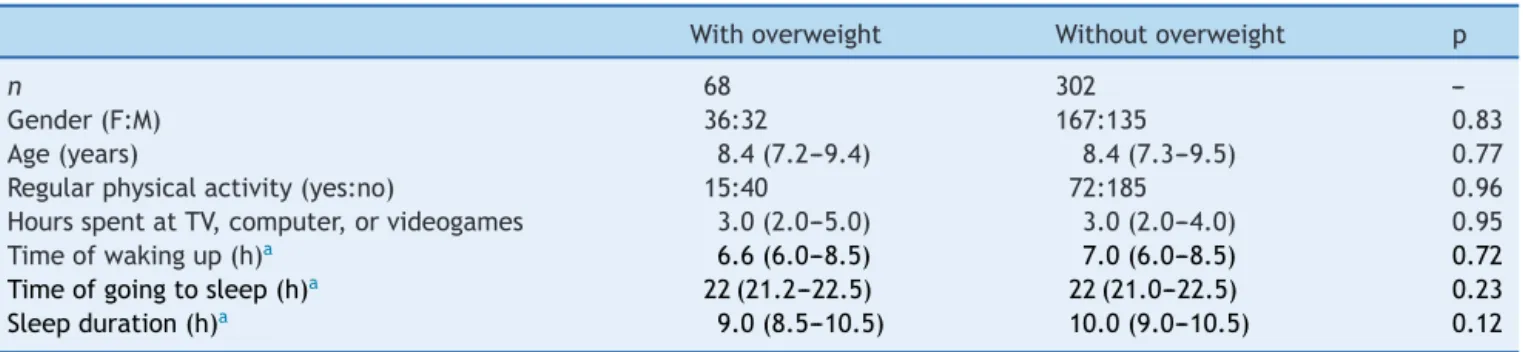
Thepracticeofregularphysicalactivitywasobservedin only27%ofchildren,withnosignificantdifferenceregarding gender or age. The numberof hoursdevotedtowatching television and playing computer or video games was also verified.Therewasnosignificantassociationbetweenthese parametersandthepresenceorabsenceofobesityinthese children.ThesedataaresummarizedinTable1.
The children slept an average of 9.7hours.An inverse association wasobserved between sleepdurationand the child’sage(r=-0.4,p<0.001).While47% ofchildrenaged between 6 and 8 yearsslept more than ten hours a day, only9%ofchildrenolderthan10yearshadthissleep dura-tionprofile(p<0.001)(Fig.1).Nosignificantassociationwas observedbetweensleepdurationandothervariables,such asgenderorregularphysicalactivity.
Sleep duration (hours)
>10
8-10
Age (y
ears)
6-8
<9 hours 9 to 10 hours >10 hours
p < 0.001
Figure1 Association between categoriesof sleepduration andage.
Regarding the association between sleep duration and obesity,there wasa tendency for a higher prevalence of excessweightamongchildrenwhosleptlessthanninehours (23%),whencomparedwithchildrenwhosleptmorethan 10hours(16%, p=0.06). Moreover,there wasa significant associationbetweensleepdurationandthecircumferences that represent central fat distribution: neck circumfer-ence (r=-0.1; p=0.01) and waist circumference (r=-0.2; p<0.001).However,these associationswere not indepen-dentfromtheassociationbetweensleepdurationandage, whenanalyzedbymultiplelinearregressions.
Thegenotype distributionregardingthe3111T/C poly-morphismoftheCLOCKgenewas4%ofchildrenhomozygous fortheCallele(n=13),31%heterozygous(n=106),and65% homozygousfor the T allele(n=221); which is consistent withtheHardy-Weinbergequilibrium(P=0.98).
Although both the prevalence of excess weight (31%) and the median BMI Z-score were greater in individuals homozygousforthe Callele,this differencedidnotshow statistical significance. Likewise, nosignificant difference wasobservedregardingsleepdurationinchildrenclassified inthedifferentgenotypegroups(Table2).
Discussion
Sleep duration has been decreasing in parallel with the increased incidence of obesity. Considering that sleep is amodifiableenvironmental factorthat canbeadopted as
Table1 Comparisonbetweenchildrenwithandwithoutoverweightinrelationtonon-geneticvariables.
Withoverweight Withoutoverweight p
n 68 302
---Gender(F:M) 36:32 167:135 0.83
Age(years) 8.4(7.2---9.4) 8.4(7.3---9.5) 0.77
Regularphysicalactivity(yes:no) 15:40 72:185 0.96
HoursspentatTV,computer,orvideogames 3.0(2.0---5.0) 3.0(2.0---4.0) 0.95 Timeofwakingup(h)a 6.6(6.0---8.5) 7.0(6.0---8.5) 0.72
Timeofgoingtosleep(h)a 22(21.2---22.5) 22(21.0---22.5) 0.23
Sleepduration(h)a 9.0(8.5---10.5) 10.0(9.0---10.5) 0.12
Table2 Comparisonofgenotypicgroups of3111T/CpolymorphismoftheCLOCK geneinrelationtooverweightandsleep duration.
CC CT TT p
n 13 106 221
Gender(F:M) 6:7 53:53 130:91 0.25
Age(years) 8.5(7.4---9.9) 8.4(7.3---9.5) 8.2(7.3---9.4) 0.70 Timeofgoingtosleepa 22(21.1---22.7) 22(21---22) 22(21---22.5) 0.43
Timeofwakingupa 6.5(6.0---8.0) 7.0(6.0---8.0) 6.6(6.0---9.0) 0.75
Sleepdurationa 9.0(8.1---10.0) 10.0(9.0---10.5) 9.9(8.6---10.5) 0.21
BMIZ-scorea 0.6(−0.1---1.5) 0.1(−0.7---1.0) 0.2(−0.6---1.5) 0.43
Overweight(%) 31% 13% 20% 0.66
amedian(interquartilerange).
apreventive measureagainstobesity,severalstudiesthat focusedontheimpactonhealthdeterminedbybehavioral and/ormolecularchangesinthesleep-wakecyclehavebeen performed inthe lastdecade.4,7 In Brazil, thisis thefirst
studythatattemptstoassesstheassociationbetweensleep durationandobesityinchildren,correlatingittoagenetic variationinvolvedinthebiologicalrhythmcontrolofseveral hormonalandmetabolicvariables.22
One of the main genes involved in the modulation of circadianrhythmistheCLOCKgene,atranscriptionfactor expressedindifferenttissuesthathasbeenimplicatedinthe regulationofmetabolicprocessessuchasinsulinsecretion,23
hypothalamicactionofleptin,13 nutrientabsorption,24and
sensitivitytoglucocorticoids.25Thepolymorphism3111T/C,
locatedinthe3′-untranslatedgeneregion,hasbeen
asso-ciatedwith feeding behavior control, hormone secretion, mood,andsleep;therefore,itwasselectedasacandidate SNPforthestudyofthemolecularassociationbetweensleep durationandobesityinchildren.16,18
Previous observations attributed a phenotype of over-weight and short sleep duration to genotype C*. An interestingstudyinvolving 1,290obeseindividuals ofboth genders,aged20to69years,observedthatpatients with atleastoneCallelehadshortersleepdurationwhen com-paredwithindividualshomozygousfortheTallele,aswell asweightlossresistance,higherserumlevelsofghrelin,and nocturnalfeedinghabits.15
Inthepresentsample,ahigherprevalenceofoverweight andshorter duration of sleep wasobserved in individuals homozygousfortheCallele;althoughconsistentwith pre-viousresults,thisdifferencewasnotstatisticallysignificant. Anegativeresultforthisassociationhasbeendescribedby otherstudies.18,26
Onepossibleexplanationforthedivergentresultsisthe statisticalpowerlimitationofthissample,asthestudyhad limitationsintermsofcostandlogisticsforexpanding sam-plesize.Anotherpossibilityisthattheassociationreported inpreviousstudiesisnotdirectlyrelatedtoacausaleffectof thispolymorphism.Althoughthefunctionalroleofthe poly-morphismonthemRNAstabilityhasbeendemonstrated,27
thepossibilityoflinkage disequilibriumwithanothertruly functionalpolymorphismcannotbediscarded,asthedegree oflinkagemayvarydependingonthegeneticprofileofeach population.
Onlyonestudy involving thispolymorphismin a Brazil-ian sample wasretrievedin the literature, whichshowed
nosignificantassociationbetweengenotypeandsleep pat-tern inadults.26 In thisstudy,inwhich 162adultsofboth
genders were genotyped for the 3111 T/C polymorphism
of the CLOCK gene, the observed genotypic frequencies
(7% CC,40% CT,and53% TT)weresimilartothosein the presentstudy,whicharealsocompatiblewiththeclassically describedfrequenciesinthedbSNPdatabase(rs1801260).
Regardingtheepidemiologicalassociationbetweensleep durationandexcessweightinchildren,thisassociationwas not consistently observed in the present sample, either. Although the methodof measuringsleepdurationused in the study, performed through questionnaires distributed to the parents, is subjectto informationbias, this is the method traditionally used in studies that demonstrated theseassociations,4andthus itcannotbeaffirmedthat it
hasadverselyaffectedthepresentstudy.
As the association showed borderline significance (p=0.06)inthecategoricalanalyses,statisticalpower lim-itation to detect this association cannot be ruled out. Moreover, this was not the first study to show a nega-tive result with regard to this association.28 Despite the
manypositivestudiesandthebiologicalplausibilityforthis association,29 thecross-sectional natureand
methodologi-callimitations of most studiesin thisarea haveled some authorstosuggestcautionwhendeterminingthenatureof causalityandthedirectionofthisassociation.30
Inconclusion,inthissampleofchildrenfromthecityof VilaVelha,ES,Brazil,nosignificantassociationwasobserved between the SNP 3111T/C of the CLOCK gene, the pres-enceofobesity,andsleepduration.However,itisimportant toperformfurtherstudieswithlargerstatistical powerto clarifytheroleofthispolymorphisminthepopulation.
Furthermore,itisimportanttoinvestigateother molec-ular circadian rhythm regulators that might possibly be involved in the modulation of the obesity susceptibility profile. The identification of risk genotypes related to ‘‘clock-genes’’ is a newarea of research on the etiology andpathogenesisofobesity,whichbroadenstheknowledge onthesubjectandprovidesanewmethodforitscontrol, allowingindividualizedtherapiestohelptreatthiscomplex andimpactfuldiseaseinthefuture.
Funding
(FAPES).ConselhoNacionaldeDesenvolvimentoCientíficoe Tecnológico(CNPq)304678/2012-0.
Conflicts
of
interest
Theauthorsdeclarenoconflictsofinterest.
References
1.FriedemannC,HeneghanC,MahtaniK,ThompsonM,PereraR, WardAM.Cardiovasculardiseaseriskinhealthychildrenand itsassociation withbodymassindex: systematic reviewand meta-analysis.BMJ.2012;345:e4759.
2.SpeliotesEK,WillerCJ,BerndtSI,MondaKL,ThorleifssonG, JacksonAU,etal.Associationanalysesof249,796individuals revealeighteennewlociassociatedwithbodymassindex.Nat Genet.2010;42:937---48.
3.FarooqiIS,RahillySO.Geneticsofobesityinhumans.Endrocrine Reviews.2006;27:710---8.
4.ChenX,BeydounMA,WangY.Issleepdurationassociatedwith childhoodobesity?Asystematicreviewandmeta-analysis. Obe-sity(SilverSpring,Md).2008;16:265---74.
5.SeegersV,PetitD, FalissardB,Vitaro F,TremblayRE, Mont-plaisirJ, etal.Short sleepdurationand bodymassindex:a prospective longitudinalstudy inpreadolescence. Am J Epi-demiol.2011;173:621---9.
6.GiuglianoR,CarneiroEC.Fatoresassociadosàobesidadeem escolares.JPediatr(RioJ).2004;80:17---22.
7.FroyO. Metabolism andcircadian rhythms - implicationsfor obesity.EndocrRev.2010;31:1---24.
8.Guo B, Chatterjee S, Li L, Kim JM, Lee J, Yechoor VK, etal.Theclockgene,brainandmuscleArnt-like1,regulates adipogenesis viaWnt signalingpathway. The FASEB Journal. 2012;26:3453---63.
9.ShiSQ,AnsariTS,McGuinnessOP,WassermanDHJC.Circadian disruptionleads to insulin resistance and obesity. Curr Biol. 2013;23:372---81.
10.Vitaterna MH, King DP, Chang AM, Kornhauser JM, Lowrey PL, McDonald JD, et al. Mutagenesis and mapping of a mousegene.Clock, essentialforcircadianbehavior.Science. 1994;264:719---25.
11.TurekFW,Joshu C,KohsakaA, LinE,IvanovaG, McDearmon E,etal. Obesityand metabolic syndrome incircadian Clock mutantmice.Science(NewYork,NY).2005;308:1043---5. 12.PrasaiMJ,Mughal RS,Wheatcroft SB,KearneyMT,Grant PJ,
ScottEM.Diurnalvariationinvascularandmetabolicfunction indiet-inducedobesity:divergenceofinsulinresistanceandloss ofclockrhythm.Diabetes.2013;62:1981---9.
13.XieX, YangS, ZouY, ChengS,Wang Y,Jiang Z,etal. Influ-enceofthecorecircadiangene‘‘Clock’’onobesityandleptin resistanceinmice.BrainRes.2013;1491:147---55.
14.Sookoian S, GemmaC,Gianotti TF, Burgue˜no A, Casta˜no G, Pirola CJ. Geneticvariants ofClock transcription factor are associatedwithindividualsusceptibilitytoobesity. AmJClin Nutr.2008;87:1606---15.
15.GarauletM,Sánchez-MorenoC,SmithCE,Lee YC,Nicolás F, OrdovásJM.Ghrelin,sleepreductionandeveningpreference: relationshipstoCLOCK3111T/CSNPandweightloss.PloSOne. 2011;6:e17435.
16.GarauletM, Corbalán MD, Madrid JA, Morales E,Baraza JC, LeeYC, etal.CLOCK geneis implicatedinweightreduction inobesepatientsparticipatinginadietaryprogrammebased ontheMediterraneandiet.IntJObes(Lond).2010;34:516---23. 17.ScottEM,CarterAM,GrantPJ.Associationbetween polymor-phismsintheClockgene,obesityandthemetabolicsyndrome inman.IntJObes(Lond).2008;32:658---62.
18.MonteleoneP,TortorellaA,DocimoL,MaldonatoMN,Canestrelli B,DeLucaL,etal.Investigationof3111T/Cpolymorphismof theCLOCKgeneinobeseindividualswithorwithoutbinge eat-ingdisorder:associationwithhigherbodymassindex.Neurosci Lett.2008;435:30---3.
19.XuX,BreenG,ChenC-K,HuangY-S,WuY-Y,AshersonP. Asso-ciationstudybetweenapolymorphismatthe3’-untranslated regionofCLOCKgeneandattentiondeficithyperactivity dis-order. Behavioral and brain functions BBF. BioMed Central. 2010;6:48.
20.AlSafar HS, Abidi FH, Khazanehdari KA, Dadour IRTG. Eval-uation of different sources of DNA for use in genome wide studies and forensic application. Appl Microbiol Biotechnol. 2011;89:807---15.
21.AbrãoMG,BillerbeckAEC,deMendonc¸aBB.Padronizac¸ãoda técnicadeextrac¸ãodeDNAdecélulasdemucosaoralcomNaCl: aplicac¸ãonoestudodogenePROP1.ArqBrasEndocrinolMetab. 2005;49:978---82.
22.Hernandez-MoranteJJ,Gomez-SantosC,MilagroF,CampiónJ, MartínezJA,ZamoraSGM.Expressionofcortisol metabolism-related genes shows circadian rhythmic patterns in human adiposetissue.IntJObes(Lond).2009;33:473---80.
23.Marcheva B, Ramsey KM, Buhr ED, Kobayashi Y, Su H, Ko CH, et al. Disruption of the clock components CLOCK and BMAL1 leadsto hypoinsulinaemiaand diabetes. NIHNature. 2010;466:627---31.
24.BalakrishnanA,TavakkolizadehA,RhoadsDB.Circadianclock genes andimplications for intestinalnutrientuptake. JNutr Biochem.2012;23:417---22.
25.KinoT,ChrousosGP.CircadianCLOCK-mediated regulationof target-tissuesensitivitytoglucocorticoids:implicationsfor car-diometabolicdiseases.EndocrDev.2011;20:116---26.
26.PedrazzoliM,LouzadaFM,PereiraDS,Benedito-SilvaAA,Lopez AR, Martynhak BJ,et al. Clockpolymorphismsand circadian rhythmsphenotypes ina sampleoftheBrazilianpopulation. ChronobiolInt.2007;24:1---8.
27.RossJ.ControlofmessengerRNAstabilityinhighereukaryotes. TrendsGenet.1996;12:171---5.
28.Calamaro CJ,ParkS,MasonTB,MarcusCL,WeaverTE,Pack A,etal.Shortenedsleepdurationdoesnotpredictobesityin adolescents.JSleepRes.2010;19:559---66.
29.LeproultR,CauterE.Van.Roleofsleepandsleeplossin hor-monalreleaseandmetabolism.EndocrDev.2010;17:11---21. 30.Cappuccio FP, Taggart FM, Kandala NB, Currie A, Peile E,