SOCIEDADE BRASILEIRA DE ORTOPEDIA E TRAUMATOLOGIA
w w w . r b o . o r g . b r
Case
Report
Total
knee
arthroplasty
with
subvastus
approach
in
patient
with
chronic
post-traumatic
patellar
dislocation
夽
Jader
Joel
Machado
Junqueira
∗,
Camilo
Partezani
Helito,
Marcelo
Batista
Bonadio,
Jose
Ricardo
Pécora,
Marco
Kawamura
Demange
InstituteofOrthopaedicsandTraumatology,FacultyofMedicine,UniversidadedeSãoPaulo,SãoPaulo,SP,Brazil
a
r
t
i
c
l
e
i
n
f
o
Articlehistory:
Received30September2015 Accepted6November2015 Availableonlinexxx
Keywords: Osteoarthritis Knee Arthroplasty Patellardislocation
a
b
s
t
r
a
c
t
Chroniclateraldislocationofthepatellaisarareconditionandacquiredcausesareusually secondarytokneetrauma.Theneglectedchronicdislocationleadstoprogressivegenu val-gumandexternaltibialtorsiondeformitieswithsubsequentgonarthrosis,whichbecomes painfulanddebilitating.Thereisnoconsensusregardingtreatmentofthesepatients,but totalkneearthroplasty(TKA)isausefultherapyincasesofpainfulsymptomatic gonarthro-sis.Fewreportshaveshownthatsubvastusapproachandlateralreleasemaybeavalid optionforTKA,sinceitallowsthecorrectionofvalgusdeformityandpatellartracking with-outinterruptingvascularbloodsupplyofpatella.ThisarticlereportsacaseofTKAand extensormechanismrealignmentwithoutpatellarresurfacinginapatientwithgenu val-gumandchronicpost-traumaticpatellardislocationwithsatisfactoryresultsaftertwoyears offollow-up.
©2016PublishedbyElsevierEditoraLtda.onbehalfofSociedadeBrasileiradeOrtopedia eTraumatologia.ThisisanopenaccessarticleundertheCCBY-NC-NDlicense(http:// creativecommons.org/licenses/by-nc-nd/4.0/).
Artroplastia
total
de
joelho
por
via
subvasto
em
paciente
com
luxac¸ão
crônica
pós-traumática
de
patela
Palavras-chave: Osteoartrose Joelho Artroplastia Luxac¸ãodepatela
r
e
s
u
m
o
A luxac¸ão crônica da patela é uma patologia rara e o trauma sua principal causa adquirida.Quandonegligenciada,levaaogenovalgoprogressivo,torc¸ãoexternadatíbia esubsequenteartrosedebilitante.Nãoexisteconsensonaliteraturacomrelac¸ãoao trata-mento desses pacientes, porém a artroplastia total de joelho (ATJ) tem se mostrado um procedimentoeficaz em casos de gonartrose sintomática dolorosa. Poucos relatos mostraramqueaviasubvastoassociadaàliberac¸ãolateraléumaopc¸ãoválidaparaATJ,já
夽WorkdevelopedintheKneeGroup,InstituteofOrthopedicsandTraumatology,HospitaldasClínicas,FacultyofMedicine,Universidade
deSãoPaulo,SãoPaulo,SP,Brazil.
∗Correspondingauthor.
E-mail:[email protected](J.J.Junqueira).
http://dx.doi.org/10.1016/j.rbo.2015.11.002
0102-3616/©2016PublishedbyElsevierEditoraLtda.onbehalfofSociedadeBrasileiradeOrtopediaeTraumatologia.Thisisanopen accessarticleundertheCCBY-NC-NDlicense(http://creativecommons.org/licenses/by-nc-nd/4.0/).
2255-4971
http://dx.doi.org/10.1016/j.rboe.2016.06.005
Universidade de São Paulo, Faculdade de Medicina, Instituto de Ortopedia e Traumatologia,
que permite a correc¸ão de deformidades em valgo e da boa excursão patelar, sem interrupc¸ãodosuprimentosanguíneo.Relatamosumcasodeumapacientecomgenovalgo eluxac¸ãocrônicapós-traumáticadepatelasubmetidaaATJassociadaaorealinhamentodo mecanismoextensor,comresultadossatisfatóriospersistentesapósseguimentodedois anos.
©2016PublicadoporElsevierEditoraLtda.emnomedeSociedadeBrasileirade OrtopediaeTraumatologia.Este ´eumartigoOpenAccesssobumalicenc¸aCCBY-NC-ND (http://creativecommons.org/licenses/by-nc-nd/4.0/).
Introduction
Chroniclateraldislocationofthepatellaisararecondition that is usuallycongenital or acquired inorigin.1 Acquired
causesareusuallysecondarytorecurrenttraumaaboutthe knee,inpatientswhohavepredispositionforpatellar disloca-tion.Femoralortibialshaftfracturewithvalgusorexternal rotation malunion will exaggerate the valgus vector and increasethispredispositionfordislocation.2
Theneglectedchronicpatellardislocationleadsto progres-sivegenuvalgumandexternaltibialtorciondeformitieswith subsequentgonarthrosis,whichbecomespainfuland debili-tating.Valgusmalalignmentofthelowerextremity,alaterally dislocatedpatella,andaweakactivekneeextensionarethe typicalphysicalfindings.3
There is no consensus regarding treatment of these patients,buttotalkneearthroplasty(TKA)isausefultherapy incasesofpainfulsymptomaticgonarthrosis.4Surgical recon-structioncanbetechnicallydemandingandrequiresattention torestoringtheextensormechanismrealignment,softtissue balancing,goodpatellartracking,aswellascorrectionofthe bonydeformitiespresentintheseverevalgusknee.2,5Another
concernisaboutthepotentialforosteonecrosisofthepatella duetodisruptionofitsbloodsupplyduringmedial parapatel-larapproachandwhenperformingextensivelateralreleaseof theextensormechanism.1,3,6
Onlyonereportshowedthatsubvastusapproachand lat-eralreleasemaybeavalidoptionforTKAinpatientswith chronicpost-traumaticpatellardislocationsinceitallowsthe correctionofvalgusdeformityandpatellartrackingwithout interruptingvascularbloodsupplyofpatella.1
WereportacaseofTKAandextensormechanism realign-ment without patellar resurfacing in a patient with genu valgumandchronicpost-traumaticpatellardislocation.
Case
report
A59-year-oldwomanwithsevereleftkneepain,whichshe hadexperiencedfor10years,wasreferredtoourHospital. Painhasgraduallyworsenedoverthelast3yearsbecauseofa traumaticdislocationofpatella.Ambulationandstair climb-ingweredifficultforherbutshecouldwalkwithoutsupport. Shehasnorelevantfamilyhistoryorcongenitaldisease. Con-servativetreatmentwithanalgesics,anti-inflammatoriesand physiotherapyformusclestrengtheningwasnoteffective.
Onexamination,therewasslightquadricepsatrophyinthe leftknee,partiallyreduciblevalgusdeformity,passiverange
Fig.1–Preoperativeclinicalphotographyshowinga completelydislocatedpatella.
ofmotionfrom0◦to100◦withpainfulcrepitusoflateral com-partmentandextensionlagof10◦.Thepatellawasdislocated laterallyanditcouldnotbereducedatfullextension(Fig.1). Minimalpatellarmobilityduringflexionandextensionwas observed.Noeffusionwaspalpableandnosignsofinstability orligamentousdeficiencywereobserved.
Astandinganteroposteriorradiographofthekneeshowed valgusdeformityandosteoarthriticchangesinall compart-mentswithalmostcomplete lossofthe lateraljointspace; lateral radiograph revealed thatthe patella was notinthe anteriorportionoftheknee;skylineviewradiographshowed acompletelydislocatedpatellaanditsdirectcontactwiththe outerborderofthelateralfemoralcondyle(Fig.2).
Surgicaltechnique
SheunderwentaTKAontheleftknee(MedialPivot,Wright MedicalTechnology, Inc.).Amidline longitudinalskin inci-sionwasmadeoverthepatellainasubvastusapproachwith theobjectivetoprotectpatellarcirculation.Thepatellawas locatedinthelateralgutterofthekneeandthelateralfemoral condylewashypoplastic.
Fig.2–Preoperativeanteroposterior,lateralandskylineradiographsoftheleftknee.
Fig.3–Intraoperativephotographyshowingthepatella centrallyplacedinthegrooveofthefemoralcomponent.
An extensive lateral release was performed beginning proximally invastus lateralisand extendingdistally tothe tibialtuberosityobtainingapatellartrackingcenteredinthe femoralgroove(Fig.3).Iliotibialbandwasalsolengthenedwith theuseofpie-crustingtechnique.Distalrealignmentbytibial tubercletransferwasnotnecessary.Totalsurgicaltimewas 95minutes.
The patient was allowed immediate weight bearing on first postoperative day. Rehabilitation program included quadriceps strengthening exercises and gradually increas-ingkneemotionfromfullextensionto120◦ flexionwithno extensorlag.
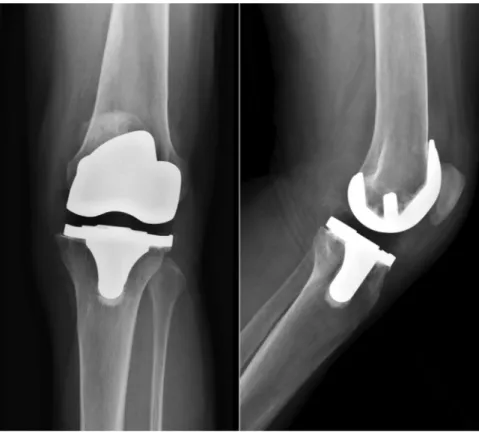
At 2 years postoperatively follow up, the patient was satisfiedwiththe surgeryand painfreeduringactiveknee motion and weightbearing activities (Fig. 4). The patient’s
KneeSocietyscore(KSS)7improvedfrompreoperativevalues of49to93postoperatively.
ATechnetium-99mmethylenediphosphatebonescanwas donetoassessthepatellarviabilityandshowed hypercapta-tionontheleft patellawithpreservedvascularizationafter 2yearspostoperatively(Fig.5).
Discussion
Considerablefunctionaldisabilityisassociatedwithchronic post-traumatic patellar dislocation. There is no consensus regardingtreatmentofneglectedpatientsandthereareonly very few reports in literature, but TKA is a useful ther-apy in patients that have developed painful symptomatic gonarthritis.4 TKA inthis groupofpatients requires major problems tobe addressed: dislocated extensormechanism andvalgusdeformity.2
Many techniques of proximal (V-Y quadricepsplasty, Z-plasty,Vulpiustechnique)anddistalrealignmenthavebeen describedandareusuallyrequiredtorelocatethepatellaand realigntheextensormechanism.3–5 Someauthors8 reported
total knee arthroplastywithout an attemptto relocatethe extensormechanismasasurgicaloption,buttheeffectsof neglectingpatellarstabilityoncomponentsurvivaland func-tionalresultsatlong-termfollow-upareunknown.Inourcase isolatedlateralreleasewasperformedfromthemusclefibers ofthevastuslateralistothetibialtuberositywithasatisfactory patellartracking.
Fig.4–Radiographsofthelastfollow-upevaluation:anteroposteriorandlateralviewsoftheleftknee.
subvastusapproach,whichpermitspreservationofthe des-cendinggeniculateartery,similarthatpreviouslydescribedby Inetal.,1associatedwithacontrolledlateralrelease,achieving anadequatepatellartracking.Onealternativethatcouldalso improvetrackingwouldberesurfacingthepatella,butdueto itssmallthicknessitwasleftintact.
Eventhoughourcasehastwo-yearfollowupitmightbe notenoughtimetoaddressallpossiblepatello-femoral com-plications.NoorpuriandMaqsood6foundapatellarnecrosis sevenyearsafteraTKAandHelitoetal.9reportedamigrated patellanineyearsafterTKA,thatiswhysurgeonsmustdoa periodicradiographiccontrolofthesepatients.
Conflicts
of
interest
Theauthorsdeclarenoconflictsofinterest.
r
e
f
e
r
e
n
c
e
s
1. InY,KongCG,SurYJ,ChoiSS.TKAusingthesubvastus approachandlateralretinacularreleaseinpatientswith permanentpost-traumaticpatellardislocation:areportoftwo cases.KneeSurgSportsTraumatolArthrosc.2009;17:
254–9.
2. BullekDD,ScuderiGR,InsallJN.Managementofthechronic irreduciblepatellardislocationintotalkneearthroplasty.J Arthroplasty.1996;11:339–45.
3. DaoQ,ChenDB,ScottRD.Proximalpatellarquadricepsplasty realignmentduringtotalkneearthroplastyforirreducible congenitaldislocationofthepatella.JBoneJointSurgAm. 2010;92:2457–61.
4.YamanakaH,KawamotoT,TamaiH,SuzukiM,KobayashiT, EguchiY,etal.Totalkneearthroplastyinapatientwith bilateralcongenitaldislocationofthepatellatreatedwitha differentmethodineachknee.CaseRepOrthop.
2015;2015:890315.
5.MatsushitaT,KurodaR,KuboS,MizunoK,MatsumotoT, KurosakaM.Totalkneearthroplastycombinedwithmedial patellofemoralligamentreconstructionforosteoarthriticknee withpreoperativevalgusdeformityandchronicpatellar dislocation.JArthroplasty.2011;26:505.e17–20.
6.NoorpuriBS,MaqsoodM.Osteonecrosisofthepatellaand prostheticextrusionaftertotalkneearthroplasty.J Arthroplasty.2002;17(5):662–3.
7.InsallJN,DorrLD,ScottRD,ScottWN.RationaleoftheKnee Societyclinicalratingsystem.ClinOrthopRelatRes.1989:13–4.
8.PradhanRL,WatanabeW,ItoiE,YamadaS,ShimadaY,SatoK. Totalkneearthroplastyinbilateralcongenitaldislocationof thepatella–acasereport.ActaOrthopScand.2001;72:422–4.
9.HelitoCP,GobbiRG,TiricoLEP,PecoraJR,CamanhoGL. Looseningofthepatellarcomponentandextra-articularand transcutaneousmigrationafterTKA.Orthopedics.