Brazilian Journal of Physics, vol. 33, no. 4, December, 2003 671
Phase Diagram of Cuprate Superconductors at
Ultrahigh Magnetic Fields
L. Krusin-Elbaum,
1,∗T. Shibauchi,
2,†and C. H. Mielke
3 1IBM T. J. Watson Research Center, Yorktown Heights, New York 10598, USA
2
Department of Electronic Science and Engineering, Kyoto University, Kyoto 606-8501, Japan
3
National High Magnetic Field Laboratory, Los Alamos National Laboratory, Los Alamos, New Mexico 87545, USA
Received on 24 July, 2003.
We have investigated the field-temperature (H−T) diagram of the superconducting and pseudogapped states of Bi2Sr2CaCu2O8+yover a wide range of hole doping (0.10 ≤ p ≤ 0.225). Using interlayer tunneling
transport in magnetic fields up to 60 T to probe the density-of states (DOS) depletion at low excitation energies we mapped the pseudogap closing fieldHpg. We found thatHpgand the pseudogap onset temperatureT⋆are
related via a Zeeman relationgµBHpg ≈kBT⋆, irrespective of whether the magnetic field is applied along
thec-axis or parallel to CuO2 planes. In contrast to large anisotropy of the superconducting state, the field anisotropy ofHpg is due solely to theg-factor. Our findings indicate that the pseudogap is of singlet-spin
origin, consistent with models based on doped Mott insulator.
1
Introduction
In the phase diagram of cuprate superconductors, the most salient and fiercely debated feature is the normal state pseu-dogap [1], whose link to the superconductivity with high transition temperature (Tc) is still unresolved. The central is-sue is whether the pseudogap originates from spin or charge degrees of freedom and, in particular, whether it derives from some precursor of Cooper pairing that acquires the su-perconducting coherence at Tc. Experimentally, the situa-tion appears deeply conflicted. On the one hand, photoe-mission [2] and surface tunneling spectroscopy [3, 4] show the pseudogap continuously evolving into a superconducting gap belowTc. The reports of anomalous and large Nernst effect in the normal state [5] led to claims of vortex-like excitations surviving up to temperatures close to T⋆. On the other hand, intrinsic tunneling measurements revealed a double gap structure [6], indicating the pseudogap distinct even belowTc. With very different magnetic field sensitivi-ties [7], the two gap features have been viewed by some as being unrelated [8].
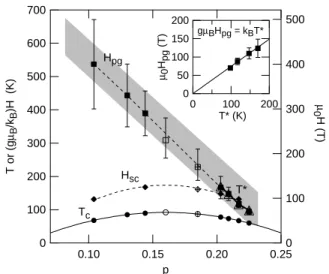
Recently we have shown that in magnetic fields along the c-axis, the field Hpg that closes the pseudogap ∆pg relates to T⋆ via a simple Zeeman relation [9] (Fig. 1), suggesting that ∆pg is controlled by the spin- rather than orbital degrees of freedom. However, several ‘precursor superconductivity’ scenarios, for example, those based on BCS-Bose Einstein crossover [10] or on intermediate cou-pling [11] models, argue that Zeeman scaling is compatible with the superconducting origin of the pseudogap. Con-ventionally, the upper critical field Hc2 ∼= Φ0/2πξ2 is determined not directly by the gap, but by the coherence
lengthξ(the size of the Copper pair). The orbital motion of the Cooper pairs with increasing field eventually leads to diamagnetic pair breaking, restoring the normal state. Ginzburg-Landau description of anisotropic 3D supercon-ductor givesHab
c2 = Φ0/2πξabξc (for the field in theab -plane) andHc
c2= Φ0/2πξ 2
ab(for the field along thec-axis), whereΦ0 denotes the flux quantum [12]. In cuprates, the field anisotropyγ=Hab
c2/Hcc2=ξab/ξcis large [13], since the coherence lengthξc along thec-axis (∼ 2A) is much˚ shorter than the in-planeξab (∼ 30A). In the ‘precursor’˚ view, one would similarly expect an orbital frustration of preformed pairs (related to their center of mass motion) at the pseudogap closing field.
Here we will discuss our experiments probing the field anisotropy ofHpg. We find that while in the superconduct-ing state anisotropy is large,Hpg(T)displays only a small anisotropy of theg-factor, independently known from the magnetic susceptibility measurements [14]. This rules out the diamagnetic pair-breaking atHpg. Furthermore, given the scales for Hpg (here, ∼ 70−100 T) and T⋆ (here, ∼100 K), the Zeeman splitting for the spin degrees of free-dom is not in correspondence with pair-breaking via a con-ventional paramagnetic (Pauli) effect [15]. The observed ab-sence of orbital frustration naturally points to a singlet spin-correlation gap closed with a triplet spin excitation atHpg.
2
Experimental
672 L. Krusin-Elbaumet al. 200 150 100 50 0 µ0 Hpg (T) 200 100 0 T* (K) gµBHpg = kBT*
700 600 500 400 300 200 100 0
T or (g
µB /kB
)H (K)
0.25 0.20 0.15 0.10 p 500 400 300 200 100 0 µ
0H (T)
Hpg
Tc
T*
Hsc
Figure 1. Doping dependence of low-temperatureHpg (squares)
andHsc(diamonds) in Bi2Sr2CaCu2O8+y(Bi-2212) together with
T⋆
(open triangles) andTc(circles). The hole concentrationpwas
obtained from the empirical formulaTc/Tcmax = 1−82.6(p−
0.16)2
[8] withTmax
c = 92K. The shaded band coversT⋆(p)
in cuprates determined by several techniques (taken from ref. [1]). Inset: ForHkcthe pseudogap closing fieldHpgandT⋆follow a
simple Zeeman scalegµBHk c
pg≈kBT⋆withg= 2.0down to the
hole doping levelp= 0.225.
we have chosen to work with overdoped Bi-2212 crystal an-nealed in 200 atm O2 for three days at375◦C to obtain a sharp transition at Tc(H = 0) ≈ 60K, corresponding to the hole dopingp= 0.225. Measurements were performed at 100 kHz in a 60 ms pulse 60 T magnet at National High Magnetic Field Laboratory (NHMFL) in Los Alamos using a lock-in technique. Negligible eddy-current heating was verified by the consistency of the data taken with successive pulses to different target fields. In overdoped samples,T⋆ can be very close toTc, or may be belowTc(Ref. [6]). In our crystal, a semiconducting-like (dρc(T)/dT <0) upturn in thec-axis resistivityρc(T)– a consistent signature of the
pseudogap [9, 14] – is very obvious whenTcis suppressed by only a∼10T field (Fig. 2). Here, the upturn – a result of the depletion in the quasiparticle density of states (DOS) near the Fermi energy – onsets atT⋆∼100K. Fig. 2 illus-trates how at high fields (∼55T) the upturn is suppressed, extending the metallic (dρc(T)/dT > 0) region to lower temperatures where the high-fieldρc(T)systematically ap-proaches the normal ungapped resistivityρn
c(T)(Ref. [6]).
3
Results and Discussion
In the superconducting state, ρc(H) becomes finite above the irreversibility fieldHirr (≡ zero resistivity fieldH0ρ, see Fig. 3). A characteristic peak is observed at a higher field
Hsc. This peak arises from a competition between two par-allel tunneling conduction channels [16]: of Cooper pairs (Josephson tunneling that decreases with increasing field) and quasiparticles (dominating at high fields). AtHsc,
2.0 1.5 1.0 0.5 0.0 ρc ( Ω cm) 120 100 80 60 40 20 0 T (K) 0 T 10 T 20 T 30 T 40 T 50 T 55 T ρc n
overdoped (Tc = 60 K)
Figure 2. c-axis resistivity vs temperature in overdoped Bi-2212 (with the hole doping levelp= 0.225) up to 55 Tkc. The normal state resistivityρn
c(T)is shown as dashed line. Here the pseudogap
temperatureT⋆∼
100 K.
the quasiparticle and the Josephson tunneling currents are comparable. Above the peak, the magnetoresistance is neg-ative until the pseudogap is quenched at Hpg whenρc(H) reachesρn
c (Fig. 3a).
Hscis a good measure – a reliable lower bound onHc2 (Ref. [16]). The temperature dependence ofHscin Fig. 4a shows that not only the initial slope for the two field align-ments is very different, namely,dHab
sc/dT|Tc= −3T/K is much larger than dHc
sc/dT|Tc= −0.27 T/K, but also the overall curvature changes from concave to convex when the field is rotated from the out- to in-plane. This is reflected in the strong temperature dependence of the anisotropy ra-tio γsc = Hscab/H
c
sc, which is ∼ 12 close to 55 K but decreases by a factor of 3 near 0.5Tc (Fig. 4b). The ir-reversibility anisotropy (also T-dependent) is even larger;
Hab irr/H
c
irr ≈20−30near 30 K, as shown in Figs. 4c and 4d.
To quantify the anisotropy of the pseudogapped state we use an identical procedure forH kcandHkabto evaluate the excess quasiparticle resistivity∆ρc due to the density-of-states (DOS) depletion associated with the pseudogap (the difference betweenρcandρnc) (Ref. [9]).∆ρc(H) fol-lows a power-law at high fields aboveHsc[9, 16], and when taken at each temperature to the limit∆ρc →0it gives the value of the pseudogap closing fieldHpg(T). Fig. 5 (top) illustrates that for the in-plane applied fieldρc(H)has to be extrapolated somewhat further to reach the ungapped nor-mal state value than forHkc. The values ofHpg(T) can be independently tracked from the high-field scaling behav-ior of∆ρc forH → Hpg shown in Fig. 5 (bottom). How-ever, in contrast toHscandHirr,Hpg(T)is temperature-independent below∼0.8T⋆, as shown in theH−Tdiagram in Fig. 6. The anisotropy ratioγpg = Hk
ab pg /Hk
c
Brazilian Journal of Physics, vol. 33, no. 4, December, 2003 673
2.0
1.5
1.0
0.5
0.0 ρc
(
Ω
cm
)
0.1 1 10 100
µ0H (T) 40 K
ρc n
Hpg H0ρ
Hsc
2.5
2.0
1.5
1.0
0.5
0.0 ρc
(
Ω
cm
)
60 50 40 30 20 10 0
µ0H (T)
2.5 K 20 K
3.5 K 50 K
40 K 30 K
10 K 7.5 K
5 K
4.2 K
H0ρ
Hsc
(a)
(b)
Figure 3. (a)ρc(H)is marked by three characteristic fields:
(zero-resistivity)H0ρ≡Hirr,Hsc, andHpg. The ungapped state value
ρn
c (dashed line) is reached at the pseudogap closing fieldHpg.
The data are for the crystal withTc= 60K of Fig. 2. Inset:ρcis
the inverse of the interlayer tunneling conductivityσcnear Fermi
energyE =EF. (b) The peak field atHsc, and the irreversibility
fieldHirrboth strongly upshift on cooling. The data shown here
are forHkc.
Hence, we conclude that a Zeeman scaling relation also holds for Hkab. This can be written asgkcµ
BHk c pg(T =
0) = gkabµ BHk
ab
pg (T = 0) ≈ kBT⋆(H = 0), with the
g-factor anisotropy gkc/gkab ≡ γ
pg. The value ofγpg is in excellent agreement with the (spectroscopic splitting)g -factor anisotropy of∼1.3obtained independently from the measurements of uniform spin susceptibilities [14] in fields kab and kc. Note that, given the scales of Hpg and T⋆, the observed absence of orbital anisotropy at the pseudo-gap closing field appears inconsistent with the simple para-magnetic Pauli pair-breaking effect,Hp|T=0= 1.84Tc|H=0 [15], and the one deduced for anisotropic singlet pairing,
Hp = 1.58Tc[18]. It is fully consistent with a singlet-spin (pseudo)gap closed by a triplet excitation atHpg arising in the spin-charge separation scenarios for high-Tc based on a doped Mott insulator [19, 20, 21].
Figure 4. Anisotropy of the characteristic fields in the supercon-ducting state. (a) The peak fieldHsc(T)and (c) the irreversibility
fieldHirr(T)forHkcandHkab. Hirrwas determined using a
ρc = 0.01ρnc criterion, consistent with our experimental
resolu-tion. Large anisotropy ofHscandHirris seen in the ratios for the
two field configurations in (b) and (d) respectively.
Figure 5. Top panel: c-axis resistivityρc vs field for Hkcand
HkabatT = 50K. Above the peak (atHsc) it follows a power-law
field dependence [∆ρc(H)−∆ρc(0)]∝Hα(∆ρc=ρc−ρnc).
At each temperature the pseudogap is closed at Hpg(T) when
ρc(H) = ρnc(H). Power-law fits indicated by thin dotted lines
point toHpgkc somewhat lower than Hk ab
pg . Bottom panel: The
high-field collapse on the same scaling curve of∆ρc(H)plotted vs
H/Hpgfor many temperatures enables us to independently track
674 L. Krusin-Elbaumet al.
Figure 6. The pseudogap closing fieldHpg(T)forHkc(left hand
side) andH kab(right hand side) in Bi-2212 withp= 0.225. The error bars indicate the uncertainties in the power-law fits. The ratio Hpgkab(T)/Hpgkc(T)≈1.35is temperature independent (inset) and
corresponds to the anisotropy of theg-factor.
Acknowledgments
We thank F. F. Balakirev and J. Betts for technical assis-tance, T. Tamegai for the use of the crystal growth facilities, and G. Blatter, V. G. Kogan, and M. P. A. Fisher for valu-able comments. Measurements were performed at NHMFL supported by the NSF Cooperative Agreement No. DMR-9527035. T. S. is supported by a Grant-in-Aid for Scientific Research from MEXT.
References
[1] T. Timusk and B. Statt, Rep. Prog. Phys. 62, 61 (1999).
[2] M. R. Norman et al., Nature 392, 157 (1998).
[3] Ch. Renner et al., Phys. Rev. Lett. 80, 149 (1998).
[4] M. Kugler et al., Phys. Rev. Lett. 86, 4911 (2001).
[5] Z. A. Xu et al., Nature 406, 486 (2000).
[6] V. M. Krasnov et al., Phys. Rev. Lett. 84, 5860 (2000).
[7] V. M. Krasnov et al., Phys. Rev. Lett. 86, 2657 (2001).
[8] J. L. Tallon and J. W. Loram, Physica C349, 53 (2001).
[9] T. Shibauchi et al., Phys. Rev. Lett. 86, 5763 (2001).
[10] Y.-J. Kao et al., Phys. Rev. B64, R140505 (2001).
[11] P. Pieri, G.C. Strinati and D. Moroni, Phys. Rev. Lett. 89, 127003 (2002).
[12] G. Blatter et al., Rev. Mod. Phys. 66, 1125 (1994).
[13] Y. Ando et al., Phys. Rev. B60, 12475 (1999).
[14] T. Watanabe, T. Fujii and A. Matsuda, Phys. Rev. Lett. 84, 5848 (2000).
[15] A. M. Clogston, Phys. Rev. Lett. 9, 266 (1962).
[16] N. Morozov et al., Phys. Rev. Lett. 84, 1784 (2000).
[17] T. Shibauchi et al., Phys. Rev. B 67, 064514 (2003).
[18] Y. Hasegawa and H. Fukuyama, J. Phys. Soc. Jpn. 56, 877 (1987).
[19] Patrick A. Lee, cond-mat/0210113 (2002).
[20] P. W. Anderson, The Theory of Superconductivity in the High-Tc Cuprate Superconductors, (Princeton University Press,
Princeton, 1997).
[21] C. Honerkamp, M. Salmhofer, and T.M. Rice, Eur. Phys. J. B
![Figure 5. Top panel: c-axis resistivity ρ c vs field for Hkc and Hkab at T = 50 K. Above the peak (at H sc ) it follows a power-law field dependence [∆ρ c (H) − ∆ρ c (0)] ∝ H α (∆ρ c = ρ c − ρ n c ).](https://thumb-eu.123doks.com/thumbv2/123dok_br/18979685.456572/3.892.532.777.467.968/figure-panel-resistivity-field-hkab-follows-power-dependence.webp)