
High Field Alloy, Thermoelectric, and mm Wave Studies
of the Field Induced Superconducting State in
λ
-(BETS)
2
Fe
x
Ga
1
−
x
Cl
4
J.S. Brooks
1, S. Uji
2, E.S. Choi
1, I.B. Rutel
1, H. Kobayashi
3,6,
A. Kobayashi
4, H. Tanaka
5, and M. Tokumoto
5,61
National High Magnetic Field Laboratory and Physics Department, Florida State University, Tallahassee, FL 32310 USA
2
National Institute for Materials Science, Tsukuba , Ibaraki 305-0003, Japan
3
Institute for Molecular Science, Okazaki, 444-8585 Japan
4
Research Center for Spectrochemistry, The University of Tokyo, Bunkyo-ku, Tokyo 113-0033, Japan
5
5 Nanotechnology Research Institute, AIST, Tsukuba 305-8568, Japan
6
JST-CREST, Kawaguchi, Japan
Received on 23 May, 2003.
Alloy studies in theπ- d organic conductorλ-(BETS)2FexGa1
−xCl4have given new insight into the nature
of field induced superconductivity (FISC), since the mechanism of the FISC involves cancellation of theπ− dexchange field by the external field. Alloying on the FexGa1
−x site allows tuning of the exchange field,
thereby influencing the FISC phase boundary. A brief review of the low temperature phases are given, and new high magnetic field thermoelectric and mm wave results that probe the low temperature ground state are presented.
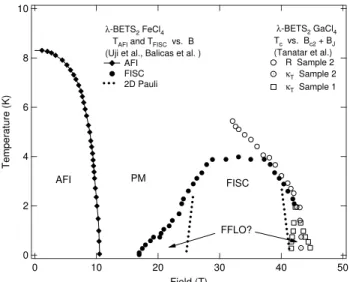
The discovery of magnetic field induced su-perconductivity in λ-(BETS)2FeCl4 [1] (BETS= bis(ethylenedithio)tetraselenafulvalene) has drawn attention to theπ−delectron spin exchange mechanisms[2] in molec-ular systems where magnetic order in the d electron system strongly influences the behavior of the conductingπ elec-tron system. The magnetic field dependent phase diagram of the λ-(BETS)2FeCl4 material is shown in Fig. 1. For H =0, and below the metal-insulator transition temperature (TM I = 8.3K),λ-(BETS)2FeCl4enters a highly insulating antiferromagnetic (AFI) phase[3]. BelowTM I, a spin-flop
transition to a canted antiferromagnetic (CAF) phase occurs near 1 T, and above 11 T, a paramagnetic metallic (PM) phase appears.
At higher magnetic fields , field induced superconduc-tivity (FISC) is stabilized in λ-(BETS)2FeCl4 below 5 K between 18 and 45 T[1, 4]. The FISC state involves the can-cellation of the exchange fieldBJby the external magnetic
fieldBext, i.e. the effective internal field in the conduction
electron layer isBef f = Bext− |BJ|( i.e. the
Jaccarino-Peter or J-P effect[5, 6], where for theπ−ddiscussed here,
BJ is negative.). Although the AFI-PM transition is nearly
independent of field direction, the PM-FISC transition re-quires careful alignment of the field in the a-cmolecular planes to avoid orbital dissipation in the superconducting phase. Recently a similar FISC state has been reported in
κ-(BETS)2FeBr4by Tanatar and co-workers.[11]
The more generalλ-(BETS)2FexGa1−xBryCl4−y class
of organic conductors, with localized magnetic moments at the anion sites, and conduction electrons in the molecular-cation layers, exhibit competition between magnetic, metal-lic, insulating, and superconducting ground states. This is exemplified in Fig. 2a and 2 b where we show the zero field ground state phases for theλ-(BETS)2FexGa1−xCl4[8] and
λ-(BETS)2FeBryCl4−y[9] series, respectively.
10
8
6
4
2
0
Temperature (K)
50 40
30 20
10 0
Field (T)
AFI FISC
λ-BETS2 GaCl4 Tc vs. Bc2 + BJ
(Tanatar et al.) R Sample 2
κT Sample 2
κT Sample 1
λ-BETS2 FeCl4
TAFI and TFISC vs. B
(Uji et al., Balicas et al. ) AFI
FISC 2D Pauli
PM
FFLO?
Figure 1. Magnetic field-dependent ground states of λ -(BETS)2FeCl4for B//c-axis. The three main phases identified are the antiferromagnetic insulating (AFI), parmagnetic metal (PM), and the field induced superconducting (FISC) state. A spin-flop transition (not shown) occurs at about 1.2 T.[3] Solid symbols are determined from magnetoresitance data on a number of different samples from Refs. [1, 13, 4]. The dashed lines represent the ex-pected FISC-PM phase boundary based on a standard 2D Pauli-limited upper critical field. Open symbols represent the upper crit-ical field of λ-(BETS)2GaCl4from resistance and thermal con-ductivity studies on two samples from Ref. [11]. Note that, for comparison of the two different systems, the upper critical field of theλ-(BETS)2GaCl4has been shifted by theλ-(BETS)2FeCl4 ex-change fieldBJ= 32 T. See text for discussion.
from Shubnikov-de Haas (SdH) frequency F, measured for B//b-axis[12]. From band structure calculations, there should be only one SdH frequency, characteristic of a sin-gle closed orbit. However, F showed a Fe-concentration dependent splitting. From a simple spin-spitting argument, ∆F = gmef f/4m0BJ, for x=1, where ∆F= 128 T,
mef f/m0 = 4, and g = 2, the exchange field isBJ = 32 T. Remarkably,BJ depended linearly on the Fe concentra-tion, and extrapolated to zero for x = 0. The connection between the λ-(BETS)2GaCl4 and the λ-(BETS)2FeCl4 , and how the exchange field could be “tuned” from zero to its maximum value was conclusively demonstrated in a sys-tematic investigation[13] ofλ-(BETS)2FexGa1
−xCl4 , the
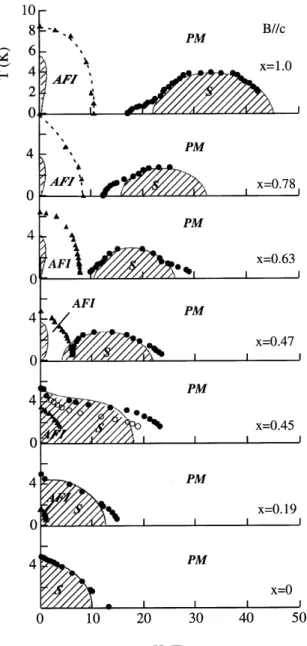
results of which are shown in Fig. 3. Here, for decreasing Fe concentration, the FISC state evolves smoothly into the
λ-(BETS)2GaCl4superconducting phase. As shown in the figure, a phenomenological model by Fischeret al.[6] gives a good fit to the results. Unlike the case for the Chevrel phases, the AFI phase replaces the B = 0 superconducting phase. However, a recent investigation at low pressures (1 kbar or less) shows a small superconducting pocket near zero field[14, 15] very similar to that depicted in Fig. 3. Hence small pressures may stabilize the “hidden S phase”.
Another remarkable aspect of the concentration depen-dence in Fig. 3 is the merging of the AFI, PM, and FISC phases near x = 0.47 for T−→ 0. This suggests the
pos-sibility of a quantum “tri-critical” point in the event that the transitions were found to be second order, for fine tuning of x (and maybe also pressure) in this region. For larger values of x, there is no PM intervening state, and the AFI and FISC phases are connected along a single phase boundary.
The relatively simple J-P picture given above for the mechanism of field induced superconductivity in the
λ-(BETS)2FexGa1
−xCl4 system is only one part of a
more complex low temperature ground state. For λ -(BETS)2FeCl4 , the metal insulating transition TM I in-volves an apparently coincident antiferromagnetic ordering and a Peierls transition, which, due to the correlated nature of theπ−dsystem, gives rise to a highly insulating phase where the resistivity increases by 6 or more orders of mag-nitude at low temperatures. It was discovered[9] that by al-loying on theCl1−yBrysite, these two transitions separate above y = 0.3, as indicated in Fig. 2 above. Here the the AFI transition, detected by susceptibility, appears below the resistive metal-insulating transition. Work is presently un-derway to examine the effects of finite y on the FISC state forλ-(BETS)2FeBryCl4−ywhere the Peierls and AF transi-tions are separated.[20]
1
2 4 6
10
2 4 6
100
2
Temperature (K)
1.0 0.8 0.6 0.4 0.2 0.0
Bromine content y
Metal
Nonmetal
Peierls Ins.
AFI
λ-BETS2FeBryCl4-y
b)
8
6
4
2
Temperature (K)
1.0 0.8 0.6 0.4 0.2 0.0
Iron content x
λ-BETS2FexGa1-xCl4
Metal
AFI SC
a)
Figure 2. a) Zero field phase diagram of λ
-(BETS)2FexGa1−xCl4(after Ref.[8]) b) Zero field phase diagram
Figure 3. Evolution of AFI, PM, and FISC (S) ground states inλ
-(BETS)2FexGa1−xCl4for decreasing Fe concentrationx. Shaded
areas are theoretical superconducting phases predicted from the J-P model. See Ref. [13] for detailed discussion.
For magnetic fields aligned exactly in the conducting plane of a low-D superconductor, a Fulde-Ferrell-Larkin-Ovchinnikov (FFLO) ground state has been predicted.[16, 17] Under field alignment, there is no orbital, but only Zee-man effects, which will split the conduction band. In 1-D, in high enough magnetic fields, it is rigorous that singlet pair-ing with finite q-values gives a FFLO ground state, which is lower in energy than either the BCS or the normal state which are allowed for finite 2D dispersion. Hence the pre-diction is that the FFLO will appear for T→0 between the regular BCS phase at lower fields and the normal state at higher fields. This result has been extended to 1-D + small 2-D dispersion[18], but as the dimensionality increases, the FFLO will be suppressed. The FFLO is termed “inhomo-geneous” since the order parameter will oscillate from
max-imum to zero with a period of the order of the coherence length. Hence impurities and mean free path effects will influence the FFLO state. There is some indication thatλ -(BETS)2GaCl4may exhibit the FFLO state, based on recent thermal conductivity measurements [11] which show bifur-cation of the upper critical field for T→0. Moreover, the FISC state in λ-(BETS)2FeCl4 shows, based on transport measurements, “wings” for T→0 where±Bef fapproaches
the two upper critical field lines. These features (wings) also appear in the alloy data in Fig. 3. This has motivated recent theoretical work which has considered the FFLO scenario forλ-(BETS)2FeCl4 , where the theory has been extended to include the effective field by Houzetet al.[21] In addition, Shimahara [22] has extended the treatment to allow both singlet and triplet pairing terms, which may be relevant in the case ofλ-(BETS)2FeCl4since there is a profound prox-imity of magnetism. It is noteworthy that from the Dingle analysis, the mean free path inλ-(BETS)2FeCl4 can be as large as 100 nm, or about an order of magnitude larger than the coherence length inλ-(BETS)2GaCl4(of order 10 nm), and hence the system is in the clean limit.[13] Although the comparison between experiment and theory is compelling, further work is needed to demonstrate the FFLO state con-vincingly in these materials. This is in part due to the quasi-two dimensional nature of the system, which complicates the more robust theoretical result obtained from a quasi-one dimensional approach to the FFLO ground state. (See also Ref. [13] for more detailed discussion.)
2 3 4 5 6 7 8
-1.0 -0.5 0.0 0.5 1.0 1.5
0 100 200 300 -30
-20 -10 0 10 20 30
Sc
(
µ
V/K)
T (K) 0 T
10 T 15 T 20 T 25 T 30 T
S
c (∆T || c-axis)
S
a (∆T || a-axis)
S (
µ
V/K)
T (K)
Figure 4. Magnetothermopower vs. temperature for λ
-(BETS)2FeCl4for different fields below and above the FISC. The
field direction and∆T are along the c-axis. Inset: zero field
ther-mopower for two crystallographic directions.
further explore the nature of the FISC state, we have car-ried out magneto-thermoelectric power[23, 24, 25] and also mm wave-type investigations at high fields. In Fig. 4 we show the temperature dependence of the c-axis thermopower for λ-(BETS)2FeCl4 for different fields. For fields in the FISC regime, the thermopower approaches zero below the PM-FISC phase boundary. In addition, the zero field ther-mopower shown in the inset shows the anisotropy of the Fermi surface, where, for the a-axis, the thermal gradient is in the direction of the hole orbits, and for the c-axis, it is directed normal to the open-orbit electron bands. Fig. 5 the field dependence for different temperatures is given. Here the thermopower again goes to zero in the FISC phase. Since the metallic thermopower is also vanishing for T→0, the PM-FISC transition becomes less pronounced with de-creasing temperature. A phase diagram, based on the ther-mopower studies (for x = 1→FISC and AFI and x = 0.8→ AFI) is shown in Fig. 7 below. The important result of this study is that, as expected for a superconducting transition, the thermopower goes to zero below Tc. Hence this
pro-vides, additional confirmation, beyond resistance measure-ments, that the FISC is indeed a superconducting ground state.
15 20 25 30
-2 -1
0 0.0
0.0 0.0 0.0 offset along y-axis
S c
(
µ
V/K)
Field (T)
1.0 K 1.3 K 2.0 K 3.0 K
Figure 5. Magnetothermopower forλ-(BETS)2FeCl4vs. field at
different temperatures below the FISC transition. The field direc-tion and∆T are along the c-axis. Arrows indicate the PM-FISC
boundary.
High field microwave studies have also been carried out vs. field and temperature up to 30 T to explore the nature of both the AFI and FISC states.[26] An example of the re-sponse of a perturbative cavity probe[27] at 66.76 GHz is shown in Fig. 6. Here the c-axis of the sample is aligned with the field, but theEacandHaccomponents of the
elec-tromagnetic resonant fields are mixed. At low fields, the ESR ,(and for H // a-axis AFMR) resonances are observed. At higher fields, since the sample resistance decreases from an essentially insulating state to a metallic state as the field removes the AFI, the electromagnetic response passes from a depolarization to a skin-depth limited behavior, and the large dip is the so-called depolarization peak (DP). The temperature-field dependence of the depolarization behav-ior below AFI is shown in Fig. 7. Above the DP, but below
the AFI-PM boundary, we observe additional structure in the signal, which we believe to arise from metastable states in the AFI phase. Finally, where the FISC state is stabilized, we find very little difference in the signal. Since the resis-tive transitions into the FISC are relaresis-tively broad, the change in the microwave signal may not be expected to be abrupt. However, systematic, higher field experiments are necessary to fully explore the mm wave behavior in the FISC state.
80
40
0
∆
f/f 10
-6
λ-BETS2FeCl4
T = 0.9 K 66.76 GHz H//c
0.32
0.30
0.28
amp (arb. units)
30
25
20
15
10
5
0
µ
0H (T)
a)
b)
ESRDepolarization Structure
FISC?
Figure 6. a) Frequency and b) amplitude response of mm wave cavity forλ-(BETS)2FeCl4at 66.7 GHz vs. field at 0.9 K.
0 5 10 15 20 25 30 35 0
2 4 6 8
DP
FISC
AFI
M
T (K)
Field (T)
x=1, H-sweep x=1, T-sweep x=0.8, T-sweep
Figure 7. AFI and FISC phase boundaries determined from magne-tothermopower measurements[25] (solid symbols) and behavior of the depolarization peak within the AFI from mm wave studies[26] (dashed line).
In summary, the λ-(BETS)2FexGa1−xBryCl4−y class
phases are non-trival due to theπ−dnature of the system. The anisotropic, low dimensional nature gives additional complexity, and novel high field superconducting ground states, such as FFLO and/or other unusual pairing mecha-nisms cannot be ruled out at this point. Even in spite of this, the connection between the pure λ-(BETS)2FeCl4 FISC phase and theλ-(BETS)2GaCl42-D superconductor phase, and how theπ−dexchange field can be tuned from the one extreme to the other, all in the context of the J-P model, is truly remarkable. There are still some very important exper-iments left to do in the FISC state, including specific heat, vortex dynamics, high field ESR on theπelectron system to check the behavior ofBef f[28], and higher field
trans-port above 42 T to firm up our understanding of the upper critical field behavior in the low temperature region.
Acknowledgments
We would like to thank K. Yang for helpful discus-sions. This work is supported by NSF-DMR 02-03532. The NHMFL is supported by a contractual agreement between the NSF and the State of Florida.
References
[1] S. Uji, H. Shinagawa, C. Terakura, T. Terashima, T. Yakabe, et al., Nature410, 908 (2001).
[2] T. Mori and M. Katsuhara, J. Phys. Soc. Japan71, 826 (2002).
[3] L. Brossard, R. Clerac, C. Coulon, M. Tokumoto, T. Ziman, D. K. Petrov, V. N. Laukhin, M. J. Naughton, A. Audouard, F. Goze, A. Kobayashi, H. Kobayashi, and P. Cassoux, Eur. Phys. J. B1, 439 (1998).
[4] L. Balicas, J.S. Brooks, K. Storr, S. Uji, M. Tokumoto, H. Tanaka, H. Kobayashi, A. Kobayashi, V. Barzykin, L.P. Gor’kov, Phys. Rev. Lett.87, 067002 (2001).
[5] V. Jaccarino and M. Peter, Phys. Rev. Lett.9, 290 (1962).
[6] Ø. Fischer, H. W. Meul, M. G. Karkut, G. Remenyi, U. Welp and J. C. Piccoche, Phys. Rev. Lett.55, 2972 (1985).
[7] M. A. Tanatar, M. Suzuki, T. Ishiguro, H. Tanaka, H. Fuji-wara and H. Kobayashi, Physica C: Superconductivity, 388-389, 613 (2003).
[8] H. Tanaka, H. Kobayashi, A. Kobayashi and P. Cassoux, Ad-vanced Materials12, 1685 (2000), and references therein.
[9] H. Akutsu, K. Kato, E. Ojima, H. Kobayashi, H. Tanaka, A. Kobayashi , P. Cassoux, Phys. Rev. B.58, 9294 (1998).
[10] A.G. Lebed and K. Yamaji, Phys. Rev. Lett.80, 2697 (1998).
[11] M. A. Tanatar, M. Suzuki, T. Ishiguro, H. Tanaka, H. Fuji-wara and H. Kobayashi, T. Toito and J. Yamada, Synth. Met. 137, 1291 (2003).
[12] S. Uji, H. Shinagawa, C. Terakura, T. Terashima, T. Yak-abe, Y. Terai, M. Tokumoto, A. Kobayashi, H. Tanaka and H. Kobayashi, Phys. Rev. B64, 024531/5 (2001).
[13] S. Uji, C. Terakura, T. Terashima, T. Yakabe, Y. Terai, Y. Imanaka, S. Yasuzuka, M. Tokumoto, F. Sakai, A. Kobayashi, H. Tanaka, H. Kobayashi, L. Balicas and J. S. Brooks, J. Phys. Soc. Japan72, 369 (2003).
[14] J.S. Brooks, L. Balicas, K.A. Storr, H. Kobayashi, H. Tanaka, A. Kobayashi, S. Uji, and M. Tokumoto, Synth. Met. 133-134, 485 (2003).
[15] L. Balicas, J.S. Brooks, K. Storr, S. Uji, M. Tokumoto, H. Tanaka, H. Kobayashi, A. Kobayashi, V. Barzykin, L.P. Gor’kov, Int. J. Mod. Phys. B16(20-22), 3101 (2000).
[16] P. Fulde and R.A. Ferrell, Phys. Rev.135A550 (1964).
[17] A.I. Larkin and Y.N. Ovchinnikov, Sov. Phys. JETP20, 762 (1965).
[18] K. Yang, Phys. Rev. B63, 140511 (2001).
[19] E. Negishi, H. Uozaki, Y. Ishizaki, H. Tsuchiya, S. Endo, Y. Abe, H. Matsui, and N. Toyota, Synth. Met. 9439 (2002).
[20] S. Uji et al., to be published.
[21] M. Houzet, A. Buzdin, L. Bulaevskii and M. Maley, Phys. Rev. Lett.88, 227001/4 (2002).
[22] H. Shimahara, J. Phys. Soc. Japan71, 1644 (2002).
[23] E. S. Choi, J. S. Brooks, J. S. Qualls, et al., Rev. Sci. Instrum. 72, 2392 (2001)
[24] E. S. Choi, J. S. Brooks, and J. S. Qualls, Phys. Rev. B65, 205119 (2002).
[25] E.S. Choi et al., to be published.
[26] I.Rutel, S. Okubo, J. Brooks, E. Jobiliong, H. Kobayashi, A. Kobayashi , and H. Tanaka, cond-mat/0207747 and to be pub-lished.
[27] S. Hill, N. S. Dalal and J. S. Brooks, Applied Magnetic Res-onance16, 237 (1999).
![Figure 7. AFI and FISC phase boundaries determined from magne- magne-tothermopower measurements[25] (solid symbols) and behavior of the depolarization peak within the AFI from mm wave studies[26]](https://thumb-eu.123doks.com/thumbv2/123dok_br/18979732.456589/4.892.481.822.647.932/figure-boundaries-determined-tothermopower-measurements-symbols-behavior-depolarization.webp)
