664 Brazilian Journal of Physics, vol. 33, no. 4, December, 2003
The Kosztin-Leggett Nonlocal Effect on the Magnetic
Penetration Depth in Superconductors with Nodes in the Gap
Ismardo Bonalde
Centro de F´ısica, Instituto Venezolano de Investigaciones Cient´ıficas, Apartado 21874, Caracas 1020-A, Venezuela
Received on 1st July, 2003.
The effect of nonlocal electrodynamics is considered in finite samples. It is found for such samples that non-locality modifies not only the in-plane penetration depthλk, as predicted by Kosztin and Leggett, but also the out-of-plane penetration depthλ⊥. The Sr2RuO4 data are reinterpreted taking into account the contribution
fromλ⊥.
1
Introduction
Penetration depth measurements have played a very fdamental role in the study of the gap symmetry of all un-conventional superconductors. For instance, from magnetic penetration depth measurements it was first suggested thed -wave symmetry for the energy gap in high critical tempera-ture superconductors (HTSC) [1]. It is expected that, for su-perconducting energy gaps with nodes on the Fermi surface, the deviation of the magnetic penetration depthλ(T)from its zero temperature value goes as a power law in tempera-ture,∆λ(T) =λ(T)−λ(0)∝Tα
, at temperatures well be-low the critical temperatureTc. The exponentαdepends on gap geometry, dimensionality and the rate at which the gap vanishes near the zeroes. For line nodes in three dimensional systems, like those with ad-wave symmetry, ∆λ(T) ∝T
(the same conclusion holds for point nodes in two dimen-sional systems). In these systems, however, the penetration depth has been found in some cases to cross over from lin-ear to quadratic temperature dependence at a temperature
T∗ << T
c. Such a crossover has been explained theoret-ically as due to impurities [2] or nonlocal electrodynamics [3].
The impurity model considers that a dilute concentration of strong scatterers in the unitary limit in unconventional su-perconductors with line nodes causes a finite residual den-sity of states near the nodes and negligible suppression of
Tc. Thus, asT → 0a ”gapless” temperature behavior [4]
∆λ(T) ∝ T2 should be expected for such
superconduc-tors, and the crossover in ∆λ(T) is predicted to occur at
T∗ ∼ √Γ∆
0. Here, Γis the scattering rate and∆0is the
energy gap maximum. The nonlocal model supposes that the local condition λ(0)/ξ0 >> 1, for which the spatial
variation of the electromagnetic field over the extent of the Cooper pair is neglected and the pair is taken as a point ob-ject, is not satisfied at temperatures well belowTc in most unconventional superconductors. Hereξ0 ≡ ~νF/π∆0 is the BCS coherence length. The nonlocal model is based on the fact that in superconductors with an anisotropic energy
gap with nodes on the Fermi surface the coherence length
ξ0(k) = ~νF/π∆(k). Kosztin and Leggett (KL) [3] sug-gested for the local condition
λ(0)
ξ0(k)
=λ(0)
ξ0
|∆(k)| ∆0
>>1, (1)
Thus near the nodes, where∆(k)→0, the local condition would no longer hold, and the superconductor would be-come nonlocal. KL predicted for very clean, semi-infinite superconductors with line nodes that nonlocal electrody-namics would affect the magnetic penetration depth only when the exciting field is applied perpendicular to the ab
plane; that is to say, only λk(T) would be perturbed by nonlocality. They proposed that ∆λk(T) ∝ T2 below a
T∗
N L= ∆0ξ0/λ(0)<< Tc.
The impurity effect has been confirmed in Zn-doped YBCO [5] and has been used to explain data from organic superconductors [6] and various HTSC [7]. On the other hand, the KL nonlocal effect has been difficult to prove, and only recently some evidence for its existence has been ob-tained. The importance of testing experimentally the valid-ity of the KL effect is because it would provide a mech-anism for the observed crossover from linear to quadratic temperature dependence of the magnetic penetration depth in very clean (impurity effect unapplicable) superconduc-tors with nodes in the energy gap. Here the KL nonlocal effect is discussed in finite superconductors with line nodes. It is found that the out-of-plane component of the penetra-tion depth,λ⊥, is also affected by nonlocality, and not only the in-plane component as predicted by KL. A discussion is given of some experimental results.
2
The Kosztin-Leggett nonlocal effect
Ismardo Bonalde 665
generated in theabplane and one measures the in-plane pen-etration depth λ||(T). When the field is parallel to theab plane the measured signal is a combination of λ|| andλ⊥:
∆λ(T)
λ(0) = λk
t + λ⊥
w . Hereλ⊥, the out-of-plane penetration depth, corresponds to screening currents along the interlayer
c direction. The parameterstandware the thickness and width of the sample, respectively.
To study the effect of nonlocal electrodynamics on the magnetic penetration depth, KL considered a weak, homo-geneous magnetic fieldHapplied along thecaxis of a semi-infinite HTSC with a plane boundary perpendicular to theb
axis (see Fig. 1). For a specular boundary
λ(T)
λ(0) =
2
π
Z ∞
0
dq
K(q, T) +q2, (2)
whereK(q, T)is the response function to a weak, transverse vector potential. For a weak coupling, anisotropic supercon-ductor [3]
K(q, T) = 2πTX
k *
k2
||∆2k p
w2
n+ ∆2k(w2n+ ∆2k+γ2) +
.
(3) Here,wnare the Matsubara frequencies,∆kis the gap func-tion,k2
||is the projection ofkon the plane boundary,h...iis an average over the Fermi surface, andγ = (qνF/2)q·k. The parameterγdetermines the relevance of nonlocal elec-trodynamics: if γ 6= 0 (γ = 0) nonlocality is (not) im-portant. In the current configuration, screening currents are generated only in the planes, and beingγ6= 0KL predicted that ∆λ||(T) ∝ ∆λ||L(T)T at temperatures T < TN L.∗ Here, ∆λ||L is the deviation of the in-plane penetration depth in the local approximation. Thus because∆λ||L ∝T ind-wave superconductors, there should be in such super-conductor a crossover from their characteristic linearT be-havior at low temperatures to a quadraticT dependence at even lower temperatures. On the other hand, if the exciting field is oriented along thebaxis, as shown in Fig. 1, because of the semi-infinite space the only parameter would be again
λ||(T). However, in this caseγ= 0and the in-plane pene-tration depth would not be affected by nonlocality. That is, for this orientation∆λ||(T) = ∆λ||L(T)∝T.
a
b c
H
s j
ˆ
q
ˆ
k
a,c
(
−∞ ∞
,
)
b
( )
0,
∞
Figure 1. Magnetic field penetration and screening currents in a semi-infinite HTSC, as supposed by Kosztin and Leggett.
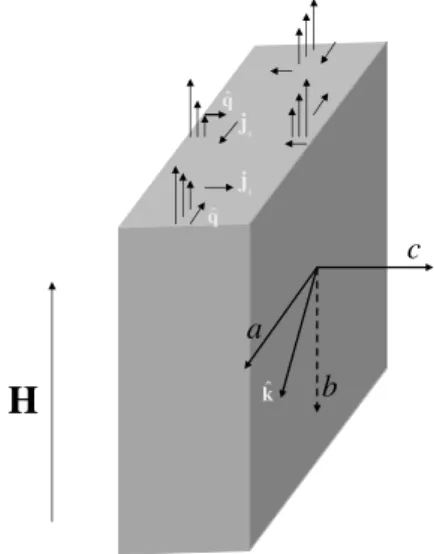
Consider now what happens in finite samples, which were not evaluated by KL. This is a quite important case, because the experimental samples are in fact small. IfH||c, as shown in Fig. 2, the KL prediction for semi-infinite sam-ples in this orientation holds. If H ⊥ c, as indicated in Fig. 3, the prediction would be different from the one stated by KL for semi-infinite samples. In this orientation,∆λ(T)
is a combination of λ||(T) and λ⊥(T), in the way men-tioned above. The deviation of the in-plane penetration depth would follow ∆λ||(T) = ∆λ||L(T) ∝ T, because
γ = 0for screening currents along the plane. Butγ 6= 0
for interlayer currents, so thatλ⊥(T)should be modified by nonlocality. Thus, the statement that the effect of nonlocal electrodynamics is only relevant toλ||(T)is no longer sus-tained in finite samples. Assuming that for an anisotropicd -wave superconductor (or any superconductor with nodes in the gap) the effect of nonlocal electrodynamics on the tem-perature dependence ofλ⊥is similar to that ofλk, one has
∆λ⊥(T)∝∆λ⊥L(T)T at temperaturesT < TN L. It must∗ be pointed out that theT∗
N Lfor the in- and out-of-plane com-ponents should be in general different. This indeed would be the case for anisotropic superconductors.
a b
c
s
j
H
ˆ
q
ˆ
k
(
−∞ ∞
,
)
c
( )
0,
∞
a,b
Figure 2. Magnetic field penetration and screening currents in a semi-infinite HTSC whenH⊥c.
a b c
H
s j
ˆ
k
ˆ
q
ˆ
q
ˆ
q
ˆ
q s
j js
666 Brazilian Journal of Physics, vol. 33, no. 4, December, 2003
a
b c
s
j
H
ˆ
q
ˆ
k
s
j
ˆ
q
Figure 4. Magnetic field penetration and screening currents in a finite superconducting sample whenH⊥c.
3
The Sr
2RuO
4experimental data
Although the KL effect was predicted with HTSC in mind, no studies of it using these superconductors have been re-ported. This is mainly due to limitations on the experimen-tal resolution forλ(T)in HTSC below 1 K (T∗
kN L∼2Kin YBCO for example).
The Sr2RuO4 penetration depth data [8] were the first
showing some evidence for the KL nonlocal effect. These data, taken from samples withTcvery close to the impurity-freeTc = 1.5K, can be reanalyzed by considering the con-tribution of the out-of-plane penetration depth whenH⊥c. It is worth to mention that Sr2RuO4has nodes in the energy
gap, although the exact symmetry of the gap is at the present time highly controversial. This material is a marginal lo-cal superconductor in theab plane, which leads to the ex-pected T∗
kN L ≃ 1 K. Measurements of ∆λk(T) down to 30 mK yielded a quadratic T dependence below 0.8 K, as shown in Fig. 4. When the field was applied perpendicular to thec axis, it was found∆λ(T) ∝T2below 0.8 K (see
Fig. 5). Considering thatλ⊥ ≃20λk, one could suppose that the signal was dominated by the out-of-plane penetra-tion depth. That is,∆λ(T)∼ ∆λ⊥(T) ∝ T2. Assuming that the localλ⊥(T)is linear inT, this result would imply the presence of nonlocal effects. However, using the value
λ⊥(0)/ξ0⊥ = 1123T⊥∗N L = 2.4 mK, which is far below the observed 0.8 K. This suggests that nonlocal effects on the out-of-planeλ(T)in Sr2RuO4should not be observed
in the temperature range of the experiment (T > 30mK). Thus, nonlocal effects may be discarded as a possible expla-nation for theT2 dependence of the magnetic penetration depth of Sr2RuO4.
4
Conclusions
The effect of nonlocal electrodynamics on the magnetic pen-etration depth in superconductors with nodes in the gap has
0,0 0,1 0,2 0,3 0,4 0,5 0,6
0 400 800 1200
∆λ||
( Å )
(T/Tc)2
Figure 5. Low temperature dependence of the in-plane penetration depth in Sr2RuO4. (From Bonaldeet al.[8]).
0,0 0,2 0,4 0,6 0,8 1,0 17,6
17,7 17,8 17,9 18,0 18,1
∆
F⊥
(kHz)
∝
∆λ⊥
T2
( K2
)
Figure 6. Low temperature dependence of the penetration depth in Sr2RuO4whenH⊥c.
been revised for finite samples. It is found that not only the in-plane penetration depthλk(T)is affected by nonlocal electrodynamics, but also the out-of-plane penetration depth
λ⊥(T). However, the temperature at which the nonlocal ef-fect should be detected inλ⊥(T)could be much smaller than the one expected forλk(T).
References
[1] W. N. Hardy, D. A. Bonn, D. C. Morgan, R. Liang, and K. Zhang, Phys. Rev. Lett.70, 3999 (1993).
[2] P. J. Hirschfeld and N. Goldenfeld, Phys. Rev. B48, 4219 (1993).
[3] I. Kosztin and A. J. Leggett, Phys. Rev. Lett.79, 135 (1997).
[4] F. Gross, B. S. Chandrasekhar, D. Eizel, K. Andres, P. J. Hirschfeld, H. R. Ott, J. Beuers, Z. Fisk, and J. L. Smith, Z. Phys. B64, 175 (1986).
[5] D. A. Bonn, S. Kamal, K. Zhang, R. Liang, D. J. Baar, E. Klein, and W. N. Hardy, Phys. Rev. B50, 4051 (1994).
[6] A. Carrington, I. Bonalde, R. Prozorov, R. W. Giannetta, A. M. Kini, J. Schlueter, H. H. Wang, U. Geiser, and J. M. Williams, Phys. Rev. Lett.83, 4172 (1999).
[7] T. Xiang, C. Panagopoulos, and J. R. Cooper, Int. J. Mod. Phys. B12, 1007 (1998).