Brazilian Journal of Physics, vol. 35, no. 3B, September, 2005 835
New Low-Energy Levels Calculation for
155
Eu
F. A. Genezini, C. B. Zamboni,
Centro Regional de Ciˆencias Nucleares-CRCN/CNEN-PE
J. Mesa, and M. T. F. da Cruz
Instituto de F´ısica da Universidade de S˜ao Paulo-IFUSP
Received on 8 June, 2005
We have revisited the low-energy calculation of oddZ155Eu in the frame of a semi-microscopic formalism as a support for the interpretation of the experimental results for the multipole mixing ratios of some electromag-netic transitions. The deformation parameters were obtained through a macroscopic-microscopic method, and the proton single particle levels, calculated with realistic Woods-Saxon potential were used as input in a quasi-particle calculation of the first few rotational band heads in the Lipkin-Nogami BCS aproximation. A better agreement is found between the experimental and calculated band heads if compared with previous evaluations and RIPL recommended values.
This work is a theoretical support for the interpretation of the experimental results for the multipole mixing ratios of ob-served electromagnetic transitions between low-energy levels in155Eu [1]. In order to explain the experimental results, it was necessary to calculate the energy, angular momentum and parity of the first excited states (E≤1MeV). Due to the fact that the parameters in the potential energy are determined for several nuclei and not for a specific one, the previous calcula-tion was not successful in the descripcalcula-tion of the first excited states. For example, in the work of Nazarewicz et al. [2], the energy of the ground state of155Eu differs from the expec-ted value. In addition, when the parameterization proposed by Cwiok et al. [3] is used, it is found that the energy of the single particle states are in disagreement with the literature values. The IAEA RIPL Database recommended single parti-cle levels for protons obtained with the Finite Range Droplet Model (FRDM) [4] and Hartree-Fock–BCS model [5] do not describe even the ground state angular momentum and parity. In this work, a new calculation of the ground-state and the low-energy levels in155Eu is proposed, using the macroscopic
-microscopic method [6]. In this sense, the odd-proton single particle levels in a deformed potential plus residual pairing interaction were calculated in order to describe the155Eu low-energy rotational band heads (with E≤1 MeV). The ground-state deformation parameters were obtained by minimizing the total energy [6]; the single particle energy spectra and wave functions for protons and neutrons were calculated in a deformed Woods-Saxon potential [7]. The parameters of the potential for neutrons were obtained from Ref. [8]. For pro-tons, these parameters were adjusted in order to adequately describe the main sequence of angular momentum and parity of the low energy excited levels (band heads), as well as the proton binding energy. The residual pairing interaction was considered in the BCS prescription using the Lipkin-Nogami approximation [9, 10].
I. NUCLEAR DEFORMATION
Within the macroscopic-microscopic method in the Stru-tinskys formalism, the total energy of the nuclear system as a function of deformation can be expressed as [6]:
Etot(ε,α) = Emacr(ε,α) +Emicr(ε,α) (1) whereεandαare the set of deformation parameters.
The bulk contribution to the total energy comes from the liquid drop model. The shell effects represent smaller varia-tions added to the liquid drop energy Emacr. The microscopic portionEmicr can be divided into two components: the con-tribution associated with the shell correction energy and the pairing contribution. In order to obtain the equilibrium defor-mation parameters (ground-state defordefor-mation) the total energy is minimized. As the Cassini ovaloid shape parameterization was used, the adopted deformation parameters were the qua-drupole moment term (ε) and the hexadecapole moment term (α4) [6]. The calculated total energy is plotted in Figure 1, as
a function of deformation parameters. It is important to note that the obtained parametersε=0.23 andα4=0.030 are in
good agreement with their equivalents in other nuclear shape parameterizations, reported in previous works [11, 12].
II. SINGLE PARTICLE ENERGIES
The single particle states were calculated using the Woods-Saxon (W-S) potential. To determine the W-S potential, twelve constants should be provided: six for protons and six for neutrons.
V0= depth of the central potential,
aso= diffuseness parameter of the spin-orbit part,
R0= radius parameter,
r0−so= radius parameter of the spin-orbit potential,
836 F. A. Genezini et al.
0 .0 0 0 .0 5 0 .1 0 0 .1 5 0 .2 0 0 .2 5 0 .3 0 0 .3 5 0 .4 0 0 .4 5 -0 .1 0
-0 .0 5 0 .0 0 0 .0 5 0 .1 0 0 .1 5 0 .2 0 0 .2 5 0 .3 0
ε α4
FIG. 1: Equilibrium deformation parameters obtained from macroscopic-microscopic model.
Several parameter sets have been proposed for the Woods-Saxon potential, usually determined through a global fit to va-rious ground state nuclear properties of severalβ-stable nuclei in a mass number range.
The Woods-Saxon potential consists of the central part Vcent, the spin-orbit partVsoand the Coulomb potentialVCoul for the protons:
Vws(r,z,ε,α) =
Vcent(r,z,ε,α) +Vso(r,z,ε,α) +V Coul(r,z,ε,α) (2)
where(r,z)are cylindrical coordinates.
The central part is defined in order to describe the density distribution function
Vcent(r,z,ε,α) =
V0
1+edist(r,z,aε,α)
(3)
wheredistis equal to the distance of a given point to the nu-clear surface
The depth of the central potential is parameterized by:
V0=V0[1±0.63(N−Z)/(N+Z)] (4)
with positive signal for protons and negative for neutrons. The spin-orbit term is defined by
Vso(r,z,ε,α) = λ
h 2Mc
2
∇V(r,z,ε,α)( −→σ× −→p) (5)
whereMis the nucleonic mass, the vector operator−→σ stands for the Pauli matrices and−→p is the linear momentum operator. The Coulomb potential is assumed to be that corresponding to the nuclear charge(Z−1)e, and uniformly distributed in-side the nucleus.
In order to diagonalize the Hamiltonian, the eigenfunctions of the axially-symmetric harmonic oscillator in the cylindrical coordinates were used:
nρnzΛΣ
=ΨΛnρ(ρ)Ψnz(z)ΨΛ(ϕ)χ(Σ) (6)
where
ΨΛ(ϕ) = √1
2e iΛϕ
Ψnz(z) = Nnz
Mω
z
1/4
e−ξ2/2Hnz(ξ)
ΨΛnρ(ρ) = NnΛρ
2Mω⊥
1/4
ηΛ/2e−η/2LΛ
nρ(η)
n⊥ = 2nρ+Λ
Here,nz−1 andn⊥−1 are the number of nodes of the basis functions in thez-direction and ther-direction, respectively; Λ andΣ are the projections of the orbital and spin angular momenta on the symmetry axis, respectively. In the above equations,
η1/2
≡
Mω⊥
r, (7)
ξ ≡
Mωz
z, (8)
Nnz ≡ π2nznz!
−1/2
, (9)
NnΛρ ≡
nρ!
nρ+Λ (10)
The energy of a given basis state is given by
Enρ,nz,Λ=
nz+ 1 2
ωz+ (n
⊥+1)ω⊥ (11)
The parameters of Woods-Saxon (W-S) potential for neu-trons were obtained from ref. [7], and for protons they were adjusted in order to describe the main sequence of angular momentum and parity of the low energy single particle states, as well as the proton binding energy of155Eu. The values ob-tained are compared with those from Cwiok et al. [3], called Universal (see Table 1). We can notice that the main diffe-rence is in the spin-orbit coupling parameter, which in our result is almost a half of the universal one.
Brazilian Journal of Physics, vol. 35, no. 3B, September, 2005 837
V0(MeV) r0(fm) a(fm) r0−so(fm) aso(fm) λ
Present Work 51.5 1.258 0.61 1.14 0.61 19.8 Universal 49.6 1.275 0.70 1.32 0.7 36.0
TABLE I: Parameters of W-S potential
FIG. 2: Proton single particle energies of155Eu obtained from diffe-rent formalisms.
HF-BCS [5] models and Cwiok et al. [3] calculations. As we can see, the recommended RIPL single particle energy and spin of Fermi level are in a total disagreement with the expe-rimental values of ground state spin and parity. For the Uni-versal parameters of Cwiok they are very well reproduced, but the gap between the ground state and the first excited single-proton level is underestimated.
III. QUASI-PARTICLE STATES
The pairing energy was evaluated in the usual prescription of the BCS approach. The Hamiltonian operator in the BCS model contains two parts: the first, ˆHsp, corresponding to the single particle states and the second ˆHpaircorresponding to the pairing interaction. If the single particle term is diagonal, the BCS operator can be written in the formalism of the second quantization as
ˆ
H=Hˆsp+Hˆpair=
∑
εΩi(a†
iai+a
† ¯
ıa¯ı)−
∑
Gjia†ja†ja¯ıai(12)
wereεΩi is the single-particle energy of leveliandGis the pairing strength between orbitals j and i. In the monopole pairing approximation, all the two-body matrix elementsGji, are taken to be equal to a singleG.
The pairing interaction was taken into account by applying the BCS theory in the Lipkin-Nogami approximation to each
configuration. All residual interactions except pairing are ne-glected.
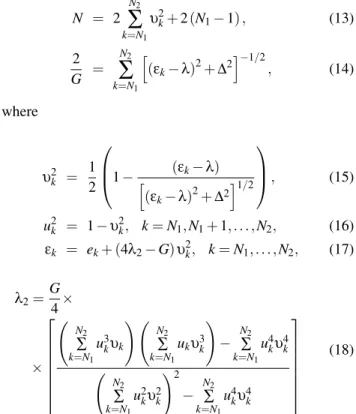
According to each generated configuration, in the Lipkin-Nogami approximation the pairing gap ∆, Fermi energyλ, number fluctuation constantλ2, occupation probabilitiesυ2k , and shifted single-particle energiesεk are determined from the 2×(N2−N1) +5 coupled nonlinear equations for protons
and neutrons:
N = 2 N2
∑
k=N1
υ2
k+2(N1−1), (13)
2
G =
N2
∑
k=N1
(εk−λ)2+∆2
−1/2
, (14)
where
υ2
k = 1 2
1− (εk−λ) (εk−λ)2+∆2
1/2
, (15)
u2k = 1−υ2k, k=N1,N1+1, . . . ,N2, (16)
εk = ek+ (4λ2−G)υ2k, k=N1, . . . ,N2, (17)
λ2=
G 4×
×
N2
∑
k=N1
u3kυk N2
∑
k=N1
ukυ3k
−
N2
∑
k=N1
u4kυ4k
N2
∑
k=N1
u2
kυ2k
2
−
N2
∑
k=N1
u4
kυ4k
(18)
andekare the known single particle energies.
The total configuration energy, according to the model, is
Ek= (εk−λ)2+∆2
1/2
−λ2, ,k=N1,N1+1, . . . ,N2.
(19) The parity of this state is defined as
π=
N2
∏
k=1
πk. (20)
As the system of equations is solved separatelly for protons (Z)and neutrons(N), all the combinations with the following energies and quantum numbers are accounted for the nuclear system:
EKπ = EΩπ(Z) +EΩπ(N), (21)
K = Ω(Z)±Ω(N), (22)
π = π(Z)π(N). (23)
838 F. A. Genezini et al.
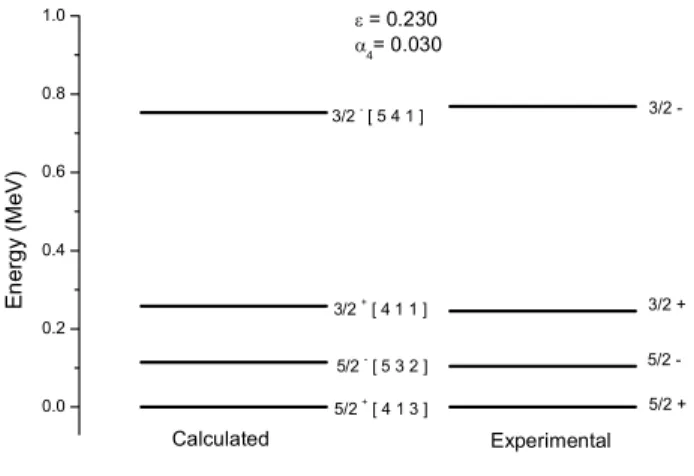
FIG. 3: Calculated and experimental band heads of155Eu .
The excitation energy is, on the other hand, calculated as the difference between the total energy of a configuration and the total energy of the ground state, where the first summation includes only blocked orbitals. Using the previously
calcu-lated proton single particle energies and spins, the rotational band heads are obtained, and are shown in Figure 3. As we can see, there exists a remarkable agreement between experi-mental and theoretical levels.
IV. CONCLUSIONS
We have calculated in a very successful way the excitation energy of the rotational band heads, with their spin and parity, for the nucleus155Eu, by using the macroscopic-microscopic method combined with residual pairing interaction in the BCS prescription using the Lipkin-Nogami approximation [9, 10]. We have also obtained a better set of parameters for the Woods-Saxon proton single particle potential of155Eu as well as the deformation parameters in a Cassinian ovals parametri-zation.
Acknowledgments
This work was partially supported by CNPq and FAPESP.
[1] F. A. Genezini et al., Braz. Jour. Phys.,34, 722 (2004). [2] W. Nazarewicz, M. A. Riley, and J. D. Garrett, Nucl. Phys. A
512, 61 (1990).
[3] S. Cwiok et al. , Comput. Phys. Commun.46, 379 (1987). [4] W. D. Myers and W. J. Swiatecki, Ann. Phys.55, 395 (1969). [5] S. Goriely, F. Tondeur, and J. M. A. Pearson, At. Data and Nucl.
Data Tables77, 311 ( 2001).
[6] F. Garcia, O Rodriguez, J. Mesa, J. D. T. Arruda-Neto, V. P. Likhachev, E. Garrote, R. Capote, and F. Guzman, Comput. Phys. Commun.120, 57 (1999).
[7] F. Garcia, E. Garrote, M. L. Yoneama, J. D. T. Arruda-Neto, J. Mesa, F. Bringas, J. F. Dias, V. P. Likhachev, O. Rodriguez, and F. Guzman, Eur. Phys. J. A6,49 (1999).
[8] Z. Lojewski, B. Nerlo-Pomorska, K. Pomorski, and J. Dudek, Phys.Rev. C51, 601 (1995).
[9] F. Garcia, O. Rodriguez, V. A. Rubchenya, and E. Garrote, Comput. Phys. Commun.86, 129 (1995).
[10] O. Rodriguez, F. Garcia, H. Dias, J. Mesa, J. D. T. Arruda-Neto, E. Garrote, and F. Guzman, Comput. Phys. Commun.137, 405 (2001).
[11] P. Moller, J. R. Nix, W. D. Myers, and W.J. Swiatecki, At. Data Nucl. Data Tables59, 185 (1995).