QUALI TY OF SLEEP I N POSTOPERATI VE SURGI CAL ONCOLOGI C PATI ENTS
1Elizabet h Barichello2
Nam ie Okino Sawada3
Helena Megum i Sonobe3
Márcia Maria Font ão Zago3
Bar ichello E, Sawada NO, Sonobe HM, Zago MMF. Qualit y of sleep in post oper at ive sur gical oncologic pat ient s. Rev Lat ino- am Enfer m agem 2009 j ulho- agost o; 17( 4) : 481- 8.
This st udy aim ed t o evaluat e surgical- oncologic pat ient s’ qualit y of sleep t hrough t he Pit t sburgh Sleep Qualit y I ndex ( PSQI ) questionnaire. I t is an exploratory study with transversal- observational design, in 46 postoperative head & neck and urology cancer pat ient s. The PSQI quest ionnaire was used t o evaluat e t he subj ect ive qualit y of sleep and the occurrence of sleep disorders. Six PSQI com ponents were statistically significant and 78.3% of t he int erviewees had im paired subj ect ive qualit y of sleep. Am ong fact ors leading t o sleep disorders we point out: taking too long to fall asleep; waking up in the m iddle of the night; getting up to go to the bathroom and napping during the day. This study is expected to sensitize the nursing team regarding the need to investigate qualit y of sleep and causes of it s disorders in cancer survivors for an effect ive course of act ion.
DESCRI PTORS: sleep disorders; neoplasm s; surgery; nursing care
LA CALI DAD DEL SUEÑO EN PACI ENTES SOMETI DOS A CI RUGÍ A ONCOLÓGI CA
El obj et iv o del est udio fue ev aluar la calidad del sueño en pacient es quir úr gicos oncológicos, ut ilizando el cuest ionario Í ndice de Calidad del Sueño de Pit t sburgh ( PSQI ) , para m ensurar la calidad subj et iva del sueño y la ocu r r en cia de dist u r bios. Con sist ió en u n a in v est igación con delin eam ien t o obser v acion al t r an sv er sal, envolviendo 46 pacientes con diagnóstico de cáncer, som etidos a procedim ientos quirúrgicos de las especialidades Cabeza Cuello y Urología. Seis com ponent es del PSQI fueron est adíst icam ent e significat ivos y 73,9% de los ent revist ados present aron com prom et im ient o de la calidad del sueño. Ent re las causas de los dist urbios del sueño se dest aca: dem or ar par a dor m ir , desper t ar en el m edio de la noche, lev ant ar se par a ir al baño y dorm it ar durant e el día. Se espera que est e est udio sensibilice al equipo de enferm ería sobre la necesidad de invest igar la calidad y las causas de los dist urbios del sueño en sobrevivient es de cáncer, para que haya una int er v ención efect iv a.
DESCRI PTORES: t rast ornos del sueño; neoplasias; cirugía; at ención de enferm ería
QUALI DADE DO SONO EM PACI ENTES SUBMETI DOS À CI RURGI A ONCOLÓGI CA
O obj etivo do estudo foi avaliar a qualidade do sono em pacientes cirúrgicos oncológicos, utilizando o questionário Í ndice de Qualidade do Sono de Pittsburgh ( PSQI ) , para m ensurar a qualidade subj etiva do sono e a ocorrência de seus distúrbios. Consistiu em pesquisa com delineam ento observacional- transversal, envolvendo 46 pacientes com diagnóst ico de câncer , subm et idos a pr ocedim ent os cir úr gicos das especialidades Cabeça e Pescoço e Ur olog ia. Seis com p on en t es d o PSQI f or am est at ist icam en t e sig n if ican t es e 7 3 , 9 % d os en t r ev ist ad os apresent aram com prom et im ent o da qualidade do sono. Ent re as causas dos dist úrbios do sono dest aca- se: dem orar para dorm ir, acordar no m eio da noite, levantar para ir ao banheiro e cochilar durante o dia. Espera-se que est e est udo Espera-sensibilize a equipe de enferm agem quant o à necessidade de invest igar a qualidade e as causas de dist úrbios do sono em sobrevivent es do câncer, para que haj a int ervenção efet iva.
DESCRI TORES: t ranst ornos do sono; neoplasias; cirurgia; assist ência de enferm agem
1Art icle ext ract ed Doct oral Dissert at ion. Research developed from t he Grupo de Est udos sobre a Reabilit ação do Pacient e Oncológico ( GARPO) ; 2Doct oral st udent in Nursing, Universidade Federal do Triângulo Mineiro, Brazil, e- m ail: [email protected] .br; 3Associat e Professor, Escola de Enferm agem de Ribeirão Pret o, Universidade de São Paulo, WHO Collaborat ing Cent re for Nursing Research Developm ent , Brazil, e- m ail: [email protected], m egum [email protected], m m fzago@eer p.usp.br.
I NTRODUCTI ON
A
ccording t o t he Nat ional Cancer I nst it ut e in Brazil, t he incidence of cancer increases at t he sam er a t e a s t h e p o p u l a t i o n a g e s d u e t o i n c r e a s e d
expect at ion of life. According t o t he inst it ut e, surgery
is st ill one of t he m ain t reat m ent s for 60% of pat ient s.
Many t um or s can be t r eat ed only w it h sur ger y w hile
o t h er s n eed t o b e t r ea t ed w i t h a co m b i n a t i o n o f
su r ger y an d r adiot h er apy an d/ or ch em ot h er apy( 1 ).
Th e sleep d isor d er s ex p er ien ced b y can cer
pat ient s can occur in differ ent per iods of t he cour se
of t he disease: at t he point of diagnosis, dur ing and
aft er t r eat m ent and in it s final phase. The incidence
o f t h i s d i so r d e r f o r t h e se p a t i e n t s i s e x p r e ssi v e
because it is about 30 t o 50% when com pared t o 15%
in t he populat ion in general. I n addit ion, 23% t o 44%
of cancer pat ient s present t his sym pt om aft er t wo or
fiv e y ear s of t r eat m ent( 2).
Sleep is well organized and st ruct ured in cycles
of NREM- REM, w hich occur about four or fiv e t im es
du r in g t h e n igh t . A y ou n g an d h ealt h y adu lt en t er s
sleep t hrough NREM st ages or phases. St age one is a
b r ief t r an sit ion al p er iod b et w een b ein g aw ak e an d
asleep , w h ich last s f iv e m in u t es an d is con sid er ed
light sleep. The st age t wo last s 10 t o 20 m inut es during
t he init ial cy cle and is consider ed t r ue phy siological
sleep. St ages 3 and 4, also called delt a or slow waves,
are t he deepest ones and can last 20 t o 40 m inut es in
t he fir st cy cle. The init ial sequence is follow ed by a
ret urn t o st ages 4, 3 and 2, followed by a REM episode.
Th e fir st REM per iod occu r s 7 0 t o 9 0 m in u t es aft er
t he beginning of sleep, norm ally wit h a short durat ion
of five t o 15 m inut es. I n general, t he four or five REM
ep i so d es h av e t h ei r d u r at i o n l en g t h en d u r i n g t h e
night( 3).
Th e w h o l e s l e e p r e g u l a t o r y m e c h a n i s m
descr ibed abov e is alt er ed in cancer pat ient s due t o
sev er al r eason s an d can cau se in som n ia, d if f icu lt y
i n f a l l i n g a sl e e p , d r o w si n e ss, n i g h t m a r e s, sl e e p
int er r upt ions in t he m iddle of t he night , st ay ing aw ak e
for lon g per iods, difficu lt ies r esu m in g sleep, w ak in g
up t oo ear ly in t he m or ning and napping dur ing t he
day( 4).
The aut hor s of t his st udy becam e concer ned
w it h t he t hem e aft er analyzing t he Oncology Nur sing
So ci et y ( ONS)( 5 ) Resea r ch Ag en d a Pr i o r i t y a r ea s,
p u b l i s h e d f r o m 2 0 0 5 t o 2 0 0 9 . I t h i g h l i g h t s t h e
consequences of sleep disorders on t he qualit y of life
of cancer pat ient s and point s out it is a lit t le st udied
and, consequent ly, lit t le under st ood field. Thus, t he
ONS launched t he challenge t o nurses working wit hin
t he field of oncology t o st udy t he t hem e, so t hat t hese
d isor d er s an d t h eir con seq u en ces in p at ien t s’ liv es
are det ect ed and evaluat ed w it h a view t o develop a
k now ledge base for safe nur sing int er v ent ions.
Accor dingly, w hen t he Brazilian lit erat ur e in
nursing was searched, we not ed t hat t he sleep t hem e
is an incipient field w it h few st udies published in t he
count r y. Thr ee st udies ar e highlight ed because t hey
co n t r i b u t e t o u n d er st a n d i n g t h e i ssu e co n cer n i n g
people w it h diabet es( 6 ), w om en u n der goin g elect iv e
g y n e c o l o g i c a l s u r g e r i e s( 7 ), a n d w o m e n w i t h
gy necological and br east cancer s( 8 ).
Th e au t h or s b ecam e m ot iv at ed t o d ev elop
t his st udy w or k ing as pr ofessor s and r esear cher s in
t he field of Oncologic Nur sing Sur ger y and aim ed t o
ev alu at e t h e q u alit y of sleep in on colog ic su r g er y
p a t i e n t s f r o m t h e h e a d a n d n e c k a n d u r o l o g y
specialt ies t hrough t he Pit t sburgh Sleep Qualit y I ndex
( PSQI ) . Expect at ions are t hat t he result s will cont ribut e
t o k n o w l ed g e i n t h e f i el d b ecau se t h ey p r o v i d e a
suppor t for planning car e deliv er y t o cancer pat ient s
w it h sleep disor der s.
Pat ient s from t he head and neck and urology
specialt ies w er e select ed due t o t he lar ge num ber of
bot h large and m edium oncologic surgeries perform ed
every year at t he inst it ut ion. These are also fields in
w hich t he m ain aut hor t eaches and deliv er s ser v ices
f or t h e com m u n it y, w h ich f acilit at ed t h e agr eem en t
of t he sur geons r esponsible for appr ov ing t he st udy.
METHOD
Th i s st u d y i s an ex p l o r at o r y st u d y w i t h a
t r ansver sal- obser vat ional design in w hich par t icipant s
ar e ev aluat ed a single t im e( 9). The st udy populat ion
w as com posed of all oncologic sur ger y pat ient s fr om
t h e h ea d a n d n eck a n d o n co l o g y sp eci a l t i es a t a
hospit al and w ho m et t he follow ing inclusion crit eria:
p a t i e n t s w i t h t h e d i a g n o s i s o f c a n c e r a n d w h o
under w ent head and neck and ur ologic sur ger y, one
up t o six m ont hs post operat ive, at t ended ret urn visit s
in t he out pat ient s’ facilit y from Oct ober 2007 t o March
t o com m u n icat e, agr eed t o par t icipat e in t h e st u dy
and signed a fr ee and infor m ed consent agr eem ent .
D at a w er e co l l ect ed at t h e Associação d e Com bat e ao Câncer do Brasil Cent ral [ Associat ion t o Com b at Can cer of Cen t r al Br azil] in Ub er ab a, MG,
Br azil in a conv enience sam ple. Dat a collect ion w as
c a r r i e d o u t a t t h e o u t p a t i e n t s ’ f a c i l i t y i n t h e
p o st o p e r a t i v e p e r i o d o f p a t i e n t s w h o a g r e e d t o
p a r t i ci p a t e . Fo r t y - si x p a t i e n t s m e t t h e se l e ct i o n
crit eria: 30.4% ( 14) from t he head and neck specialt y
and 69.6% ( 32) fr om t he ur ology specialt y.
Th e s t u d y w a s a p p r o v e d b y t h e Et h i c s
Resear ch Com m it t ee at t he Feder al Univ er sit y of t he
Tr iân g u lo Min eir o an d au t h or ized b y t h e h osp it al’s
Clinical dir ect or ( Pr ot ocol No. 984) .
The Pit t sburg Sleep Qualit y I ndex ( PSQI ) was
used for dat a collect ion and anot her inst r um ent w as
d ev el o p ed t o i d en t i f y p a t i en t s’ so ci a l a n d cl i n i ca l
ch a r a ct e r i st i cs. Th e PSQI w a s v a l i d a t e d f o r t h e
Br azi l i an cu l t u r e( 1 0 ). Th i s i n st r u m en t w a s u sed t o
evaluat e t he subj ect ive qualit y of sleep and occurrence
of it s disor der s. I t cont ains t en quest ions, it em s one
t o four are open quest ions and five t o t en are sem
i-open quest ions. I f int er v iew ees w ished and deem ed
n ecessar y t h ey cou ld ad d com m en t s t o an y of t h e
quest ions in space pr ov ided for t hat .
The PSQI has seven com ponent s: t he first is
t he subj ect ive qualit y of sleep, t hat is, t he individual
p e r ce p t i o n o f sl e e p q u a l i t y ; t h e se co n d i s sl e e p
lat ency; t he t hird is sleep durat ion, obt ained t hrough
t he r elat ion bet w een t he num ber of hour s slept and
t h e n u m b er of h ou r s sp en t in b ed , n ot n ecessar ily
sl e e p i n g ; t h e f o u r t h i s r e l a t e d t o h a b i t u a l sl e e p
efficiency; t he fift h is sleep disorders, t hat is, sit uat ions
t hat com prom ise sleep hours; t he sixt h is t he use of
m e d i c a t i o n s , t h a t i s , w h e t h e r t h e p a t i e n t u s e s
m edicat ions t o sleep; t he sevent h is relat ed t o diurnal
sleepiness and disorders during t he day and refers t o
alt er at ions in disposit ion and ent husiasm t o per for m
daily t ask s( 6).
Wh en t h e in st r u m en t w as applied, pat ien t s
w er e or ient ed t o answ er quest ions consider ing t heir
sleep habit s only during t he last m ont h, in t he m aj orit y
of days and night s.
The global score is det erm ined by t he sum of
t he seven com ponent s and each one received a score
b e t w e e n z e r o a n d t h r e e p o i n t s . Th e m a x i m u m
i n st r u m e n t sco r e i s 2 1 . Sco r e s h i g h e r t h a n f i v e
indicat e a poor qualit y of sleep pat t er n.
A dat abase was creat ed using Excel® and t hen
t r an sfer r ed t o t h e St at ist ical Pack age for t h e Social
Scien ces ( SPSS) for an aly sis.
The PSQI ’s int er nal consist ency w as checked
by Cronbach’s alpha coefficient . This is obt ained aft er
a single applicat ion of t he m easur em ent inst r um ent ,
which produces values bet ween 0 and one or bet ween
0 and 100% . When it is higher t han 70% we say t he
m easu r es ar e r eliable. All cor r elat ion s ( p) bet w een
each it em score and t he t ot al score of t he rem aining
it em s w er e calculat ed( 11). For t his st udy, p< 0.05 was
consider ed st at ist ically significant .
Th e v a r i a b l e s o f t h e t e n q u e s t i o n s a r e
p r esen t ed t h r o u g h d escr i p t i v e st at i st i cal an al y si s,
f r e q u e n c y a n d p e r c e n t a g e . A v e r a g e , s t a n d a r d
dev iat ion and st at ist ical significance ( ANOVA) of t he
PSQI com ponent s in relat ion t o t he global score were
also com pu t ed. Th is par am et r ic t est of t h e an aly sis
of variance is used t o est im at e t he real average value
of quant it at ive variables and real percent age of som e
ev ent s of int er est .
RESULTS
Th ir t y - f iv e ( 7 6 . 1 % ) p ar t icip an t s ou t of 4 6
w er e m en ; f iv e ( 1 0 . 9 % ) w er e b et w een 3 0 an d 5 0
years of age, 30 ( 65.2% ) bet ween 50 and 70, and 11
( 23.9% ) w ere bet w een 70 and 90 years of age.
Fourt een ( 30.4% ) part icipant s had up t o one
m in im u m w age salar y ; 1 9 ( 4 1 . 3 % ) h ad on e t o t w o
m inim um wage salaries, 12 ( 26.1% ) had t wo t o t hree
a n d o n e ( 2 . 2 % ) p a r t i ci p a n t h a d m o r e t h a n f o u r
m inim um w age salar ies. One ( 2.2% ) par t icipant w as
illit er at e, 2 3 ( 5 0 % ) h ad n ot com p let ed elem en t ar y
school, 13 ( 28.3% ) had com plet ed elem ent ary school,
t h r ee ( 6 . 5 % ) h ad n ot com p let ed h ig h sch ool, f ou r
( 8 . 7 % ) h ad com plet ed h igh sch ool an d t w o ( 4 . 3 % )
h ad bach elor s’ degr ees.
Reg ar d in g h ow lon g h ad p assed sin ce t h e
post oper at iv e per iod, fou r ( 8 . 7 % ) pat ien t s r epor t ed
u p t o t w o m on t h s post su r ger y, 1 2 ( 2 6 % ) bet w een
t wo and t hree m ont hs, nine ( 19.6% ) pat ient s bet ween
t hree and four m ont hs, anot her nine ( 19.6% ) bet ween
four and five m ont hs and 12 ( 26.1% ) pat ient s report ed
bet ween five and six m ont hs post surgery. Regarding
ad j u v an t an d n eoad j u v an t t r eat m en t s, 4 5 ( 9 7 . 8 % )
34 ( 73.9% ) were not subm it t ed t o any ot her t reat m ent
in t he post oper at iv e per iod.
I n r e g a r d t o t h e d i a g n o s i s , 1 4 ( 3 0 . 4 % )
pat ient s had head and neck cancer and 32 ( 69. 6% )
h a d c a n c e r i n t h e u r i n a r y t r a c t . Re g a r d i n g t h e
localizat ion of t he t um or, t en ( 21% ) had t he t um or in
t h e t h y r oid, t w o ( 4 . 3 % ) in t h e lar y n x , an ot h er t w o
( 4.3% ) in t he floor of t he m out h, 28 ( 60.9% ) in t he
prost at e, t wo ( 4.3% ) in t he penis, one ( 2.2% ) in t he
bladder and one ( 2.2% ) in t he kidney.
The PSQI was subm it t ed t o Cronbach’s alpha
an d t h e r esu lt w as 0 . 7 9 , h ig h er t h an 0 . 7 0 , w h ich
i n d i cat es t h e i t em s h i g h i n t er n al co n si st en cy an d
hom ogeneit y( 11). I n relat ion t o t he PSQI global score,
34 ( 73. 9% ) scor ed higher t han fiv e, w hich indicat es
t heir subj ect iv e qualit y of sleep w as com pr om ised.
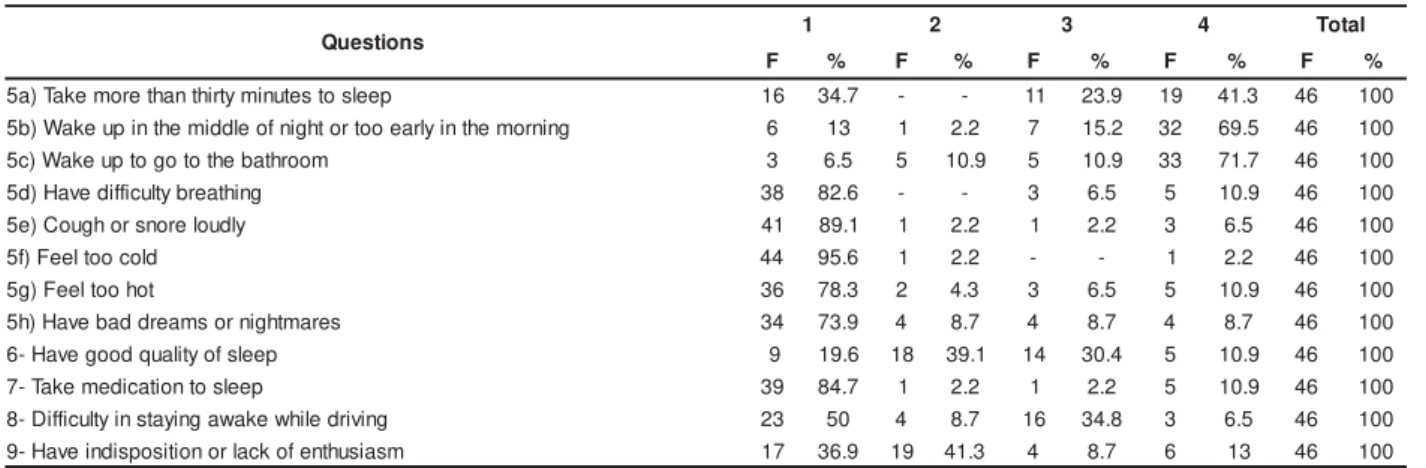
Table 1 pr esent s t he answ er s t o t he PSQI ’s
first four open quest ions and t ables 2 and 3 refer t o
t he sem i- open quest ions fr om five t o t en w it h it em s’
f r equ en cy an d per cen t age.
We obser v ed t hat t he m ost fr equent t im e t o
go t o bed was bet ween 9 and 11 P.M. for 80.4% of t he
p ar t icip an t s, 3 7 % t ook u p t o 1 5 m in u t es t o sleep ,
54.3% woke up aft er six t o seven hours of sleep and
26.1% slept six t o seven hours per night on average.
Table 1 – Frequencies and percent age of part icipant s’
answ er s t o t he PSQI sem i- open quest ions. Uber aba,
MG, Br azil 2008
Table 2 – Fr equency and per cent age of par t icipant s’ answ er s in t he PSQI sem i- open quest ions. Uberaba ( MG) ,
2 0 0 8
s n o i t s e u
Q Answers F %
? d e b o t o g u o y d i d e m it t a h W
-1 19 21h 7 15.2
h 3 2 1
2 37 80.4
h 1 3
2 1 2.2
h 3
1 0 0
h 5
3 1 2.2
u o y d i d ) s e t u n i m n i ( g n o l w o H -2 ? p e e l s o t ll a f o t e k a
t <o=15min 17 37
n i m 0 3 -6
1 15 32.6
n i m 0 6 -1
3 8 17.4
n i m 0 6
> 6 13
d e b f o t u o t e g u o y d i d e m it t a h W -3 ? g n i n r o m e h t n
i 3 4h 1 2.2
h 5
4 2 4,3
h 6
5 13 28.3
h 7
6 25 54.3
h 7
> 5 10.9
p e e l s u o y d i d s r u o h y n a m w o H -4 ? t h g i n r e
p 1 2h 1 2.2
h 3
2 2 4.3
h 4
3 7 15.2
h 5
4 9 19.6
h 6
5 5 10.9
h 7
6 12 26.1
h 8
7 5 10.9
h 9
8 3 6.5
h 0 1
9 2 4.3
s n o i t s e u
Q 1 2 3 4 Total
F % F % F % F % F %
p e e l s o t s e t u n i m y t r i h t n a h t e r o m e k a T ) a
5 16 34.7 - - 11 23.9 19 41.3 46 100
g n i n r o m e h t n i y l r a e o o t r o t h g i n f o e l d d i m e h t n i p u e k a W ) b
5 6 13 1 2.2 7 15.2 32 69.5 46 100
m o o r h t a b e h t o t o g o t p u e k a W ) c
5 3 6.5 5 10.9 5 10.9 33 71.7 46 100
g n i h t a e r b y tl u c if f i d e v a H ) d
5 38 82.6 - - 3 6.5 5 10.9 46 100
y l d u o l e r o n s r o h g u o C ) e
5 41 89.1 1 2.2 1 2.2 3 6.5 46 100
d l o c o o t l e e F ) f
5 44 95.6 1 2.2 - - 1 2.2 46 100
t o h o o t l e e F ) g
5 36 78.3 2 4.3 3 6.5 5 10.9 46 100
s e r a m t h g i n r o s m a e r d d a b e v a H ) h
5 34 73.9 4 8.7 4 8.7 4 8.7 46 100
p e e l s f o y t il a u q d o o g e v a H
-6 9 19.6 18 39.1 14 30.4 5 10.9 46 100
p e e l s o t n o it a c i d e m e k a T
-7 39 84.7 1 2.2 1 2.2 5 10.9 46 100
g n i v i r d e li h w e k a w a g n i y a t s n i y tl u c if f i D
-8 23 50 4 8.7 16 34.8 3 6.5 46 100
m s a i s u h t n e f o k c a l r o n o it i s o p s i d n i e v a H
-9 17 36.9 19 41.3 4 8.7 6 13 46 100
not once, 2- less t han once a week, 3- once or t wice a week and 4- t hree t im es a week or m ore
So m e i t e m s a r e n o t e w o r t h y l i k e t h e 1 9
pat ient s ( 41.3% ) w ho t ake m or e t han t hir t y m inut es
t o fall t o sleep, 32 ( 69.5% ) who wake up in t he m iddle
of t he night or t oo early in t he m orning and 33 ( 71.7% )
who wake up t o go t he bat hroom .
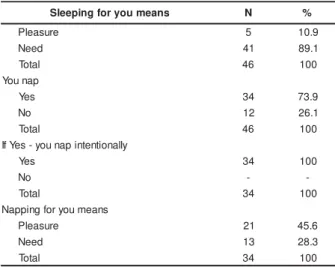
Ta b l e 3 p r e s e n t s t h e r e s u l t s c o n c e r n i n g
quest ion num ber t en, which is relat ed t o t he m eaning
of sleep and of t he habit of t aking a nap or not . The
answers t o t his quest ion are not sum m ed up, t hat is,
t hey are not com put ed in any of t he seven com ponent s
and t her efor e ar e not par t of t he inst r um ent global
scor e. How ever, t he answ er s of pat ient s w ho hav e a
habit of t aking a nap help t o underst and t he subj ect ive
Ta b l e 3 – Fr eq u en cy a n d p er cen t a g e o f p a t i en t s’
answers t o t he PSQI quest ion 10. Uberaba ( MG) , 2008
s n a e m u o y r o f g n i p e e l
S N %
e r u s a e l
P 5 10.9
d e e
N 41 89.1
l a t o
T 46 100
p a n u o Y s e
Y 34 73.9
o
N 12 26.1
l a t o
T 46 100
y ll a n o it n e t n i p a n u o y -s e Y fI s e
Y 34 100
o
N -
-l a t o
T 34 100
s n a e m u o y r o f g n i p p a N e r u s a e l
P 21 45.6
d e e
N 13 28.3
l a t o
T 34 100
Acco r d i n g t o Tab l e 3 , 4 1 ( 8 9 . 1 % ) p at i en t s
consider sleeping a necessit y. Table 4 relat es av erage,
st andard deviat ion and level of st at ist ical significance
of t he PSQI com ponent s in relat ion t o t he inst rum ent
g l o b a l s c o r e . Th e s e w e r e o b t a i n e d t h r o u g h t h e
par am et r ic t est of analy sis of v ar iance ( ANOVA) for
t he 46 int er v iew ees.
Table 4 – Average, st andar d dev iat ion and st at ist ical
significance of t he PSQI com ponent s in relat ion t o it s
global scor e. Uber aba ( MG) , 2008.
e l a c
S Scores Variable Average Standard n o i t a i v e d f o l e v e L e c n a c i f i n g i s I Q S P 1 p m o
C 0 3.50 1.31 0.000*
1 8 3.01
2 10.79 2.89
3 16 2.53
2 p m o
C 0 5.92 3.45 0.000*
1 5.17 2.23
2 10 3.56
3 12.93 3.34
3 p m o
C 0 4.17 1.60 0.000*
1 6.35 3.24
2 10 1.41
3 13.29 2.91
4 p m o
C 0 4.80 2.62 0.000*
1 5.50 1
2 10 2.12
3 13.06 2.98
6 p m o
C 0 8.56 3.96 0.048**
1 4
-2 13
-3 13.60 6.23
7 p m o
C 0 5.62 2.84 0.001*
1 8.87 3.58
2 11.43 3.82
3 13.25 6.70
* p≤0.001 * * p< 0.05
On ly com p on en t f iv e w as n ot st at ist ically
significant and t herefore was not included in Table 4.
Table 5 present s t he result s of t he param et ric
t est ANOVA w it h v alu es st at ist ically sig n if ican t in
r e l a t i o n t o t h e i n st r u m e n t i t e m s, w h i ch r e f e r t o
pat ient s’ social and clinical char act er ist ics.
Table 5 – Average, st andar d dev iat ion and st at ist ical
significance of sociodem ographic and clinical variables
in r elat ion t o t he PSQI global scor e. Uber aba ( MG) ,
2 00 8
e l a c
S Scores Variable Average Standard n o i t a i v e D f o l e v e L e c n a c i f i n g i s ) I Q S P ( l a b o l G e m o c n
I 1 13 4.13 0.000*
2 8 3.04
3 6.83 4.06
4 3 g n il o o h c
S 1 15 - 0.040**
2 9.22 3.83
3 11 4.76
4 7.33 6.11
5 5 2.16
6 3.50 0.71 f o e t i S r e c n a
c 1 8.25 3.82 0.023**
2 15
-3 8.50 4.95
4 8.30 4.19
6 14.60 5.37
* p< 0.001 * * p< 0.05
Th e ANOVA t est r ev ealed t h r ee st at ist ically
sign if ican t scor es: econ om ic in com e, sch oolin g an d
sit e of cancer.
DI SCUSSI ON
For t y - one ( 89. 1% ) pat ient s w er e older t han
5 0 y ear s o f ag e, w h i ch i s i n acco r d an ce w i t h t h e
lit er at ur e because age is an im por t ant r isk fact or for
all t y pes of cancer since t he incidence and m or t alit y
of t he disease incr ease ex ponent ially aft er 50 y ear s
of age( 1).
St a t i st i ca l si g n i f i ca n ce w a s n o t f o u n d i n
relat ion t o t he qualit y of sleep wit h age and gender.
I n com e u p t o t w o m in im u m w ag e salar ies
( 7 1 . 7 % ) a n d sch o o l i n g u p t o e l e m e n t a r y sch o o l
( 8 0 . 5 % ) i n d i ca t e p a t i en t s w h o l i v e i n p o o r l i v i n g
c o n d i t i o n s d u e t o t h e i r l a c k o f p r o f e s s i o n a l
q u alif icat ion s an d low ed u cat ion al lev el. Th ey also
h av e lim it ed access t o p u b lic ser v ices su ch as t h e
p r a c t i c e s a n d e a r l y d e t e c t i o n( 1 2 ). Th e s e s o c i a l
charact erist ics can also hinder t he knowledge of t hese
pat ient s regarding com plem ent ary t reat m ent s t hat can
m inim ize sleep disorders. Financial difficult ies can also
generat e worries t hat int erfere wit h sleep pat t erns. A
s y s t e m a t i c r e v i e w( 1 3 ) t h a t e v a l u a t e d t h e u s e o f
alt er n at iv e an d com p lem en t ar y t r eat m en t s am on g
pat ient s wit h cancer shows t hat pat ient s who use t hese
t herapies are t hose wit h a high level of educat ion and
high fam ily incom e.
These findings are com pat ible wit h t he findings
o f t h i s st u d y b ecau se i n co m e an d sch o o l i n g w er e
st at ist ically significant in r elat ion t o t he PSQI global
score, confirm ing t he im port ance of t hese aspect s for
t he sleep qualit y of t hese pat ient s.
A st u d y( 8 ) ev a l u a t i n g t h e sl eep q u a l i t y o f
w om en w it h cancer, how ever, show s differ ent r esult s
b ecau se t h e lev el of ed u cat ion w as sim ilar am on g
individuals w it h good and poor qualit y of usual sleep
( average of 4.5 and 5 years of schooling, respect ively)
as well as fam ily incom e: five m inim um wage salaries
predom inat ed ( in 91.7% of t he part icipant s wit h good
sleep pat t erns and in 84.6% of t hose wit h poor sleep
pat t er n s) .
Th e sit e of can cer w as also a st at ist ically
sign ifican t v ar iable ( p= 0 . 0 2 3 ) . I t is k n ow n t h at t h e
sit e and st age of t he disease det er m ine t he k ind of
t r eat m en t ch osen an d also af f ect t h e r ecov er y an d
qualit y of life of t hose w ho sur v iv e it( 14). I n pat ient s
su bm it t ed t o pr ost at ect om y, t h e av er age qu alit y of
sleep, accor ding t o t he PSQI global scor e, w as 8.25.
I n t his group, one of t he causes dist urbing t heir sleep
was t he need t o wake in t he m iddle of t he night t o go
t o t he bat hr oom , usually leav ing t hem unable t o fall
back t o sleep; anot her fact or w as t he pr eoccupat ion
of not being able t o k eep an act iv e sex ual life w it h
t heir par t ner s.
Alt hough t he frequency of pat ient s subm it t ed
t o ch em ot h er ap y an d r ad iot h er ap y w as sm all, on e
can n ot f or g et t o m en t ion t h e im p or t an ce of t h ese
t herapies for sleep qualit y. Cancer pat ient s w ho were
subm it t ed t o specific t reat m ent s in t he last six m ont hs
w e r e m o r e s u b j e c t t o p r o b l e m s o f e x c e s s i v e
som n olen ce( 8 ).
Tw ent y- four ( 52.2% ) pat ient s in t his sam ple
slep t less t h an six h ou r s on av er ag e. Th is f in d in g
differs from anot her st udy( 15) wit h 123 cancer pat ient s
in w h ich 9 5 % of t h e in div idu als h ad an av er age of
6 . 5 8 h ou r s of sleep. How ev er, t h e lit erat u r e( 1 6 ) also
r ev eals t h at w h en sleep d isor d er s ex ist b ef or e t h e
disease, t he sym pt om s worsen in 58% of t he pat ient s
aft er t he diagnosis.
Anot her st udy t hat focused on t he poor sleep
qualit y of cancer pat ient s( 8) highlight ed t he follow ing
problem s: early waking ( 92% ) and t he need t o go t o
t h e b at h r oom ( 9 2 % ) , f ollow ed b y ep isod es of p ain
( 6 9 . 3 % ) a n d se n sa t i o n o f h e a t d u r i n g t h e n i g h t
( 46. 2% ) . These findings ar e sim ilar t o t hose of t his
st udy in w hich 27 ( 58.7% ) pat ient s report ed poor or
v er y poor sleep pat t er ns.
Regar ding t he habit of napping ( answ er s t o
t he PSQI quest ion t en) Table 3 shows t hat 34 ( 73.9% )
p ar t icip an t s r ep or t ed t h ey in t en t ion ally t ak e a n ap
du r in g t h e day. We also obser v ed t h at 2 1 ( 4 5 . 6 % )
consider napping t o be pleasur able and 13 ( 28. 3% )
con sid er it a n ecessit y. Th e act of n ap p in g in t h e
m or ning or aft er noon w as also found in 39% of t he
respondent s of anot her st udy and 60 % of t hem nap
at least t hree t im es a week( 16). Thus, naps during t he
day m ight be associat ed wit h int errupt ed sleep during
t h e n ig h t , w h ich in t u r n con t r ib u t es t o p oor sleep
qu alit y.
Hence, when t he PSQI com ponent s are j oint ly
ev aluat ed in r elat ion t o t he global scor e w e hav e a
bet t er underst anding of t he relat ion bet ween t hem . A
person who sleeps less t han five hours per night and
t a k e s m o r e t h a n t h i r t y m i n u t e s t o f a l l a sl e e p i s
co n si d e r e d t o h a v e a p o o r q u a l i t y o f sl e e p a n d
con seq u en t ly m ig h t b ecom e sleep y d u r in g t h e d ay
and feel t he need t o nap.
Disor der s in sleep pat t er ns indicat e sleep is
b e i n g h a r m e d b y e n v i r o n m e n t a l a n d / o r p e r so n a l
f act o r s. I t i s i m p o r t an t t o n o t e t h at st u d y i n g t h e
m u l t i p l e sy m p t o m s o f ca n ce r i s a co m p l e x t a sk
because of t he differ ences found in t he or igin of t he
disease and specific sy m pt om s. Som e sy m pt om s ar e
r elat ed t o t he disease and ot her s ar e r elat ed t o t he
t reat m ent ( i.e. nauseas and vom it ing can be t he result
of in t est in al ob st r u ct ion or ch em ot h er ap y ) ; or y et
sym pt om s can be relat ed t o t he disease and t reat m ent
( i. e. f at igu e) ; an d t h er e is also t h e possibilit y t h at
o n e o r m o r e sy m p t o m s a r e t r i g g er ed b y a n o t h er
sym pt om ( sleep disorder t hat can lead t o fat igue)( 14).
Sleep pat t erns have t o be det erm ined in order
t o ev alu at e w h et h er sleep q u alit y is ad eq u at e. For
t hat , professionals in t he healt h field should invest igat e
pat ient s’ r out ines so as t o det er m ine t he t im e w hen
t hey go t o bed, how long t hey t ak e t o fall t o sleep,
sleep d u r at ion , n u m b er of t im es t h ey w ak e d u r in g
t h e t i m e t h e y w a k e u p . Th e se d a t a ca n h e l p t o
d e t e r m i n e t h e s l e e p p a t t e r n s o f p a t i e n t s a n d
p r o f essi o n a l s t o p er cei v e w h et h er t h er e w a s a n y
c h a n g e a f t e r t h e d i a g n o s i s o f c a n c e r a n d / o r
t r eat m ent( 17).
B a s e d o n t h e a b o v e , i m p l e m e n t i n g
int er v ent ions so t hat cancer pat ient s acquir e healt hy
sleep h ab it s in clu d e: k eep a r eg u lar t im e t o sleep
and wake up ( even during weekends) ; go t o bed only
when feeling sleepy; get up when not able t o resum e
sleeping aft er 15- 20 m inut es and go t o anot her room ,
t hen per for m a non- st im ulat ing act iv it y unt il feeling
sleep y ; sleep on ly t h e n ecessar y am ou n t ; ex er cise
regularly, which should be done four t o six hours before
going t o bed; eat a light m eal befor e going t o bed;
avoid heavy foods; reduce t he level of noise and light ;
av oid st im u lan t s su ch as n icot in e, f ood an d d r in k s
w it h caf f ein e f ou r t o six h ou r s bef or e goin g t o bed
( i.e. chocolat e, coffee and soft drinks) ; avoid drinking
alcoh ol b ecau se it cau ses n oct u r n al w ak in g ; av oid
napping during t he day, or lim it it t o 20 m inut es, and
avoid napping aft er 3PM( 17).
CONCLUSI ONS
This st udy aim ed t o evaluat e t he sleep qualit y
of 46 sur gical cancer pat ient s in t he head and neck
and ur ology specialt ies t hr ough t he Pit t sbur gh Sleep
Qu alit y I n d ex an d a sp ecif ic in st r u m en t t o id en t if y
t he social and clinical char act er ist ics of pat ient s.
Result s show t hat all pat ient s value sleep and
t he m ain disor der s ar e: t ak ing t oo long t o fall sleep
and discont inued noct ur nal sleep.
I n com e, sch oolin g an d sit e of t h e d isease
w er e st at i st i cal l y si g n i f i can t f act o r s f o r q u al i t y o f
sleep . Th e p ar t icip an t s ex p r essed t h e n eed t o n ap
du r in g t h e day, w h ich can be a n ecessit y f or som e,
b u t m ig h t lead , at t h e sam e t im e, t o d isor d er s in
n o ct u r n a l sl eep .
Com paring t he result s of t his st udy wit h ot her
st u d ies w e f in d t h at t h er e ar e d if f er en ces in sleep
qualit y am ong gr oups of cancer pat ient s, w hich lead
t o t he conclusion t hat focusing on t he sit e of disease
and specific t reat m ent s leads t o m ore accurat e result s.
This st udy pr esent s som e lim it at ions due t o
t he het erogeneous sam ple because t he consequences
of sur ger ies in t he head and neck ar e differ ent fr om
u r o l o g i ca l o n e s. Th e sa m p l e i s co m p o se d o f 4 6
pat ient s, w hich can be consider ed a sm all num ber if
com pared t o t he num ber of cancer pat ient s at t ended
per year at t he inst it ut ion. Anot her lim it at ion is relat ed
t o t he t ransversal- observat ional design. A longit udinal
st udy can com plem ent t he evaluat ion of sleep qualit y
in d if f er en t st ag es of t h e d isease. Su ch lim it at ion s
can be ov er com e in fut ur e st udies.
REFERENCES
1. Minist ério da Saúde [ hom epage na I nt ernet ] . Secret aria de At enção à Saúde: I nst it ut o Nacional de Câncer ; [ Acesso em 2008 fev er eir o 15] . Est im at iv as 2008: I ncidência de Câncer no Br asil; [ 96 t elas] . Disponível em : ht t p: / / w w w. inca. gov. br / est im at iv a/ 2 0 0 8 / v er saof in al. p d f
2. Vachani C. I nsom nia in t he pat ient w it h cancer. Oncolink– Abr am son Can cer Cen t er of t h e Un iv er sit y of Pen n sy lv an ia [ ser ial online] 2007 Apr [ cit ed 2007 m ay 17] ; ( 1) : [ about 4 scr een s] . Av ailable f r om : h t t p: / / w w w . on colin k . com / copin g/ a r t i cl e . cf m ?c= 5 & s= 6 9 & ss= 1 1 6 & i d = 7 0 9
3. Savard J, Morin CM. I nsom nia in t he cont ext of cancer: a r ev iew of a neglect ed pr oblem . J Clin Oncol 2001 Febr uar y ; 1 9 ( 3 ) : 8 9 5 - 9 0 8 .
4 . Kaplow R. Sleep depr iv at ion an d psy ch osocial im pact in acu t ely I ll can cer p at ien t s. Cr it Car e Nu r s Clin Nor t h Am 2 0 0 5 Sep t em b er ; 1 7 ( 3 ) : 2 2 5 - 3 7 .
5 . On colog y Nu r sin g Societ y [ h om ep ag e on t h e I n t er n et ] . Pi t t sb u r g : On co l o g y Nu r si n g So ci et y ( ONS) ; [ ci t ed 2 0 0 7 S e p t e m b e r ] ; 2 0 0 5 – 2 0 0 9 O N S Re s e a r c h A g e n d a ; [ 2 scr e e n s] . Av a i l a b l e f r o m : h t t p : / / w w w . o n s. o r g / r e se a r ch / in f or m at ion / docu m en t s/ pdf s/ t alk in g0 5 . pdf
6 . Cu n h a MCB, Z an et t i MLH, Van d er lei J. Sleep q u alit y in t y p e 2 d i a b e t i c s . Re v La t i n o - a m En f e r m a g e m 2 0 0 8 ; 1 6 ( 5 ) : 8 5 0 - 5 .
7 . Z a r o s MC, Ce o l i m MF. S l e e p / w a k e c y c l e o f w o m e n subm it t ed t o elect iv e gy necological sur ger y w it h a one- day hospit al st ay. Rev Lat ino- am Enfer m agem 2008; 16( 5) : 838-4 3 .
8 . Fu r l a n i R, Ce o l i m MF. Sl e e p q u a l i t y o f w o m e n w i t h gynecological and br east cancer. Rev Lat ino- am Enfer m agem 2 0 0 6 d ezem b r o; 1 4 ( 6 ) : 8 7 2 - 8 .
9. Polit FD, Beck CT, Hungler BP. Fundam ent os de Pesquisa em Enferm agem : m ét odos, avaliação e ut ilização. 5ª ed. Port o Alegr e ( RGS) : Ar t m ed; 2 0 0 4 .
10. Ceolim MF. Padr ões de at iv idades e de fragm ent ação do sono em pessoas idosas [ t ese] . Ribeir ão Pr et o ( SP) : Escola de Enfer m agem de Ribeir ão Pr et o/ USP; 1999.
11. Mart ins GA. Sobre confiabilidade e validade. RBGN 2006; 8 ( 2 0 ) : 1 - 1 2 .
12. Guim ar ães RM, Rom anelli G. A inser ção de adolescent es no m er cado de t r abalho at r av és de um a ONG. Psicol Est udo 2 0 0 2 j u lh o/ d ezem b r o; 7 ( 2 ) : 1 1 7 - 2 6 .
s i s t e m á t i c a . Re v S a ú d e Pú b l i c a 2 0 0 8 f e v e r e i r o ; 4 2 ( 1 ) : 1 5 8 - 6 4 .
1 4 . B e c k S L, D u d l e y W N , B a r s e v i c k A . Pa i n , s l e e p d ist u r b an ce, an d f at ig u e in p at ien t s w it h can cer : u sin g a m ediat ion m odel t o t est a sym pt om clust er. Oncol Nurs Forum 2 0 0 5 May ; 3 2 ( 3 ) : 5 4 2 - 6 5 .
1 5 . Mer cadant e S, Gir elli D, Casuccio A. Sleep disor der s in
advanced cancer pat ient s: prevalence and fact ors associat ed. Su p p or t Car e Can cer 2 0 0 4 May ; 1 2 ( 5 ) : 3 5 5 - 9 .
16. Dav idson JR, Macleana AW, Br undageb MD, Schulzec K. Sl e e p d i st u r b a n ce i n ca n ce r p a t i e n t s. So ci a l Sci e n ce & Med i ci n e 2 0 0 2 May ; 5 4 ( 9 ) : 1 3 0 9 - 2 1 .
1 7 . O ’ d o n n e l l JF. I n s o m n i a i n Ca n c e r Pa t i e n t s . Cl i n Cor n er st on e 2 0 0 4 ; 6 Su p p l: 6 - 1 4 .