REVISTA
BRASILEIRA
DE
ANESTESIOLOGIA
PublicaçãoOficialdaSociedadeBrasileiradeAnestesiologiawww.sba.com.br
SCIENTIFIC
ARTICLE
Comparison
of
different
methods
of
nasogastric
tube
insertion
in
anesthetized
and
intubated
patients
Ali
Sait
Kavakli
∗,
Nilgun
Kavrut
Ozturk,
Arzu
Karaveli,
Asuman
Arslan
Onuk,
Lutfi
Ozyurek,
Kerem
Inanoglu
AntalyaTrainingandResearchHospital,DepartmentofAnesthesiologyandReanimation,Antalya,Turkey
Received2February2016;accepted7August2016 Availableonline2September2016
KEYWORDS
Intubation, nasogastric; Endotrachealtube assisted;
Videolaryngoscope; Successrate
Abstract
Background: Nasogastrictubeinsertionmaybedifficultinanesthetizedandintubatedpatients
withheadintheneutralposition.Severaltechniquesareavailableforthesuccessfulinsertion ofnasogastrictube.Theprimaryaimofthisstudywastoinvestigatethedifferenceinthefirst attemptsuccessrateofdifferenttechniquesforinsertionofnasogastrictube.Secondaryaim wastoinvestigate thedifferenceofthedurationofinsertionusingtheselected technique, complicationsduringinsertionsuchaskinkingandmucosalbleeding.
Materialandmethods: 200adultpatients,whoreceivedgeneralanesthesiaforelective
abdom-inal surgeries that required nasogastric tube insertion, were randomized into four groups: Conventionalgroup(GroupC),headinthelateralpositiongroup(GroupL),endotrachealtube assistedgroup(GroupET)andMcGrathvideolaryngoscopegroup(GroupMG).Successrates, durationofinsertionandcomplicationswerenoted.
Results:Successratesofnasogastrictubeinsertioninfirstattemptandoverallwerelowerin
GroupCthanGroupETandGroupMG.Meandurationandtotaltimeforsuccessfulinsertionof NGtubeinfirstattemptweresignificantlylongerinGroupET.KinkingwashigherinGroupC. MucosalbleedingwasstatisticallylowerinGroupMG.
Conclusion:UseofvideolaryngoscopeandendotrachealtubeassistanceduringNGtube
inser-tioncomparedwithconventionaltechniqueincreasethesuccessrateandreducethekinking inanesthetized andintubated adult patients. Use ofvideolaryngoscope duringnasogastric tubeinsertioncomparedtoothertechniquesreducesthemucosalbleedinginanesthetizedand intubatedadultpatients.
©2016SociedadeBrasileiradeAnestesiologia.PublishedbyElsevierEditoraLtda.Thisisan openaccessarticleundertheCCBY-NC-NDlicense( http://creativecommons.org/licenses/by-nc-nd/4.0/).
∗Correspondingauthor.
E-mail:[email protected](A.S.Kavakli). http://dx.doi.org/10.1016/j.bjane.2016.08.002
PALAVRAS-CHAVE
Intubac¸ão, nasogástrica; Intubac¸ãotraqueal assistida;
Videolaringoscópio; Taxadesucesso
Comparac¸ãodediferentesmétodosdeinserc¸ãodesondanasogástricaempacientes anestesiadoseintubados
Resumo
Justificativa: Ainserc¸ãodesondanasogástrica(NG)podeserdifícilempacientesanestesiados
eintubadoscomacabec¸aemposic¸ãoneutra.Háváriastécnicasparaainserc¸ãobem-sucedida desondaNG.Oobjetivoprimáriodesteestudofoiinvestigaradiferenc¸adataxadesucessona primeiratentativadediferentestécnicasparainserc¸ãodesondaNG.Oobjetivosecundáriofoi investigaradiferenc¸adotempodeinserc¸ãocomousodatécnicaselecionadaeascomplicac¸ões duranteainserc¸ão(dobraduradasondaesangramentodamucosa).
Materialemétodos: 200 pacientes adultos que receberam anestesia geral para cirurgias
abdominaiseletivasqueexigiaminserc¸ãodesondaNGforamrandomicamentedistribuídosem quatro grupos:grupoconvencional(GrupoC),grupocomacabec¸aposicionadalateralmente (GrupoL),grupocomassistênciadetubotraqueal(GrupoTE)egrupocom videolaringoscó-pioMcGrath(GrupoMG).Astaxasdesucesso,ostemposdeinserc¸ãoeascomplicac¸õesforam registrados.
Resultados: Astaxasde sucesso deinserc¸ão dasondaNGnaprimeira tentativae em geral
forammenoresnoGrupoCquenosgruposTEeMG.Asdurac¸õeseostempostotaisdeinserc¸ão bem-sucedidadasondaNGnaprimeiratentativaforamsignificativamentemaioresnoGrupo TE.DobradurafoimaiornoGrupoC.Sangramentodamucosa foiestatisticamentemenorno GrupoMG.
Conclusão:OusodevideolaringoscópioedeTEduranteainserc¸ãodesondaNGcomparadoao
usodatécnicaconvencionalaumentouataxadesucessoereduziuadobraduradasondaem pacientesadultosanestesiadoseintubados.Ousodevideolaringoscópioduranteainserc¸ãode sondaNGemcomparac¸ãocomoutrastécnicasreduzosangramentodamucosaempacientes adultosanestesiadoseintubados.
©2016SociedadeBrasileiradeAnestesiologia.PublicadoporElsevierEditoraLtda.Este ´eum artigo OpenAccess sobumalicenc¸aCCBY-NC-ND( http://creativecommons.org/licenses/by-nc-nd/4.0/).
Introduction
Insertionofnasogastric (NG)tube isfrequentlyperformed procedure for laparoscopic or majorabdominal surgeries. Thisproceduremaybesometimesdifficultfor anesthesiol-ogists.Inanesthetizedandintubatedpatients,thegastric tube maybecome coiledin oral cavitydue toinability to swallowandpresenceofaninflatedcuffintheproximal tra-chea.Furthermore,flexiblestructureoftheNGtubemaybe causetocoilingandunsuccessfulplacement.Non-opposing lateraleyeslikeopeningnearthetipmayprovokekinking ofNGtube.1Manystudieshavebeenreportedlowersuccess
ratesonthefirstattemptandmorecomplicationswiththe headintheneutralposition.2---5
Previous studies have been described the different techniques for facilitation of NGT insertion such as the use of intubation stylet,1 endotracheal tube-assisted
technique,6 endoscopic technique,7 the use of frozen NG
tube,8useof‘peel-away’splittrachealtube,9angiography
catheterguidedtechnique,10esophagealguidewire-assisted
technique.11 Effective devicesusedin trachealintubation
such as Glidescope,12 King Vision,13 Pentax-AWS14 video
laryngoscopeshavebeenreportedtofacilitatetheNGtube insertion.
We hypothesized that use of different techniques for NG tube insertion could increase the rate of successful insertion compared with the conventional technique in
anesthetizedandintubatedpatientsundergoingabdominal surgery.Therefore, wecomparedconventional technique, head in the lateral position, endotracheal tube assisted techniqueanduseofMcGrathMACvideolaryngoscope for NG insertion to determine the success rate, duration for insertion,andincidenceofcomplications,suchasbleeding andkinking.
Methods
This study was prepared through the application of the guidelinesof‘‘TheDeclarationofHelsinki’’,evaluatedand approved by the ethics committee of the Training and ResearchHospital,Antalya,Turkey,ApprovalNumber64/14, anditwasalsoenteredintotheClinicaltrials.govclinical tri-alsregistry(n◦NCT02557204).Allpatientsgavetheirwritten
informedconsenttotakepartofthestudy.
The primary aim of this study was to investigate the difference in the first attempt success rate of different techniquesforinsertionofNGtube.Secondaryaimwasto investigatethedifferenceofthedurationofinsertionusing theselectedtechnique,complicationsduringinsertionsuch askinkingandmucosalbleeding.
bycomputer-generatedrandomization:conventionalgroup (Group C), head in the lateral position group (Group L), endotracheal tube (ET) assisted group (Group ET) and McGrathvideolaryngoscopegroup(GroupMG).
Patients with a history of coagulopathy, nasal steno-sis, upper respiratory tract anomalies, esophageal varix, esophagealhiatushernia,baseofskullfracture,looseteeth, CormackandLehaneand/orMallampatiscoresof3or4were excluded.
On patient’s arrival to the operating room, a periph-eralvenouscatheterwasestablished.Standardmonitoring wasincluded non-invasive blood pressure, five-lead elec-trocardiography and pulse oximetry. In all patients, generalanesthesiawasinduced withintravenouspropofol 2mg.kg−1,fentanyl2
g.kg−1,rocuronium0.6mg.kg−1.All
patientsweretracheallyintubated,witha7.5mminternal diameterendotrachealtubeinfemalesandan8.0mm inter-nal diameterendotracheal tube in males. Anesthesia was maintainedwith5---6% desfluraneandnitrousoxide60%in oxygen,withpositivepressureventilationinacirclesystem. AllNGtubeinsertionswereperformedbythesamethree anesthesiologistswhoblindedtostudyexperienced inthe techniques.TheauthorsdidnotperformNGtubeinsertion toavoidoperatorbias.AFr.16,121cmNGtube(Bicakcilar, Istanbul,Turkey)wasusedinallcases.
InGroup C,theNGtube wasinserted gentlythrougha selectednostril while the head maintainedin the neutral positionwithoutanymaneuversorinstrument.
In GroupL, thepatient’s head wasturnedtothe right lateralposition.NGtubewasinsertedthroughtheselected nostrilwithoutanymaneuversoftheneck.
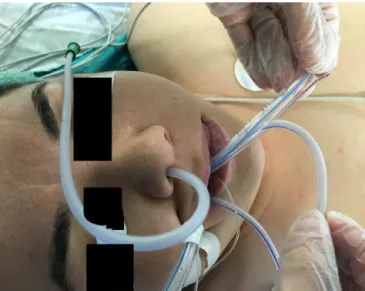
InGroupET,theNGtubewasinsertedthroughselected nostril. Patient’smouth was opened withtwo fingersand about80cmofNGtubewastakenoutfromthemouth.For preparingofsplitET,anETwhichhas7.5mminternal diam-etertube wascarefully cutted lengthways (fromdistal to proximalend)withsterilescissorsandlubricatedbothinner andoutersurface.NGtubewasinsertedintothesplittedET. ETwasadvancedblindlythroughtheoralcavitytoadepth approximately18cm without using laryngoscope while ET had NG tube inside it. And then NG tube was advanced approximately65cm(±5cm).NGtubewasfreedfromthe cut of the ET when the successfulinsertion was verified. Anditwaspulledoutthroughthenostriluntiltherequired length(Fig.1).
InGroupMG,McGrathMACvideolaryngoscope(Aircraft MedicalLtd,Edinburgh,UK)wasinsertedintraorallywhen thepyriformsinusor esophaguswasviewed;NGtube was inserted transnasally and advanced into esophagus under directvision(Fig.2).
Inallprocedures,successfulinsertionwasconfirmedby hearing the gurgling sounds of auscultation over the epi-gastriumwhen injecting 10mLof air via theNGtube. All patientswereexaminedbydirectlaryngoscopyintermsof oralmucosalbleedingafternasotrachealtubeplacement.
Thedurationofinsertiontimewasmeasuredwitha stop-watch by an anesthetic nurse. Durationof insertion time wasdefined as the start when the NG tube was inserted throughthenostrilandastheendwhenthesuccessful inser-tion was confirmed in first attempt. If the first attempt failed;theNGtubewasfullywithdrawn,cleaned,lubricated (Dispogel,Dispofarma,Ankara, Turkey)and theprocedure
Figure1 Endotrachealtubeassistedtechnique.
wererepeatedusingthesametechnique. Iftwoattempts forinsertionwereunsuccessful;theselectedtechniquewas consideredasafailure.NGtubewasinsertedwiththe assis-tance of a laryngoscope and Magill forceps under direct visioninallfailedprocedures.Whenmorethanoneattempt was required, NG tube insertion times for each attempt weresummed,buttimesbetweenattemptswhichincluded cleaningandrelubricatingofNGtubewereneglected.
Success rate of the selected technique (first attempt, second attempt and overall), duration of insertion for selected technique, complications such as kinking and mucosalbleedingwerenoted.
Poweranalysis wasperformed toevaluate the success rates ofdifferenttechniques inthefirstattemptof inser-tionof NGtube. A pilotstudy with15 patientsper group was performed to calculate the estimated sample size.
Table1 Patients’characteristics(valuesaremean±SDornumberwithpercentage).
GroupC(n=50) GroupL(n=50) GroupET(n=50) GroupMG(n=50) p-Value
Age 54.3±11.2 52.2±10.7 55.7±9.9 50.9±11.3 0.726
Gender
Male 28(56%) 26(52%) 25(50%) 27(54%) 0.544
Female 22(44%) 24(48%) 25(50%) 23(46%) 0.623
BMI(kg.m−2) 24.1±3.3 24.4±2.9 23.7±4.1 23.9±2.8 0.584
Height(cm) 162.9±6.7 161.2±5.9 163.4±6.2 162.6±5.1 0.695
PreoperativeASAstatus
ASA1 29(58%) 28(56%) 29(58%) 31(62%) 0.644
ASA2 17(34%) 17(34%) 16(32%) 15(30%) 0.826
ASA3 4(8%) 5(10%) 5(10%) 4(8%) 0.794
Mallampatiscores
MP1 30(60%) 28(56%) 31(62%) 33(66%) 0.462
MP2 20(40%) 22(44%) 19(38%) 17(34%) 0.371
BMI,bodymassindex;ASA,AmericanSocietyofAnesthesiologists;MP,mallampati.
Consequently,aminimumof44patientsforeachgroupwas requiredfor an approximate30%improvement (frombase rate of 55% to 85%) in success rate of NG tube insertion using these techniques (˛=0.05 and ˇ=0.2). Hence, 50 patientspergroupwereincludedtoreplaceanydropouts.
Statistical analysis was performed using SPSS version 21 statistical software (SPSS Inc., Chicago, IL, USA). All numerical data were tested for normal distribution by Kolmogorov---Smirnovtest. Categoricaldatawereanalyzed usingPearson Chi-square or Fisher exact test. Continuous datawereanalyzedusingANOVAorKruskal---Wallistest.All data areexpressed as mean±standard deviation (SD)for continuousdataandnumbers (percentage)for categorical data. p-Value less than 0.05 wereconsidered statistically significant.
Results
Twohundredpatientswereenrolledinthestudy.Therewas nodifferenceinage,gender,bodymassindex,height, Amer-icanSociety ofAnesthesiologists(ASA) physicalstatus and mallampatiscoresinallfourgroups(Table1).
Success rateofNGinsertionin firstattemptwaslower inGroupCthanGroupETandGroupMG.Similarly,overall successratewaslowerinGroupCcomparedwithGroupET andGroupMG.Therewasnostatisticaldifferencebetween GroupL,GroupETandGroupMGintermsofsuccessrates (Table2).
MeandurationforsuccessfulinsertionofNGtubeinfirst attempt was significantly longer in Group ET than other groups.TotaltimeforsuccessfulinsertionofNGtube was significantly longer in Group C compared to Group L and Group MG.Total timefor successfulinsertion of NG tube wassimilarinGroupLandGroupMG(Table3).
A few complications were noted: kinking and mucosal bleeding. Kinking was higher in Group C. Mucosal bleed-ingwasstatisticallylowerinGroupMGcomparedtoother groups(Table4).
Life-threatening complications arising from NG tube insertionsuchasesophagealorstomachperforation,severe bleedingwasnotobserved.
Discussion
Ourstudyshowsthat,NGinsertionusingconventional tech-niqueiscausetolowersuccessrateandmorecomplications. Therearestudies availablein theliteraturecomparing differenttechniquesforNGinsertion.
InstudybyMohaririandcolleagues12prospectively
com-paredconventional technique andusing GlideScope video laryngoscopefor NGtube insertionin80 patients;success rateinfirst attemptwas57.5% inconventional groupand 85%inGlidescopegroup.Thesefindingsweresimilartoour study.Overallsuccessratewashigherinconventionalgroup thanourstudy(95%and56%,respectively).Thisdifference maybeduetolimitedwithtwoattemptsforeverytechnique
Table2 Successratesofnasogastrictubeinsertion(valuesarenumberwithpercentage).
GroupC(n=50) GroupL(n=50) GroupET(n=50) GroupMG(n=50)
Firstattempt 27(54%) 39(78%) 50(100%)a 46(92%)b
Secondattempt 6(12%) 5(10%) 0(0%) 3(6%)
Overallsuccess 33(66%) 44(88%) 50(100%)c 49(98%)d
Table3 Comparisonofdurationfornasogastrictubeinsertion(valuesaremean±SD).
GroupC(n=50) GroupL(n=50) GroupET(n=50) GroupMG(n=50)
Meandurationforsuccessfulfirstattempt(s) 27.3±3.8 21.4±5.3a 82.3±7.9b 24.6±2.3c
Totaltimeforsuccessfulinsertion(s) 62.5±15.3 43.4±7.8d 82.3
±7.9e 42.4 ±4.2f
ap=0.001ETvs.L. b p=0.001ETvs.C. c p=0.001ETvs.MG. d p=0.047Lvs.C.
e p=0.021ETvs.Candp=0.001ETvs.L. f p=0.038MGvs.Candp=0.001ETvs.MG.
Table4 Complications(valuesarenumberwithpercentage).
GroupC(n=50) GroupL(n=50) GroupET(n=50) GroupMG(n=50)
Kinking 10(20%) 3(6%)a 0(0%)b 1(2%)c
Mucosalbleeding 10(20%)d 9(18%)e 10(20%)f 1(2%)
ap=0.039Cvs.L. b p=0.001Cvs.ET. c p=0.020Cvs.MG. d p=0.020Cvs.MG. e p=0.041Lvs.MG. f p=0.020ETvs.MG.
inourstudy.Because;theyhadreachedthisratioafterthird attempt.
InstudybyOkabeandcolleagues13whichwasperformed
in60patientsbyusingKingVisionvideolaryngoscope com-paredtotheconventional technique; overallsuccess rate was 90% in conventional group and 100% in King Vision group.Unlikeourstudy,theywereconsideredtobeafailed attemptifthetimerequiredforinsertionwas5minormore. Thelongerattemptperiodmaycausetohighsuccessrate intheconventionalgroup.
Inbothstudies,highsuccess ratewiththeuseofvideo laryngoscopedemonstratedtheeffectivenessoftheNGtube insertionunderdirectvision.
Ifthe patient’shead turnstolaterally; tipofthe tube mayfollowthelateralborderofthepharynxandthetube mayadvancethroughtheesophaguswithout coilinginthe laryngopharynx.2 Disadvantage of this technique is being
unsafefor patients withunstable cervicalspine andhead injuries. Bong and colleagues2 reported that success rate
infirstattemptwas80%intheheadinthelateralposition and40%intheheadintheneutralposition.Theyreported thatheadinthelateralpositiontechniqueavoidedsomeof complexityandtime-consumingmeasuresoffailedNGtube insertion.In our study, success rates in firstattempt and overallwerehigherinheadinlateralpositionthanneutral group.Buttherewerenosignificantdifference.
RigidityoftheNGtubemayaffectsuccessrate.Warming andsofteningofNGtubeduringtheinsertionmayaffectthe pass ofNGtube. An ET guidancecan beusedtoincrease tube rigidity.15 Kwon and collegues6 reported efficacy of
NGinsertionin astudy performed in 56patients. Intheir study,successrateinfirstattempt(100%)andoverall(100%) wassimilartoETgroupinourstudy.AppukuttyandShroff reportedasimilarresultaftersecondattemptas92%.5
Traumacanbeobservedalongthetractfromthenaresto esophagusduringNGinsertionanditcancausetobleeding.
Blind insertioncan increasethe risk.16 Kinking andcoiling
oftheNGtubeisdescribedasthemostcommon complica-tionduringNGinsertionwithconventionaltechniqueinthe previous studies.1,5,6,11,17,18 NGtube is mostly impacted in
thepyriformsinusesandarytenoidcartilage.19Theseresults
complywithourfindings.Inourstudy,kinkingwasthemost commoncomplicationinGroupCcomparedtoothergroups. DirectvisioncandecreasedurationofNGinsertionand trauma-relatedcomplicationsinanesthetizedpatients.20,21
Inour study,in GroupMG,complications werelowerthan theothergroups.
Ourstudyhassome limitations. The mainlimitation of this study; the anesthesiologists who performed the NG insertion knew the technique usedfor NG tube insertion. Therefore,NGinsertionswereperformedbythree anesthe-siologistswhowereblindedtothestudytoavoidpotential investigatorevaluationbias.Anotherlimitationwas verifica-tionoftheNGtubeplacement.ConfirmingtheNGinsertion byauscultationmethodmaynotbereliableallthetime.22
Butwepreferredthismethodbecauseitwaseasytoapply andusedasaroutine.
Potential criticism is why we did not use Magill for-ceps for NG insertion in ET group. Because; in ET group, mucosal bleeding wasmore than other groups. Using the Magillforcepsunderdirectvisualizationbylaryngoscopyhas increasedtheriskofupperairwaytrauma.23 Thissituation
couldaffecttheresultsofourstudy.
Conclusions
insertioncomparedtoendotrachealtubeassistedtechnique reducesthedurationofinsertion.Useofvideolaryngoscope during NG tube insertion compared to other techniques reduces mucosal bleeding in anesthetized and intubated adultpatients.Furtherstudieswithhighersamplesizesand patientswithdifficultairwaysshouldbedonetoconfirmthe conclusionsofourstudy.
Funding
Departmentalresourceswereusedforthestudy.
Conflicts
of
interest
Theauthorsdeclarenoconflictsofinterest.
References
1.TsaiYF,LuoCF,IlliasA,etal.Nasogastrictubeinsertionin anes-thetizedandintubatedpatients:anewandreliablemethod. BMCGastroenterol.2012;12:99.
2.BongCL,MacachorJD,HwangNC.Insertionofthenasogastric tubemadeeasy.Anesthesiology.2004;101:266.
3.MahajanR,GuptaR.Anothermethodtoassistnasogastrictube insertion.CanJAnaesth.2005;52:652---3.
4.KayoR,KajitaI,ChoS,etal.Astudyoninsertionofanasogastric tubeinintubatedpatients.Masui.2005;54:1034---6.
5.AppukuttyJ, Shroff PP. Nasogastric tube insertion using dif-ferent techniques in anesthetized patients: a prospective, randomizedstudy.AnesthAnalg.2009;109:832---5.
6.KwonOS,ChoGC,JoCH,etal.Endotrachealtube-assisted oro-gastrictubeinsertioninintubatedpatientsinanED.AmJEmerg Med.2015;33:177---80.
7.BostanAG.Anovelendoscopictechniqueforfailednasogastric tubeplacement.OtolaryngolHeadNeckSurg.2015;153:685---7. 8.ChunDH,KimNY,ShinYS,etal. Arandomized,clinicaltrial offrozenversusstandardnasogastrictubeplacement.WorldJ Surg.2009;33:1789---92.
9.Dobson AP. Nasogastric tube insertion-another technique. Anaesthesia.2006;61:1127.
10.GhatakT, SamantaS, BaroniaAK. Anewtechniquetoinsert nasogastrictubeinanunconsciousintubatedpatient.NAmJ MedSci.2013;5:68---70.
11.Kirtania J, Ghose T, Garai D, et al. Esophageal guidewire-assisted nasogastric tube insertion in anesthetized and intubatedpatients:aprospectiverandomizedcontrolledstudy. AnesthAnalg.2012;114:343---8.
12.MoharariRS,FallahAH,KhajaviMR,etal.TheGlideScope facil-itatesnasogastrictubeinsertion: a randomizedclinicaltrial. AnesthAnalg.2010;110:115---8.
13.OkabeT, GotoG,Hori Y, etal. Gastrictube insertionunder direct vision using the King VisionTM video laryngoscope: a randomized, prospective, clinical trial. BMC Anesthesiol. 2014;14:82.
14.Ikeno S, Nagano M, Tanaka S, et al. Gastric tube insertion undervisualcontrolwiththeuseofthePentax-AWS.JAnesth. 2011;25:475---6.
15.Sprague DH,Carter SR.An alternatemethodfor nasogastric tubeinsertion.Anesthesiology.1980;53:436.
16.Halloran O, Grecu B, Sinha A. Methods and complications of nasoenteral intubation. JPEN J Parenter Enteral Nutr. 2011;35:61---6.
17.Illias AM, Hui YL, Lin CC, et al. A comparison of nasogas-trictubeinsertiontechniqueswithoutusingotherinstruments in anesthetized and intubated patients. Ann Saudi Med. 2013;33:476---81.
18.MandalMC,DolaiS,Ghosh S,etal.Comparisonoffour tech-niquesofnasogastrictubeinsertioninanaesthetised,intubated patients: a randomized controlled trial. Indian J Anaesth. 2014;58:714---8.
19.Parris WC. Reverse Sellick maneuver. Anesth Analg. 1989;68:423.
20.GombarS,KhannaAK,GombarKK.Insertionofanasogastric tube underdirectvision:anotheratraumaticapproach toan age-oldissue.ActaAnaesthesiolScand.2007;51:962---3. 21.JonesA, DiddeeR,Bonner S.Insertionofa nasogastrictube
underdirectvision.Anaesthesia.2006;61:305.
22.MilsomSA,SweetingJA,SheahanH,etal.Naso-enterictube placement: a review of methods to confirm tip location, globalapplicabilityandrequirements.WorldJSurg.2015;39: 2243---52.