Energy Dependence of a Vortex Line Length
Near a Zigzag of Pinning Centers
Mauro M. Doria and Antonio R. de C. Romaguera
Instituto de F´ısica, Universidade Federal do Rio de JaneiroC.P. 68528, 21941-972, Rio de Janeiro RJ, Brazil
Received on 12 July, 2004
A vortex line, shaped by a zigzag of pinning centers, is described here through a three-dimensional unit cell containing two pinning centers positioned symmetrically with respect to its center. The unit cell is a cube of sideL = 12ξ, the pinning centers are insulating spheres of radiusR, taken within the range0.2ξto 3.0ξ, ξbeing the coherence length. We calculate the free energy density of these systems in the framework of the Ginzburg-Landau theory.
1
Introduction
Superconductors have many kinds of imperfections, that is, internal regions where Cooper pairs either don’t exist at all or exist purely as a fluctuation effect. Thus the macro-scopic wave function, describing the collective state, van-ishes abruptly or asymptotically inside such regions. In presence of an external magnetic field vortices arise inside the superconductor and are strongly attracted to such imper-fections, also called pinning centers. For this reason pinning centers have been extensively studied in the past in many ways, including artificially made ones, such as columnar de-fects [1], antidots [2,3] and micro holes [4]. They are esting because they bring clear-cut questions about the inter-action between vortices and pinning centers [5,6], such as how local misalignment really occurs inside the supercon-ductor. Vortices lines should be aligned to the applied field but the presence of strong attraction to a pinning center can change this locally. As a result of competing energetic de-mands new interesting phenomena can take place in vortex Physics, such as the one considered here. A vortex line in the absence of pinning centers is aligned along the magnetic induction direction, hereafter called z-axis. The presence of a zigzag of pinning centers forces the vortex line to bend and acquire this shape, resulting into local misalignment, though it remains oriented along the magnetic induction.
Pinning forces act on the vortex core whose radius is given by the coherence length ξ. The interaction of pin-ning centers with vortices has been studied using several approaches [7]. From the point of view of the Ginzburg-Landau theory, pinning may be caused by spatial fluctua-tions of the critical temperature [8], Tc(~x), or of the mean
free-path [9] that changes the coefficient in front of the gra-dient term,ξ(~x)2|(∇ −~ 2πi
Φ0 ~
A)∆|2. The interaction between
a vortex line and a pinning center has been considered by many authors in the context of the Ginzburg-Landau the-ory [9,10]. The number of vortex that can be trapped by a defect is an interesting problem. In case of a columnar
defect the saturation number has been determined long ago by Mkrtchyan and Shmidt [11]: ns = λ/2ξ, though this
formula has to change near the upper critical field [12]. Re-cently the saturation number has been discussed for three dimensional cavities [13].
The system under investigation here consists of a vor-tex line trapped by a zigzag of very large pinning cen-ters, namely, spherical insulating cavities, with radius taken to vary from0.2ξ to3.0ξ. For these pinning centers the boundary-value problem has to be taken into account, as usually treated since the de Gennes boundary condition [14] must be satisfied at the cavity surface. We chose to describe this system through a unit cell with two cavities inside, that rotate freely around its center, producing for each angle a distinct zigzag arrangement. In this paper we analyze nu-merically the angular dependence of the Helmholtz free en-ergyFc(θ, R)and propose an expression for it.
This paper is organized as follows. In section 2 we present the model for a 3-D superconducting media with the cavities. In section 3, we discuss out theoretical approach. In sections 4 and 5 we show the results obtained through nu-merical simulations. In section 6 we summarize the main results of the work.
2
The model
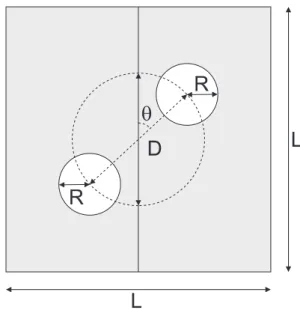
The system studied here consists of a cubic unit cell with sizeL equal to12ξ, and two insulating cavities of radius
R, as specified by the Fig. 1. The line segment joining the cavities makes an angleθ ranging from0◦ to180◦, taken here in increments of3◦. Notice that because of symmetry
θvarying from0◦ to90◦is sufficient to obtain all possible configurations.
radius.
q
R
R
L
L
D
Figure 1. The plane of rotation of the cavities inside the unit cell. The distanceDbetween the two cavities is equal toL/2. The su-perconductor fills the remain of the unit cell, shown here as a gray region.
Our numerical treatment demands a mesh grid to de-scribe the unit cell. The length of the cube side is 12ξ, and we choose the number of mesh points along a given direction, P, to be 19. This choice implies that distance between two consecutive mesh points,a, be equal to2ξ/3. The value ofa must be smaller than the coherence length
ξ, which is the minimum physical scale of the Ginzburg-Landau theory. The number of grid points inside the cavity should be large enough to describe it. This number is ob-tained from the ratio between the two volumes, of the cavity and of the cube. Since the entire cube hasP3 points, the
number of grid points inside the cavity is43π(Ra)3(1 + a L)3.
For instance, a cavity of radiusR= 1.0ξhas approximately 16 points, whereas theR = 2.0ξsphere has 8 times more points. Obviously in the limit of a cavity with radius smaller thant the mesh distance, that isR < a= 2/3ξ, there will be just one point in the mesh describing the cavity. In this case the order parameter does not vanish inside the defect but just undergoes a drop on its value.
3
Theoretical approach
We start our considerations for the energy density functional of the Ginzburg-Landau theory [15], expressing it in units of the critical field energy density [13],H2
c/4π. The
peri-odicity of the problem requires a search of the free energy minimum for a fixed integer, the number of vortices inside the unit cell.
This integer also fixes the magnetic induction B~(~x), which is the average of the local field taken over the unit cell volume,
~ B= 1
v
Z
v
~hd3r.
(1)
The magnetic induction is completely determined by the vorticity of the system because the overall current circula-tion vanishes inside the unit cell. The relacircula-tionship between the vorticity of the system~νφ0and the magnetic induction
~
B(~x)in reduced units is,
~
B(~x) = 2πκ
µ
ξ L
¶2
~ν, (2)
where~ν = nxxˆ+nyyˆ+nzzˆis the vorticity in an
arbi-trary direction. In the present paper we consider ~ν = ˆz
and present some results concerning the~ν = 2ˆzcase. The parameterκ= λ/ξis the dimensionless Ginzburg-Landau parameter andλis the penetration depth. Here we consider the no magnetic shielding limit. The field penetrates in the superconductor with no Meissner-Ochsenfeld effect. In this regime~h(~x) =∇×A~(~x) =B~. This situation can be viewed as a largeκlimit. In reduced units the free energy density is normalized by the critical field density,H2
c/4π, and the
order parameter density is dimensionless, varying between 0 and 1.
Fc =
Z dv
V τ(~x)
"
ξ2
¯ ¯ ¯ ¯
(∇ −~ 2πi Φ0
~ A)∆
¯ ¯ ¯ ¯
2
− |∆|2 #
+ 1 2|∆|
4
, (3)
The function τ(~x) is a step-like function used to spec-ify the cavities in this approach [13]. Explicitly we have
τ(~x) =τ1(~x)τ2(~x)and
τi(~x) = 1−
2
1 +e(|~x−~xi|/R)N, (4)
where τi is equal to 0 inside and 1 outside the ith
cav-ity. The above explicit representation of the τ function is necessary for computational reasons and for accuracy we take that N = 8. In the limit N → ∞, the func-tionτtends to the well-known Heaviside function,τ(~x) = Θ³|~x−~x1|
R −1
´
Θ³|~x−~x2|
R −1
´ .
Since we are in the no shielding limit, the vector poten-tialA~(~x)is determined from Eqs. 1, 2 and the condition of magnetic flux quantization inside the unit cell. The vector potential does not participate in the minimization process of the free energy density that only takes into account the real and imaginary parts of the order parameter. The free energy density contains two terms. The first term is the conden-sation energy density,−τ(~x)|∆|2+ 1
2|∆| 4
, which in case of no vortices (|∆|2 = 1) and no cavity (τ = 1) has the value -0.5. The presence of a cavity raises the energy since inside it the density vanishes (|∆|2 = 0). And the second term, the kinetic energy density, τ(~x)ξ2¯¯
¯(∇ −~
2πi
Φ0 ~ A)∆¯¯
¯
2
. Notice that there is kinetic energy in case of no vortices but with a cavity. At the insulating-superconducting interfaceτ
0 20 40 60 80 100 120 140 160 180 −0.43
−0.42 −0.41 −0.4 −0.39 −0.38
θ (degree)
Free Energy
(a)
0.5 1 1.5 2 2.5 3
−0.43 −0.42 −0.41 −0.4 −0.39 −0.38
R (ξ)
Free energy
(b)
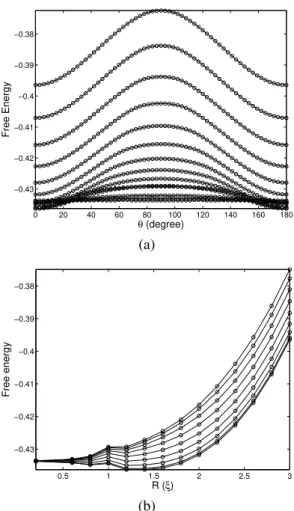
Figure 2. Dependence of the free energy,Fc, with the pinning cen-ter radiusRand the angleθ.
Fig. 2(a) - Variation ofFcas a function of the angleθin the range
0◦to180◦, data points obtained for increments of3◦. The radius
Rvaries from0.2ξto3.0ξand for each increment of0.2ξresults in a distinct curve, all plotted in ascendant order from bottom to top.
Fig.2(b) - Variation ofFcas a function of the pinning center ra-dius for a specific value ofθ. The radius varies from0.2ξto3.0ξ with an increment of0.2ξ. Distinct curve correspond to different θ, equal to0◦,9◦,18◦,27◦, 36◦,45◦,54◦, 63◦and72◦in the
ascendant order form bottom to top.
The most significant advantage of the present method, is that the free energy functional, Eq. 3, contains the appropri-ate boundaries conditions to the problem. This removes the necessity of solving the theory in two independent regions and later applying the Neumman boundary conditions. Be-sides the present method easily applies to internal regions of any shape, not just spherical, and finds its solution for the given normal-superconductor interface.
4
Results
For a given pinning arrangement, which means fixed val-ues ofθandR, and the condition of one vortex in the unit cell, we carry the minimization of the free energy. Here we present the results of several independent simulations obtained for the pairs (θ, R), ranging from (0◦,0.2ξ) to (180◦,3.0ξ), in increments of3◦ forθ, and of0.2ξforR.
For each simulation we initialize the order parameter in a random way and the minimization procedure is carried for each temperature1. Then the temperature is lowered until a convergence criteria is reached, which means that the free energy has become stable. For each simulation we imple-ment at least 1200 Monte Carlo visits per mesh point in a Metropolis algorithm.
Our main results are shown in the two main curves of Fig. 3. The Fig. 2a shows several curves of the free en-ergy density versus the angleθ, each curve associated to a differentRvalue. Similarly the Fig. 2b shows several free energy density versusRcurves, each corresponding to a dis-tinct value ofθ. The Fig. 2a shows that mirror symmetry
θ↔π−θholds as expected, since the two cavities inside the unit cell are equivalent. The free energyFc(θ, R)is an
even function inθ.
0.2 0.4 0.6 0.8 1 1.2 1.4 1.6 1.8 2 2.2 2.4 2.6 2.8 3 0.0002
0.0006 0.0013 0.0027 0.0052 0.0073 0.0096 0.0119 0.0141 0.0163 0.0184 0.0203 0.022 0.0233 0.024
cavity radius
F(
θmax
,R)−F(
θmin
,R)
Figure 3. Amplitude of oscillation.Fc(90
◦, R)− F
c(0
◦, R).
In our previous work [16,17] we have found the remark-able property that cavities inside a superconductor can lower its energy as compared to the cavity-free superconductor. This effect can be verified here in Fig. 2b, which display a set of points lying under the energy threshold of−0.434, the free energyFc(θ, R = 0), of the system without
cavi-ties, approximated byFc(θ = 0, R = 0.2), as previously
discussed. In summary we found here several pinning con-figurations, each described by the pair of values(θ, R), that have lower energy than the cavity free system. Table 1 ex-hibits these pairs(θ, R)of lower energy.
The curve of Fig. 2b shows monotonic growth [17] for the free energy, but only for R equal or larger than 1.2ξ. It also shows a local maximum for the free energy atR = 1.0ξ. In fact the behavior is distinct for the two regimes,
R > 1.0ξ andR ≤ 1.0ξ. To understand theR > 1.0ξ
case lut us hold the angle fixed, and vary the cavity radius. One finds that the free energy density is given by a constand density times the volume of the unit cell, V0 = L3,
removed of the
1The temperature here is the parameter associated with the metropolis algorithm. Its meaning is not related with the thermodynamical variable of the
TABLE 1. Range ofθandRvalues that establish a configuration with lower energy than the cavity-free superconductor.
θ(degree) 0 - 3 0 - 15 0 - 24 0 - 12 0 - 27 0 - 24 0 - 21 0 - 9
R(ξ) 0.4 0.6 0.8 1.0 1.2 1.4 1.6 1.8
non-superconductor volume of the cavities,Vc = 8/3πR3.
This result is only approximately valid since the curvature of the order parameter near the pinning sphere surface causes an increase in the kinetic energy, an effect that becomes more pronounced for large spheres. Thus we have that for
R >1.0ξ,
Fc(θf ixed, R)∝ Fcf
µ
1−8πR
3
3L3

, (5)
where Fcf ∼= Fc(0◦,0.2ξ) = −0.434 is the cavity-free
energy. The monotonic growth seen in Fig. 2b is well de-scribed by the cubicRdependence of Eq. 5.
The dependence with the angle θ exhibited in Fig. 2a may be described by the expression
Fc(θ, Rf ixed)∝fk(Rf ixed) sin2θ (6)
where the functionfk(R)incorporate all the kinetics effects
produced by the presence of the cavities with radiusR. In Fig. 2a, fk(R)provides the amplitude of oscillation for a
fixedR. As we have mentioned before, the kinetic effects become more pronounceable as the cavity radius increase. We assume thatfk is a linear function ofR.
We add Equations 5 and 6 together to obtain a general free energy expression to describe arbitrary angles of rota-tion and radii bigger than the coherence length:
Fc(θ, R) =Fcf
µ 1−Vc
V0

+fk(R) sin2θ. (7)
For all radii, the configurations of minimum and maximum energies are obtained for 0◦ and 90◦, respectively. The maximum atθ = 90◦ has a smaller superconducting vol-ume as compared to the minimum at θ = 0◦ configura-tion. This is easy to understand because the0◦ configura-tion has the two spheres aligned along the z-axis and both overlap with the vortex line, whereas the90◦configuration only one overlaps the vortex line. The other one is free in space thus taking away space that could be otherwise su-perconducting. This makes the90◦ configuration closer to the normal state than the0◦one. At some intermediate an-gle between0◦ and90◦ a depinning transition takes place, although it is not noticeable in both Figs. 2a and 2b. This transition has been studied in Ref. [16]. The functionfk(R)
is easily obtained by taking its difference at extreme an-gles,Fc(θmax, R)− Fc(θmin, R), whereθmax = 90◦ and
θmin = 0◦. This difference is shown in Fig. 3 as a function
ofR. Thus Eq. 7, the major conclusion of this paper, gives a good description of the free energy for all(θ, R)pairs.
In the limit thatR→0, the free energy should converge to the cavity free superconductor,Fcf, whose energy only
depends on the unit cell vorticity. Thus the termfkshould
vanish in this limitR → 0so that the angular dependence sin2θdisappears from the free energy:
lim
R→0fk(R) →0. (8)
We determine thefk(R)term fitting the curve of the Fig. 3
with the best linear function. In this way, the function found is:
fk(R) =−0.00358 + 0.00962R. (9)
The linear dependence of the Eq. 9 with the radiusRreflects the importance of the kinetic energy, ξ2¯¯
¯(∇ −~
2πi
Φ0 ~ A)∆¯¯
¯
2
, which describes the bending of the order parameter at the surface of the cavities, that becomes more important for large cavities.
Substituting all the terms in Eq. 7 by the terms obtained in the fitting and the parameters of the system, the energy dependence is expressed by following equation:
Fc(θ, R) = Fcf
µ
1−8πR
3
3L3

+ (0.00962R−0.00358) sin2θ. (10)
The negative constant−0.00358is in conflict with the con-dition expressed by Eq. 8. In fact in the regionR ≤1.0ξ, Eq. 9 does not apply because of mesh effects. Besides for such smallRthe present Ginzburg-Landau approach is not applicable, as previously discussed.
5
Many vortices near the zigzag of
cavities
So far we have described the case of just one vortex near a zigzag of cavities,~ν = 1ˆz. In this section we briefly com-ment on the general case of many vortices along the z di-rection,~ν =nzzˆ. Asnzincreases the upper critical field is
approached and beyond the upper critical field there is also a surface superconductivity state at the surface of the cavi-ties. The radius of the cavitiesRand the angle of rotationθ
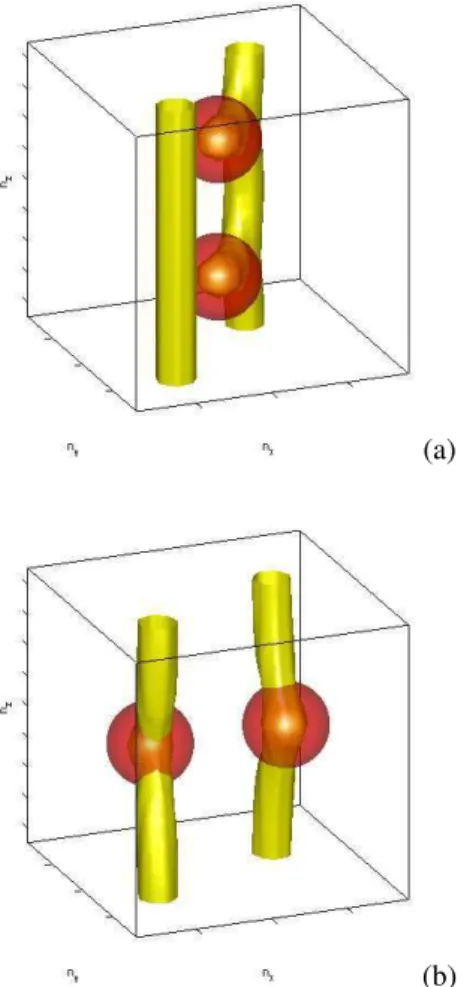
sets new geometric configurations in the unit cell that lead to multiple trapping and giant vortex states in the superconduc-tor [13]. A simple example of such configurations is shown in Fig. 4, which displays two vortices in the unit cell (nz= 2
case) forR = 1.8ξat the two extreme angles,θ= 0◦, and
θ= 90◦. Forθ= 0◦the system presents strong competition between the vortex-vortex repulsion and the vortex-cavity attraction. While one of the vortices is barely trapped by the cavities the other vortex is not pinned. The rotation of the cavities to theθ = 90◦ configuration yields a state of two vortices each one trapped by a distinct cavity. For values of
nz bigger than 2 more complex situations are possible and
(a)
(b)
Figure 4. Iso-surfaces of the order parameter|∆(~x)|2inside the
unit cell, a cube with sideL = 12ξ containing cavities (in red) with radius R = 1.8ξ. The Fig. 4a corresponds toθ = 0◦and
shows just one vortex line trapped by the defect, whereas the other one is not pinned and repelled due to vortex-vortex repulsion. In the Fig. 4b the cavities form an angleθ= 90◦and each vortex is
trapped by an independent cavity.
6
Conclusions
We have carried here a Ginzburg-Landau theory study of a vortex line near a zigzag of pinning centers. The pinning centers are insulating spherical cavities and their arrange-ment is well described by a unit cell containing two of them. Inside the unit cell the rotation of the two cavities around the center produces a continuous of zigzag arrangements whose effects on the vortex line are here discussed. We observe distinct behavior for cavity radius above and below 1.0ξ. Sweeping the angle of rotation of the cavities around its cen-ter,θ, makes the zigzag more pronounced to the point that
the vortex line decouples from it above the critical angleθc,
as previously found [13]. Below this angle the vortex line is pinned by both cavities and above by just one. Here we have determined that the free energy density has a simple analytical dependence, expressed by the Eq. 7.
Acknowledgments
Research supported in part by Instituto do Milˆenio de Nano-Ciˆencias, CNPq, and FAPERJ (Brazil).
References
[1] J.-Y. Lin, M. Gurvitch, S. Tolpygo, A. Bourdillon, S. Hou, and J. M. Phillips. Phys. Rev. B,54, 12717 (1996). [2] V. V. Moshchalkov, M. Baert, V. V. Metlusko, E. Rossell,
M. J. V. Bael, K. Temst, and Y. Bruynserade. Phys. Rev. B57, 3615 (1998).
[3] V. Yurchenko, P. Lahl, S. Bunte, M. Jirsa, and R. Wordenwe-ber. Physica C404, 426 (2004).
[4] A. Bezryadin and B. Pannetier. J. of Low Temp. Phys.98, 251 (1995).
[5] W. V. Pogosov and V. V. Moshchalkov. Physica C404, 285 (2004).
[6] A. I. Buzdin. Phys. Rev. B47, 11416 (1993).
[7] J. B. Ketterson and S. N. Song. Superconductivity. Cam-bridge University Press, 1st. edition, 1999.
[8] A. I. Larkin. Sov. Phys.-JETP31, 784 (1970). [9] E. H. Brandt. Rep. Prog. Phys.58, 1465 (1995).
[10] D. J. P. Jr. and H. A. Fertig. Phys. Rev. B67, 054504 (2003). [11] G. S. Mkrtchyan and V. V. Shmidt. Soviet Physics JETP,34,
195 (1972).
[12] M. M. Doria, S. C. B. de Andrade, and E. Sardella. Physica C,341-348, 1199 (2000).
[13] M. M. Doria and G. F. Zebende. Phys. Rev. B66, 064519 (2002).
[14] P. G. de Gennes. Superconductivity in Metals and Alloys. Persus Book, 2nd. edition, 1989.
[15] A. A. Abrikosov. Soviet Physics JETP,5, 1174 (1957). [16] M. M. Doria and A. R. de C. Romaguera. Europhys. Lett.
67, 446 (2004).
[17] A. R. de C. Romaguera and M. M. Doria. Eur. Phys. J. B42, 3 (2004).