Numerial Study of the Anisotropi Properties
of Vortex Motion in Superonduting
Films with a Periodi Lattie of Deets
I. G. R.Pitta, Cleio C. de Souza Silva,and J. Albino Aguiar
DepartamentodeFsia,UniversidadeFederaldePernambuo,
50670-901 Reife,PE,Brasil
Reeivedon28February,2002
TheanisotropieetsonthedynamialphasesofavortexlattiedrivenbyauniformLorentzfore
areinvestigatedbynumerialsimulations. Asquarearrayofolumnardefetsis representedbya
periodipinningpotential. Weassumethatowiselasti,sothatthevortex-vortexinterationsan
berepresented byelasti fores. V-Iharateristisandmean-squaredisplaementsandveloities
fordierent orientations of thedrivingfore arealulated. It is foundthat, for awiderange of
drivingforemagnitudeandorientation,thevortexlattieistransverselypinnedinhighsymmetry
diretionsof thepinning potential. Inaddition, thetransverse pinnedvortexlattie is thermally
depinnedathighenoughtemperatures.
I Introdution
The transport properties in a type-II superondutor
are dominated by the quantized ux lines, vorties,
whiharepresentinthesampleinawiderangeof
ur-rent and magneti eld. In these samples, eletrial
resistivity is zero as long as there is no oletive
mo-tionofvorties. Asatransport urrentisapplied, this
isonlypossibleifthepinningforeproduedby
mate-rialdefetsorartiialpinningentersisstrongenough
to ounter-balanethe Lorentz fore produed by the
urrent. Inadditionto, thermalutuationsshould be
suÆientlysmalltopreventthermallyativatedux
mo-tion throughthe pinning barriers. If these onditions
arenotsatised,thevortexlattie(VL)startsmoving
andompetitionbetweentheVLinternalforesand
in-terationwith theeetivepinning potentialanlead,
dependingontheurrentstrength,todierent
dynam-is whih determine the voltage-urrent (V-I)
hara-teristis.
Lattiestrutures driven by an externalfore over
aperiodiordisorderedsubstratehaveattrated
grow-ing interest. These systems usually exhibit a variety
ofomplexphenomenaanddynamialphasesthat an
dominate transport properties. Physial systems in
whihdynamialphasesplayanimportantroleinlude
boundarylubriation[1℄,hargedensitywaves,Wigner
ristals,Josephsonjuntionarrays(JJA)[2℄andvortex
latties [3-5℄. The development of several tehniques
toartiiallyfabriateperiodistruturesin
superon-vorteximagingmakedrivenvortexassemblies
interat-ing withperiodi pinningaspeially usefullsystemto
probetheories ondynamial phasesand phase
transi-tions.
Inthiswork,weuseasimpleelastimodeltostudy
the dynamis of vortex latties driven by an
exter-nal fore in a superonduting lm with periodi
ar-ray of olumnar defets. Individual vortex motion is
desribedbyoverdampedLangevinequationswhih
a-ountforrst-neighborselastiinterations,square
pin-ningpotentialanduniformdrivingforeF
d
. The
trans-portpropertiesaredeterminedbyalulatingthe
time-averagedVLenterofmass(CM)veloityasafuntion
ofF
d
. Wendthat theV-Iurvesareanisotropiand
transverse pinning of the moving VL in high
symme-try diretionsof the squarepinning arrayis observed.
We also study the stability of this phasewith respet
to thermalutuations. Wendthat the transversely
pinned VL an be thermally depinned above ertain
temperatures. These resultsarein agreementtothose
obtainedbymorerealistiomputersimmulations[3,4℄
andtoreentexperimentsin [5℄.
II Numerial details
We simulatedthe dynamisof avortexlattie in thin
olum-lattieofvortiesinteratingwiththeirrstneighbors
byelasti fores,i. e.,F
vv
= d, wheredisthe
dis-tane betweentwonearbyvortiesandis theelasti
oeÆient. Forthis preliminar study, we useda small
system, namely 8x8 vorties, with a onentration of
one vortex per deet, and periodi boundary
ondi-tions were onsidered. The defet lattie is modeled
byaperiodi pinningpotential. Tosimplify ourstudy
we expand the pinning potential in a Fourier series,
U v p
(r)= P
Q U
Q e
iQr
,whereQarereiproallattie
vetorsof the square pinning lattie, onsidering only
thehighsymmetrydiretionsofthesquarelattie,[1,0℄,
[0,1℄ and [1,1℄, that is, the Fourieromponents of the
pinningpotentialaregivenby:
U
Q =
8
>
<
>
: U
1
Q= 2
a
p ^ x;
2
a
p ^ y;
U
2
Q= 2
a
p
(^xy);^
0 otherwise:
(1)
Here weassumeU
1
=0:1and U
2 =U
1
=2. This gives
asquarepotentialasshowninFig. 1.
0
0.5
1
1.5
2
0
0.5
1
1.5
2
−10
−5
0
5
x/a
p
y/a
p
U/U
1
Figure1.Surfaeplotofthesquarepinningpotentialgiven
byEq.(1)andusingU
2 =U
1 =2.
Thermalutuationsareaddedbyapplyingan
ap-propriatedBrownianfore
i
ineahvortex. Thisfore
isagaussian,stohastivariablewithzeroaverageand
representsthethermalnoise,beingrelatedtothe
tem-peraturebytheutuation-disspationtheorem.
ThedrivingforeF
d
istheLorentzforedue toan
externally applied urrent J, i.e., F
d =
0 ^
J, where
is the unit vetor parallel to the vortex symmetry
axis. Approximatingvortiestomasslesspartiles,
vor-tex dynamis an be desribed by overdamped
equa-tionsofmotion,
v
i =F
vv rU
p +F
d +
i
; (2)
where isthefritionaloeÆient. Fromnowon,,
andthepotentialperiodiitya aretakentobeunits.
III Results and disussion
Forsmallenoughdrivingfores,thevortexlattie
inter-ationswiththepinningentersdonotallowthelattie
toow. Byinreasingthedrivingforeslightly,
depin-ning ours and the vortex lattie starts owing. In
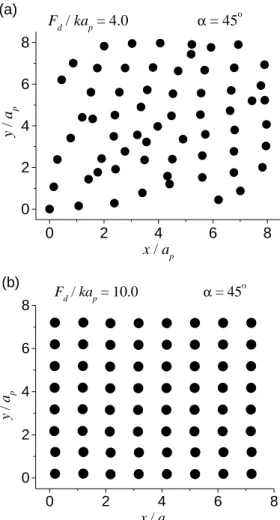
thisinitialowthevortexmotionisdisorderedor
plas-ti(Fig. 2-a) and reorder into a lattie (Fig. 2-b)as
F
d
inreases. This reorderingeet isexpeted, sine,
for high enough driving fores, the pinning potential
asfeltby the movingvortexassembly is avaregedout
inthe diretionof motion. Forvortexmotionin some
high symmetry axis, the moving VL interats with a
stati\washboard" potential periodi in thediretion
perpendiular to CM motion and the ordered vortex
lattieanbeeitherommensurateorinommensurate
withthiswashbordpotential,dependingonthepinning
strength. For motion in other diretions the average
pinningpotential desapearsompletely. This leads to
stronglyanisotropitransportproperties.
0
2
4
6
8
0
2
4
6
8
(a)
F
d
/ ka
p
= 4.0
α
= 45
o
y /
a
p
x / a
p
0
2
4
6
8
0
2
4
6
8
(b)
F
d
/ ka
p
= 10.0
α
= 45
o
y /
a
p
x / a
p
Figure2.Snapshotsofthevortexassemblyfor(a)F
d =a
p =
4:0(disorderedow)and(b)Fd=ap=10:0(orderedlattie
ow).
Tostudythisanisotropiproperties,weusedinour
ranging from 0to 45 Æ
in multiples of 5 Æ
. InFigs. 3-a
and3-bF
d
isappliedatzerotemperatureandthe
hor-izontal (v
x
)andvertial(v
y
)omponentsofVLenter
of mass veloities are alulated. As an be seen in
Fig. 3-a the onset of vortex motionin x and y
dire-tionsoursfordierentF
d
intensities. ForF
d
orienta-tionsbetween0and25 Æ
,afterthedepinningthreshold,
the motion remains trapped (or transverselly pinned)
in [1,0℄diretion until F
y
reahes aritial value. As
seenin Fig. 3-b,for higherangles(0 Æ
<<45 Æ
),the
VLis pinnedin the [1,1℄diretion (v
x =v
y
). InFigs.
3- and 3-d we made the samesimulation using
non-zerotemperatures. This gureshows that theritial
transversedepinningforedereasesastemperature
in-reases,whihmeansthatthepinningpotentialeets
aresoftenedbythermalutuations.
To study in further details the transverse
depin-ning, F
d
wasinitially xed in the horizontal diretion
(F
x
= 4:0=a
p
) and F
y
raised from F
y
= 0up to 5.5
a
p
for four dierenttemperatures: from k
b
T =0 up
to k
b
T =0:06a 2
p
, as shown in Fig. 4. The range of
foreswheretheVLmotionremainsinthetransversely
pinned phase { diretions [1,0℄ and [1,1℄ { dereases
as temperature inreases. In this way, it is possible
to transversely depin the VL by raisingthe
tempera-ture. This is illustrated by Fig. 5, where the
tem-peraturedependene of transversedepinning is shown
for xed F
x
= 4:0a
p
and for three dierent F
y
in-tensities, namely: F
y
= 1:05a
p , F
y
= 1:15a
p and
F
y
=1:25a
p
. AT F
y
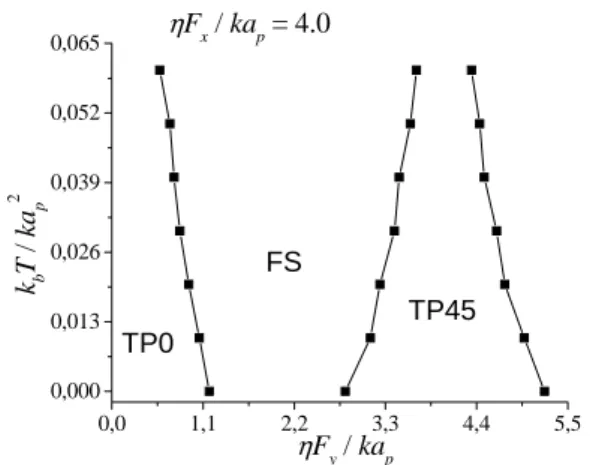
dynamialphasediagram,for
F
x
xedat 4:0=a
p
, isshownin Fig. 6. Three phases
an be distinguished: twotransversely pinned phases,
one in the [1,0℄ diretion and another in the [1,1℄
di-retion, and aoating solid phase, where no trapping
our.
0
3
6
9
12
15
0
3
6
9
12
15
(a)
v
x
v
y
k
b
T = 0.0 ka
p
2
η
v /
k a
p
F
d
/ k a
p
0
3
6
9
12
15
0
3
6
9
12
15
(b)
v
x
v
y
k
b
T = 0.0 ka
p
2
η
v /
k a
p
F
d
/ k a
p
0
3
6
9
12
15
0
3
6
9
12
15
(c)
v
x
v
y
k
b
T = 0.01 ka
p
2
η
v /
k a
p
F
d
/ k a
p
0
3
6
9
12
15
0
3
6
9
12
15
(d)
v
x
v
y
k
b
T = 0.01 ka
p
2
η
v /
k a
p
F
d
/ k a
p
Figure3. Vortexlattieveloityasafuntionofthedriving
foreforranging,inmultiplesof5 Æ
,from0to25 Æ
,(a)and
(),andfrom30 Æ
to45 Æ
,(b)and(d). Thearrows indiate
inreasing. (a), (b)are atzero temperatureand (),(d)
atkbT=0:01a 2
0
1
2
3
4
5
6
0
1
2
3
4
5
6
v
y
v
x
F
x
= 4.0 ka
p
k
b
T = 0.00 ka
p
2
k
b
T = 0.02 ka
p
2
k
b
T = 0.04 ka
p
2
k
b
T = 0.06 ka
p
2
η
v /
ka
p
F
y
/ ka
p
Figure4. v
x andv
y
asfuntionsofF
y forF
x
xedat4:0a
p
anddierenttemperatures.
0,0000
0,0055
0,0110
0,0165
0,0220
0,0275
0,0
0,2
0,4
0,6
F
x
/ ka
p
= 4.0
F
y
/ ka
p
= 1.05
F
y
/ ka
p
= 1.15
F
y
/ ka
p
= 1.25
η
v
y
/
ka
p
k
b
T / ka
p
2
Figure5.Temperaturedependeneofthetransverse
depin-ningwithFx xedat4:0apandthreedierentintensities
ofFy.
IV Conlusion
Inonlusionwehavenumeriallysimmulatedavortex
lattie in a superonduting lm with a square array
of pinning enters driven by a uniform driving fore.
As asimpliation,thevortieswereonsidered to
in-terat onlywiththeirrstneighbors viaelastifores.
Theresultsagreequalitativelywithreentexperiments
[5℄ and numerial simulationof long-rangeinterating
vorties[3℄andJJA[4℄. TheV-Iharateristis,
repre-shown to be highly anisotropi, and it was observed
transverse pinning in the diretions [1,0℄ and [1,1℄ of
the square pinning lattie. We have also studied the
temperaturedependeneofthetransverseCMveloity
whih illustratethermaltransversedepinning. Our
re-sultsontransverse pinningare summarizedin the
dy-namial phase diagram of Fig. 6, where the onset of
transversevoltageareplotted.
0,0
1,1
2,2
3,3
4,4
5,5
0,000
0,013
0,026
0,039
0,052
0,065
TP0
TP45
FS
η
F
x
/ ka
p
= 4.0
k
b
T
/
ka
p
2
η
F
y
/ ka
p
Figure6. Dynamialphasediagram;showingthreephases:
trasnversaly pinned in diretions [1,0℄ (TP0) and [1,1℄
(TP45)andadepinnedoroatingsolidphase(FS).
Aknowledgments
ThisworkwassponsoredbytheBrazilianAgenies
CNPqandFACEPE.WethankL.R.E.Cabralfor
use-fullsuggestionsandstimulatingdisussions.
Referenes
[1℄ B.N.J. Persson, Sliding Frition: Physial Priniples
andappliations(Springer,Heidelberger,1998).
[2℄ R.S.Newrok,C.J.Lobb,U.Geigenmller,andM.
O-tavio,SolidStatePhys.54,263(2000).
[3℄ G. Carneiro J. Low Temp. Phys. 117, 1323 (1999);
Phys.Rev.B62,14661(2000).
[4℄ V.I.Maroni, S.Candia,P.Balenzuela,H. Pastoriza,
D.Dominguez,Phys.Rev.B62,4096(2000).
[5℄ V.I.Maroni andD.Dominguez,Phys.Rev.Lett.82,
4922(1999);Phys.Rev.B63,174509 (2001).
[6℄ A.N. Lykov, Adv. Phys. 42, 263 (1993). V.V.
Moshhalkov,V.Bruyndonx,L.VanLook,M.J.Van
Bael, Y. Bruynseraede,and T.Tomomura,Handbook
ofNanostrutured MaterialsandNanotehnology,Vol.