www.jped.com.br
ORIGINAL
ARTICLE
Screen
time
impairs
the
relationship
between
physical
fitness
and
academic
attainment
in
children
夽
Macarena
M.
Aguilar
a,
Felipe
A.
Vergara
a,
Erikson
J.A.
Velásquez
a,
Raquel
Marina
b,
Antonio
García-Hermoso
c,∗aUniversidadAutónomadeChile,Talca,Chile
bUniversidadAutónomadeChile,SantiagodeChile,Chile
cLaboratoriodeCienciasdelaActividadFísica,elDeporteylaSalud,UniversidaddeSantiagodeChile,USACH,
SantiagodeChile,Chile
Received8August2014;accepted23October2014 Availableonline31January2015
KEYWORDS
Academic performance; Cardiorespiratory fitness;
Muscularstrength; Sedentarylifestyle
Abstract
Objective: Thepurposeofthisstudywastwofold:toanalyzetheassociationbetween phys-ical fitnessandacademicattainment,andtodeterminetheinfluenceofscreentimeonthe associationbetweenphysicalfitnessandacademicattainment.
Methods: Across-sectionalstudyincluding395schoolchildrenfromsevenschoolsoftheMaule Region, Chile(meanage12.1years;50.4%boys)participatedintheautumnof2014(March toJune).Self-reportedphysicalactivityandscreentimewereevaluated.Thestudymeasured academic achievement(meanofthegrades obtainedinseveralcoresubjects),physical fit-ness(cardiorespiratoryfitnessandmuscularstrength),weight,height,parentaleducation,and socioeconomicstatus.Linearregressionanalysiswasusedtoanalyzetherelationshipsbetween physicalfitnessandacademicattainmentafteradjustingforpotentialconfoundersbygender. Analysisofvariancewasusedtoanalyzethedifferencesinacademicattainmentaccordingto fitnessandscreentimecategories(<2hours/dayand≥2hours/day).
Results: Inbothgendersgoodcardiorespiratoryfitnesslevelswereassociatedwithhigh lan-guage (=0.272---0.153)and mean academic attainment (=0.192---0.156) grades;however, afteradjustingforscreentimeandotherpotentialconfounders,theseassociationsdisappear. Similarly,norelationshipwasobservedafteranalyzingthosechildrenwhospendmorehoursof screentime(≥2hours/day).
Conclusions: Academicattainment isassociated withhighercardiorespiratoryfitnesslevels; however,itwasweaklyimpairedbyscreentime.Thesefindingsseemtosuggestthatparents andpolicymakers shouldminimizethenegativeeffectsofscreentime onchildren’s livesto maximizethebeneficialeffectofhealthyhabitsonacademicattainment.
©2015SociedadeBrasileiradePediatria.PublishedbyElsevierEditoraLtda.Allrightsreserved.
夽
Pleasecitethisarticleas:AguilarMM,VergaraFA,VelásquezEJ,MarinaR,García-HermosoA.Screentimeimpairstherelationship betweenphysicalfitnessandacademicattainmentinchildren.JPediatr(RioJ).2015;91:339---45.
∗Correspondingauthor.
E-mail:[email protected](A.García-Hermoso).
http://dx.doi.org/10.1016/j.jped.2014.10.004
340 AguilarMMetal.
PALAVRAS-CHAVE
Desempenho acadêmico; Aptidão
cardiorrespiratória; Forc¸amuscular; Estilodevida sedentário
Otempodetelaprejudicaarelac¸ãoentreaformafísicaeosucessoacadêmicoem crianc¸as
Resumo
Objetivo: Oobjetivodesteestudofoiduplo:analisararelac¸ãoentreaformafísicaeosucesso acadêmicoedeterminarainfluênciadotempodetelasobrearelac¸ãoentreaformafísicaeo sucessoacadêmico.
Método: Umestudo transversal incluindo395crianc¸asem idade escolarde seteescolasda regiãodeMaule,Chile(comidade médiade12,1anos;50,4%demeninos), foirealizadono outonode2014(marc¸oajunho).A atividadefísicaeotempodetela autorrelatadosforam avaliados.Mensuramosodesempenhoescolar(médiadasnotasobtidasemdiversasmatérias principais),aformafísica(aptidãocardiorrespiratóriaeforc¸amuscular),opeso,aestatura, aescolaridadedospaiseacondic¸ãosocioeconômica.Aanálisederegressãolinearfoiusada paraavaliarasrelac¸õesentreaformafísicaeosucessoacadêmicoapósoajustepelaspossíveis variáveisdeconfusãoporsexo.Aanálisedevariânciafoiusadaparaavaliarasdiferenc¸asno sucessoescolardeacordocomascategoriasdeformafísicaetempodetela(<2horas/diae ≥2horas/dia).
Resultados: Emambosossexos,osbonsníveisdeaptidãocardiorrespiratóriaforamassociados àsmaioresnotasemlínguas(=0,272-0,153)eàmédiadesucessoacadêmico(=0,192-0,156); contudo,apósajustarotempodetelaeoutraspossíveisvariáveisdeconfusão,essasassociac¸ões desaparecem.Damesmaforma,nãofoiobservadanenhumarelac¸ãoapósanalisarascrianc¸as commaishorasdetempodetela(≥2horas/dia).
Conclusões: O sucesso acadêmico está associado amaiores níveis de aptidão cardiorrespi-ratória; contudo,foi poucoprejudicadopelotempodetela. Essesachadosparecemsugerir queospaiseórgãosreguladoresdevemminimizarosefeitosnegativosdotempodetelasobre asvidasdascrianc¸as paramaximizaroefeitobenéfico dehábitossaudáveissobreosucesso acadêmico.
©2015SociedadeBrasileiradePediatria.PublicadoporElsevierEditoraLtda.Todososdireitos reservados.
Introduction
Electronic media use is a common pastime for children today and has led to negative health effects in children andadolescents.1Theseeffectsincludelesstimefor physi-calactivity,2pooreracademicperformance,3higherriskof overweight,4andlowlevelsofphysicalfitness,5interalia. Therefore,strategiesaimed toreduce screen timeinthis populationhavestartedtoemerge.6Forexample,theWorld HealthOrganization goalhasbeentoincreasethe propor-tionofadolescentswhoviewtelevisiontwoorfewerhours onaschoolday.7
According toprevious studies, higherlevelsof physical fitness8,9andphysicalactivity(PA)10arerelatedtoenhanced overall health11 and are also associated withhigher aca-demic attainment. However, the evidence from several studiesconcerningtheassociationbetweenphysicalfitness andacademicattainmentremainsweak,dueprincipallyto lackofcontrolforimportantconfounders.12Becausescreen timeisasignificantpredictorofacademicattainment2and highscreen-timeduringchildhoodisanindependent predic-toroflowercardiorespiratoryfitnessinyouth,13,14itappears importanttoexaminethemediatingeffectthatscreentime mayhave ontheassociation betweenphysical fitnessand academicattainment.Totheauthors’knowledge,nostudy hasattemptedtoanswerthisquestion.Therefore,the pur-poseofthisstudywastwofold:toanalyzetheassociationof
physicalfitnessandacademicattainment,andtodetermine the influence of screen time on the association between physicalfitnessandacademicattainment.
Methods
Participants
BodyComposition
Participantswearinglightclothingwereweighedtwiceusing adigitalscalewithanaccuracyof100g.Height was mea-sured twice to the nearest 0.1cm, without shoes, using awall-mounted stadiometer.Themeanof these measure-mentswasusedtocalculatebodymassindex(BMI)asweight inkilogramsdividedbythesquareoftheheightinmeters (kg/m2).Waistcircumference(WC)wasdeterminedbythe averageoftwomeasurementstakenwithaflexibletapeat thewaist(atthemidpointbetweenthelastribandtheiliac crest).Ameanoftworeadings wastakenin themorning, undercontrolledtemperatureandhumidityconditions,with thechildshoeless,fasting,andafterurinationanda15min rest.
Physicalfitnesstests
PhysicalfitnesstestswereassessedaccordingtotheAlpha Battery,valid andreliable in children.15 Cardiorespiratory fitness (CRF) was measured using the 20m shuttle run test.Theinitialspeedwas8.5km/h;thiswasincreasedby 0.5km/hmin−1(stageduration=1minute)andthelasthalf
stage completed wasrecorded.16 Scores of the last stage numberwereconvertedtopredictmaximaloxygenuptake: VO2max(ml/kg/min)=31.025+3.238x(speed-km/h)---3.248
x(age)+0.1536x(speedxage).Muscularstrength(MS)was measured with the standing broad jump test (lower limb explosive strength assessment). Participants jumped hori-zontallytoreachmaximumdistance(incentimeters).This testwasperformedtwice,andthebestscorewasrecorded. The CRF and MS were categorized as follows: poor (first quartile),satisfactory(secondandthirdquartiles),andgood (fourthquartile).
Academicattainment
Academic attainment was assessed using the students’ grades in the core subjects (mathematics and language). Gradeswere collected fromthe officialschool recordsat fourmomentsinthefirstsemester(March,April,May,and June 2014). Numeric grade scores in Chile range from 1 (worst) to7 (best). The average scorewas calculatedfor allsubjects.
Self-reportedscreentime
Screen timewasassessedby askingparticipants toreport thenumberofhourspertypicaldayinthepastsevendays withathree-partquestion:‘‘Abouthowmanyhoursaday do you usually watch television, play computer or video games,anduseacomputer(forpurposesother than play-inggames,for example,emailing,chatting,or surfingthe Internetordoinghomework)inyourfreetime?’’This ques-tionwasusedintheHealthBehaviorinSchool-agedChildren (HBSC)study.17Finally,dailyscreentimeaverageswere cal-culated byadding thethree componentstogether.Screen timewas dichotomized (0=< 2h/d; 1=≥ 2h/d)based on internationalguidanceonlimitingpediatricscreentime.18
Self-reportedphysicalactivity
The questionnaire employed to assess PA was the Physi-calActivityQuestionnaireforAdolescents(PAQ-A),Spanish version.19 In brief,thePAQ-Awasdesigned toassess ado-lescents’levelsofmoderateandvigorousphysicalactivity. Physicalactivitywasdefinedas‘sports,games,ordancethat makeyoubreathhard,makeyour legsfeeltired,ormake yousweat’.Subjectswereaskedtoquantifytheirphysical activitylevelsduringtheirsparetimeinthepreviousseven days.Nine items scored ona five-point Likert scale were averagedtoderiveanoverallphysicalactivityscoreranging fromonetofive(higher scoresindicating higher levelsof physicalactivity).
Confounders
Potentialconfoundersidentifiedinpreviousliteraturewere included in the analyses. The mother’s and father’s edu-cation andsocio-economic status(SES) wasrecorded in a questionnaire.Parentswereaskedabouttheirhighestlevel of education (both mother and father) and were catego-rizedasprimary,secondary,anduniversityeducation.SES was measured using a scale based on Graffar’s modified method,20takingintoacountthreecategoriesaccordingto school(High,Medium,andLowSES).Thesecategorieshave beenusedinotherrecentstudieswithChileanchildren.10
Data
analysis
342 AguilarMMetal.
Table1 Characteristicsofthestudysample.
Total (n=395)
Boys (n=199)
Girls (n=196)
p
Age,years 12.1±0.7 12.2±0.6 12.2±0.7
Bodycomposition
Height,m 1.56±0.07 1.57±0.08 1.56±0.06 0.262
Weight,kg 55.3±11.1 56.1±12.0 54.4±10.16 0.140
BMI,kg/m2 22.6±5.1 23.0±5.5 22.2±4.58 0.129
Waistcircumference,cm 70.1±8.0 70.2±8.1 69.9±7.92 0.668
Health-relatedphysicalfitness
CRF:VO2max,ml/kg/min 19.1±9.8 20.4±10.1 17.8±9.3 0.008
MS:Standingbroadjump,cm 154.3±29.5 168.8±27.3 139.5±23.9 <0.001
Academicachievement
Language 5.0±0.9 4.8±0.9 5.2±1.8 <0.001
Mathematics 5.3±2.6 5.3±3.6 5.2±0.8 0.606
Meanacademicachievementa 5.3±0.6 5.3±0.7 5.2±0.6 0.058
Self-reportedsedentarybehavior
Screentime,h/day 2.7±1.3 2.9±1.4 2.4±1.1 <0.001 Exceedingrecommendedlimitsb,n(%) 122(30.9) 75(37.7) 47(24.0) <0.001
Self-reportedphysicalactivity
PAQ-A 1.90±0.3 1.96±0.3 1.84±0.3 0.006
Father’seducation
Primary,n(%) 23(5.9) 16(8.0) 7(3.6) 0.347
Middle,n(%) 304(77.0) 152(76.4) 152(77.6) University,n(%) 68(17.2) 31(15.6) 37(18.9)
Mother’seducation
Primary,n(%) 13(3.3) 7(3.5) 6(3.1) 0.638
Middle,n(%) 324(82.0) 157(78.9) 167(85.2) University,n(%) 58(14.7) 35(17.6) 23(11.7)
SES
Low,n(%) 70(17.7) 32(16.1) 38(19.4) 0.581
Middle,n(%) 267(67.6) 143(71.9) 124(63.3) High,n(%) 58(14.7) 24(12.1) 34(17.3)
BMI,bodymassindex;CRF,cardiorespiratoryfitness;MS,muscularstrength;SES,socioeconomicstatus;PAQ-A,PhysicalActivity Ques-tionnaireforAdolescentsSpanishversion.
Valuesaremean±SD.
aMeanofthescoresinmathematicsandlanguage(scale1-7). b ≥2h/dofscreentime.
Results
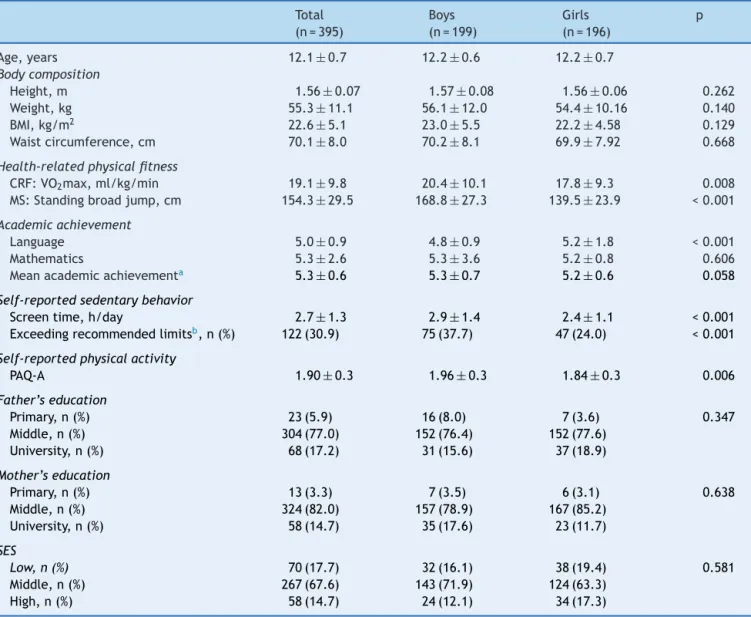
Table 1 presents descriptive characteristics of the study samplebygender.Therewerenodifferencesinage,body compositionvariables,parentaleducation,orSES.Overall, boysscoredhigherthangirls infitnesstests,screen time, andPA.Fortheirpart,girlshadhighervaluesthanboysin languageandmeanacademicattainment.
Multipleregression models predictingacademic attain-ment, using physical fitness levels as predictors, and controllingforage,gender,BMI,SES,PA,andparental edu-cationbygender areshown inTable2.CRFwaspositively associated with language (=0.272, R2=0.156; =0.153,
R2=0.177 in boys and girls, respectively) and mean
aca-demicattainment(=0.192,R2=0.125;=0.156,R2=0.132
inboysandgirls,respectively)in model1;however,after adjustingbyscreentimeinmodel2theseassociations dis-appeared.
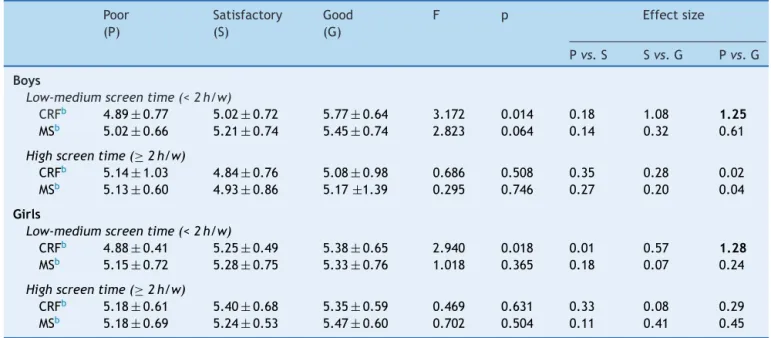
Table3showsmeandifferencesinacademicachievement by categories of CRFand MS according toamount screen time,adjustingforage,gender,BMI,SES,PA,andparental education.Academicattainmentwashigherinchildrenwith goodCRFlevels(ES=1.25,p=0.010;ES=1.28,p=0.015in boysand girls,respectively) andlow-medium screen time (< 2hours/day) than in children with poor fitness. How-ever,in childrenofbothgenderswithhighscreentime(≥ 2hours/day)thisdifferencewasnotsignificant.
Discussion
screen
time,
and
academic
attainment
343
Table2 Associationsofphysicalfitnesswithacademicattainmentinchildrenbygender.
Math Language Meanacademicattainment
(95%CI) p R2 (95%CI) p R2 (95%CI) p R2
Boys
Model1
CRF 0.102(-1.559,6.758) 0.219 0.056 0.272(0.658,2.365) 0.011 0.156 0.192(0.021,0.210) 0.016 0.125 MS 0.006(-8.355,9.947) 0.946 0.046 0.108(-0.034,3.408) 0.067 0.101 0.102(-0.022,0.276) 0.075 0.103
Model2
CRF 0.100(-1.613,6.734) 0.227 0.057 0.172(-0.653,2.367) 0.081 0.057 0.101(-0.020,0.210) 0.098 0.106 Muscularstrength 0.005(-8.429,8.923) 0.955 0.048 0.100(-0.244,3.411) 0.099 0.093 0.061(-0.123,0.276) 0.453 0.094
Girls
Model1
CRF 0.047(-0.760,1.370) 0.572 0.025 0.153(0.048,1.885) 0.022 0.177 0.156(0.049,0.251) 0.015 0.132 MS 0.103(-0.687,3.044) 0.214 0.033 0.170(-0.118,3.508) 0.066 0.083 0.150(-0.008,0.254) 0.095 0.071
Model2
CRF 0.059(-0.703,1.460) 0.490 0.026 0.151(-0.070,1.902) 0.078 0.076 0.048(-0.099,0.054) 0.563 0.051 MS 0.095(-0.815,2.985) 0.261 0.031 0.104(-0.231,3.591) 0.085 0.043 0.117(-0.013,0.254) 0.105 0.070
CRF,cardiorespiratoryfitness;MS,muscularstrength;CI,confidenceinterval.
344 AguilarMMetal.
Table3 Meandifferencesofacademicattainmentaandphysicalfitnessaccordingtoscreentimecategories.
Poor (P)
Satisfactory (S)
Good (G)
F p Effectsize
Pvs.S Svs.G Pvs.G
Boys
Low-mediumscreentime(<2h/w)
CRFb 4.89±0.77 5.02±0.72 5.77±0.64 3.172 0.014 0.18 1.08 1.25
MSb 5.02±0.66 5.21±0.74 5.45±0.74 2.823 0.064 0.14 0.32 0.61
Highscreentime(≥2h/w)
CRFb 5.14±1.03 4.84±0.76 5.08±0.98 0.686 0.508 0.35 0.28 0.02
MSb 5.13±0.60 4.93±0.86 5.17±1.39 0.295 0.746 0.27 0.20 0.04
Girls
Low-mediumscreentime(<2h/w)
CRFb 4.88±0.41 5.25±0.49 5.38±0.65 2.940 0.018 0.01 0.57 1.28
MSb 5.15±0.72 5.28±0.75 5.33±0.76 1.018 0.365 0.18 0.07 0.24
Highscreentime(≥2h/w)
CRFb 5.18±0.61 5.40±0.68 5.35±0.59 0.469 0.631 0.33 0.08 0.29
MSb 5.18±0.69 5.24±0.53 5.47±0.60 0.702 0.504 0.11 0.41 0.45
CRF,cardiorespiratoryfitness;MS,muscularstrength. Valuesareexpressedasmean±SD.
Theeffectsizecorrespondingtomeanpairsthatshowedstatisticalsignificance(p-valueslessthan0.05forposthochypothesistwo-sided testingwiththeBonferronicorrectionformultiplescomparisonsaresetinbold).
Analysesadjustedforage,bodymassindex,SES,PA,andparentaleducation. aMeanofthescoresinMathematicsandLanguage(scale1-7).
b CategoriesofCRFandmusclestrengtharecategorypoor(P),satisfactory(S),andgood(G),representingthefirst,second-third,and
fourthquartiles,respectively.
mayhave a harmful influence onacademic attainment in children,disfavoringthebenefitsofhealth-relatedphysical fitnesscomponents. However, due tothe methodused to evaluatetheacademicperformance,thesefindingsshould beinterpretedwithcaution.
Agrowingbodyofevidencesuggeststhatphysicalfitness mayplay akeyrolein academicattainmentinyouth.8,9,22 Inthissense,parallelingthefindingsofthepresent cross-sectional study, several studies have shown a positive relationshipbetweenCRFandacademicattainment,inboth genders8,23orinboys.9Therefore,CRFappearstoimprove cognitionthroughincreasedlevelsofcirculatingfactorsthat positivelyinfluence cognitive functionand brain health.22 Furthermore, the relationship between MS and academic attainmentislesswelldocumented,andpreviousresearch in thisarea hasyielded equivocal results. Several studies haveshownarelationship12,23,24or,inlinewiththepresent study, have not shown a relationship.8,9 Discrepancies in thesefindings couldbedue todifferences in evaluations, thetestsusedforthispurpose(standinglong-jump,handgrip test,curl-ups,etc.),andthepotentialconfounders consid-eredintheanalyses.
The relationship between screen time and academic attainmentis notcompletelyknown.Severalstudies have shown that screen time interferes with academic activ-ities, and hence has adverse consequences on academic attainment.3,25 In contrast, other studies have found a positiverelationship26,27 or reportedno association.28 The presentresultsshowedthatscreentimewasinversely asso-ciated with academic attainment in both genders (data not shown). Furthermore, a recent large study in English
youths13andatwoyearlongitudinalstudy14showeda nega-tiveassociationbetweenscreentimeandCRFindependent of PA.Thus,CRF andacademicattainment areassociated withscreentime.Thepresentresultssuggestthatthe rela-tionshipbetween bothis notindependentof screentime. Therefore, it seems that this parameter should be taken into accountas the confoundingvariable in this relation. The datacouldalsosupportsomepotentialcognitive ben-efitsofcurrentrecommendationstolimitdailyscreentime to<2hours.3 These findings, among others, highlight the needforestablishingprogramsfocusedoneducatingparents aboutrecommendedlimitsandtheimportanceofconsistent rules regarding screen time.29 Thus, it may limit the so-called‘‘timedisplacementtheory’’,30 encouraginggreater participationinPA,oranotheractivitysuchasreading,doing homework, or sleeping that provides positive benefits on learningandacademicattainment.
In conclusion, academic attainment is associated with higherCRFlevels,butitseemsthisrelationshipwas some-whatimpairedbyscreentime.Thepresentfindings,among others, highlight that screen time influences on children should be recognized by schools, policymakers, product advertisers,andentertainmentproducers,thusestablishing strategiestominimizethenegativeeffects.
Limitations
grades to index academic attainment provided objective information, but makes it difficult tocompare with stan-dardized tests used by others authors. Similarly, using school-based grades given by teachers is subjectto bias. Third,thisstudydidnotaskabouttheuseof‘‘newmedia’’ technologies (including cell phones, tablets, and social media),adominantforceinchildren’slives.29Fourth,other teststodeterminemuscularfitnessarerequired(e.g., hand-grip test).9 Finally, dataobtainedonPA levelsandscreen time(self-reportedquestionnaire)maynotprovidean accu-rateoverallrepresentationoftheseimportantvariables.
Conflicts
of
interest
Theauthorsdeclarenoconflictsofinterest.
Acknowledgements
Theauthorswouldliketothanktheschools,children,and familiesfortheirparticipationandinterestinthestudy.
References
1.Strasburger VC, Jordan AB, Donnerstein E. Health effects of media on children and adolescents. Pediatrics. 2010;125:756---67.
2.SyväojaHJ,KantomaaMT,AhonenT,HakonenH,Kankaanpää A,TammelinTH.Physicalactivity,sedentarybehavior,and aca-demicperformanceinFinnishchildren.MedSciSportsExerc. 2013;45:2098---104.
3.SharifI, Sargent JD. Association between television, movie, andvideogameexposureandschoolperformance.Pediatrics. 2006;118:e1061---70.
4.Falbe J, Rosner B, Willett WC, Sonneville KR, Hu FB, Field AE.Adiposityand differenttypesofscreentime. Pediatrics. 2013;132:e1497---505.
5.ArangoCM, ParraDC, GómezLF,Lema L, LobeloF,Ekelund U.Screentime,cardiorespiratoryfitnessandadiposityamong school-agechildrenfromMonteria,Colombia.JSciMedSport. 2014;17:491---5.
6.FriedrichRR,PoletJP,SchuchI,WagnerMB.Effectof interven-tionprogramsinschoolstoreducescreentime:ameta-analysis. JPediatr(RioJ).2014;90:232---41.
7.WorldHealthOrganization(WHO).Globalrecommendationson physicalactivityforhealth.Geneva:WHO;2010.
8.Esteban-CornejoI,Tejero-GonzálezCM,Martinez-GomezD, del-CampoJ,González-GaloA,Padilla-MoledoC,etal.Independent andcombinedinfluenceofthecomponentsofphysicalfitness onacademicperformanceinyouth.JPediatr.2014;165,306-12. e2.
9.Torrijos-Ni˜noC,Martínez-VizcaínoV,Pardo-GuijarroMJ, García-PrietoJC,Arias-PalenciaNM,Sánchez-LópezM.Physicalfitness, obesity,andacademicachievementinschoolchildren.JPediatr. 2014;165:104---9.
10.Correa-BurrowsP.,BurrowsR.,IbacetaC.,OrellanaY.,Ivanovic D.PhysicallyactiveChileanschoolkidsperformbetterin lan-guageandmathematics.HealthPromotInt.2014Mar12.[Epub aheadofprint].
11.OrtegaFB,RuizJR,CastilloMJ,SjöströmM.Physicalfitnessin childhoodandadolescence:apowerfulmarkerofhealth.IntJ Obes(Lond).2008;32:1---11.
12.Eveland-SayersBM,FarleyRS,FullerDK,Morgan DW,Caputo JL.Physicalfitness andacademicachievementinelementary schoolchildren.JPhysActHealth.2009;6:99---104.
13.SandercockGR,OgunleyeAA.Independenceofphysical activ-ityandscreentimeaspredictorsofcardiorespiratoryfitnessin youth.PediatrRes.2013;73:692---7.
14.Aggio D, Ogunleye AA, Voss C, Sandercock GR. Temporal relationships betweenscreen-time and physicalactivity with cardiorespiratoryfitnessinEnglishschoolchildren:a2-year lon-gitudinalstudy.PrevMed.2012;55:37---9.
15.RuizJR,Espa˜naRomeroV,CastroPi˜neroJ,ArteroEG,Ortega FB,CuencaGarcíaM,etal.ALPHA-fitnesstestbattery: health-related field-based fitness tests assessment in children and adolescents.NutrHosp.2011;26:1210---4.
16.LégerLA, MercierD, GadouryC,LambertJ. The multistage 20 metre shuttle run test for aerobic fitness. J Sports Sci. 1988;6:93---101.
17.CurrieC.,ZanottiC.,MorganA.,CurrieD.,DeLoozeM.,Roberts C.etal.Socialdeterminantsofhealthandwell-beingamong youngpeople.HealthBehaviourinSchool-agedChildren(HBSC) study:internationalreportfromthe2009/2010survey. Copen-hagen:WHORegionalOfficeforEurope,2012(HealthPolicyfor ChildrenandAdolescents,No.6);2010.p.133-7.
18.AmericanAcademyofPediatrics.CommitteeonPublic Educa-tion. AmericanAcademyofPediatrics:children,adolescents, andtelevision.Pediatrics.2001;107:423---6.
19.Martínez-GómezD,Martínez-de-HaroV,PozoT,WelkGJ, Vil-lagraA,CalleME,etal.ReliabilityandvalidityofthePAQ-A questionnairetoassessphysicalactivityinSpanishadolescents. RevEspSaludPublica.2009;83:427---39.
20.Alvarez ML, Muzzo S, Ivanovi´c D. Scale for measurement of socioeconomic level, in the health area. Rev Med Chil. 1985;113:243---9.
21.CohenJ.Statisticalpoweranalysisforthebehavioralsciences. 2ndedHillsdale:LawrenceErlbaumAssociates,Inc;1988. 22.ScudderMR,FedermeierKD,RaineLB,DireitoA,BoydJK,
Hill-manCH.Theassociationbetweenaerobicfitnessandlanguage processinginchildren:implicationsforacademicachievement. BrainCogn.2014;87:140---52.
23.CoeDP,PivarnikJM,WomackCJ,ReevesMJ,MalinaRM. Health-related fitness and academic achievement in middle school students.JSportsMedPhysFitness.2012;52:654---60.
24.BassRW,BrownDD,LaursonKR,ColemanMM.Physicalfitness andacademicperformanceinmiddleschoolstudents.Acta Pae-diatr.2013;102:832---7.
25.Peiró-VelertC,Valencia-PerisA,GonzálezLM,García-MassóX, Serra-A˜nó P, Devís-Devís J. Screen media usage, sleep time and academicperformance in adolescents: clusteringa self-organizingmapsanalysis.PLoSOne.2014;9:e99478.
26.BowersAJ,BerlandM.Doesrecreationalcomputeruseaffect highschoolachievement?EducTechnolResDev.2013;61:51---69. 27.JacksonLA,VonEyeA,WittEA,ZhaoY,FitzgeraldHE.A lon-gitudinalstudyoftheeffectsofInternetuseand videogame playing on academic performance and the roles of gender, raceandincomeintheserelationships.ComputHumanBehav. 2011;27:228---39.
28.MunasibA,BhattacharyaS.Isthe‘Idiot’s Box’raisingidiocy? Earlyandmiddlechildhoodtelevisionwatchingandchild cog-nitiveoutcome.EconEducRev.2010;29:873---83.
29.StrasburgerVC,HoganMJ,MulliganDA,AmeenuddinN, Chris-takisDA,CrossC,etal.Children,adolescents,andthemedia. Pediatrics.2013;132:958---61.