www.jped.com.br
ORIGINAL
ARTICLE
Television
viewing
habits
and
their
influence
on
physical
activity
and
childhood
overweight
夽
,
夽夽
Gisele
F.
Dutra
a,∗,
Cristina
C.
Kaufmann
b,c,
Alessandra
D.B.
Pretto
a,
Elaine
P.
Albernaz
a,daPost-GraduatePrograminHealthandBehavior,UniversidadeCatólicadePelotas(UCPEL),Pelotas,RS,Brazil bUniversidadeCatólicadePelotas(UCPEL),Pelotas,RS,Brazil
cSchoolofNutrition,UniversidadeFederaldePelotas(UFPEL),Pelotas,RS,Brazil dUniversidadeFederaldePelotas(UFPEL),Pelotas,RS,Brazil
Received6August2014;accepted12November2014 Availableonline22January2015
KEYWORDS
Children; Cohortstudies; Physicalactivity; Sedentarylifestyle; Television
Abstract
Objectives: Toassesstheprevalenceoftelevision(TV)viewinghabitsandtheirassociationwith
childhoodsedentarylifestyleandoverweightin8-year-oldchildren,fromacohortinacityin
SouthernBrazil.
Methods: Aprospectivecohortstudywithhospitalscreeningofallbirthsthatoccurredfrom
September of2002 to May of2003. This study refers to a cross-sectional analysis of data
collectedduring thecohort’s follow-upconducted at 8years ofage.Toevaluate thelevel
ofphysicalactivity,aphysicalactivity questionnairefor children andadolescentswas used
(PAQ-C),duringtheconsultationat8yearsofage.
Results: Ofthe616interviewedchildren,aprevalenceofsedentarylifestyle>70%wasfound,
aswell as thehabit ofwatching TV for more thantwo hours aday in60%of thesample,
regardlessofgender(p=0.30),income(p=0.57),orfamilysocioeconomiclevel(p=0.90).The
daily time spent watching TV was inverselyassociated withphysical activity (p<0.05) and
positivelyassociatedwithexcessweight(p<0.01).Regardingphysicalactivity,runningwasthe
mostfrequentlypracticedsportsmodalityamongthepopulation.
Conclusions: Consideringthehighprevalenceofsedentarylifestyleandchildrenwho watch
TVfor anexcessiveperiod oftime,itis necessaryto motivatesuch individualstoperform
interactiveactivities,aswellaspromoteamoreactivelifestyle,bydecreasingthetimechildren
spendinfrontoftheTV.
©2015SociedadeBrasileiradePediatria.PublishedbyElsevierEditoraLtda.Allrightsreserved.
夽 Pleasecitethisarticleas:DutraGF,KaufmannCC,PrettoAD,AlbernazEP.Televisionviewinghabitsandtheirinfluenceonphysical
activityandchildhoodoverweight.JPediatr(RioJ).2015;91:346---51.
夽夽
StudyperformedatthePost-GraduatePrograminHealthandBehavior,UniversidadeCatólicadePelotas(UCPEL),Pelotas,RS,Brazil.
∗Correspondingauthor.
E-mail:[email protected](G.F.Dutra). http://dx.doi.org/10.1016/j.jped.2014.11.002
PALAVRAS-CHAVE
Crianc¸as;
Estudosdecoorte; Atividadefísica; Sedentarismo; Televisão
Hábitodeassistirtelevisãoesuainfluênciasobreaatividadefísicaeoexcessode pesoinfantis
Resumo
Objetivos: Avaliaraprevalênciadohábitodeassistirtelevisão(TV)esuarelac¸ãocomo
seden-tarismoinfantileoexcessodepeso,emcrianc¸asaosoitoanosdeidade,pertencentesauma
coortedeumacidadedoSuldoBrasil.
Métodos: Estudodecoorteprospectivo,comtriagemhospitalardetodososnascimentos
ocor-ridos entresetembro de2002 amaio de2003. Opresente estudorefere-se a uma análise
transversaldosdadoscoletadosnoacompanhamentodacoorteocorridoaos8anosdeidade.
Paraavaliaro nívelde atividadefísica,um questionáriodeatividadefísica para crianc¸ase
adolescentesfoiutilizado(PAQ-C),duranteavisitaaosoitoanosdeidade.
Resultados: Nas616crianc¸as entrevistadas,encontrou-se uma prevalênciade sedentarismo
superiora70%,eohábitodeassistirTVporumperíodosuperiora2horasdiáriasem60%da
amostra,independentedogênero(p=0,30),renda(p=0,57)ounívelsocioeconômico(p=0,90).
O tempo diário assistindo televisão associou-se inversamente à prática de atividade física
(p<0,05)epositivamenteaoexcessodepeso(p<0,01).Comrelac¸ãoàatividadefísica,corrida
foiapráticaesportivamaisfrequentenapopulac¸ão.
Conclusões: DiantedaelevadaprevalênciadesedentarismoedejovensqueassistemTVporum
períodoexcessivo,faz-senecessáriooestímuloaatividadesinterativas,bemcomoapromoc¸ão
deumestilodevidamaisativo,comareduc¸ãodotempoquejovensdispensamemfrenteà
TV.
©2015SociedadeBrasileiradePediatria.PublicadoporElsevierEditoraLtda.Todososdireitos
reservados.
Introduction
According to data from the latest Household Budget Sur-vey(HBS),theBrazilian populationinall agegroupsolder than 5 years has followed the global trend of weight
gain1However,alsointhepreschoolpopulation,datafrom
the National Health and Nutrition Research (PNSN-1989)
andtheNationalResearchonDemographicsandHealthof
Children andWomen (PNDS-1996 and 2006/07) show that
excessweighthas increaseddramatically over thelast 17
years.2 Although the proportionof obese adultsis higher
than that of children and adolescents, the prevalence of
childhood obesity is continuously and rapidly growing in
the country, having increased three-fold in the last 20
years.1
Theimportanceofchildhoodobesitypreventioniswidely
recognized;however,manyinterventionstendtoreachonly
a small part of the population, especially in developed
countries.Therefore, population-based prevention
strate-gies seek to support and facilitate increased levels of
physical activity and healthier diets, as they are factors
amenabletointervention.3
Satisfactory results in childhood obesity control have
beenobtainedthroughtactics thatstimulatethedecrease
in sedentary behaviors.4 According to Santaliestra-Pasías
etal.,5childrenandadolescentsspendmuchoftheirleisure
timewithlowintensity andlowcaloricexpenditure
activ-ities.Additionally,in arecentstudy,Ghavamzadehetal.6
showed a direct association between the habit of
watch-ingtelevision(TV)andexcessweightinIranianadolescents,
regardless of physical activity and consumption of
obeso-genicfood.
Conversely, astudy byGiammattei etal.7 showedthat
moresedentaryschoolchildrenconsumed softdrinksmore
frequentlyand,therefore,weremoreobese.Furthermore,
according toThivel & Chaput,8 the time spent on
seden-tarybehaviorsis exacerbatedby excessivecalorie intake.
Thus,spendingmoretimeinlessvigorousactivities,suchas
watchingTV,usingthecomputer,andplayingvideogames,
hascontributedtothe weightgainof adolescents,asthe
mainphysiopathologyofthisdisorderisthepositivebalance
ofenergyintake.9Inthissense,Friedrichetal.10suggested,
basedonasystematicreview,thatinterventionprogramsin
schoolscan havea positiveeffectinreducing thetimein
frontofthescreen.
Thus,theaim ofthis studywastoevaluatethe
preva-lenceof thehabitofwatching TVanditsassociation with
childhoodsedentarylifestyleandexcessweightinchildren
aged8years,fromacohortinacityinSouthernBrazil.
Methods
BetweenthemonthsofSeptemberof2002andMayof2003, allhospitalbirthsthatoccurredinthecityofPelotaswere identified.Thisstudyreferstoacross-sectionalanalysisof datacollectedinthefollow-upofacohortthatoccurredat 8yearsofage.Detailsofthemethodologyaredescribedin previousstudies.11,12
Thisstudydescribedthepracticeofphysicalactivityin
childrenaged8years.Forthispurpose, itusedaphysical
activityquestionnaireforchildrenandadolescents(PAQ-C)13
characterizingthe level of physical activityperformed on
hasbeentranslatedandadaptedtoexcludephysical
activ-itiesandsportsnotpracticedinBrazil.14 Thequestionnaire
consistsofquestionsaboutsportsandgames,physical
activ-itiesatschool,andthoseduringleisuretime,includingthe
weekend.Eachquestionisscoredfrom1to5,withthefinal
scoreobtainedthroughthe meansof thequestion scores.
Thescores1-5represent,respectively,theverysedentary,
sedentary,moderatelyactive,active,andveryactive
cate-gories.Thus,individualscanbeclassifiedasactive(score≥
3)orsedentary(score<3).Italsocontainsaquestiononthe
meandailytimespentwatchingTV.
Forhomogeneityofdatacollection,aninstruction
man-ual was made available to the interviewers, who were
previously trained. The standardized questionnaire was
applied to the mothers or caregivers and the children
regarding aspects of childhood health, including the
fre-quency, type, and intensity of physical activity in the
previousweek.Arandomsampleof10%answereda
summa-rizedquestionnaire,appliedbythefieldworksupervisor,to
evaluatethequalityandaccuracyofthecollected
informa-tion.TheKappacoefficient(0.94)wasusedforcomparison
purposes.
Tocalculatethecohortstudysamplesize,asignificance
levelof95%andstatisticalpowerof80%wereused,
estimat-ingexposuresrangingfrom15%to80%andarelativeriskof
2.0.Totheinitiallycalculatedsize,15%wasaddedfor
possi-blelossesandcontrolofpotentialconfoundingfactors.For
theconsultationat8yearsofage,allchildrenfromprevious
follow-upswereattemptedtobelocated,butduetonew
objectsofstudyandthelargenumberoflosses,a
posteri-oricalculationofstatisticalpowerwasperformedwiththe
sampleof616children.Toanalyzethemainoutcome
(phys-icalinactivity,excessweight,andtimespentinfrontofthe
TV),thestatisticalpowerwasgreaterthan80%,maintaining
analphavalueof5%.
Thefollowingvariableswereanalyzed:demographic(sex
ofthechild-male,female,andmaternalageincomplete
years)andsocioeconomicfactors(familyincome,economic
classaccordingtotheBrazilianAssociationofResearch
Com-panies [Associac¸ão Brasileira de Empresas de Pesquisa
---ABEP]15 and maternal education), parity(number of
chil-dren,includingtheoneinthestudy),maritalstatus(living
ornotlivingwithapartner),andchildcharacteristics
(gesta-tionalage,birthweightingrams,nutritionalstatus,physical
activity, and habit of watching TV). To characterize the
sample,univariateanalysiswasperformed (frequencyand
percentage).In order toverify the difference in the
fre-quencyof physical activities andtimespent watching TV,
gender, income and economic strata, and their
associa-tionwithexcessweight,bivariateanalysiswasperformed,
assessingtheoutcomesinrelationtothosevariablesusing
thechi-squaredtest,withsignificancelevelofp<0.05.
Data wereentered in duplicate usingEpi Info 6.0 (Epi
InfoTM Help Desk Centers for Disease Control and
Preven-tion,USA)for identification andcorrection oftypos. Data
analysiswascarriedoutusingthestatisticalpackageSPSS,
release21.0 (IBMCorp.SPSSStatisticsfor Windows,USA).
TheresearchprojectwasapprovedbytheEthicsCommittee
ofUniversidadeCatólicadePelotas.Afterreceivingdetailed
informationonthestudy, parentsor guardianssigned the
InformedConsent,agreeingtotheirchildren’sparticipation
inthestudy.
100%
90%
80%
70%
60%
50%
40%
30%
20%
10%
0%
5 + times 1-4 times None
Bicycling Jumping
Playground
Dancing
Dodgeball Volleyball Basketball Swimming
Skate
Gymnastics
Running Soccer
Hide-and-seek
W
alking
Figure1 Weeklyfrequencyofperformanceofdifferenttypes
ofphysicalactivityat8yearsofage,Pelotas,RS,Brazil.
Results
Of the 3,449 births that occurred in the study screening period,81.0%(2,799)werenewbornswhose motherslived inthecityofPelotas.Ofthese,tenhadearlydischarge,26 motherswereHIVpositive(whichwereexcluded,asthe ini-tialobjectivesofthecohortwererelatedtobreastfeeding), andanother22refusedtoparticipateinthestudy,totaling 2,741 newborns,fromwhich arandomsampleof 30%was selected,correspondingto973babies.
Atthefollow-upat8yearsold,616childrenwere inter-viewed,whichrepresented63.3%oftheinitialsample,with lossesrelatedtofiverefusals,17deaths,93movestoother states or cities, and 242 addresses that were not found. Despitethelosses,thesampleinterviewedat8yearsofage showed no statistically significant differences when com-paredwiththeinitialcohort.
Itwasverifiedthata littlemorethan halfof the sam-pleweremales,60%watchedTVmorethantwohoursdaily, and71%weresedentary.Othercharacteristicsareshownin
Table1.Itcanbeobservedthatinactivityratewashigherin
girls(75.3%)thaninboys(67.4%)(p<0.05).However,itwas
independentfromincome(p=0.95)orsocioeconomicstatus
(p=0.78),andwasnotassociatedwithexcessweight,with
aprevalenceratio(PR)of1.12and95%confidenceinterval
(95%CI)of0.86to1.46;p=0.38(datanotshownintable).
The habit of watching TVfor more than twohours a day
wasnotassociatedwiththechild’sgender(p=0.30),
fam-ilyincome(p=0.57),orsocioeconomicstatus(p=0.90),but
was inversely associated withphysical activity (PR=0.78,
95% CI:0.61 to0.99;p<0.05).Moreover,itwaspositively
associated with excess weight (PR=0.83; 95% CI: 0.73 to
0.95;p<0.01).
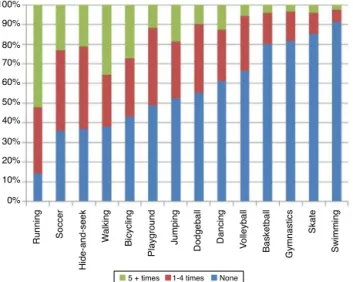
Regardingphysicalactivity,Fig.1showsthatrunningwas
the mostfrequent activity in thegeneral population.The
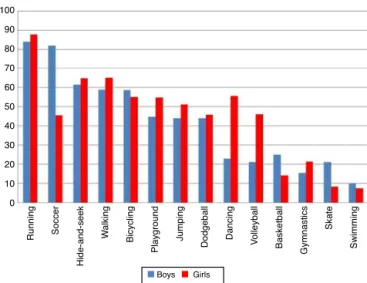
analysisby gendershows thatthispracticewasalsomore
prevalentinbothgenders.
Regardingtheparticipationineachactivityaccordingto
gender, soccer(p<0.01),basketball(p<0.01),andskating
Table1 Characteristicsofthestudysample,Pelotas,RS,
Brazil,2011.
Variable N %
Familyincomea
≤1 85 13.8
1.01to3 308 50.0
3.01to6 144 23.4
>6 66 10.7
Unknown 13 2.1
Economicclass(ABEP)b
A1andA2 24 3.9
B1andB2 202 32.8
C1andC2 325 52.8
DandE 65 10.5
Maternalagec
≤25 52 8.4
26-35 311 50.5
>35 249 40.4
Unknownd 4 0.6
Maternalschooling
Illiterate/3rdyearElementarySchool 34 5.5
Finished4thyearElementarySchool 176 28.6
FinishedElementarySchool 133 21.6
FinishedHighSchool 213 34.6
FinishedCollege/University 53 8.6
Unknowne 7 1.1
Motherliveswithpartner
Yes 480 77.9
No 128 20.8
Unknowne 8 1.3
Numberofchildren
One 143 23.2
Morethanone 473 76.8
Gestationalage
<37weeks 66 10.7
≥37weeks 550 89.3
Newbornbirthweight
<2,500g 49 8.0
≥2,500g 567 92.0
NumberofdailyhourswatchingTV
≤2hours 250 40.6
>2hours 366 59.4
Physicalactivitylevel
Sedentary 439 71.2
Active 177 28.8
Excessweight
Yes 231 37.5
No 385 62.5
Total 616 100.0
a InBrazilianminimumwages.
b Classification according to the Brazilian Association of
ResearchCompanies(ABEP);itemphasizesthepurchasingpower ofindividuals,withoutclassifyingtheminsocialclasses. Eco-nomic class A comprises individuals with highest purchasing power,andeconomicclassE,thosewithleastpurchasingpower.
c Incompleteyears. d Maternaldeath.
e Childrenwhodonotlivewiththemother.
100
90
80
70
60
50
40
30
20
10
0
Boys Girls
Bicycling Jumping
Playground
Dancing
Dodgeball Volleyball Basketball Swimming
Skate
Gymnastics
Running Soccer
Hide-and-seek
W
alking
Figure2 Percentageofdifferenttypesofphysicalactivities
performed,accordingtogender,Pelotas,RS,Brazil.
boysthanbygirls.Amonggirls,dancing(p<0.01)and volley-ball(p<0.01)werethemorefrequentlypracticedactivities (Fig.2).
Discussion
Runningwasthemostoftenpracticedactivityinboth gen-dersinthispopulation,whichdiffersfromtheresultsfound inthestudybyAzevedoetal.,16 performedinadolescents
alsofromthecity ofPelotas,in whichmostreported
soc-cerasthemostoftenpracticedphysicalactivity.Analyzing
theactivitiesthatweremorefrequentlycarriedout
accord-ingtogender,runningwasalsothemostoftenpracticedby
bothboysandgirls.Thisresultdiffersfromthatofprevious
studies,whichfoundthatsocceristhemostprevalent
phys-icalactivityinmales,whilevolleyballisthemostpracticed
sportsmodalityingirls.16,17
However,in thisstudy,whenanalyzingthemost
preva-lentactivitiesineachgender,itcanbeobservedthatsoccer
waspracticedsignificantlymorebyboys(p<0.01),aswell
as basketball (p=0.01) and skating (p<0.01). Volleyball,
whichwas reportedin the aforementioned studies asthe
most often practiced by girls, was also practiced
signifi-cantlymoreoftenbygirlsinthepresentstudy,inadditionto
dancing(p<0.01).Itisnoteworthythatalsointhestudyby
Azevedoetal.,16thepracticeofdancingwasoneofthemost
popularactivitiesamonggirls,secondonlytovolleyball.Also
accordingtotheseauthors,thesedifferencesbetweenthe
typesofactivitypracticedbythegenderscanbeexplained
inpartby culturalandsocialfactors. Themoreprevalent
practiceof soccerby boyswould bedue tothe influence
ofthissportinthecountry,whilevolleyballamonggirlsis
relatedtothefact that,in thepast, therewasa greater
incentivefor thepracticeof thismodalitydue tothefact
thatthereisnophysicalcontactbetweentheplayers.16
The fact that running was the most popular sport in
thissamplemaybeduetothelowervalidityofthe
ques-tionnaireforourculture,asthesocio-culturalenvironment
directlyinfluencesthe practiceofphysical activity,which
isalimitingfactorofthestudy.14Inaddition,another
sample, but,in spite ofthis fact,the sample visitedat 8
yearsofagewasrepresentativeoftheoriginalpopulation.
Furthermore,the hypothesisthatthe associationbetween
timespentwatchingTVwithasedentarylifestyleandexcess
weightmightbeareflectionofreversecausalitybiascannot
be ruled out, as these variables were collected
simulta-neously.
InrelationtothetimespentwatchingTV,approximately
60%ofchildrenspendmorethantwohoursperdayonthis
activity.This is a matter of concern, as according tothe
AmericanAcademy of Pediatrics,18 children should watch
nomorethantwohoursdaily.Moreover,itdiffersfromthat
proposedbytheWorldHealthOrganization (WHO) forthe
prevention of obesity in children and adolescents, which
implies,amongotherpractices,thepromotionofanactive
lifestyle,withrestrictedscreentime.19
In this context, previous studies have shown a direct
association between hours spent in front of the TV and
weight.20,21Thisfactmaybeassociatedwithlackofparental
controloverthishabit,whichoftencauseschildrentowish
toacquiresweetsandcandyshowninTVadvertisements.22
In a study designed to evaluate food choices of children
and adolescentsexposed and not exposed to food
adver-tisementsshown onTV,Mattosetal.23 demonstratedthat
advertisedfoodsweremoreoftenchosenthanother
prod-ucts.Thisfactisimportant,asinanotherstudythataimed
toanalyzetheamountoffoodadvertisementsshownonTV
andthetimetheywereshown, theauthorsidentified239
advertisementsthroughout336hoursofprogramming;85%
oftheseproductsadvertisedsourceofsugars,oils,andfats,
inadditiontothetotalabsenceoffruitsandvegetables.24
The lack of association between time spent watching
TVand gender, socioeconomic, status and income differs
frompreviousstudies.Vasconcellosetal.,25 when
evaluat-ingscreen timein schoolchildren from Niterói, RJ, found
that among females, this practice was significantly more
prevalent.Regardingsocioeconomicstatus,apreviousstudy
showed a positive association between this variable and
screentime.Accordingtotheauthors,thisisprobablydue
tothedifficulty of accessto electronicequipmentof the
lower classes.26 Moreover, according to Keihner et al.,27
lower-incomechildren spendmoretimeonactivitiessuch
aswatchingTVwhencomparedtothosebelongingtohigher
incomefamilies.
The high prevalence of physical inactivity (71.2% in
sedentaryand verysedentaryindividuals) observed inthe
population can be explained, in part, by the habit of
watching TV for a period longer than two hoursdaily, as
a significant and direct association between the two was
observed(p<0.05). This resultissimilar tothatobserved
by Hallalet al.,17 which also found a positive association
betweenthesevariableswhenassessingtheprevalenceof
physical inactivity and associated factors in adolescents
aged10-12yearsinPelotas.
Corroborating these results, Babey et al.28 also found
thatadolescentsmoreinvolvedinphysicalactivitiesspent
less time watching TV or using the computer.
Further-more,the association found in this studybetween excess
weight and daily hours watching TV confirms the results
found byVasconcellos et al.,25 which also found a
signifi-cantdirectassociationbetweenthesevariables.Moreover,it
supportstheresultsreportedbySantaliestra-Pasíasetal.,5
who found that the reduction of time spentin sedentary
behaviors can be used as a strategy to fight childhood
obesity.
According tothe present results, a high prevalence of
physicalinactivitywasfound,aswellaschildrenwhowatch
TVforan excessiveperiodof time.Additionally, the
asso-ciationofthishabitwithlowlevelsofphysicalactivityand
excessweightinthissampleconfirmspreviousstudiesthat
demonstratedtheassociationbetween sedentarybehavior
andexcessweightinchildren.20,21Thus,interventionsthat
aim toreduce suchhabitscan help fight the obesity
epi-demic.
Therefore,itisnecessarytostimulateinteractive
activ-itiesandpromoteamoreactivelifestyle,byreducingthe
timethatyoungindividualsspendinfrontoftheTV,which
contributes to the reduction of physical inactivity and,
therefore,ofexcessweightinthispopulation.
Acknowlegdments
Fundac¸ãodeAmparoàPesquisadoEstadodoRioGrandedo Sul(Fapergs)andUniversidadeCatólicadePelotas(UCPel), for providingScientific InitiationGrants,andtheConselho NacionaldePesquisa(CNPQ),fortheResearchProductivity Grants(EPA).
Conflicts
of
interest
Theauthorsdeclarenoconflictsofinterest.
References
1.Brasil.Ministério doPlanejamento.In: Orc¸amento eGestão. InstitutoBrasileirodeGeografiaeEstatística(IBGE).Pesquisade orc¸amentosfamiliares2008-2009:análisedoconsumoalimentar pessoalnoBrasil.RiodeJaneiro:IBGE;2011.
2.Silveira JA, Colugnati FA, Cocetti M, Taddei JA. Secular trendsand factorsassociated withoverweightamong Brazil-ianpreschoolchildren:PNSN-1989,PNDS-1996,and2006/07.J Pediatr(RioJ).2014;90:258---66.
3.WorldHealthOrganization(WHO).Population-basedprevention strategiesforchildhoodobesity.ReportoftheWHOforumand technicalmeeting.Geneva:WHO;2009.
4.CampbellK,WatersE,O’MearaS,KellyS,SummerbellC. Inter-ventionsforpreventingobesityinchildren.CochraneDatabase SystRev.2002;(2):CD001871.
5.Santaliestra-PasíasAM,Rey-LópezJP,MorenoAznarLA.Obesity andsedentarisminchildrenandadolescents:whatshouldbe done?NutrHosp.2013;28:99---104.
6.GhavamzadehS,KhalkhaliHR,AlizadehM.TVviewing, inde-pendentofphysical activityand obesogenic foods,increases overweightand obesity in adolescents. JHealth Popul Nutr. 2013;31:334---42.
7.GiammatteiJ, BlixG, MarshakHH, WollitzerAO, PettittDJ. Television watchingand soft drink consumption: associations withobesityin11-to13-year-oldschoolchildren.ArchPediatr AdolescMed.2003;157:882---6.
8.ThivelD,ChaputJP.Foodconsumptioninchildrenandyouth: effectofsedentaryactivities.RevEpidemiolSantePublique. 2013;61:399---405.
10.FriedrichRR,PoletJP,SchuchI,WagnerMB.Effectof interven-tionprogramsinschoolstoreducescreentime:ameta-analysis. JPediatr(RioJ).2014;90:232---41.
11.Mascarenhas ML, Albernaz EP, Silva MB, Silveira RB. Preva-lence of exclusive breastfeeding and its determiners in the first3monthsoflifeintheSouthofBrazil.JPediatr(RioJ). 2006;82:289---94.
12.FonsecaAL,AlbernazEP,KaufmannCC,NevesIH,FigueiredoVL. Impactofbreastfeedingontheintelligencequotientof eight-year-oldchildren.JPediatr(RioJ).2013;89:346---53.
13.CrockerPR,BaileyDA,FaulknerRA,KowalskiKC,McGrathR. Measuringgenerallevelsofphysicalactivity:preliminary evi-denceforthePhysicalActivityQuestionnaireforOlderChildren. MedSciSportsExerc.1997;29:1344---9.
14.daSilvaRC, Malina RM. Level ofphysical activityin adoles-centsfromNiterói,RiodeJaneiro,Brazil.CadSaúdePública. 2000;16:1091---7.
15.Associac¸ãoBrasileira de Empresasde Pesquisa (ABEP).2008. [cited01Apr2013].Availablefrom:http://www.abep.org 16.AzevedoMR,AraújoCL,CozzensadaSilvaM,HallalPC.
Track-ing of physical activity from adolescence to adulthood: a population-basedstudy.RevSaudePublica.2007;41:69---75.
17.HallalPC,BertoldiAD,Gonc¸alvesH,VictoraCG.Prevalenceof sedentarylifestyleandassociatedfactorsinadolescents10to 12yearsofage.CadSaudePublica.2006;22:1277---87.
18.AmericanAcademyofPediatrics,CommitteeonPublic Educa-tion.AmericanAcademy ofPediatrics:children,adolescents, andtelevision.Pediatrics.2001;107:423---6.
19.World Health Organization (WHO). Population-based approaches to childhood obesity prevention. Geneva: WHO; 2012.
20.Rose D,BodorJN.Householdfoodinsecurity and overweight statusinyoungschoolchildren:resultsfromtheEarlyChildhood LongitudinalStudy.Pediatrics.2006;117:464---73.
21.TassitanoRM,BarrosMVG,TenórioMCM,BezerraJ,HallalPC. Prevalênciaefatoresassociadosaosobrepesoeàobesidade em adolescentes, estudantesde escolas de Ensino Médio de Pernambuco,Brasil.CadSaúdePública.2009;25:2639---52.
22.RodriguesVM,FiatesGM.Hábitosalimentaresecomportamento deconsumoinfantil:influênciadarendafamiliaredohábitode assistiratelevisão.RevNutr.2012;25:353---62.
23.MattosMC,NascimentoPC,AlmeidaSS,CostaTM.Influênciade propagandasdealimentosnasescolhasalimentaresdecrianc¸as eadolescentes.PsicolTeorPrat.2010;12:34---51.
24.SantosCC,StuchiRA,Arreguy-SenaC,PintoNA.Ainfluênciada televisãonos hábitos,costumesecomportamento alimentar. CogitareEnferm.2012;17:65---71.
25.VasconcellosMB,AnjosLA,VasconcellosMT.VasconcellosMTL. Nutritional statusand screentime among publicschool stu-dentsinNiterói,RiodeJaneiroState,Brazil.CadSaúdePública. 2013;29:713---22.RiodeJaneiro.
26.OliveiraTC,SilvaAAM,SantosC.deJ,SilvaJS,Conceic¸ãoSI. Physicalactivityandsedentarylifestyleamongchildrenfrom privateandpublicschoolsinNorthernBrazil.RevSaúdePúbl. 2010;44:996---1004.
27.KeihnerA,MitchellP,LinaresA,SugermanS.Low-income chil-drenfacehealthylifestylebarriers:topfactsfromCalifornia, 2009Sacramento,CA:CaliforniaDepartmentofPublicHealth; 2011.