www.jped.com.br
ORIGINAL
ARTICLE
Resurgence
of
pertussis
at
the
age
of
vaccination:
clinical,
epidemiological,
and
molecular
aspects
夽
Rosângela
S.L.A.
Torres
a,b,∗,
Talita
Z.
Santos
c,
Robson
A.A.
Torres
b,
Valéria
V.G.
Pereira
a,
Lucas
A.F.
Fávero
b,
Otavio
R.M.
Filho
b,
Margareth
L.
Penkal
a,
Leni
S.
Araujo
daLaboratoryofBacteriology,EpidemiologyLaboratoryandDiseaseControlDivision,LaboratórioCentraldoEstadodoParaná,
Curitiba,PR,Brazil
bUniversidadePositivo,Curitiba,PR,Brazil
cPontifíciaUniversidadeCatólicadoParaná(PUC-PR),Curitiba,PR,Brazil
dCommunicableDiseaseSurveillanceDivision,EpidemiologyCenter,HealthSecretariatoftheStateofParaná,Curitiba,PR,
Brazil
Received2June2014;accepted8September2014 Availableonline23January2015
KEYWORDS Whoopingcough; Clones;
Bordetellapertussis; Rep-PCR;
Vaccine; Incidence
Abstract
Objective: Reporttheincidence,epidemiology,clinicalfeatures,death,andvaccination sta-tusofpatientswithwhoopingcoughandperformgenotypiccharacterizationofisolatesofB. pertussisidentifiedinthestateofParaná,duringJanuary2007toDecember2013.
Methods: Cross-sectional study including1,209 patients with pertussis.Datawere obtained through the Notifiable Diseases InformationSystem (Sistema de Informac¸ão de Agravosde Notificac¸ão---SINAN)andmolecularepidemiologywasperformedbyrepetitivesequence-based polymerasechainreaction(rep-PCR;DiversiLab®,bioMerieux,France).
Results: TheincidenceofpertussisinthestateofParanáincreasedsharplyfrom0.15-0.76per 100,000habitantsbetween2007-2010to1.7-4.28per100,000between2011-2013.Patientswith lessthan1yearofageweremorestricken(67.5%).Fifty-ninechildren(5%)developedpertussis evenafterreceivingthreedosesandtwodiphtheria-tetanus-pertussis(DTP)boostersvaccine. Themostcommoncomplicationswerepneumonia(14.5%),otitis(0.9%),andencephalopathy (0.7%).IsolatesofB.pertussisweregroupedintotwogroups(G1andG2)andeightdistinct patterns(G1:P1-P5andG2:P6-P8).
Conclusion: The resurgence ofpertussis shouldstimulatenew researchtodevelopvaccines withgreatercapacityofprotectionagainstcurrentclonesandalsoencourageimplementation ofnewstrategiesforvaccinationinordertoreducetheriskofdiseaseininfants.
©2015SociedadeBrasileiradePediatria.PublishedbyElsevierEditoraLtda.Allrightsreserved.
夽
Pleasecitethisarticleas:TorresRS,SantosTZ,TorresRA,PereiraVV,FáveroLA,FilhoOR,etal.Resurgenceofpertussisattheageof vaccination:clinical,epidemiological,andmolecularaspects.JPediatr(RioJ).2015;91:333---8.
∗Correspondingauthor.
E-mail:[email protected](R.S.L.A.Torres).
http://dx.doi.org/10.1016/j.jped.2014.09.004
PALAVRAS-CHAVE Coqueluche; Clones;
Bordetellapertussis; Rep-PCR;
Vacinas; Incidência
Ressurgimentodacoqueluchenaeravacinal:aspectosclínicos,epidemiológicose moleculares
Resumo
Objetivo: Relatar aincidência,aspectos epidemiológicos, clínicos, morte e avacinac¸ão de pacientescomcoquelucheerealizaracaracterizac¸ãogenotípica deisoladosdeB.pertussis
identificadosnoestadodoParaná,dejaneirode2007adezembrode2013.
Métodos: Estudotransversal,incluindo1.209pacientescomcoqueluche.Osdadosforam obti-dosatravésdo Sistemade Informac¸ão deAgravosde Notificac¸ão (SINAN)eaepidemiologia molecular foi realizada por PCR baseada em sequências repetitivas (rep-PCR; DiversiLab®,
bioMerieux,France).
Resultados: A incidênciadecoqueluchenoEstadodoParanáaumentouacentuadamentede 0,15-0,76por100.000habitantesentre2007-2010para1,7-4,28por100.000habitantesentre 2011-2013.Ospacientescommenosdeumanodeidadeforamosmaisafetados(67,5%). Cin-quentaenovecrianc¸as(5%)desenvolveramcoqueluchemesmodepoisderecebertrêsdosesda vacinaedoisreforc¸oscomavacinatrípliceDTP.Ascomplicac¸õesmaiscomunsforampneumonia (14,5%),otite(0,9%)eencefalopatia(0,7%).IsoladosdeB.pertussisforamagrupadosemdois grupos(G1eG2)eoitopadrõesdistintos(G1:P1-P5eG2:P6-P8).
Conclusão: Oressurgimentodacoqueluchevemparasugerirnovaspesquisascomoobjetivo sedesenvolvervacinascommaiorcapacidadedeprotec¸ãocontraosclonesatuaisetambém implementarnovasestratégiasdevacinac¸ão,afimdereduziroriscodedoenc¸asemlactentes. ©2015SociedadeBrasileiradePediatria.PublicadoporElsevierEditoraLtda.Todososdireitos reservados.
Introduction
Pertussis,commonlyknownaswhoopingcough,isasevere, highlycontagious diseaseof the human respiratory tract, caused by Bordetella pertussis.1 The disease is
charac-terized by uncontrollable coughing fits, accompanied by inspiratory stridor.2 Children and adults of any age can
developthedisease;however,itismoresevereininfants, especiallyupto6monthsofage.3Despitegoodvaccination
coverage,itis estimatedthat 50millioncases occureach year, withapproximately300,000 deaths annually, 90% of themindevelopingcountries.1,4
The last decade showed a surprising increase in inci-dence rates of pertussis in several regions of the world. Thecausesofthisdiseaseresurgencearestillunclear.Some hypothesesraisedwerepost-vaccineimmunityloss; imple-mentationofmolecularmethodsfordiagnosis;improvement of epidemiological surveillance systems; reduction of the vaccine efficacy; or even genetic changes in the pathogen.5,6
In Brazil, pertussis was included in the notifiable dis-easeslistin1975,withtherecommendationtoinvestigate all disease outbreaks. In the early 1980s, there were more than 40,000 cases a year and the incidence rate was>30/100,000 inhabitants. This number has decreased sharplysince1983,withtheintroductionofthe diphtheria-tetanus-pertussis(DTP) vaccine in the Brazilian childhood vaccinationschedule;sincethen,ithasshownadownward trend.EvidenceofpertussisresurgenceinBrazilwas demon-stratedbythedetectionofsomeoutbreaksin2010,followed byan increaseinthe numberofcasesin severalBrazilian capitals.7
Themonitoring ofB.pertussiscirculation is being per-formedintheBrazilianstates,withtheimplementationof surveillanceservicesandqualifiedlaboratoriesfor the iso-lation of the etiological agent. The methods used in the laboratory diagnosis of pertussis include culture and real timepolymerasechainreaction(RT-PCR).Thediagnosis of pertussisbylaboratorytestingwasimplementedinthe Cen-tralLaboratoryof thestate ofParaná(Lacen-PR)in 2005. Thetest(culture)wasfirstmadeavailableforthreesentinel hospitals; twoimplemented inthe capitalcity of Curitiba andanotherinthecityofLondrina.
ThefirstisolationofB.pertussisoccurredonlyin2007,in afamilycontactwithcough,fromachildwiththedisease symptoms. In 2011, thesurvey wasexpanded toall Basic HealthUnits(BHUs)andotherhospitalsinthecityofCuritiba andthemetropolitanarea.Theseservicesreceivedtraining that addressed clinical diagnosis, epidemiological behav-ior,andbiologicalsamplecollection.Recently,somestudies have reported the use of repetitive element sequence-basedPCR (rep-PCR;DiversiLab®,bioMerieux,France)for molecular typing of microorganisms. This method uses oligonucleotideprimerscomplementarytorepetitivehighly conserved DNA sequences present at numerous copies in the bacterial genome. It allows genotypic characteriza-tion, clone differentiation, and their dispersion in the community.8
The objective of this study was to describe the inci-dence,epidemiologicalandclinicalcharacteristics,number ofdeathsandvaccinationstatus,ofpatientswithpertussis, andtoperformthegenotypiccharacterizationofisolatesof
Materials
and
Methods
This wasan observational and cross-sectional study, con-sistingofpatients witha confirmeddiagnosisof pertussis, performed in the state of Paraná, from January 2007 to December 2013. The cases of pertussis are reported to the Notifiable Diseases Information System (Sistema de Informac¸ão deAgravos de Notificac¸ão --- SINAN), in which thenotifyingsourcecompletesaformthatprovidesdataon location,identification,clinicalsignsandsymptoms,death, andvaccinationstatusofpatients.
Pertussiscaseswereconfirmedby:I.Clinicalcriteria-an individual,regardlessofageandvaccinationstatus,whohad coughofanykind for14daysormoreassociatedwithtwo or moreof the followingsigns andsymptoms: paroxysmal cough,inspiratorystridor,and/or vomitingaftercoughing; II.Laboratory criteria-allindividualswhometthe defini-tionofasuspectedcaseofpertussisandhaveB.pertussis isolatedincultureoridentifiedbyRT-PCR;andIII.Clinical epidemiologicalcriteria-allindividualswhometthe defini-tionofasuspectedcaseandwhohadcontactwithacaseof pertussisconfirmedbylaboratorytesting,duringtheperiod ofcommunicability.2
All cases of pertussisconfirmed by at least one of the abovementioned criteria were included in the study. The following epidemiologicaland clinicalvariables were ana-lyzed:age,sex,clinicalsignsandsymptoms,complications, numberof deaths, andvaccination status.This study was approvedbytheResearchEthicsCommitteeofHospitaldo Trabalhador/SESA/PR,CAAE16584713.6.0000.5225.
Laboratorydiagnosis
Clinicalsamples(deepnasopharyngealsecretion)ofpatients with suspected pertussis were referred to Lacen-PR in Regan-Lowe (RL)transport media supplemented with10% sheep blood and 40g/mL cephalexin. The samples were
culturedinRLagarplatesandincubatedat35◦C(±1)ina humidenvironment forten days.Suspectedcolonies ofB. pertussiswere identifiedthroughtheir developmentafter threedaysofincubation,bydemonstratingGram-negative morphology,catalaseandoxidasepositivity,andcompatible biochemicalidentification accordingtopublishedstudies.9
Allisolatesidentifiedduringthestudyperiodwerestoredin afreezerat-80◦C.
Rep-PCRTyping
B. pertussis isolates were typed by the repeated DNA sequence technique (rep-PCR; DiversiLab®, bioMerieux, France)todeterminethegeneticproximitybetweenthem. This technique analyzes specific regions of the bacterial genomethatmayormaynotbepresentincertainstrains. Whenpresent,theyareamplifiedandcanbevisualizedby creatingbandsonthevirtualgelformedbythesystem.The differences and similarities (presence and/or intensity of bands)betweenisolatesallowtheirclassificationin differ-entgroups andpatterns.Isolatesthathad≥90%similarity were considered as belonging tothe same group. Unique
patterns (clones) were considered when isolates showed similarity≥97.0%toeachotherandhadnodifferentband.
Statisticalanalysis
The SINAN system provides data for the calculation of epidemiological indicators using the application TABWIN, version 32 (http://www2.datasus.gov.br/DATASUS/index. php?area=060805),whichgeneratesreportsfromtheSINAN NET Postgres base or the DBF base of the NET or SINAN ONLINE versions (http://dtr2004.saude.gov.br/sinanweb/ novo/relatorios/descricao.pdf). To calculate the annual incidence, coefficient tabulation was performed in the TABWIN format of the number of new cases each year (2007-2013), divided by the state of Paraná’s popula-tion.TheDiversiLabsoftware,version1.2.66(DiversiLab®, bioMerieux, France) analyzed the genotyping results by creating a proximity matrix, using Pearson’s correlation coefficienttocalculatedistancematricesandcreatea den-drogram.Thereportsweregeneratedautomaticallybythe system.Thevariablesweredescribedaccordingtotheir fre-quencies.
Results
During the analyzed period, 3,451 pertussis cases were reportedinthestate ofParaná;however,only1,209were confirmedbytheabovecriteria.Aconsiderableincreasein theincidence ofthis diseasewas observed,which ranged from0.15to0.76per100,000inhabitantsbetween2007and 2010to1.7per100,000in2011,3.83per100,000in2012, and 4.28 per 100,000 in 2013. Six hundredand sixty-five (55%)patientswerefemales.The mostaffectedagegroup wastheoneagedlessthan1year,with816(67.5%)cases, especiallyininfantsyoungerthan2months.
Theclinicalpresentationofpertussismayvaryandmore thanonesign/symptommaybepresentinthesamepatient. Themostfrequentsigns/symptomswereparoxysmalcough, present in 817 (67.5%) patients, followed by cyanosis in 763(63.1%),vomitingaftercoughingin615(50.8%), inspi-ratory stridor in 504 (41.6%), and apnea in 389 (32.1%). Temperature ≥ 38◦
C was found in 269 (22.2%) patients, andtemperaturebetween37and38◦Cwasobservedin389 (32.1%;Fig. 1). A significant number of patients required hospitaladmissionandthemaincomplicationwas pneumo-niain176(14.5%).Nineteenpatientsdied;ofthem,11were males,17(89.5%)wereyoungerthan2monthsofage,one was3 months old, and another was 44 years old,with a previousdiagnosisoftuberculosis.
Almosthalf ofthepatientswithconfirmeddiagnosis of pertussis,592(49%),hadalreadyreceivedatleastonedose ofDTPvaccine and,amongthese,93 (7.7%)hadreceived three doses and 59 (5%) had completed the vaccination schedule(threedoses+twoboosters;Table1).
11(0.9%) Otitis
Encephalopathy
Hospitalization
Temp. ≥38ºC
Temp. <38ºC
Apnea
Stridor
Post-cough vomiting
Cyanosis
Paroxysmal cough Pneumonia
9(0.7%)
176(14.5%)
706(58.3%)
269(22.2%)
389(32.1%)
389(32.1%)
504(41.6%)
615(50.8%)
763(63.1%)
817(67.5%)
Figure1 Signs,symptoms,andcomplicationsassociatedtopatientswithpertussis.* *Thepresenceofanysigns/symptoms/complicationsisnotmutuallyexclusive.
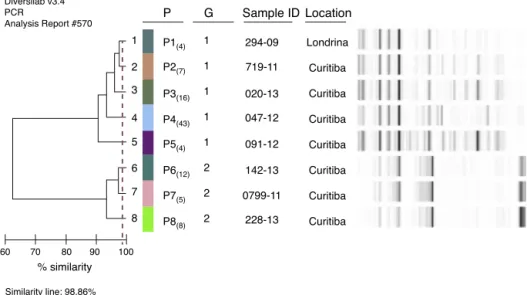
B.pertussisanalyzed.TheG1groupwasthemostfrequent with74isolatesandtheG2groupconsistedof25isolates. Thesimilaritybetweenthetwogroupswaslessthan62%.
It was possible to differentiate five different patterns [P1,P2,P3,P4, andP5] inthegroupG1,while onlythree patterns[P6,P7andP8]wereobservedinG2.Eachpattern showed ≥ 97% similarity to the others, with nodifferent bands.TheB.pertussisisolateidentifiedin2007belonged tothemostfrequentclone(G1:P4). Theisolateswiththe patterns[G1:P2,P3,P4,andP5]werefoundtobe circulat-inginallanalyzedyears(Fig.2).ThepatternG2:P6wasfirst detectedin2009,andthepatternsG2:P7andG2:P8 cir-culatedfrom2011,andsincethen,havebeendisseminated inlateryears.The G1:P1clonecirculatedonlyduringthe year2012.
Discussion
PertussishasresurgedinthestateofParaná,increasingfrom 16casesin 2010 to178in 2011.In thesubsequent years, thenumberofconfirmedcaseshascontinuedtoincrease, with400 in2012and 447in2013. Thismaybeassociated withthepresenceofmultiple circulatingclonesof B. per-tussis.
Brazil started the systematic control of pertussis in 1983, with the inclusion of the DTPvaccine in children’s basic vaccine schedule, aroundthe time when developed countriesindicatedthefirstsignsofdiseaseresurgence.10,11
In 1990, vaccination coverageincreased toapproximately 70% and the incidence of the disease decreased from 30 to10.6/100,000 inhabitants. Inthe last decade, the inci-denceof pertussisinBrazilremainedstable,rangingfrom 0.72/100,000 inhabitants in 2004 to0.32/100,000 inhabi-tantsin2010.In2011,therewasasudden increaseinthe numberofconfirmed casesin relationtothepreviousfive years,increasingtheincidenceto1.2/100,000inhabitants, eventhoughhighvaccinationcoveragewasmaintained.12
Theclassicsymptomsofpertussisareprolonged (‘‘100-day cough’’) and paroxysmal coughing, accompanied by noisy breathing (inspiratorystridor).4 Cyanosiswasa very
common findingin patients of the present study,in addi-tiontothepresenceoftheclassicsymptoms.Nicolaietal. reportedthat paroxysmal coughis a highlyspecific symp-tomforthediagnosisofpertussis,presentin63.2%ofcases, whereasnotfoundinpatientswithbronchiolitiscausedby respiratorysyncytialvirus(RSV).Therateofcyanosis(52.6%) found inpatients withpertussiswasalsohigherthan that foundinpatientswithRSVinfection(10.5%),withstatistical significance(p=0.006).13 IntheseriesevaluatedbyBayhan
Table1 Confirmedcasesofpertussisbyagerangeandnumberofdiphtheria-tetanus-pertussis(DTP)vaccinedosesinthestate duringtheperiodof2007-2013.
Agerange Missinginfo 1Dose 2Doses 3Doses 3+B 3+2B NotVacc. Total
<1year 98 233 86 40 0 0 359 816
1-4y 26 11 2 49 61 12 2 163
5-9y 19 1 0 0 13 34 1 68
10-14y 10 0 0 1 20 12 4 47
15-19y 11 0 0 0 4 0 1 16
20-34y 31 0 0 2 9 1 8 51
35-49y 22 0 0 0 0 0 10 32
50-64y 6 0 0 1 0 0 3 10
65-79y 5 0 0 0 0 0 1 6
Total 228 245 88 93 107 59 389 1,209
Diversilab v3.4 PCR
Analysis Report #570
60 70 80
% similarity
Similarity line: 98.86% 90 100
1 1
P G Sample ID Location
294-09 Londrina
Curitiba
Curitiba
Curitiba
Curitiba
Curitiba
Curitiba
Curitiba 719-11
020-13
047-12
091-12
142-13
0799-11
228-13 1
1
1
1
2
2
2 P1(4)
P2(7)
P3(16)
P4(43)
P5(4)
P6(12)
P7(5)
P8(8) 2
3
4
5
6
7
8
Figure2 B.pertussisgroupsandpatternsidentifiedinthestateofParanábetween2007-2013.
DendrogramandvirtualgelgeneratedbytheDiversiLabrep-PCRfingerprintingsystem.G,Group(1and2).P,Pattern(P1,P2,P3, P4,P5,P6,P7,P8).
etal.,39.3%ofpatientswithpertussishadinspiratorystridor and87.1%hadcyanosis.14
Pneumonia was the main complication found in the patients studied herein. This complication is the most common cause of death related to pertussis. In the United States and Canada, pneumonia was observed in 5.2% and 9.4% of cases, respectively.15,16 B. pertussis
triggers a cascade of inflammatory events that includes acutepulmonaryvasoconstrictionandincreasedleukocyte circulation, which affects pulmonary blood circulation, exacerbateshypoxemia,andcreatesaviciouscycleof pul-monaryhypertension.17
Inthisstudy,mostdeathsoccurredduringthelastthree yearsofthestudy,andinchildrenyoungerthan 2months ofage.AccordingtoSINANdata,atotalof15,428casesof pertussis were reportedin Brazil in 2011, of which 2,248 wereconfirmed,with56deathsandmortalityof2.5%.
Thenumberofcasescontinuedtoincreasein2012,with 5,416confirmed cases,84 deathsassociated withthe dis-ease, andmortality of 1.6%. In2013, the state of Paraná accountedfor10%ofdeathsrecordedinBrazil.12InEngland,
between2001and2011,atotalof48deathswererecorded duetothediseaseinchildrenyoungerthan1year ofage; ofthese,41(85.41%)wereyoungerthan66daysoflife.18In
theUSin2012,atotalof48,277caseswerereportedand therewere18(0.04%)deaths,whichisthehighestrecorded numberofcasesofthediseaseinthelast60yearsinthat country.19 ItisobservedthatthediseaselethalityinBrazil
exceeded40timesthatfoundintheUSA.
Thecurrentlyavailablevaccinesareconsideredsafeand immunogenic; however, they provide protection with an approximateeffectivenessof46%afterthe1stdose,79.6% afterthe2nddose,91.7%afterthe3rddose,and96.4%after the4thdose,lastingabout10years.20,21Inthepresentstudy,
59 (5%) children had completed the vaccination schedule (threedoses+twoboosters),butstilldevelopedthedisease. The rep-PCR technique allowed the identification of eight B. pertussis clones (P1 - P8) circulating in the
state of Paraná. It is possible that the current clones have different antigenic variations than those found in theclonescirculating inthe pre-immunizationperiod,22,23
or they might even be different from the strain used in the vaccine production. Therefore, the vaccine would not show the expected effectiveness against all circu-lating strains. It has been suggested that B. pertussis
adapteddue toselectivepressureexerted bythe vaccine during the last 60 years, expressing pertussis toxin, per-tactin, and fimbria differently from those found in the vaccine strain. These modifications may explain in part thedecreaseinvaccine efficacy,promptingthehypothesis that vaccine-induced reduced immunity may be respon-sible for the increased number of cases of the disease worldwide.24
Anotherissueisthatthecurrentvaccinationstrategies, focusing only on children, appear insufficient to prevent deathinyounginfants.Thus,newstrategiesmustbe ana-lyzed to include vaccination in newborns, adolescents, the elderly, health care workers, professionals working withchildreninnurseriesandkindergartens,andpregnant women.20,25,26 While it is not possible to provide booster
doses for the entire population, it is a priority to vacci-nateindividualswhohavedirectcontactwithyounginfants, especiallymothers,aswellastomaintainhighvaccine cov-erageinchildren.25
This study has some limitations. Itis possible that the number of pertussis cases was underreported. The lack of familiarity with the pertussis diagnosis, explained by thelong period duringwhich the disease remainedunder epidemiological control,may have influencedthe disease incidencerates.Anotherfactorthatmighthavecontributed isthatsomepatientshavemildersymptoms,whichare sim-ilar to viral infections, making it difficult to suspect and diagnosethedisease.Inthesecases,itisimportantto iden-tifytheinfectionetiology;however,theconfirmationofviral etiologydoesnotruleoutthepossibilityofcoinfectionwith
The authors conclude that pertussis is a re-emerging disease in this state, with non-immunized infants repre-sentingthemostoften-affectedagerange.However,itwas observedthatsomechildrendevelopedthediseasedespite havingbeenfullyvaccinated.Advancedstudiesoncelland molecularbiologyshouldbeencouragedtorecognize anti-genicchangesindifferent clonesofB.pertussiscurrently circulatingand offer new, more effective, and more pro-tectivevaccines tothepopulation.The resurgence ofthe diseasealsorequiresurgentchangesintheplanningofnew vaccinationstrategiesaimingtoreducetheriskofacquiring thediseaseandinfantmorbimortality.
Conflicts
of
interest
Theauthorsdeclarenoconflictsofinterest.
References
1.MattooS,CherryJD.Molecularpathogenesis,epidemiology,and clinicalmanifestationsofrespiratoryinfectionsdueto Borde-tellapertussisandotherBordetellasubspecies.ClinMicrobiol Rev.2005;18:326---82.
2.World Health Organization (WHO). Department of Immu-nization, Vaccines and Biologicals. In: Generic protocol for estimatingtheburdenofpertussisinyoungchildren.Geneva: WHO;2005.
3.Centers for Disease Control and Prevention (CDC). Pertussis --- United States, 2001-2003. MMWR Morb Mortal Wkly Rep. 2005;54:1283---6.
4.World HealthOrganization (WHO). Departmentof Immuniza-tion,VaccinesandBiologicals.In:Recommendedstandardsfor surveillanceofselectedvaccine-preventablediseases.Geneva: WHO;2003.
5.SkowronskiDM,DeSerresG,MacDonaldD,WuW,ShawC, Mac-nabbJ,etal.Thechangingageandseasonalprofileofpertussis inCanada.JInfectDis.2002;185:1448---53.
6.MooiFR,vanLooIH,KingAJ.AdaptationofBordetellapertussis tovaccination:acauseforitsreemergence?EmergInfectDis. 2001;7:526---8.
7.Centro de Vigilância Epidemiológica Prof. Alexandre Vran-jac. Informe técnico Coqueluche-2011: Atualizac¸ão da situac¸ão epidemiológica. São Paulo: Divisão de Doenc¸as de Transmissão Respiratória/CVE/CCD/SE-SP e Divisão de Imunizac¸ão/CVE/CCD/SES-SP. [cited 14 Dec 2013]. Available from: http://www.cve.saude.sp.gov.br/htm/resp/pdf/IF11 COQUELUCHE.pdf
8.ShuttCK,PounderJI,PageSR,SchaecherBJ,WoodsGL. Clini-calevaluationoftheDiversiLabmicrobialtypingsystemusing repetitive-sequence-basedPCRforcharacterizationof Staphy-lococcusaureusstrains.JClinMicrobiol.2005;43:1187---92.
9.LeiteD,CassidayPK,TattiKM,VazTM,TondellaML.Serotypes and genetic profiles of Bordetella pertussis strains isolated in the city of São Paulo, 2006-2008. J Pediatr (Rio J). 2012;88:357---60.
10.JacksonDW,RohaniP.Perplexitiesofpertussis:recentglobal epidemiologicaltrendsand theirpotentialcauses. Epidemiol Infect.2014;142:672---84.
11.Cherry JD. Thepresent and future control ofpertussis. Clin InfectDis.2010;51:663---7.
12.Brasil.PortaldaSaúde.SistemadeInformac¸ãodeAgravosde
Notificac¸ão(SINAN).Brasília:SINAN.[cited10Dec2013].
Avail-ablefrom:http://dtr2004.saude.gov.br/sinanweb/
13.NicolaiA,NennaR,StefanelliP,CarannanteA,SchiavarielloC, PierangeliA,etal.Bordetellapertussisininfantshospitalized foracuterespiratorysymptomsremainsaconcern.BMCInfect Dis.2013;13:526.
14.BayhanG˙I,TanırG,Nar-OtgunS,Aydın-TekeT,Metin-TimurÖ, ÖzFN.Theclinicalcharacteristicsandtreatmentofpertussis patientsina tertiarycenter over a four-yearperiod.TurkJ Pediatr.2012;54:596---604.
15.Centers for Disease Control and Prevention (CDC). Pertussis --- United States, 1997-2000. MMWR Morb Mortal Wkly Rep. 2002;51:73---6.
16.HalperinSA,WangEE,LawB,MillsE,Morris R,DéryP,etal. Epidemiological featuresof pertussisinhospitalizedpatients inCanada,1991-1997:reportoftheImmunizationMonitoring Program–Active(IMPACT).ClinInfectDis.1999;28:1238---43.
17.PaddockCD,SandenGN,CherryJD,GalAA,LangstonC,Tatti KM,etal.PathologyandpathogenesisoffatalBordetella per-tussisinfectionininfants.ClinInfectDis.2008;47:328---38.
18.vanHoekAJ,CampbellH,AmirthalingamG,AndrewsN,Miller E.Thenumberofdeathsamonginfantsunderoneyearofagein Englandwithpertussis:resultsofacapture/recaptureanalysis fortheperiod2001to2011.EuroSurveill.2013:18,pii:20414.
19.CenterofDiseaseControl(CDC).Pertussis(whooping cough):
Surveillance and reporting 2012. Atlanta (USA): Center of
DiseaseControl (CDC).[cited 22Feb 2014]. Available from:
http://www.cdc.gov/pertussis/surv-reporting.html
20.CoudevilleL, vanRie A,Andre P.Adultpertussis vaccination strategiesandtheirimpactonpertussisintheUnitedStates: evaluation of routineand targeted (cocoon) strategies. Epi-demiolInfect.2008;136:604---20.
21.BisgardKM,Rhodes P,Connelly BL,Bi D,Hahn C,Patrick S, etal.Pertussis vaccineeffectivenessamongchildren6to59 months of age in the United States, 1998-2001. Pediatrics. 2005;116:e285---94.
22.Queenan AM, Cassiday PK, Evangelista A. Pertactin-negative variantsofBordetellapertussisin theUnitedStates.NEngl JMed.2013;368:583---4.
23.SchmidtkeAJ,BoneyKO,MartinSW,SkoffTH,TondellaML,Tatti KM.PopulationdiversityamongBordetellapertussisisolates, UnitedStates,1935-2009.EmergInfectDis.2012;18:1248---55.
24.WoodN, McIntyreP.Pertussis:reviewofepidemiology, diag-nosis, management and prevention. Paediatr Respir Rev. 2008;9:201---11,quiz211-2.
25.BricksLF.Pertussis:newvaccinationstrategiestopreventan olddisease.JHealthBiolSci.2013;1:73---83.
26.GamadeSousaS,BarrosH.PertussisinPortugal-timefor a newstrategy.RevPortPneumol.2010;16:573---88.