REVISTA
BRASILEIRA
DE
ANESTESIOLOGIA
PublicaçãoOficialdaSociedadeBrasileiradeAnestesiologia www.sba.com.brSCIENTIFIC
ARTICLE
Pain
after
major
elective
orthopedic
surgery
of
the
lower
limb
and
type
of
anesthesia:
does
it
matter?
夽
Diogo
Luís
Pereira
a,∗,
Hugo
Lourenc
¸o
Meleiro
b,
Inês
Araújo
Correia
b,
Sara
Fonseca
a,caUniversidadedoPorto,Porto,Portugal bCentroHospitalarSãoJoão,Porto,Portugal
cCentroHospitalarSãoJoão,DepartamentodeAnestesiologia,Porto,Portugal
Received14April2015;accepted5June2015 Availableonline19March2016
KEYWORDS
Arthroplasty; Generalanesthesia; Neuraxialanesthesia; Preoperativepain; Postoperativepain; Chronicpain; Chronic
postoperativepain
Abstract
Backgroundandobjectives: Totalkneearthroplastyandtotalhiparthroplastyareassociated withchronicpaindevelopment.Of thestudiesfocusingonperioperativefactorsforchronic pain,fewhavefocusedonthedifferencesthatmightarisefromtheanesthesiatypeperformed duringsurgery.
Methods:ThiswasaprospectiveobservationalstudyperformedbetweenJuly2014andMarch 2015withpatients undergoingunilateral electivetotal kneearthroplasty (TKA)ortotalhip arthroplasty(THA)forosteoarthritis.Datacollectionandpainevaluationquestionnaireswere performedinthreedifferentmoments:preoperatively,24hourspostoperativelyandat6months aftersurgery.Tocharacterizepain,BriefPainInventory(BPI)wasusedandSF-12v2Healthsurvey wasusedtofurtherevaluatethesample’shealthstatus.
Results:Fortyandthreepatientswereenrolled:25.6%menand74.4%women,51,2%fortotal kneearthroplastyand48.8%fortotalhiparthroplasty,withameanageof68years.Surgeries wereperformedin25.6%ofpatientsundergeneralanesthesia,55.8%underneuraxial anesthe-siaand18.6%undercombinedanesthesia.Postoperatively,neuraxialanesthesiahadabetter paincontrol.Comparingpainevolutionbetweenanesthesiagroups,neuraxialanesthesiawas associatedwithadecreasein‘‘worst’’,‘‘medium’’and‘‘now’’painatsixmonths.Combined anesthesiawas associated withadecreaseof‘‘medium’’ painscores atsixmonths. Ofthe threegroups,onlythoseinneuraxialgroupshowedadecreaseinlevelofpaininterference in‘‘walkingability’’.TKA,‘‘worst’’painpreoperativelyandgeneralwerepredictorsofpain developmentatsixmonths.
夽 PerformedinCentroHospitalarSãoJoão(CHSJ),AlamedaProf.HernâniMonteiro,4200---319Porto,Portugal.
∗Correspondingauthor.
E-mail:[email protected](D.L.Pereira).
http://dx.doi.org/10.1016/j.bjane.2015.06.002
Conclusions: Patientswithgonarthrosisandseverepainpreoperativelymaybenefitfrom indi-vidualized pre- and intraoperative care, particularly preoperative analgesia and neuraxial anesthesia.
©2016SociedadeBrasileiradeAnestesiologia.Publishedby ElsevierEditoraLtda.Thisisan openaccessarticleundertheCCBY-NC-NDlicense (http://creativecommons.org/licenses/by-nc-nd/4.0/).
PALAVRAS-CHAVE
Artroplastia; Anestesiageral; Anestesianeuroaxial; Dorpré-operatória; Dorpós-operatória; Dorcrônica; Dorcrônica pós-operatória
Dorapóscirurgiaeletivaortopédicadegrandeporteemmembroinferioreotipo deanestesia:issoimporta?
Resumo
Justificativaeobjetivos: Aartroplastiatotaldejoelhoeaartroplastiatotaldequadrilestão associadasaodesenvolvimentodedorcrônica.Dentreosestudosqueavaliamosfatores peri-operatóriospara adorcrônica, poucosabordamasdiferenc¸as quepodem surgirdotipode anestesiarealizadaduranteacirurgia.
Métodos: Estudoobservacional,prospectivo,realizadoentrejulhode2014emarc¸o2015com pacientessubmetidosàATJunilateraleletivaouATQparaaosteoartrite.Acoletadedadose aavaliac¸ãodadorpormeiodequestionáriosforamrealizadasemtrêsmomentosdistintos:no pré-operatório,em24horasdepós-operatórioeaosseismesesapósacirurgia.OInventário BrevedaDor(IBD)foiusadoparacaracterizaradoroeoQuestionárioSF-12v2foiusadopara avaliarmelhoroestadodesaúdedaamostra.
Resultados: Quarentaetrêspacientesforaminscritos:25,6%homense74,4%mulheres,51,2% paraATJe48,8%ATQ,commédiadeidadede68anos.Acirurgiafoirealizadaem25,6%dos pacientessobanestesia geral,em 55,8%sob anestesianeuroaxialeem 18,6%sobanestesia combinada. Nopós-operatório,aanestesianeuraxialapresentou melhorcontroledador.Na comparac¸ão daevoluc¸ãoda dorentreosgrupos, aanestesianeuraxialfoi associadaauma diminuic¸ãode‘‘pior’’,‘‘médio’’e‘‘sem’’doremseismeses.Aanestesiacombinadafoi asso-ciada aumadiminuic¸ãodoescore‘‘médio’’dedorem seismeses. Dostrêsgrupos,apenas aqueles nogrupo neuraxialapresentaram umadiminuic¸ãodo nível de interferência da dor na ‘‘capacidadedecaminhar’’. ATJ, ‘‘pior’’ dorno pré-operatórioe anestesiageral foram preditivosdedesenvolvimentodedoraosseismeses.
Conclusões: Ospacientescomgonartroseedorintensanopré-operatóriopodemobterbenefício decuidadosindividualizadosnopréeintraoperatório,particularmentedeanalgesiano pré-operatórioeanestesianeuraxial.
©2016SociedadeBrasileiradeAnestesiologia.PublicadoporElsevierEditoraLtda.Este ´eum artigo OpenAccess sobumalicenc¸aCCBY-NC-ND (http://creativecommons.org/licenses/by-nc-nd/4.0/).
Introduction
Total Knee Arthroplasty (TKA) and Total Hip Arthroplasty
(THA) are common elective procedures whose demand is
continuallyrising due toageing population.1 According to
thePortugueseArthroplastyRegister4234primaryTKAand
4440primaryTHAwereperformed inPortugalin2013, 80
and63ofthese,respectively,inCentroHospitalarSãoJoão.2
Themajoraimofthesesurgeriesistoreliefpain,improve
quality of life, physical activity and mobility, allowing a
bettersocialandpsychologicalwell-being.3Variousauthors
havestudiedthisandpainreliefwasidentifiedasthemost
importantfactorconcerningqualityoflife,followedby
psy-chologicalwell-beingandrestorationof physical activity.4
Despite the high satisfaction rates published,5 up to20%
of TKA5 and 7% of THA6 patients remain dissatisfiedafter
surgery and require post-surgical supplementary medical
treatment,producinganadditionalburdenforthenational
healthcaresystem.7
The final decision to undergo surgery is based on a
surgeon---patient agreement. The clinical criteria are
dif-ferentbetweenorthopaedic centres8andevenwillingness
among patients depends on age, gender, race,
socio-economic statusand pain.9 This differenceis evenhigher
amongorthopaedicsurgeons,rheumatologists andprimary
careproviders.Theonlycommoncriteriaamongallispain
notresponsivetodrugtherapy.10
Chronicpost-surgicalpainhasbeenassociatedtoTKAand
THAinseveralstudies.Despitethetechnologicaland
techni-calimprovements,11,12thereisstillagroupofpatientswith
painafter surgery.13 Pain-relateddistress, suchas
frustra-tion,angeranddepression,donotcorrelatesolemnlytothe
painintensity but alsowithindividual belief, expectation
andperceptionoftheircondition.14
During the last years, investigators are searching for
chronic pain predictors after TKA and THA in order to
diminishitsincidence.Preoperativepainintensity,disease
predictorsforchronicpaindevelopmentafteran
uncompli-catedsurgery.15Otherfactorsthathaveshownrelationwith
chronicpainincludefemalesex,youngerageatthetimeof
surgery16,17andpaininotherlocations.18
Differences in postoperative paincontrol due to
anes-thesia technique (neuraxial anesthesia versus general
anesthesia) for lower limb joint replacement have been
demonstrated. Neuraxial anesthesia improves
postopera-tive outcomes by relieving pain, reducing pulmonary
complications, allowing early mobilization and shortening
thelengthofhospitalstay.19,20 Itis alsoassociated witha
decreaseinsystemicinfections21andmortality.22
Theaimofthisstudyistoevaluateifthetypeof
anes-thesiainterfereswithpostoperativepaininapopulationof
patientssubmittedtoTKAorTHA.
Methods
AfterapprovaloftheEthicsCommitteeofCentroHospitalar
SãoJoão (CHSJ), in Porto, Portugal, a prospective
obser-vationalstudywasperformedbetweenJuly2014andMarch
2015withpatientsundergoingunilateralelectiveTKAorTHA
for osteoarthritis. Exclusion criteriawere: age <18 years,
inability to give informed consent, failure to understand
Portugueselanguage,refusaltoparticipate,American
Soci-etyofAnesthesiologists(ASA)physicalstatus>3,analgesic
allergy,pepticdisease,previoussurgeryonthesame
loca-tionandtimebetweensurgeryandchronicpainevaluation
lessthan6months.Thepatientsenrolledsignedthe
state-ment of informed consent. Chronic pain definition is not
consensualintheliterature.Theauthorsconsideredchronic
pain as pain that is present at least 6 months after the
surgery.23,24
Data wasobtained by electronic health record
consul-tation and evaluation questionnaires performed in three
different moments. The first (T0), comprised the patient
recruitmentduringtheanesthesiologyappointment15days
prior to the surgery in which the informed consent
dec-laration was given and signed. Authors also collected
socio-demographicdata,typeofsurgery,ASAphysical
sta-tus,painandhealthstatusfromthepatient’spointofview.
Thesecond (T1),wasobtained 24h aftersurgery.Authors
recordedthetypeofanesthesia(Generalanesthesia(GA),
Neuraxial anesthesia(NA) or Combined anesthesia(CA)
---generalplusneuraxialanesthesia)andevaluatedpain.Data
mentioning the analgesic medication used wasalso
regis-tered.The third(T2) wasconductedby phone,at least6
monthsaftersurgery,whentheauthorsre-evaluatedpain.
Surgerywasperformedbyateamoforthopaedicsinthe
hospital’sorthopaedicunit,withnointerferenceor
limita-tionbytheinvestigationteamforthepurposeofthiswork.
AnesthesiawasclassifiedasGeneralifonlyintra-operative
intravenous and/or inhalatory anesthetics and analgesics
wereusedwithventilationassistance,asNeuraxialifa
sub-arachnoidorepiduralblockwasperformedwithorwithout
intraor postoperative epiduralanalgesia andcombinedif
bothcriteriaoverlapped.
Pain wasassessedas adependent variablein both the
intensityandinterferencedomains,usingBriefPain
Inven-tory(BPI) inT0 andT2.In T1,onlythe intensity domains
ofBPIwere usedtoassess pain.These questionnairesare
validatedforthePortuguesepopulation25---27tocalculatethe
psychological,socioeconomicallyandqualityofliferelated
topain.
HealthStatusbythepatient’spointofviewwasassessed
byshortformSF-12® HealthSurveyquestionnaire(SF-12v2
Standard 4week) inT0usingthe2009norms. Ithasbeen
validated28 andusedinprevious studies.29 The Portuguese
version wordingandformatwasmodified. Licensefor the
useoftheSF-12v2wasgranted.
AllthedomainsrecommendedbytheInitiativeon
Meth-ods, Measurement and Pain Assessment in Clinical Trials
(IMMPACT) whichincludephysical andemotional function,
painseverity,painmedicationusage,painqualityandthe
temporalaspectsofpainwereassessed.30
Questionnaires
BriefPainInventory(BPI)
BPI evaluates the multidimensional perspective of pain,
namely severity, localization, functional interference and
strategic therapies.31 It relies on a numeric range scale
(NRS) that evaluates pain intensity from 0 to 10 (0 no
pain,1---3mild pain,4---6 moderatepain,7---9severepain,
10 worstpain).BPIcapturestwobroad paindomains: the
sensoryintensityofpainandthedegreetowhichpain
inter-feres withdifferentareas of life.The 17 itemsscale also
captures painlocation,pain medication useand response
totreatments.This questionnaire isa valid,sensitive and
reproductive instrument of characterization of pain with
extensiveuseinseveralstudies.32---34
StudyShortForm12(SF-12)
SF-12 is a multipurpose short-form generic measure of
healthstatusfromthepatient’spointofview.The12items
intheSF-12areasubsetofthoseintheSF-36,andinclude1
or2itemsfromeachofthe8healthconcepts:physical
func-tioning, role limitations due to physical health problems,
bodilypain,generalhealth,vitality(energy/fatigue),social
functioning,rolelimitationsduetoemotionalproblemsand
mentalhealth(physicaldistress,psychologicaldistressand
psychological well-being). The Physicaland Mentalhealth
Composite Scale scores (PCS & MCS) derive from the 8
healthconceptsandaretransformedtoaTscore(mean=50,
standarddeviation=10).Ameanof45orgreaterindicates
atleastaverageoverallfunctioningorwell-beingandscores
lessthan40indicatingsignificantimpairment.
Statisticalanalysis
AllstatisticalanalysiswasperformedusingSoftwareSPSS®
version22.0(IBMCorporation,NewYork,USA).
Continuous variables were expressed as mean and
standard deviation aswell asmedianand range.
Dichoto-mousoutcomeswereexpressedasthenumberofeventsand
percentage.
NormalitytestswereconductedusingShapiro---Wilktest
forap<0.05.Whennon-normaldistributionwasconsidered,
forcomparisonbetweengroups whenassessing continuous
orordinalvariables.One-wayANOVAwasusedwhen
normal-itywasconsidered.
Crosstabs were used to compare nominal variables
between thegroups. ExactFisher test wasusedto
deter-minethecorrelationwhen3groupswerecompared.Iftwo
groupsanalysiswascarried,theinvestigationalteamused
chi-squaretestinstead.
Wilcoxonsigned-ranktestwasusedwhencomparingtwo
relatedsamples.Ifbothvariablesfollowedanormal
distri-bution,pairedttestwasusedinstead.
A logisticregressionmodel wasperformedtoascertain
the effectsof the surgical procedure, ‘‘worst’’, ‘‘least’’,
and‘‘now’’painpreandpostoperativelyandtypeof
anes-thesiaonthelikelihoodofhavingpainat6months.Medium
painscorevariablewasexcludedofthemodeldueto
mul-ticollinearity.
All reportedp-valuesaretwotailed, withap-valueof
0.05indicatingstatisticalsignificance.
Results
107 patients were evaluated during the anesthesiology
appointmentpriortothesurgery(T0),43hadthe surgery
cancelled or rearranged for a date that did notcomprise
thestudytimeframe,2wereexcludedforincompleteBPIin
T0.Ofthe62thatcompletedT0andT1,3wereexcludedfor
notmeetingthe6monthsminimumtimeaftersurgeryand
16for notanswering thephonecallonT2(responseratio
73%),leavingafinalsampleof43patients.
Demographics
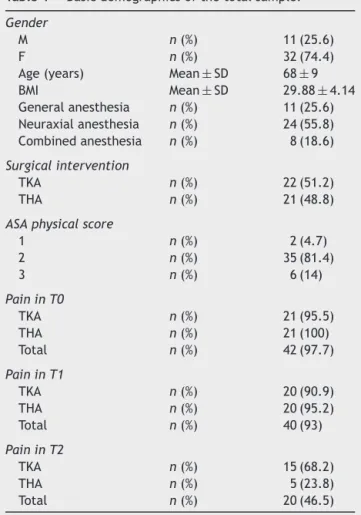
Basic demographics of the 43 patients can be found in
Table1.
Sample comprised25.6% menand74.4%women,51.2%
TKA and48.8%THA. Mean ageat thetimeof surgerywas
68yearsand meanbodymass index(BMI)was29.88.The
majorityofthesample(81.4%)scoredASA2physicalstatus
and14% scored ASA 3.Concerning anesthesiatype,25.6%
patientswere submittedtoGA, 55.8%toNAand18.6%to
CA.Painwasreportedby 42patients(97.7%)atT0,by 40
(93%)patientsatT1andby20patients(46.5%)atT2.
Surgery (p=0.456),age (p=1.000),sex(p=0.648), BMI
(p=0.807),ASAphysicalstatusscore(p=0.321)andhealth
statuslevelfromthepatient’spointofview(PCS,p=0.065;
MCS,p=0.147) didnotinterfere withtheanesthesiatype
choice(Table2).
Painandpainrelatedresults
Preoperative(T0)painevaluation
AtT0,whenBPIquestionnairewasappliedinpainintensity
domains,nodifferenceswerefoundbetweenthe3
anesthe-siagroups(Table3).
24haftersurgery(T1)painevaluation
AtT1,intheintensitydomainofBPI,pain‘‘now’’was
sta-tisticallysignificant(p=0.035),withGAreportingamedian
pain of 4 (min=0, max=8) while NA and CA reported a
Table1 Basicdemographicsofthetotalsample.
Gender
M n(%) 11(25.6)
F n(%) 32(74.4)
Age(years) Mean±SD 68±9
BMI Mean±SD 29.88±4.14
Generalanesthesia n(%) 11(25.6) Neuraxialanesthesia n(%) 24(55.8) Combinedanesthesia n(%) 8(18.6)
Surgicalintervention
TKA n(%) 22(51.2)
THA n(%) 21(48.8)
ASAphysicalscore
1 n(%) 2(4.7)
2 n(%) 35(81.4)
3 n(%) 6(14)
PaininT0
TKA n(%) 21(95.5)
THA n(%) 21(100)
Total n(%) 42(97.7)
PaininT1
TKA n(%) 20(90.9)
THA n(%) 20(95.2)
Total n(%) 40(93)
PaininT2
TKA n(%) 15(68.2)
THA n(%) 5(23.8)
Total n(%) 20(46.5)
T0,preoperatively;T1,24hourspostoperatively;T2,6months
postoperatively;BMI,BodyMassIndex;ASA,AmericanSocietyof
Anesthesiologists(ASA)physicalstatus.
medianof0(Neuraxial:min=0,max=7;combined:min=0, max=6).
‘‘Worst’’, ‘‘least’’ and ‘‘medium’’ pains were similar between groups (p-values 0.544, 0.185 and 0.456 respec-tively). In all groups there were patients that reported themaximum of pain intensity,with nostatistical differ-ence being found in the ‘‘worst’’ pain (GA: median=8, min=5, max=10; NA: median=8, min=3, max=10; CA: median=7.50,min=5,max=10).Although‘‘least’’painhad similar scores with median score varying between 0 and 1 amongthe three groups, the CA and GA groups scored higher intensity levels (CA: median=0, min=0, max=5; NA: median=0, min=0, max=3; GA: median=1, min=0, max=6,p=0.185).
6Monthsaftersurgery(T2)painevaluation
At T2, 20 patients (46.5%) reported pain. The anesthe-siagroupwithahigherpercentage ofcaseswasCAgroup (62.5%). However, no statistical significance was found betweenanesthesiatypegroups(p=0.645).
CAandNAwereassociatedwithlowerscoresof‘‘worst’’ and‘‘least’’pains. Nonetheless,nostatisticalsignificance was found among groups (p=0.352 and p=0.496 respec-tively).
Table2 Demographicsaccordingtoanesthesia.
Generalanesthesia Neuraxialanesthesia Combinedanesthesia p
Surgery 0.456a
TKA n(%) 4(36.4) 14(58.3) 4(50)
THA n(%) 7(63.6) 10(41.7) 4(50)
Age 1.000a
<65 n(%) 4(36.4) 8(33.3) 3(37.5)
>65 n(%) 7(63.6) 16(66.7) 5(62.5)
Sex 0.648a
M n(%) 4(36.4) 5(20.8) 2(25)
F n(%) 7(63.6) 19(79.2) 6(75)
BMI 0.807a
<25 n(%) 1(9.1) 2(9.1) 1(14.3)
>25 n(%) 7(63.6) 10(41.7) 4(57.1)
>30 n(%) 3(27.3) 10(41.7) 2(28.6)
ASA 0.321a
<3 n(%) 8(72.7) 22(91.7) 7(87.5)
=3 n(%) 3(27.3) 2(8.3) 1(12.5)
SF-12
PCS Mean±SD 27.54±8.21 31.60±5.58 26.20±5.49 0.065b
MCS Mean±SD 50.68±11.85 43.35±11.94 40.34±12.97 0.147b
BMI,BodyMassIndex;ASA,AmericanSocietyofAnesthesiologists(ASA)physicalstatus;PCS,PhysicalCompositeScale;MCS,Mental CompositeScale.
aFicher’sExactTest.
b One-wayANOVA.
‘‘worst’’,‘‘medium’’and‘‘now’’pain(p=0.037,p=0.019,
p=0.011, respectively) between T0 and T2 and ‘‘worst’’
painbetweenT1andT2.CAwasassociatedwithadecrease
of‘‘medium’’painscoresbetweenT0andT2(p=0.041)and
T1andT2(p=0.041).
Paininterferencedomain
AtT0,allpatientsthatreportedpain,complainedofsome
sortofinterferenceintheirdailylifeduetopain(Table4),
particularly in generalactivity, mood, walkingability and
normalwork.InT0,GAwasassociatedwithinterferenceof
painonmoodpreoperativelywhencomparedwiththeother
typeofanesthesia(p=0.046).
AtT2,generalactivity,walkingabilityandnormalwork
scoredhighermedians.Howevernotallpatientsreporting
paincomplained ofinterference in their lifedue topain,
withnostatisticaldifferencefoundbetweentypeof
anes-thesiagroups.
Although many patients reported a decrease of pain
interference between T0 and T2, only those in NA group
Table3 Painrelatedvariablesaccordingtoanesthesia.
Generalanesthesia Neuraxialanesthesia Combinedanesthesia
n(%) Mean±SD Median
(min---max)
n(%) Mean±SD Median
(min---max)
n(%) Mean±SD Median
(min---max)
p
PainatT0 10(91) 24(100) 8(100) 0.422a
Worstpain 7±1.94 7(4---10) 7.50±1.72 8(3---10) 7.25±2.82 7.50(3---10) 0.720b
Leastpain 2.20±2.04 2(0---6) 2.29±2.81 2(0---6) 3.13±2.4 3(0---6) 0.525b
Mediumpain 5.20±2.49 5(2---10) 5.13±1.85 5(2---10) 5.50±2.07 6(2---8) 0.905c
Nowpain 3.4±3.27 2(0---10) 3.88±3.06 4.50(0---10) 5.50±2.45 6(0---8) 0.311c
PainatT1 9(81.8) 23(95.8) 8(100) 0.240a
Worstpain 7.89±2.21 8(5---10) 7±2.05 8(3---10) 7.50±2.20 7.50(5---10) 0.544c
Leastpain 2±2.45 1(0---6) 0.65±1.03 0(0---3) 1±1.92 0(0---5) 0.185b
Mediumpain 4.67±2.12 4(2---8) 3.48±1.28 4(0---5) 4±1.85 3.50(2---7) 0.456b
Nowpain 4.11±2.89 4(0---8) 1.74±2.14 0(0---7) 1.38±2.56 0(0---6) 0.035b,d
PainatT2 5(50) 10(41.7) 5(62.5) 0.645a
Worstpain 7.40±2.61 8(3---10) 5.40±2.86 4.50(3---10) 6.80±2.95 5(4---10) 0.352b
Leastpain 2.80±3.11 2(0---7) 1.60±3.34 0(0---10) 1±1.73 0(0---4) 0.496b
Mediumpain 2.50±2.65 2(0---6) 2.80±3.55 1(0---10) 2±1.73 1(1---5) 0.930b
Nowpain 3.20±3.42 3(0---8) 1.70±3.65 0(0---10) 0 0(0) 0.138b
Meanscoreswithstandarddeviationandmedianscorewithmaximumandminimumoftheintensityofpaininits‘‘worst’’,‘‘least’’,‘‘medium’’and‘‘now’’.BPI scores,usinga0---10numericrangescale(NRS).T0,pre-operatively,T2,postoperatively.
aFisher’sExactTest.
b Kruskal---Wallisone-wayanalysisofvariance.
c One-wayANOVA.
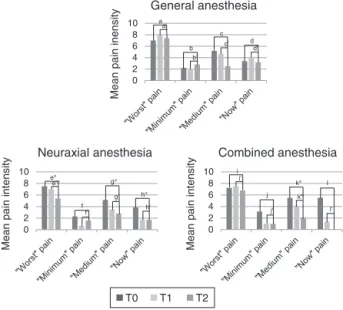
0 2 4 6 8 10 Mean pa in i nen si
ty General anesthesia
0 2 4 6 8 10 Mean pain int ens ity
Combined anesthesia
a 0 2 4 6 8 10 Mean pain int ens ity
Neuraxial anesthesia
a' b b' c c' d' d e∗ e'∗ f' f g∗
g' h∗ h' i' i j' j k∗ k'∗ l' l
T0 T1 T2
Figure1 Comparisonofpainintensityusingallthedomains ofpaininBPIbetweenT0(pre-operatively)andT2(6months postoperatively)usingWilcoxonsigned-ranktest.a,p=1.000; a′,p=0.586;b,p=0.891;b′,p=1.000;c,p=0.144;c′,p=0.066;
d,p=0.892;d′,p=0.588;e,p=0.037;e′,p=0.028;f,p=0.102;
f′,p=0.416;g,p=0.019;g′,p=0.412;h,p=0.011;h′,p=0.915;
i,p=0.581;i′,p=0.257;j, =0.144;j′,p=0.157;k,p=0.041;k′,
p=0.041;l,p=0.066;l′,p=0.180;*p<0.05.
showedalowerlevel ofinterferencein ‘‘walkingability’’
(p=0.007).
Predictingpain
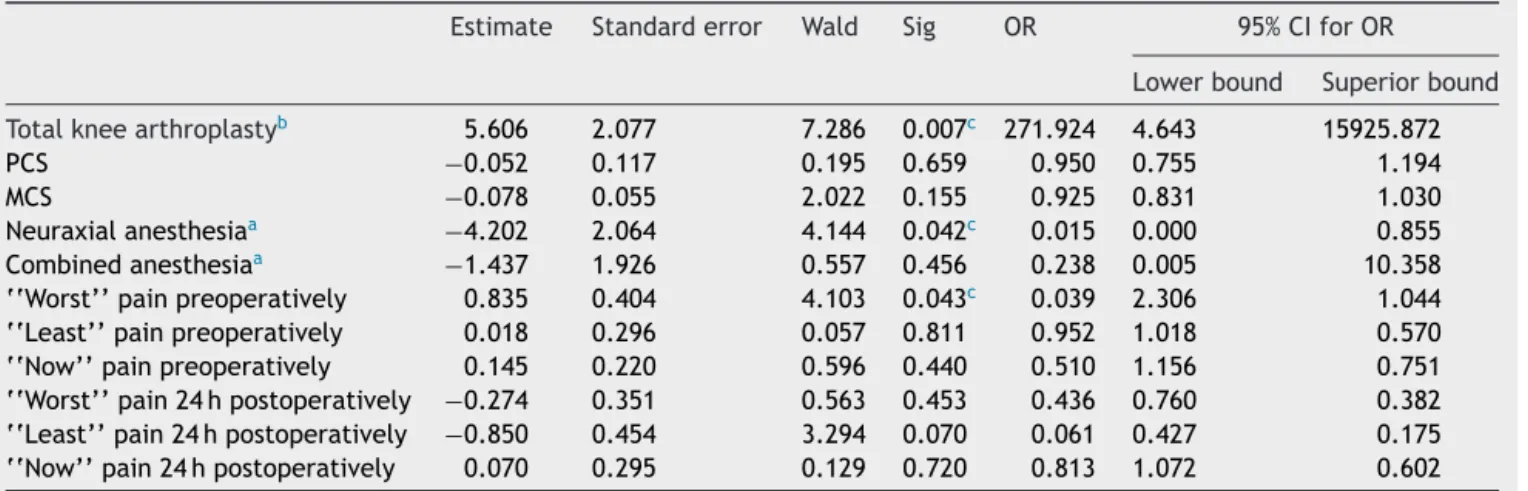
Alogistic regression (Table 5)wasperformed toascertain
the effects of surgical procedure, ‘‘worst’’, ‘‘least’’ and
‘‘now’’painpreandpostoperativelyandtypeofanesthesia
onthelikelihoodtohavepainat6months.
TKA(p=0.007),‘‘worst’’painpreoperatively(p=0.043)
andNA(p=0.042)wereassociatedwithdevelopmentofpain
at6months.
Discussion
Totaljointarthroplastyis thegold-standardtreatmentfor
‘‘end-stage’’ osteoarthritis.35 Several risk factors related
tothepatient,surgeryorpostoperativeperiod,havebeen
recentlyidentifiedfor continuouspainanddisabilityafter
total joint arthroplasty. Patients’ non-modifiable
charac-teristics such as younger age, female sex, low income
andlack of education areassociated with a higher
prob-ability of developing chronic postsurgical pain.16,17,36,37
Equally, modifiable factors such as anxiety, depression,
pain catastrophizing, comorbidities, obesity, BMI,
high-intensitybaselinepain,unrealistic patients’expectations,
andextent,localandincisiontypehavealsoprovedtobe
associatedwiththe developmentof pain.38,39 Fromthese,
obesityandBMIhaveshownanegativeimpactonpainand
functionafterprimaryelectiveTKAandTHA.40,41
Postoperativeanalgesiaisadevelopingareaand
anesthe-siaisanessentialpartwhenchoosingtheanalgesiaprotocol.
Thetypeofanesthesiadependsonmultiplefactors,related
tothe patient’s features and preferences, the
anesthesi-ologist’sexperience and tothe surgeryand rehabilitation
requirements.
Inthisstudy,theauthorsexploredthefactorsthatmay
influencepostoperativepaincontrolandchronicpain
devel-opmentafterTHAandTKAandtherelationbetweenthem
andtheanesthesiatechnique.
Mostof thepatientsofthisstudywereselectedfor NA
(55.8%).Thischoicedidnotdependonpreoperativefactors
suchassurgicalintervention,age,gender,BMIandASA
phys-icalstatusandprobablyreflectedtheanesthesiologist’sor
anesthesiologydepartment’spreferences.On a
retrospec-tivereviewofTHAandTKA,performedin400USAhospitals,
Memtsoudiset al.reportedthat 74.8% weresubmitted to
GA,11% toNAand 14.2% toCA,42 whichmay alsoreflect
localorpersonalpreferencesorthetimeofdatacollection
(2006until2010).
Dailyactivities, such asdressing, walking,climbing up
ordown aflightof stairs mightpose achallengefor most
ofthepatientspreoperatively.Soitisunderstandablethat
patients’ expectations after surgery are high, hoping to
regainactivityandimprovementofpain.43,44 Inthisstudy,
allpatients thatreportedpainin the preoperative period
complainedofsomeinterference intheirlifeduetopain,
particularlyin general activity,mood, walkingability and
normal work. But only GA was associated with
interfer-ence of pain on mood. The authors cannot exclude that
patients’mood may have influenced the anesthetic
tech-nique choice by the anesthesiologist. At 6 months after
surgery, the authors did not find any relation between
Table4 Interferenceofpain.
Generalanesthesia Neuraxialanesthesia Combinedanesthesia
T0 T2 p T0 T2 p T0 T2 p
Interferenceofpain,n(%) 10(91) 10(0---10) 24(100) 9(38) 8(100) 5(63)
Generalactivity(Mean±SD) 7.90±1.85 7±4.47 0.893a 6.71±2.59 5±3.39 0.310a 7.5±1.51 7.50±2.08 1.000a
Mood(Mean±SD) 8.10±2.2 5.4±4.56 0.416a 4.92±3.51 2±3.42 0.106a 5.63±3.78 1.50±1.92 0.593a
Walkingability(Mean±SD) 8.20±1.62 6±3.84 0.322b 7.88
±1.96 5.11±2.98 0.007b,c 8.13
±1.89 6.25±2.99 0.174b
Normalwork(Mean±SD) 8.60±0.97 7±4.12 0.285a 6.79±2.28 5.78±3.73 0.498a 7.63±2.13 4.75±4.57 0.102a
Relationswithotherpeople(Mean±SD) 3.40±4.22 2.60±3.71 0.109a 3.63±3.49 1.11±3.33 0.136a 3.38±3.38 0 0.317a
Sleep(Mean±SD) 5.70±3.40 3.80±4.02 0.461a 3.25
±3.07 2.78±3.7 0.175a 4.88
±3.14 2.50±5 0.180a
Enjoymentoflife(Mean±SD) 4.50±3.87 3.40±2.07 0.144a 4.21±3.30 1.78±3.35 0.671a 4.88±3.9 0 0.180a
Meanscoresandstandarddeviationoftheinterferenceofpainindailyaspectsoflife.BPIscores,usinga0---10numericrangescale (NRS).T0,pre-operatively;T2,postoperatively.
a Wilcoxonsigned-ranktest.
Table5 Logisticregressionassessingthelikelihoodofdevelopmentpainat6months.
Estimate Standarderror Wald Sig OR 95%CIforOR
Lowerbound Superiorbound
Totalkneearthroplastyb 5.606 2.077 7.286 0.007c 271.924 4.643 15925.872
PCS −0.052 0.117 0.195 0.659 0.950 0.755 1.194
MCS −0.078 0.055 2.022 0.155 0.925 0.831 1.030
Neuraxialanesthesiaa −4.202 2.064 4.144 0.042c 0.015 0.000 0.855
Combinedanesthesiaa
−1.437 1.926 0.557 0.456 0.238 0.005 10.358
‘‘Worst’’painpreoperatively 0.835 0.404 4.103 0.043c 0.039 2.306 1.044
‘‘Least’’painpreoperatively 0.018 0.296 0.057 0.811 0.952 1.018 0.570
‘‘Now’’painpreoperatively 0.145 0.220 0.596 0.440 0.510 1.156 0.751
‘‘Worst’’pain24hpostoperatively −0.274 0.351 0.563 0.453 0.436 0.760 0.382 ‘‘Least’’pain24hpostoperatively −0.850 0.454 3.294 0.070 0.061 0.427 0.175 ‘‘Now’’pain24hpostoperatively 0.070 0.295 0.129 0.720 0.813 1.072 0.602
PCS,PhysicalCompositeScale;MCS,MentalCompositeScale.
Themodelexplained65%(NagelkerkeR2)ofthepresenceofpainandcorrectlyclassified82.5%ofcases.
aComparedtoreferencecategoryGeneralanesthesia. b Dichotomousvariable:TKA=1,THA=0.
c p<0.05.
anesthesia and interference of pain on daily life
activi-ties.Manypatientsreportedadecreaseofpaininterference
betweenT0andT2.HoweveronlythoseinNAgroupshowed
alowerlevelofinterferencein‘‘walkingability’’.
TKA has been associated with a higher likelihood of
chronicpostoperativepaindevelopmentthanTHA.12Infact,
ahighernumberofpatientssubmittedtoTKA complainof
painat6months,asdemonstratedbyWyldeetal.in2011
andPintoetal.in2013.18,45Theauthor’sstudyfurther
sup-portstheseresultsbyfindingthat68.2%oftheTKApatients
and23.8%oftheTHAgroupcomplainedofpainat6months
aftersurgery. Pintoetal.alsoreportedthe pain
interfer-enceindailyactivities,withhigherresultsbeingfound on
oursample.Thismighthaveoccurredduetoourhighermean
ofage.
Acutepostsurgicalpainhasbeendescribedasachronic
postoperativepainpredictor.46---49However,presurgicalpain
has showed a stronger predictive value50,51 which seems
plausiblein face of the long-term influence that it might
poseontheneuro-physiologicprocessesunderlyingchronic
postoperativepaindevelopment.15,52 Inourmodelall
post-surgicalpainintensityvariablesfailedtoshowsignificance
in predicting pain at 6 months. Only ‘‘worst’’ pain
pre-operatively showed predicting capability, supporting the
importanceofpresurgicalpainaspredictor.
In this sample, NA showed a protective trend in pain
developmentat 6 monthswhen comparedtoGA (OR<1).
Infact,NAwasassociatedwithlower‘‘worst’’,‘‘medium’’
and‘‘now’’painbetweenT0andT2.Althoughtheauthors
didnot find any similar studies that assessed the
predic-tionof chronic postoperative painbetween THA/TKA and
anesthesiatype,thishas beendemonstratedin other
sur-gical models. In fact, inguinal herniorrhaphy,53 caesarean
section50,54orhysterectomy55haveshownahigherlikelihood
ofdevelopingpainat6monthswithGAwhencomparedwith
NA.
PatientsontheNAorCAgrouphadabetterpaincontrol
onthe‘‘now’’painintensityscale,at24hpostoperatively.
This is probably theresult of the postoperative analgesic
protocol. Infact,patientsontheNAandCAgroups hada
strongeranalgesicprotocol(basedonneuroaxialopioidand
localanestheticplussystemicanalgesicsand/orNSAID)than
GAgroup(basedonsystemicNSAID’s,ParacetamolandWeak
opioids, withstrong opioidsbeingusedasrescue
medica-tion).Macfarlane,inanextended review,reportedsimilar
resultswithNAshowingbenefitsonpaininthefirst72hand
onopioidconsumption.19 Other studiesonlydemonstrated
benefitsof spinalanesthesiainthe first6hafter TKA56 or
THA,57 butinthesecases,patientsonlyreceived
intrathe-callocalanesthetics(withnoopioid).Nonetheless,abetter
pain control has been associated witha shorter recovery
time,fastermobilizationanddischarge,whichmayimprove
lifequality.58
The authors recognize some limitations on this study
that may compromise its external validity. The sample is
small due to the follow-up losses, all patients are from
a single academic institution, authors did not evaluate
complications resulting from anesthesia or surgery nor
post discharge events and did not take in account other
anesthesia/analgesia methods such as peripheral nerve
blocks.
Conclusion
Inthisprospectivestudy,totalkneearthroplasty,‘‘worst’’
painpreoperativelyandgeneralanesthesiaarepredictorsof
chronicpaindevelopment.
Patientswithgonarthrosisandseverepainpreoperatively
may benefit from individualized pre- and intraoperative
care, particularly preoperative analgesia and neuraxial
anesthesia.
This study wasobservational andthe results maybe a
reflection of the patients’ characteristics or due tobeing
a smallsample instead of the effectscaused by the type
ofanesthesia.Arandomizedcontrolledtrialcomparingthe
typeofanesthesiaandthepaindevelopmentat 6months
Nonetheless,thisstudyisanotherimportantsteptowards
abettercomprehensionofthedevelopmentofchronicpain
afteramajorarthroplastyofthelowerlimb.
Conflicts
of
interest
Theauthorsdeclarenoconflictsofinterest.
References
1.Hootman JM, Helmick CG. Projections of US prevalence of arthritisand associatedactivity limitations.Arthritis Rheum. 2006;54:226---9.
2.TraumatologyP.S.o.O.a.2014[cited201409-11-2014];Available from:http://www.rpa.spot.pt/Main-Sections/Hospitals.aspx]. 3.MancusoCA,SculcoTP,WickiewiczTL,etal.Patients’
expecta-tionsofkneesurgery.JBoneJointSurgAm.2001;83-a:1005---12.
4.Yoo JH, Chang CB, Kang YG, et al. Patient expectations of totalkneereplacementandtheirassociationwith sociodemo-graphic factors and functional status. JBone JointSurg Br. 2011;93:337---44.
5.BourneRB,ChesworthBM,DavisAM,etal.Patientsatisfaction aftertotalkneearthroplasty:whoissatisfiedandwhoisnot? ClinOrthopRelatRes.2010;468:57---63.
6.AnakweRE,JenkinsPJ,MoranM.Predictingdissatisfactionafter totalhiparthroplasty:astudyof850patients.JArthroplasty. 2011;26:209---13.
7.Azevedo LF, Costa-Pereira A, Mendonc¸a L, Dias CC, Castro-LopesJM.Theeconomicimpactofchronicpain:anationwide population-basedcost-of-illnessstudyinPortugal.EurJHealth Econ.2016;17:87---98.
8.CobosR,Latorre A,AizpuruF,et al.Variabilityofindication criteriainkneeandhipreplacement:anobservationalstudy. BMCMusculoskeletDisord.2010;11:249.
9.MotaRE,TarriconeR,CianiO,etal.Determinantsofdemandfor totalhipandkneearthroplasty:asystematicliteraturereview. BMCHealthServRes.2012;12:225.
10.CrossWW 3rd,SalehKJ,WiltTJ,KaneRL. Agreementabout indicationsfortotalkneearthroplasty.ClinOrthopRelatRes. 2006;446:34---9.
11.HetaimishBM,KhanMM,SimunovicN,etal.Meta-analysisof navigationvs conventionaltotalkneearthroplasty. J Arthro-plasty.2012;27:1177---82.
12.Gothesen O, Espehaug B, Havelin LI, et al. Functional out-comeand alignmentincomputer-assistedand conventionally operatedtotalkneereplacements:amulticentreparallel-group randomisedcontrolledtrial.BoneJointJ.2014;96-b:609---18.
13.BeswickAD,WyldeV,Gooberman-HillR, etal.What propor-tionofpatientsreportlong-termpainaftertotalhiporknee replacementforosteoarthritis?Asystematicreviewof prospec-tivestudiesinunselectedpatients.BMJOpen.2012;2:e000435.
14.Jeffery AE, Wylde V, Blom AW, et al. It’s there and I’m stuckwithit’’:patients’experiencesofchronicpainfollowing totalkneereplacementsurgery.ArthritisCareRes(Hoboken). 2011;63:286---92.
15.PintoPR,McIntyreT,FerreroR,etal.Riskfactorsformoderate andseverepersistent painin patientsundergoingtotalknee andhiparthroplasty:aprospectivepredictivestudy.PLoSOne. 2013;8:e73917.
16.BonninMP,BasigliniL, Archbold HA.Whatarethefactors of residualpainafteruncomplicatedTKA?KneeSurgSports Trau-matolArthrosc.2011;19:1411---7.
17.SinghJA,GabrielS,LewallenD.TheImpactofgender,age,and preoperativepainseverityonpainafterTKA.ClinOrthopaedics RelRes.2008;466:p.2717---23.
18.WyldeV,HewlettS,LearmonthID,etal.Persistentpainafter jointreplacement:prevalence,sensoryqualities,and postop-erativedeterminants.Pain.2011;152:566---72.
19.MacfarlaneAJ,PrasadGA,ChanVW,etal.Doesregional anes-thesia improve outcome after total knee arthroplasty? Clin OrthopRelatRes.2009;467:2379---402.
20.HuS,ZhangZY,HuaYQ,etal.Acomparisonofregionaland generalanaesthesiafortotalreplacementofthehiporknee:a meta-analysis.JBoneJointSurgBr.2009;91:935---42.
21.Liu J, Ma C, Elkassabany N, et al. Neuraxial anesthesia decreases postoperative systemic infection risk compared with general anesthesia in knee arthroplasty. Anesth Analg. 2013;117:1010---6.
22.HuntLP,Ben-ShlomoY,ClarkEM,etal.90-Daymortalityafter 409,096 total hip replacements for osteoarthritis, from the NationalJointRegistryforEnglandandWales:aretrospective analysis.Lancet.2013;382:1097---104.
23.SchugS,P.-Z.E.Chronicpainaftersurgeryorinjury.Painclinical updates.2011.
24.ChristaHarstallMO.Howprevalentis chronicpain?Pain Clin Updates.2003.XI(N.2).
25.AzevedoLF,CostaPereiraA,DiasC,etal.Traduc¸ão,adaptac¸ão cultural e estudo multicêntrico de validac¸ão de instrumen-tospararastreio eavaliac¸ãodoimpactodadorcrónica.Dor. 2007;15:6---65.
26.FerreiraPL.DevelopmentofthePortugueseversionofMOS SF-36.PartII-Validationtests.ActaMedPort.2000;13:119---27.
27.FerreiraPL.DevelopmentofthePortugueseversionofMOS SF-36.PartI.Culturalandlinguistic adaptation.ActaMedPort. 2000;13:55---66.
28.BullingerM,AlonsoJ,ApoloneG,etal.Translatinghealthstatus questionnairesandevaluatingtheirquality:TheIQOLAProject Approach.JClinEpidemiol.1998;51:913---23.
29.SilveiraMF,AlmeidaJC,FreireRS,etal.Psychometric proper-tiesofthequalityoflifeassessmentinstrument:12-itemhealth survey(SF-12).CienSaudeColet.2013;18:1923---31.
30.DworkinRH,TurkDC,FarrarJT,etal.Coreoutcomemeasures for chronic pain clinical trials: IMMPACT recommendations. Pain.2005;113:9---19.
31.CleelandCS,RyanKM.Painassessment:globaluseofthebrief paininventory.AnnAcadMedSingapore.1994;23:129---38.
32.Caraceni A, Cherny N, Fainsinger R, et al. Pain measure-menttoolsandmethodsinclinicalresearchinpalliativecare: recommendations of an Expert Working Group of the Euro-peanAssociationofPalliativeCare.JPainSymptom Manage. 2002;23:239---55.
33.Keller S,Bann CM,DoddSL, etal. Validityofthebriefpain inventoryforuseindocumentingtheoutcomesofpatientswith noncancerpain.ClinJPain.2004;20:309---18.
34.TanG,JensenMP,ThornbyJI,etal.Validationofthebriefpain inventoryforchronicnonmalignantpain.JPain.2004;5:133---7.
35.ChoongPF,DowseyMM.Updateinsurgeryforosteoarthritisof theknee.IntJRheumDis.2011;14:167---74.
36.ClementND,MuzammilA,MacdonaldD,etal.Socioeconomic statusaffectstheearlyoutcome oftotalhipreplacement.J BoneJointSurgBr.2011;93:464---9.
37.LaverniaCJ,AlcerroJC,ContrerasJS,etal.Ethnicandracial factors influencing well-being, perceived pain, and physical functionafterprimarytotaljointarthroplasty.ClinOrthopRelat Res.2011;469:1838---45.
38.Singh JA,Lewallen DG.Medicaland psychological comorbid-itypredictspoorpainoutcomesaftertotalkneearthroplasty. Rheumatology(Oxford).2013;52:916---23.
39.SinghJA,LewallenDG.Medicalcomorbidityisassociatedwith persistentindexhippainaftertotalhiparthroplasty.PainMed. 2013;14:1222---9.
replacement:aprospectivestudyof529consecutivepatients. JBoneJointSurgBr.2010;92:513---20.
41.JarvenpaaJ,KettunenJ,SoininvaaraT,etal.Obesityhasa neg-ativeimpactonclinicaloutcomeaftertotalkneearthroplasty. ScandJSurg.2012;101:198---203.
42.MemtsoudisSG,SunX,ChiuYL,etal.Perioperativecomparative effectivenessofanesthetictechniqueinorthopedicpatients. Anesthesiology.2013;118:1046---58.
43.Palazzo C, Jourdan C, Descamps S, et al. Determinants of satisfaction 1 year after total hip arthroplasty: the role of expectationsfulfilment.BMCMusculoskeletDisord.2014;15:53.
44.NakaharaH,OkazakiK,Mizu-UchiH,etal.Correlationsbetween patientsatisfactionandabilitytoperformdailyactivitiesafter totalkneearthroplasty:whyaren’tpatientssatisfied?JOrthop Sci.2015;20:87---92.
45.Pinto PR, McIntyre T, FerreroR, et al. Persistent pain after totalkneeorhiparthroplasty:differentialstudyofprevalence, nature,andimpact.JPainRes.2013;6:691---703.
46.HanleyMA,JensenMP,SmithDG,etal.Preamputationpainand acutepainpredictchronicpainafterlowerextremity amputa-tion.JPain.2007;8:102---9.
47.EisenachJC,PanPH,SmileyR,etal.Severityofacutepainafter childbirth,butnottypeofdelivery,predictspersistentpainand postpartumdepression.Pain.2008;140:87---94.
48.Peters ML,Sommer M, deRijke JM,et al. Somaticand psy-chologic predictors of long-term unfavorable outcome after surgicalintervention.AnnSurg.2007;245:487---94.
49.PuolakkaPA,RorariusMG,RoviolaM,etal.Persistentpain fol-lowingkneearthroplasty.EurJAnaesthesiol.2010;27:455---60.
50.BrandsborgB,NikolajsenL,HansenCT,etal.Riskfactorsfor chronic painafterhysterectomy:a nationwide questionnaire anddatabasestudy.Anesthesiology.2007;106:1003---12.
51.LingardEA,KatzJN,WrightEA,etal.Predictingtheoutcome of total knee arthroplasty. J Bone Joint Surg Am. 2004;86-a:2179---86.
52.LewisGN,RiceDA,McNairPJ,etal.Predictorsofpersistentpain aftertotalkneearthroplasty:asystematicreviewand meta-analysis.BrJAnaesth.2015;114:551---61.
53.PaajanenH, ScheininT, Vironen J.Commentary: nationwide analysisofcomplicationsrelatedtoinguinalherniasurgeryin Finland:a5yearregisterstudyof55,000operations.AmJSurg. 2010;199:746---51.
54.Nikolajsen L, Sorensen HC, Jensen TS, et al. Chronic pain following Caesarean section. Acta Anaesthesiol Scand. 2004;48:111---6.
55.GuptaA,GandhiK,ViscusiER.Persistentpostsurgicalpainafter abdominalsurgery.TechRegAnesthPainManag.2011;15:140---6.
56.Harsten A, Kehlet H, Toksvig-Larsen S. Recovery after total intravenous general anaesthesia or spinal anaesthesia for total knee arthroplasty: a randomized trial. Br J Anaesth. 2013;111:391---9.
57.HarstenA,KehletH,LjungP,etal.Totalintravenousgeneral anaesthesiavs.spinal anaesthesiafor totalhiparthroplasty: a randomised, controlled trial. Acta Anaesthesiol Scand. 2015;59:298---309.