REVISTA
BRASILEIRA
DE
ANESTESIOLOGIA
PublicaçãoOficialdaSociedadeBrasileiradeAnestesiologiawww.sba.com.br
MISCELLANEOUS
Quality
of
recovery
from
anesthesia
in
patients
undergoing
orthopedic
surgery
of
the
lower
limbs
Eduardo
Toshiyuki
Moro
∗,
Manoel
Arthur
Nóbrega
da
Silva,
Marcelo
Gouvêa
Couri,
Danielle
da
Silva
Issa,
Julia
Morais
Barbieri
PontifíciaUniversidadeCatólicadeSãoPaulo(PUC-SP),FaculdadedeCiênciasMédicasedaSaúde,Sorocaba,SP,Brazil
Received5March2015;accepted19May2015 Availableonline30September2016
KEYWORDS
Anesthesia; Orthopedics; Patientsatisfaction; Questionnaire; Complications
Abstract
Backgroundandobjectives: Forpatientsundergoingregionalanesthesiafororthopedicsurgery, acommonsituationinourworkenvironment, thequalityofrecovery may beinfluencedin differentways,whichjustifiesstudiestoidentifypossiblepredictivefactorsofdissatisfaction. Theaimofthisstudywastoassesstheopinionofpatientsonrecoveryfromanesthesia for lowerlimborthopedicsurgeries.Wealsoidentifiedpotentialpredictivefactorsforpoorquality ofrecovery.
Methods:We evaluated patients undergoing lower limb orthopedic surgeries and able to participate inthe study.Data related to surgery,anesthesia, possiblecomplications inthe post-anestheticcareunit(PACU)andinthewardwererecorded.Inthemorningaftersurgery, patients were evaluated by amedical student who applied the QoR-40 questionnaire. The resultedscore----between40and200----wasusedtodeterminethequalityofrecoveryandidentify thepotentialpredictors.
Results:We evaluated 172 patients. The questionnaire average score was 192 points. The chancetohavelowerscoresintheQoR-40wastwotimeshigheramongmales.Patientswho remainedundersedation,classifiedas greaterthanor equalto4onthescale proposedby Ramsay,hada3.5timeshigherriskofhavinglowerscoresintheQoR-40comparedtothose whoremainedwithlevel1or2ofsedation.Regardingpain,ateveryincreaseofoneunitinthe numericalscale(0---10),therewasa19%increaseinriskforQoR-40≤195.Similarly,therisk forascorebelowthemedianwas2.3timeshigheramongthosepresentingwithnauseaand/or vomitingintheward.
Conclusion:Male,nausea,vomiting,painwhileintheward,anddeeperlevelsofsedationare possiblepredictivefactorsforlowerscoresaccordingtotheadoptedinstrument.
©2016SociedadeBrasileiradeAnestesiologia.PublishedbyElsevierEditoraLtda.Thisisan openaccessarticleundertheCCBY-NC-NDlicense(
http://creativecommons.org/licenses/by-nc-nd/4.0/).
∗Correspondingauthor.
E-mail:[email protected](E.T.Moro).
http://dx.doi.org/10.1016/j.bjane.2015.05.001
PALAVRAS-CHAVE
Anestesia; Ortopedia; Satisfac¸ão dopaciente; Questionário; Complicac¸ões
Qualidadedarecuperac¸ãodaanestesiaempacientessubmetidosàcirurgia ortopédicaemmembrosinferiores
Resumo
Justificativaeobjetivos: Para os pacientes submetidos à anestesia regional para cirurgias ortopédicas, situac¸ãocomumem nossomeio,aqualidadedarecuperac¸ãopodeser influen-ciada de diversasformas, oque justificaadeterminac¸ão depossíveis fatorespreditivos de insatisfac¸ão.Oobjetivo do estudo foi avaliaraopinião dospacientes sobrea recuperac¸ão daanestesiaparacirurgiasortopédicas emmembrosinferiores.Tambémforamidentificados possíveisfatorespreditivosparabaixaqualidadedarecuperac¸ão.
Métodos: Foramavaliadosospacientessubmetidosàcirurgiaortopédicanosmembros inferi-oreseaptosaparticipardoestudo.Osdadosrelacionadosàcirurgia,àanestesia,àspossíveis complicac¸õesnasaladerecuperac¸ãopós-anestésica(SRPA)enaenfermariaforamregistrados. Namanhãseguinteàcirurgia,ospacientesforamavaliadosporumestudantedemedicinaque aplicouoquestionárioQoR-40.Apontuac¸ãoobtida,entre40a200,foiusadaparadeterminar aqualidadedarecuperac¸ãoeidentificarospossíveisfatorespreditivos.
Resultados: Foramavaliados172pacientes.Oescoremédiodoquestionáriofoide192pontos. A chancedeocorrênciadevalores menoresdeQoR-40foi2vezesmaiorentreospacientes dosexomasculino.Pacientesquepermaneceramsobsedac¸ãoclassificadacomomaiorouigual a4segundoaescalapropostaporRamsayapresentaramrisco3,5vezesmaiordeapresentar menorpontuac¸ãonoQoR-40quandocomparadoscomaquelesquepermaneceramcomnívelde sedac¸ão1ou2.Emrelac¸ãoàdor,acadaincrementodeumaunidadenaescalanumérica(0 a10),houveumaumentode19%noriscoparaQoR-40≤195.Damesmaforma,oriscopara pontuac¸ãoabaixodamedianafoi2,3vezesmaiorentreaquelesqueapresentaramnáusease/ou vômitosnaenfermaria.
Conclusão:Osexomasculino,anáusea,ovômito,adorduranteapermanêncianaenfermariae níveismaisprofundosdesedac¸ãosãopossíveisfatorespreditivosparamenorpontuac¸ãosegundo oinstrumentoadotado.
©2016SociedadeBrasileiradeAnestesiologia.PublicadoporElsevierEditoraLtda.Este ´eum artigo OpenAccess sobumalicenc¸aCCBY-NC-ND(
http://creativecommons.org/licenses/by-nc-nd/4.0/).
Introduction
Thegrowingconcernwiththequalityofhealth care deliv-ered gaverisetoa newfocusonclinicalinvestigationsin anesthesiology:theassessmentofsatisfactionwithcertain therapeutic options. It is in this scenario that researches on health-related quality of life have emerged as an appropriate option to allow anesthesiologists’ awareness of the concerns and views of their patients and incor-porate it into their practice. The development of the QualityofRecovery-40questionnaire(QoR-40),1avalidated
instrument to assess the quality of anesthesia recovery, allowsamore realisticapproachtothe factorsthat influ-ence the perception of patients during the perioperative period. For patients undergoing regional anesthesia for orthopedicsurgery,acommonsituationinourmedical envi-ronment, many factors couldinfluence the quality of the recovery,which justifies the QoR-40 application asa way to determine possible predictors of dissatisfaction. The results could contribute to the monitoring and adequacy of care in anesthesia for this group of individuals. The aim of this study was to evaluate the quality of recov-ery from anesthesia using the QoR-40 questionnaire in patientsundergoinglowerlimborthopedicsurgery.Wealso identified potential predictive factors for poor quality of recovery.
Material
and
methods
AfterapprovalbytheEthicsCommitteeoftheFaculdadede CiênciasMédicaedaSaúdeatPUC-SPandobtainingwritten informedconsent,patientsundergoinglowerlimb orthope-dicsurgeryattheHospitalSantaLucindaandableto partici-patewereevaluated.Patientsundergoinglowerlimb ortho-pedicsurgeryunderspinalanesthesia,withphysicalstatus ASAIorII,andagedbetween18and65yearswereincluded. Exclusioncriteriawererefusal toparticipateinthe study, failuretocommunicateduetoalteredlevelofconsciousness or presence of neurological or psychiatric disease, con-traindicationtotheuseofneuraxialanesthesiaorallergyto anyofthedrugsusedinthestudy,andhistoryofalcoholism or drugdependence. Patients whounderwent hipsurgery werealsoexcluded,astheyareoftensenttotheintensive careunitforrecovery onthefirstpostoperativeday.Age, sex,physical status,durationof theprocedure, historyof previouslower limbsurgery or anesthesia,use (or not)of nonsteroidalanti-inflammatoryor prophylactic antiemetic drugs,andneedforurinarycatheterwererecorded.
After pre-anesthetic evaluation and admission to the operating room, all patients were monitored with car-dioscopy,noninvasive blood pressure, andpulseoximetry. Midazolam (0.06---0.08mgkg−1) was administered prior
bupivacaine, in variable dose at the anesthesiologist’s discretion, associated with morphine 80mcg. During the procedure,sedation wasclassified bythe anesthesiologist responsible using Ramsay sedation scale.2 At the end of
surgery, patients were transferred to the post-anesthesia care unit (PACU) where they remained until obtaining a score ≥9, according to the Aldrete---Kroulik modified scale. During PACU stay, the presence of pain, nausea, vomiting, pruritus, urinary retention, temperature below 36◦C, and length of stay were recorded. Pain severity
was assessed every 15min using a 0---10 numerical scale (0=no pain, 10=worst pain imaginable). Intravenous morphine(1---2mg)wasadministeredevery10mintoreach a scorebelow 4 (1mg for pain<7 and 2mg for pain≥7). After PACU discharge, all patients received intravenous ketoprofen (100mg) every 12h and dipyrone (30mgkg−1)
every6h.Forcasesinwhichpatientsconsideredthe anal-gesic regimen insufficient, intravenous tramadol (100mg) was given every 8h. Postoperative nausea and vomiting weremanaged with ondansetron (4mg) and pruritus with diphenhydramine(25mg)every6hasneeded.Painseverity (VAS); analgesic consumption; and occurrence of nausea, vomiting, pruritus or urinary retention in the ward were recorded.
QoR-40questionnaire
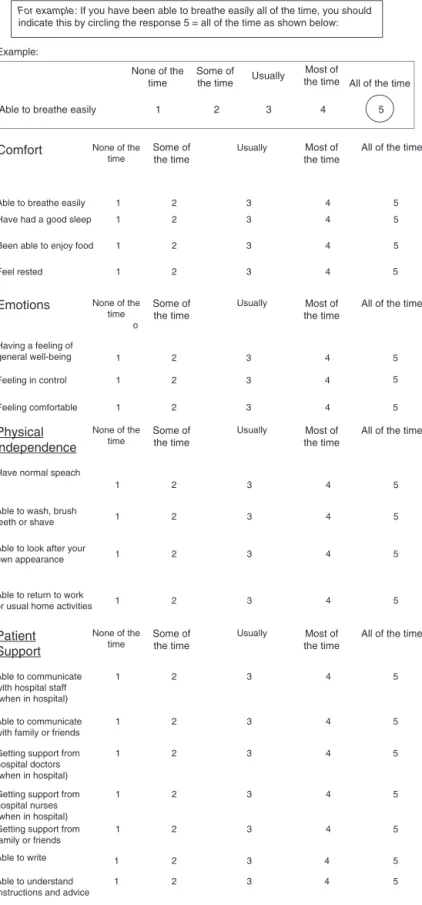
The interviews were performed in the ward the morn-ing after surgery for one of two medical school students whoparticipatedinthestudy andwereblind tothe anes-theticprocedureadopted.Aftertheexplanationofhowto filldequestionnaire, thequestionnaire wascompletedby the patient with the interviewer at his/her side to clar-ify any doubts. The QoR-40 has 40 questions divided into five dimensions: emotional status (nine questions), phys-ical comfort (12 questions), psychological support (seven questions),physicalindependence(fivequestions),andpain (seven questions). Each question relates to its frequency ofoccurrence,accordingtotheLikertscale:‘‘noneofthe time’’,‘‘sometimes’’,‘‘often’’,‘‘mostofthetime’’,‘‘all the time’’. Each of the indicative terms of frequency is assignedanumberfromonetofive.
The questionnaire has two parts(A and B). In part A, thequestionsindicatepositiveaspects;thatis, thehigher thefrequency ofoccurrence,thehigherthescore.InPart B,it isthereverse. Therefore,in partA,theterm‘‘none ofthetime’’is representedbyone;‘‘sometimes’’ is rep-resentedbytwo; ‘‘often’’isrepresentedbythree;‘‘most of the time’’is represented by four, and ‘‘all the time’’ is represented by five. In part B, ‘‘none of the time’’ is representedbyfive;‘‘sometimes’’is representedbyfour, andsoon.ThetotalpossiblescoreforQoR-40rangesfrom 40(poorrecovery)to200points(excellentrecovery).The questionnairewastranslated,adaptedandvalidatedtothe Portugueselanguage3 andforpatientsundergoingregional
anesthesia.4
Multivariate analysis through multiple binary logistic regressionwasusedtoidentifycovariatesassociatedwith theoccurrenceof QoR-40≤195(distributionmedian). Ini-tially, univariate binary logistic analyzes were conducted to test the association between each covariate and the
binaryresponsevariable.Intheseanalyses,whenthe phe-nomenon of data ‘‘separation’’ was noticed the exact logisticregressionmethodwasappliedinsteadofthe con-ventionalasymptoticmethod.Subsequently,thecovariates with a p-value <0.20 in univariate regression analyzes were considered in the multiple logistic regression anal-ysis with the conventional maximum likelihood method and selection of variables according to the backward elimination technique. The linearity assumption of the logit scale (log-odds) between each quantitative covari-ateandthebinaryresponsevariableinthebinarylogistic regression analysis were evaluated using fractional poly-nomials and building the smoothed scatter plots. When the assumption was not met, quantitative covariates were categorized according to the distribution terciles. The multicollinearity diagnosis was performed via esti-mation of the variance inflation factors (VIF). The final multiple logisticregressionmodel calibrationand discrim-inatoryabilitywereevaluatedusingtheHosmer---Lemeshow test and c-statistics, respectively. Normality wasassessed by visual inspection of histograms and application of Shapiro---Wilks normality test. Categorical variables were described as absolute (relative) frequencies and continu-ous variables described as mean±standard deviation or median (interquartile range). All presented significance probabilities (p-values) are of bilateral type and values lessthan0.05wereconsideredstatisticallysignificant.SAS version 9.3 software was used for statistical analysis of data.
Results
FromAugust2013toJune2014,197patientswereselected, of whom25wereexcluded: fourdue torefusalto partic-ipate in the study, nine due tocontraindication to spinal anesthesiaorallergytooneofthedrugsusedinthestudy, and12 duetohistory ofdependence onalcohol or drugs. Among the 172 patients enrolled, the mean age was 35 years,77%male,and49%reportedneverhavingundergone previous surgeryor anesthesiain the lower limbs. In 76% ofcases,thelevelofsedationwasmaintainedabovetwo, according tothe Ramsayscale. Theaverage lengthof the procedureswas171minandtheaveragelengthofPACUstay was70min.Duringthisperiod,onlyonepatienthadsevere pain (>4), according to the adopted scale. Two patients had nauseaand/or vomiting,one complained of pruritus, and there was no urinary retention complaint. The most commonly seen complication was hypothermia (tempera-ture<36◦C),presentin27%ofpatients.Intheward,nausea
Table1 NumberofpatientswithQoR-40>195or≤195,accordingtovariables,suchassex,physicalstatus,previouslower limbsurgery,andpreviousanesthesiaforlowerlimborthopedicsurgery.Dataareexpressedasnumber(%).
QoR-40>195 QoR-40≤195 Total
Sex
Female 21(54%) 18(46%) 39(100%)
Male 48(36%) 85(64%) 133(100%)
ASA
I 51(42%) 71(58%) 122(100%)
II 18(35%) 32(65%) 50(100%)
Previoussurgery
No 38(45%) 46(55%) 84(100%)
Yes 31(35%) 57(65%) 88(100%)
Previousanesthesia
No 38(45%) 46(55%) 84(100%)
Yes 31(35%) 57(65%) 88(100%)
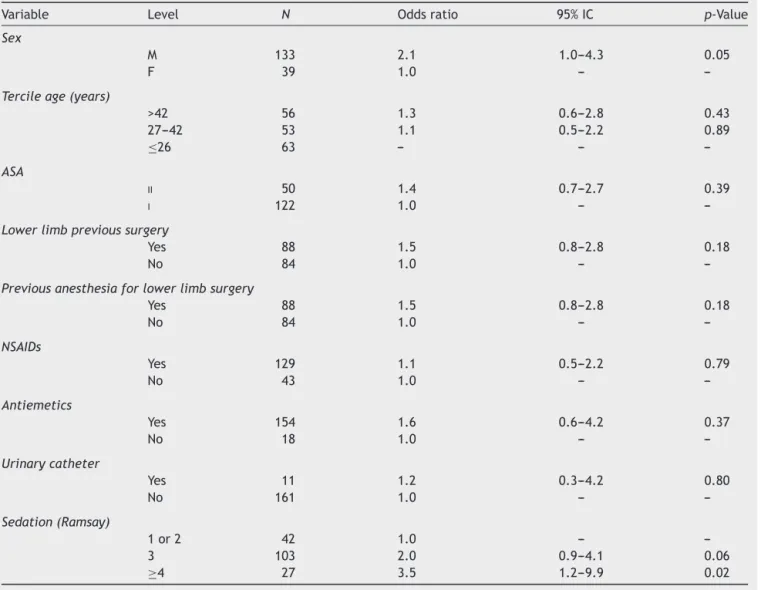
Table2 Influenceofthevariablessex,age,ASAphysicalstatus,previouslowerlimbsurgeryorpreviousanesthesiaforlower limbsurgery,intraoperativeadministrationofanti-inflammatoryorantiemeticdrugs,urinarycatheterintheoperatingroom, andlevelofsedation,accordingtoRamsayscaleforqualityofrecovery.
Variable Level N Oddsratio 95%IC p-Value
Sex
M 133 2.1 1.0---4.3 0.05
F 39 1.0 ---
---Tercileage(years)
>42 56 1.3 0.6---2.8 0.43
27---42 53 1.1 0.5---2.2 0.89
≤26 63 --- ---
---ASA
II 50 1.4 0.7---2.7 0.39
I 122 1.0 ---
---Lowerlimbprevioussurgery
Yes 88 1.5 0.8---2.8 0.18
No 84 1.0 ---
---Previousanesthesiaforlowerlimbsurgery
Yes 88 1.5 0.8---2.8 0.18
No 84 1.0 ---
---NSAIDs
Yes 129 1.1 0.5---2.2 0.79
No 43 1.0 ---
---Antiemetics
Yes 154 1.6 0.6---4.2 0.37
No 18 1.0 ---
---Urinarycatheter
Yes 11 1.2 0.3---4.2 0.80
No 161 1.0 ---
---Sedation(Ramsay)
1or2 42 1.0 ---
---3 103 2.0 0.9---4.1 0.06
Table3 Influenceofthevariablesobservedinthepost-anesthesiacareunitonqualityofrecovery.
Variable Level N Oddsratio 95%IC p-Value
Tercilestay(minutes)
>90 51 1.8 0.8---3.8 0.14
61---90 44 0.9 0.4---1.8 0.71
≤60 77 1.0 ---
---Temperature<36◦C
Yes 47 0.9 0.5---1.8 0.81
No 125 1.0 ---
---Nauseaand/orvomiting
Yes 2 0.7 0.1---11.3 0.80
No 170 1.0 ---
---Pruritus
Yes 1 0.7 0.0---13.2 0.82
No 171 1.0 ---
---Urinaryretention
Yes 0 --- ---
---No 172 --- ---
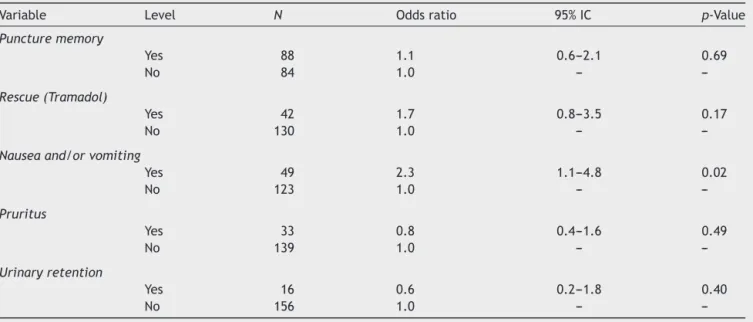
---Table4 Influenceofthevariablesobservedinthewardonqualityofrecovery.
Variable Level N Oddsratio 95%IC p-Value
Puncturememory
Yes 88 1.1 0.6---2.1 0.69
No 84 1.0 ---
---Rescue(Tramadol)
Yes 42 1.7 0.8---3.5 0.17
No 130 1.0 ---
---Nauseaand/orvomiting
Yes 49 2.3 1.1---4.8 0.02
No 123 1.0 ---
---Pruritus
Yes 33 0.8 0.4---1.6 0.49
No 139 1.0 ---
---Urinaryretention
Yes 16 0.6 0.2---1.8 0.40
No 156 1.0 ---
---Discussion
A cross-sectional study was performed in order to assess thequality of recovery fromanesthesia usingthe QoR-40 questionnaireinpatientsundergoinglowerlimborthopedic surgery.Theaveragescorewas192points(40---200),which represents a high quality recovery in the patients’ opin-ion.Potentialpredictivefactorsforpoorqualityofrecovery werealsoidentified.So,weanalyzedanthropometricdata, previousexperiencewithlowerlimbanesthesiaorsurgery, level of perioperative sedation, prophylactic administra-tion of anti-inflammatory or antiemetic drugs, and the occurrence(ornot)ofcomplicationsinPACUorward. Multi-variateanalysisviamultiplelogisticregressionwasusedand theevents were analyzed according to theoccurrence of
Name: study #: Hospital UR #: Date:
Part A How have you been feeling in the last 24 hours?
(1 to 5, where: 1 = very poor and 5 = excellent)
Example:
None of the time
Some of the time
Some of the time
Usually the timeMost of
Most of the time
All of the time
All of the time
Able to breathe easily 1 2 3 4 5
Comfort None of the time
Usually
Some of the time
Most of the time
All of the time
None of the time
Usually
Some of the time
Most of the time
All of the time
None of the time
Usually
Some of the time
Most of the time
All of the time
None of the time
Usually Able to breathe easily
Have had a good sleep
Been able to enjoy food
Feel rested
1 2 3 4 5
1 2 3 4 5
1 2 3 4 5
1 2 3 4
Emotions
o
Having a feeling of
general well-being 1 2 3 4 5
5
Feeling in control 1 2 3 4
Feeling comfortable 1 2 3 4 5
5 For example: If you have been able to breathe easily all of the time, you should indicate this by circling the response 5 = all of the time as shown below:
Physical independence
Have normal speach
1 2 3 4 5
Able to wash, brush
teeth or shave 1 2 3 4 5
Able to look after your
own appearance 1 2 3 4 5
Able to return to work
or usual home activities 1 2 3 4 5
Patient Support
Able to communicate with hospital staff (when in hospital)
1 2 3 4 5
Able to communicate with family or friends
1 2 3 4 5
Getting support from hospital doctors (when in hospital)
Getting support from hospital nurses (when in hospital)
1 2 3 4 5
1 2 3 4 5
Getting support from family or friends
Able to write
Able to understand instructions and advice
1 2 3 4 5
1 2 3 4 5
1 2 3 4 5
Numerousaspectscaninfluencethepatient’sperception aboutthequalityofrecoveryfromanesthesia.Lowerlimb orthopedicsurgeriesarecommonlyperformedunderspinal anesthesiaand accompaniedby somepostoperative pecu-liaritiesthatdeserveattention,suchasambulationlimited by surgery or disease, dependence on support from oth-ersfor basic activities, pain,urinaryretention,and other
possibleadverseeffectsrelatedtoanesthesiaandsurgery. Poor quality recovery can prolong hospital stay, generate dissatisfaction, and change the pattern of use of hospi-tal resources, resulting in higher costs.5 Determining the
cause for a possible oscillation of the anesthesia recov-ery quality level of a service may suggest strategies for resolvingdeficienciesordiscoveryofpotentialimprovement
Part B: Have you had any of the following in the last 24 hours?
(5 to 1, where: 5 = excellent and 1 = very poor)
Comfort None of
the time
Some of the time
Usually Most of
the time
All of the time
None of the time
Some of the time
Usually Most of
the time
All of the time
None of the time
Some of the time
Usually
Usually
Most of the time
All of the time
None of the time
Some of the time
Most of the time
All of the time
Nausea 5 4 3 2 1
Vomiting
Vomiting without
content 5 4 3 2 1
Dry-retching
Feeling restless 5 4 3 2 1
Shaking or twitching
Feeling too cold 5 4 3 2 1
Feeling dizzy
Emotions
Had bad dream
Feeling anxious 5 4 3 2 1
Feeling angry
Feeling depressed 5 4 3 2 1
Feeling alone
Had difficulty falling
asleep 5 4 3 2 1
Patient Support
Feeling confused 5 4 3 2 1
Pain
Moderate pain 5 4 3 2 1
Severe pain
Headache 5 4 3 2 1
Muscle pains
Backache 5 4 3 2 1
Sore throat
5 4 3 2 1
5 4 3 2 1
5 4 3 2 1
5 4 3 2 1
5 4 3 2 1
5 4 3 2 1
5 4 3 2 1
5 4 3 2 1
5 4 3 2 1
5 4 3 2 1
Sore mouth 5 4 3 2 1
opportunities. Hence theimportance of a careful evalua-tionnotonlyofpostoperativepainbutalsootherphysical, functional, and psychological aspects of patients. Various forms of measurement have been proposed for this pur-pose,butwhencomparingthemeasuringinstrumentsafter anestheticprocedures,QoR-40showedmoreadequate psy-chometriccharacteristicsandhasbeenconsideredthebest tooldevelopedfor thispurpose, asshownby two qualita-tivesystematic reviewsanda quantitativeone.6---8QoR-40
(Fig.1)has40questionsdividedintofivedimensions: emo-tionalstatus,physicalcomfort,emotionalsupport,physical independence, and pain.Each question relates toits fre-quency of occurrence, according to theLikert scale. The totalpossiblescoreforQoR-40rangesfrom40(poor recov-ery) to200 points (excellentrecovery). Few studies have evaluatedthequalityofrecoveryafteranesthesiafor ortho-pedicsurgery.In thepresent study,variablessuchasage, lower limb orthopedic surgery or previous anesthesia for this procedure, prophylactic administration of antiemetic oranti-inflammatorydrugs,andurinarycatheterwerenot determining factors for poor quality recovery. Similarly, thelength of PACUstay andthepresence of hypothermia observedinthisunitdidnotdeterminealowerscorein QoR-40.Postoperativecomplications,suchaspruritusandurinary retention,evaluatedinPACUorward,werenotconsidered asa riskfactor for a scorelower than195. Some authors observed that female patients were more likely to have poor quality recovery after anesthesia. One explanation wouldbeahigherincidenceofnauseaandvomitingamong female patients or greater willingness to report dissatis-factionduringthepostoperativeperiod.9---11 Inthepresent
investigation,malewasconsideredasapredictivefactorfor lowerscoreintheQoR-40questionnaire.Itwasnotpossible toestablishapossibleexplanationforthisresult.Another interestingfindingwasthatpatientsundersedation(Grade 4 ormore), according toRamsayscale, had lowerquality ofrecoverycomparedtothosewhoremainedmoreaware (Ramsay1or2).Thisresultmaycontainsomebiasthatmust beconsidered.Itisunlikelythatpatientpreferenceistostay awake,although thisissue hasnotbeendirectly assessed. Perhapssedationhasbeen appliedwithgreaterfrequency andintensityinpatientsundergoingmorecomplexand pro-longedprocedures,whichwouldjustifytheworstqualityof recovery.Anotherpossibilityis thepossible occurrenceof adverseeffectsassociatedwithsedation,suchasprolonged sleepiness.
Despite midazolam administration immediately before spinal anesthesia, 49% of patients reported having mem-oryof the puncturetime.Still, thememory hasnotbeen considered a predictive factor for poor quality recovery. On the other hand, pain, nausea,and vomiting, asnoted by other authors,7,10 were determining factors for lower
scoreaccordingtotheadoptedscale.Thesecomplications were uncommon in the PACU,but there wasa significant increase in the length of stay in the ward. According to Ekstein and Weinbroum,12 pain severity after orthopedic
surgery can overcome that observed in patients undergo-ing laparotomy, which requires the adoption of specific protocols for postoperative management. The incidence of nauseaand/or vomiting amongthe participants of this study was 28%. Authors who evaluated the occurrence of these complications in patients undergoing orthopedic
surgery under spinal anesthesia with bupivacaine and morphine13,14 reported incidence of 40---60%. The
prophy-lactic administration of ondansetron in 89% of cases in our study could explain the lower incidence, although therewas nocomparison between those receiving or not prophylactic antiemetics. The administration of intrathe-calmorphine at a dose up to0.1mg does not appear to increasetheriskofpostoperativenauseaandvomiting.13,15
As it is across-sectional study, theremay bedifficulty in establishing causal relationships from the exposed data. Thepresent studyindicatestheneed forrandomized con-trolled trials comparing the quality of the recovery of patients undergoing orthopedic surgery under different techniques for postoperative pain, nausea and vomiting management.
Inconclusion, male, nausea,vomiting, andpainduring wardstayarepredictivefactorsforpoorqualityofrecovery afteranesthesiaforlowerlimborthopedicsurgeries.
Conflicts
of
interest
Theauthorsdeclarenoconflictsofinterest.
References
1.MylesPS,WeitkampB,JonesK,etal.Validityandreliability ofapostoperativequalityofrecoveryscore:theQoR-40.BrJ Anaesth.2000;84:11---5.
2.RamsayMAE,SavegeTM,SimpsonBRJ,etal.Controlled seda-tionwithalpaxalone---alphadolone.BMJ.1974;2:656---9.
3.SchwerdtfegerCMMA.Qualidadederecuperac¸ãoemanestesia: abordagemdasatisfac¸ãodospacientessubmetidosao proced-imento anestésico. [Thesis] Bauru. Hospital de Reabilitac¸ão deAnomaliasCraniofaciais,UniversidadedeSãoPaulo;2010. p.1---144.
4.IdvallE,BergK,UnossonM,etal.Assessmentofrecoveryafter daysurgeryusingamodifiedversionofqualityofrecovery40. ActaAnaesthesiolScand.2009;53:673---7.
5.Tong D, Chung F, Wong D. Predictive factors in global and anesthesiasatisfactioninambulatorysurgicalpatients. Anes-thesiology.1997;87:856---64.
6.GornallBF,MylesPS,SmithCL,etal.Measurementofquality ofrecoveryusingtheQoR-40:aquantitativesystematicreview. BrJAnaesth.2013:2---9.
7.Herrera FJ, Wong J, Chung F. A systematic review of post-operativerecoveryoutcomesmeasurementsafterambulatory surgery.AnesthAnalg.2007;10:63---9.
8.Kluivers KB, Riphagen I, Vierhout ME, et al. Systematic reviewonrecoveryspecificquality-of-lifeinstruments.Surgery. 2008;143:206---15.
9.MylesPS,McLeodADM,HuntJO,etal.Sexdifferencesinspeed ofemergenceandqualityofrecoveryafteranaesthesia:cohort study.BMJ.2001;322:710---1.
10.MylesPS,WilliamsDL,HendrataM,etal.Patientsatisfaction afteranaesthesiaandsurgery:resultsofaprospectivesurvey of10,811patients.BrJAnaesth.2000;84:6---10.
11.Buchanan FF,Myles PS,CicuttiniF.Patient sex and its influ-enceongeneralanesthesia.AnaesthIntensiveCare.2009;37: 207---8.
13.Borgeat A, Ekatodramis G, Schenker CA.Postoperative nau-sea and vomiting in regional anesthesia. Anesthesiology. 2003;98:530---47.
14.Jacobson L, Chabal C,Brody MC. A dose---response studyof intrathecalmorphine:efficacy,duration,optimaldose,andside effects.AnesthAnalg.1988;67:1082---8.