A STUDY ABOUT FAMI LI ES OF CHI LDREN AN D TEEN AGERS W HO W ERE VI CTI MS OF
VI OLENCE AND FACED JUDI CI AL I NTERVENTI ON
Eliana Mendes de Souza Teix eir a Roque1 Mar ia das Gr aças Car v alho Fer r iani2
Roque EMST, Fer r iani MGC. A st udy about fam ilies of childr en and t eenager s w ho w er e vict im s of violence and faced j udicial int er v ent ion. Rev Lat ino- am Enfer m agem 2 0 0 7 j ulho- agost o; 1 5 ( 4 ) : 5 4 9 - 5 5 .
The goal of t his st udy w as t o t r ack t he st eps of fam ilies t hat com m it t ed som e kind of violence against t heir childr en and faced j udicial int er vent ion, as w ell as t o explor e t heir per cept ions about t he event s involving su ch in t er v en t ion ; t o qu an t ify an d assess t h e law su it s, du r in g t h e per iod fr om 2 0 0 0 t o 2 0 0 5 , ch ar act er izin g sit uat ions of fam ily v iolence and r e- v ict im izat ion. The st udy w as t heor et ically based on t he ecological cont ex t of hum an developm ent . The m et hodology em ployed w as quant it at ive- qualit at ive. The t ools used w er e: analysis of t he pr oceedings, filling out census m aps, elabor at ion of genogr am and ecom ap. The analy sis w as based on dialect ic her m eneut ics. The r esult s show ed t hat t her e w er e 1766 law suit s at t he cour t , 8. 21% of w hich w er e linked t o fam ily violence. Thr ee em pir ical cat egor ies cam e up: “ I didn’t have” , w hich por t r ays a kind of childhood w her e negat ion w as a const r uct iv e elem ent of int er act ions, per v er sely engender ed in t he econom ic, polit ical and inst it ut ional univer ses; “ I t doesn’t help and it w on’t change anyt hing” show ed a Judicial Syst em t hat did not under st and societ y and it s conflict s, and “ I n t he st r eet ” , feat ur ing ev er y day r out ines of social ex clusion.
DESCRI PTORS: fam ily , dom est ic v iolence; child abuse; adolescent
ESTUDI O DE LAS FAMI LI AS DE N I Ñ OS Y ADOLESCEN TES, VÍ CTI MAS DE VI OLEN CI A,
QUE HAN SUFRI DO I NTERVENCI ÓN DE LA JUSTI CI A
El obj et ivo de est e est udio fue conocer la t r ayect or ia y per cepción de la fam ilia acer ca de las ocur r encias ligas a int er vención de la j ust icia a la violencia que se ha com et ido; cuant ificar y analizar los pr ocesos for enses, en el per íodo de 2000 a 2005, car act er izando violencia en la fam ilia y r evict im ización. El r efer encial ut ilizado es el del con t ex t o ecológico del desar r ollo h u m an o). La m et odología es cu an t icu alit at iv a. Los in st r u m en t os son an álisis de pr ocesos, r ellen o de los m apas cen su ales, elabor ación del gen ogr am a y ecom apa. El an álisis se inspir ó en la her m enéut ica dialéct ica. Los r esult ados apunt an 1.766 pr ocesos j udiciales de infancia y j uv ent ud, ent r e esos el 8, 21% de v iolencia en la fam ilia. Sur gier on t r es cat egor ias em pír icas: “ No Tuv e” que pr esent a u n a in fan cia en qu e la n egación es elem en t o con st r u ct iv o de in t er accion es per v er sam en t e gen er adas en los univer sos económ ico, polít ico e inst it ucional. “ No Ayuda” y “ No Da Nada” , expr esan un Poder Judicial con poca cap acid ad p ar a en t en d er la socied ad y su s con f lict os. “ En la Calle” t r ae cot id ian os sin gu lar es d e ex clu sión social.
DESCRI PTORES: fam ilia; v iolencia dom ést ica; m alt r at o a los niños; adolescent e
ESTUDO DAS FAMÍ LI AS DE CRI AN ÇAS E ADOLESCEN TES, VÍ TI MAS DE VI OLÊN CI A,
QUE SOFRERAM I NTERVENÇÃO DA JUSTI ÇA
Obj et iv o do est udo: conhecer a t r aj et ór ia e a per cepção da fam ília acer ca dos acont ecim ent os ligados à in t er v en ção da j u st iça n a v iolên cia com et ida; qu an t if icar e an alisar os pr ocessos f or en ses n o per íodo de 2000 a 2005, car act er izando sit uações de violência na fam ília e de r evit im ização. O r efer encial ut ilizado é o do cont ext o ecológico do desenvolvim ent o hum ano. A m et odologia é quant iqualit at iva. Os inst r um ent os são análise de pr ocessos, pr eenchim ent o dos m apas censit ár ios, elabor ação de genogr am a e ecom apa. A análise inspir ou-se n a h er m en êu t ica dialét ica. Os r esu lt ados apon t am 1 . 7 6 6 pr ocessos j u diciais de in fân cia e j u v en t u de, dos q u ais 8 , 2 1 % são d e v iolên cia n a f am ília. Em er gir am t r ês cat eg or ias em p ír icas “ Não t iv e” q u e ap r esen t a a infância na qual a negação é elem ent o const r ut iv o de int er ações, per v er sam ent e engendr adas nos univ er sos econôm ico, polít ico e inst it ucional. “ Não aj uda” e “ Não v ir a nada” , ex pr essam um Poder Judiciár io com pouca capacidade de ent ender a sociedade e seus conflit os. “ Na r ua” t r az cot idianos singular es de ex clusão social.
DESCRI TORES: fam ília; v iolên cia dom ést ica; m au s- t r at os in fan t is; adolescen t e
1 PhD in Nur sing and Public Healt h, e- m ail: j k r [email protected] .br ; 2 Full Pr ofessor, Univ er sit y of São Paulo at Ribeir ão Pr et o College of Nur sing, WHO Collabor at ing Cent r e for Nur sing Resear ch Developm ent , Br azil, e- m ail: car oline@eer p.usp.br
I NTRODUCTI ON
T
he int er est in st udy ing t he r eint egr at ion of child and/ or adolescent v ict im s of v iolence int o t heirfam ilies aft er j udicial int ervent ion is due t o t he result s
of our Mast er’s t hesis: “ violence in t he fam ily against
childr en and adolescent s and t he per cept ion of legal
oper at or s in t he Count y of Jar dinópolis- SP”.
Th e r e se a r ch w a s l i m i t e d , a s i t a sse sse d
j udicial cases based on denouncem ent s, r educing t he
concept s and r esult ing pr oblem s, m ainly w it h r espect
t o t h e fam ily, w h ich is w hy w e st ar t ed t o qu est ion :
Wh ich ar e t h ese f am ilies t h at g o t o cou r t , h ow d o
t hey live and w hat are t heir profiles and com posit ions?
To a n s w e r t h i s q u e s t i o n , w e u s e d t h e
t h eor et ical r efer en ce fr am ew or k t h at cen t er s on t h e
view of t he ecological cont ext of hum an developm ent ,
pr oposed by( 1 ).
Convenience w as found am ong t he descr ibed
m et am od els( 2 ), select in g “ con t ex t u alism ”, t h at is, a
g i v e n e v e n t a t a g i v e n t i m e a s a r e s u l t o f t h e
i n t e r a c t i o n a m o n g a l l a s p e c t s o f t h e s y s t e m ,
cont aining as r elevant point s t hat per son and cont ext
cannot be separ at ed; t he cont ext consist s of differ ent
lev els of v ar iables; t he per son and t he m ult iple- lev el
con t ex t ar e a dy n am ic sy st em ; act iv it y an d ch an ge
i n t h e c a s e o f t h e o r g a n i s m d o n o t n e e d t o b e
ex p lain ed .
Cont r ibut ions by( 1- 3) describe four cores of an
ecological syst em : Person, Process, Cont ext and Tim e.
The per son is underst ood in his/ her biological,
ph y sical, psy ch ological ch ar act er ist ics, in in t er act ion
w it h t he environm ent . The per son’s st r uct ur e consist s
of t hr ee com bining aspect s: 1 ) t he disposit ions t hat
act iv at e an d m ain t ain h is/ h er i n t er act ion w i t h t h e
e n v i r o n m e n t ; 2 ) t h e r e s o u r c e s , a c q u i r e d
charact erist ics t hat are int ernalized t hrough int eract ion
w i t h t h e e n v i r o n m e n t , su ch a s e x p e r i e n ce s a n d
ab i l i t i es; 3 ) i n h er en t an d p r ed et er m i n ed d em an d s
( gen der, et h n ics, gen et ic in h er it an ce, t em per am en t )
t h a t s u s t a i n o r n o t r e a c t i o n s e x e r t e d b y t h e
en v ir on m en t , ad ap t ab le an d self - r eg u lat or y in v iew
o f t h e r e s i s t a n c e c a p a c i t y t h e y p r e s e n t i n t h e
challenges of int r a- and ex t r a- fam ily v iolence, dr ugs,
low socioecon om ic lev el, du r in g an d af t er a cer t ain
h i s t o r i c a l t i m e o f f a c t s . “ Th e p e r s o n u n d e r
developm ent is not consider ed m er ely as a blank slat e
a f f e ct e d b y t h e e n v i r o n m e n t , b u t a s a g r o w i n g ,
d y n a m i c e n t i t y t h a t p r o g r e ssi v e l y p e n e t r a t e s t h e
m eans it liv es in and r est r uct ur es it ” ( 1) .
Th e p r o c e s s i s h o w e x p e r i e n c e s a n d
int er act ions ar e int er pr et ed and t he envir onm ent it is
dev eloped in elabor at e t his concept , nom inat ing it as
a proxim al process, in w hich t he person int eract s w it h
ot her per sons, cont ex t s, obj ect s and sy m bols.
The int er act ion bet w een t he per son and t he
en v i r o n m e n t i s co n si d e r e d t w o - w ay, t h a t i s, i t i s
char act er ized by r ecipr ocit y, does not r em ain lim it ed
t o a s i n g l e e n v i r o n m e n t , b u t i n c l u d e s t h e
int er connect ions am ong t hese env ir onm ent s, as w ell
as ex t er n al in flu en ces fr om br oader m ean s.
Th e con t ex t ap p ear s as su b d iv id ed in f ou r
sy st em s: t he fir st , called m icr osy st em , is com posed
b y t h e i m m e d i a t e e n v i r o n m e n t t h a t co n t a i n s t h e
dev eloping per son, t he house, t he k inder gar t en, t he
classr oom ; t hese ar e places w her e people can easily
int egrat e face t o face. Act ivit y, r ole and int er per sonal
relat ion fact ors const it ut e t he elem ent s or blocks t hat
con st r u ct t h e m icr osy st em .
The second includes t he int er - r elat ions am ong
t he env ir onm ent s t he per son act iv ely par t icipat es in
( such as t he relat ions at hom e, at school for a child) ,
w hich ar e ex pended w henev er t he dev eloping per son
ent ers a new environm ent and is called m esosyst em .
Th e t h ir d sy st em , t h e ex osy st em , r ef er s t o
en v ir on m en t s t h at do n ot in v olv e t h e per son as an
act ive par t icipant , but in w hich event s occur t hat affect
w h a t h a p p e n s i n h i s/ h e r i m m e d i a t e e n v i r o n m e n t
( par ent s’ econom ic and w or k condit ions and childr en’s
liv ing condit ions) .
Th e m a n i f e s t a t i o n o f g l o b a l i d e o l o g y
st andar ds t hr ough t he com plex of sy st em s t hat fit in
a n d a r e co n n e ct e d , r e p r e se n t i n g t h e d i m e n si o n s
r elat ed t o t h e b r oad er cu lt u r al, econ om ic, p olit ical,
social and educat ional view s define t he fourt h syst em ,
d esig n at ed as m acr osy st em , w h ich ex er t s a st r on g
in f lu en ce on d ev elop m en t an d q u alit y of lif e, as it
covers t he rules for j oint life, st ereot ypes, beliefs and
pr ej udices of a cult ur al gr oup.
Ti m e , ca l l e d ch r o n o sy st e m , i n cl u d e s t w o
dist inct m odels. The fir st is r elat ed t o t he per son and
his/ her pr ox im al pr ocesses, w hich adv ance and need
t o b e st u d ied ov er t im e. Th e secon d r ef er s t o t h e
passage of t im e in t he sense of t he hist orical cont ext .
Th e ecolog ical t r an sit ion issu e is d iscu ssed
b y( 1 ). I t o ccu r s w h en ev er t h e p er so n ’ s p o si t i o n i s
a l t e r e d a s a r e s u l t o f a c h a n g e i n p o s i t i o n ,
e n v i r o n m e n t o r b o t h , m a k i n g t h e se ch a n g e s b e
The ecological concept ion of dev elopm ent in
t h e co n t e x t o f f e r e d t h e t h e o r e t i ca l b a se f o r t h e
sy st em at i c d ef i n i t i on of a con st r u ct ex ecu t ed i n a
nat ur al env ir onm ent and w hich inv olv ed obj ect s and
act iv it ies fr om daily life, w her e t he char act er ist ics of
t he per son and t he envir onm ent , t he st r uct ur e of t he
env ir onm ent al scenar ios and t he pr ocesses occur r ing
i n s i d e a n d a m o n g t h e m w e r e c o n s i d e r e d a s
int er dependent and analy zed in t er m s of sy st em s.
OBJECTI VES
I n t his scope, w e delim it ed t he obj ect iv es of
q u an t if y in g an d an aly zin g t h e f or en sic in t er v en t ion
t r ials in Childhood and Adolescence in t he Count y of
Ja r d i n ó p o l i s - S P, B r a z i l , f r o m 2 0 0 0 t o 2 0 0 5 ,
ch ar act er izin g sit u at ion s of v ict im izat ion of ch ildr en
and adolescent s w ho suffer ed v iolence in t he fam ily,
and of revict im izat ion am ong childr en and adolescent s
at t ended in t he Count y, fr om 1995 t o1999, as inser t ion
i n t h e f am i l y o r n o t . We an al y zed a t r aj ect o r y o f
r e i n t e g r a t i o n o f a g g r e sso r s a n d v i ct i m s i n t o t h e
cont ext , ver ifying how t he fam ily per ceived t he event s
relat ed w it h t he j udicial int ervent ion in t he com m it t ed
violence, get t ing t o know t he developm ent over a t
en-y ear per iod an d h ow t h een-y per ceiv ed an d dealt w it h
t h eir en v ir on m en t .
METHODS
Fo r t h e r e a l i z a t i o n o f t h i s s t u d y, w e
considered t he guidelines and regulat ions for research
inv olv ing hum an beings published in Resolut ion 1 9 6
by t he Nat ional Healt h Council, issued in 1 9 9 6 . The
r esear ch w as ap p r ov ed b y t h e I n st it u t ion al Rev iew
Board at t he Universit y of São Paulo at Ribeir ão Pr et o
College of Nu r sin g.
As f r om t h is st ep of t h e r esear ch p r oj ect ,
forensic aut horit ies w ere asked for t heir aut horizat ion
t o car r y out t he r esear ch in t he inst it ut ion r elat ed t o
t h e p r ocesses.
As a par t of t h e docu m en t at ion det er m in ed
in t his legislat ion, w e elaborat ed t he “ Consent Ter m ”,
w h i c h c o n t a i n e d c l a r i f i c a t i o n s f o r t h e r e s e a r c h
subj ect s, w rit t en in clear language, in order t o inform
t h em abou t t h e st u dy obj ect iv es, pr ocedu r es, r isk s,
d i s c o m f o r t a n d b e n e f i t s , a n d a l s o t o g u a r a n t e e
a n o n y m i t y a n d r e s p e c t f o r t h e i r w i l l i n g n e s s t o
par t icipat e or not . Those w ho agr eed t o par t icipat e in
t he r esear ch w er e asked t o sign t he t er m . Dur ing t he
first m eet ing, t hey received a copy of t he clarificat ions
and of t he t erm it self. On t his occasion, w e also asked
for t heir aut hor izat ion t o r ecor d t he int er v iew s.
Th e q u a n t i t a t i v e( 4 ) a n d q u a l i t a t i v e( 5 )
m et h o d o l o g y w a s a d o p t ed . Th e f i r st w a s u sed t o
quant ify j udicial t rials of violence against children and
adolescent s, in t he per iod fr om 2000 t o 2005, as w ell
as r ev ict im izat ion in t he fam ily.
We c h a r a c t e r i z e d t y p e s o f m i s h a n d l i n g ,
a sp e ct s r e l a t e d t o t h e v i ct i m a n d t h e a g g r e sso r,
r e v i ct i m i za t i o n s, ca r e l i m i t s a n d p r o b l e m so l v i n g
a b i l i t y, r e l a t i n g t h e m w i t h t h e p r e v i o u s f i v e- y e a r
p er iod . Dat a w er e collect ed b y an aly zin g t h e t r ials
a n d t h e n f i l l i n g o u t t h e ce n su s m a p s, f o r w h o se
q u an t it at iv e an aly sis elect r on ic w or k sh eet sof t w ar e
w as u sed . For t h e q u alit at iv e p ar t , sem ist r u ct u r ed
in t er v iew s an d f r ee obser v at ion w er e u sed, as w ell
as p h o t o g r ap h m at er i al p r o d u ced b y t h e r esear ch
subj ect s. To out line t he fam ily st ruct ure, w e used t he
Ca l g a r y Fa m i l y Asse ssm e n t Mo d e l ( CFAM) , w h i ch
consist s in a m ult idim ensional st ruct ure w it h t hree m ain
cat egor ies: st r uct ur al, dev elopm ent al and funct ional,
b a se d o n a t h e o r e t i ca l f o u n d a t i o n t h a t i n v o l v e s
syst em s, com m unicat ion and change. This m odel w as
adapt ed fr om t he fam ily assessm ent m odel( 6).
When assessing a fam ily, t her e is a need t o
exam ine it s st ruct ure, t hat is, w ho is part of it ( int ernal
st r uct ur e) , w hat is t he affect ive bond w it h individuals
fr om out side t he fam ily ( ext er nal st r uct ur e) , and w hat
is it s cont ext .
We a l s o u s e d t h e g e n o g r a m , w h i c h i s a
d i a g r a m o f t h e f a m i l y g r o u p , a n d t h e e co m a p , a
diagr am of t h e f am ily ’s con t r act w it h ot h er people,
besides t h e im m ediat e f am ily, w h ich r epr esen t s t h e
im p or t an t con n ect ion s b et w een t h e f am ily an d t h e
w or ld , f acilit at in g alt er n at iv e in t er p r et at ion s of t h e
fam ily ex per ience. The analy sis w as inspir ed on( 7- 8).
RESULTS AND DI SCUSSI ON
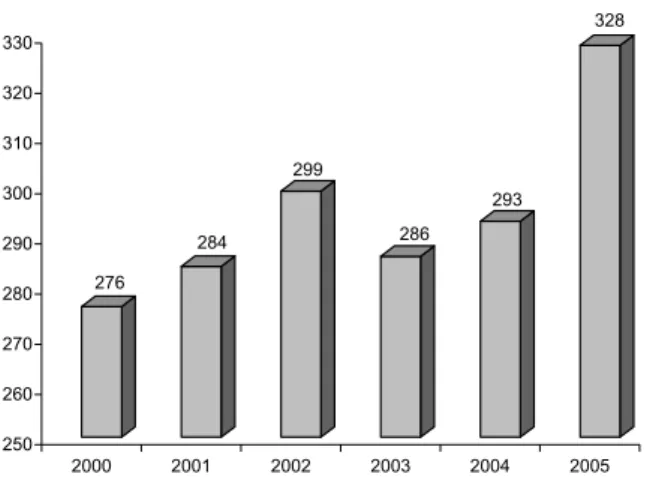
Th e r esear ch r esu lt s appoin t t h at , bet w een
2 0 0 0 an d 2 0 0 5 , accor din g t o dat a fr om t h e Ju dicial
Mo v e m e n t , t h e Co u n t y o f Ja r d i n ó p o l i s- SP, Br a zi l ,
Figure 1 - Dist ribut ion of Judicial Movem ent r elat ed t o
Childhood and Adolescence accor ding t o t he num ber
of t r ials in Jar dinópolis –SP- Br azil fr om 2000 t o 2005
I n t his gr oup, 8 . 2 1 % r efer s t o phy sical and
sex u al v iolen ce an d n eglect in t h e f am ily, inv olv in g
257 v ict im s, of w hom 121 w er e gir ls and 136 boy s.
Phy sical v iolence show ed t he highest incidence lev el
( 4 4 . 1 % ) , f ol l ow ed b y n eg l ect ( 4 2 . 1 % ) an d sex u al
violence ( 13.8% ) . I t w as ver ified t hat violent behavior
appear ed in child vict im s bet w een 1995 and 1999, in
t he pr act ice of offenses in ( 13) event s, cor r elat ed w it h
( 37) r epeat ed v ict im s in subsequent y ear s.
276
284 299
286 293
328
250 260 270 280 290 300 310 320 330
2000 2001 2002 2003 2004 2005
42,86%
21,43%
7,14% 14,29%
7,14% 7,14%
0,00% 5,00% 10,00% 15,00% 20,00% 25,00% 30,00% 35,00% 40,00% 45,00%
Traffic Drugs possession
Robbery attempt
Customs Theft Robbery
Figure 2 – Dist ribut ion of violent behavior per offense
pr act ice, bet w een 2000 and 2005, accor ding t o vict im s
o f p h y si ca l v i o l e n ce , n e g l e ct a n d se x u a l v i o l e n ce
bet w een 1995 and 1999
When com paring t hese result s w it h an earlier
r esear ch( 9 ), t h e cu r r en t ch ar act er izat ion of v iolen ce
i n t h e f am i l y ap p oi n t a si g n i f i can t i n cr ease i n t h e
o c c u r r e n c e p e r c e n t a g e s o f n e g l e c t a n d s e x u a l
v i ol en ce.
69,4% 20,8%
9,7%
physical violence neglect sexual violence
44,1%
42,1% 13,8%
Period from 1995 to 1999 Period from 2000 to 2005
Figure 3 - Com parat ive dist ribut ion of physical violence,
neglect and sexual violence, according t o confirm at ion
in Jardinópolis –SP- Brazil from 1995 t o 2005
N e g l e c t , c o n s i d e r e d a s a n a t t i t u d e a n d
p er cep t ion in t h e con t ex t of f am ily lif e an d n ot as
b e h a v i o r, s t o o d o u t i n c o n n e c t i o n w i t h f a m i l y
disor gan izat ion , in t h e r oles m en an d w om en adopt
i n t h ei r f am i l y n u cl ei . Th e eco n o m i c co n d i t i o n s t o
m aint ain and m ak e feasible t his sam e fam ily nucleus
ar e inser t ed in t his cont ex t .
This is a negat ive elem ent t hat , in t he r efer r ed
st u d y, w as p u lv er ized t og et h er w it h ot h er n eg at iv e
el em en t s, d i st r i b u t ed i n d i f f er en t d am ag es t o t h e
f am ilies.
We can even think of a continuum of elem ents
that not only give rise to the physical discom fort of staying
am ong insects like m ice and bugs, one end of which would
cont ain ot her part s of a whole t hat cause not only low
interactional quality, but also elem ents that could lead to
im por t an t losses in af f ect iv e, in t ellect u al an d social
developm ent, until reaching the other end, in which the
elem ent s w ould be locat ed t hat favor t he breaking of
fam ily bonds, w hich w ere also present in t he fam ilies
under st udy as “ vice”, “ int ra and ext ra- fam ily violence”
and “ ir r esponsibilit y ”. We consider t hat t hese r elat ed
elem en t s ap p ear in t h is st u d y as p ot en t ially m or e
destructive to fam ily bonds and to the protective functions
the fam ily should perform .
The r esult s show t hat a single m odel of fam ily
life is being shar ed, in w hich t he w om an occupies a
cen t r al p osit ion , an d ir r esp on sib ilit y is an elem en t
r e l a t e d a s p o t e n t i a l l y m o r e d e st r u ct i v e t o f a m i l y
b on d s.
I n collect ing infor m at ion about t he differ ent
s e x u a l v i o l e n c e s i t u a t i o n s a g a i n s t c h i l d r e n a n d
adolescent s in t he fam ily t hat occur r ed bet w een 1995
an d 2 0 0 5 , w e ob ser v e t h at t h e v ict im s ar e m ost ly
f e m a l e , b e a r i n g c o n s e q u e n c e s o f p r o b l e m s a n d
t hreat s t o life and t o t he qualit y of exist ence, affect ing
Figur e 4 - Com par at ive dist r ibut ion of sexual violence
accor ding t o t ype of or ganic consequences for vict im s
in Jar dinópolis- SP, Brazil, fr om 1995 t o 2005
Re p o r t s e m e r g e d f r o m t h e i n t e r v i e w e e s’
d iscou r se, u sin g Por t u g u ese in a w ay t h at is q u it e
dist inct fr om it s nat ur al char act er ist ics.
The elaborat ion of t he genogram s defined t hat
t he com posit ion of t hese fam ilies always result ed from
differ ent and successiv e lov e r elat ions, per m eat ed by
regular rupt ures t hat involve elem ent s of violence, non
r ecognit ion of childr en’s pat er nit y, successiv e addr ess
changes, giving up children for adopt ion, lit t le insert ion
in t he labor w orld, som e w it h unst able t raj ect ories in
t h e r u r al con t ex t or as pain t er s or br ick lay er s. Th e
ecom aps dr ew v ar ious r elat ionship m odalit ies. These
f am ilies st ood ou t by t h e pr esen ce of on e or m or e
s e r i o u s a n d s e v e r e l o n g - t e r m a n d v e r y i n t e n s e
sy m p t o m s. Th ei r a g g r eg a t e a n d k i n sh i p el em en t s
configure a fam ily st ruct ure. The nat ure of t he relat ions
and roles played by each person in t his st ruct ure finds
t hings at t he lim it s, conj ugalit y, parent hood, resilience
an d m olar act iv it ies, an d is def in ed as a con t in u ed
behav ior t hat has a m om ent , quant it y of m ov em ent ,
it s own drive and is perceived as having a m eaning or
int ent ion by t he part icipant s in t he environm ent( 1).
Th r ee em p i r i cal cat eg o r i es w er e i d en t i f i ed
from t he m at erial collect ed in t he int erview : ” I did not
have”, “ I t does not help and it w on’t change anyt hing”,
“ I n t he st r eet ”.
I n t h e f i r st e m p i r i ca l ca t e g o r y ” I d i d n o t
h a v e ” , s i t u a t i o n s o f i n s e c u r i t y a n d h e l p l e s s n e s s
e m e r g e , w i t h c o n s e q u e n c e s f o r b e h a v i o r a n d
developm ent in a childhood m ar ked by “ hunger ”, “ child
w or k ”, ” absence of gam es”, ” no school inser t ion”, in
t he econom ic, polit ical and inst it ut ional univ er ses.
We found in t he st udy t hat 85% of t he fam ilies
con sist of w om en . Th ese d at a ar e cor r ob or at ed b y
o t h er r esear ch , su ch as a st u d y d ev el o p ed i n t h e
10,0%
10,0%
10,0%
10,0% 60,0%
Abortion Pregnancy
Physical injuries Genital injuries Rape attempt No information
7,4%
33,3%
18,5%
40,7% Period from 2000 to 2005
Period from 1995 to 1999 cont ext of t he pr oj ect “ Per m anent Social Developm ent
Ob s e r v a t o r y ” i n A v e i r o , Po r t u g a l( 1 0 ), w h e r e t h e
cen t r alit y of w om en in t h e sam p le of p oor f am ilies
w it h m ult iple pr oblem s found a com posit ion of 82.1%
o f w o m e n , w h o a t a v e r y y o u n g a g e b e c a m e
r espon sible f or dif f er en t f igu r es in t h e h ou se, ev en
for y ounger siblings, in housew or k . The lack of r ules
a n d t h e d e v a l u a t i o n o f e d u c a t i o n , r e f l e c t e d i n
absent eeism , abandonm ent and even failur e, int ensify
t his r ole of ear ly adult ness, w it hout adequat e m at ur it y
an d pr epar at ion .
Th e r e i s v u l n e r a b i l i t y i n t e r m s o f t h e
cont inuat ion of it s m em ber s in t he fam ily, br oken by
r eg u l ar occu r r en ces of p r i son s, p r esen ce i n p ol i ce
st at ion s f or d if f er en t r eason s, r an gin g f r om alcoh ol
and dr ugs abuse, t r affic, int er cur r ences of successiv e
visit s t o t he court house, quit e an int erest ing presence
i n t h e a sso ci a t i o n o f l a w y e r s, se e k i n g f r e e l e g a l
r e p r e s e n t a t i o n , m a i n l y i n d e m a n d s f o r D N A
( Deoxyribonucleic Acid) t est s. All of t his co- exist s over
long periods of t im e, aligned w it h prost it ut ion, incest ,
w h i ch a r e cl o sel y a sso ci a t ed w i t h co m p l ex h ea l t h
sit u at ion s, su ch as sex u ally t r an sm issib le d iseases,
including AI DS. Som e chr onic diseases ar e obser v ed,
as w ell as im pair m en t s. How ever, alt h ou gh m u lt iple
a n d v a r i e d , t h e i n d i v i d u a l s y m p t o m s p r e s e n t a
secon d ar y r ole in t h e f ace of t h e f am ily sy m p t om ,
w hich w e cor r obor at e( 11).
I n det er m ining how t he fam ily per ceiv es t he
j u dicial in t er v en t ion , t h e cat egor y “ I t does n ot h elp
and it w on’t change any t hing” r ev eals few incur sions
on violence, revealing point s t hat st rangle t he j udicial
p o w e r ’ s a c t i o n p o s s i b i l i t i e s i n t r i a l s : ( q u a n t i t y,
pr ocedur es and t im e) ; em ploy ees; child as absolut e
p r i o r i t y ; i n s t i t u t i o n a l v i o l e n c e ; l a c k o f s u p p o r t
in st it u t ion . Th e j u dicial lan gu age is n ot u n der st ood,
an d d if f icu lt ies ar e f aced t o t r an slat e an d in t er p r et
legal pr ocedur es. They use but do not speak t he sam e
language, w hich is one of t he det erm inant s of disbelief
i n t h e j u d i ci a l p o w e r, w h i ch i s t r a n sl a t e d i n t h e
expansion crisis of societ y, not exclusive of t he j udicial
cult ur e, w hose t r adit ions and inst it ut ional v ices t ur n
t he j udicial pow er slow , for m alist , elit ist and dist ant
from t he social realit y, in a pict ure t hat is unfav orable
t o t h e ef f icacy an d ef f icien cy of t h e Con st it u t ion al
Pow er it holds.
The fam ilies pr esent per cept ions of j ust ice’s
i n e f f i ci e n cy t h r o u g h t h e v i o l e n t e v e n t , a n d a l so
c o n s i d e r t h i s s a m e j u s t i c e a s a n a u t h o r i t a r i a n ,
They live sit uat ions in t heir cont ext , out lined
b y in t en se d if f icu lt y, in a p er m an en t r isk sit u at ion ,
w het her due t o t he local t rafficker w ho is t hreat ening
or t o an ex t r em ely v ulner able socioeconom ic r ealit y,
m o st l y su st a i n e d b y so ci a l su b si d i e s g r a n t e d b y
g o v e r n m e n t a c t i o n s l i k e B o l s a Es c o l a ( S c h o o l
Sch olar sh ip ) . Th er ef or e, d esp it e som e f ew r ep or t s,
no lar ge school ev asion is obser v ed, as t he benefit ’s
e l i g i b i l i t y st a n d a r d i s b a se d o n sch o o l a ssi d u i t y.
M o r e o v e r, b e s i d e s t h e s e s u b s i d i e s , t h e y a l s o
appr opr iat e t hem selv es of com m unit y or inst it ut ional
h elp, oft en in com bin at ion w it h pr odu ct s of r obber y
or illegal act ivit ies. Children also t ake part in obscure
incom e w hich, alt hough at t em pt s w er e m ade t o hide
it from t he researchers, appeared quit e clearly in t he
s t a t e m e n t s , d e m o n s t r a t i n g t h e p r o d u c t i o n o f
disint egr at ion sym pt om s. When Tulio w as, like, a m inor , he
w or ked as a car r ier , you know , lady? For t he dr ugs t r affic, I did
t his t o pay for m y addict ion, I didn’t have a childhood, I don’t
have any m em or y of ever having played w it h anyt hing. ( F9)
The cat egor y “ I n t he st r eet ” ent ails inser t ion
in per v er se r elat ion s, est ablish ed in t h e u n iv er se of
drugs t raffic, explorat ion, rej ect ion, violat ion of right s
an d econ om ic h ar dsh ip.
Ch ild r en , y ou n g p eop le an d ad u lt s p r esen t
t he sam e relat ions, except t hat childr en im pede ot her
dialogues in t he fam ily spher e it self, so as t o br eak
link s and bonds, w it hout success.
We could verify t hat , in living in a sit uat ion of
m isery, t he fam ilies at t em pt t o sat isfy t heir basic needs
of sur vival t hr ough som e kind of act ivit y on t he st r eet
and, oft en, t he st r at egies t hey use ar e based on t he
w ork of t heir children, elderly and relat ives w it h som e
kind of im pairm ent . This for m of living dir ect ly affect s
t he cont ex t of t he fam ily gr oup as a w hole, not only
due t o t he socioeconom ic sit uat ion, w hich places t hem
in t he popular classes, but also due t o t he obst acles
faces in com ply ing w it h t heir funct ions as socializing
agent for t heir childr en and adolescent s. We m ake no
int ent on consider ing t he socioeconom ic sit uat ion of
popular classes, and specifically t hese fam ilies’ incom e
of n ot ev en on e m in im u m w age, as t h e on ly f act or
det erm ining t he genesis of t his sit uat ion “ I n t he st reet ”.
Resilien ce m ov em en t s sh ou ld be obser v ed, ev en in
t he face of t he har d condit ions t hey pr esent .
St udies about st r eet childr en obser v e t hat it
is v er y sim plist ic t o say t h at , in all cases, t h e boy s
a n d g i r l s w e r e c o m p e l l e d b y t h e s o c i o e c o n o m i c
st r u ct u r e t o liv e in t h e st r eet s b ecau se, of t en , t h e
ch i l d r e n t h e m se l v e s m a k e t h i s o p t i o n . Th e r e a r e
general aspect s of t he social st ruct ure t hat det erm ine
t h e liv in g con d it ion s an d ex er t a d ecisiv e in f lu en ce
for childr en and adolescent s t o becom e boys and gir ls
liv ing in a st r eet sit uat ion. For t hem , t he st r eet can
r ep r esen t n ot on ly f r eed om b u t also alm ost d ir ect
access – ev en if illusionar y - t o t he benefit s t he cit y
offer s( 1 2 ).
CONCLUSI ON
I t i s co n cl u d e d t h a t t h e f a m i l i e s p r e se n t
alt er at ion s f r om on e h ist or ical m om en t t o an ot h er,
co n si d e r i n g d i st i n ct v a r i a b l e s a n d w i t h a sp e ci f i c
com plexit y, in t erm s of t he abilit ies t o discover, sust ain
or alt er t h e ch ar act er ist ics of t h eir d ev elop m en t in
t h e en v ir on m en t .
I n focusing on t he fam ily in t he fr am ew or k of
t h e Th e o r y o f Ec o l o g i c a l S y s t e m s( 1 ), w e c o u l d
under st and t he fact or s t hat per m eat e t he et iology of
violence and it s relat ions m anifest ed w it hin t his focus.
Tolerance t o differ ences appear ed as a bond t hat t ur ns
t he fam ily int o t he social and em ot ional st r uct ur e of
it s m em ber s.
I t is fundam ent al t o t r y and develop r esear ch
an d p r og r am s w it h b r oad er v iew s, w h ich n ot on ly
f ocu s on t h e v ict im , bu t also on t h e aggr essor an d
t he r em ainder of t he fam ily gr oup.
Th e r esu lt s of t h is r esear ch can b e essen t ial
t o e n co u r a g e a n d i m p l a n t p r o g r a m s t o i n t e r v e n e
in an d p r ev en t v iolen ce in t h e ecolog ical con t ex t it
i s d e v e l o p e d i n , w i t h p o s s i b i l i t i e s , t h r o u g h
ed u ca t i o n a l co n t r i b u t i o n s, t o cr ea t e a w a r en ess i n
t h e f am ilies ab ou t t h eir b eh av ior s an d r elat ion sh ip s
t h at lead t o v iolen ce, w h ich can act as p r om ot er s
o f r esi l i en ce.
We p o i n t t o w a r d s t h e i m p o r t a n c e o f a n
art iculat ion of j oint act ions, in healt h syst em s, by t he
j u d i ci al p o w er, w i t h a v i ew t o a l ess b u r eau cr at i c
act ion, w it hin a short er t im e period and m ore efficient ,
in t he fam ilies t hat received j udicial int ervent ion w hen
t he com m it t ed v iolence w as v er ified.
Th e v iew of h old in g t h e f am ily r esp on sib le
for t he violence sit uat ions lost subst ant ial force in our
s t u d y, c o r r e l a t e d w i t h c u l t u r a l , p s y c h o l o g i c a l ,
r elat ion al an d socioecon om ic f act or s.
Judicial int ervent ion in cases of fam ily violence
needs t o consider t he new social fr am ew or ks, adapt ing
t h em t o n ew legal det er m in at ion s on ot h er pr ocess
i n t e r v e n t i o n i s m a r k e d b y t h e i n a b i l i t y t o so l v e
p r ob lem s, b ein g con sid er ed as h er m et ic, slow an d
ar b it r ar y.
Th e f l e x i b i l i z a t i o n o f t h e l a w l a c k s
reengineering of t he t rial procedures and of law it self,
w i t h a sy st em o f st an d ar d s ad ap t ab l e t o t h e n ew
r ealit y.
Reflect ing t he lim it s and range of t hese result s
is of fundam ent al im port ance t o influence t heoret
icalm et h odological an d et h ical polit ical coicalm pet en ce, in
-an d ou t sid e t h e j u d icial sy st em , w it h st r at eg ies t o
ov er com e not only t he obst acles t o t he guar ant ee of
r ig h t s, b u t also t o t h e f am ilies’ p ar t icip at ion in t h e
co n st r u ct i o n o f so ci a l p o l i ci e s, co n si d e r e d i n i t s
d i m e n s i o n w i t h i n t h e e c o l o g i c a l s y s t e m a n d i t s
m e a n i n g s , i n t e r c o n n e c t e d i n v a s t a n d i n t r i c a t e
n e t w o r k s o f p e r s o n , p r o c e s s , c o n t e x t a n d t i m e
r elat ion s.
REFERENCES
1. Br onfenbr enner U. A ecologia do desenvolvim ent o hum ano.
exper im ent os nat ur ais e planej ados: Por t o Alegr e ( RS) : Ar t es
Mé d i ca s; 1 9 9 6 .
2 . Ciciar elli VG. Th e in d iv id u al in t h e f am ily lif e cicle. I n :
Lábat e L, ( or g.) Handbook of developm ent al fam ily psichology
a n d p s y c h o p a t h o l o g y. N e w Yo r k : W i h e y – I n t e r s c i e n c e
Pu b l i cat i o n ; 1 9 9 4 .
3. De Ant oni C, Koller SH. O psicólogo ecológico no cont ext o
i n st i t u ci o n a l : u m a e x p e r i ê n ci a co m m e n i n a s v ít i m a s d e
v i o l ên ci a. Psi co l o g i a ci ên ci a e p r o f i ssão 2 0 0 1 ; 2 1 ( 1 ) : 1 4
-2 9 .
4 . Gil DG. Violen ce ag ain st ch ild r en p h y sical ab u se in t h e
Un it ed St at es. 8 ª ed. USA: Har v ar d Un iv er sit y ; 1 9 7 8 .
5 . Mi n a y o MCS . O d e s a f i o d o c o n h e c i m e n t o : p e s q u i s a
qualit at iva em saúde. 4a. ed. São Paulo ( SP) : Hucit ec; 1996.
6 . Tom m K, San d er s G . Fam ily assessm en t in a p r ob lem
or ient ed r ecor d. I n: Hansen JJC, Keeney BF ( eds.) . Diagnosis
and assessm ent in: fam ily t her apy. . London: Aspen Sy st em s
Cor p or at ion ; 1 9 8 3 .
7. Haber m as J. Dialét ica e her m enêut ica. Por t o Alegr e ( RS) :
L& PM ; 1 9 8 7 .
8. Gadam er HG. Ver dade e m ét odo: t r aços fundam ent ais de
u m a h er m en êu t ica filosófica. Pet r ópolis ( RJ) : Vozes; 1 9 9 7 .
9 . Ro q u e EMST. A v i o l ên ci a n a f a m íl i a co n t r a cr i a n ça s e
ad olescen t es e a p er cep ção d os op er ad or es d o d ir eit o, n a
com ar ca de Jar dinópolis SP [ Disser t ação] Ribeir ão Pr et o ( SP) :
Escola d e En f er m ag em / USP; 2 0 0 1 .
1 0 . Pir es S, Mat os A, Cer qu eir a M, Figu eir edo D, Sou sa L.
Ret r at os da vida das fam ílias m ult ipr oblem át icas. Rev Ser viço
Social e Sociedade 2 0 0 4 n ov em br o; 8 0 ( 1 ) : 6 - 3 2 .
1 1 . Ro q u e EMST, Fer r i an i MGC. D esv en d an d o a v i o l ên ci a
d om ést ica con t r a cr ian ças e ad olescen t es sob a ót ica d os
op er ad or es d o d ir eit o d a com ar ca d e Jar d in óp olis- SP. Rev
Lat in o- am en f er m ag em 2 0 0 2 ; 1 0 ( 3 ) : 3 3 4 - 3 4 4 .
1 2 . Med ei r o s M, Fer r i an i MGC. Pr o g r am as d e at en ção às
cr ianças e aos adolescent es em sit uação de r ua: per cepções
d e s e u s c o o r d e n a d o r e s . Re v. Cr e s c i m e n t o e D e s e n v o l .
Hu m an o, 1 9 9 5 j an eir o/ d ezem b r o, . 5 ( 1 / 2 ) ; 4 8 - 5 9 .