*e-mail: [email protected]
1. Introduction
Aluminum titanate ceramics (Al2TiO5) are promising materials for insulating applications in automotive industry, such as engine components, portliners, manifolds and linings of turbochargers1,2. Also, this ceramic is suitable as catalyst carriers for puriication of fume produced by cars, containers and tubes for storing or conveying melted steel as well as protective tube for thermocouples. This is because of their low thermal expansion coeficient (0.2 - 1x10⁻⁶ K-1), low Young’s modulus, high melting point (~1860oC), low thermal conductivity (0.9 – 1.5 Wm-1K-1) and outstanding thermal shock resistance which can reach up to 500 Wm-11-4 .
However, a pronounced anisotropy in thermal expansion coeficient, typical of aluminum titanate, induces severe microcracking during the cooling process that takes to damage mechanical properties of the inal sintered material 1,5. The anisotropic behavior is due to the crystal structure of the Al2TiO5 which is isomorphous with pseudobrookite (Fe2TiO5), crystallizing in the orthorhombic space group Cmcm, with a theoretical density of 3.70 g/cm3.
Another problem associated with the formation of Al2TiO5 which has limited its application ield is the eutetoid-like decomposition to α-Al2O3 and TiO2 (rutile) within temperature range from 900 to 1280oC6. This reaction accompanied by an 11% molar increase contributes to a microcracking process and consequently to deterioration of the ceramic component7,8.
The referred limitations are usually solved using composites with alumina or mullite, or else additives to
stabilize the structure and avoid decomposition reactions3,7,9,10. Studies reported that additives can increase the formation of aluminum titanate which leads to thermodynamic stability, as well as an improving in sintering11. Although there are some researches about the formation of aluminum titanate doped with different substances2,12-16, most are related to the presence of large amounts of additives with conlicting results. This encouraged us to investigate the effect of small contents of MgO and SiO2 on formation of Al2TiO5.
Moreover, additives were selected considering the small difference between the size of its cation and aluminum ionic radius (Al3+=0,054nm, Si4+=0,041nm and Mg2+=0,071nm) in order to avoid large distortion in aluminum titanate crystal and damaging the thermal expansion of the material17.
2. Experimental procedure
The raw materials used in this study were α- Al2O3 (A1000 SG, Alcoa), TiO2 (rutile, Merck), MgO (Sigma-Aldrich, 99.99% trace metals basis) and SiO2 (fumed silica, Aerosil –Degussa). Titania and alumina powders were separately ground in a ball mill for 16 hours. Afterwards, equimolar mixtures of alumina and titania, containing 0-1.0 wt-% silica or magnesia (as listed in Table 1) were ground in an attritor mill at 250 rpm for 2 hours using isopropanol as liquid medium.
After grinding process, the compositions were dried in a rot evaporator. Samples were submitted to differential thermal analysis (DTA) using air atmosphere to 1400ºC, at
Formation of Aluminum Titanate with Small Additions of MgO and SiO
2Cecilia Chaves Guedes-Silvaa*, Flávio Machado de Souza Carvalhob, Thiago dos Santos Ferreiraa
and Luis Antonio Genovaa
aInstituto de Pesquisas Energéticas e Nucleares – IPEN, Comissão Nacional de Energia Nuclear – CNEN, Av. Prof. Lineu Prestes, 2242, Cidade Universitária, CEP 05508-000, São Paulo, SP, Brazil
bInstituto de Geociências – IGC, Universidade de São Paulo – USP, Rua do Lago, 562, CEP 05508-080, São Paulo - SP, Brazil
Received: August 25, 2015; Revised: November 6, 2015; Accepted: December 23, 2015
The formation of aluminum titanate was investigated by isothermal treatments of samples obtained from equimolar mixtures of alumina and titania, containing small amounts of silica and magnesia. Results of differential thermal analysis and Rietveld reinements of data collected by X-ray powder diffraction (XRPD) showed that additions of silica in amounts used in this work did not inluence the formation of aluminum titanate. However, the presence of magnesia favored the formation of aluminum titanate in two steps, irst one by incorporating Mg2+ into Al
2TiO5 lattice during its initial formation, and the second one by accelerating the Al2TiO5 formation, contributing to large quantities of this phase. MgO doped samples have also developed a more suitable microstructure for stabilizing of Al2TiO5, what make them promising for applications such as thermal barriers, internal combustion engines and support material for catalyst.
a heating rate of 10ºC/min, (Netzsch, DSC 404 F3 Pegasus) so that possible reactions involved from 1250 to 1400oC could be explored.
In order to investigate the reactions taking place in the compositions shown in Table 1, uniaxially (50 MPa) and cold isostatically pressed (200 MPa) pellets were subjected to isothermal treatments at air, being quickly introduced into a tubular furnace which was previously stabilized at 1250, 1300 and 1400oC, respectively. The pellets were held in respective temperatures for one hour and quenched in water so that a rapid cooling would be ensured to preserve, at room temperature, the aluminum titanate phase which tends to decompose in α-Al2O3 and TiO2 during slow cooling processes. After that, samples were dried at 110° C for 24 hours.
Pulverized heat-treated pellets were analyzed by X-ray powder diffraction (D5000 Siemens/Brucker diffractometer equipped with copper tube and scintillation detector) in a range from 15 to 100o (2θ) with step of 0.02o (2θ) and 5s/pass. Phases quantitative analysis and computations of lattice parameters were carried out by the Rietveld method using Topas Academic18 as computer program.
Scanning electron microscopy (Philips XL30 scanning electron microscope) was performed in fractured samples to evaluate the microstructure after the heat treatments.
3. Results and Discussion
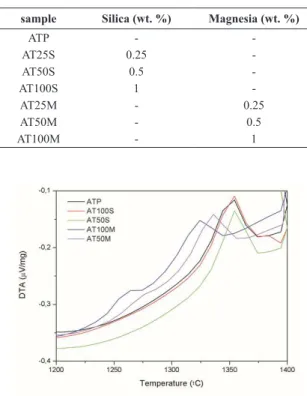
Figure 1 shows DTA curves of the studied compositions. There is an endothermic peak between 1300 and 1360°C, which can be associated with the solid state reaction of
formation of aluminum titanate. This reaction occurred at lower temperatures when MgO was present, showing that MgO anticipates the formation of Al2TiO5 compared to other evaluated compositions. This behavior should be related to a prior reaction with Mg2+ ions represented by another endothermic event found at around 1250°C in AT50M and AT100M compositions. Instead, additions of SiO2 showed no inluence on this temperature, since the reactions in compositions with SiO2 (AT50S and AT100S) overlap with that of the composition without additive (ATP).
X-ray powder diffraction analysis (Figure 2) of isothermally heat-treated samples (1250, 1300 and 1400 for 1 hour)
Table 1. Additives in the equimolar mixture of alumina and titania.
sample Silica (wt. %) Magnesia (wt. %)
ATP -
-AT25S 0.25
-AT50S 0.5
-AT100S 1
-AT25M - 0.25
AT50M - 0.5
AT100M - 1
Figure 1. Differential thermal analysis (DTA) curves of samples from 1200 to 1400 °C.
Figure 2. X-ray powder diffraction (XRPD) spectra taken from
samples obtained by heat treatments at 1250, 1300 and 1400 for 1
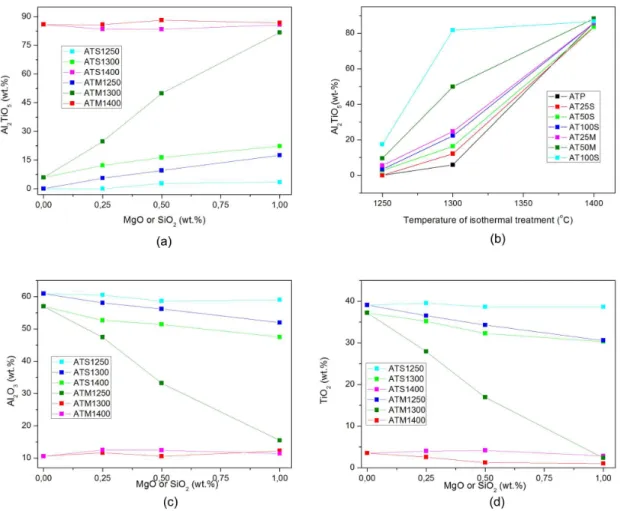
show the evolution of the formation of aluminum titanate. Quantitative analysis with Rietveld reinements conirms the eficiency of MgO additions to Al2TiO5 formation. Plots of Al2TiO5, Al2O3 and TiO2 contents in function to amount of additive (MgO or SiO2) and temperature of isothermal heat treatment (Figure 3), indicates that Al2TiO5 phase was formed in all investigated samples, except in pure sample (ATP) and in that with 0.25 wt-% SiO2 (AT25S), both treated at 1250oC. Although this temperature did not favor the formation of Al2TiO5, MgO already proved to be an effective additive for obtaining the studied ceramic.
The greater eficiency of MgO with respect to SiO2 is quite pronounced when the heat treatment was performed at 1300°C (see Figures 3a and 3b). Just as an example, the sample containing 1 wt-% MgO reached 81.72 wt-% Al2TiO5, while other doped with 1 wt-% SiO2 promoted formation of 22.26 wt-% Al2TiO5. It means a difference of three times in amount of formed Al2TiO5.
At 1400oC, despite the addition of MgO has promoted formation of Al2TiO5 in higher amounts than the addition of SiO2, the inluence of additive concentration is very slight. In other words, the effect of temperature exceeded that of additives when the heat treatment proceeded at 1400oC.
The effect of MgO additions on formation of Al2TiO5 most likely involves the endothermic reaction detected in the DTA curves (Figure 1) for MgO doped samples (AT50M and AT100M). This reaction can be associated with the altered values found for the Al2TiO5 lattice parameters of MgO doped samples treated at 1250oC (Table 2). Ishitsuka et al.19 studying Al2TiO5 synthesized with Mg(OH)2, observed changes in lattice parameters of Al2TiO5 phase assigned to formation of solid solutions of Al2(1-x)MgxTi1+xO5, at low temperatures. Some works related the presence of a transitional phase during the formation of Al2TiO5, however conlicting opinions yet are discussing in view of the presence of this phase, as well as its composition and effect on the formation of Al2TiO512,14,20.
Altered values found for the Al2TiO5 lattice parameters of MgO doped samples treated at 1250oC (Table 2) suggest that aluminum titanate is formed in two steps, just characterized by the endothermic reactions. In the irst step, Mg2+ should be incorporated into Al2TiO5 lattice during its formation, producing a solid solution that behaved as a nucleating agent to accelerate the second stage of Al2TiO5 formation. It is means that the eficiency of the additive is related to the Mg2+ incorporation into the structure of Al
2TiO5.
Besides, Al2O3 and rutile phases were detected in the samples (Figures 2 and 3), indicating that the solid state reaction for formation of Al2TiO5 could not be concluded in any conditions used here. Although high amounts of Al2TiO5 have been formed during heat treatments at 1400oC, Al
2O3 and TiO2 were also found as residual phases.
The quantitative phase analysis clearly demonstrates that larger amounts of alumina remained as residual phase in all samples (Figure 3c), indicating that rutile is preferably consumed to form Al2TiO5. These results reveal that an equimolar mixture of Al2O3 and TiO2 does not contribute to complete the formation of Al2TiO5 by means of solid state reaction.
Figure 4 shows micrographs of samples with fractured surfaces. By this igure, it is observed that both additions result in inhibition of grain growth of Al2TiO5, and MgO additions are more eficient in this action compared to SiO2 additions. This suggests that MgO is also more eficient in stabilization of Al2TiO5 phase and consequently for reducing of microcracks. This because the phenomena are related to grain size, i.e., Al2TiO5 becomes stable at room temperature, below a critical grain size. Also, below a certain critical grain size (which is not necessarily the same), the stresses caused during cooling become insuficient for formation of microcracks21-23. This fact controls thermal and mechanical properties of the material22,24,25.
Table 2. Al2TiO5 lattice parameters obtained by Rietveld reinements.
Identiication a (Å) b (Å) c (Å) Cell vol. (Å3)
AT25M-1250oC 3.59462(55) 9.5020(23) 9.7300(24) 332.340(13)
AT25M-1300oC 3.58728(18) 9.45799(56) 9.68367(61) 328.552(33)
AT25M-1400oC 3.588785(85) 9.44434(21) 9.65933(21) 327.390(13)
AT50M-1250oC 3.60200(37) 9.5054(15) 9.7299(16) 333.138(82)
AT50M-1300oC 3.58971(13) 9.45307(38) 9.66753(42) 328.056(23)
AT50M-1400oC 3.589806(86) 9.44414(22) 9.65758(23) 327.417(13)
AT100M-1250oC 3.59642(28) 9.5156(10) 9.7300(11) 332.982(58)
AT100M-1300oC 3.59229(11) 9.44913(29) 9.66158(31) 327.953(18)
AT100M-1400oC 3.592480(75) 9.44984(21) 9.66067(21) 327.964(12)
4. Conclusions
Additions of MgO provided prior formation of Al2TiO5 owing to a further endothermic reaction detected at low temperature. The presence of two endothermic reactions in MgO doped samples as well as results of XRPD and Rietveld reinement led to conclude that the formation of Al2TiO5 occurred in two stages. The irst stage was associated with
formation of an aluminum titanate solid solution containing Mg2+, and the second reaction was related to actual formation of Al2TiO5. Also, small contents of MgO shown to be promising in the stabilization of Al2TiO5, whereas they promoted the development of a microstructure consisting of small grains.
In contrast, additions of silica do not promote expressive results related to the formation of Al2TiO5.
5. References
1. Kim JI, Zhao F, Gong J, Lee KS, Han IS, Kuk WS. Thermal
durability of aluminum titanate-mullite composites with high thermal shock resistance. Journal of Ceramic Processing Research. 2003;4(2):71-70.
2. Buscaglia V, Nanni P, Battilana G, Aliprandi G, Carry C. Reaction
sintering of aluminium titanate: I-Effect of MgO addition. Journal of the European Ceramic Society. 1994;13(5):411-417. DOI: 10.1016/0955-2219(94)90018-3
3. Buscaglia V, Nanni P, Leoni M, Thermodynamics and kinetics
of decomposition of Al2TiO5-base ceramics. Key Engineering Materials. 1997;132-136:810-813.
4. Nagano M, Nagashima S, Maeda H, Kato A. Sintering behavior of Al2TiO5 base ceramics and their thermal properties. Ceramics
International. 1999;25(8):681-687.
5. Tsetsekov A. A comparison study of tialite ceramics doped with various oxide materials and tialite-mullite composites: microstructural, thermal and mechanical properties. Journal of European Ceramic Society. 2005;25(4):335-348. doi:10.1016/j. jeurceramsoc.2004.03.024
6. Low IM, Oo Z, O’Connor BH. Effect of atmospheres on the
thermal stability of aluminium titanate. Physica B.
2006;385-386(Part 1):502-504. doi:10.1016/j.physb.2006.05.256
7. Ibrahim DM, Mostafa AA. MgO stabilized tialite prepared by urea formaldehyde polymeric route. British Ceramic Transactions. 1999;98(4):182-186. DOI:10.1179/096797899680417
8. Thomas HAJ, Stevens R, Gilbart E. Effect of zirconia additions on the reaction sintering of aluminium titanate. Journal of Materials Science. 1991;26:3613-3616.
9. Ananthakumar S, Jayasankar M, Warrier KG. Microstructural, mechanical and thermal characterisation of sol–gel-derived aluminium titanate–mullite ceramic composites. Acta Materialia. 2006;54:2965-2973.
10. Perera FH, Pajares A, Melendez JJ. Strength of aluminium
titanate/mullite composites containing thermal stabilizers. Journal the European Ceramic Society. 2011;31(9):1695-1701.
doi:10.1016/j.jeurceramsoc.2011.03.012
11. Preda M, Crisan IM, Jitiann A, Crisan D, Zaharescu M.
Reaction mechanisms of tialite formation in the presence of mineralizers. Journal of Optoelectronics and Advanced Materials. 2000;2(5):563-568. http://joam.inoe.ro/arhiva/pdf2_5/Preda.
12. Buscaglia V, Caracciolo F, Leoni M, Nanni P, Viviani M, Lemaitre
J. Synthesis, sintering and expansion of Al0.8Mg0.6Ti1.6O5: a low-thermal-expansion material resistant to thermal decomposition. Journal of Materials Science. 1997;32(24):6525-6531.
13. Jiang L, Chen X, Hang G, Meng Y. Effect of additives on
properties of aluminium titanate ceramics. Tranactions of
Nonferrous Metal Society of China. 2011;21(7):1574-1579. doi:10.1016/S1003-6326(11)60899-6
14. Korim T. Effect of Mg2+ and Fe3+ ions on formation mechanism of aluminum titanate. Ceramics International. 2009;35:1671-1679.
15. Yoleva A, Djambazov S, Arsenov D, Hristov V. Effect of SiO2 addition on thermal hysteresis of aluminum titanate. Journal of the University of Chemical Technology and Metallurgy. 2010; 45(3):269-274. http://dl.uctm.edu/journal/node/j2010-3/6_Albena_Yoleva_269-274.pdf
16. Thomas H, Stevens R. Alumina Titanate - A Literature review. Part. 2 Engineering properties and thermal stability. British Ceramics Transactions Journal. 1989;88:184-190.
17. Arenas IB. Reactive sintering of aluminum titanate. In:
Lakshmanan A, editor. Sintering of Ceramics – New Emerging Techniques [Internet]. Rijeka, Croatia: InTech; 2012. p.505-523. [cited 2015 Jan 30]. Available from: http://www.intechopen. com/books/sintering-of-ceramics-new-emerging-techniques/ reactive-sintering-ofaluminum-titanate
18. TOPAS-Academic version 5 [Internet]. Brisbane, Australia: Coelho Software; 2012. [cited 2013 Apr 17]. Available from: http://www.topas-academic.net.
19. Ishitsuka M, Sato T, Endo T, Shimada M. Synthesis of thermal stability of aluminum titanate solid solutions. Journal of the American Ceramic Society . 1987;70(2):69-71.
20. Huang YX, Senos AM, Baptista RJ. Synthesis of aluminium
titanate powder by different processing methods. In: Fourth Euro-Ceramics Conference. Italy: Faenza; 1995. p. 187-194.
21. Takahashi M, Fukuda M, Kukuda H, Yoko T. Preparation,
structure, and properties of thermally and mechanically improved aluminium titanate ceramics doped with alkali feldspar. Journal of the American Ceramic Society. 2002;85(12):3025-3030.
DOI: 10.1111/j.1151-2916.2002.tb00573.x
22. Giordano L, Viviani M, Bottino C, Buscaglia MT, Buscaglia V, Nanni P. Microstructure and thermal expansion of
Al2TiO5-MgTiO5 solid solutions obtained by reaction sintering. Journal of the European Ceramic Society. 2002;22(11):1811-1822
23. Ohya Y, Nakagawa Z, Hamano K. Crack healing and bending strength of aluminum titanate ceramics at high temperature. Journal of the American Ceramic Society. 1988;71:C232-C233.
DOI: 10.1111/j.1151-2916.1988.tb05064.x
24. Parker FJ, Rice RW. Correlation between grain size and
thermal expansion for aluminum titanate materials. Journal of the American Ceramic Society. 1989;72:2364-2366. DOI:
10.1111/j.1151-2916.1989.tb06091.x