Abstract
The present paper studies the Propagation of SH waves in a double non-homogeneous crustal layers lying over an isotropic homogene-ous half-space, where upper layer ((i.e. rigidity and density varying trigonometrically with depth) and intermediate layer (i.e. rigidity and density varying parabolically with depth). The wave velocity equation has been obtained. Closed form solutions have been de-rived separately for the displacements in two non-homogeneous crustal layers and lower half-space. The dispersion curves are de-picted by means of graphs for different values of non-homogeneity parameters and thickness ratio for layers.
Keywords
SH waves, Whittaker functions, Non homogeneity, Differential equations.
Propagation of SH Waves in a Double Non-Homogeneous Crustal
Layers of Finite Depth Lying Over an Homogeneous Half-Space
1 INTRODUCTION
The formulations and solutions of many problems of linear wave-propagation for homogeneous me-dia are available in the literature of continuum mechanics of solids. In recent years, however, suffi-cient interest has arisen in the problem connected with bodies whose mechanical properties are functions of space, i.e. non-homogeneous bodies. This interest is mainly due to the advent of solid
Munish Sethi a Arvind Sharma b Anupamdeep Sharma c
a Faculty of Science, Govt. Polytechnic,
Jalandhar. Email:
[email protected] or [email protected]
b Department of Applied Sciences,
Chandigarh Engineering College, Land-ran, Mohali.
Email: [email protected]
c Faculty of Natural Sciences, Sant Baba
Bhag Singh University, Jalandhar. Email: [email protected]
http://dx.doi.org/10.1590/1679-78253005
rocket propellants, polymeric materials and growing demand of engineering and industrial applica-tions.
The propagation of surface waves in elastic media is of considerable importance in earth-quake engineering and seismology on account of occurrence of stratification in the earth crust, as the earth is made up of different layers. As a result, the theory of surface waves has been developed by Stone-ley [1924], Bullen [1965], Ewing et al. [1957], Hunters [1970] and Jeffreys [1970].
Many results of theoretical and experimental studies revealed that a real earth is considerably more complicated than the models presented earlier. This has led to a need for more realistic repre-sentation as a medium through which seismic waves propagate. The wave propagation in crystalline media plays a very interesting role in geophysics and also in ultrasonic and signal processing. Mono-clinic medium is an example of such medium, keeping in the mind the fact that the non-homogeneity characteristic is one of the most generalized elastic conditions inside the earth, many authors have studied the propagation of different waves in different media with non-homogeneity.
Sezawa [1927] studied the dispersion of elastic waves propagated on curved surfaces. The transmission of elastic waves through a stratified solid medium was studied by Thomson [1950]. Haskell [1953] studied the dispersion of surface waves in multilayered media. Biot [1965] studied the influence of gravity on Rayleigh waves, assuming the force of gravity to create a type of initial stress of hydrostatic nature and the medium to be incompressible.
Propagation of Love waves in a non-homogeneous stratum of finite depth sandwiched between two semi infinite isotropic media has been studied earlier by Sinha [1967]. Wave propagation in a thin two-layered laminated medium with couple under initial stress was studied by Roy [1984]. Dat-ta [1986] studied the effect of gravity on Rayleigh wave propagation in a homogeneous, isotropic elastic solid medium. Effects of irregularities on the propagation of guided SH waves has been stud-ied by Chattopadhyay et al [1983]. Goda [1992] studstud-ied the effect of non-homogeneity and anisotro-py on Stoneley waves. Gupta et al. [2012] investigated the influence of linearly varying density and rigidity on torsional surface waves in inhomogeneous crustal layer.
Some of the recent notable works on propagation of seismic waves in various media with differ-ent geometries were done by Chattopadhyay et al [2009, 2010, 2010].
Recently Sethi et al. [2013] investigated the surface waves in homogeneous visco-elastic media of higher order under the influence of surface stresses.
In the present problem, we have considered the propagation of SH waves in a double non-homogeneous crustal layers lying over an isotropic non-homogeneous half-space. The expression for dis-placement and dispersion equation is found in the closed form. The dispersion curves are depicted by means of graphs for different values of non-homogeneity parameters and thickness ratio. The influence of non-homogeneity parameters, wave number and thickness ratio of the layers on the dimensionless phase velocity has been studied.
Here, the non-homogeneity in the upper layer can be taken as
1( sin );1 z 1( sin ),1 z 0. Also, the non-homogeneity in intermediate layer can be tak-en as, 2(1nz) ,2 2(1nz n) ,2 0. and the lower half-space is homogeneous, where , n are
2 FORMULATION OF THE PROBLEM
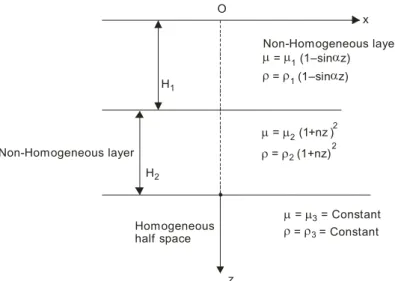
Let the density and rigidity of layers (medium-I) and (medium-II) areand , respectively and , are the density and rigidity of homogeneous half-space (medium-III).
The thicknesses of the first and second layers are and respectively.
z
x O
Non-Homogeneous layer = (1–sin z)
= (
111–sin z)
= (1 )
= (1+nz)
2 2
2 2
+nz
= = Constant= = Constant33
Homogeneous half space Non-Homogeneous layer
H1
H2
Figure 1: Geometry of the problem.
Let us consider x-axis along the direction of the wave propagation and z-axis is taken vertically downwards. Let u, v, w are displacements along x, y, z axis respectively.
Let (u1, v1, w1), (u2, v2, w2), (u3, v3, w3) are the displacements for the layers (medium-I) and
(medium-II) and half-space (medium-III) respectively. For SH wave propagation we have,
u w 0 and v v x, z, t (1) The equation governing the propagation of Love wave in homogeneous isotropic elastic medium in the absence of body forces are
x y z
u t
x y z
v t
x y z
w t
xx yx zx
xy yy zy
xz yz zz
2 2 2
2 2
2
,
,
,
(2)
Also, Hooke’s law for isotropic medium,
ijij2ij, (3)
Also u x
u x
ij i
j j i
, .
L
N
M
M
O
Q
P
P
1
2 (4)
3 SOLUTION FOR UPPER LAYER (MEDIUM-I)
In view of equations (1), (3) and (4), equation of motion (2) gives the non-vanishing equations of motion for propagation of SH wave in upper layer (medium-II) as
x
u
x z
u z
u t
1 1 2 1
F
HG
I
KJ
F
HG
I
KJ
(5)For a wave propagating in x-direction,
u W z ei kx wt
1 ( ) ( ) (6)
equation (5) reduces to,
d W
dz
d
dz
dW
dz
K
c
W
2
2 2
2
1
1
0
F
HG
I
KJ
,
(7)where
c
K
be the velocity of SH waves.Introducing W = W1
in equation (7), to eliminate dW
dz , we get d W
dz
d dz W
d
dz W K
c W
2 1 2
2
2 1 2
2
1 2
2 1 1
2
1
4 1 0
F
HG
I
KJ
F
HG
I
KJ
(8)
We take variations in rigidity and density as
1( sin );
1
z
1( sin ),
1
z
(9)Here > 0 for non-homogeneity and = 0 for homogeneity Introducing (9) in equation (8), we obtain
d W
dz W
where K
K c 2
1
2 2 1
2 2 2
2 2
12 1
2 2 0
4 1
;
( ), (10)
Thus solution for equation (10) can be taken as
W1Acosz B sinz
where A and B are arbitrary constants.
u x z t A z B z
z e
i Kx wt
1 1 2
1
( , , ) cos sin
( sin ) / ( )
(11)
4 SOLUTION FOR INTERMEDIATE LAYER (MEDIUM-II)
In view of equations (1), (3) and (4), equation of motion (2) gives the non-vanishing equations of motion for propagation of SH wave in upper layer (medium-II) as
x
u
x z
u z
u t
2 2 2 2
2
F
HG
I
KJ
F
HG
I
KJ
(12)For a wave propagating in x-direction,
u2 V z e( ) i kx wt( ) (13)
equation (13) reduces to,
d V dz
d dz
dV dz K
c V
2
2 2
2
1 1 0
F
HG
I
KJ
(14)
Introducing V = V1
in equation (14), to eliminate dV
dz , we get d V
dz
d dz V
d
dz V K
c V
2 1 2
2
2 1 2
2
1 2
2 1 1
2
1
4 1 0
F
HG
I
KJ
F
HG
I
KJ
(15)
We take variations in rigidity and density as
μ
=
μ
2(1 +
nz
)
2,
ρ
=
ρ
2(1 +
nz
)
2 (16)Here n > 0 for non-homogeneity and n= 0 for homogeneity Introducing (16) in equation (15), we get
d V
dz m V
where m K c
2 1
2 2 1
2 2 2
22 2
2 2 0
1
;
( ),
17)
Thus solution for equation (17) can be taken as
V1Ccosmz D sinmz,
where C and D are arbitrary constants.
Thus displacement component for non-homogeneous intermediate layer (medium-II) is given by
u x z t C mz D mz
nz ei Kx wt
5 SOLUTION FOR SEMI INFINITE HALF SPACE (MEDIUM-III)
In view of equations (1), (3) and (4), equation of motion (2) gives the non-vanishing equations of motion for propagation of SH wave in upper layer (medium-II) as
x
u
x z
u z
u t
3 3 2 3
2
F
HG
I
KJ
F
HG
I
KJ
(19)For a wave propagating in x-direction,
u U z ei kx wt
3 ( ) ( ) (20)
equation (20) reduces to,
d U dz
d dz
dU dz K
c U
2
2 2
2
1 1 0
F
HG
I
KJ
(21)
Introducing U = U1
in equation (21), to eliminate dU
dz , we get d U
dz
d dz U
d
dz U K
c U
2 1 2
2
2 1 2
2
1 2
2 1 1
2
1
4 1 0
F
HG
I
KJ
F
HG
I
KJ
(22)
We take variations in rigidity and density as
3, 3. (23)
Introducing (23) in equation (22), we get d U
dz p U
where p K c
2 1
2 2 1
2 2 2
32 3 3 3 0
1
;
( ),
(24)
Thus solution for equation (24) can be taken as
U Ee pz F epz
1 ,
where E and F are arbitrary constants.
Thus displacement component for homogenous half-space (medium-III) is given by
u x z t Ee pz i Kx wte
3( , , ) ( ). (25)
6 BOUNDARY CONDITIONS
( ) , ( ) , ( ) , ( ) ( ) i u
z at z
ii u
z
u
z at z H iii u u at z H
iv u
z
u
z at z H H
v u u at z H H
1 1
1 1 2 2 1
1 2 1
2 2 3 3 1 2
2 3 1 2
0 0
Using all the boundary conditions (i) to (v) and after simplification, we have
2A B 0. (26)
1 1 1 1
1 1
1
1 1 1
1
2 1 2 1
F
HG
I
KJ
F
HG
I
KJ
L
N
MM
O
Q
PP
sin cos cos
sin sin cos
H A Cos H H
Sin H Sin H B
H
H H H
F
HG
I
KJ
F
HG
I
KJ
L
N
MM
O
Q
PP
2 1
1 1 1 1 1 1
1
1 1
( nH C) n cos sin sin cos
nH mH m mH D
n
nH mH m mH
(27)
A H B H
H
C CosmH D mH
nH cos sin sin sin ( ) . 1 1 1 1 1 1 1 1 (28)
2 1 2
1 2 1 2 1 2 1 2 1 2 1 2 3
1
1 1 1 2
( ( )) {
( )cos ( ) sin ( )} { ( )sin ( ) cos ( )} ( )
L
NM
O
QP
n H H C n
n H H m H H m m H H D
n
n H H m H H m m H H pep H H E(29)
C m H H D m H H
n H H Ee p H H
cos ( ) sin ( )
( ) ( )
1 2 1 2
1 2
1 1 2
(30)
Eliminating A, B, C, D and E from (26), (27), (28), (29) and (30), we get
Det (Gij) = 0, where i, j = 1, 2, 3, 4, 5. (31)
where
G G G G G
G Sin H H
H H H
G Sin H H
H H H
G nH n
nH mH m mH
G nH n
nH mH m mH G
11 12 13 14 15
21 1 1 1
1 1 1
22 1 1 1
1 1 1
23 2 1
1 1 1
24 2 1
1 1 1 25
2 0 1 2 1 1 2 1 1 1 1 1 0
L
NM
O
QP
L
NM
O
QP
L
NM
O
QP
L
NM
O
QP
, , , cos
sin cos sin ,
cos
sin sin cos ,
( ) cos sin ,
G Cos H Sin H G
Sin H Sin H G
CosmH nH
G mH
nH G
G G G n H H n
n H H Cosm H H m m H H
G n H H n
n H H m H H m m H H
G 31 1 1 32 1 1 33 1 1 34 1 1 35
41 42 43 2 1 2
1 2 1 2 1 2
44 2 1 2
1 2 1 2 1 2
45 3
1 1 1
1 0 0 1 1 1 1
L
NM
O
QP
L
NM
O
QP
, , ,
sin , ,
, ( ( ))
( ) ( ) sin ( ) ,
( ( ))
( )sin ( ) cos ( ) ,
pe
G G G Cos m H H
n H H G
Sin m H H
n H H
G e
p H H
p H H
( ) ( ) , , ( ) ( ) , ( ) ( ) , . 1 2 1 2
51 52 53 1 2
1 2 54
1 2 1 2 55 3 0 1 1
After simplification equation (31), we have
tan ,
H T S
T S 1 2 1 1 2 (32) where
S T T mH
T T T T T
7 6 1
4 6 7 3 5 tan
( ) ,
T Cos H
Sin H
T Cos H
Sin H
T n
nH m mH
1 2 2 1 1 2 1 1 3 1 1 4 1
2 1 1
1
F
HG
I
KJ
, , tan , T n
nH mH m
T nH
H
T n n H H p m n H H m H H
T n n H H p m H H m n H H
4 1 1 5 2 1 1 2 1
6 1 2 3
2 1 2
2
1 2
7 1 2 3
2 1 2 1 2
2 1 1 1 1 1 1 1
L
NM
O
QP
tan ,
( )
sin ,
( ) ( ( )) tan ( ),
( ( )) tan ( ) [ ( )] .
b
g
7 PARTICULAR CASES
Case (I): When upper layer is homogeneous i.e. =0, and intermediate layer is non-homogeneous, i.e. n≠0, dispersion equation (32) takes the form,
tan ( )
( tan )
,
KH c T T T T T
K T T mH c
1 2
12
4 6 7 3 5
7 6 1
2
12 1
1
L
N
M
M
O
Q
P
P
(33)
where,
T n
nH m mH
T n
nH mH m
T nH
H
T n n H H p m n H H m H H
T n n H H p m H H m n H H
3
1 1
4
1 1
5 2
1
1 2 1
6 1 2 3
2 1 2
2
1 2
7 1 2 3
2 1 2 1 2
2 1
1 1 1
1 1
1 1
L
NM
O
QP
tan ,
tan ,
( )
sin ,
( ) ( ( )) tan ( ),
( ( )) tan ( ) [ ( )] .
b
g
which gives the wave velocity equation for propagation of SH waves in a homogeneous isotropic
layer lying between two initially stressed non-homogeneous isotropic semi-infinite medium.
Case (II): When upper layer is non-homogeneous i.e. ≠0, and intermediate layer is homoge-neous, i.e. n=0, dispersion equation (32) takes the form,
tanH T S, T S
1 2
1 1
2
(34)
where
S T T mH
T T T T T
7 6 1
4 6 7 3 5
tan
( ) ,
T Cos H
Sin H
T Cos H
Sin H
T m mH
1 2
2
1 1
2 1
1
3 1
4 1
2 1 1
F
HG
I
KJ
,
,
T m
T
H
T p m m H H
T p m H H m
4
5 2
1 1
6 3
2 1 2
7 3
2 1 2
1 1 , sin ,
tan ( ),
tan ( ) .
which gives the dispersion relation for propagation of SH waves in a non-homogeneous isotropic
layer lying between initially stressed Gibson half-space and initially stressed non-homogeneous iso-tropic semi-infinite medium.
Case (III): When both layers are homogeneous i.e. =0, n=0, dispersion equation (32) reduces to,
tan
tan ( )
tan
tan tan ( )
tan tan ( ) ,
H m
p m m H H
mH m
mH m H H
mH m H H
1 2
1 3
2 1 2
3
2 2
1 1 2
1 1 2
2 1 1
L
N
M
M
M
M
O
Q
P
P
P
P
L
NM
O
QP
(35)where, K c
m K c
p K c
2 12 2 22 2 32 1 1 1 , , .
which gives the wave velocity equation for propagation of SH waves in a homogeneous isotropic layer lying over homogeneous isotropic semi-infinite medium.
Case (IV): In the absence of upper layer i.e. H1→0, n≠0, and H2≠0, dispersion equation (32)
reduces to, tan ( ) ( ) ( ) ( ) . KH c
n nH KH c
n nH nH K c nK c
2 2 22 2 2 2 2 22 2
2 2 2 2
2 22 3 2 2 32 1 1 1
1 1 1 1
L
N
M
M
O
Q
P
P
(36)
which gives the wave velocity equation for propagation of SH waves in a non-homogeneous isotropic layer lying over homogeneous isotropic semi-infinite medium.
Case (V): In the absence of upper layer i.e. H1→0, n=0, and H2≠0, dispersion equation (32)
tan KH c . c c 2 2 22 3 2 32 2 2 22 1 1 1
L
N
M
M
O
Q
P
P
(37)which gives the wave velocity equation for propagation of SH waves in a homogeneous isotropic layer lying over homogeneous isotropic semi-infinite medium.
Case (VI): In the absence of intermediate layer i.e. H2→0, ≠0, and H1≠0, dispersion equation
(32) reduces to,
tan KH c .
Cos H
Sin H K c K c
K c K c Cos H
Sin H 1 2 2 12 1 1 3 1 2 32 2 2 32
2 2 2
32 3 1 2 32 1 1 4 1
2 1 1 1 4 1
4 1 2 1 2 1
F
HG
I
KJ
F
H
GG
I
K
JJ
F
HG
I
KJ
L
N
M
M
O
Q
P
P
F
HG
I
KJ
F
HG
I
KJ
L
N
M
M
O
Q
P
P
F
H
GG
I
K
JJ
(38)
which gives the wave velocity equation for propagation of SH waves in a non-homogeneous isotropic upper layer lying over homogeneous isotropic semi-infinite medium.
Case(VII): In the absence of intermediate layer i.e. H2→0, =0, and H1≠0, dispersion equation
(32) reduces to,
tan KH c .
c c 1 2 12 3 2 32 1 2 12 1 1 1
L
N
M
M
O
Q
P
P
(39)
which gives the wave velocity equation for propagation of SH waves in a homogeneous upper iso-tropic layer lying over homogeneous isoiso-tropic semi-infinite medium.
8 NUMERICAL COMPUTATIONS AND DISCUSSION
To study the effect of various dispersion non-homogeneities and thickness ratio on the propagation of SH wave propagating in double non-homogeneous layers lying over an isotropic homogeneous semi-infinite media, where upper layer (i.e. rigidity and density varying trigonometrically with depth) and intermediate layer (i.e. rigidity and density varying parabolically with depth), phase velocity is calculated numerically for equation (32), we take the following data:
For non-homogeneous crustal layer (Medium-I) (Gubbins and Tierstein [1990]) 1784 10. 10N m/ 2,13535Kg m/ 3.
For non-homogeneous crustal layer (Medium-II) (Gubbins and Tierstein [1990])
2 10 2
2 3
634 10 3364
Figure 2: Variation of dimensionless phase velocity (c/ 1)2 against dimensionless wave number KH demonstrating
the influence of non-homogeneity associated with upper crustal layer for n/K = 1.0, H2/H1= 1.0.
Figure 3: Variation of dimensionless phase velocity (c/ 1)2 against dimensionless wave number KH demonstrating
the influence of non-homogeneity associated with intermediate crustal layer for /2K = 1.0, H2/H1= 1.0.
Figure 4: Variation of dimensionless phase velocity (c/ 1)2 against dimensionless wave number KH demonstrating
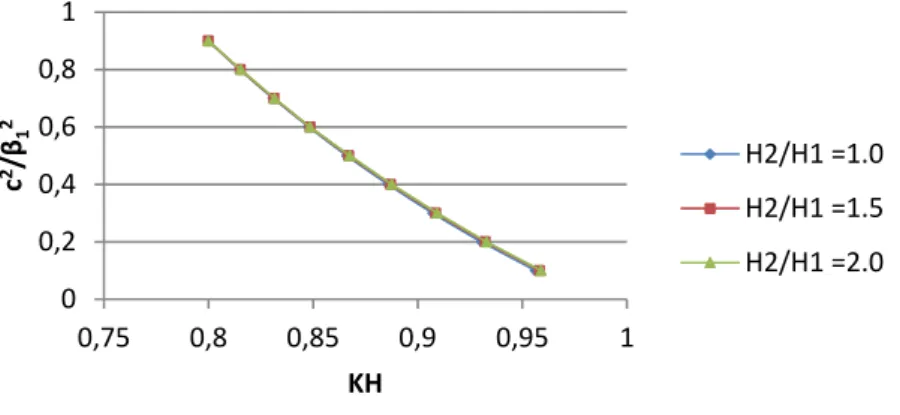
the influence of thickness ratio H2/H1 for /2K = 1.0, n/K = 1.0.
, , , ,
, ,
c
/β
KH
α/ K = . α/ K = . α/ K = .
, , , ,
, , , , ,
c
/β
KH
n/K = . n/K = . n/K = . n/K = .
, , , ,
, , , , ,
c
/β
KH
Figure 2 shows the effect of non-homogeneity parameter /2K involved in the rigidity and den-sity of the upper crustal layer. Following observations and effects are obtained under the above considered values.
(1a) For a particular dimensionless wave number KH and fixed value of non-homogeneity in ri-gidity and density of intermediate layer and thickness ratio i.e. n/K=1.0 and H2/H1=1.0, the
dimensionless phase velocity (c/ 1)2 of SH waves decreases, as the value of /2K increases from
1.0 to 2.0.
(1b) For various values of /2K and particular values of n/K and H2/H1=1.0, the phase
veloci-ty (c/ 1)2 increases as the wave number decreases in all curves 1-3.
(1c) Curve 1(for /2K=2.0) is steeper than the curve 2 (for /2K =1.5), which in turn is steep-er than curves 3 (for /2K =1.0), that reveals that the dimensionless non-homogeneity factor
/2K has a prominent effect on SH wave propagation.
Figure 3 shows the effect of non-homogeneity parameter n/K involved in the rigidity and densi-ty of the non-homogeneous intermediate layer. Following observations and effects are obtained un-der the above consiun-dered values.
(2a) For a particular dimensionless wave number KH and fixed value of non-homogeneity of upper layer i.e. /2K = 1.0, and fixed thickness ratio i.e. H2/H1=1.0, the dimensionless phase
velocity (c/ 1)2 of SH waves increases, as the value of n/K increases from 0.1 to 1.0.
(2b) For various values of n/K and particular values of /2K and H2/H1, the phase velocity
(c/ 1)2 increases as the wave number decreases in all curves 1-4.
(2c) Curve 1(for n/K=0.0) is steeper than the curve 2 (for n/K=0.1), which in turn is steeper than curve 3, 4 (for n/K=0.6, n/K=1.0), that reveals that the dimensionless non-homogeneity factor n/K has a prominent effect on SH wave propagation.
(2d) All the four curves are coinciding as wave number approaching 0.7 and dimensionless phase velocity (c/ 1)2 approaching 0.85.
Figure 4 shows the effect of thickness ratio H2/H1 on dimensionless phase velocity (c/ 1)2.
Fol-lowing observations and effects are obtained under the above considered values.
(3a) For a particular dimensionless wave number KH and fixed value of non-homogeneity of upper and intermediate layers i.e. /2K=1.0 and n/K = 1.0, the dimensionless phase velocity (c/ 1)2 of SH waves decreases, as the value of H2/H1 increases from 1.0 to 2.0.
(3b) For various values of H2/H1and particular values of n/K and /2K, the phase velocity
(c/ 1)2 increases as the wave number decreases in all curves 1-3.
9 CONCLUSIONS
Here, we has been studied the propagation of SH waves in double non-homogeneous crustal layers lying over an isotropic homogeneous half space. Closed form solutions have been derived separately for the displacements in non-homogeneous crustal layers and lower half-space. By using the asymp-totic expansion of Whittaker’s function we have derived the wave velocity equation for the SH waves in compact form. Dimensionless phase velocity (c/ 1)2 is calculated numerically. The effect of
1.For a particular dimensionless wave number KH and fixed value of non-homogeneity in rigid-ity and densrigid-ity of intermediate layer and thickness ratio i.e. n/K and H2/H1, the
dimension-less phase velocity (c/ 1)2 of SH waves decreases, as the value of /2K increases.
2.For various values of /2K and particular values of n/K and H2/H1, the phase velocity (c/ 1)2
increases as the wave number decreases.
3.For various values of n/K and particular values of /2K and H2/H1, the phase velocity
(c/ 1)2 increases as the wave number decreases.
4.For a particular dimensionless wave number KH and fixed value of non-homogeneity of upper layer i.e. /2K, and fixed thickness ratio i.e. H2/H1, the dimensionless phase velocity (c/ 1)2
of SH waves increases, as the value of n/K increases.
5.For a particular dimensionless wave number KH and fixed value of non-homogeneity of upper and intermediate layers i.e. /2K and n/K = 1.0, the dimensionless phase velocity (c/ 1)2 of
SH waves decreases, as the value of H2/H1 increases.
6.For various values of H2/H1and particular values of n/K and /2K, the phase velocity (c/ 1)2
increases as the wave number decreases.
The study of the shear wave propagation in layered media has some possible applications in the field of earthquake engineering, seismology, civil engineering and geophysics. In geophysics, they are helpful not only in the exploration of internal structure of earth which consist of many crustal lay-ers but also in the exploration of valuable materials buried inside the earth like minerals, metals, hydrocarbons and petroleum, etc. In earthquake engineering and seismology, Shear waves are very useful in predicting earthquakes (in-terms of finding their epicentre) in dynamic response of soils and man-made structures. SH-waves cause more destruction to the structure than the body waves due to slower attenuation of the energy. So this study may be useful for understanding the cause and estimation of damage due to earthquakes. Hence, the present theoretical study may be useful for the practical application of shear waves in the non-homogeneous layered media.
References
Biot, M.A. (1965). Mechanics of incremental Deformations, J. Willy. Bullen, K.E. (1965). Theory of Seismology, Cambridge University Press.
Chattopadhyay, A., Chakraborty. M., Pal, A.K. (1983). Effects of irregularity on the propagation of guided SH waves, Jr. de Mecanique Theo. et appl. 2, No. 2: 215-225.
Chattopadhyay, A., Gupta, S., Sahu, S.A., Singh, A.K. (2010). Dispersion of shear waves in an irregular magnetoe-lastic self-reinforced layer sandwiched between two isotropic half-spaces, International Journal of Theoretical and Applied Mechanics 5(1): 27-45.
Chattopadhyay, A., Gupta, S., Singh, A.K., Sahu, S.A. (2009). Propagation of shear waves in an irregular magneto-elastic monoclinic layer sandwiched between two isotropic half-spaces, International Journal of Engineering, Science and Technology1(1): 228–244.
Chattopadhyay, A., Gupta, S., Singh, A.K., Sahu, S.A. (2010). Propagation of SH waves in an irregular non-homogeneous monoclinic crustal layer over a semi-infinite monoclinic medium, Applied Mathematical Sciences 4, No. 44: 2157-2170.
Goda, M.A. (1992). The effect of inhomogeneity and anisotropy on Stoneley waves, Acta Mech.93, No.1-4: 89-98. Gubbins, D. (1990). Seismology and Plate Tectonics, Cambridge University Press, Cambridge.
Gupta. S., Vishwakarma. S.K., Majhi. D.K., Kundu. S. (2012). Influence of linearly varying density and rigidity on torsional waves in inhomogeneous crustal layer, Appl. Math. Mech.-Engl. Ed. 33(10):1239-1252.
Haskell, N.A. (1953). The dispersion of surface waves in multilayered media, Bull. Seis. Soc. Amer. 43: 17-34.
Hunter, S.C. (1970). Viscoelastic waves, Progress in solid mechanics, I. (ed: Sneddon IN and Hill R), Cambridge University Press.
Jeffreys, H. (1970). The Earth, Cambridge University Press.
Roy, P.P. (1984). Wave propagation in a thin two layered medium with stress couples under initial stresses, Acta Mechanics 54: 1-21.
Sethi, M., Gupta, K.C., Monika, R., Vasudeva, A. (2013). Surface waves in homogeneous viscoelastic media of high-er ordhigh-er undhigh-er the influence of surface stresses, J Mech Behav Mathigh-er, 22(5-6): 185–191.
Sezawa, K. (1927). Dispersion of elastic waves propagated on the surface of stratified bodies and on curved surfaces, Bull. Earthq. Res. Inst. Tokyo, 3:1-18.
Sinha, N. (1967). Propagation of Love waves in a non-homogeneous stratum of finite depth sandwiched between two semi-infinite isotropic media, Pure Applied Geophysics 67: 65-70.
Stoneley, R. (1924). Proc. R. Soc. A 806: 416-428. Thomson, W. (1950). J. Appl. Phys. 21: 89–93.