Abstract— We present and analyze a 17.6-Tb/s DWDM optical transmission composed of 79 channels with 224-Gb/s RZ-DP-16QAM modulation format per-channel and coherent detection. A maximum reach of 678 km is obtained with an optical recirculation loop composed by 226 km of pure-silica core fibers and EDFA amplification only in a 50-GHz grid system with spectral efficiency of 4.2-b/s/Hz. Also, a 25-GHz Gaussian optical pre-filter is applied to each channel and the same reach of 678 km is obtained in a 37.5-GHz channel grid system with spectral efficiency of 5.6-b/s/Hz. These results demonstrate a 33% system capacity improvement without transmission penalties.
Index Terms— Coherent detection, high-speed optical systems, modulation
format, optical filtering, optical networks, spectral efficiency.
I. INTRODUCTION
Enabled by the increasing traffic in communications networks, which is mainly composed by high-bandwidth data traffic, the optical fiber infrastructure is undergoing an evolution process in order to meet this wide variety of applications [1]. Optical networks have rapidly evolved in a way that, nowadays, presents reconfigurability characteristics and are capable of handling dense wavelength-division-multiplexing (DWDM) traffic with 100-Gb/s per-channel [2]. Today, high-speed systems targeting 400-Gb/s and 1-Tb/s per-channel are being intensively researched [3]. Since the beginning of its existence the optical transmission systems were based on intensity modulation (OOK) up to 10-Gb/s. However, the increase of transmission rates and the spectral occupancy required for the maintenance of 50-GHz DWDM grid forced changes in the structure of transmission and reception in order to increase the spectral efficiency (SE) for systems with bit rates higher than 10-Gb/s. Transmission structures with phase modulation and differential coding (DQPSK) and interferometer-based reception for phase difference extraction were used for 40-Gb/s systems [4]. These systems improved the spectral efficiency from 0.5-b/s/Hz (OOK) to 1-b/s/Hz (DQPSK). A 2-b/s/Hz spectral efficiency is needed for 100-Gb/s channels to fit in the current 50-GHz DWDM grid. To reach such SE, polarization multiplexing together with the phase modulation was used to double the spectral efficiency. The use of dual-polarization quadrature phase-shift-keying (DP-QPSK) modulation format improved the SE to 2-b/s/Hz and enabled the 100-Gb/s DWDM transmission in a 50-GHz grid. However, coherent detection was needed in order to meet the phase recovery requirements. The use of
Spectrally-Efficient 17.6-Tb/s DWDM
Optical Transmission System over 678 km
with Pre-Filtering Analysis
L. H. H. Carvalho, E. P. Silva, R. Silva, J. P. K Perin, J. C. R. F. Oliveira, M. L. Silva, P. P. G. Cardoso and A. Paradisi
coherent detection also enabled the total electrical field recovery, allowing the use of high-speed analog-to-digital converters (ADCs) for signal acquisition and digital signal processing (DSP) for digital coherency. The DSP is also used for chromatic dispersion compensation and polarization demultiplexing [5].
In order to meet the growing demand for transmission rates while maintaining the 100-Gb/s standardized [6] transmission and reception structures, the use of dual-polarization 16-quadrature amplitude modulation (DP-16QAM) modulation format is presented as a potential solution and its use in optical coherent systems is being intensively investigated [7]-[9]. The use of amplitude and phase modulation together with polarization multiplexing improves the SE from 2-b/s/Hz (DP-QPSK) to 4-b/s/Hz (DP-16QAM), achieving a 200-Gb/s line rate while maintaining the same symbol rate. Basically the same 100G QPSK transmission and reception structures are used for 200G DP-16QAM systems, with the exception of the DSP algorithms for polarization demultiplexing and phase recovery. Another approach for spectral efficiency improvement is to make use of optical pre-filtering, in which the modulated signal is filtered before being transmitted in order to reduce the signal bandwidth while maintaining the bit rate.
We demonstrate a 17.6-Tb/s DWDM optical system composed of 79 channels in a 50-GHz grid using 224-Gb/s RZ-DP-16QAM modulation format per-channel with 4.2-b/s/Hz SE and coherent detection with offline DSP. This result is the higher aggregate system bit rate reported in Latin America. A maximum reach of 678 km is obtained using an optical recirculation loop composed of 226 km of pure-silica core fiber (PSCF), 6 erbium-doped-fiber amplifiers (EDFAs) and a reconfigurable optical add/drop multiplexer (ROADM) based on flexible-grid wavelength selective switch (WSS) technology. We also perform optical pre-filtering in order to increase the system spectral efficiency. The same reach of 678 km is obtained when applying 25-GHz Gaussian pre-filtering in each carrier before transmission and transmitting the channels in a 37.5-GHz channel grid system, resulting in a spectral efficiency improvement from 4.2-b/s/Hz to 5.6-b/s/Hz without transmission penalties. The different channel grid is enabled by the use of a flexible-grid wavelength selective switch (WSS) with 12.5-GHz granularity.
II. EXPERIMENTAL SETUP
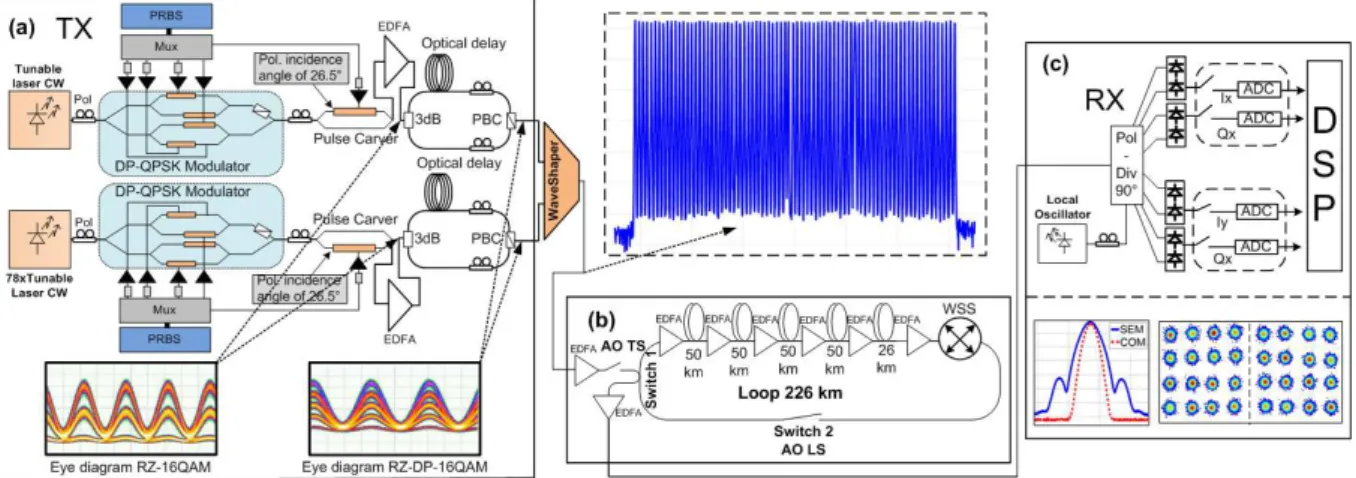
pseudo-random bit sequences (PRBS) with 215-1 length at 28-GHz were used to modulate each carrier into a 112-Gb/s PDM-QPSK signal. The 112-Gb/s signals were sent to a pulse carver for RZ pulse shaping, which also acted as a linear polarizer. With a specific state-of-polarization (SOP) input, the 56-Gb/s QPSK signals in each polarization of each carrier were combined into a single-polarization signal inside the pulse carver, and a single-polarization 112-Gb/s RZ-16-QAM was obtained in each carrier at the output, as described in [10]. A polarization multiplexing stage (PDM emulator) was used to generate a 224-Gb/s RZ-PDM-16-QAM signal in each carrier. The optical eye-diagrams for the 112-Gb/s RZ-16QAM and for the 224-112-Gb/s RZ-DP-16QAM are depicted in Fig. 1. All the carriers were combined by a waveshaper in order to generate a 79-channel DWDM system with 17.6-Tb/s aggregate bit rate and 224-Gb/s per-channel, as depicted in Fig. 1. The waveshaper was also used to apply the optical pre-filtering in each carrier before transmission.
Fig. 1. Experimental setup. (a) Transmission; (b) recirculation loop; (c) reception. The transmitted DWDM spectrum, as well
as the tested channel spectrum with and without pre-filtering and the received constellation are also illustrated.
The optical recirculation loop structure is detailed in Fig. 1b. An EDFA is used at the loop input in order to compensate losses from passive components and to reach the required input power for the loop operation. The operation of the recirculation system is controlled by two acousto-optic switches (AOS) operating in a complementary mode, which means that at the instant when one switch is open the other one is closed. This operation enables the signal to propagate through the system by any desired number of loop rounds in order to evaluate the maximum transmission reach. The total fiber length is composed of four spans of 50 km and one span of 26 km, all spans of PSCF with 0.176 dB/km of attenuation, 80µm2 of effective area, 18.6 ps/nm of chromatic dispersion (CD) and 0.0665
ps/√km of polarization mode dispersion (PMD) at 1550 nm. The 50 km span losses of ~9 dB are
filtering. Fig 2.b depicts a 37.5-GHz channel grid DWDM optical system composed of 79 channels with 224-Gb/s RZ-DP-16QAM modulation format and 25-GHz Gaussian optical pre-filtering per channel. In order to validate the transmission of RZ-DP-16QAM in a constrained bandwidth system, the optical channel filtering imposed by the flexible-grid WSS is modified from standard 50-GHz (Fig. 2.a) to a 37.5-GHz narrow-bandwidth filtering (Fig. 2.b). This can be achieved due to the flexible-grid technology, which allows the user to define custom channel filtering with 12.5-GHz granularity.
Fig. 2. DWDM system scenarios with 79x224-Gb/s RZ-DP-16QAM channels. (a) 50-GHz channel grid;
(b) 25-GHz optical pre-filtering and 37.5-GHz channel grid.
III. DIGITAL SIGNAL PROCESSING
The use of coherent detection, which implies the use of a local oscillator and an analog-to-digital converter, enables the application of digital signal processing techniques on the acquired signal in order to minimize the physical-layer effects imposed by the communications channel and to completely recover the frequency and phase of the signal.
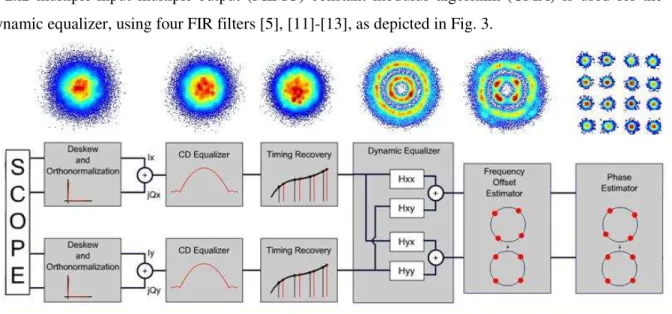
The algorithms sequence used in the DSP unit is depicted in Fig. 3. A deskew algorithm is used to compensate for the electrical paths differences (different electrical cables), while the orthonormalization compensates the I/Q components distortions and the 90º Hybrid imperfections using the Gram-Schmidt algorithm [11]. The total chromatic dispersion imposed by the transmission link is fully compensated using the time-domain CD equalizer, as in [12]. The coefficients and length of a finite impulse response (FIR) filter are calculated and used to equalize the signal by applying the CD inverse transfer function.
A timing recovery based on Gardner algorithm [13] recovers the correct symbol time. The dynamic equalizer separates the orthogonal polarizations and also compensates the residual CD and the PMD. A 2x2 multiple-input multiple-output (MIMO) constant modulus algorithm (CMA) is used for the dynamic equalizer, using four FIR filters [5], [11]-[13], as depicted in Fig. 3.
Fig. 3. Functional diagram of the DSP unit.
IV. RESULTS
This section presents the obtained experimental results. The measured back-to-back curves for the 224-Gb/s RZ-DP-16QAM, 224-Gb/s RZ-DP-16QAM with 25-GHz Gaussian filtering and 224-Gb/s NRZ-DP-16QAM with 25-GHz Gaussian filtering channels, as well as the theoretical back-to-back curve for 224-Gb/s DP-16QAM are depicted in Fig. 4. For the 224-Gb/s RZ-DP-16QAM, the required OSNR/0.1 nm for a BER of 1×10⁻³ is 23.5 dB, which is a ~3.5 dB penalty with respect to theory. An additional ~0.1 dB penalty is obtained from filtering the 224-Gb/s RZ signal, which can be considered a negligible filtering penalty. However, an additional ~2.5 dB penalty is obtained from filtering the 224-Gb/s NRZ signal. This verifies the filtering resilience of the RZ channel, which is enabled by the spectrum shape of the RZ pulse that acts as a signal pre-emphasis to reduce the intersymbol interference (ISI) caused by the filtering, resulting in an increase of spectral efficiency with negligible penalties. The required OSNR/0.1 nm at the FEC limit of 3.8×10⁻³ for the 224-Gb/s RZ-DP-16QAM is ~19.5 dB and for the 224-Gb/s RZ-DP-16QAM with 25-GHz Gaussian filtering is ~20 dB.
Fig. 4. Back-to-back curves, measured and theoretical.
Fig. 5. Spectrum of a 224-Gb/s RZ-DP-16QAM signal
with and without 25-GHz filtering.
The optical spectrums of the 224-Gb/s RZ-DP-16QAM with and without 25-GHz optical filtering are depicted in Fig. 5. The spectral-component losses and the bandwidth narrowing due to the filtering can be observed. However, as verified in Fig. 4., the OSNR penalty due to the filtering in the RZ signal is considered negligible. The RZ pulse shaping with optical pre-filtering will be used in order to increase the system spectral efficiency.
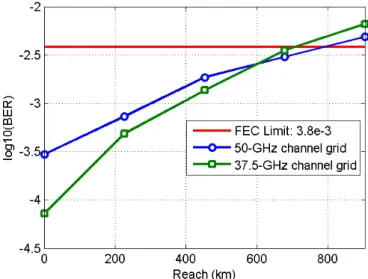
received OSNR for the 50 and 37.5-GHz channel grid systems are 23.6 dB and 23.8 dB, which results in a total transmission penalty of 4.1 dB and 3.8 dB, respectively.
Fig. 6. Transmission reach results.
Although the systems present the same maxmim reach, the use of optical pre-filtering increases the system spectral efficiency. A system with 224-Gb/s DP-16QAM at 28-GBd in a 50-GHz channel grid presents a spectral efficiency of 4.2-b/s/Hz, while the same system with 25-GHz optical pre-filtering in a 37.5-GHz channel grid scenario presents a spectral efficiency of 5.6-b/s/Hz, which represents an increase of 33% in the system capacity. The use of higher-order QAM signals is another approach to increase the system SE. However, the requirements in terms of laser phase noise, received OSNR, nonlinear threshold and ADC effective number of bits (ENoB) are more stringent for these signals, which turns the use of 16QAM modulation a suitable approach for next generation of optical transmission. Although channel grids lower than 50-GHz are not commercially available, the use of flexible-grid WSSs enables the construction ROADMs with variable bandwidth in a 12.5-GHz granularity. The use of optical pre-filtering in conjunction with flexible-grid ROADMs composes a simple and efficient solution to increase the capacity of the current optical systems.
V. CONCLUSION
We demonstrate a spectrally-efficient 17-Tb/s (79×224-Gb/s RZ-DP-16QAM) DWDM optical transmission system with coherent detection and offline DSP. Using the current 50-GHz DWDM grid, a maximum reach of 678 km is obtained with a 4.2-b/s/Hz spectral efficiency. The use of RZ pulse shaping with optical pre-filtering allowed the transmission in a 37.5-GHz channel grid system with a 5.6-b/s/Hz SE in the same reach of 678 km, which results in a 33% improvement in the system capacity without transmission penalties. These results were obtained in a scenario with EDFA amplification only, showing the robustness of the proposed system in a real network scenario.
transmission performance due to the intersymbol interference caused by the filtering. Thus, pre-filtering systems should be designed considering a trade-off between spectral efficiency, performance and maximum reach. This is an important factor when we consider that the future of optical networks tends to flexible applications of bit rate, modulation formats and channel bandwidth.
ACKNOWLEDGMENT
This work has been sponsored by Funttel/Finep: GIGA Project, phase 2, and PAR100GETH.
REFERENCES
[1] Renaudier, J., Bertran-Pardo, O., Charlet, G., Salsi, M., Mardoyan, H., Tran, P. eBigo, S., “8 Tb/s long haul transmission over low dispersion fibers using 100 Gb/s PDM-QPSK,” Bell Labs Technical Journal 14(4), 27–46 (2010).
[2] A. Nag, M. Tornatore, e B. Mukherjee, “Optical Network Design with Mixed Line Rates and Multiple Modulation
Formats”, IEEE/OSA J. of Lightwave Technology, V. 28, N. 4, pp.466 – 475, 2010.
[3] S. Chandrasekhar e Xiang Liu, “Terabit Superchannels for High Spectral Efficiency Transmission”, ECOC 2010,
Tu.3.C.5, Sep. 2010.
[4] Chandrasekhar, S. and Liu, X., “40 Gb/s DBPSK e DQPSK formats for transparent 50 GHz DWDM transmission,” Bell
Labs Technical Journal 14(4), 11–26 (2010).
[5] S.J. Savory, "Digital Coherent Optical Receivers: Algorithms and Subsystems," Selected Topics in Quantum Electronics, IEEE Journal of, vol.16, no.5, pp.1164-1179, Sept.-Oct. 2010.
[6] Optical Internetworking Forum, “Implementation Agreement for Integrated Polarization Multiplexed Quadrature Modulated Transmitters”, IA # OIF-PMQ-TX-01.0, Mar. 2010.
[7] A. H. Gnauck, P. J. Winzer, S. Chandrasekhar, X. Liu, B. Zhu and D. W. Peckham, “Spectrally Efficient Long-Haul WDM Transmission Using 224-Gb/s Polarization-Multiplexed 16-QAM”, journal of lightwave technology, vol. 29, no. 4, pp. 373-377, February 15, 2011.
[8] P. J. Winzer, A. H. Gnauck, S. Chandrasekhar, S. Draving, J. Evangelista and B. Zhu, “Generation and 1,200-km Transmission of 448-Gb/s ETDM 56-Gbaud PDM 16-QAM using a Single I/Q Modulator”, Optical Communication (ECOC), 2010 36th European Conference and Exhibition.
[9] Carsten Behrens, Sergejs Makovejs, Robert I. Killey, Seb. J. Savory, Ming Chen, and Polina Bayvel, "Pulse-shaping versus digital backpropagation in 224Gbit/s PDM-16QAM transmission.", Optics Express, Vol. 19, Issue 14, pp. 12879-12884, 2011.
[10] I. Morohashi, M. Sudo, T. Sakamoto, A. Kanno, A. Chiba, J. Ichikawa and T. Kawanishi, “16 QAM Synthesis by
Angular Superposition of Polarization using Dual-Polarization QPSK Modulator”, ECOC 2010, P3.14, Sep. 2010.
[11] S. Haykin, Adaptive Filter Theory, 4th Ed., Prentice Hall, 2001.
[12] S. J. Savory, "Digital filters for coherent optical receivers," Opt. Express 16, 804-817 (2008).
[13] F. Gardner, “A BPSK/QPSK timing-error detector for sampled receivers,” IEEE Trans. Commun., vol. COM-34, no. 5, pp. 423–429, May 1986.
[14] Z. Li et al., “Wide-Range and Fast-Convergence Frequency Offset Estimator by BER-Aiding...”OSA/ACP 2009, ThT2, (2009).