Elasti and Rotational Exitation Cross Setions
for Eletron Sattering by Polyatomi Moleules
L. E.Mahado
,L. M. Bresansin y
, and M.-T. Lee z
Departamento deFsia,UFSCar,13565-905, S~aoCarlos,SP,Brazil
y
InstitutodeFsia\GlebWataghin", UNICAMP,13083-970,Campinas, SP,Brazil
z
Departamentode Qumia,UFSCar,13565-905, S~aoCarlos,SP,Brazil
Reeivedon10Deember,2001. Revisedversionreeivedon7Marh,2002.
In this work we present a theoretial study on eletron sattering by both polar and nonpolar
polyatomimoleulesinthelow-energyrange. More speially,wereportalulated elasti and
rotationallyinelastidierentialrosssetionsforeletronsatteringbyCH4,H2O,andH2Sinthe
(2.14-30)-eVrange. Exatstati-exhangeplusmodelorrelation-polarizationpotentialsareusedto
representtheeletron-moleule interation. TheShwingervariationaliterativemethodisusedto
solvethesatteringequations. Inaddition,theadiabati-nulei-rotation approximation isapplied
toalulaterotationalrosssetions. Theomparison ofouralulated resultswithexperimental
andothertheoretialdataavailableintheliteratureisenouraging.
I Introdution
Eletron sattering by moleules is a very wide eld
of researh. In partiular, ollisions of eletrons with
smallpolyatomimoleulessuhasCH
4 ,H
2
OandH
2 S
among others, playan important role in several areas
ofinvestigation[1℄, mainlyin atmospheriandplasma
physis, radiation biology, hemistry, et. Inthe
low-energyrange,bothrotationallyelastiandrotationally
inelastiproessesareknowntoberelevantforstudies
insomeoftheseareas[2,3℄.
Besidesthisintrinsiinterestinrotationalproesses,
anotherinterestingpointarisesfortheaseofeletron
ollisionswith polar targets. In viewof thesmallness
of the eletron mass, as ompared to that of the
nu-lei,andduetothefat thattheollisiontimeis
typi-allymuhshorterthantheharateristitimesofthe
nulear motions, theoretial studies often rely on the
xed-nulei framework,whih onsists in treatingthe
nulei as xed-in-spae partiles during the ollision
proess. However, this treatment of eletron
satter-ing by polar moleules is known to lead to divergent
dierential ross setions (DCS) in the forward
dire-tion,duetotheslowfallooftheT-matrixelementsfor
largeangular-momentum partial-waveomponents[4℄.
This divergeneanberemovedonlybythe
introdu-tionofthenulearmotionintheHamiltonian[5℄. That
inlusion,in priniple,willrequirethesolutionof
om-pliated oupledrovibroniequations[2℄. But,indeed,
thatdivergeneanbeavoidedinamuhsimpler
man-ner, byalulatingrotationally-summed rosssetions
inelasti rosssetions,alulatedin theframeworkof
theadiabati-nulei-rotation(ANR)approximation[6℄.
Also,due tothedipolarnature ofsuh moleules,itis
veryinterestingtostudyboththeinueneofthe
long-rangedipoleinterationonthebehavioroftheangular
distributionsforelastiandinelastiproessesandthe
eÆieny of theinelasti ollisionswith eletronsthat
anexitetherotortargetstates.
Althoughabsoluterosssetionsforrotationally
un-resolvedelastisatteringofeletronsbyCH
4 ,H
2 Oand
H
2
S are known sinethelast deades ofthe past
en-tury,thelakofhigh-resolutionapparatuseshasmade
rotationalexitation measurementsmuhmoresare.
Toourknowledge,experimentalresultsforrotationally
resolvedDCSareavailableonlyforH
2
O[3℄andCH
4 [7℄.
Onthetheoretialside,rotationalexitation ross
se-tions for somelow-lying rotational exited levels have
beenreportedforCH
4
[6,8-13℄,H
2
O[6,13-16℄andH
2 S
[13,17,18℄. However,signiantdisrepanieshavebeen
observed in the reported ross setions for the (0!1)
rotationalexitationforH
2
O[6,13℄andH
2
S[13,17,18℄
aswellasfor the (0!3)and (0!4)rotational
exita-tionsforCH
4
[6,9,11℄. Therefore,additionaltheoretial
studies onrotational exitationproessesofthese
tar-getsusingadierentformulationwouldbeuseful.
In this paper we report alulated DCS for
ro-tationally elasti and inelasti sattering of eletrons
by H
2 O, H
2
S and CH
4
for inident energies ranging
from2.14to30eV.Also,rotationally-summedDCSat
10 and 20 eV are reported and ompared with some
re-proximationisused toalulate auratelow
angular-momentum partial-wavesattering amplitudes viathe
Shwinger variational iterative method (SVIM) [32℄.
Rotationallyelastiandinelastirosssetionsare
al-ulated within the framework of the ANR
approxi-mation. Forpolar targets, higher angular-momentum
dipole-potentialT-matrixomponentswerethenadded
to innity through a rstBorn approximation(FBA)
losureformula. Thisproedurewaspreviouslyusedby
our andother groups[6,11,33,34℄forstudies of elasti
eletron-polarmoleulesattering.
Theorganizationofthepaperisasfollows. InSe.
II we present averybrief disussion of the theory we
haveused andreport somedetails of thealulations.
InSe. IIIweompareourresultstoexperimentaland
other theoretial data available in the literature.
Fi-nally,in Se. IVwesummarizeouronlusions.
II Theory and alulation
Inthissetionwewillbrieydisussthemethod used.
Amoredetaileddisussion ontheSVIManbefound
elsewhere[32℄. Within the ANR framework, theDCS
fortheexitation ofanasymmetri-top rotor(asH
2 O
andH
2
S) from aninitial rotational level J to a nal
levelJ 0
0
isgivenby
d
d
(J !J 0 0 )= 1 2 1
(2J+1) J
X
M= J J 0 X M 0 = J 0 k J 0 0 k J Z 2 0 djf
JM !J 0 0 M 0 j 2 ; (1) d wheref
JM !J 0
0
M
0 istherotationalexitation
sat-tering amplitude, related to the rotational
eigenfun-tionsofthetargetby
f
JM !J 0 0 M 0 =h J 0 0 M 0
()jf LF
j
JM ()i:
(2)
In Eq. (1) k
J and k J 0 0
are the magnitudes of the
linearmomenta oftheinidentandthesattered
ele-tron, respetively. In Eq. (2) (;;) are the
Euler angles dening the orientationof themoleular
prinipal axes [35℄ and f LF
is the eletroni part of
the laboratory-frame (LF)sattering amplitudewhih
an be related to the orresponding body-frame (BF)
T matrixbyanusualframetransformation. The
eigen-funtions
JM
() appearing in Eq. (2) are written
aslinearombinationsofsymmetri-topeigenfuntions
[36℄: JM ()= J X K= J a J KM JKM
(); (3)
wherethesymmetri-top eigenfuntionsaregivenby
JKM ()=
2J+1
8 2 D J KM () (4) where D J KM
are the well{known Wigner rotation
ma-tries[35℄. For aspherial-top rotor(as CH
4
) the
ro-tationaleigenfuntions are still given by Eq. (4), but
the degeneray in both K and M quantum numbers
reduesEq. (1)totheform:
d
d
(J !J 0
)= 1
2 1
(2J+1) 2 J X K;M= J J 0 X K 0 ;M 0 = J 0 k J 0 k J Z 2 0 djf
JKM !J 0 K 0 M 0 j 2 : (5) d
The Lippmann-Shwinger sattering equation for
elasti eletron-moleule ollision is solved using the
SVIM, in whih the ontinuum wavefuntions are
single-entreexpandedas
~
k (~r)=
2 1=2 X (i) l k k lm (~r)X pu lh ( ^ k); (6)
where the supersripts (+) and ( ) denote the
inoming-wave and outgoing-wave boundary
ondi-tions,respetively. TheBF T matrixanalso be
on-venientlypartial-waveexpandedas
where ^ k 0 and ^
k arethelinear-momentum diretionsof
theinidentandsatteredeletronsintheBF,
respe-tively. InEqs. (6) and (7)X p
lh (
^
k)are the
symmetry-adaptedfuntions [37℄whih areexpandedintermsof
theusualspherialharmonisasfollows:
X p
lh (^r) =
X m b p lhm Y lm
(^r) (8)
Here p is an irreduible representation (IR) of the
moleularpointgroup,isaomponentofthis
repre-sentationandhdistinguishesbetweendierentbasesof
thesameIRorrespondingtothesamevalueofl. The
oeÆients b p
lhm
satisfy important orthogonality
rela-tions and are tabulated for C
2v and O
h
point groups
[37℄.
In atual alulations, the expansionsin Eqs. (6)
and(7)havebeentrunated inasetofuto
parame-ters. Forpolartargets(H
2
OandH
2
S),higher
partial-waveontributionsweretakenintoaountviaa
Born-losureproedurewhihisthesameasusedbyResigno
andLengseld[33℄andbyourgroup[34℄forthestudy
of the elasti sattering of eletrons by water. A BF
Born-losureformula for theT matrixan be written
as:
T = T B + 1 k LL 0 X plhl 0 h 0 i l l 0 T p SVIM k ;lh;l 0 h 0 T p B k ;lh;l 0 h 0 X p lh ( ^ k)X p l 0 h 0 ( ^ k 0 ); (9) d whereT p SVIM k ;lh;l 0 h 0
arethepartial-waveT-matrixelements
alulatedviaSVIMandtrunatedtosomeuto
val-uesL=(l
;h ),T p B k ;lh;l 0 h 0
aretheorresponding
partial-wave point-dipole FBA T-matrix elements and T B
is
theompletepoint-dipoleFBAT matrix.
In this work the eletron-moleule sattering
dy-namisisrepresentedbyanoptialpotential,givenby
V opt =V st +V ex +V p ; (10) whereV st ,V ex ,andV
p
arethestati,theexhange,and
theorrelation-polarizationontributions,respetively.
In our alulation, V
st
and V
ex
are derived
ex-atly from a Hartree-Fok SCF target wavefuntion.
Aparameter-freemodelpotentialintroduedbyPadial
andNorross[38℄isusedtoaountforthe
orrelation-polarizationontribution. Inthismodel, ashort-range
orrelation potential between the sattering and the
target eletrons is dened in an inner interation
re-gionandalong-rangepolarizationpotentialinanouter
region. Theorrelationpotentialisalulatedbya
free-eletron-gasmodel, derivedusingthetarget eletroni
density aording to Eq. (9) of Padial and Norross
[38℄. Inaddition, theasymptotiform ofthe
polariza-tionpotentialisusedforthelong-rangeeletron-target
interation. The rst rossing of the orrelation and
polarizationpotentialurvesdenestheinner andthe
outer regions. No further adjustable parameters are
neededforthealulationofV
p .
TheSCFwavefuntionsofthetargetsarealulated
from standard ontrated basis sets [39℄. At the
ex-perimental equilibriumgeometries,thealulatedSCF
total energies are 40.1987, -76.0199, and -398.68
a.u., forCH
4 , H
2
O,and H
2
S, respetively, to be
om--76.0632 [40℄, and -398.61 a.u. [41℄. The
polarizabil-ities
0
= 17:5 a.u. (for CH
4
) [42℄,
0
= 24:55 a.u.
(for H
2
S) [42℄, and
0
= 10:6253 a.u., 0 2 = 0:6363 a.u. and 2 2
= 0:30788 a.u. (for H
2
O) [43℄ were used
to alulate the asymptoti form of V
p
. All
partial-wave expansionswere trunated, at most, at l
= 16
with allpossiblevaluesof hl retainedforagivenl.
Fortheassumed l
, ithasbeenveriedthat alldipole
T p SVIM k ;lh;l 0 h 0
and the orresponding point-dipole FBA T
-matrix elements agree within 5%. Our results shown
belowwereallonvergedwithin fouriterations.
III Results and disussion
Although the main interest of the present work is
to disuss rotational exitation ross setions of
poly-atomimoleules,somealulationsofelasti
(rotation-allysummed)rosssetionswerealsoperformed. These
rosssetionswereobtainedbyaddingtherotationally
resolvedDCS,givenbyEq. (1),uptoonvergene.For
illustration, representativeresultsof DCS for eletron
sattering by CH
4 , H
2
O, and H
2
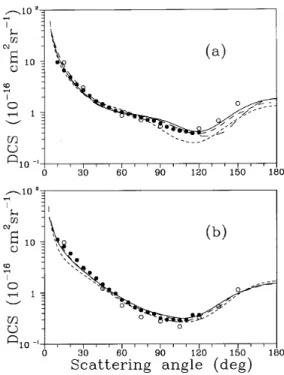
S are shown in Figs.
1{3,respetively,forinidentenergiesof10and20eV.
Someseletedexperimental[19-23,28-30℄and
theoreti-alresults[24-27,31℄arealsopresentedforomparison.
Our alulatedDCS agree well with the experimental
results andalso with mostalulated data.
Figure 1. DCS for elasti e {CH
4
ollisions at (a) 10eV
and (b) 20 eV. Solid line, present (rotationally summed)
results; dotted line, theoretialresults of Jain [24℄;
short-dashedline,theoretialresultsofBettegaetal. [27℄;dashed
line,theoretialresultsofNishimuraandItikawa[26℄;
long-dashedline, theoretialresults ofMNaughten et al. [25℄;
opensquares, experimentaldataofTanakaet al. [19℄; full
triangles, experimentaldata ofCurryetal. [21℄; open
tri-angles, experimentalresults ofVuskoviand Trajmar[20℄;
open irles, experimentaldata of Shynand Cravens [22℄;
fullirles,experimentalresultsofBoestenandTanaka[23℄.
Figure 2. DCS for elasti e -H2Osattering at (a)10eV
and (b)20eV.Solidline, present rotationallysummed
re-[13℄;dashedline,theoretialresultsofGianturoetal.[16℄;
long-dashed line, theoretial results of Greer and
Thomp-son[15℄;openirles,experimentalresultsofShynandCho
[28℄;fullirles,experimentaldataofJohnstoneandNewell
[29℄.
Figure3. DCSfor elasti e {H2Ssattering at (a)10eV
and(b)20eV.Solidline, present rotationallysummed
re-sults;long-dashedline,omplex-Kohnvariationalresultsof
Lengseld etal. [31℄;short-dashedline,theoretialresults
of Varella et al. [13℄; full irles, experimental results of
Gulleyetal. [30℄.
III.1e -CH
4
sattering
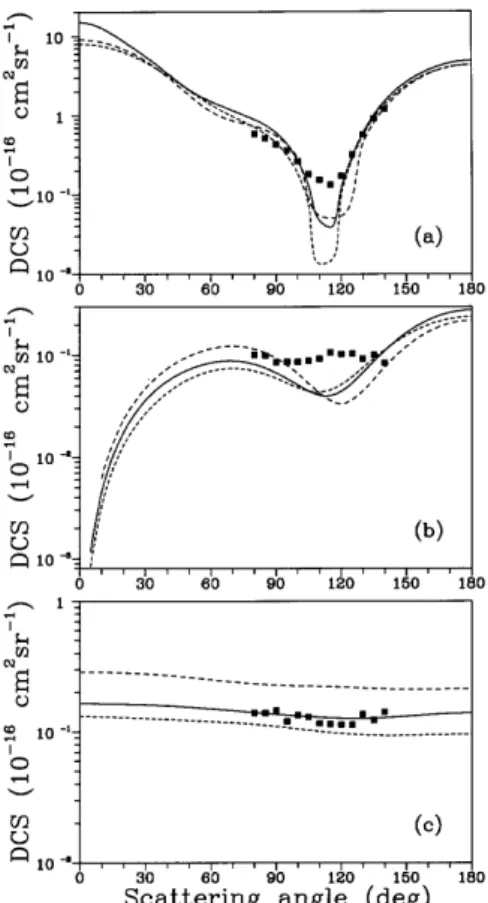
Figures 4{6 show our results for rotationally
re-solvedDCSat5,7.5and10eV,respetively,alongwith
theexperimentalresultsofMulleretal. [7℄andthe
the-oretialresultsof Jainand Thompson[6℄, Abusalbiet
al. [8℄, Bresansin et al. [9℄, and Varella et al. [13℄,
when available. Comparing our data with other
the-oretial results, a general qualitative agreement with
eah other is observed. In ontrast, the reent
alu-latedDCSofGianturoetal. [11℄(notshown)have
pre-sentedunphysialosillationsforthe(0!3)and(0!4)
transitions. Quantitatively, our rotationally resolved
DCSareinverygoodagreementwiththoseofAbusalbi
etal. [8℄ at10 eVand theyarealso infair agreement
withtheotheralulatedresultsforthis energy. Also,
agoodagreementisseenamongthepresentand
exper-imental resultsfor the (0!0)rotational transition,as
wellasforthe(0!3)transitionat5eVandthe(0!4)
transitionat10eV.Fortheotherases,theagreement
Figure4. DCSfortherotational(a)(0!0),(b)(0!3),and
() (0!4) transitionsinCH4 by eletronimpatat 5 eV.
Solidline,presentresults;short-dashedline, theoretial
re-sultsofBresansinetal. [9℄;dashedline,alulatedresults
ofJainandThompson[6℄;fullsquares,experimentalresults
ofMulleretal. [7℄.
around 125 Æ
for the (0!3) transition and the strong
derease at large sattering angles ( 120 o
) for
the(0!4)transitionin theexperimentalvaluesofthe
DCSat7.5eV[7℄. SinethedatareportedbyMulleret
al. [7℄aretheonlyexperimentalresultsavailableinthe
literature, newmeasurementswould help larify these
disrepanies.
III.2 e -H
2
Osattering
Figures 7(a)and 7(b) showour results for the
ro-tationally elasti and the averaged 1
[(0!1)+(1!0)℄
rotationalexitation/de-exitationDCSat2.14eV,
re-spetively,alongwiththeexperimentalresultsof Jung
et al. [3℄ and the available theoretial resultsof Jain
and Thompson [6℄ and Gianturo et al. [16℄. Similar
omparison, but for 6 eV, is shown in Figs. 7() and
7(d). Ourresultsagreereasonablywellwiththe
exper-imental andothertheoretialresults,although noneof
thealulationswasabletopreditthebroadmaximum
enteredataround70 o
seenintheexperimentaldataof
Fig. 7(d). Again,sinetheresultsofthreedierent
al-ulationsagreereasonablywellwitheahotheratleast
qualitatively, we think that new measurements would
beneededto onrmortodisprovethatstruture.
Figure5. SameasFig. 4butfor 7.5eV.Dottedline,
Figure6. Same asFig. 5butfor 10eV.Long-dashedline,
theoretialresultsofAbusalbietal. [8℄.
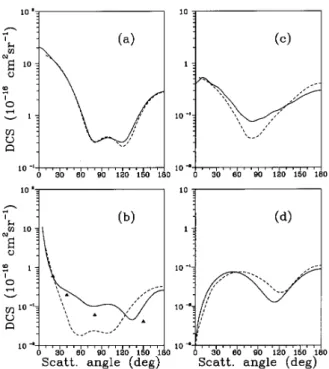
Figure 7. Rotationally resolved DCS for e -H2O
satter-ing for (a)the(0!0) elasti proessand (b)the averaged
1
2
[(0! 1)+(1!0)℄rotationalexitation/de-exitation
pro-ess, both at 2.14 eV, and for () the (0!0) elasti
pro-ess and (d) the averaged 1
2
[(0! 1) + (1!0)℄ rotational
presentresults;dashedlines,theoretialresultsofGianturo
etal. [16℄;long-dashedlines,theoretialresultsofJain and
Thompson[6℄; fullsquares,experimentalresultsofJunget
al. [3℄.
Figures8(a{d) showourDCSfor the(0!0;1;2;3)
rotationaltransitions, respetively,at 30 eV.
Unfortu-nately,therearenoorrespondingexperimentalresults
available in the literature. Therefore, omparison is
made only with the other alulated data [13,16℄. A
generaloverallagreementisobservedamongallthe
al-ulatedresults.
Figure8. RotationallyresolvedDCSfore -H
2
Osattering
at30eVforrotational(a)(0!0),(0!1),()(0!2),and(d)
(0!3)transitions. Solidline,present results;short-dashed
lines,theoretialresults ofVarellaetal. [13℄;dashedline,
alulatedresultsofGianturoetal. [16℄.
III.3e -H
2
Ssattering
InFigs. 9 and 10wepresentthe (0!0;1;2;3)
ro-tationaltransition ross setions, forinident energies
of10and15eV,respetively. Thealulatedresultsof
Varella et al. [13℄ and Gianturo [18℄ (for 0!1 only)
are also shown for omparison. General good
agree-mentisfound, bothinshapeandmagnitude, between
allalulations,exeptforthe(0!1)exitation,where
a signiant disagreement between our data and the
SMCresults anbe seen. As this disrepany is only
apparentintheexitationhannelforwhihthe
Born-losure proedure is needed (J 0
=1), it ould bedue
to dierent implementations of this proedure in the
alulations. Unfortunately, no experimental result is
availableinordertoshedsomelightonthisdisussion.
Figure9. RotationallyresolvedDCSfor e -H
2
Ssattering
at10eVforrotational(a)(0!0),(0!1),()(0!2),and(d)
(0!3)transitions. Solidline,presentresults;short-dashed
line,theoretialresultsofVarellaetal. [13℄;triangles,
al-ulatedresultsofGianturo[18℄.
Figure10. SameasFig. 9,butfor 15eV.
IV Summary and onlusions
In this work, we report a theoretial study of
moleules. Rotationally elasti and inelasti, as well
asrotationallysummedrosssetions arepresentedin
omparisonwithsomeexistingexperimentalandother
theoretialresults.Ouralulatedrotationallysummed
DCSareingeneralgoodagreementwiththemeasured
rotationally unresolved data. Forsome ases, our
ro-tationally resolved results also agree quite well with
theorrespondingexperimentaldata. Thisgood
agree-ment supports the desription of the interation
dy-namionsideredinthepresentstudyandthemethods
usedforsolvingthesatteringequations. Extensionto
higherinidentenergiesandothermoleulartargetsare
underway.
Referenes
[1℄ S. Trajmar, D. F. Register, and A. Chutjian, Phys.
Rep.97,219(1983).
[2℄ N.F.Lane,Rev.Mod.Phys.59,29(1980).
[3℄ K.Jung,Th.Antoni,R.Muller,K-H.Kohem,andH.
Erhardt,J.Phys.B15,3535(1982).
[4℄ D.W.NorrossandL.A.Collins,AdvanesinAtomi
andMoleularPhysis18,341(1982).
[5℄ L. A. Collins and D. W. Norross, Phys.Rev.A 18,
467(1978).
[6℄ A. Jain and D. G. Thompson, J. Phys. B 16, 3077
(1983).
[7℄ R.Muller,K.Jung, K.-H. Kohem, W.Sohn,and H.
Erhardt,J.Phys.B18,3971(1985).
[8℄ N.Abusalbi,R.A.Eades,T.Nam,D.Thirumalai,D.
A. Dixon, D. G. Truhlar, and M. Dupuis, J. Chem.
Phys.78,1213 (1983).
[9℄ L.M.Bresansin,M.A.P.Lima,andV.MKoy,Phys.
Rev.A40,5577(1989).
[10℄ A.Jain,Z.Phys.D21,153(1991).
[11℄ F.A.Gianturo,J.A.Rodriguez-Ruiz,andN.Sanna,
Phys.Rev.A52,1257 (1995).
[12℄ M. T.doN.Varella,M. H.F.Bettega, and M. A.P.
Lima,Z.Phys.D39,59(1997).
[13℄ M.T.doN.Varella,M.H.F.Bettega,A.P.P.
Natal-ense,L.G.Ferreira,andM.A.P.Lima,Braz.J.Phys.
31,21(2001).
[14℄ F.A.Gianturo,J.Phys.B24,3837(1991).
[15℄ R. Greer and D. G. Thompson, J. Phys. B 27, 3533
(1994).
[16℄ F.A.Gianturo,S.Meloni,P.Paioletti,R.R.
Luh-ese,andN.Sanna,J.Chem.Phys.108,4002(1998).
[17℄ A. Jain and D. G. Thompson, J. Phys. B 17, 443
(1983).
[18℄ F.A.Gianturo,J.Phys.B24,4627(1991).
[19℄ H. Tanaka, T.Okada, L. Boesten, T. Suzuki, T.
Ya-mamoto,andM.Kubo,J.Phys.B15,3305(1982).
[21℄ P.J.Curry,S.Newell,andA.C.Smith,J.Phys.B18,
2303 (1985).
[22℄ T. W. Shyn and T. E. Cravens, J. Phys. B 23, 293
(1990).
[23℄ L.BoestenandH.Tanaka,J.Phys.B24,821(1991).
[24℄ A.Jain,Phys.Rev.A34,3707 (1986).
[25℄ P. MNaughten, D. G. Thompson, and A. Jain, J.
Phys.B23,2405(1990).
[26℄ T. Nishimura and Y. Itikawa, J. Phys. B 27, 2309
(1994).
[27℄ M. H.F.Bettega, A.P.P.Natalense, M.A. P.Lima,
andL.G.Ferreira,J.Chem.Phys.103,10566(1995).
[28℄ T. W. Shyn and S. Y. Cho, Phys. Rev. A 36, 5138
(1987).
[29℄ W. M. Johnstone and W. R. Newell, J. Phys. B 24,
3633 (1991).
[30℄ R. J. Gulley, M. J. Brunger, and S. J. Bukman, J.
Phys.B26,2913(1993).
[31℄ B.H.LengseldIII,T.N.Resigno,C.W.MCurdy,
andS.Parker(1992),asquotedbyRef.30.
[32℄ R.R.Luhese,G.RaseevandV.MKoy,Phys.Rev.
A25,2572(1982).
[33℄ T.N.ResignoandB.H.LengseldIII,Z.Phys.D24,
117(1992).
[34℄ L.E.Mahado,M.-T.Lee,L.M.Bresansin,M.A.P.
Lima,andV.MKoy,J.Phys.B28,467(1995).
[35℄ A. R. Edmonds, Angular Momentum and
Quan-tumMehanis,PrinetonUniversityPress,Prineton
(NJ),(1960).
[36℄ C.VanWinter,PhysiaXX,274(1954); A.Jain and
D. G. Thompson, Comput. Phys. Commun. 30, 301
(1983).
[37℄ P.G.Burke,N.Chandra,andF.A.Gianturo,J.Phys.
B5,2212 (1972).
[38℄ N. T. Padial and D. W. Norross, Phys.Rev. A 29,
1742(1984).
[39℄ T.H.DunningJr.,J.Chem.Phys.55,716(1971).
[40℄ T.H.DunningJr.,R.M.Pitzer,andS.Aung,J.Chem.
Phys.57,5044(1972).
[41℄ I.Caelli, V.Caravetta, A. Rizzo,and R. Moia, J.
Chem.Phys.102,1230(1995).
[42℄ J.O.Hirshfelder,C.F.Curtis,andR.B.Bird,
Mole-ularTheory of Gases andLiquids, John Willey, New
York(NY),(1954).
[43℄ N.S.HushandM. L.Williams,Chem.Phys.Lett.6,