UN I V ERSI TY STUD EN TS’ PERCEI V ED N ORM S OF PEERS AN D D RUG USE: A M ULTI CEN TRI C STUD Y I N FI V E LATI N AM ERI CAN COUN TRI ES
I nés V. Bust am ant e1 Ana Mar ia Pim ent a Car v alho2 Elias Bar bosa de Oliv eir a3 Her cilio Per eir a de Oliv eir a Júnior4 Sy nt ia Dinor a Sant os Figuer oa5 Er ik a Mar ia Mont oy a Vásquez6 An g elica Cazen av e7 Ev a Ch an am e8 Luz St ella Medina Mat allana9 Julia Ram ir ez Cast illo1 0
V. Bust am ant e I , Car valho AMP, Oliv eira EB, Oliveir a HP Júnior, Sant os Figuer oa SD, Mont oya Vásquez EM, et al. Univ er sit y st udent s’ perceived norm s of peers and drug use: a m ult icent ric st udy in five lat in am erican count ries. Rev Lat ino- am Enferm agem 2 0 0 9 n ov em b r o- d ezem b r o; 1 7 ( Esp . ) : 8 3 8 - 4 3 .
This cross- sect ional st udy com pared perceived peer drug use and act ual drug use in a sam ple of Lat in Am erican universit y st udent s. St udent s from nine universit ies in five count ries ( Brazil, Chile, Colom bia, Honduras and Peru) com plet ed a quest ionnaire t hat addressed
t he use of t obacco, alcohol, m arij uana and cocaine. Analysis focused on com paring percept ions t o act ual drug use. The findings largely,
but not com plet ely, confirm ed t he idea t hat st udent s overest im at e peer drug use. The unexpect ed findings were t hose relat ing t o
alcohol. While st udent s generally overest im at ed peer use of t obacco, m arij uana and cocaine, t hey accurat ely est im at ed or underest im at ed
peer use of alcohol. Apart from t he anom alous findings wit h regard t o alcohol, t his st udy shows t hat perceived drug use relat es t o act ual
drug use in Lat in Am erica as it does elsewhere. The result s also support t he suggest ion t hat int ervent ions using norm at ive feedback
would be useful t o st rengt hen drug use prevent ion program s aim ed at yout h in Lat in Am erica.
DESCRI PTORS: alcohol; t obacco; cannabis; cocaine
N ORM AS PERCI BI D AS POR ESTUD I AN TES UN I V ERSI TARI OS RESPECTO A SUS PARES Y EL USO D E D ROGAS: ESTUD I O M ULTI CÉN TRI CO EN CI N CO PAÍ SES D E AM ÉRI CA LATI N A
Est e est udio t ransversal se com paró la percepción que se t iene del consum o de los pares con el uso real de drogas, en una m uestra de
est udiant es univer sit ar ios de Am ér ica Lat ina. Los est udiant es de nueve univ er sidades en cinco países ( Br asil, Chile, Colom bia,
Honduras y Perú) respondieron a un cuest ionario que abordaba el uso de t abaco, alcohol, m arihuana y cocaína. El análisis se concent ró
en la com paración de la percepción y el consum o real de drogas. Los result ados en gran m edida, aunque no com plet am ent e, confirm aron
que los est udiant es sobreest im an el uso de drogas ent re sus pares. Los result ados inesperados fueron los relacionados con el alcohol.
Mient ras que los est udiant es generalm ent e sobrest im aron el consum o de t abaco, m arihuana y cocaína ent re sus pares, los m ism os
est im aron con bast ant e precisión o subest im aron el uso de alcohol ent re sus pares. Adem ás de los result ados inesperados en relación
al alcohol, est e est udio m uest ra que la percepción del uso de drogas en Am érica Lat ina se com port a de m anera sim ilar a ot ros lugares.
Los result ados t am bién apoyan la sugerencia respect o a que la ret roalim ent ación norm at iva sería út il para fort alecer los program as de
prevención de drogas dirigidos a j óvenes en Am érica Lat ina.
DESCRI PTORES: alcohol; t abaco; cannabis; cocaína
N ORM AS PERCEBI D AS POR ESTUD AN TES UN I V ERSI TÁRI OS SOBRE SEUS COM PAN H EI ROS E USO D E D ROGAS: UM ESTUD O M ULTI CÊN TRI CO EM CI N CO PAÍ SES D A AM ÉRI CA LATI N A
Est e est udo t ransversal com parou a percepção dos com panheiros de usuários de drogas em um a am ost ra de est udant es universit ários
da Am érica Lat ina. Os est udant es de nove universidades, localizadas em cinco países ( Brasil, Chile, Colôm bia, Honduras e Peru)
responderam quest ionário que abordou quest ões sobre o t agagism o, álcool, m aconha e cocaína. A análise foi focalizada na com paração
da percepção e da realidade dos at uais usuários de drogas. Os result ados confirm aram , de form a geral, a ideia de que os est udant es
superest im am o uso de drogas. Result ados inesperados foram ident ificados em relação ao uso de álcool. Enquant o os est udant es
geralm ent e superest im am o uso de t abaco, m aconha e cocaína, ent re seus pares, est im aram com bast ant e precisão ou subest im aram
o uso de álcool ent re seus pares. Apesar desse result ado inesperado, est e est udo m ost ra que a percepção do uso de drogas ent re
est udant es universit ários da Am érica Lat ina se com port a de m aneira sim ilar ao uso de drogas em out ras localidades. Os result ados
t am bém apóiam a sugest ão de que int ervenções, usando ret roalim ent ação norm at iva, seriam út eis para fort alecer os program as de
prevenção ao uso de drogas, dirigidos aos j ovens da Am érica Lat ina.
DESCRI TORES: alcohol; t abaco; cannabis; cocaína
I NTRODUCTI ON
W
or ldw ide dr ug use affect s liv es at a high cost . According t o t he World Healt h Organizat ion’s 2004Up d a t e o f t h e Gl o b a l Bu r d e n o f D i se a se , a l co h o l
dependence and drug use rem ained wit hin t he t op 10
leading causes ofdisabilit y in count ries at all levels of
in com e( 1 ).
I n La t i n Am e r i ca , y o u t h a g e d 1 8 t o 2 4 ,
especially univ er sit y st udent s, r epor t higher lifet im e
an d p ast y ear p r ev alen ce of leg al an d illeg al d r u g
use t han ot hers. These differences are higher for illegal
dr ugs t han for alcohol and t obacco( 2- 5). For inst ance, t h e past y ear pr ev alen ce of m ar ij u an a u se is t h r ee
t im es higher am ongst yout h aged 18 t o 24 years t han
in t he w hole populat ion in Chile ( 1 6 % v s. 5 . 3 % )( 3 ), an d t w o t im es gr eat er in Per u ( 6 . 8 % v s. 3 . 3 % )( 6 ). Th e p ast y ear p r ev alen ce f or cocain e u se is ab ou t
t wo t im es higher am ongst 18 t o 24 years olds t han in
t he whole populat ion in t hese t wo count ries( 3- 6). I n Lat in Am erica and t he Caribbean, 6.5% of t he t ot al burden
of disease is at t ribut able t o high- risk alcohol use, and
t he eight h leading cause of disabilit y and pr em at ur e
deat h in 2001 w as alcohol use disor der s( 7). I n young adult s, t he m ort alit y rat es associat ed wit h alcohol and
w it h t he use of ot her dr ugs ar e higher t han in ot her
age gr oups( 8).
Hi g h r a t e s o f d r u g u se a m o n g u n i v e r si t y
st udent s have been t he focus of several st udies w it h
a p a r t i c u l a r a i m o f t r y i n g t o u n d e r s t a n d t h e
det erm inant s of t his drug phenom enon. Peer influence
has been found as a key fact or associat ed w it h dr ug
use am ongst 18 t o 24 years olds( 9- 10) and “ social norm s t heory” has been used as a fram ework t o underst and
t h is r elat ion sh ip . On e of t h e m ain con cep t s of t h is
t h e o r y ( a s a p p l i e d t o a l c o h o l c o n s u m p t i o n ) i s
m i s p e r c e p t i o n o f p e e r d r i n k i n g , d e f i n e d a s t h e
discrepancy bet ween t he act ual norm ( t he prevalence
of drinking) and t he com m on percept ion of t he norm
( t he per ceiv ed fr equency of dr ink ing by peer s)( 11). There is evidence of t he associat ion bet ween
ov er est i m at i on of p eer s’ al coh ol u se an d d r i n k i n g
behaviour am ongst college st udent s in Nort h Am erica
an d ot h er d ev el op ed cou n t r i es. St u d en t s t y p i cal l y
t h ou g h t t h e n or m s f or bot h t h e f r eq u en cy an d t h e
am ou n t of dr in k in g am on g t h eir peer s w er e h igh er
t h a n w a s a ct u a l l y t h e ca se , a n d t h e y g e n e r a l l y
b eliev ed t h at t h eir p eer s w er e m or e p er m issiv e in
t h eir p er son al at t it u d es ab ou t d r u g u se t h an t h ey
were( 12- 14). Addit ionally, t here is som e evidence of an
associat ion bet w een over est im at ion of peer s’ t obacco
use and sm ok ing( 15). Ther e is also som e ev idence of o v e r e st i m a t i o n a n d i l l e g a l d r u g u se , sp e ci f i ca l l y
m a r i j u a n a( 1 5 - 1 7 ), a n d co ca i n e( 1 5 ). Ad d r e ssi n g t h e inaccuracy of perceived norm s about peers’ drug use
i s a p o w e r f u l co m p o n e n t o f a n y d r u g p r e v e n t i o n
pr ogr am( 1 4 ).
The purpose of t his st udy is t o est im at e and
descr ibe if t h er e is a dif f er en ce bet w een per ceiv ed
norm s am ong peers drug use and own drug use in a
sa m p l e o f u n i v er si t y st u d en t s en r o l l ed i n 5 La t i n
Am er ican cou n t r ies.
I t is n ot ew or t h y t o m en t ion t h at t h er e is a
lack of st udies on peers norm s and drug use am ongst
Lat in - Am er ican st u d en t s. How ev er, t h er e ar e som e
st u dies abou t peer s an d dr u g u se am on gst sch
ool-at t ending yout h. For inst ance RLAE has published som e
ar t icles t hat st udied am ongst sev er al r isk fact or s for
d r u g u s e , t h e i n f l u e n c e o f p e e r s i n s e c o n d a r y
st udent s( 18- 19). So t his st udy will shed light of perceived n or m s ab ou t d r u g u se an d ow n d r u g u se am on g st
u n i v e r s i t y s t u d e n t s . A l s o i t m a y h e l p t o r a i s e
aw ar eness on t his subj ect in univ er sit y com m unit ies,
societ y in general and governm ent s on t his issue and
f aci l i t at e t h e d ev el o p m en t o f ef f ect i v e p r ev en t i v e
st r at eg ies.
METHODS
Th is is a qu an t it at iv e cr oss- sect ion al m u lt
i-cen t r ic st u d y. St u d en t s en r olled in v ar iou s Healt h
Sciences pr ogr am s ( Medicine, Nur sing, Dent ist r y and
Public Healt h) and in Educat ion in nine universit ies in
five Lat in Am erican count ries were recruit ed. The nine
sit es w er e u n iv er sit ies locat ed in Ribeir ão Pr et o/ SP,
Sant o André/ SP and Rio de Janeiro in Brasil, Medellin
a n d Bo g o t a i n Co l o m b i a , Sa n t i a g o d e Ch i l e a n d
Concepcion in Chile, Tegucigalpa in Honduras and Lim a
in Per u.
Al l cu r r e n t so p h o m o r e a n d j u n i o r h e a l t h
sciences and educat ion st udent s, aged 18 t o 24, were
in v it ed t o p ar t icip at e in t h e st u d y. Th e st u d y w as
approved by t he Research Et hics Board at t he Cent re
for Addict ion and Ment al Healt h ( CAMH) and by each
of t he univer sit ies involved in t he st udy.
Th e q u e st i o n n a i r e w a s cr e a t e d f r o m t w o
d if f er en t in st r u m en t s ( Th e Cor e Dr u g an d Alcoh ol
Su r v e y, 1 9 8 9 ; Ca n a d i a n Ca m p u s Su r v e y, 2 0 0 4 )
abou t peer s’ dr u g u se am on gst college st u den t s. I t
h ad fou r sect ion s: 1 ) social an d dem ogr aph ic dat a;
2) percept ions about drug use am ongst peers; 3) t he
st u d en t ’s ow n d r u g u se; an d 4 ) u n iv er sit y cam p u s
p olicies r eg ar d in g d r u g u se, con seq u en ces of d r u g
use, and drug access. The quest ionnaire was t ranslat ed
fr om English int o Spanish and Por t uguese and t hen
back t r anslat ed int o English t o ensur e t he v alidit y of
t h e t r an slat ion s. Dat a w er e en t er ed an d an aly zed
u si n g St a t i st i ca l Pa ck a g e f o r t h e So ci a l Sci e n ce s
( SPSS® 1 5 . 0 f or Win d ow s) . Th e st at ist ical an aly sis w as essen t ially descr ipt iv e.
RESULTS
A t o t a l o f 3 3 3 9 s t u d e n t s c o m p l e t e d t h e
q u e st i o n n a i r e . Am o n g p a r t i ci p a n t s, 7 5 . 7 % w e r e
f e m a l e , 9 6 . 1 % w e r e s i n g l e , a n d 1 0 . 2 % w e r e
e m p l o y e d . Pa r t i ci p a n t s w e r e e n r o l l e d i n v a r i o u s
depart m ent s, including: 28.2% in m edicine, 32.3% in
nursing, 19.3% in dent ist ry, 4.9% in public healt h and
15.3% in educat ion.
For each dr ug, st udent s w er e ask ed if t hey
had ev er used t he dr ug at least once in t heir liv es,
and t hose w ho had w er e ask ed how oft en t hey had
used t he drug in t he past 12 m ont hs. The m aj orit y of
st u d e n t s r e p o r t e d t h a t t h e y h a d e v e r co n su m e d
t o b a cco ( 5 8 . 7 % ) a n d a l co h o l ( 9 1 . 6 % ) w h er ea s a
m in or it y r ep or t ed m ar ij u an a ( 1 8 . 5 % ) an d cocain e
( 2 . 7 % ) u se. Wh en ask ed abou t u se in t h e past 1 2
m on t h s, 3 5 . 9 % r ep or t ed sm ok in g t ob acco, 8 5 . 6 %
dr in k in g alcoh ol, 1 0 . 8 % u sin g m ar ij u an a an d 1 . 4 %
u sin g cocain e. Par t icip an t s w er e also ask ed ab ou t
frequency of use in t he past 12 m ont hs by t ype.
For st u d en t s w h o h ad ev er u sed ( Tab le 1 )
t obacco, m ar ij u an a, an d cocain e, m an y did n ot u se
i n t h e p a s t y e a r ( 3 8 . 7 % , 4 1 . 2 % , a n d 4 8 . 8 %
r espect iv ely ) , 3 2 . 8 % u sed t obacco m or e t h an on ce
p e r m o n t h i n t h e p a s t 1 2 m o n t h s , 7 . 5 % u s e d
m ar ij uana m or e t han once per m ont h in t he past 12
m ont hs, and 7.3% used cocaine m or e t han once per
m ont h in t he past 12 m ont hs, 42.0% of t he st udent s
who had ever used alcohol report drinking m ore t han
once per m ont h in t he past y ear and only 6.5% did
not drink alcohol in t he past 12 m ont hs.
Table 1 - Frequency of use in past 12 m ont hs for each drug for st udent s who had ever used t he drug
Fo r t o b acco , st u d en t s w h o h ad ev er u sed
t obacco were asked t he num ber of cigaret t es sm oked
per day in t h e last 3 0 day s. Th e lar gest pr opor t ion
( 6 3 . 4 % ) did n ot sm ok e at all in t h e past 3 0 day s.
St udent s who drank alcohol during t he past year were
ask ed t h e n u m ber of dr in k s t h ey u su ally con su m ed
per drinking day in t he past year, how frequent ly t hey
had consum ed 5 or m ore drinks on t he sam e occasion
in t h e past y ear, an d t h e h igh est n u m ber of dr in k s
t hey had on one occasion in t he past 3 0 day s. The
m ean num ber of dr ink s per dr ink ing day in t he past
year w as 4.8 ( SD = 5.3, N = 2510) . Only 22.1% of
st udent s dr ank 5 or m or e dr ink s per occasion m or e
fr equ en t ly t h an on ce per m on t h . Th e m ean h igh est
num ber of drinks on a single occasion in t he past 30
days was 4.6 ( SD = 5.3, N = 2517) .
Per ceiv ed pr ev alence and nor m s of peer dr ug use
For each d r u g , st u d en t s w er e ask ed w h at
percent age of t heir peer s ( in t heir opinion) had used
t h e d r u g a t l e a s t o n c e i n t h e i r l i v e s a n d w h a t
per cen t age h ad u sed it in t h e last y ear. Th e m ean
est im at es of peer ev er use w er e 72.5% for t obacco, 85.8% for alcohol, 39.4% for m ar ij uana, and 20.2%
for cocain e. Th e r espect iv e m ean est im at es of peer use in t he past year were 66.8% , 82.2% , 31.6% and 1 5 . 1 % . For each dr u g, t h e est im at ed pr opor t ion of
e s U f o y c n e u q e r F
o c c a b o
T Alcohol Marijuana Cocaine
N % N % N % N %
r e v e
N 681 38.7 178 6.5 228 41.2 40 48.8 r
a e y a n i e c n
O 292 16.6 528 19.2 207 37.4 27 32.9 h
t n o m a n i e c n
O 211 12.0 889 32.3 77 13.9 9 11.0 h
t n o m a n i s e m it 3
-2 165 9.4 599 21.7 24 4.3 2 2.4 k
e e w a n i e c n
O 107 6.1 392 14.2 9 1.6 3 3.7 k
e e w a n i s e m it 3
-2 150 8.5 136 4.9 5 0.9 1 1.2 y
a d y r e v
E 155 8.8 34 1.2 4 0.7 0 0.0 l
a t o
peer s w ho had ev er used it w as slight ly higher t han
t he est im at ed proport ion of peers who had used it in
t he past y ear. Roughly, st udent s est im at ed t hat 4 of
every 5 st udent s drank alcohol, 2 of every 3 sm oked
t obacco, 1 of ever y 3 used m ar ij uana, and t hat 1 of
every 7 used cocaine in t he past year. For each drug,
st udent s were asked how oft en in t he past year t heir
peer s ( in t h eir opin ion ) u sed t h e dr u g. Th e r esu lt s
ar e show n in Table 2. Most st udent s est im at ed t hat
t obacco is used on a daily basis, alcohol is used a few
t im es a week, m arij uana is used a few t im es a m ont h,
and cocaine is used a few t im es a y ear by a t y pical
st udent in t heir univ er sit y.
Tab l e 2 - Per cen t ag es o f st u d en t s w h o est i m at ed
fr equencies of peer dr ug use in t he past year
Pe r c e i v e d p e e r d r u g u s e n o r m s v e r s u s a c t u a l
d r u g u se
Ov er all, st udent s subst ant ially ov er est im at ed
t h e p e r ce n t a g e o f t h e i r p e e r s w h o u se t o b a cco ,
m ar ij uana, and cocaine, but slight ly under est im at ed
t he percent age of st udent s who use alcohol ( Table 3) .
Table 3 - Mean per cen t ages of est im at ed peer ever u se an d peer past y ear u se com par ed t o ow n ev er
use and ow n past year use
e c n a t s b u S % d e t a m i t s E r e v E r e e P ) n a e m ( e s U d e t r o p e R r e v E n w O ) % ( e s U % d e t a m i t s E r a e Y t s a P r e e P ) n a e m ( e s U d e t r o p e R t s a P n w O ) % ( e s U r a e Y o c c a b o
T 72 58.7 66.8 35.9 l o h o c l
A 85.8 91.6 82.2 85.6 a n a u ji r a
M 39.4 18.5 31.6 10.8 e n i a c o
C 20.2 2.7 15.1 1.4
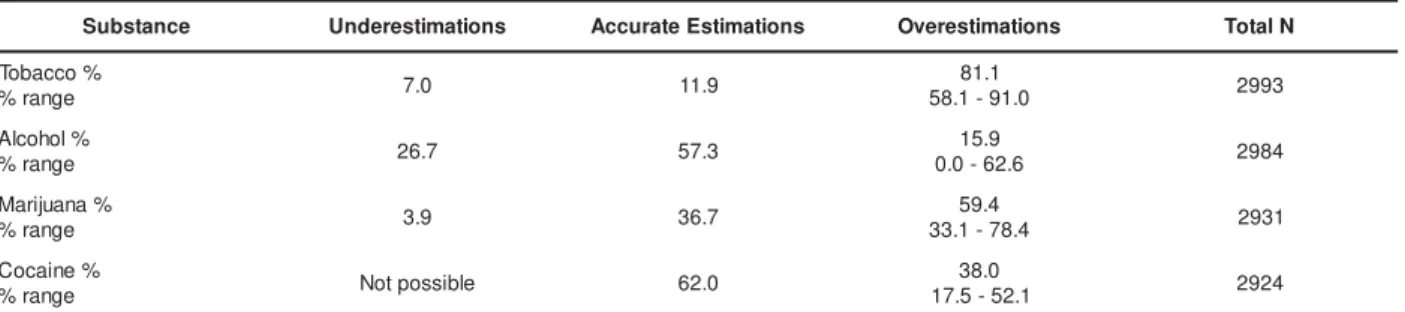
Est im at ions of st udent s’ peer past year dr ug
use w er e deem ed “ accur at e” if w it hin 10 per cent age
point s of act ual prevalence, “ underest im at ions” if m ore
t h a n 1 0 p e r c e n t a g e p o i n t s l o w e r t h a n a c t u a l
p r ev alen ce, an d “ ov er est im at ion s” if m or e t h an 1 0
per cen t age poin t s h igh er t h an act u al pr ev alen ce( 2 0 ). These r esult s ar e show n in Table 4.
Table 4 - Accuracy of st udent s’ est im at es of peer s’ past y ear dr ug use
e c n a t s b u
S Underestimations AccurateEstimations Overestimations TotalN
% o c c a b o T e g n a r
% 7.0 11.9
1 . 1 8 0 . 1 9 -1 . 8
5 2993 % l o h o c l A e g n a r
% 26.7 57.3
9 . 5 1 6 . 2 6 -0 .
0 2984 % a n a u ji r a M e g n a r
% 3.9 36.7
4 . 9 5 4 . 8 7 -1 . 3
3 2931 % e n i a c o C e g n a r
% Notpossible 62.0
0 . 8 3 1 . 2 5 -5 . 7
1 2924
y c n e u q e r
F Tobacco Alcohol Marijuana Cocaine
r e v e
N 1.7 0.7 7.8 20.0 r a e y a n i e c n
O 2.5 0.9 19.1 39.9 h t n o m a n i e c n
O 3.8 5.1 26.2 21.3 h t n o m a n i s e m it 3
-2 4.7 12.1 20.7 9.8 k e e w a n i e c n
O 8.0 38.3 15.5 5.2 k e e w a n i s e m it 3
-2 26.3 38.2 9.0 2.7 y a d y r e v
E 53.0 4.8 1.7 1.0 % 0 0 1 = N l a t o
T 2970 2967 2903 2889
Since t he r epor t ed pr ev alence for past y ear
u se of cocain e r an g ed f r om 0 . 4 % t o 3 . 3 % acr oss
u n i v e r si t i e s, n o e st i m a t e co u l d b e m o r e t h a n 1 0 p e r c e n t a g e p o i n t s b e l o w a c t u a l p r e v a l e n c e a n d
underest im at ion was t herefore not possible. As shown
in Table 4, overest im at ion of peer drug use is far less frequent for alcohol t han for t obacco, m arij uana, and
cocain e.
Co m p a r i s o n o f s t u d e n t d r u g u s e p a t t e r n s a n d
p er ceiv ed n or m s
Est im at es of peer use of each drug, for bot h
ever use and past year use, were significant ly higher
for past year users t han for past year non- users ( please
see Table 5 ) . For each dr u g, past y ear u ser s m ade
higher est im at es of peer use t han did past year
non-u ser s.
Table 5 - Mean per cent age est im at es of peer use by
ow n past y ear use
e c n a t s b u
S PastYearUsers PastYearNon-users
e s u r e v e r e e p % o c c a b o
T 77.1 70.0 e s u r a e y t s a p r e e p
% 71.5 64.2 e s u r e v e r e e p % l o h o c l
A 87.6 74.8 e s u r a e y t s a p r e e p
% 84.0 71.5 e s u r e v e r e e p % a n a u ji r a
M 54.2 37.6 e s u r a e y t s a p r e e p
% 45.3 29.9 e s u r e v e r e e p % e n i a c o
C 32.3 20.1 e s u r a e y t s a p r e e p
For t obacco, st udent s w ho sm ok ed once per
w e e k o r m o r e w e r e s l i g h t l y m o r e l i k e l y t o
ov er est im at e peer t obacco use. For alcohol, st udent s
who had never used alcohol, or had not used it in t he
past year, w er e t he m ost likely t o over est im at e peer
alcohol use. For m ar ij uana t her e w as no r elat ionship
bet ween frequency of use and est im at ion of peer use.
For cocain e, st u den t s w h o u sed cocain e m or e t h an
once per m ont h seem ed m or e lik ely t o ov er est im at e
t he use of cocaine by t heir peers, but t his is suggest ed
cau t iou sly, g iv en t h at t h e g r ou p sizes ar e so v er y
sm all.
Fo r t o b acco , st u d en t s w h o sm o k ed si x o r
m or e cigar et t es per day w er e slight ly m or e lik ely t o
ov er est im at e t he pr opor t ion of sm ok er s am ong t heir
p eer s. For alcoh ol, st u d en t s w h o r ep or t ed d r in k in g
m o r e p e r d r i n k i n g d a y w e r e m o r e l i k e l y t o
u n d e r e s t i m a t e p e e r a l c o h o l u s e . S t u d e n t s w h o
report ed a higher num ber of drinks per occasion were
also m or e lik ely t o under est im at e peer alcohol use.
DI SCUSSI ON
Th is st u d y su r v ey ed u n iv er sit y st u d en t s in
t heir 2nd or 3d year of st udy, aged 18 t o 24, enrolled in Healt h Sciences or Educat ion program s in nine Lat in
A m e r i c a n u n i v e r s i t i e s . Th e s e s t u d e n t s w e r e
pr edom inant ly fem ale, single, and not w or k ing.
Th e f i n d i n g s l a r g e l y, b u t n o t co m p l e t e l y,
confir m ed t he idea t hat st udent s over est im at e peer s’
d r u g u se r elat iv e t o t h e act u al p r ev alen ce of d r u g
u se su g g est ed b y st u d ies in d if f er en t in t er n at ion al
con t ex t s( 1 3 - 1 7 ). Th e m ean est im at ion s of pr ev alen ce w er e h i g h er t h a n o v er a l l r ep o r t ed p r ev a l en ce f o r
t obacco, m arij uana, and cocaine, but not for alcohol.
The per cent ages of st udent s w ho ov er est im at ed t he
pr ev alen ce of t obacco, m ar ij u an a, an d cocain e u se
f a r e x c e e d e d t h e p e r c e n t a g e o f s t u d e n t s w h o
o v er est i m at ed t h e p r ev al en ce o f al co h o l u se. Th e
com p ar ison of p er ceiv ed n or m s b et w een p ast y ear
u ser s an d n on - u ser s f ou n d t h at , f or all f ou r dr u gs,
users m ade significant ly higher est im at es of peer use,
bot h ever and past y ear, t han did non- user s.
Fo r t o b a c c o , t h o s e w h o s m o k e d m o r e
frequent ly or sm oked m ore cigaret t es were m ore likely
t o ov er est im at e peer t obacco u se. For alcoh ol, t h e
r esult s w er e opposit e t o pr edict ion. Those w ho used
alcohol m ost fr equent ly, or in gr eat er am ount s, w er e
less lik ely t o ov er est im at e p eer alcoh ol u se. Th er e
d id n ot seem t o b e a sim p le r elat ion sh ip b et w een
fr equency of use and ov er est im at ion of peer use for
m arij uana. For cocaine, t he group sizes for users were
t oo sm all t o r eliab ly t est t h e r elat ion sh ip b et w een
fr equency of use and ov er est im at ion of peer use.
Th e u n ex p ect ed f in d in g s in t h is st u d y ar e
t h o s e r e l a t i n g t o a l c o h o l . Th e m e a n e s t i m a t e d
pr ev alen ce of alcoh ol u se by peer s w as n ot h igh er
t han t he act ual prevalence report ed in t his st udy, far
few er st udent s ov er est im at ed t he pr ev alence of peer
alcoh ol u se t h an w as t h e case for t h e ot h er dr u gs,
and t he heavier users of alcohol were t he least likely
t o overest im at e peer alcohol use. These result s w ere
opposit e t o pr edict ions based on pr ev ious r esear ch.
Several possibilit ies m ay cont ribut e t o t hese findings.
One is t hat t he act ual prevalence of alcohol use is so
h i g h ( 8 5 . 6 % o v e r a l l , r a n g e 4 8 . 1 t o 9 6 . 9 a cr o ss
univ er sit ies) t hat t o ov er est im at e t he pr ev alence by
t en p er cen t or m or e is in m an y cases im p ossib le.
Anot her is t hat t he m easur es used in ot her r esear ch
were different from t hose used in t his st udy. I n ot her
st udies( 14), st udent s have been asked t o est im at e t he am ount of alcohol t hat peer s t y pically dr ink on each
o cca si o n , w h e r e a s t h i s st u d y a sk e d st u d e n t s t o
est im at e what percent age of t heir peers drank alcohol
at least once ( ev er and in t he past year ) . Thir dly, in
t h is st u dy, m ales w er e m or e lik ely t o ov er est im at e
pr evalence of peer s’ alcohol use. Not ably, m ales ar e
under - r epr esent ed in t his sam ple ( 24. 3% ) .
CONCLUSI ON
Ap a r t f r o m t h e u n e x p e ct e d f i n d i n g s w i t h
r eg ar d t o alcoh ol, t h is st u d y con f ir m ed t h at m an y
st u den t s ov er est im at e t h e pr opor t ion of t h eir peer s
w h o u se t ob acco, m ar ij u an a, an d cocain e. Fu r t h er,
past year users of each drug, including alcohol, m ade
significant ly higher est im at es of t he proport ion of peers
using t hose drugs t han did past year non- users. These
r esu lt s sh ow t h at p er ceiv ed p eer n or m s r elat ed t o
drug use in universit y st udent s in five Lat in Am erican
count r ies ar e com par able t o ot her ar eas. The r esult s
also p r ov id e su p p or t f or t h e su g g est ion t h at b r ief
i n t er v en t i o n s u si n g n o r m at i v e f eed b ack w o u l d b e
useful addit ions t o dr ug pr ev ent ion pr ogr am s aim ed
a t y o u t h i n La t i n Am er i ca . Fu t u r e r esea r ch co u l d
ex plor e t he ex ist ence of nor m at iv e m isper cept ions in
r e p r e se n t a t i v e sa m p l e s o f u n i v e r si t y st u d e n t s t o
t o alcohol need t o be replicat ed, and fut ure effort s t o
do so sh ou ld ask f or est im at ion s of t h e am ou n t of
alcoh ol u se b y p eer s as w ell as f or est im at ion s of
peer s’ pr ev alence of any alcohol use.
STUDY LI MI TATI ONS
Lim it at ion s of t h is st u dy r elat e pr im ar ily t o
t h e sam p l e. As m en t i o n ed , m al es m ay b e u n d er
-r ep -r esen t ed , a n d t h o se st u d y i n g Hea l t h Sci en ces
ov er - r epr esent ed com par ed t o t he t y pical populat ion
o f u n i v er si t y st u d en t s. Th e ch a r a ct er i st i cs o f t h e
sam ple do n ot allow gen er alizin g t h e r esu lt s at t h e
c o u n t r y o r Re g i o n a l l e v e l s n e i t h e r t o c o m p a r e
accu r at el y t h e r esu l t s am o n g co u n t r i es. Th e d at a
present ed here are based on self- report s which m ight
i m p l i e s s o m e s o u r c e s o f e r r o r s s u c h a s s o c i a l
d e s i r a b i l i t y o r r e c a l l b i a s e s . S o m e p o t e n t i a l
w eak n esses in t er m s of t h e v alid it y of t h e ap p lied
m easur em ent inst r um ent ( quest ionnair e) hav e t o be
also con sider ed.
ACKNOW LEDMENTS
Th is r esear ch w as con d u ct ed w it h su p p or t ,
a d v i ce a n d f u n d i n g o f t h e Ca n a d i a n g o v er n m en t ,
Or g a n i z a t i o n o f A m e r i c a n S t a t e s ( OA S ) , I n t e r
-Am er ican Dr u g Abuse Con t r ol Com m ission ( CI CAD) ,
and Cent r e for Addict ion and Ment al Healt h ( CAMH) ,
Can ada. We ack n ow ledge t h e collabor at ion of ot h er
colleag u es w h o con t r ib u t ed d ir ect ly or in d ir ect ly in
t he developm ent of t his st udy.
REFERENCES
1 . Wor ld Healt h Or gan izat ion ( WHO) . Th e global bu r den of disease: 2 0 0 4 u pdat e. Gen ev a: WHO; 2 0 0 8 .
2 . Car lin i EA, Gald u r óz JCF, Not o AR, Nap p o AS, Bar b osa MTS, Far ias AML. Lev ant am ent o dom iciliar nacional sobr e o u so d e d r o g a s p si co t r ó p i ca s: est u d o en v o l v en d o a s 1 0 7 m aior es cidades do pais: 2001. Sao Paulo: UNI FESP; 2002. 3 . Co n se j o Na ci o n a l p a r a e l Co n t r o l d e Est u p e f a ci e n t e s ( CONACE) . Sépt im o est udio nacional de dr ogas en población gen er al de Ch ile. San t iago: CONACE; 2 0 0 7 .
4. Cent ro de I nform ación y Educación para la Prevención del Abu so de Dr ogas ( CEDRO) . Epidem iologia de dr ogas en la población ur bana per uana. Lim a: CEDRO; 2 0 0 6
5. Minist er io de la Pr ot ección Social – OMS/ Har v ar d – FES. Est udio nacional de salud m ent al Colom bia. Cali: Minist er io de la Pr ot ección Social – OMS/ Har v ar d – FES; 2 0 0 3 . 6 . Com isión Nacion al par a el Desar r ollo y Vida sin Dr ogas ( DEVI DA) . I I En cu est a n acion al d e Pr ev en ción y con su m o d e d r og as 2 0 0 2 . Per ú : DEVI DA; 2 0 0 3 .
7. Mat her s CD, Lopez A, St ein C, Fat DM, Rao C, I noue M, Shibuya K, et al. Deat hs and disease burden by cause: Global b u r d en of d isease est im at es f or 2 0 0 1 . Wash in g t on : Wor ld Ba n k Co u n t r y Gr o u p s. D i sea se Co n t r o l Pr i o r i t i es Pr o j ect Wor k ing Paper No. 18, Apr il 2004, r ev ised 2005.
8. Rehm J, Taylor B, Room R. Global burden of disease from alcoh ol, illicit d r u g s an d t ob acco. Dr u g Alcoh ol Rev 2 0 0 6 ; 2 5 ( 6 ) : 5 0 3 - 1 3 .
9. Andrews J, Tidesley E, Hops H, Li F. The influence of peers o n y o u n g a d u l t s u b s t a n c e u s e . H e a l t h Ps y c h o l 2 0 0 2 ; 2 1 ( 4 ) : 3 4 9 - 5 7 .
10 . Sale E, Sam brano S, Springer F, Turner C. Risk, prot ect ion, and subst ance use in adolescent s: a m ult i- sit e m odel. J Drug ed u cat i o n 2 0 0 3 ; 3 3 ( 1 ) : 9 1 - 1 0 5 .
11. Per k ins HW. Social nor m s and t he pr event ion of alcohol m isu se in colleg iat e con t ex t s. J St u d Alcoh ol 2 0 0 2 ; Su p p l 1 4 : 1 6 4 - 7 2 .
12. Borsari B, Carey KB. Descript ive and inj unct ive norm s in college dr ink ing: A m et a- analy t ic int egr at ion. J St ud Alcohol 2 0 0 3 ; 6 4 ( 3 ) : 3 3 1 - 4 1 .
1 3 . Neigh bor s C, Dillar d AJ, Lew is MA, Ber gst r om RL, Neil TA. Nor m at iv e m isper cept ion s an d t em poral pr eceden ce of p e r c e i v e d n o r m s a n d d r i n k i n g . J S t u d A l c o h o l 2 0 0 6 ; 6 7 ( 2 ) : 2 9 0 - 9 .
14. Perkins HW, Haines MP, Rice R. Misperceiving t he college drinking norm and relat ed problem s: a nat ion st udy of exposure t o p r ev en t i o n i n f o r m at i o n , p er cei v ed n o r m s an d st u d en t alcoh ol m isu se. J St u d Alcoh ol 2 0 0 5 ; 6 6 ( 4 ) : 4 7 0 - 8 . 15. Mart ens MP, Page JC, Mowry ES, Dam ann KM, Taylor KK, Cim ini MD. Differences bet ween act ual and perceived st udent norm s: An exam inat ion of alcohol use, drug use, and sexual beh av ior. J Am Coll Healt h 2 0 0 6 ; 5 4 ( 5 ) : 2 9 5 - 3 0 0 .
16. Kilm er J, Walker D, Lee C, Palm er R, Mallet K, Fabiano P, et al. Mispercept ions of college st udent m arij uana use: im plicat ions for prevent ion. J St ud Alcohol 2006; 67( 2) : 277- 81.
17. Wolfson S. St udent ’s est im at es of prevalence of drug use: ev idence for a false consensus effect . Psy chol Addict Behav . 2 0 0 0 ; 1 4 ( 3 ) : 2 9 5 - 8 .
18. Jordan Jinez, ML, Souza JRM, Pillon, SC. Uso de drogas y f a c t o r e s d e r i e s g o e n t r e e s t u d i a n t e s . Re v La t i n o - a m En f er m ag en 2 0 0 9 ; 1 7 ( 2 ) : 3 6 9 - 7 5 .
1 9 . Ca r v a j a l LMC, An d r a d e D . La e scu e l a b á si ca e n l a prevención del consum o de alcohol y t abaco: Ret rat o de una r e a l i d a d . Re v La t i n o - a m En f e r m a g e n 2 0 0 5 ; 1 3 ( n ú m e r o e sp e ci a l ) : 7 8 4 - 9 .
2 0 . Ky pr i K, Lan gley JD. Per ceiv ed social n or m s an d t h eir r elat ion t o univ er sit y st udent dr ink ing. J St ud Alcohol 2003; 6 4 ( 6 ) : 8 2 9 - 3 4 .