The Role of Alpha Partiles in the Emission
of Plasma Waves Inside Solar Ejeta
S.Dasso 1;2
,F.T. Gratton 1
, and C.J. Farrugia 3
1
InstitutodeFsiadelPlasma,CONICET-FCEyN/UBA,
CiudadUniversitaria,Pab.1, 1428BuenosAires,Argentina
2
Institutode Cienias,UniversidadNaionalde GeneralSarmiento,
CampusUniversitario,JoseM.GutierrezentreJoseL.SuarezyVerdi,
1613LosPolvorines,Prov. deBuenosAires,Argentina
3
Institute fortheStudyofEarth, Oeans,andSpae,
UniversityofNewHampshire,Durham,NH03824, USA
Reeivedon26Deember,2001
Theenhanementoftheresonantinstabilityofright-handpolarizedeletromagnetiionylotron
wavesbyalphapartilesforphysialparametersorrespondingtooronalmassejetionsisstudied.
Wefousontheeets ofalphathermalanisotropyandrelativeHe ++
=H +
abundaneongrowth
andabsorptionrates. Therstparametergovernsdiretlywaveemission,whiletheseondmodies
alsothewavespeedandindiretlyenhanesthewaveexitation.
I Introdution
Solar ejeta(alsooronalmassejetions, CMEs) area
heterogeneousset ofobjetswiththefollowingplasma
properties: (i)lowprotonplasmabeta(see[1℄and
refer-enes therein),(ii) bidiretionalstreaming(along eld
lines) of suprathermal eletron heat uxes (few
hun-dreds of eV)[2℄ and energeti protons ( 1 MeV)[3℄,
(iii) avariable n
=n
p
relativeproton-to-alphapartile
density whih may be muh higher than the average
solar wind value of 4%[4, 5℄, and (iv) a thermal
anisotropy(A=T
k =T
?
1)whihisoftennegativei.e.,
T
k >T
?
, forbothprotonsand eletrons(see
Rihard-son et al., 1997[6℄ and referenes therein). The last
two properties may hold only in parts of the ejeta.
Althoughphysial parametersofCMEsevolveasthey
propagate awayfrom the sun, theyhange little on a
timesaleofseveralhours. Theexitationofright-hand
polarizedeletromagnetiionylotronwaves(EICWs)
depends sensitively on a number of parameters: the
proton beta (
p
=8nT
p =B
2
), the alpha-proton
tem-perature ratio (T
=T
p
), the alpha-proton density
ra-tio (
= n
=n
p
), the thermal anisotropy of eah
speie (A
p = T
k;p =T
?;p
1, for protons, with similar
denitions for alpha partiles and eletrons), and the
eletron-protontemperatureratio(T
e =T
p ).
Thepossibility ofright-hand polarized wave
ativ-ityinCMEsduetothenegativeprotonanisotropywas
[8℄, Dasso et al., 1999 [9℄, Dasso et al., 2000 [10℄, and
Dasso et al., 2001 [11℄. Here, we fous on the
inu-ene of A
and
on the growth (and absorption)
rates of the waves. The former is a little known
pa-rameter not yet routinely measured in CMEs.
How-ever,onthebasisofmagnetimomentonservationin
an expandingmagneti eld,weexpetthat all
parti-le speies willdevelopanegativethermalanisotropy.
Thus, it seems plausible that A
will have the same
signofA
p
,i.e.,negativeinmostsolarejeta. The
exi-tationofright-handpolarizedEICWsisdueto
anoma-lous Cherenkov emission, and relies on a small
num-berofions(intheMaxwelliantail)that resonatewith
the wave[12℄. As we shall show, there are frequeny
ranges where emission overomes absorption for
neg-ative anisotropy. Thus, a negative A
, and
,
on-tributediretlytothegrowthrate. However,theeet
of
ismostlyindiret: addinginreasestheinertia
of theplasma and thereby redues the phase veloity
ofthewave. Thus, moreions(protonsandalphas)are
brought into resonane. This leads to a onsiderable
enhanementofEICWativityin helium-rih plasmas
withrespetto low
ongurations.
II Dispersion Relation
The instabilityof right-hand polarizedEICWs
k 2 2 =! 2 + X s ! 2 ps A+
(A+1)!+A
kw k Z( !+ kw k ) s ; (1) d
(summed overspeies indexed by s = eletrons,
pro-tons, and alphas; angular frequeny ! [! = !
r +i℄;
wavenumberparallel to the ambienteld k; ylotron
frequeny ; plasma Zeta funtion Z). In (1), all
speiesaremodelledbybiMaxwelliandistribution
fun-tions. Here, !
ps
is the plasma frequeny; w
k =
p
2T
k
=m,isthethermalspeed(temperaturein energy
units and m is the massof the partile); and is the
speedoflight. Wavequantitiesvaryasexp[i(kz !t)℄,
wherethez axisisalignedwiththemagnetield.
In the following, frequeniesand growth rates are
normalizedtotheprotonylotronfrequenyx=!=,
where = eB
0 =m
p (B
0
is the bakground
mag-neti eld intensity); and the normalizedwavenumber
y = kv
a
=, where v
a = B 0 = p 4n p m p
is the proton
Alfvenveloity. Foraplasmaomposedofprotons,
al-phas,andeletrons,Eq. (1)anbewrittenas
y 2 =A p + A p
(x+1)+x
y 1=2
k;p Z(
x+1
y 1=2 k;p )+ A + A
(x+1=2)+x
y 1=2
k;
Z(
x+1=2
y 1=2 k; ) +A e e 1 + 3=2 e 1=2 A e (x 1
)+x
y 1=2 k;e Z( x 1 y 1=2 k;e 1=2 e 1=2
): (2)
d
The following parameters
k;p = 8n p T k;p =B 2 0 , k; = (8n p T k; =B 2 0 )(m p =m ), and k;e = 8n e T k;e =B 2 0
, =m
e =m p , and e =n e =n p havebeen
introdued. We solve the dispersion relation
numeri-ally usinganinhouseodefortheZetafuntion.
Pa-rametersareobtainedfromstatistialsurveys[2,6℄and
otherasestudies. Fromtherootsofthedispersion
re-lation,weobtaintheomplexdimensionless frequeny
x=x
r
+ig,asafuntion ofthewavenumbery.
III Results
Theparametern
=n
p
inCMEsishighlyvariable[2,6℄,
with n
=n
p
rangingfrom verysmall to valuesashigh
as 15 20%[5℄. We onsider variations of A
around moderateA
p
values, hosen herein the range
T
k =T
?
= 2 3. Results of alpha partile eets on
the growth and absorption rates of the EICW
insta-bility are presentedin gures1-4. Fig. 1showsfrom
toptobottomtheabsorptionandemissionranges,and
the phase speed, all shown asafuntion of
, whih
parametrizes the various urves. We show results for
=0, =0:04,
=0:08,and
=0:15. The
ele-trons are isotropi,A
e
=0. Theother parametersare
A =A = 0:67, =0:4, and T =T = 4. An
in-reasein
inreasesgrowthratesandshiftstheative
rangeto lowerfrequeny. When
=0:15,the
maxi-mumvalueof thegrowthrateis ==8x10 4
whih
oursfor!==0:56. Thisorrespondstoane-folding
time()of15minutesfora15nT magnetield. Sine
typial CMEs evolutiontimes are many hours, this
valueissuÆientlyshorttoallowtheinstabilityto
de-velop.
Whentheabsolutevalueofthealphapartile
ther-mal anisotropy is inreased with respet to the ase
A
=A
p
,anenhaementofgrowthratesanda
broad-eningof theemission range ensues. Infat, an
inre-mentoftheparalleltemperatureofthealphapartiles,
keepingtheaveragetemperature(T
=T
p
=4)onstant,
inreases
k;
, whih in turn augments the
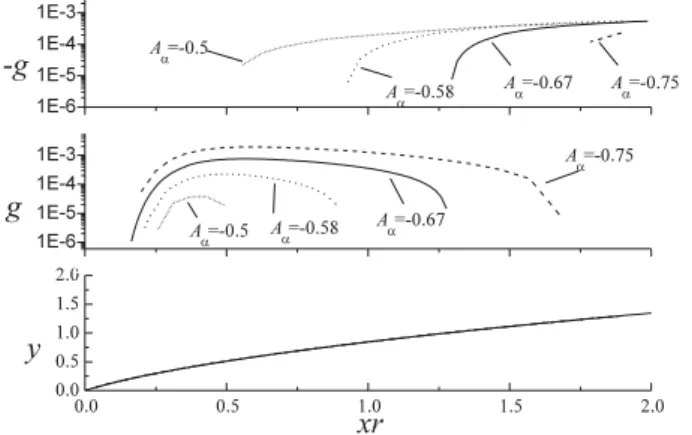
instabil-ity. This eet an be observed in the Fig. 2, where
we vary A
(= 0:5; 0:58; 0:67; 0:75) while
keep-ing other parameters xed at A
p = 0:67, p = 0:4, T =T p =4,
=0:15. AgainA
e
=0. ForA
= 0:75,
themaximumgrowthrateis g =2x10 3
,and the
un-stable x
r
intervalextends from 0:2 to 1:8.
Con-versely,whenA
=A
p
issmallerthan1,theativerange
is redued and the low-frequeny ut-o of the
ab-sorption is shifted to lower frequenies. For example,
whenA
=A
p
dereasesby14%,from A
=A
p =1to
shiftedtox
r
0:9. Atx
r
=1,wendinstabilitywith
agrowth rateg =3:5x10 4
when A
= A
p
= 0:67.
WhenA
= 0:58,at thesamefrequenywend
ab-sorptioninstead,withdampingrate g=5x10 5
.
Figure 1. Dimensionless damping rate g, growth rate g
and wavenumbery versus dimensionless frequeny xr for
right-hand polarized EICWs. Dependene on (with
Ap = A = 0:67, p = 0:4, T=Tp = 4, and Ae = 0
onstants).
Figure 2. Same as Fig. 1 but showing on A
(with
A
p
= 0:67,
p
= 0:4, T
=T
p = 4,
= 0:15, T
e = T
p ,
andA
e
=0onstants).
Weinludetheontributionofanisotropieletrons
in gures 3 and 4. Fig. 3 shows a ase in whih
the instability is eliminated (and we obtain
absorp-tion instead) when A
goes from A
= 0:5(= A
p )
to A
= 0:4keepingA
p
= 0:5,
p
=0:4, T
=T
p =4,
=0:08,T =T ,andA = 0:5onstant.
Figure 3. Same as Figure 2, with Ap = 0:5, p = 0:4,
T=Tp=4,=0:08,Te=Tp,Ae=Aponstants.
Somewhat larger absolute values of anisotropies
are onsidered in Fig. 4. Here, we hoose A
=
0:4; 0:5; 0:67; 0:75,foraongurationwithA
p =
0:67,
p
= 0:4, T
=T
p =4,
= 0:08, T
e = T
p , and
A
e
= 0:67. A gap in the unstable range (seond
panel)is formed when A
= 0:4. In thisgap an
ab-sorptionband appears.
Figure 4. Same as Figure 2, withAp = 0:67, p = 0:4,
T=Tp=4,=0:08,Te=Tp,Ae=Aponstants.
IV Conlusions
Summarizing, we examined the eet of variations in
thermal anisotropy and abundane of alpha partiles
on the growth and absorption rates of EICWs in
pa-rameter regimes typial of many CMEs. Inreasing
n
=n
p
and/orthealpha-to-protonanisotropyratio
pro-dueenhanementsofgrowthandabsorptionrates. An
inrementofn
=n
p
alsoshiftstheativerangetolower
frequenies. Whentheratioofalpha-to-protonthermal
anisotropy inreases, an absorption band may appear
between twounstableranges. Toadvane studies like
the one reported here, it would be desirable to
mea-surethealphapartilethermalanisotropyroutinelyin
CMEs,sineaswehaveshowntheright-handpolarized
The alpha abundane also inuenes the growth rate
byits eetonthephaseveloityofthewaves. These
propertiesmayhelptoexplainthespetrumoflow
fre-queny utuationsseenin manyCMEsby WIND at
1AU[14℄.
Aknowledgments
Work partially supported by Argentinian grants
UBACyT(TX032/98andX059/2001)and CONICET
PIP 4536/96, and USA NASA grant NAG5-2834and
livingwithastargrantNAG5-10883.
Referenes
[1℄ J.T. Gosling, inCoronal Mass Ejetions, edited by N.
Crooker,J.A.Joselyn,andJ.Feynman,9,(AGU,
Wash-ington,1997).
[2℄ J.T. Gosling, D.N.Baker, S.J. Bame, W.C. Feldman,
andR.D.Zwikl,J.Geophys.Res.,92,8519(1987).
[3℄ R.G. Mardsen, T.R. Sanderson, C. Tranquille, K.P.
Wenzel, and E.J. Smith, J. Geophys. Res., 92, 11009
(1987).
[4℄ G.Borrini,J.T.Gosling,S.J.Bame,andW.C.Feldman,
J.Geophys.Res.,87,7370(1982).
[5℄ A.B.Galvin, inCoronal Mass Ejetions, edited by N.
Crooker, J.A. Joselyn, and J. Feynman, 253 (AGU,
[6℄ I.G.Rihardson, C.J.Farrugia,and H.V.Cane,J.
Geo-phys.Res.,102,4691(1997).
[7℄ C.J. Farrugia, F.T. Gratton, G. Gnavi, and K.W.
Ogilvie,J.Geophys.Res.,103,6543 (1998).
[8℄ F.T. Gratton, S.Dasso,and C.J. Farrugia,inPro.of
1998 Int. Congress on Plasma Physis &25 th
Euro-pean Physial Soiety Conf on Controlled Fusion and
PlasmaPhysis,Praha,editedbyP.Pavlo,ECA,
Euro-peanPhysialSoiety,22C,1122 (1998).
[9℄ S. Dasso, F.T. Gratton, and C. J. Farrugia, in Solar
WindNine,editedbyS.Habbaletal.,AIPConf.Pro.,
471,669-672(1999).
[10℄ S.Dasso,F.T.Gratton,C.J.Farrugia,andG.Gnavi,in
TheSolarWind-MagnetosphereSystem3,71-80,edited
byH.K.Biernat,C.J.Farrugia,and D.F.Vogl,
Aus-trianAademyofSienePress,Vienna(2000).
[11℄ S.Dasso, C.J. Farrugia, F.T. Gratton, R.P.Lepping,
K.W. Ogilvie, and R.J. Fitzenreiter, Adv. Spae Res.,
28,5,747-752(2001).
[12℄ C.F.KennelandF.L.Sarf,J.Geophys.Res.,73,6149
(1968).
[13℄ T.H.Stix,WavesinPlasmas(AIM,NewYork,1992).
[14℄ L.Janoo,C.J.Farrugia,R.B.Torbert,J.M.Quinn,A.
Szabo,R.P.Lepping,K.W.Ogilvie,R.P.Lin,D.
Lar-son,J.D. Sudder,V. A.Osherovih,andJ.T.