Abstract— This paper describes the transmission of a non-guard interval 1.12 Tb/s 10-carrier superchannel, launched into a 226 km recirculating loop. After two round trips (452 km) a BER below the FEC limit (3.8 x 10⁻³) was still obtained. To evaluate the superchannel generation technique, up to 72 comb lines (OSNRmin = 12.7 dB) were generated and modulated (DP-QPSK) at 112.5 Gb/s and, in a back-to-back configuration, such an 8.06 Tb/s signal was detected by a coherent receiver with offline processing, resulting in a maximum BER of 2.4 x 10⁻³.
Index Terms— Coherent optical receiver, optical comb generator,
recirculating frequency shift technique, superchannel, Tb/s transmission.
I. INTRODUCTION
Long distance optical systems with channel bit rates higher than 100 Gb/s are required to outgrow a number of technical obstacles before becoming a commercial reality. In an optical physical layer perspective, those challenges, mainly related to data modulation format, signal (de)multiplexing, broadband low-noise amplification, and coherent reception, have been addressed by many research groups with promising results [1][2]. In these new generation systems, the combined use of high speed digital-to-analog (DAC) and analog-to-digital (ADC) converters with digital signal processors (DSP) allows efficient compensation, in the electrical domain, of deleterious effects imposed to a modulated optical signal during its fiber propagation. However, there are still limits to the growth in the system reach and transmission rate. In fact, despite of advances in digital signal processing, transmission nonlinear effects still limit the launched power in coherent systems [3] whilst the maximum symbol rate that can be transmitted by a single channel is limited by the electronic circuitry speed [4]. Therefore, a new challenge thus arises from the need of coping with such an electronic bottleneck.
Increasing the signal robustness against propagation effects and the system spectral efficiency appears as an attractive solution for overcoming this problem, and that can be accomplished by the use of orthogonal frequency division multiplexing, OFDM, a technique well known in modern access and wireless networks. Basically, in OFDM systems, the bandwidth available for each channel is subdivided to accommodate multiple subcarriers. The increase on the number of subcarriers, per
channel, reduces the modulation rate of each subcarrier, thus solving the ADC’s and DAC’s speed
Transmission of a 1.12 Tb/s superchannel
over 452 km fiber
Daniel Moutinho Pataca1, Luis Henrique Hecker de Carvalho1, Cristiane Brandani Ferrari Adami1,
Fabio Donati Simões1, Mônica de Lacerda Rocha2, and Júlio C. R. F. Oliveira1
1
Fundação CPqD, Campinas, Brazil, {pataca; lhecker; cadami; fsimoes; julioc}@cpqd.com.br
2
limitation problem, and also increasing the signal robustness against fiber propagation effects. This optical signal, comprising a number of non-guard interval orthogonal subcarriers, is also known as
superchannel and appears as the foundation for the next generation of high capacity optical systems,
where the transmission bit rates per channel are as high as 400 Gb/s, 1 Tb/s and beyond [5][6].
In such context, this paper describes the experimental implementation of an optical comb generator, OCG, based on the recirculating frequency shift, RFS, technique [7][8], capable of generating a large number of subcarriers with optical signal to noise ratio, OSNR, high enough for enabling transmission through hundreds of fiber kilometers. This way, by applying a 112 Gb/s dual polarization quadrature phase shift keying, DP-QPSK, modulation scheme on a superchannel with up to 72 subcarriers (8.06 Tb/s), we investigate, in a back to back configuration with a coherent receiver and offline digital signal processing, the impact on the bit error ratio, BER, versus OSNR caused by the RF signal applied to the OCG modulator. For the fiber transmission evaluation, a 1.12 Tb/s (10-subcarrier) superchannel was launched into a recirculating loop comprising six erbium doped fiber amplifiers, EDFAs, and five pure silica fiber spools (4 x 50 km + 26 km). The results indicated that up to two round trips (452 km) the BER level remained below the FEC (forward error corrector) limit.
The paper is organized as follows. Section two summarizes the principles of the optical comb generation based on the recirculating frequency shift technique. Sections three and four describe the back-to-back and fiber transmission experiments and results, respectively, whereas in section five some conclusions are highlighted.
II. OPTICAL COMB GENERATOR
One of the techniques that enable transmission of several Tb/s per fiber relies upon the use of coherent and orthogonal multicarrier, which makes use of a single laser source with high aggregate capacity, and exploits parallel processing techniques with moderate speeds per carrier and high spectral efficiency. Such high bit rate signal, comprising multiple subcarriers locked in frequency and
modulated in a synchronous mode, is known as superchannel. In this signal, the interference between
the modulated subcarriers can be eliminated by controlling the phase of adjacent lines [5]. It has been shown that a subcarrier, among several others, can be detected, with minimum penalty caused by interference between each other, when the following conditions are met [9]: (i) the subcarrier separation is equal to the symbol rate of each modulated subcarrier; (ii) the symbols, in the modulated subcarriers, are aligned in time; (iii) the transmitter bandwidth is large enough to accommodate the subcarriers; (iv) an appropriate sample rate and anti-aliasing filtering are applied.
the frequency conversion produced by a single side band modulation, allows the generation of a great number of highly stable carriers and has been chosen for the implementations described in this paper.
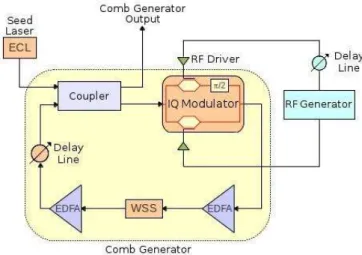
Figure 1 illustrates how the optical signal, generated by a laser source, shifts in frequency within a recirculation loop. The so-called Optical Comb-Generator (OCG) consists of a singlemode seed laser, a 2x2 optical coupler, an optical IQ Mach-Zehnder (MZ) modulator, an EDFA, to compensate for the loop losses, and an optical filter, for limiting the number of generated carriers and the level of amplified spontaneous emission noise within the loop. According to Fig. 1, a cw optical signal is continuously injected into the loop through one of the coupler input ports. After each round trip part of the signal outputs the loop and part is reinjected into it. The optical modulator DC biasing is adjusted in a way to provide, when combined with two RF phase-controlled sine waves, a single side-band suppressed carrier (SSB-SC) modulation. The action of the loop filter is fundamental for limiting the optical amplifier noise and cutting off the optical subcarriers pulled out of its bandwidth. The number of comb lines at the coupler output is limited by the RF frequency and the filter bandwidth because, at each round trip, the SSB-SC modulation shifts the signal spectrum in a frequency equal to the RF frequency applied to the modulator. After many round trips, the circulating signal spectrum is shifted to outside of the filter bandwidth. One of the factors that determine the filter bandwidth is the minimum OSNR per subcarrier allowed for a given bit error ratio and modulation format [7][8], where the OSNR is mainly degraded by the EDFA noise.
Fig. 1. Schematic diagram of the Recirculating Frequency Shift technique for generation of an optical comb. (ECL= external cavity laser)
III. BACK TO BACK
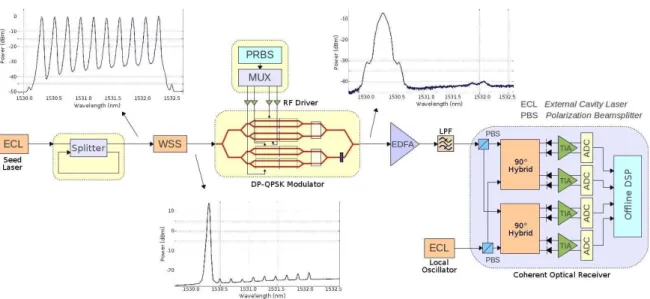
The main objective of the first experiment was to evaluate the OCG performance in generating a superchannel where each subcarrier is modulated at 112 Gb/s by a DP-QPSK scheme. The setup (Fig. 2) may be divided in three blocks: OCG, DP-QPSK modulator and coherent receiver [11].
came from the clock output of a PRBS/MUX board (a fundamental part of the second block); in the second configuration, that RF source has been replaced by a synthesized RF generator. At the OCG output, the subcarriers were filtered by a Wavelength Selective Switch, WSS. As an example illustrated in Fig. 2, out of 10 subcarriers separated by 28 GHz ,the first one (#1) has been selected by the WSS. The OSNR of this superchannel varied around 25 dB, i.e. within the acceptable range for this kind of bit rate and modulation scheme, as described in a previous work [8].
Fig. 2. Back to back experimental setup for the OCG characterization.
In the second block, a commercial board that generates, together with a 20:4 MUX, a pseudo random binary sequence, PRBS, provided four 28 Gb/s electrical data sequences used to modulate the superchannel exiting the OCG. Two of those sequences, named IX and QX, were set aside for the
optical signal aligned into the X polarization axis; the other two, IY and QY, for the signal in the Y
polarization axis. The four data sequences, after being aligned and amplified by a quadruple RF
driver, were applied into a single-drive DP-QPSK Ti:LiNbO3 Mach-Zehnder modulator. Packaged
into a single unit, this modulator comprises a 3 dB coupler, two QPSK modulators, one polarization rotator and one polarization beam combiner. After the combination of those four 28 Gb/s sequences, as illustrated in Fig. 2 for line #1, the spectrum of each subcarrier is modulated at 112 Gb/s.
analog to digital converter, ADC, presented in a real time sampling oscilloscope (electrical bandwidth of 30 GHz). Finally, offline DSP algorithms work to restore the signal constellation, as indicated in Fig 3. The DSP maximizes the independence among subcarriers, automatically controls their intensity, compensates for fiber propagation linear effects such as chromatic dispersion and polarization mode dispersion, PMD, and determines and adjusts timing errors of the receiver and those caused by phase errors between transmitted and local oscillator signals [12].
Fig. 3. Block diagram of the signal processing algorithms.
As already mentioned, initially we used the PRBS/MUX clock output as the OCG modulator RF source, provided its clock frequency is equal to the symbol rate of the electrical data signals. Figure 4 (a) shows the OCG output spectrum when 10 subcarriers were generated with frequency separation of 28 GHz and OSNR superior to 25 dB. As it can be noticed, except for the first comb line, which presented a cleaned spectrum, the other lines show distortions in their base. In order to determine the origin of those deformations, we characterized the electrical spectrum of two RF sources: the PRBS/MUX clock output and an RF synthesized generator. As the electrical spectrum analyzer available in our laboratory is limited to 26.5 GHz, we performed the characterization at 25 GHz and assumed that the PRBS/MUX clock output would behavior similarly either at 25 GHz or at 28 GHz. The electrical spectra are presented in Fig. 4 (b) and indicate the better quality of the synthesized signal. Therefore, after replacing the RF source, new measurements were carried out and the results, presented in Fig. 4 (c), confirm the suppression of distortions and also provide a lower level of intensity fluctuations.
Once the optimization of the comb lines had been performed, we carried out system measurements in a back-to-back configuration to evaluate the BER versus OSNR behavior at 112 Gb/s DP-QPSK per subcarrier. Initially, for 10 comb lines, the results are presented in Fig. 5 (a), from where we may observe a maximum power penalty of 0.74 dB, for the subcarrier #10 in relation to the reference,
subcarrier (#1), and to the FEC limit (BER = 3.8 x 10⁻³). When using the PRBS/MUX output clock in
the OCG, the back-to-back results showed a high degradation in comparison to the previous measurements. As an example, a penalty of 3.81 dB was obtained for subcarrier #4 and, from line #5, inclusive, the signal reception became unfeasible. With the RF synthesized generator, the OCG presented a high stability along many hours and that was due to the use of panda fibers in the OCG loop, which reduces the need for periodic adjustments of the signal polarization at the OCG modulator input.
The high quality results obtained with 10 subcarriers (1.12 Gb/s) motivated us to push the number of comb lines to its limit, in the back-to-back configuration, in terms of BER values below the FEC limit. Figure 5 (b) shows the constellation diagrams and the correspondent BER values for some subcarriers among a total of 72 comb lines (8.06 Tb/s). Figure 5 (c) presents the superchannel spectrum at the OCG output, before being modulated at 112 Gb/s in a DP-QPSK format. Among the
72 subcarriers, the minimum OSNR was 12.7 dB, leading to a maximum BER of 2.4x10⁻³. Those
results demonstrate the potential of the RFS technique for generating stable superchannels with a high count of lines.
Fig. 5. Characterizations in the back-to-back configuration: (a) BER x OSNR, for 10 subcarriers, (b) constellation diagram and BER values for some selected subcarriers, among 72, and (c) their spectra, at the OCG output.
IV. FIBER TRANSMISSION
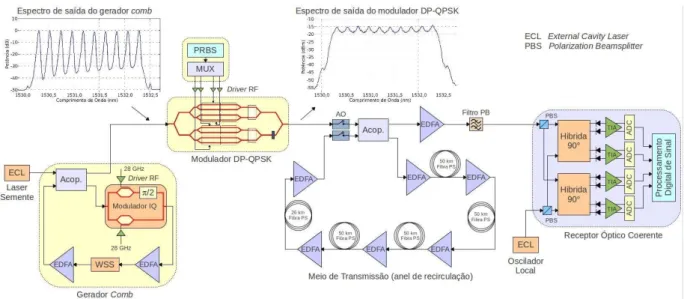
comprises five spools of pure silica fiber G.654 (4 x 50 km and 26 km), six EDFAs, two acousto-optical switches, AO, and a 3 dB acousto-optical coupler. As in a typical recirculating loop, the first AO is switched on to enable the loop loading with a bit sequence long enough to fill it, when it is then switched off. After that, the second AO is kept closed for the signal recirculation along the loop with the round trip number necessary to simulate the signal propagation through a given fiber length. By using the 3 dB coupler, after each round trip, part of the signal exits the loop, part is reinjected into it. The exiting signal arrives at the coherent receiver which is synchronously adjusted to the loop propagation duration to acquire and process the transmitted data.
Fig. 6. Recirculating loop experimental setup for fiber propagation characterization.
Three subcarriers, among the 10, were selected for the system performance evaluation: #1, for presenting the best OSNR in the back-to-back configuration, #5, for being close to the superchannel center and suffering interference from both adjacent lines, and #10, for presenting the worst OSNR in the back-to-back experiment. The resultant BER versus roundtrip number and constellation diagrams may be seen in Fig. 7.
The signal optical to electrical conversion of those three subcarriers has been accomplished by tuning the receiver local oscillator into their correspondent wavelengths. The four detected electrical data sequences were sampled, by the high speed oscilloscope ADCs, in a sampling rate of 80 GS/s, and stored in 80 kS sized samples. The BER estimation for each subcarrier, as a function of the loop round trip number (i.e. fiber propagation length) was performed offline, by standard algorithms optimized for 112 Gb/s DP-QPSK. Each point in Fig. 7 curves corresponds to ten processed samples, thus, the results correspond to an average. The same rule applies to the constellations seen in both
configurations, i.e. back-to-back and after two round trips. By setting the a FEC limit (3,8x10⁻³ ) as a
Fig. 7. BER and constellation diagrams versus round trip number, for three out of ten subcarriers in the 1.12 Tb/s superchannel.
V. CONCLUSION
We have described the experimental implementation of an OCG, based on the recirculating frequency shift technique, capable of generating up to 72 subcarriers with a minimum OSNR of
12.7 dB and maximum BER of 2,4x10⁻³, in the back-to-back configuration with a coherent receiver.
Each subcarrier was modulated at 112 Gb/s by a DP-QPSK scheme, resulting in a superchannel with aggregate capacity of 8.06 Tb/s. Those results attested the importance of feeding the OCG IQ modulator with a high quality RF signal, thus avoiding the generation of spurious frequency components as well as subcarrier intensity fluctuations. Although the RFS technique represents an efficient way for generating a high number of stable comb lines, which enables the assembling of a superchannel with many Terabit/s aggregated capacity, it also presents some drawbacks. Among them, two problems stand out: the complexity and high cost of components and the OSNR
degradation, with the increase on the subcarriers’ number, caused by ASE accumulation after many
round trips in the OCG loop. Despite of that we have demonstrated, in a recirculating loop configuration, a 1.12 Tb/s superchannel (spectral efficiency of 4 b/s/Hz) error free transmission through up to 452 km of pure silica fiber.
From the obtained results, we may infer that by improving the spectral quality of the generated comb lines, as well as with improvements in the DSP algorithms aiming a better subcarrier selection and reduction of interchannel interferences, longer distances and higher bit rates may be achieved. For the first target, related to the comb line generation, the cascade of phase modulators technique seem to be promising and is subject of our current research [14].
VI. ACKNOWLEDGMENT
REFERENCES
[1] S. Gringeri, E. B. Basch, T.J. Xia, “Technical Considerations for Supporting Data Rates Beyond 100Gb/s”, IEEE Communications Magazina, vol. 50, pp. 521-530, February 2012.
[2] P. J. Winzer. “Beyond 100G Ethernet.” IEEE Communications Magazine, vol. 48, pp. 26-30, July 2010.
[3] P. Poggiolini, “Analytical Modeling of Non-Linear Propagation in Coherent Systems”, proceedings of ECOC 2012, Tutuorial Session VI, Th.2.G, September 2012.
[4] G. Wellbrock, and T. J. Xia. “The road to 100G Deployment.” IEEE Communications Magazine, vol. 48, pp 14-18, March 2010.
[5] S. Chandrasekhar and Xiang Liu, “Terabit Superchannels for High Spectral Efficiency Transmission”, proceedingsof ECOC 2010, Tu.3.C.5, September 2010.
[6] W. Shieh e I. Djordjevic, OFDM for Optical Communications, Academic Press, 1st edition, 2010.
[7] D. M. Pataca, F. D. Simões and M. L. Rocha, “Optical Frequency Comb Generator for Coherent WDM System in Tb/s
Applications”, proceedings ofIMOC 2011, October 2011.
[8] F. D. Simões, D. M. Pataca and M. L. Rocha, “Design of a Comb Generator for High Capacity Coherent-WDM
Systems”, proceedings ofIEEE-LATINCOM 2011, October 2011.
[9] S. Chandrasekhar, and Xiang Liu, .“Experimental investigation on the performance of closely spaced multi-carrier PDM-QPSK with digital coherent detection”,Optics Express, vol. 17, pp 21350-21361, 2009.
[10]T. Kawanishi, T. Sakamoto, S. Shinada, and M. Izutsu. “Optical frequency comb generator using optical fiber loops with single-sideband modulation.” IEICE Electronics Express, vol. 1, pp. 217-221, 2004.
[11]L. H. H. de Carvalho, C. B. F. Adami, F. D. Simóes, J. C. R. F. Oliveira, D. M. Pataca, “Gerador Comb Óptico para Transmissão de Supercanal CO-OFDM de 8,06 Tb/s”proceedings of MOMAG 2012, August 2012.
[12]V. B. Ribeiro, E. S. Rosa, J. C. Diniz, A. C. Bordonalli and J. C. R. F de Oliveira, “Equalização Dinâmica via CMA e
DPC-CMA com Adaptação de Ganho em Sistemas Ópticos Coerentes PDM-QPSK a 112 Gb/s”, proceedings of SBrT 2011, October 2011,
[13]D. M. Pataca, L. H. H. de Carvalho, C. B. F. Adami, F. D. Simões, and J. C. R. F. Oliveira, “Transmissão de um supercanal OFDM de 1,12 Tb/s por 452 km com eficiência espectral de 4 b/s/Hz”, proceedings of SBrT 2012,
September 2012.
[14]J. Yu, Z. Dong, J. Zhang, X. Xiao, H-C. Chien, N. Chi, “Generation of Coherent and Frequency-Locked Multi-Carriers Using Cascades Phase Modulators for 10 Tb/s Optical Transmission System”, Journal of Lightwave Technology, vol.