SOCI ODEMOGRAPHI C PROFI LE OF UNDERGRADUATE NURSI NG STUDENTS
1Nat alia Cadioli Wet t er ich2 Már cia Regina Ant oniet t o da Cost a Melo3
Wet t er i ch NC, Mel o MRAC. So ci o d em o g r ap h i c p r o f i l e o f u n d er g r ad u at e n u r si n g st u d en t s. Rev Lat i n o - am Enfer m agem 2 0 0 7 m aio- j unho; 1 5 ( 3 ) : 4 0 4 - 1 0 .
Th e College of Nu r sin g at Rib eir ão Pr et o, Un iv er sit y of São Pau lo, Br azil h as b een p r oj ect ed as a nat ional r efer ence w it h special appeal for st udent s, w hich m ot iv at ed t his st udy on t he pr ofile of t he school’s applicant s. The populat ion of t his explorat ory- descript ive st udy is com posed of alum ni from 1999 t o 2003. The dat a collect ion was perform ed t hrough t he universit y’s regist rat ion form s and t he analysis t hrough t he quant it at ive m et h od. Resu lt s sh ow a decr easin g n u m ber of applicat ion s f r om Ribeir ão Pr et o, a pr edom in an ce of y ou n g, fem ale and single applicant s; few of t hem were em ployed at t he t im e. Regarding t heir educat ional background, t he dat a show an incr easing num ber of applicant s com ing fr om pr iv at e schools, w hile t he m aj or it y of t hem ent er ed t he univ er sit y w it hin t w o y ear s aft er concluding secondar y school. Som e of t he st udent s t em por ar ily abandoned t he course or lost one or m ore sem est ers, while m ost of t hem graduat ed wit hin t he expect ed t erm .
DESCRI PTORS: nur sing; st udent s, nur sing; st at ist ical dist r ibut ions
PERFI L SOCI O-DEMOGRÁFI CO DEL ALUMNO DE PREGRADO EN ENFERMERÍ A
La Escuela de Enfer m er ía de Ribeir ão Pr et o de la Univ er sidad de São Paulo se ha consider ado com o referencia nacional, por ser un polo de at racción para alum nos, lo cual fue nuest ra m ot ivación para conocer el perfil de quienes buscan est udiar en est a escuela. Est udio explorat orio- descript ivo, cuya población fue com puest a por egr esos de 1 9 9 9 a 2 0 0 3 . Siendo ut ilizado el m ét odo cuant it at iv o par a analizar los dat os r ecolect ados a t ravés de un Form ulario de I nscripción del Alum no I ngresant e a la Universidad de São Paulo, en el m om ent o de su m at r ícu la. Los r esu lt ados se car act er izan por ser escasas per son as or iu n das de Ribeir ão Pr et o, j óv en es, m u j er es y solt er os. Pocos t r abaj aban . Con r elación a la en señ an za secu n dar ia, la gr an m ay or ía est u dio en colegios part iculares, quienes luego de concluir sus est udios ingresaron a la universidad dent ro de los dos años post eriores a su salida del colegio. Algunos alum nos abandonaron por un t iem po la universidad o se ret razaron, sin em bar go la gr an m ay or ía t er m inó dent r o del t iem po pr ev ist o.
DESCRI PTORES: enfer m er ía; est udiant es de enfer m er ía; dist r ibuciones est adíst icas
PERFI L SOCI ODEMOGRÁFI CO DO ALUNO DO CURSO DE GRADUAÇÃO EM ENFERMAGEM
A Escola de En f er m agem de Ribeir ão Pr et o da Un iv er sidade de São Pau lo t em ocu pado posição de dest aque e de referência nacional, configurando- se com o pólo de at ração para alunos, o que m ot ivou conhecer o per fil dos que buscam essa escola. Est e é um est udo de nat ur eza explor at ór io- descr it iva, cuj a população foi com post a pelos egressos de 1999 a 2003. Foi ut ilizado m ét odo quant it at ivo para análise dos dados que foram colet ad os at r av és d o For m u lár io d e Cad ast r am en t o d o Alu n o I n g r essan t e n a Un iv er sid ad e d e São Pau lo, p r een ch i d o n o at o d a m at r ícu l a. Os r esu l t ad o s m o st r ar am d i m i n u i ção d o n ú m er o d e r i b ei r ão - p r et an o s, pr edom in ân cia de j ov en s, m u lh er es e solt eir os. Pou cos ex er ciam at iv idade r em u n er ada. Qu an t o ao en sin o m édio, os dados m ost r ar am aum ent o da for m ação em escolas par t icular es, sendo que a m aior ia concluiu o colegial e ingressou na universidade at é dois anos após o seu t érm ino. Alguns alunos t rancaram a m at rícula ou caír am de t ur m a, m as a m aior ia se for m ou dent r o do t em po pr ev ist o.
DESCRI TORES: enfer m agem ; est udant es de enfer m agem ; dist r ibuições est at íst icas
1
St udy funded by PI BI C/ CNPq; 2 RN, PI BI C/ CNPq grant holder, e- m ail: nat wet t erich@hot m ail.com ; 3 RN, PhD, Universit y of São Paulo at Ribeirão Pret o College of Nursing WHO Collaborat ing Cent er for Nursing Research Developm ent , Brazil
I NTRODUCTI ON
I
n t he r est r uct ur ing of t he Br azilian Healt h Minist ry, t he creat ion of t he Secret ary of Healt h Worka n d Ed u ca t i o n Ma n a g em en t , i n 2 0 0 3 , f o cu sed o n
H u m a n Re s o u r c e s a s a c e n t r a l i s s u e i n t h e
developm ent of t he Nat ional Healt h Policy. I t assum es,
am ong ot her fact or s, a st r at egic r ole in int er sect or al
g u id elin es in v olv in g t h e d ev elop m en t of a Nat ion al
Policy of Hum an Resour ces in Healt h ( PNRHS) * .
Accor ding t o Decr ee No 1 , issued on Mar ch
11t h 2004, t he Secret ary of Healt h Work and Educat ion Man ag em en t d et er m in es on t h e f u n ct ion in g of t h e
Obser v at or y Net w or k of Hum an Resour ces in Healt h,
d e f i n i n g t h e m e s f o r st u d y b y t h e d i f f e r e n t Wo r k
St at ions. The k now ledge pr oduced by t he Univ er sit y
of São Pau lo at Ribeir ão Pr et o College of Nu r sin g
-EERP- USP an d d issem in at ed b y it s Ob ser v at or y of
Hum an Resour ces has been gr ouped in five t hem at ic
a x e s : H u m a n Re s o u r c e Po l i c i e s i n N u r s i n g ;
Pr of ession al Nu r sin g Or g an izat ion s; Nu r sin g Lab or
Mar k et ; Nur sing Ser v ice and Car e Managem ent ; and
Knowledge Product ion, Educat ion and Hum an Resource
Training in Nursing, which t his st udy is part of.
The healt h labor m arket has been undergoing
im por t ant t r ansfor m at ions, det er m ined by econom ic,
t e c h n o l o g i c a l a n d s o c i a l p o l i c i e s . Th e s e
t r ansfor m at ions dem and r efor m ulat ions of educat ion
devices, so t hat t he schools’ graduat es at t end t o t he
new dem ands t hat ar e gener at ed.
Th e m i s s i o n o f EERP- US P, a W H O
Collabor at ing Cent r e for t he Dev elopm ent of Nur sing
Resear ch, specifically in it s under gr aduat e pr ogr am s,
is t o ed u cat e g en er alist n u r ses w it h h ig h lev els of
t echnical- scient ific and polit ical com pet ency, based on
et hical and hum anist ic v alues.
Allied wit h t he requirem ent s of im plem ent ing
t he guiding principles of t he Single Healt h Syst em , in
t h e t e a ch i n g m a r k e t , “ EERP- USP st a n d s o u t a n d
const it ut es a nat ional reference point , because it has
cont ribut ed wit h it s hist ory, experience and product ion,
dialoguing wit h new inst it ut ional act ors. I n t his posit ion,
t he school int ends t o m aint ain it s place as a reference
for t he t eaching and j ob m arket , in order t o face t he
com p et it ion in p r act ical t each in g ar eas an d in t h e
allocat ion of it s graduat es t o j obs”( 1).
This out st anding posit ion has grant ed visibilit y
t o EERP- USP, which has t urned int o an at t ract ion pole
for st udent s w ho int end t o follow t he nur sing car eer.
This assert ion can be verified t hrough t he candidat e/
place index in t he last fiv e college ent r y ex am s held
by Fu v est , sh ow in g t h at t h e dem an d h as ex ceeded
t h e n u m b er of av ailable places ( 8 0 ) . I n 2 0 0 5 , t h is
index cor r esponded t o 10.75, against 10.85 in 2004,
10.51 in 2003, 10.23 in 2002, 8.64 in 2001 and 14.01
candidat es/ place in 2000( 2).
These aspect s and one of t he aut hor s being
a graduat e from t his college in const ant cont act w it h
ot h er g r ad u at es ar ou sed ou r in t er est in g et t in g t o
k now w ho t hese st udent s ar e.
We found st udies about t he profile of nursing
st udent s in ot her r egions( 3- 6), one of w hich assessed t he charact erizat ion of nursing st udent s at USP’s t w o
Nursing Colleges( 7),anot her carried out in t wo schools f r om t h e Sou t h east( 8 ), an d also r esear ch abou t t h e pr ofile of gr aduat es fr om ot her nur sing cour ses( 9- 11). Specif ically at t h e USP at Ribeir ão Pr et o College of
Nur sing, t w o st udies of it s gr aduat es bet w een 1957
a n d 1 9 9 0 w e r e c a r r i e d o u t , f o c u s i n g o n t h e i r
per m anence t im e on t he j ob( 12- 13). Moreover, t he fact t hat , unt il now , t his Unit does not hav e a dat abase
wit h inform at ion about t he profile of it s st udent s and
t he professional life of it s form er st udent s m akes t he
analy sis m or e difficult .
The obj ect iv es of t his st udy w er e t o ident ify
t he sociodem ographic profile of undergraduat e nursing
st udent s at EERP- USP and t he average t im e t hey t ake
t o finish t he course.
METHODOLOGY
We car r i ed o u t an ex p l o r at o r y - d escr i p t i v e
st u dy, w h ich aim s t o obser v e, descr ibe an d ex plor e
a sp e ct s o f a si t u a t i o n( 1 4 ), u si n g t h e q u a n t i t a t i v e m et hod for dat a analy sis.
Th e s t u d y p o p u l a t i o n w a s d e l i m i t e d a s
gr adu at es fr om 1 9 9 9 , 2 0 0 0 , 2 0 0 1 , 2 0 0 2 an d 2 0 0 3 .
The New St udent Regist r at ion For m of t he Univer sit y
of São Paulo, filled out when t he st udent s enroll, was
used as a dat a collect ion inst r um ent .
Fi r st , w e a sk e d t h e D e a n o f t h e USP a t
Ribeir ão Pr et o College of Nu r sin g f or per m ission t o
carry out t he st udy, t hrough a let t er. Aft er t he research
had been form ally accept ed, t he proj ect was subm it t ed
t o t h e Resear ch Et h ics Com m it t ee at t h is Colleg e,
alt hough t his r esear ch w or k ed w it h secondar y dat a.
The pr oj ect w as appr ov ed, as r egist er ed in Of.
CEP-*
EERP/ USP- 0 0 7 / 2 0 0 5 . Nex t , w e r equ est ed t h e for m s
for dat a collect ion, carried out in t he first t w o w eeks
of Januar y 2005, fr om t he Under graduat e Secr et ar y.
Wh en w e pr oposed a st u dy on t h is t h em e,
w e con sider ed t h e follow in g defin in g aspect s of t h e
st udent s’ profile: gender, age, civil st at us, origin, paid
w or k , secon dar y sch ool an d y ear of con clu sion an d
o b t a i n ed d eg r ee, t i m e b et w een t h e co n cl u si o n o f
secon dar y edu cat ion an d t h e ent r y in t o college and
av er age t im e t o conclude t he under gr aduat e cour se.
The collect ed dat a were used t o elaborat e an
init ial gener al gr oup and per class, using a Micr osoft
Ex cel dat abase for dat a descr ipt ion and analy sis.
RESULTS AND DI SCUSSI ON
Every year, 80 st udent s who passed t he Fuvest
ent ry exam are enrolled at t he USP at Ribeirão Pret o
College of Nursing. However, t he num ber of graduat es
is different , as som e st udent s put t heir enrollm ent on
hold or do not pass t he course. EERP- USP graduat ed
57 st udent s in 1999; 83 in 2000; 77 in 2001; 77 in
2002; and 83 in 2003, t ot aling 377 st udent s.
I n t his group of 377 st udent s, 94.69% ( 357)
cam e fr om cit ies in t he St at e of São Paulo, 27. 05%
( 102) of w hom fr om Ribeir ão Pr et o. Four t een of t he
rem aining 5.30% ( 20) cam e from t he St at e of Minas
Ger ais, t w o f r om Goiás an d f ou r f r om Mat o Gr osso
do Sul. These dat a are shown in a m ore det ailed form
in Table 1.
Table 1 - Dist ribut ion of st udent s st art ing t he course at
EERP- USP, who part icipat ed in t he st udy, according t o
year and cit y of origin. Ribeirão Pret o, SP, 1999- 2003
y t i
C 1999 2000 2001 2002 2003
n % n % n % n % n %
o t e r P o ã r i e b i
R 20 35,1 22 26,5 26 33,8 23 29,9 11 13,2
o ã S m o r f s e it i c r e h t O e t a t S o l u a
P 36 63,1 58 69,9 49 63,6 49 63,6 67 80,7
s e t a t S r e h t
O 1 1,8 3 3,6 2 2,6 5 6,5 5 6,1
l a t o
T 57 100 83 100 77 100 77 100 83 100
I n a st u dy of st u den t s en r olled in t h e f ir st
y e a r o f t h e u n d e r g r a d u a t e co u r se a t EERP- USP, car r ied out in 1 9 7 7( 6 ), a higher num ber of st udent s
from Ribeirão Pret o was observed in t he beginning, a
percent age t hat decreased over t im e. I n 1968, 71.9% of st udent s liv ed w it h t heir fam ily in Ribeir ão Pr et o.
Th i s p er cen t ag e am ou n t ed t o 3 4 . 4 % i n 1 9 7 1 an d
54.5% in 1976.
Sin ce 1 9 9 3 , t h e Social Com m u n icat ion an d Pr e s s S e r v i c e o f t h e Ri b e i r ã o Pr e t o Ca m p u s Governm ent - ACSI - PCARP( 15- 16) has been researching on t he new st udent s on cam pus w ho ar e inv it ed t o enroll t hrough Fuvest ’s first call. I n 1996, a decrease in t h e pr esen ce of st u den t s f r om Ribeir ão Pr et o by about 1.25% since t he st art of t he research appeared. Th is st u d y sh ow s t h at t h e sam e ch an g e is occu r r in g at EERP- USP, as t h e n u m b er of st u d en t s fr om Ribeir ão Pr et o decr eased, r epr esent ing 27.05% o f t h e t o t a l n u m b e r o f st u d e n t s w h o g r a d u a t e d bet w een 1999 and 2003. The percent age of st udent s from Ribeirão Pret o corresponded t o 35.08% in 1999; 26.5% in 2000; 33.76% in 2001; 29.87% in 2002 and 13.25% in 2003.
I n a st udy of nursing st udent s from t he first unt il t he nint h cour se sem est er, car r ied out at Cear á St at e Universit y( 3), it was observed t hat 85% of sam ple st udent s cam e fr om t he St at e of Cear á, and 11. 5% from ot her Brazilian st at es. The sam e occurs at EERP-USP, where 94.69% of st udent s who graduat ed bet ween 1999 and 2003 cam e from t he St at e of São Paulo. The aut hors also m ent ion t hat m ost st udent s st ill live wit h t h eir par en t s or fam ily, an d t hat few st u dent s liv ed alone or in republics. This m eans t hat a sm all num ber of st udent s left t heir cit y of residence t o go t o college, as opposed t o what we found in our st udy.
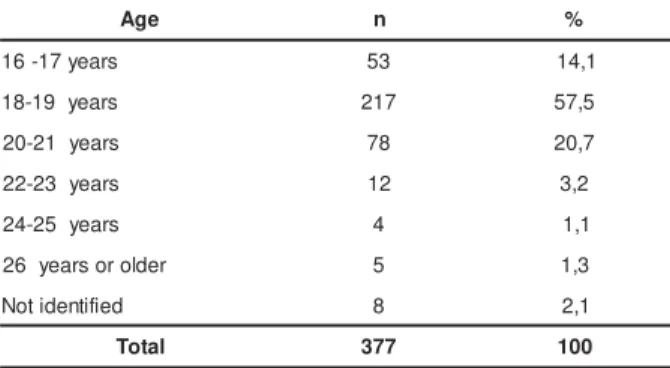
When t hey ent ered t he Universit y, EERP- USP st u d en t s’ ag es r an g ed f r o m 1 6 t o 4 5 y ear s, w i t h 92.04% ( 347) bet w een 17 and 21 y ear s, dist r ibut ed as follow s: 17 y ear s - 52 st udent s; 18 y ear s - 116; 19 years - 101; 20 years - 55; 21 years - 23. The age of t he rem aining 5.83% ( 22) was as follows: 22 years - eight ; 23 y ear s - four ; 24 y ear s - t hr ee; and one st udent each for t he ages of 16, 25, 26, 29, 32, 36 and 45 . Eight st udent s’ age could not be ident ified. Table 2 shows age range dat a for t he st udent s on t he day of t heir enr ollm ent .
Table 2 - Dist r ibut ion of st udent s st ar t ing t he cour se at EERP- USP, who part icipat ed in t he st udy, according t o age range on t he day of enrollm ent . Ribeirão Pret o,
SP, 1999- 2003
e g
A n %
s r a e y 7 1 -6
1 53 14,1
s r a e y 9 1 -8
1 217 57,5
s r a e y 1 2 -0
2 78 20,7
s r a e y 3 2 -2
2 12 3,2
s r a e y 5 2 -4
2 4 1,1
r e d l o r o s r a e y 6
2 5 1,3
d e if it n e d i t o
N 8 2,1
l a t o
The aut hor of t he st udy from 1977( 7) observed a sm all n u m b er of n u r sin g st u d en t s ov er 2 3 , an d
m ent ions t he day t im e and full- t im e cour se st r uct ur e
as a possible cause. This ent ails problem s for working
per sons and t he fact t hat t he pr ofession is pr obably
ch osen v er y ear ly.
I n 1998, a st udy of new st udent s on t he USP
at Ribeirão Pret o cam pus( 15) showed t hat 90% of t hem w er e up t o 20 y ear s old, and t hat av er age age w as
decr easing in com par ison w it h ear lier y ear s.
At UECE( 3), m ost st udent s t aking t he Nursing course in 1993 were bet ween less t han 20 and up t o
25 y ear s old. A st udy in t he Sout h of Br azil, car r ied
out in 2004( 16), indicat ed t hat 88% of t he int erviewed st udent s were bet ween 17 and 28 years old. Anot her
r e s e a r c h i n t h e S o u t h e a s t , r e a l i z e d i n 2 0 0 6( 8 ), appoint ed a m ean age of 21.58 year s. Many aut hor s
consider t he age bet ween 18 and 20 years as t he end
of adolescence. This phase is beneficial for decision
m a k i n g , w h e n t h e y o u n g p e o p l e b e co m e l e g a l l y
capable of assum ing j ob r esponsibilit ies.
Th ese d at a coin cid e w it h ou r f in d in g s. Th e
ent r y of y oung st udent s, m ost ly bet w een 17 and 21
y ear s, m ay be du e t o t h e fact t h at it is a fu ll- t im e
course, which does not allow st udent s t o com bine work
and st udy.
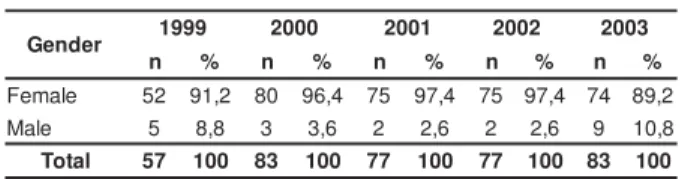
The lar ge m aj or it y of st udent s, i. e. 94. 42%
( 3 5 6 ) w er e f em ale, again st on ly 5 . 5 7 % ( 2 1 ) m ale.
Their share in t he five years under st udy was: 8.77%
in 1999; 3.61% in 2000; 2.59% in 2001 and 2002 and
10.84% in 2003, according t o Table 3.
Table 3 – Dist ribut ion of st udent s st art ing t he course
at EERP- USP, who part icipat ed in t he st udy, according
t o gender, Ribeir ão Pr et o, SP, 1999- 2003
r e d n e
G 1999 2000 2001 2002 2003
n % n % n % n % n %
e l a m e
F 52 91,2 80 96,4 75 97,4 75 97,4 74 89,2
e l a
M 5 8,8 3 3,6 2 2,6 2 2,6 9 10,8
l a t o
T 57 100 83 100 77 100 77 100 83 100
I n view of dat a showing t hat alm ost all nursing
st udent s w ere fem ale, t he st udy from 1977( 7) relat ed t his fact wit h t he prej udice t hat exist s about t he im age
of t he profession: “ ... t his prej udice refers t o t he fact
t hat , hist orically, t he Nursing profession is synonym ous
w it h an ex clusively fem ale pr ofession”.
Th e r e se a r ch ca r r i e d o u t b y ACSI - PCARP
sh o w e d t h a t , f r o m 1 9 9 3 t o 1 9 9 9 , a n i n cr e a si n g
n u m b er of w om en st ar t ed t o st u d y at t h e USP at
Rib eir ão Pr et o, d esp it e an alm ost eq u al d iv ision of
places bet w een bot h gender s in 2000. “ The changes
t radit ionally at t ribut ed t o one gender, like in t he case
o f n u r s i n g , s h o w t h a t t h e r e o c c u r s a c o n s t a n t
m o v e m e n t i n y o u n g p e o p l e ’ s i n t e r e s t a n d t h a t
prej udices are broken, t o t he ext ent t hat t he num ber
of m ale st udent s in t his course rose from 3 t o 10% in
only t wo years”( 15- 16).
The m ale gender ’s int er est in t he pr ofession
seem s t o sh ow t h at con cept ion s abou t Nu r sin g ar e
goin g t h r ou gh t r an sf or m at ion s, leav in g beh in d t h at
of bein g an ex clu siv ely f em ale pr of ession , alt h ou gh
t his concept ion st ill pr edom inat es.
I n 1 9 5 5 , t h e n u m b e r o f w o m e n f i n i sh i n g
secondar y educat ion w as higher t han t he num ber of
m en , alt h ou gh t h e n u m ber of st u den t s apply in g t o
EERP- USP in t he next year w as a m er e 0.9% of t his
t ot al. I n t he sam e year, 1,478 fem ale st udent s enrolled
in t he 33 ex ist ing nur sing schools, r epr esent ing 8%
of t he t ot al num ber of 18,281 wom en enrolled in som e
higher educat ion cour ses. Fift een st udent s r egist er ed
f or t h e pr of ession al h abilit at ion ex am at EERP- USP,
1 4 o f w h o m w e r e w o m e n a n d o n e m a n( 1 7 ). I n com par ison w it h t h e dat a obt ain ed in t h is st u dy, a
ch a n g e m o v e m e n t i s p e r ce i v e d , e v e n i f sl o w , i n
co n cep t i o n s ab o u t t h i s p r o f essi o n . Ev en t o d ay, at
EERP- USP, m ost n u r sin g st u d en t s ar e w om en an d
single. How ev er, a gr ow ing num ber of m ale st udent s
choose t he profession, and t he com pet it ion t o conquer
a place in college has becom e incr easingly ev ident .
As t o c i v i l s t a t u s , 9 6 . 2 8 % ( 3 6 3 ) o f t h e
st udent s w er e single on t he day of t heir enr ollm ent ,
in line wit h dat a from t he research realized in 1993( 13). I n t h e r e m a i n i n g g r o u p , s i x w e r e m a r r i e d , t w o
d i v o r ced an d si x d i d n o t f i l l o u t t h i s i t em o n t h e
q u est ion n air e.
Dat a ar e sim ilar t o t hose of a st udy car r ied
out in 1977( 7), in w hich pr act ically all st udent s w er e single. Again, t he aut hor m ent ions t he course st ruct ure
as an in f lu en ce on t h e st u den t s’ pr of ile, becau se it
dem ands full- t im e dedicat ion and because, m oreover,
classes and t raining periods are unequally dist ribut ed
acr oss m or n in gs an d aft er n oon s, cau sin g difficu lt ies
for m ar r ied per sons or people w ho need t o w or k .
Only 4.5% ( 17) of st udent s had som e kind of
paid w or k , 4 1 . 1 7 % ( 7 ) of w hom w or k ed as nur sing
t echnicians or aids. The r em ainder, i.e. 95.4% ( 360)
did not have any kind of paid work.
I n 1996, ot her aut hors( 3) observed t hat 84.5% ( 234) of t he st udent s did not have any paid work before
act ivit y t hat could or could not be reconciled wit h t he
full- t im e nur sing cour se.
I n a st udy carried out in 1995( 4), it was found t hat 56.5% of st udent s enrolled in 28 nursing schools fr om t h e St at e of São Pau lo did n ot h av e an y paid
w or k , t hat 15. 8% of t he new st udent s w or k ed par t -t im e, -t ha-t is, up -t o 30 hours per week, agains-t 19%
who worked full- t im e, in shift s of m ore t han 30 hours per w eek. Am ong w or king st udent s, 58.8% belonged
t o differ ent nur sing cat egor ies ( 43. 2% had t echnical t raining; 76.8% secondary educat ion and 48.1% basic
educat ion) . According t o t he aut hors of t hat st udy, “ it
seem s t hat t hese per sons at t end t he nur sing cour se b e c a u s e t h e y a r e m e m b e r s o f o t h e r c a t e g o r i e s
( at t endant s, aids and t echnicians) , in t he at t em pt t o i m p r o v e t h e i r p r o f e s s i o n a l a c t i v i t i e s a n d g e t
a ck n o w l e d g e m e n t f o r t h e i r p r o f e ssi o n , a s t h e se cat eg or ies ar e lit t le v alu ed an d t h eir salar y in t h e
healt h sect or is low ”.
A s t o t h e s c h o o l w h e r e t h e y f i n i s h e d
secondar y educat ion, 3 5 . 5 4 % ( 1 3 4 ) of t he st udent s st u d ied in p r iv at e sch ools; 3 9 . 2 5 % ( 1 4 8 ) in p u b lic
sch ools an d 2 5 . 1 9 % ( 9 5 ) of t h e qu est ion n air es did
not cont ain t his infor m at ion.
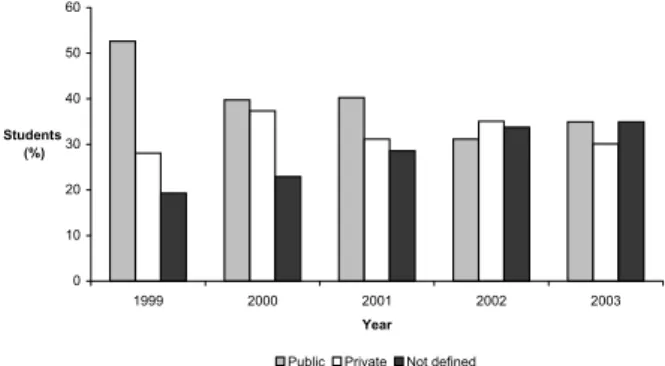
The dat a obt ained t hrough t his st udy indicat ed
t hat , over t im e, t he percent age of new st udent s who finished t heir secondar y educat ion at pr iv at e schools
h as in cr eased : 2 8 . 0 7 % in 1 9 9 9 ; 3 7 . 3 4 % in 2 0 0 0 ; 3 6 . 3 6 % in 2 0 0 1 ; 4 0 . 2 5 % in 2 0 0 2 ; an d 3 3 . 7 3 % in
2 0 0 3 . Con seq u en t ly, t h e n u m b er of st u d en t s f r om p u b l i c sch o o l s h a s d e cr e a se d : 5 2 . 6 3 % i n 1 9 9 9 ;
39. 75% in 2000; 41. 55% in 2001; 31. 16% in 2002
and 34.93% in 2003. These dat a are shown in Figure1.
0 10 20 30 40 50 60
1999 2000 2001 2002 2003
Year Students
(%)
Public Private Not defined
Figure 1 – Dist ribut ion of st udent s st art ing t he nursing
cou r se at EERP- USP, accor din g t o t h e sch ool w h er e
t hey concluded secondar y educat ion. Ribeir ão Pr et o,
SP, 1999- 2003
Du e t o t h e lar ge n u m ber of qu est ion n air es
t h at d id n ot con t ain t h is in f or m at ion , it can n ot b e
a f f i r m e d t h a t m o s t n e w s t u d e n t s f i n i s h e d t h e i r
secon d ar y ed u cat ion at a p r iv at e or p u b lic sch ool,
a l t h o u g h t h e r e se e m s t o b e a t e n d e n cy t o w a r d s
secon d ar y ed u cat i on i n p r i v at e sch ool s, m ai n l y i n
r ecen t y ear s.
Th e r e s e a r c h c a r r i e d o u t a t t h e US P a t
Ribeir ão Pr et o( 15- 16) since 1993 has show n t hat m ost new st udent s at t he Universit y of São Paulo at Ribeirão
Pr et o f in ish ed t h eir secon d ar y ed u cat ion in p r iv at e
sch ools. I n 1 9 9 6 , t h is p er cen t ag e cor r esp on d ed t o
75% ; in 1997, 82% ; in 1999, 74% ; in 2000, 79% ; in
2001, 75% ; in 2002, 82% ; in 2003, 76% ; in 2004,
8 1 % ; in 2 0 0 5 , 8 0 % . Th e r esear ch also sh ow s t h at
nursing is one of t he courses wit h t he largest num ber
o f s t u d e n t s f r o m p u b l i c s c h o o l s , t o g e t h e r w i t h
chem ist r y and account ing.
As t o t h e seco n d a r y d eg r ee t h e st u d en t s
obt ained, 34.21% ( 129) of t he quest ionnaires did not
co n t a i n t h i s i n f o r m a t i o n ; 5 8 . 6 2 % ( 2 2 1 ) f i n i sh e d
secon d ar y ed u cat ion ; 1 . 5 9 % ( 6 ) t ook t h e n u r sin g
t e c h n i c i a n c o u r s e a n d 5 . 5 7 % ( 2 1 ) a t t e n d
pr ofessionalizing cour ses in ot her ar eas.
Dur ing t he st udy per iod, som e st udent s got
i n t o c o l l e g e s o o n a f t e r t h e y f i n i s h e d s e c o n d a r y
ed u cat ion , i. e. 2 4 . 9 3 % ( 9 4 ) ou t of 3 7 7 st u d en t s;
38.46% ( 145) got int o college aft er one year; 22.28%
( 84) aft er t w o y ear s; 6.89% ( 26) aft er t hr ee y ear s;
5 . 5 7 % ( 2 1 ) b et w een f ou r an d 2 6 y ear s af t er t h ey
had finished secondar y educat ion; and 1.85% ( 7) of
t h e qu est ion n air es did n ot con t ain t h is in for m at ion ,
as shown in Table 4.
Table 4 – Dist ribut ion of num ber of st udent s, according
t o t im e in y ear s bet w een con clu sion of h igh sch ool
an d en t r y in t o college per y ear, EERP- USP, Ribeir ão
Pr et o, SP, 1999- 2003
r e d n e
G 1999 2000 2001 2002 2003
n % n % n % n % n %
e l a m e
F 52 91,2 80 96,4 75 97,4 75 97,4 74 89,2
e l a
M 5 8,8 3 3,6 2 2,6 2 2,6 9 10,8
l a t o
T 57 100 83 100 77 100 77 100 83 100
I n t h e st u dy f r om 1 9 7 7( 7 ), it w as obser v ed t hat , at fir st , t he st udent got int o college soon aft er
t hey had finished secondary educat ion. I n 1971, t here
w a s a b a l a n ce b e t w e e n t h e n u m b e r o f st u d e n t s
ent ering aft er one and aft er t wo years ( 41% and 34% )
and, in 1977, st udent s get t ing int o college t wo years
aft er finishing secondary educat ion predom inat ed. The
au t h or m en t ion s t h at t h is in cr eased t im e b et w een
m a y b e d u e t o t h e a l m o st o b l i g a t o r y n a t u r e o f
pr epar at or y cour ses for st udent s, as a consequence of t he increased dem and for nursing schools in recent
y ea r s.
I n 1 9 9 6 , ot h er au t h or s( 3 ) sh ow ed t h at 1 7 4 ( 62.8% ) out of a t ot al group of 277 st udent s got int o c o l l e g e s o o n a f t e r t h e y h a d f i n i s h e d s e c o n d a r y
educat ion, w hile 72 ( 26. 0% ) st ar t ed aft er one y ear. These dat a differ fr om our st udy.
Am ong t he 377 graduat es bet ween 1999 and 2 0 0 3 , 1 6 . 4 4 % ( 6 2 ) pu t t h eir en r ollm en t on h old or
lost one or m ore sem est ers. The lat t er cont inued t he
cour se or gr aduat ed w it h anot her class gr oup. Av er ag e g r ad u at ion t im e r an g ed f r om f ou r
t o 10 years. During t he st udy period, m ost st udent s, i . e . 3 0 5 ( 8 0 . 9 % ) , f i n i sh e d t h e co u r se w i t h i n t h e
est ablished t im e – four years. I n t he rem aining group, which put t heir enrollm ent on hold or lost one or m ore
sem est er s, 38 finished in five year s; 13 in six; eight in seven; one in eight ; t hree in nine; one in 10 years.
Th i s i n f o r m a t i o n co u l d n o t b e o b t a i n e d i n e i g h t q u est ion n air es.
I n 1955, a larger num ber of wom en t han m en
f in ish ed secon dar y edu cat ion , alt h ou gh t h e n u m ber o f w o m e n e n t e r i n g t h e EERP- USP o n e y e a r l a t e r
corresponded t o only 0.9% of t his t ot al. I n t he sam e y ea r, 1 , 4 7 8 w o m en r eg i st er ed a t t h e 3 3 ex i st i n g
nursing schools, represent ing 8% of t he t ot al num ber of 18,281 wom en enrolled in higher educat ion courses.
I n 1962, 15 candidat es regist ered for t he professional h ab i l i t at i on ex am at EERP- USP, 1 4 of w h om w er e
w o m e n a n d o n e m a n( 1 7 ). I n co m p a r i so n w i t h t h e in f or m at ion ob t ain ed t h r ou g h t h is st u d y, a ch an g e m ov em ent is per ceiv ed, ev en if slow , in concept ions
ab o u t t h i s p r o f essi o n . Ev en t o d ay, m o st st u d en t s t ak in g t h e n u r sin g cou r se at EERP- USP ar e sin g le
w o m e n . Ho w e v e r, a n i n cr e a si n g n u m b e r o f m a l e
st udent s is observed, and t he com pet it ion for college
places has becom e incr easingly ev ident .
FI NAL CONSI DERATI ONS
Our int erest in get t ing t o know t he profile of
u n der gr adu at e st u den t s f r om t h e n u r sin g cou r se at
EERP- USP led t o t h e r ealizat ion of t h is r esear ch . I t
co u l d b e v e r i f i e d t h a t t h i s co l l e g e r e p r e se n t s a
reference point in nursing t eaching, at t ract ing st udent s
from t he cit y it self and from ot her cit ies in t he St at e
of São Paulo, and ev en fr om ot her St at es, alt hough
t he num ber of st udent s liv ing in Ribeir ão Pr et o has
been gr adu ally decr easin g.
Yo u n g , f e m a l e a n d si n g l e st u d e n t s w e r e
pr edom inant . A sm all num ber of st udent s per for m ed
som e k ind of paid w or k befor e t hey got int o college
an d alm ost h alf of t h ose w h o w or k ed w er e alr eady
act iv e in t he nur sing ar ea.
I n t he st udy period, dat a showed an upward
t en d en cy i n t h e n u m b er o f st u d en t s f r o m p r i v at e
sch ools. Mor eov er, in secon d ar y ed u cat ion , it w as
observed t hat m ost st udent s finished high school, and
t h at som e t ook pr of ession alizin g cou r ses, in clu din g
nur sing t echnician cour ses. Aft er finishing t his st age,
it t ook m ost st u d en t s u p t o t w o y ear s t o g et in t o
colleg e.
Alt hough an ear lier st udy w as car r ied out in
1977 about t he pr ofile of t his college’s gr aduat es( 7), we suggest t he realizat ion of ot her st udies in short er
int er v als so as t o assess possible changes.
For t he sake of fut ure com parat ive st udies, it
w o u l d b e v e r y u se f u l i f EERP- USP m a i n t a i n e d a
com p u t er ized r eg ist er, cov er in g b r oad er asp ect s of
n u r sin g gr adu at es.
REFERENCES
1 . Un iv er sid ad e d e São Pau lo. Escola d e En f er m ag em d e
Ribeir ão Pr et o. Rede Obser v at ór io de Recur sos Hum anos em
Saú de. Plan o Dir et or ; 2 0 0 4 - 0 5 . Ribeir ão Pr et o: EERP/ USP;
2 0 0 5 .
2 . Fu n dação Un iv er sit ár ia par a o Vest ibu lar [ h om epage n a
I n t er n et ] . Ri b ei r ão Pr et o : Fu n d ação Un i v er si t ár i a p ar a o
Vest ibu lar [ acesso em 2 0 0 5 Ju lh o 2 1 ] . Relação can didat o/
v ag a; [ 5 t elas] . Disp on ív el em : h t t p : / / w w w . f u v est . b r / scr /
i n scar. asp ?an o f u v = 2 0 0 5 & x r eg = TT& t e= 2
3 . Jo r g e MSB, Ho l a n d a MLT. Pe r f i l d e m o g r á f i co e só ci o
-econôm ico do est udant e de enfer m agem da UECE. Rev Br as
En f er m ag em 1 9 9 6 j an eir o- m ar ço; 4 9 ( 1 ) : 1 0 5 - 2 0 .
4. Tavar es MSG, Rolin EJ, Franco LHRO, Oliveir a FL. O per fil
do aluno ingressant e nos cursos superiores do est ado de São
Pau lo: 1 9 9 3 . Rev Pau l En f er m ag em 1 9 9 5 m aio- d ezem b r o;
1 4 ( 2 / 3 ) : 5 5 - 6 5 .
5. Boll RB, Hoppen B, Lopes EM, Vacilot t o EN, Zaslav sk y I ,
Eilert J. Qual é o perfil do est udant e de enferm agem na UFRGS.
Rev Gaú ch En fer m agem 1 9 9 8 dezem br o; 9 ( 2 ) : 1 1 8 - 2 4 .
6 . Sau pe R, Niet ch e EA, Cest ar i ME, Gior gi MDM, Kr ah l M.
Qu al i d ad e d e v i d a d o s acad êm i co s d e en f er m ag em . Rev.
Lat ino- Am . Enfer m agem . [ per iódico na I nt er net ] . 2 0 0 4 Ago
[ cit ado 2 0 0 7 Abr 1 3 ] ; 1 2 ( 4 ) : 6 3 6 - 4 2 . Disponív el em : ht t p: /
/ w w w . sci el o . b r / sci el o . p h p ?scr i p t = sci _ a r t t ex t & p i d = S0 1 0 4
-1 -1 6 9 2 0 0 4 0 0 0 4 0 0 0 0 9 & l n g = p t & n r m = i so
7. Manzolli MC, Mont eleone Z. Caract erização do est udant e de
8 . Sh i n y a s h i k i GT, Me n d e s I AC, Tr e v i z a n MA, D a y RA.
S o c i a l i z a ç ã o p r o f i s s i o n a l : e s t u d a n t e s t o r n a n d o - s e
en f er m ei r os. Rev. Lat i n o- Am . En f er m ag em . [ p er i ód i co n a
I n t er n et ] . 2 0 0 6 Ag o [ ci t ad o 2 0 0 7 Ab r 1 3 ] ; 1 4 ( 4 ) : 6 0 1 - 7 .
D i s p o n ív e l e m : h t t p : / / w w w . s c i e l o . b r /
s c i e l o . p h p ? s c r i p t = s c i _ a r t t e x t & p i d = S 0 1 0 4
-1 -1 6 9 2 0 0 6 0 0 0 4 0 0 0 -1 9 & l n g = p t & n r m = i so .
9 . So u za SND H . O e g r e sso d o cu r so d e g r a d u a çã o e m
en f er m ag em n a Un iv er sid ad e Est ad u al d e Lon d r in a: p er f il
só ci o e co n ô m i co - d e m o g r á f i co , i n se r çã o n o m e r ca d o d e
t r a b a l h o , a t u a çã o p r o f i ssi o n a l e co n t r i b u i çã o d o cu r so .
[ disser t ação] . São Paulo ( SP) : Escola de Enfer m agem / USP;
2 0 0 0 .
1 0 . Ca r d o so RJ. Eg r e sso s d o ce n t r o d e g r a d u a çã o e m
enfer m agem da Faculdade de Medicina do Tr iângulo Mineir o:
sua for m ação e t r aj et ór ia pr ofissional. [ t ese] . Ribeir ão Pr et o
( SP) : Escola de Enfer m agem de Ribeir ão Pr et o/ USP; 2002.
1 1 . Mo r g a n GASG. Es t u d o d e r e p r e s e n t a ç ã o s o c i a l d o
enferm eiro recém - form ado em seu prim eiro em prego e suas
e x p e c t a t i v a s e m r e l a ç ã o a o Pr o g r a m a d e Or i e n t a ç ã o .
[ disser t ação] . São Paulo ( SP) : Escola de Enfer m agem / USP;
1 9 9 2 .
1 2 . An g er a m i ELS, Go m es D LS, Men d es I JM. Est u d o d a
p er m an ên ci a d e en f er m ei r o s n o t r ab al h o . Rev Lat i n o - am
En fer m agem 2 0 0 0 ou t u br o; 8 ( 5 ) : 5 2 - 7 .
1 3 . Du ar t e GG, An g er am i ELS, Gom es DLS, Men d es I JM.
Vida m édia e labor dos en fer m eir os egr essos da Escola de
Enfer m agem de Ribeir ão Pr et o, USP - Br asil. Rev Lat ino- am
En fer m agem 2 0 0 0 dezem br o; 8 ( 6 ) : 9 1 - 5 .
14. Polit DF, Hungler BP. Delineam ent o de pesquisa. I n: Polit
DF, Hungler BP. Fundam ent os de Pesquisa em Enfer m agem .
Por t o Alegr e ( MS) : Ar t es Médicas; 1 9 9 5 . p. 1 0 8 - 4 0 .
1 5 . Un iv er sid ad e d e São Pau lo. Pr ef eit u r a d o Cam p u s d e
Ri b e i r ã o Pr e t o . A s s e s s o r i a d e Co m u n i c a ç ã o S o c i a l e
I m pr ensa. Per fil do Calour o. Jor nal USP Ribeir ão 1993- 1998.
1 6 . Un i v er si d ad e d e São Pau l o [ h o m ep ag e n a I n t er n et ] .
Rib eir ão Pr et o: Un iv er sid ad e d e São Pau lo. Pr ef eit u r a d o
Ca m p u s d e Ri b e i r ã o Pr e t o . Asse sso r i a d e Co m u n i ca çã o
Social e I m pr ensa. Jor nal USP; [ Acesso em 2005 m aio 05] .
Pe r f i l d o Ca l o u r o ; [ 5 t e l a s ] . D i s p o n ív e l e m : h t t p : / /
w w w . pcar p. usp. br / acsi/ new page1 . ht m
1 7 . Alcân t ar a. G. A en f er m ag em m od er n a com o cat eg or ia
p r o f i s s i o n a l : o b s t á c u l o s à s u a e x p a n s ã o n a s o c i e d a d e
br asileir a. [ t ese de cát edr a] . Ribeir ão Pr et o ( SP) : Escola de
En fer m agem de Ribeir ão Pr et o/ USP; 1 9 6 3 .