Line Shape of Emission Spetra of the
Luminesent Polymer Poly(p-Phenylene Vinylene)
A. Marletta, F. E. G.Guimar~aes, and R. M. Faria
Institutode FsiadeS~aoCarlos,UniversidadedeS~aoPaulo,
CaixaPostal369,CEP13560-970,S~aoCarlos-SP,Brazil
Reeivedon5Deember,2001
The inuene of eletron-phonon oupling inthe emission spetra of self-assembly(SA) lms of
poly(p-phenylenevinylene)(PPV)isdisussed. PPVisanimportantpolymerisystembeause it
exhibitsstronglumineseneeet.Asemi-empirialmodelwasusedtoanalyzethe
photolumines-enespetraofPPV.Thismodelassumesthatdefetsalongthemoleulegiverisetoadistribution
ofonjugatedsegmentsofdierentlengths. Inaddition,itwasonsideredthateletronitransition
wasessentiallyoupledwiththreeeetivephononmodeswithorrespondentenergiesat62,-139
and192meV,whihwereobservedexperimentally.
I Introdution
Optial and eletrial properties of onjugated
poly-mers have been extensively investigated due to their
tehnologial interest in optoeletroni devies suh as
light-emittingdevies[1-2℄. Theprogressinthe
hemi-alsynthesisofpoly(p-phenylenevinylene)(PPV),and
itsderivative,wasfollowedbyasimilardevelopmentin
experimentalandtheoretialeletroni struture
stud-iesofsuhmaterials[3-5℄. Optialandeletroni
prop-ertiesofonjugatedpolymerhavebeeninvestigatedby
absorptionandphotoluminesene(PL)spetrosopies
[6-7℄. Inpartiular,spetrosopiinvestigationsofPPV
(and its derivatives) thin lms have shown a strong
dependene ontheir strutural order, on intrinsi
de-fets,andonmoleularaggregations. Theonventional
proedure to obtain PPV lms via the soluble
PPV-preursor route should follow a thermal treatment at
relativelyhightemperatures(>250 Æ
C),whihanbea
soureofagreatamountofintrinsidefetsby
thermal-oxidation,i. e.,theformationofarbonylgroups[8-11℄.
Thesedefets,whihareeÆientnon-radiativeenters
and that redue theeetive hain length[12-14℄,
im-pose a physial limit in the spetra resolution.
Typ-ially, the PL spetrum of asting-PPV lm presents
higheletron-phononouplingwithaline-widthof
zero-phonontransitionofapproximately250meV[15℄. This
value is muh higher than the phonon energy
mea-suredbyinfraredandRamanspetrosopies,100meV
[16-17℄,indiatingthat thedisorderedstrutureofthe
solid-lmontributestothelineenlargement. Asa
re-sult, the neessary resolution to measure the phonon
havinglmshighly ordered and with lessintrinsi
de-fets.
In a previous paper we developed an alternative
proess that allows obtainingPPV onverted at
rela-tively low temperature (110 Æ
C), whih, in addition,
stronglyreduedthenumberofarbonylgroups.
Con-omitantly, we show that thin lms prepared by SA
andLangmuir-Blodgett(LB)tehniquesaremuhmore
ordered [15,18-19℄. Photoluminesene studies of suh
lmsshowed anenhanement ofthe PLspetral
reso-lution. Both, SA andLBlmspresentedwell-resolved
vibroniPLspetrawithaline-widthofapproximately
65 meV, measuredat lowtemperature (30K). In the
present paper we analyze emission line shapes,
mea-sured at 30 K and at room temperature, of SA-PPV
onvertedat110 Æ
C,usinganempirialmodelassuming
aGaussiandistributionofonjugatedsegmentlengths.
II Experimental proedures
ThePPV-preursor,poly(xylyliden
tetrahydrothiophe-niumhloride)(PTHT),wassynthesizedusingthe
pre-ursorroutedesribedintheliterature[8℄. The
onen-tration of polyation PTHT-solution was0.16 mg/ml
andthe anionof dodeylbenzenesulfonate(DBS)
solu-tionwaspreparedwith10 1
Monentration. The
so-lutionsweredilutedinpurewateratpH=5.0. Twenty
layers SA-PTHT/DBS were deposited on hydrophili
quartz substrates through alternate immersion in the
polyation solution for 1 min and anion solution for
30 s, and nally dried byN
2
ux. The substrate was
so-lmsatlowtemperature(110 Æ
C)during30minunder
atmospherionditions.
The optial properties of these lms were
inves-tigated by UV-Vis and photoluminesene
spetro-sopies. Forabsorptionexperimentsweused aHitahi
U-2001 spetrometer. PLmeasurementsin thevisible
region, were obtained exiting the samples by a 458
nm line of an Ar +
laser with an average exitation
of 5 mW/m 2
. The seletive exitation spetrosopy
(SES) experimentswere arried outusing avery
nar-rowexitation-line (FWHM1 nm) by dispersing the
light of a 450W Xe-lamp, whih allows the variation
of the exitation wavelength (Ex.) from 495 nm to
527 nm. PL and SES spetra were obtained using a
photomultiplier mounted on a 0.5 m monohromator
ontrolled by the lok-in tehnique. The temperature
ouldbevariedfrom 30 to 300K using alosed-yle
heliumryostat.
III Theory analysis
The line shape of the emission was alulated via
Fermi'sgoldenruleontainingtheouplingbetween
lo-alized moleular states and vibrational modes. The
analytiexpressionwasobtainedusingCondon
approx-imation. TheemissionoeÆientanbealulated
on-sideringtheeletronitransitionfromexitedstatebto
groundstatea(b !a)asin thefollowingexpression
[20-24℄:
I
n (!)=
2a
m !
3
3} j
!
n j
2 Z
+1
1 dtexp
it(!
n !)
d 2
t 2
2
Y
j G
j
(t) (1)
d
where !
n
is the eletroni transition moment, a
m
de-sribesthemedium eet, the speedof light,}!
n =
E n
b E
n
a
is the dierene between LUMO (E n
b ) and
HOMO(E n
a
)ofaonjugatePPVsegmentwithnunits,
anddrepresentstheinhomogeneousspetralline
broad-eningdesribedbyaGaussian distribution. The
fun-tionG
j
(t)istheFrank-Condonfatorinharmoni
ap-proximationand in the aseof pure displaementan
expressedas[21,25℄:
Y
j G
j
(t)=exp "
N
X
j=1 S
j f(n
j
+1)exp(it!
j )+n
j
( exp( it!
j ) 1)g
#
(2)
d
whereS
j
istheHuang-Rhysfator,!
j isthej
th
-phonon
energy,andn
j
=1=(exp( }!
j
=2kT) 1).
IV Results and disussions
Figure 1a showstheabsorbane spetraof a SA-PPV
lmasfuntionasthetemperature(10Kto300K).At
lowtemperatures thespetra exhibit well-resolved
vi-bronistruturesnearthebandedge(between450and
510 nm at 10 K). As the temperature inreasesthese
struturesbeomelessresolved,broadeningthepeaks,
owingtothethermalinduedstruturaldisorder.
Sim-ilar behavioris observedin the PLspetra(Fig. 1b).
Compared with the absorption of LB-lms, the
SA-spetra present lower absorption in the region of low
wavelength. This is an indiative that SA-PPV lms
narrow distribution of the onjugatedlengths
inreas-ing, therefore, the amount of eetive degree of
on-jugate PPVsegments along thepolymer hain. Sine
HOMO-LUMO gaps are lower for large segments the
absorptionpeaksmovetowardslowerenergies. Onthe
otherhand,theemission peak ofSA-PPV at 300Kis
verysimilar tothat ofLB-lms. However,at low
tem-perature (30K) it presents awell-resolvedline at 521
nmwith line-width of about 65 meV. As the
temper-ature inreases the PL spetrum dereases slightly in
intensity, owingto thermalativation ofnon-radiative
proesses, and is blue-shifted due thermal moleular
motionswhihsimulatesaredutionofthePPV
ee-tiveonjugationlength. ThePLspetrumofLB-PPV
lm at room temperature is shifted to high energies
ausing a low Stokes-shift in omparison to SA lm
500
550
600
650
700
30 K
60 K
210 K
90 K
120 K
180 K
240 K
270 K
300 K
LB-PPV
(b)
300 K
PL-Intensity (arb.u.)
Wavelength (nm)
400
450
500
550
600
650
300 K
LB-PPV
SA-PPV
(a)
SA-PPV
Wavelength (nm)
Absorbance
300 K
270 K
240 K
210 K
180 K
150 K
120 K
90 K
60 K
30 K
10 K
Figure1. Absorbane(a)andemission(b)spetraofa
SA-PPVlmasfuntionofthetemperature. Thespetraofa
LB-PPVlmatroomtemperaturearepresentfor
ompar-ison.
500
525
550
575
600
625
PL-Intensity (a.u.)
3
2
1
30 K
Wavelength (nm)
Figure 2. Line shape of PLspetrum at low temperature
(30K) ofSA-PPVlm. Threeunresolved strutures(1,2
e3) areindiated withenergyabout535, 555and570nm
withare relatedwithvibrationalmodes. Thezero-phonon
line(----)isplottedusingtheequation1andSj=0.
The PL spetrum at 30 K of a SA-PPV lm is
now displayed in Fig. 2 in the 500-625 nm spetral
range,showingin detailthewellresolvedpeakaround
521 nm that is tted by the zero-phonon transition
(dashed line). This t was obtained assuming a
neg-parameterS
j
equal0in Eq. 2. The resultis a
Gaus-sianfuntion entralized inzero-phononpeakwidened
bytheparameterd(non-homogeneouswidening
param-eter).
Superimposedto theemissionspetraitis also
ob-served other small peaks, at 535, 555 and 570 nm
thatshallorrespond,respetively,to!
1
=500m 1
(62
meV), !
2
=1170m 1
(139 meV) and !
3
=1550 m 1
(192meV). InfraredandRamanmeasurements[16-17℄
haveidentiedspetralfeaturesofPPVvibronimodes
of C-H plus C-Cring out-of-plane bend (522 and 555
m 1
), C-H ring in-plane-bend (1005, 1135 and 1174
m 1
)andC-Cringstreth(1518,1543,1550and1584
m 1
). Then,weusedinouralulationsthesethree
ef-fetivephononsoupledwiththeeletronitransitions
asparameters,forwhihS
1 ,S
2 andS
3
arethe
Huang-Rhysfatorsrespetively.
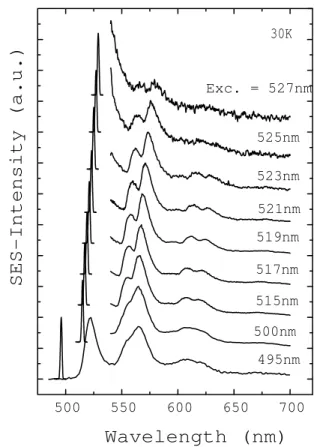
Figure3showsPLspetraobtainedfromSES
mea-surements, arriedout at 30 K,of aSA-PPV sample.
The sharp peaks in the left are the exitation lines,
whihwas variedfrom 495nmto 527nm. The
exita-tionenergywassannedoverthezero-phononspetral
region seleting only long onjugated PPV segments.
Astheexitationenergygoesthroughthezero-phonon
transition (521nm),twospetrallines,at 555nmand
570nm, beome welldened showingthe existeneof
twoeetivemodes that were notresolvedin the
nor-malPLspetraofFig. 2.
500
550
600
650
700
495nm
500nm
515nm
517nm
519nm
521nm
523nm
525nm
Exc. = 527nm
SES-Intensity (a.u.)
Wavelength (nm)
30K
Figure 3. SES experiment with exitation (Ex.) varing
SA-Thetheoretialmodel, expressedbyEq. 1,was
ap-plied to t the PL spetra presented in Fig. 1. In
the tting, wexed, basedon theexperimental result
of Fig. 2, the phonon frequenies (500 m 1
, 1170
m 1
and1550 m 1
),but wevariedtheHuang-Rhys
parameters (S
j
), the homogeneous widening (d) and
the zero-phonon position (!
n
). Figure 4 shows that
thetheoretial model presentsareasonableagreement
withtheexperimentaldata(at30K).Theontribution
of eah vibrational mode is also shown in the Fig. 4.
The used parameterswere: the width d is equal(580
m 1
),!
n
equal2.34eV,andtheHuang-Rhys
param-eters S
1
=0.14, S
2
=0.48, and S
3
=0.80. The two rst
parameters, dand !
n
were extratedfrom the
experi-mental results. Therelatively low Ruang-Hys
param-eter values (S
j
<1) onrm that SA-PPV has rather
long onjugated segments and lowmoleular disorder
[24℄. ConsideringtheeÆientarriermigration
meha-nismtolowerenergystates(HOMOandLUMO
mole-ularstates),theradiativereombinationoursathigh
PPVonjugatesegments(10units)[27℄.
500
550
600
650
700
PL (a.u.)
Wavelength (nm)
T = 30 K
d = 580 cm
-1
Experimental
Theoretical
1
= 1550 cm
-1
2
= 1170 cm
-1
3
= 500 cm
-1
Figure 4. PL spetrum at lowtemperature(30 K)of
SA-PPVlm(|O|)andtheoretialspetrum(||)
onsider-ingtheontributionofthreeeetivephononsat500m 1
(||),1170m 1
(----)and1550m 1
().
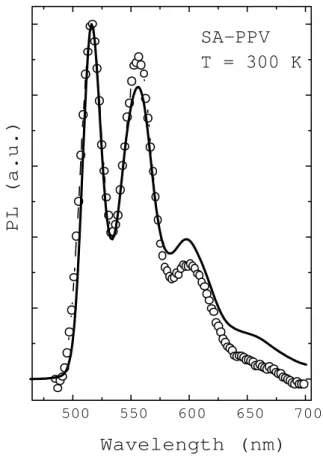
Similartting were arried outwith the spetrum
obtained at 300 K, shown in Fig. 5. In this tting
the adjusted parameters were: S
1
=0.22,S
2
=0.60and
S
3
=0.85,whereasdequalto840m 1
and!
n
isequal
2.39eV.Thebroadeningofthezero-phononlinewidthd
andthe!
n
-blue-shiftof50meVreetsthethermal
dis-orderinduedbythetemperature. Theenhanementof
S
1 andS
2
valuesshowsthat theeletron-phonon
ou-plingalsodependsonthetemperature,whihindiates
that the eletronimoleular statesare moresensitive
totheringvibration(phenylenering)inthePPVunit.
Sine !
1 and !
2
are assoiated, respetively, with the
bendvibrationoftheringout-of-planeandthering
in-plane-bend[16℄,wemayexpetthatthesephenomenon
undergoesintermoleularinterations,beinghigherfor
500
550
600
650
700
PL (a.u.)
SA-PPV
T = 300 K
Wavelength (nm)
Figure 5. PL spetrum at room temperature (300 K) of
SA-PPVlm(|O|)andtheoretialspetrum(||).
V Conlusions
In this paper we show that SA-PPV lms display
absorption and emission urves with high resolution,
mainly at low temperatures, allowing a quantitative
studyoftheemissionspetrumonsideringitsvibroni
strutures. In addition, by the use of the SES
teh-niquewewereableto resolvethevibrationalmode
as-soiated with the rst replia of zero phonon
transi-tion. Calulations of eletroni transition rates were
obtainedbyamodelbasedontheCondon
approxima-tiontakingintoaounteletron-phononouplingand
a distribution in lengths of onjugated lengths along
the polymeri hain. By the analysis of the
Huang-Rhys parametersand the zero-phonon line-width and
its position in the spetrum we tted, with great
a-uray, the experimental emission urve at low
tem-perature. Thesmall Huang-Rhys oupling-parameters
(smallerthantheunity)onrmsthequalityofthe
pro-duedSA-PPV lmswhenompared to that madeby
onventional asting proedure. The slight dierene
observedbetweenthetheoretialandtheexperimental
urvesin Fig. 5indiates that otherinterations need
to be onsidered, as, for example, interhain
Aknowledgement
The nanial support from Brazilian ageny
Funda~aodeApoioaPesquisadoEstadodeS~aoPaulo
(FAPESP)isaknowledged.
Referenes
[1℄ R.H.Friend,R.W.Gymer,A.B.Holmes,J.H.
Bur-roughes,R.N.Marks,C.Taliani,D.D.C.Bradley,D.
A.dosSantos, J.L.Bredas,M. Logdlund,andW.R.
Salanek,Nature397,121(1999).
[2℄ M. T. Bernius, M. Inbasekaran, J. O'Brien, and W.
Wu,Adv.Mat12,1737(2000).
[3℄ S.C.Graham,D.D.Bradley,R.H.Friend,andC.W.
Spangler,Synth.Met.41-43,1277(1991).
[4℄ T.W.Hagler,K.Pakbaz,andA.J.Heeger,Phys.Rev.
B44,8652(1991).
[5℄ K.Pihler,D.A. Halliday,D. D.Bradley,P.L. Burn,
R. H. Friend, and A. B. Holmes, J. Phys.: Condens.
Matter5,7155(1993).
[6℄ K.Pakbaz,C.H.Lee,A.J.Heeger,T.W.Hagler,and
D.Mbranh,Synth.Met.64,295(1994).
[7℄ J.ObrzutandF.E.Karasz,J.Chem. Phys.87,2349
(1987).
[8℄ D. A. Halliday, P. L. Burn, R. H. Friend, and A.
B.Holmes, J. Chem. So. Chem.Commun. 22, 1685
(1992).
[9℄ B.H.CumpstonandK.F.Jensen,TRIP4,151(1996).
[10℄ F.Papadimitrakopoulos,M.Yan,L.J.Rothberg,H.E.
Katz,E.A. Chandross,andM.E. Galvin,Mol.Crys.
Liq.Crys.256,663(1994).
[11℄ W. Holzer, A. Penzkofer, M. Pihlmaier, D. D. C.
Bradley,andW.J.Blau,Chem.Phys.248,273(1999).
[12℄ L. J. Rothberg,M. Yan, F.Papadimitrakopoulos, M.
E.Galvin,E.W.Kwok,andT.M.Miller,Synth.Met.
80,41(1996).
[13℄ R. Kersting, U. Lemmer, R. F. Mahart, K. Leo, H.
Kurz, H. Bassler, and E. O. Gobel, Phys.Rev. Lett.
70,3820 (1993).
[14℄ M. Yan, L. J. Rothberg, F.Papadimitrakopoulos, M.
E.Galvin,andT.M.Miller,Phys.Rev.Lett.73,744
(1994).
[15℄ A. Marletta, D. Gonalves, O.N. Oliveira Jr., R.M.
Faria, and F.E.G. Guimar~aes, Maromoleules 28,
7107(1995).
[16℄ D.Rakvie,R.Kostie,L.A.Gribov,andI.E.Davidova,
Phys.Rev.B41,10744(1990).
[17℄ S.Lefrant, E. Perrin, and J.P.Buisson, Synth.Met.
29,E91(1989).
[18℄ A. Marletta, D. Gonalves, O.N. Oliveira Jr., R. M.
Faria,andF.E.G.Guimar~aes,Synth.Met.119,1447
(2001).
[19℄ A. Marletta, D. Gonalves, O.N. Oliveira Jr., R. M.
Faria,andF.E. G.Guimar~aes,Synth.Met. 119,629
(2001).
[20℄ S.H.Lin,J.Chem.Phys.44,3759 (1966).
[21℄ A.D. Brailfordand T.Y.Chang, J.Chem.Phys.53,
3109(1970).
[22℄ J.Yu,W.S.Fann,F.J. Kao, D.Y. Yang, andS.H.
Lin,Synth.Met.66,143(1994).
[23℄ J.Yu,M.Hayashi,S.H.Lin,K.K.Liang,J.H.Hsu,
W.S.Fann,C.I.Chao,K.R.Chuang,andS.A.Chen,
Synth.Met.82,159(1996).
[24℄ R.Chang,J.H.Hsu, W.S.Fann,K.K.Liang,C.H.
Chang,M. Hayashi,J.Yu,S.H. LinE.C.Chang,K.
R. Chuang, and S.A. Chen, Chem. Phys. Lett. 317,
142(2000).
[25℄ R. Chang, J. C.Chang, R. Chang, J. H. Hsu, W. S.
Fann,M.Hayashi,J.Yu,J.C.Jiang,S.H.Lin,Y.Z.
Lee,K.R.Chuang,andS.A.Chen,Synth.Met.106,
139(1999).
[26℄ A. Marletta, D. Gonalves, O.N. Oliveira Jr., R.M.
Faria,andF.E.G.Guimar~aes,Adv.Mat.12,69(2000).
[27℄ D. G.Cahill, M.Katiyar,and J.R.Abeldeson,Phys.
Rev.B50,6077(1994).
[28℄ Y. Shi,J. Liu,and Y.Yang, J.Appl. Phys.87, 4254
(2000).
[29℄ J. W. Blathford, S. W. Jessen, L. B. Lin, T. L.
Gustafson, D. K.Fu, H. L. Wang, T.M. Swager, A.
G.MaDiarmid, andA.J. Epstein,Phys.Rev.B54,
9180(1996).
[30℄ T.Q.Nguyen,V.Doan,andB.J.Shwartz,J.Chem.