Spae Weather Impat on Magnetosphere:
New Helium Radiation Belt Storm Time Formation
D. Bosher 1
, S. Bourdarie 1
, A.A. Gusev 2
, U. Jayanthi 2
, I.M. Martin 3
,
G.I. Pugaheva 2
, and W.N. Spjeldvik 4
1
ONERA/DESP-2,av. E.Belin,BP4025,31055 ToulouseCedex4, Frane
2
InstitutoNaionaldePesquisas Espaiais/INPE, 12201-970,S~aoJosedosCampos,SP, Brazil
3
UniversityofCampinas,Instituto deFsia/DRCC,13083-970, Campinas,SP,Brazil
4
Departmentof Physis,WeberStateUniversity,Ogden,Utah84408-2508
Reeivedon28November,2001
TheonsequenesoftheMarh1991stormontheEarth'sradiationenvironmentarenowwellknown
throughmanyin-situmagnetospheriobservations. MeasurementfromtheCRRESspaeraftshow
the sudden formation of a new Helium ion struture deep within the magnetosphere. In that
event, two additional new radiation belts were reated, one ontaining large uxes of 10 MeV
eletrons, and the other forming a struture ontaining 30 MeV protons. These sudden spae
weatherphenomenaappeartobeduetheonjuntionofthetwoourrenes: (1)asolarenergeti
partile (SEP) event arriving inthe viinityof theEarth,and (2)averyintensemagnetistorm
withintheEarth'smagnetosphere. Attemptstoreproduetheappearaneofstormtimeheliumbelt
byomputationalmodelingaremade usingathree-dimensionalhargedpartileode (Salammbo
ode)inorporatingHeliumionhargeexhangeandpost-eventlassialdiusiontheory. Wehave
extendedtheapabilitiesoftheodetoHeliumions,andweshowthatthesephysial phenomena
analsoleadtoabuild-upofanewHeliumbeltinthe30MeVrange.Detailedmodelingpreditions
oftheloationofthisbeltandomputeduxlevelswillbepresentedanddisussedintheontext
ofspaeweatherphenomenaintheEarth'smagnetosphere.
I Introdution
The Earth's radiation belt region is a dynami entity
that readilyrespondstohangesin thesolarenergeti
partileenvironment. With thelaunh ofmany Earth
orbiting spaeraft with telesopes, one has the
abil-itytomeasureandmonitortheradiationbeltregionin
onsiderable details. Advanes in numerial modeling
of this radiation environment has brought forth
sim-ulation and predition apabilities of great utility for
eventual spae weather foreast. In the early part of
thespae era,the radiationbeltmodelingwasarried
out by both experimental and theoretial means [1-5℄
to understand the souresand losses ofthe great belt
uxesandtheSpaeWeatherProgramusheredina
dy-namial modeling of radiation belt. Two-dimensional
modelingoftheradiationbeltuxenhanementfor
en-ergetiprotonshavebeenarriedoutwithtimevariable
diusive transport oeÆients and time variable (but
xed loation) boundary onditions[6℄. Variations in
thegeomagnetirigidityut-oloationswithpartile
energy and geomagnetionditions, as well asthe
so-attempted until now. Weattempt here more
ompre-hensivemodeling.
Modern observations have shown that there an
belargevariationsinthegeomagnetiallyonned
ra-diation, even deep within the trapping region [7-9℄.
ThephysialonsequenesoftheMarh1991magneti
storm in the Earth's radiation environment are now
reasonably well known through many in-situ
magne-tospheri observations. Measurement made with the
CRRES spaeraftshowa suddenformationof a new
geomagnetiallyonned energeti radiationstruture
onsisting of several dierent harged partile speies,
inludinganewHeliumionradiationbelt,deepwithin
the Earth'smagnetosphere, andin that event,several
additionalnewradiationbeltswererathersuddenly
re-ated, one ontaininglargeuxes of 10MeV eletrons,
anotherontaining30MeVprotons.
These abrupt spaeweatherstorm-phenomena
ap-pear to be due to the onjuntion of the two
our-renes: (1)asolarenergetipartile(SEP)event
arriv-ingin theviinityoftheEarth,and(2)averyintense
it-model 10
, it was shown that with inreased
geomag-neti turbulene and availability of enhaned partile
uxesimpulsivelyformedprotonradiationbeltsanbe
modeledwithloationandintensityingoodagreement
withmeasurementsmadebytheCRRESsatellite. F
ur-thertests ofthis modeling mustinlude other partile
speies, and we hereaddress the reation of an inner
radiationzoneHeliumionbelt.
II Proesses inluded in
model-ing
The existing Salammboode for 3-dimensional
alu-lations of radiation belt proton distributions [11℄ was
extended to Helium ions by the inlusion of both the
ionistatesandtheouplingbetweenthem[12-14℄. In
short,Helium ions an appear in two dierent harge
states(He1+andHe2+)withhargeexhangeoupling
betweenthetwospeies induedbyollisional
intera-tions in the exospheri thermal neutral hydrogen
en-vironment. The naturalradial transport of Helium is
thus ourringsimultaneouslywiththeollisional
pro-esses. The diusion equations governing these two
harge states of Helium are oupled. In phase spae
spanned with the three adiabati invariants, the two
oupledtransportequationsarewritten as:
f ++ t =L 2 L D LL ++ L 2 f ++ L + M M t ++ f ++ ! + J J t ++ f ++ ! + f + +=++ f ++ ++=+ ; f + t =L 2 L D LL+ L 2 f + L + M M t + f + ! + J J t + f + ! f + 0=+ f + +=++ + f ++ ++=+ ; d wheref + andf ++
arerespetivelythedistribution
fun-tions(phasespaedensities)orrespondingtotheHe1+
andHe2+populations,M,J,andLarerespetivelythe
relativistimagnetimoment, theseondadiabati
in-variantand theMIlwainL-shellparameter. TheD
LL
oeÆients are the radial diusion oeÆients, whih
an be dierent for the two ioni states of the same
elementalspeiesduetothehargedependentdrift
ve-loities.
Following theearlier suess of the proton ode in
3-D time dependent simulations [10℄, the Helium ion
radial diusion oeÆients were assumed to be
mag-netiativitydependentthroughthemagnetiativity
index, Kp. Weassumedthe D
LL
-valuesto be
propor-tional to+exp(0.74Kp),followingthedependene
de-The oeÆients, dM/dt and dJ/dt, are derived from
theeetiveCoulombenergydegradationrates,dE/dt,
dueto non-harge-exhangeinterationswiththe
neu-traloftheexosphere. Finally,theouplingoeÆients
o=+ , +=++ and ++=+
arerelativetothe harge
ex-hange reations. The harge exhange ross setion
werederivedfrom laboratorymeasurements[13℄.
In the present Helium ion simulation, no internal
radiationbeltsoureswereonsidered,andtheHelium
ionradiationbeltsarethoughttobelledbysoures
ex-terior,eitherfromthemagnetotail(ordiretentryfrom
themagnetosheath)orfromtheEarth'sionospherevia
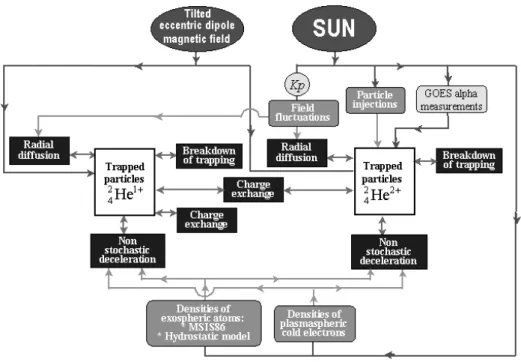
highlatitudeproesses. Globally,theproessowhart
of thetrappedHelium populationis exhibited in Fig.
Figure1. FlowhartoftheHelimtrappedradiation model.
III Boundary onditions
Thetrapping region islimited to low altitudesbythe
high atmosphere, with nominal 100 km height. This
limitstheaessof Heliumionsto lowL-shells,andit
alsoprovidesaneetiveboundaryinpithanglespae
forhigherL-shells. Asin theearlierwork,at high
alti-tudes,thenominalouterzoneboundarywastakenasL
=7forveryquietonditions,butwefounditneessary
to modify this traditional boundary when signiant
eventstakeplae sothat the eetiveouter boundary
adjustsaordingtovariationsinthegeomagnetield
topology. Inthisregarditwasdesirableto obtain
He-lium ionux simulations ofveryenergetiions (up to
300MeV),anditwasneessarytoinludethemagneti
ut-ooftheHeliumions. Thisut-oisrelatedtothe
large Larmor radius of Helium ions ompared to the
salelengthsofthegradientsinthemagnetield.
As ions approah the Earth magneti eld from
interplanetary spae, they deviate from their
pre-enounter trajetories. The minimum radial loation
they an penetrate into the terrestrial magnetosphere
depends on the partile magneti rigidity, a property
dependent on Helium ion energy and harge state as
wellasthegeomagnetield enountered. Wehere
as-sumethat theut-oenergyE
utoff
onageomagneti
driftshellloationdenedbytheL-parameterdoesnot
dependon theHeliumionpith angle, andanbe
ex-pressed as: E
utoff
= exp (aL 2
+bL + ) [in MeV℄,
iionspeies(Heliumioninourase)deduedfrom
theempirialinformationshowninFig. 2.
Figure 2. Empirially modeledut-o energiesversus the
geomagneti L-shellparameterfor thetwohargestatesof
Helium. Comparisonisalsomadewiththesameonditions
forprotons.
At very high energies, beause of their high
interplane-of theinternal magnetosphere,inludingthe radiation
beltregion. Toestablishtherealistimagnetiut-os
weusedmeasurementsofalphapartiles(He2+)uxes
from the NOAA/GOES-6 geosynhronous satellite as
boundary onditions, and we assumed that the same
uxes would be present at lower L-shell down to the
rigidity ut-o loation. Toestablish afull spetrum,
weextended theempirialGOES-6Heliumspetra
to-wardslowerenergies. Boundary onditionswerexed
to zero during the whole period for He1+, assuming
that the sun predominantly supplies He2+ ions. In
analogy with the atomi Oxygen ion work of
Spjeld-vikandFritz[13℄,thispermitsaparameterized
under-standingoftheeetoftheionihargeexhange.
IV Diusive transport modeling
We havebuiltanumerialmodelto solvethe oupled
governingtransportequationsforenergetiHeliumions
withtwobuilt-inalgorithms: (1)Adiretiterative
equi-librium state seeker with test routines to insure that
equilibrium was indeed attained; and (2) A forward
time-steppertosimulatetimeprogressionduringevents
ofinterest,eitherstartingfromanarbitraryinitialstate
or from theomputed equilibrium onguration. This
modelhasbeenusedtogaindetailed knowledgeofthe
dynamialevolutionoftheHeliumradiationbelt
stru-ture.
Togaininsightintotheoupledproessesinthe
3-D radiation beltonnementregion, wewantedtosee
learly the time variable eets of dierent proesses
(ioni harge exhange, Coulomb energy degradation,
ross-L transport, and the eet of a Solar Energeti
Partile Event). We herereport results from someof
thesesimulationswhereweusedasinitialonditionsan
otherwise empty magnetosphereandletit be lled by
ross-eldtransportfromanouteredgesourespeied
as aboundaryondition.
With this starting point attained we proeeded to
modelthetransportofpartilesduringthegreatMarh
1991storm. Numerialomputationsweremade
simu-lating thestrutureoftheHeliumuxesfortheperiod
between23 Marh and 2 April, 1991. Toinsure
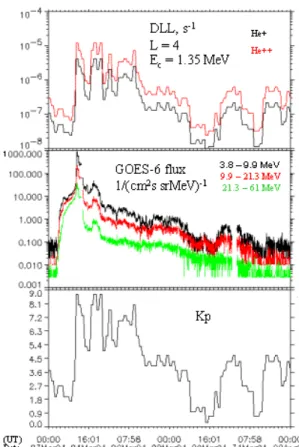
real-ismweusedtheorrespondingKpvaluesandGOES-6
alphapartilemeasurements(Fig. 3)to mimithe
ge-omagneti response to thesolar-indued disturbanes.
This wedid with bothD
LL
-valuesKp-dependentand
the geomagneti ut-o energy (and thus the
orre-spondingut-oloationforagivenenergy). Itshould
benotiedthattheinterestingSolarEnergetiPartile
Eventbeginon23Marh atround10:00 amwhilethe
storm,seenwiththeKpindex, beginson24 Marhat
Figure3.Timedependentinputparametersappliedforthe
numerial model run. From bottom to top: (1) the
geo-magnetiindexKp; (2) alphapartile measurementswith
theGOES-6satelliteinthreedierentenergyhannels;(3)
modeled Kp-dependent radial diusion oeÆients versus
timeat L =4 for 1.35 MeV Hepartilesin eitherharge
state.
V Results of the numerial
sim-ulations
Theresultsofthenumerialsimulationsareillustrated
in Fig. 4 whih depits the Helium ion ux
distribu-tionsforHe1+andHe2+presentedasomni-diretional
uxes versus time (absissa axis) and geomagneti
L-shell parameter (ordinate axis). Regarding the He2+
ions, we an understand this result in terms of lower
energy, partiles ontinuously injeted from the
geo-magnetitail,andsomadeavailableto theouter edge
ofthestable onnement regionatanominal loation
ofL =7. Inthepresentmodel, theseHelium ionsare
transportedtolowerLshellsbytimedependentradial
diusion.
Letus rstonsider therangeofmoderateHelium
ion energies, in the tens and hundred of keV range.
WhentheavailabilityofHeliumionsin theouterzone
issubstantialandtheKpindexishigh(i.e.,theEarth's
trapping region, so that the He ux seen at L = 4
growths rapidly. When Kp dereases, this transport
proess slows down, and the in-situ harge exhange
from He2+ to He1+ beomes a very eÆient loss for
theoriginallyinjetedHe2+partiles. ThustheHe2+
ux dereases rapidly while the ux of He1+ ions
in-reases. FurtherhargeexhangefromHe1+toneutral
energetiHeliumatstountrapthepartiles,andthese
arethenlostalmostinstantaneouslyfromtheradiation
belts. SomeenergetiHeliumdisappeartoouterspae
whileotherspreipitateintotheatmospherewhere
se-ondaryollisionalreationstakeplae.
Figure4. Resultsofthenumerialsimulationsfor bothspeiesintermsofequatorialomnidiretionaluxinaL(ordinate)
versustime(absissa)plotforthreerepresentativeenergies(100keV,1MeVand10MeV).
Theeetivetransporttimeonstantforthe1MeV
Heliumionspopulationislonger,sotheHeliumionux
growsmoreslowlyatL=4. Theseuxesontinueto
in-reaseaslongasthestorminjetioneetsarepresent,
and itbeomesalmost onstantafterwardsdue theto
lowerratesofhargeexhangelossesthanomparedto
the lowerenergy Heliumions. These partilesan be
trapped for long periods of time. The white olored
portionoftheplotforL greaterthan5orrespondsto
partilesrossingthemagnetosphere,beausethe
geo-magnetirigidityut-oenergyorrespondsto 1MeV
atL=5(Fig. 2). Beyondthisut-o,theuxisbelow
the minimum of the sale, and is not seen in the
g-ure. Athigherenergies(say,10MeV),thegeomagneti
rigidityut-o loationis loser to theEarth (around
L=3.8).
Partiles from the Solar Energeti Partile Event
are seen between this ut-o L-shell loation and the
boundary,andtheuxistakentobeonstantbetween
these twoL-values. Thusthe timedependenyof this
surements, shown in Fig. 3. During the geomagneti
storm,theseHeliumionsrossintothemagnetosphere
and havefreeaessto thetrappingregiondue to the
time dependent rigidity ut-o loation, the time
de-pendene of this value being aused by the hanging
geomagnetieldtopologyduringtheevent. The
om-binedeetof(1)enhanedHeliumionuxavailability
at the edge of the trapping region, (2) enhaned and
time variable ross-L transport, and (3) time variable
geomagneti rigidity ut-o loation ause the
forma-tion of a new (and temporary) Helium ion radiation
beltatlowerL-values(herearoundL=3.6at1MeV),
onstitutinganewHe2+belt.
In our model parameters, singly harged ions
(He1+)areformedonlybyhargeexhangefromHe2+.
Beause the harge exhange proess is far more
eÆ-ientatlowerHeliumionenergy,theuxofthisharge
speies (He1+)is greaterat 100keV than at 1 MeV.
Computationally,theyappearquasiinstantaneously
lowerthantheut-osforalphapartiles,andthis
im-plies that itispratiallyimpossible tosee He1+
par-tiles at higher L-shells beyond L = 5.8 for 100 keV.
Aording to this simulation, 1 MeV He1+ partiles
arepredominantlyproduednearL =2.8.
Thedistributions(omnidiretionaluxversusL)for
the twospeies are plotted at 1MeVat thetemporal
end of the simulation, and this is depited in Fig. 5.
The radial proles of He1+ and He2+ are dierent,
thisbeingessentiallyaneetofthehargedependent
rigidityut-oofthetwoHeliumionhargestates.
Figure 5. Distributions (equatorialomnidiretional
dier-entialux versusL-shell) ofHe1+ and He2+ at 1MeVat
theendofthesimulationrun.
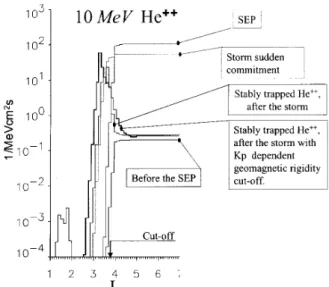
TheHeliumionux distributions at dierent
peri-ods in thesimulationintervalareplotted in Fig. 6for
the10MeVpartiles. Thegeomagnetirigidityut-o
forthepartilesislearlyseeninthisgureastheux
then is onstantin L (vertial stripes in this display)
betweentheenergy-dependentrigidityut-o loation
andournominalboundaryatL=7. Thisuxofourse
varieswithtimeas theavailabilityofouteredgeuxes
vary (as seen with GOES-6), and the initial value at
thisloationisre-establishedwhentheSolarEnergeti
PartileEventisover. Attheendofthenumerial
sim-ulation, the result is that anew "diusivelyinjeted"
radiation beltwasreatedbytheonjuntionbetween
theenhaneduxavailabilityeventandtheintense
ge-omagnetistorminthemagnetosphere. Themaximum
uxesofthisadditionalradiationbeltismodeledtobe
loated atL =3.6and theomni-diretionaluxthere
1 2 1
Figure6. Distributionofequatorialomni-diretional He2+
partilesatdierentinstantsduringthesimulatedevent
pe-riod.
Figure7.Omnidiretionaldierentialux(inunitsof: ions
MeV-1m-2s-1)of1MeVHe1+andHe2+ionsattheend
ofthesimulation timespan. It anbeseenthat thealpha
partile(He2+) radiationbeltgenerated inthis partiular
eventalso extendsdowntolowaltitudes alongthesameL
shell.
Thistime-dependentandhargestateoupled
phys-ialmodelisdevelopednotonlyforequatorialpartiles,
butalsooutsidethegeomagnetiequatorandinludes
thefullrangeofequatorialpithanglesforHeliumions
outsidethe atmospheri boune lossone. The entire
radiationbeltreatedat10MeVattheendofthe
sim-ulationanbeseeninFig. 7. Thismodelthusprovides
a quantitative explanation for the rapid formation of
newtemporalradiationbeltswithin thelassial
VI Disussion and Conlusion
With this simple model that employs a ombination
oflassialdiusiontheoryonepts(timevariable
ra-dialtransport,ionihargeexhangeandCoulomb
ol-lisional energy degradation) oupled with the idea of
time variable geomagneti rigidity ut-os due to
ge-omagneti topologyvariations, it was possible to
re-ate an alphapartile radiation belt at L =3.6 for 10
MeVandorrespondingstruturesatdierentenergies.
TheneessaryonditionsareaSolarEnergetiPartile
Event,whihbringsthesepartilesneartheouter
radi-ation zonetrappingboundary(eetivelythe
geomag-neti rigidity ut-o loation for a given energy) and
an intense geomagneti storm, whih transport these
partilesinthetrappingregiondowntolowerLshells.
The nal L-shell of the eetive insertion of these
partilesis aombination ofthe ut-o(L =3.8at 10
MeV) and the range of L-shells they an diusively
ross one within the rigidity ut-o L-value. These
o-ourrenes depend on the intensity as well asthe
durationofthestorm. Infat,theL-shellrangeofthe
diusiveproessishererathersmall(arounddeltaL=
0.2), so the main "injetor-mehanism" is the
tempo-ralvariationofthegeomagnetirigidityut-oloation
in theinnermagnetosphere. Ofourse,in aseswhere
thedurationandintensityofthegeomagnetistormare
large,eetiveL-shellrossingbydiusionanalsobe
importantandanadditionalmehanism.
To emphasize the importane of the geomagneti
topologyvariationsduringgeomagnetistorms,wenote
that the geomagneti rigidity ut-o is ertainly
sub-stantiallymodiedduringtheprogressionofanintense
magneti storm. In this paper we have provided the
rst quantitativeattempt at modelingusing a Kp
de-pendent ut-oondition withaE
utoff
-formula(and
thusequivalentlyaL
utoff
-loationforagivenenergy)
derived from the empirial ut-o versus L
relation-ship E
utoff
= exp (a L 2
+ bL+ )). In fat, in the
presentnumerialsimulationsweusedonlya
normaliz-ingfatorforLinthisequation,thisfatorbeingequal
to (3+4exp(-Kp/3.06))/3.78 [10℄
, sothat it is equalto
unity for Kp = 5. This means that energeti Helium
ionsgoinsidethelimitseeninFig. 2forevenhigherKp
values,and lie outsidefor lowerKpvalues. With this
formula, the geomagneti rigidity ut-o for 10 MeV
alpha partiles at Kp = 9 omes down as far asto L
= 3.2. The distribution of the 10 MeV alpha
parti-les withthis runis shown inFig. 8attheend ofthe
simulation.
It anbeseenthat the maximumomni-diretional
uxofthenewlyformed beltinthisseondsimulation
is found at L = 3.1, and is a little bit higher in ux
intensity,around800ionsMeV 1
m 2
s 1
. Itthen
ap-pearsthatthemaximumHeliumionuxintensitylevel
dependsnotonlyonthe outerzone inidentspetrum
neti rigidityut-oduring thestorm. The
harater-isti width of the new Helium ion radiation belt also
signiantly depends on the eetive radial diusion
oeÆients and on the temporal displaement history
ofthemagnetirigidityut-osduringthestorm.
Figure 8. Distributionofequatorial He2+ions atthe end
ofthesimulation,whihusesaKpdependentgeomagneti
rigidity ut-o.
With thepresentnumerialmodel, theimpulsively
formed radiation belt is reated over all the energies
whereHeliumionuxduringtheSolarEnergeti
Parti-leEventisgreaterthanthebakgroundduetoosmi
rays. Dependingontheut-oloationsandthe
inten-sityof a partiular storm, this newHelium ion
radia-tionbeltstrutureanbeeetivelyreatedwellinside
the lassial trapping region. This may well at times
ometobroadeningeomagnetiinvariantlatitudesand
may possibly interfere with man-made strutures and
operations in spae, inluding theInternationalSpae
Station. Underworstase senariosit ispossiblethat
newlyreatedradiationbeltsofeletrons,protons,
He-lium ions and even heavier ion speies may endanger
thehealthorlifeofastronauts,espeiallyduringExtra
VehiularAtivities.
Aknowledgments
Figures 3, 4, and 7 were made using the PAPCO
data analysis pakage supported by MPAE Lindau
throughtheMax-PlankGesellshaft, DARA,grant50
Referenes
[1℄ J. Zinn,H. Hoerline, andA. G.Pethek,TheMotion
ofBombDebrisFollowing theStarshTest,in
Radia-tionTrappedintheEarth'sMagnetiField,D.Reidel,
Dordreht,Holland,(1966).
[2℄ M. Shulz, Geomagnetially Trapped Radiation, Sp.
Si.Rev.17,481(1975).
[3℄ W.N. Spjeldvik,ExpetedChargeStatesofEnergeti
Ions in the Magnetosphere, Sp. Si. Rev. 23, 499
(1979).
[4℄ T.A. Fritz, W. N. Spjeldvik, Experimental
Determi-nationofGeomagnetiallyTrappedHeavyIonFluxes,
International Assoiation of Aeronomy and
Geomag-netism, International Symposium, Edinburgh,
Sot-land,August,(1981).
[5℄ M.Walt,Introdution toGeomagnetiallyTrapped
Ra-diation,CambridgeUniv.Press,NewYork,(1994).
[6℄ W.N.Spjeldvik,ConsequenesoftheDurationofSolar
EnergetiPartile AssoiatedGeomagneti Stormson
the Intensity of Geomagnetially TrappedRadiation,
311, inSpaePhysis Modeling, Amerian
Geophysi-alUnionMonograph,N o
44,Washington,DC,(1988).
[7℄ G.D. Reeves, (editor), Workshop on the Earth's
TrappedRadiationenvironment,AmerianInstituteof
Physis Conferene Proeedings, No.383, New York,
(1996).
[8℄ G.I.Pugaheva,A.A.Gusev,I.M.Martin,W.N.
Sp-jeldvik, T. Kohno, The Temporal Evolution of 3 - 9
MeV/nuleonHeFluxTrappedintheMagnetosphere,
Geophys.Res.Letters,23,2793 (1996).
[9℄ A.A. Gusev, T. Kohno, W. N. Spjeldvik, I. M.
Mar-tin, G. I. Pugaheva, and A. Turtelli, Jr., The 3-9
MeV/Nuleon He Ions Flux Dynamis in the Inner
MagnetosphereObtained withOhzora Satellite, Adv.
SpaeRes.,20-3,385(1997).
[10℄ A.Vaaresse,D.Bosher,S.Bourdarie,M.Blan,and
J.-A.Sauvaud,ModelingtheHighEnergyProtonBelt,
J.Geophys.Res.,104,28601(1999).
[11℄ T.Beutier, D.Bosher, andM. Frane,Salammb^o,A
Three-dimensionalSimulationoftheProtonRadiation
Belt,J.Geophys.Res.100,17181(1995).
[12℄ J.M.Cornwall,RadialDiusionofIonizedHeliumand
Protons: A Probe for Magnetospheri Dynamis, J.
Geophys.Res.,77,1756(1972).
[13℄ W.N.Spjeldvik,T.A.Fritz,EnergetiIonizedHelium
intheQuietTimeRadiationBelts: Theory and
Com-parison with Observation, J. Geophys. Res., 83, 654
(1978).
[14℄ W.N.Spjeldvik,T.A.Fritz,ObservationsofEnergeti
HeliumIonsin the Earth's Radiation Belts During a
Sequene of Magneti Storms, J. Geophys. Res., 83,
2317(1978).
[15℄ L.J.Lanzerotti,D.C.Webb,andC.W.Arthur,
Geo-magnetiField Flutuationsat SynhronousOrbit,2.