Evolution of Dynamic Localization Regimes
in Coupled Minibands
P. H. Rivera1
and P.A. Schulz2
1Departamento de Fsica, Universidade Federal de S~ao Carlos
Caixa Postal 676, 13564{200, S~ao Carlos, SP, Brazil
2Instituto de Fsica Gleb Wathagin, Universidade Estadual de Campinas
Caixa Postal 6165, 13083{970, Campinas, SP. Brazil
Received February 7, 1999
We consider the behaviour of two coupled symmetric electronic minibands in the presence of an AC intense eld. Symmetric coupled minibands are realized as dimerization procedures. The minibands are emulated by a tight-binding nite chain, whereas the interaction with an AC eld is described by a time-independent Hamiltonian. We follow the evolution of dressed minibands, non perturbatively, in a wide frequency range. For one dimerization procedure, a transition between both limits can be systematically followed and a dynamic breakdown is unambigously identied. The most striking eect that may occur is a eld-induced analog of an insulator-metal transition due to the suppression of a Peierls-like instability.
The electronic properties of semiconductor mi-crostructures dressed by intense AC elds have been at-tracting growing interest in the past few years, leading to predictions of tunable quantum well lasers [1], dy-namic localization (DL) in dressed minibands of semi-conductor superlattices [2, 3], as well as resonant tun-neling suppression [4]. These eld eects on superlat-tices have been observed experimentally [5, 6]. One important theoretical result is that DL in isolated mini-bands can be characterized by miniband collapses obey-ing the zero order Bessel function (ZOBF) roots, where the argument of J0 involves the eld frequency and
tensity. The present work is concerned with the in-tense AC eld eects on coupled superlattice mini-bands. Although intensively studied in the past few years[7, 8, 9, 10], there are still open questions related to the mechanisms of DL in multi-miniband systems.
One of these multiminibands system is a set of two coupled symmetric minibands, completely isolated from other minibands. They are obtained by either one of two dimerization processes, as was suggested by Holthaus[7]: alternating two barrier widths or alternat-ing two dierent quantum wells.
We start our work by simulating these dimerized superlattices with a heuristic tight-binding nite chain model. For two alternating barrier widths, the Hamil-tonian is given by:
Ho= EoX
`m
j`m >< `mj+
1 2
X
`n
V1
(,1)`+ 1
2 + V2
(,1)` +1+ 1
2
j`m >< ` + 1;mj+
V1
(,1)` +1+ 1
2 + V2
(,1)`+ 1
2
j` + 1;m >< `mj
: (1)
And for two alternating quantum wells, we have Ho=X
`m[Eo+ (
,1)`]j`m >< `mj+ ;
V 2
X
`m
h
j`m >< ` + 1;mj+j` + 1;m >< `mj i
(2) where V1, V2, V are the hopping parameters related to
the barrier widths; `, m are the site and the photon index, respectively. E0 is the s-orbital energy related
to the quantum well state energy and the dierence of energy with respect to the rst neighbor s-orbital en-ergy, leading to Eg= 2 when the intensity of the eld is zero.
The interaction with an intense AC eld of a given frequency is described by a semiclassic time-dependent
Hamiltonian, which is replaced by a innite time-independent Hamiltonian through a Floquet-Fourier unitary tranformation. The treatment of the time-dependent Schrodinger equation is based on Floquet states j`;m > following the procedure developed by
Shirley[11]. The so called called Floquet matrix for the case of two alternating quantum wells is given by
(E,mh!,[Eo+ (,1)`]`
0`m0m=
V
2 m0m(`0;` ,1+ `
0;` +1)+
1
2eaF``0`(m0;m
,1+ m 0;m
+1); (3)
where E is the quasi-energy spectrum of the system, a
new motion constant due to the fact that a new quasi Brillouin zone (QBZ) created by the photon eld is as-sociated to the system as well as to the photon energies. F, ! are the intensity and angular frequency of the AC eld, respectively; a is the SL period, and e is the elec-tron charge.
The dimension of the matrix is given by L(2M +1), where L is the number of sites, while M is the maximum of the photon index, given by a convergence criterium: no level crossing at the QBZ edge, being the rst one spanned in the range,h!=2Eh!=2 [2].
In what follows we represent the eigenvalues of the Floquet matrix (quasi-energies) versus the intensity of the electric eld, in units of potential drop by a period of the superlattice, eaF. We consider AC external elds with wavelengths that are many times longer than the length of the superlattice and all are linearly polarized along the superlattice growth direction. The frequency will be constant along the present analysis, h! = 0:5 meV, but the tight-binding parameters will be varied throughout the work.
0 1 2 3
eaF (meV)
-1.0 -0.5 0.0 0.5 1.0
Quasienergy (meV)
2 m=0
1 m=+1
2 m=-1
1 m=0
Figure 1. Dressed Minibands corresponding to a linear chain withL = 8, V = 0:2 meV,E
g = 0
:1 meV,M = 40. We
observe a DL similar to an isolated miniband.
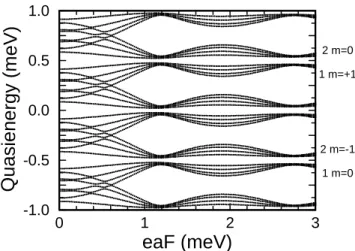
We rst analyse a dimerized superlattice obtained by alternating two dierent quantum wells. In Fig.1 the case for high frequency limit, i.e. when Egh!, is
shown. Here the case of M = 8 sites with a hopping pa-rameter V = 0:2 meV, Eg= 0:1 meV and L = 40 pho-tons is simulated. The number x m =m in Fig.1 and
others represent the position in energy of the dressed miniband x = 1 (fundamental) or x = 2 (excited) due to the absorption (+) or emission (-) of m photons.
The DL of replicas of the two minibands obeys to the ZOBF roots distribution (J0(eaF=h!)) and the
memory of the DL of replicas of an isolated miniband, Eg = 0 meV, remains[12]. This type of regime is valid for low and high intensities of AC eld and this be-haviour is predicted by an analytical equation obtained through the gauge transformation hk ,! hk + eA(t)
[2, 3] also discussed by Zhao[9]:
E(k;!) =2
E2
g+ V2J2
0
eaF h!
cos2
(ka2)
1=2
: (4) By varying the tight-binding parameters, the sys-tem will evolve from high to low frequencies even when the AC eld frequency remains constant. As Eg in-creases, the collapses mentioned above disappear and the miniband replicas evolves to a shape where other dierent collapses begin to appear.
0 1 2 3
eaF (meV)
-0.5 0.0 0.5
Quasienergy (meV)
2 m=0
1 m=+1
2 m=-1
1 m=0
Figure 2. Dressed minibands corresponding to a linear chain with L = 8, V = 0:2meV, Eg = 0:5 meV and M = 40
(dots).Two level systemL = 2 with same parameters
(cir-cles).
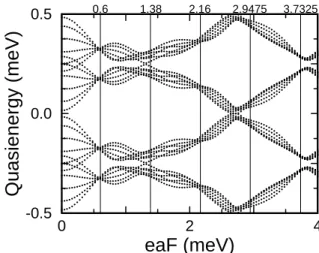
collapses in a way resembling the corresponding two level system (single pair of sites). At these collapses the dimerized superlattice miniband behaves as an iso-lated set of dimers. At intermediate eld intensities the miniband width is greater and a dynamic break-down occurs, separating the two limits described above. These characteristics are better observed in Fig.3, for
E
g = 2
:0 meV. At low intensities, the DL of isolated
minibands replicas are well dened, at eaF 0:6; 1:3
meV, related to zeros of J 0(
e(2a)F=h !). At high
in-tensities there are collapses of dressed isolated dimers,
eaF 3:8 meV; while a dynamic breakdown of the
dressed minibands occurs at eaF E
g. Just beyond
the dynamic breakdown line a rst induced analog of an insulator-metal transition due to total suppression of a Peierls-like instability may be observed.
0 1 2 3 4
eaF (meV)
-0.5 0.0 0.5
Quasienergy (meV)
1 m=+3
2 m=-2
1 m=+2
2 m=-3
Figure 3. Dressed minibands corresponding to a linear chain with L = 8, V = 0:2meV, E
g = 2
:0 meV and M = 40.
There are two DL of isolated minibands at eaF 0:6; 1:3
meV, and a collapse of the minibands at eaF 3:8 meV,
and a induced eld analog of an insulator-metal transition ateaF 2:8 meV.
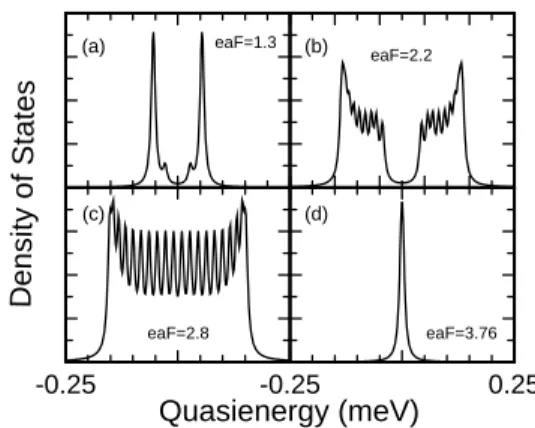
The many aspects discussed above can be better vi-sualized in a density of states (DOS) representation, Fig.4. Here we start from the spectra of dressed mini-bands for a linear chain withL= 20 andM = 90, while
the other parameters are the same as in Fig.3. The DOS of dressed minibands are spanned in the rst QBZ. In Fig.4.(a), the DOS related to coupled miniband repli-cas when they are collapsing like dressed isolated mini-bands (low eld intensity) is shown. The surface states are in the gap between both miniband replicas, as can be seen in the gure. In Fig.4.(b), the DOS in the the region of dynamic breakdown of the miniband replicas, ateaF = 2:2 meV, is represented. The minibands have
lost their isolated superlattice miniband identity and begin to predominate their dimer identity. Signatures of an insulator-metal transition, induced dynamically by the AC eld, is show in Fig.4.(c) ateaF = 2:8 meV.
Here a clear single band like DOS can be observed, re-vealing the suppression of the originally imposed
dimer-ization for this particular eld intensity. This analog to a Peierls instability is supressed at certain eld in-tensities, whenever eaF >E
g as in Fig.4.(c), i.e., the
AC eld reduces the gap, dynamically leading to equal eective barrier widths and equal eective quantum wells. Finally, Fig.4.(d), shows the DOS of the collapse of all dimers ateaF = 3:76 meV.
Clearly we observe two dierent regimes of DLs, whenE
g
h!. At low intensities, we have the DL of
isolated minibands with the related collapses remaining for any valueE
g
h!. At high intensities, there are
collapses of dimers only when E g
=h! = n, n is
inte-ger. Out of this condition the dimer collapses evolve to a double collapse structure that remains for high eld intensities, Fig.5.
-0.25 -0.25 0.25
eaF=1.3
eaF=2.2
eaF=2.8 eaF=3.76
Quasienergy (meV)
Density of States
(a) (b)
(c) (d)
Figure 4. The DOS for a linear chain withL= 20,V = 0:2, E
g = 2
:0 meV, h!= 0:5 meV and M = 90 is shown. (a)
DL of isolated minibands ateaF = 1:3 meV; (b) dynamic
breakdown of the minibands ateaF = 2:2 meV; (c)
transi-tion to single-band DOS induced by the eld ateaF = 2:8
meV; and (d) collapse of the dimers ateaF= 3:76 meV.
0 2 4 6
eaF (meV)
-0.5 0.0 0.5
Quasienergy (meV)
Figure 5. Dressed minibands corresponding to a linear chain withL= 8,V = 0:2meV,E
g= 1
:6 meV andM= 40
pho-tons. The system is out of resonance condition E g
=h !=n
The dimerization by alternating the barriers leads to a more involved physical picture, which has been only partially addressed. The model for this situation is implemented by simply alternating the hopping pa-rameters, while keeping the atomic site orbital energy xed throughout the linear chain, Eq.(1). In the high frequency limit an analytical exprression for the dressed spectra is obtained in a similar way as for the previous case. Here:
E(k z) =
q
(V 2
1 + V
2
2) + 2 V
1 V
2cos( k
z a)
J
o
eaF
h!
where the gap, in function of the eld intensity, is de-ned byE
g= 2 jV
1 ,V
2 jJ
0(
eaF=h!) and the miniband
width by E= 2V
1, considering that jV
2 >V
1 j.
This analytical solution [10] is indeed a good ap-proximation for the numerical results, as shown in Fig.6. Comparying with Fig.1, we already see that both dimerization procedures, although leading to qual-itatively similar electronic structures in absence of AC elds, imply in completely dierent behaviours for the corresponding dressed spectra.
0 2 4
eaF (meV)
-0.5 0.0 0.5
Quasienergy (meV)
Figure 6. Dressed minibands of a linear chain withL= 12
and M = 60; V1 = 0:125 meV and V2 = 0:25 meV, and
h! = 0:5 meV. Eg = 0:25 meV and E = 0:25 meV at eaF= 0.
In the scenario given by this second dimerization procedure, the interplay between intra and inter mini-band coupling is of paramount importance. In the low frequency limit, isolated miniband behaviour as a func-tion of eld intensity may be clearly identied, when-ever the miniband width is less than the eld frequency. On the other hand, signatures of this behaviour survive for very high eld intensities, as can be seen in Fig. 7. In contrast to what has been shown for the dimerization by alternating quantum wells, no clear dynamic break-down intensity region can be traced and no clear resem-ble of a two level system is found. Actual superlattices
should show characteristics involving both procedures discussed in this work. Further work is necessary in order to verify how robust the features analysed here, like the insulator-metal transition, as well as the dy-namic breakdown, are in front of deviations of the ideal dimerization conditions.
0 2 4
eaF (meV)
-0.5 0.0 0.5
Quasienergy (meV)
0.6 1.38 2.16 2.9475 3.7325
Figure 7. Dressed minibands of linear chain with L = 12
and M = 60. V 1 = 0
:15, V 2 = 1
:15 meV, and h! = 0:5
meV.Eg = 2:0 meV and E = 0:3 meV at eaF = 0. The
vertical lines indicate the ZOBF roots.
In conclusion, in dimerized SL for alternating quan-tum wells there are three dierent dynamic localiza-tion. As isolated minibands when h!<E
g and as non
coupled minibands for h! >E
g. The other regime
re-semble to dimer collapses for (h ! =E g) =
n<(eaF=E g)
and a eld induced metal-insulator like transition due to the break of like Peierls instability is observed. Also a dynamic breakdown occur ateaF E
g.
Although the observability of these eects deserves further work, the present results are for parameters that resemble typical semiconductor systems. The frequency
h!= 0:5 meV corresponds to 0.1 THz, while miniband
dispersion and gap of the order of meV or less are typ-ical for GaAs/AlGaAs superlattices with periods of a few hundred Angstroms, corresponding to eld inten-sities, as shown in the gures, of the order of 10 - 100 kV/cm, which are usual values [7].
The authors acknowledge the nancial supports of Fundac~ao de Amparo a Pesquisa do Estado de S~ao Paulo (FAPESP) and Conselho Nacional de Desenvolvi-mento Cientco e Tecnologico (CNPq).
References
[1] E. Gerck and L. C. M. Miranda,Appl.Phys.Lett.44,
837 (1984)
[3] M. Holthaus,Z. Phys.B89, 251 (1992)
[4] M. Wagner,Phys. Rev.B49, 16544 (1994)
[5] P.S.S. Guimaraeset al,Phys. Rev. Lett.70, 3792 (1993)
[6] B. J. Keayet al,Phys. Rev. Lett.75, 4102 (1995)
[7] D. Hone and M. Holthaus, Phys. Rev. B 48, 15123
(1993)
[8] K. Drese and M. Holthaus,J. Phys.: Cond. Matter8,
1193 (1996)
[9] X-G. Zhao,J. Phys.: Cond. Matter9, L385 (1997)
[10] S-Q. Bao, X-G. Zhao, X-W. Zhang, W-X. Yan,Phys. Lett.A240, 185 (1998)
[11] J. H. Shirley,Phys. Rev.138, B979 (1963)
[12] P. H. Rivera and P. A. Schulz, Proc. 24th