Brazilian Journal of Physics, vol. 29, no. 4, December, 1999 675
Cyclotron Mass of Electrons in GaN-Al
x
Ga
1
,x N Heterostructures
Solemar Silva Oliveira, Marcio Adriano R. Souza,
Instituto de Fsica, Universidade Federal de Goias, Caixa Postal 131, 74001-970, Goi^ania, Goias, Brazil
Antonio Newton Borges, and Francisco A. Pinto Osorio
Instituto de Fsica, Universidade Federal de Goias, Caixa Postal 131, 74001-970, Goi^ania, Goias, Brazil
Departamento de Matematica e Fsica, Universidade Catolica de Goias, 74605-010, Goi^ania, Goias, Brazil
Received February, 1999
The quasi-two-dimensional electron cyclotron mass in GaN-AlxGa1,xN heterostructures is
theoret-ically calculated. The shifting in Landau Levels due to the electron Longitudinal Optical phonon interaction is calculated through the Second Order Improved Wigner Brillouin Perturbation Theory (IWBPT). Experimental results recently obtained for GaN heterojunction are well described by the theory. We have also investigated the eects of the electronic density on the Cyclotron Resonance frequency.
I Introduction
Cyclotron Resonance (CR) is a powerful experimen-tal technique to investigate the eective mass of quasi-two dimensional(Q2D) electron systems in semiconduc-tor structures of reduced dimensionality. In the past, InSb inversion layer of the metal-oxide-semiconductor (MOS) and GaAs-AlGaAs heterostructures have been intensively studied by several authors [1]. In GaAs-based heterostructures the cyclotron resonance experi-ments have shown that the polaronic eects are reduced in comparison with the results for the semiconductor bulk.
More recently, the Cyclotron Resonance (CR) mass of quasi-two-dimensional electrons conned in a GaN/AlGaN heterojunction was experimentally inves-tigated [2;3]. Gallium Nitrite (GaN) and related III-V ternary alloys as AlxGa1,xN and GaxIn1,xN are wide direct bandgap semiconductors, and the GaN is a mod-erately polar material with Frohlich coupling constant = 0:49. Since the rst report by Dingle et al.[4] on GaN optical properties numerous investigations have been made, motivated by the potential technological applications of this material for construction of the op-toelectronic devices. However, little is still known about
the basic properties of these materials, and only in the recent years there appeared some theoretical and ex-perimental investigations.
In this paper we calculate the electron cyclotron mass in a GaN/AlGaN heterojunction and in a GaN Quantum Well (QW) with innite potential barrier for the electronic connement. We take into account the electron-phonon-longitudinal optical (LO) interac-tion (polaronic eects) through the Improved Wigner-Brillouin Perturbation Theory (IWBPT). The IWBPT has been successfully applied to GaAs-AlGaAs het-erostructures [5,7]. For the GaN heterojunction our theoretical results for CR frequency were compared with the experimental results presented in Ref. [2]. We also investigate the eects of the electronic density on the CR frequency.
II Theory
676 Solemar Silva Oliveira et al.
c
H = P2 z
2mb + P 2 x
2mb + mb! 2 c
2 (x,Qyl
2) + V (z) + H
ph+ He,ph (1)
d where Qy= hPy, l is the classical radius of Landau, !c
is the CR-frequency, !Lo is the LO-phonon frequency
and mb is the electron band mass. Next, the
LO-phonon Hamiltonian, is given by Hph= h!Lo
X k
b+ kb
k (2)
where b+ k(b
k) is the creation (annihilation) operator for the bulk LO phonon of wave vector k= (K;kz). The electron{LO-phonon interaction is described by the Frohlich Hamiltonian
He,ph= X
k
(Vkeikrb k+ V
ke,ikrb+
k); (3) where
Vk=, ih!Lo
jkj
(4V )1=2; (4)
and and V are the standard coupling constant for GaN and the volume of the system, respectively. The electron-phonon interaction shifts the Landau energy level. In this way we have that the dimensionless po-laron energy is given by,
En= (n + 12)2+ E
n (5)
where 2 = !c
!Lo and the energy correction, En , is calculated through the second order Improved Wigner Brillouin Perturbation Theory ( IWBPT) yielding the correct pinning behavior for coupling constant < 1. The IWBPT, as well the memory function formalism [8], has been successfully applied to GaAs/AlGaAs het-erostructures. Therefore Enis given by
c
En=, 1 X m=0
n2! n1! Z
1 0
F(q)Ln1,n 2 n2 (q
2=2) 1,n,Wnm
e,q 2 2 q2 2 n 1,n 2 dq (6) d where the parameters n1and n2 denotes respectively the maxima and the minima between the indices n and m. Ln1,n
2
n2 (x) is the associate Laguerre polynomial and Wnm = (n,m)
2 is the parabolic energy transition between the Landau levels n and m . In the IWBPT , n= En,EoRSPT , where ERSPTo is obtained through the Rayleigh-Schrodinger Perturbation Theory (RSPT). The form factor, taking into account the di-mensionality of the system, is given by,
F(q) =Z dzZ
dz0 j(z)j
2 j(z
0) j
2exp(
,qjz,z 0
j) (7) where (z) is the electron wave function in the z-direction, and we have used the Fang-Howard wave function [5;6;7] for the heterojunction. For the one-dimension QW having width L and the potential bar-rier having innite height, we use the standard wave function for an electron conned in this system.
The CR mass as a function of the electron band mass is obtained by evaluating numerically the expres-sion
m mb =
1 + E1
,E 0 2 ,1 (8) as a function of the magnetic eld strength. The eec-tive CR-frequency is connected with the CR eeceec-tive mass by the relation:
!
c =
2 (m=m
b)!Lo: (9)
III Results and Discussions
In this section we present the theoretical results ob-tained for GaN heterostructures. The values of physical GaN parameters used in the calculation were: h!Lo =
Brazilian Journal of Physics, vol. 29, no. 4, December, 1999 677 mass was treated as a tting parameter, to be
deter-mined by comparison of experimental data [2] with our theoretical results.
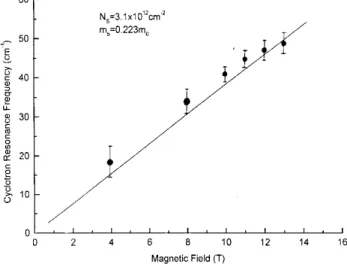
In Fig. 1 we have shown the CR-frequency as a func-tion of the applied magnetic eld, for a GaN/AlGaN heterojunction with electronic density Ns = 3:1
1012cm,2. The experimental results shown in this g-ure ( circles with error barrs) were obtained by Knap and co-workers [2]. Our theoretical results (solid line) were calculated for the electron band mass assumed as mb = 0:223me, where meis the free electron mass. We can note a good agreement between both the experi-mental and theoretical results. The qualitative behav-ior of the CR-frequency as function of the applied mag-netic eld is the same as observed previously for het-erostructures of GaAs [5,8]. However, in GaAs struc-tures the eects of non parabolicity of the conduction band and the screening of the electron-phonon interac-tion are decisive for the tting of the experimental data [5,8]. Here we have neglected these eects because, for the available set of experimental data, the inclusion of these eects do not improve the agreement between the experimental and theoretical results. The results by Knap et al. [2] for the electron band mass at the bottom of the conduction band were mb = (0:223
0:011)m e which agrees with our best t of the experimental data shown in the Fig. 1. Other experimental values found in the literature for mb=me are 0:219 [3]; 0:220
0:005 [9] and 0:210:02 [10].
Figure 1. CR frequency as a function of the applied mag-netic eld, for a GaN heterojunction with electronic density
Ns= 3:1 10
12cm,2. The experimental results shown in the
gure are those by Knap and co-workers [2] and our theo-retical results (solid line) came from the electron band mass assumed asmb= 0:223me.
Recently, Wu and Peeters [11] calculated the correc-tion to the electron CR mass using the memory func-tion formalism. As the IWBPT, this formalism has
been successfully applied to GaAs-based heterostruc-tures over the whole magnetic eld range [7]. The electron band mass was assumed as mb = 0:22me and a good agreement between the experimental data and the theoretical curves was observed. This calculation has taken into account the non parabolicity of the con-duction band and the screening of the electron-phonon interaction.
Figure 2. The magnetic eld dependence of the CR fre-quency for a GaN heterojunction with electronic density
Ns= 3:1 10
12cm,2, for various electron band mass values.
Figure 3. Theoretical results for the CR frequency calcu-lated for three values of the electronic density, 3:110
11cm,2,
1012cm,2and 3:1 10
12cm,2;the electron band mass being
assumed asmb= 0:223me.
678 Solemar Silva Oliveira et al. decreases as the electronic densities increase, this
be-ing due to the narrowbe-ing of the electronic layer, which increases the CR mass via the form factor given in the Eq.(7).
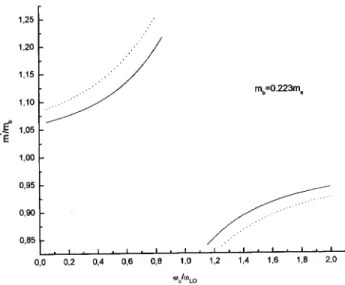
Fig. 4 shows the CR mass of electrons conned in a GaN quantum well with innite height for the potential barrier, as a function of the applied magnetic eld (solid lines). Also, for comparison, we have plotted in this g-ure the results for a GaN/AlGaN heterojunction (dot-ted lines).The qualitative behavior of the curves are the same observed previously for GaAs-structures [4,6;8]. Note in this gure that the width of the electronic layer in the heterojunction is approximately 35A, corre-sponding to an electronic density Ns= 3:1
10
12cm,2, while for the QW the width is L = 100A. Also, we can observe that, below the resonance (!c < !LO) the CR mass is higher for the heterojunction than for QW due to the highest connement the reverse occurring above the resonance.
Figure 4. Electron CR mass as function of the applied mag-netic eld for two GaN heterostructures, a quantum well with innite height for the potential barrier (solid lines) and a heterojunction (dotted line). The parameters used in the calculations were,mb= 0:223me,Ns= 3:1
10
12cm,2 and L= 100A.
As a resume, we have made a calculation of the CR frequency (and mass) of electrons conned in GaN het-erostructures including the electron-LO phonon interac-tion. For GaN/AlGaN heterojunction we compare our theoretical results with recent experimental data and a good agreement is found when the electron eective mass is taken as mb = 0:223me. Theoretical results for the electron CR mass in a GaN quantum well (innite connement) are considered.
References
[1] T. Ando, A. B. Fowler and F. Stern, Rev. Mod. Phys.
54, 437 (1982).
[2] W. Knap, H. Alause, J.M. Bluet, J. Camassel, J. Young, M. Assif Khan, Q. Chen, S. Huant and M. Shur, Solid State Comm.99, 195 (1996).
[3] Y.J. Wang, H. K. Ng, R. Kaplan, K. Doverspike, D. K. Gaskill, T. Ikedo, I. Akasaki and H. Amano, J. Appl. Phys.79, 8007 (1996).
[4] R.Dingle, D.D. Sell, S.E. Stokowski and M. Illegems, Phys. Rev. B4, 1211 (1971).
[5] F. A. P. Osorio, M. H. Degani and O. Hipolito, Phys. Rev. B38, 8477 (1988).
[6] F. A. P. Osorio, M. H. Degani and O. Hipolito, Sup-perltt. and Microst.6,107 (1989).
[7] F. A. P. Osorio, M. H. Degani and O. Hipolito, Braz. Jour. Phys.24, 248 (1994).
[8] F. M. Peeters, Wu Xiaoguang and J.T. Devreese, Phys. Rev. B33, 4338 (1986).
[9] M. Drechsler, D. M. Hofmann, B. K. Meyer, T. Detch-prohm, H. Amano and I. Akasaki, Jpn. J. Appl. Phys.
34, L1178 (1995).
[10] P. Perlin, E. Litwin- Staszewska, B. Suchanek, W. Knap, J. Camassel, T. Suski, R. Piotrziwski, I. Grze-gory, S. Porowski, E. Kaminska and J. C. Chervin, Appl. Phys. Lett.68, 1114 (1996).
[11] X. Wu and F.M. Peeters, Phys. Rev. B 55, 15438