REVISTA
BRASILEIRA
DE
ANESTESIOLOGIA
PublicaçãoOficialdaSociedadeBrasileiradeAnestesiologiawww.sba.com.br
SCIENTIFIC
ARTICLE
The
antimicrobial
activity
of
ephedrine
and
admixture
of
ephedrine
and
propofol:
an
in
vitro
study
Serkan
Tulgar
a,∗,
Elcin
Akduman
Alasehir
b,
Onur
Selvi
aaMaltepeUniversityFaculityofMedicine,DepartmentofAnesthesiologyandReanimation,Istanbul,Turkey bMaltepeUniversityFaculityofMedicine,DepartmentofMicrobiology,Istanbul,Turkey
Received3June2016;accepted20June2017 Availableonline13July2017
KEYWORDS
Ephedrine; Propofol; Antimicrobial
Abstract
Introduction:PropofolandEphedrinearecommonlyusedduringanesthesiamaintenance,the
formerasahypnoticagentandthelaterasavasopressor.Theadditionofpropofoltoephedrine oradministrationofephedrinebeforepropofolinjectionisusefulfordecreasingorpreventing propofol relatedhemodynamicchangesandvascularpain.This invitrostudy evaluatedthe antibacterialeffectoncommonhospital-acquiredinfectionpathogensofephedrine aloneor combinedwithpropofol.
Materialandmethod: The study was performed in two stages. In the first, the Minimum
Inhibitory Concentrationofpropofoland ephedrinealone andcombined was calculated for
Escherichiacoli,Enterococcusfaecium,Staphylococcusaureus,Pseudomonasaeruginosa,and
aclinicalisolateofAcinetobacterspp.at0,6,12and24h,usingthemicrodilutionmethod.In thesecondstage,thesamedrugsandcombinationwereusedtodeterminetheireffecton bac-terialgrowth.Bacterialsolutionswerepreparedat0.5MacFarlandinsterile0.9%physiological salineanddilutedat1/100concentration.Colonynumbersweremeasuredascolonyforming units.mL−1at0,2,4,6,8,10and12thhours.
Results:Ephedrineeitheraloneorcombinedwithpropofoldidnothaveanantimicrobialeffect
on Escherichia coli, Enterococcus faecium, or Pseudomonas aeruginosa and this was
simi-lar topropofol. However, ephedrine alone and combined with propofol was found to have anantimicrobialeffectonStaphylococcusaureusandAcinetobacterspeciesat512mcg.mL−1
concentrationandsignificantlydecreasedbacterialgrowthrate.
Conclusion: EphedrinehasanantimicrobialactivityonStaphylococcusaureusand
Acinetobac-terspecieswhichwerefrequentlyencounteredpathogensasacauseofnosocomialinfections. ©2017SociedadeBrasileiradeAnestesiologia.Publishedby ElsevierEditoraLtda.Thisisan openaccessarticleundertheCCBY-NC-NDlicense( http://creativecommons.org/licenses/by-nc-nd/4.0/).
∗Correspondingauthor.
E-mail:[email protected](S.Tulgar).
https://doi.org/10.1016/j.bjane.2017.06.004
0104-0014/©2017SociedadeBrasileiradeAnestesiologia.PublishedbyElsevierEditoraLtda.ThisisanopenaccessarticleundertheCC
PALAVRAS-CHAVE
Efedrina; Propofol; Antimicrobiano
Aatividadeantimicrobianadeefedrinaedacombinac¸ãodeefedrinaepropofol:um estudoinvitro
Resumo
Introduc¸ão:Propofol e efedrinasãofármacoscomumente usadosduranteamanutenc¸ãoda
anestesia,oprimeirocomoagentehipnóticoeosegundocomovasopressor.Aadic¸ãodepropofol àefedrinaouaadministrac¸ãodeefedrinaantesdainjec¸ãodepropofoléútilpara diminuir oupreveniralterac¸õeshemodinâmicasedor vascularrelacionadasao propofol.Esteestudo
invitroavaliouoefeitoantibacterianodeefedrina,isoladaouemcombinac¸ãocompropofol,
empatógenoscomunsimplicadoseminfecc¸ãohospitalar.
Materialemétodo:O estudo foi realizado em duas etapas. Na primeira, a concentrac¸ão
inibitóriamínima(CIM)depropofoledeefedrinaisoladaeemcombinac¸ãofoicalculadapara
Escherichiacoli,Enterococcusfaecium,Staphylococcusaureus,Pseudomonasaeruginosaeum
isoladoclínicodeAcinetobactersppàs0,6,12e24horas,usandoométododemicrodiluic¸ão. Nasegundaetapa,omesmofármacoesuacombinac¸ãoforamutilizadosparadeterminarseus efeitosnocrescimentobacteriano.Assoluc¸õesbacterianasforampreparadasemsorofisiológico a0,9%em0,5McFarlandediluídasaumaconcentrac¸ãode1/100.Osnúmerosdascolôniasforam medidoscomocfu.mL−1às0,2,4,6,8,10e12horas.
Resultados: Efedrinaisoladaouemcombinac¸ãocompropofolnão apresentouefeito
antimi-crobianosobreE.coli,E.faeciumouP.aeruginosa,umresultadosemelhanteaodepropofol. Porém,efedrinaisoladaeemcombinac¸ãocompropofolapresentouefeitoantimicrobianosobre
Staphylococcusaureus eAcinetobacter spp,em concentrac¸ão de512 mcg.mL−1,ereduc¸ão
significativadataxadecrescimentobacteriano.
Conclusão:EfedrinatematividadeantimicrobianaemS.aureuseAcinetobacterspp,quesão
patógenosfrequentementeidentificadoscomocausadeinfecc¸õesnosocomiais.
©2017SociedadeBrasileiradeAnestesiologia.PublicadoporElsevierEditoraLtda.Este ´eum artigoOpen Accesssobumalicenc¸aCCBY-NC-ND( http://creativecommons.org/licenses/by-nc-nd/4.0/).
Introduction
Propofolacommonlyusedhypnoticagentfortheinduction andmaintenanceofanesthesiaisknowntobeamicrobial growth-promotingagentthatispronetocontamination,due toitslipidemulsionstructure.1,2Despiteawarenessofthe
potentialofcontaminatedpropofol,sepsisandendotoxemia arestillobserved,sometimesevencausingmortality.3---5
Sev-eralagents have been usedin combination withpropofol todecrease its risk of contamination, including lidocaine that is also helpful in reducing the pain observed dur-ingadministration.2,6---8Propofolis,ofcourse,nottheonly
sourceof bacterial contaminationin operatingrooms and intensive care units,and several medicationsand devices canleadtothe complications ofbacterial contamination, includingsepsis.
Ephedrineisacommonlyusedvasopressoragentthathas beenusedforseveralpurposesin anesthesiapractices.9,10
Studies have demonstrated that the addition of propo-fol as an admixture to ephedrine or administration of ephedrinebeforepropofolinjectionisusefulfordecreasing or preventingpropofolrelated hemodynamic changesand propofol related vascular pain.11---13 A recently published
studyreportedthatephedrinehadan antimicrobialeffect on Escherichia coli at certain concentrations.14 We are
unawareofanysimilarstudies.
This in vitro study was performed to evaluate the antibacterialeffectoncommonhospital-acquiredinfection pathogensofephedrinealoneorcombinedwithpropofol.
Material
and
method
Drugsandmicroorganisms
Ephedrine(Efedrin Hidroklorür ampul0.05g.mL−1,Biosel,
Turkiye) and 1% propofol (Propofol 1% Fresenius, Turkiye) was usedin this study.The study was designed withtwo stages. Inthe firststage,the MinimumInhibitory Concen-trations (MIC) of ephedrine and propofol separately and combined were determined using the brothmicrodilution methodaccordingtotheproceduresoutlinedbytheClinical and LaboratoryStandards Institute (CLSI).15 In thesecond
stage, the effect on growth rate of organisms found to beaffected bythesedrugswasmeasured. Staphylococcus aureusATCC25923,E.coliATCC25922,Pseudomonas aeru-ginosaATCC27853,EnterococcusfaeciumRSKK01.016and aclinicalisolateofamultidrugresistantAcinetobacterspp. wereusedascontrolmicroorganisms.Thesestrainsof bacte-riawere obtainedfromAmericanTypeCultureCollection, USA(ATCC)andRefikSaydamNationalTypeCulture, Collec-tion,Turkey(RSKK).
DeterminationofMIC
Table1 MinimumInhibitoryConcentration(MIC)valuesofEphedrine(E)andPropofol&Ephedrin(E+P)admixturesat0,6th, 12thand24thhoursfordifferentmicroorganisms.NI,NoInhibitionatanyconcentration.
0hour 6thhour 12thhour 24thhour
E
(g.mL−1)
E+P (g.mL−1)
E
(g.mL−1)
E+P (g.mL−1)
E
(g.mL−1)
E+P (g.mL−1)
E
(g.mL−1)
E+P (g.mL−1)
E.coli NI NI NI NI NI NI NI NI
P.Aeruginosa NI NI NI NI NI NI NI NI
E.faecium NI NI NI NI NI NI NI NI
S.aureus NI NI 512 512 512 512 512 512
Acinetobacter NI NI 512 512 512 512 512 512
32g.mL−1,16g.mL−1,8g.mL−1,4g.mL−1,2g.mL−1, 1g.mL−1and0.5g.mL−1.
Step2:Preparationofbacterialsolutions:Solutionswere prepared at 0.5MacFarland in sterile 0.9% physiological salineforeachbacterium.
Step 3: Preparation of microwells: 0.1mL of drug mixtureand0.01mLofbacterialsolution(5×10⁵
Colony-Forming Units per milliliter [CFU.mL−1]), 0.1mL CAMHB
(Cation-AdjustedMuellerHinton Broth)wereplaced into microwellsforalldrugandbacteriacombinations. Step4:Subculturesandcolonycount:Subculturesfrom allmicrowellsweretakenat 0,6th,12thand24thhours ofincubation.Eachsubculturewasincubatedat36±2◦C
for 18h. After incubation, colonieswere countedfor all preparations.
Determinationofbacterialgrowthrate
This sectionofthestudy wasonlyperformed for microor-ganismsfoundtobeinhibitedbyE,PorE+P.
Step1:Preparationofdrugsolutions:Eightsetsoftubes werepreparedfor E, PandE+Prespectively.Each tube waspreparedtohaveaconcentrationof512g.mL−1with a total of 1mL in each tube. One tube in each set was assignedasthecontroltube.
Step2:Preparationofbacterialsolutions:Bacterial solu-tions were prepared at 0.5MacFarland in 0.9% sterile solutionthatwasdilutedto1/1000.
Step 3: Combination of drug and bacterial solutions: 50Lofbacterialsolutionwasaddedtoeachsetofdrug solutionexceptforthethreecontroltubes.
Step4:Determinationofcolonynumbers:Alltubeswere incubatedat36±2◦C.At0,2nd,4th,6th,8th,10thand
12thhours,sampleswereobtained anddilutedto1/100 with 0.9% sterile saline solution. 100L of this dilution wasinoculatedintosheepbloodagar.Plaqueswere incu-bated at 36±2◦C for 24h. Colony numbers (CFU.mL−1)
weremeasuredbyasecondresearcher.16,17
Results
TheMICvaluesformicroorganismsindifferentdrugsolutions areshown inTable1.TheMICvaluesofmicroorganismsin ephedrineweredeterminedasfollowsat6thhour:E.coli, P.aeruginosa and E.faeciumwere above512g.mL−1;S. aureusandAcinetobacterspp.were512g.mL−1andafter
24h theMIC valueswere thesame for allthe isolates.In propofolstudiedstrainsgrewwithin3---6h.
TheMICvaluesofephedrineinpropofolwerethesame as ephedrine alone. Ephedrine has antibacterial effects onS. aureus andAcinetobacterspp. whicharefrequently encountered in hospital settings, but when these drugs areadministeredasan infusion aloneor withpropofol,it shouldbeusedat concentrationsequaltoor greaterthan 512g.mL−1.
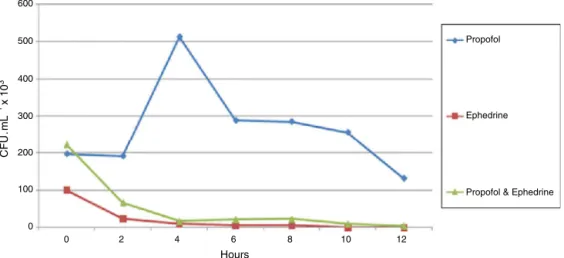
In the second stage, the growth rates of S. aureus andAcinetobacter spp. inephedrine aloneandephedrine pluspropofol weredetermined. These rates areshown in Figs.1and2. Ephedrinealoneor combinedwithpropofol wasfoundtosignificantlydecreasethegrowthrateofthese microorganisms.
Discussion
Propofol,asshowninthisstudy,isastrongbacterialgrowth promotingemulsion.Ephedrineitheraloneorcombinedwith propofol did not have an antimicrobial effect on E. coli, E.faeciumorP.aeruginosaandthis wassimilarto propo-fol.However,ephedrinealoneandcombinedwithpropofol wasfoundtohaveanantimicrobialeffectonS.aureusand Acinetobacterspp.at512mcg.mL−1concentrationand
sig-nificantlydecreasedbacterialgrowthrate.
Contaminated propofol can lead to many infectious complications. The administration of lidocaine before propofol injection or its addition to propofol is com-monly used to prevent propofol injection related pain. Severalstudieshaveshowntheantibacterialeffectof lido-caine at high concentrations. However, Vidovich et al.18
reported that lidocaine alone or combined with propofol didnothavean effectonS. aureus,Serratiamarcescens, PseudomonasaeruginosaandCandidaalbicansatlow con-centrations(1%).Ozeretal.7reportedantimicrobialeffect
oflidocaineonE.coli,S.aureus,S.epidermidisandP. aeru-ginosaat ahighconcentrationof2%,but noantimicrobial effectat low concentrations of 0.05---0.1%. Similar tothe previously mentioned reports, many studies have demon-stratedthatpropofolisastrongbacterialgrowthpromoting agent.
In addition to the above mentioned studies, Masaki et al.19 evaluated the physicochemical
600
500
400
300
200
100
0
0 2 4 6
Hours
CF
U.
mL
–1 x 10
3
8 10 12
Propofol
Ephedrine
Propofol & Ephedrine
Figure1 Staphylococcusaureusgrowthratesindifferentdrugsandadmixture.CFU,ColonyFormingUnits.
using gas chromatography. Secondly, for formation of microprecipitationoroildropletsfor evaluatedwith scan-ningelectron microscopyin randomlyselectedfields. The authorsreportedalineardecreasein lidocaine concentra-tionafter4h inthemixturethatincluded40mglidocaine and electron microscopy showed droplets with diameters of ≥5m appearing 30min after preparation of mixture. Due tothese findings, the authors drew attention tothe possibilityofemboliat highdosesoflidocaineinpropofol mixture. There are no similar studies for ephedrine and propofol.
The antimicrobial effect of many anesthetic agents has previously been studied. Begec et al.2 evaluatedthe
antimicrobial effect of ketamine---propofol combination, commonlyusedforanesthesiainductionandsedoanalgesia. TheirstudyreportedantimicrobialeffectonE.coli,P. aeru-ginosaand C. albicans at high ketamine concentration of admixture,butnosucheffectonS.aureus.
In a study evaluating the antimicrobial effect of 1---10---100g.mL−1 concentrations of remifentanil in propofol, the authors found a dose-related significant
antimicrobial effect on S. aureus and P. aeruginosa, and a similar but less effect on E. coli and C. albicans.20
Another in vitro study reported the antimicrobial effect of remifentanil on S. aureus, S. epidermidis, E. faecalis, E. coli,P.aeruginosa anda clinical isolateof amultidrug resistantAcinetobacterspp.17
Theantimicrobial effectofanesthetic agentsis mostly comparedwithpropofolortheagentisusedasanadmixture withpropofol.Inourstudy,weevaluatedtheantimicrobial effectofephedrinealoneandasanadmixturewith propo-fol.Wefoundthatephedrinebothaloneandincombination waseffectiveatinhibitingbacterialgrowthofS.aureusand Acinetobacterspp.Thesameeffectwasnotobservedwith othermicroorganisms.
The only previous study on antimicrobial effect of ephedrinewaspublishedby Zhaoetal.14 Usingephedrine
ataconcentrationof328.76mcg.mL−1at37◦C,theyfound that E. coli growth was inhibited by 50%. The authors therefore concluded that ephedrine could be a poten-tialantibacterialagentofclinical importance.This report was the inspiration for the current study. In the current
25
20
15
10
5
0
0 2 4 6
Hours
CF
U.
mL
–1 x 10
3
Propofol
Ephedrine
Propofol & Ephedrine
8 10 12
study, however, we were unable todetermine any effect ofephedrineoninhibitinggrowthofE.coli.
In order to determine the effect of ephedrine on E. coli, Zhaoet al.14 usedmicrocalorimetric tests to
cal-culatethehalfinhibitoryconcentration.Microcalorimetric testsarenon-invasiveandnon-destructivetechniques that demonstrate the interaction of a drug and the microbial cell. Microcalorimetric studies have been used to evalu-atethe effect ofsingle or a combination of antibacterial drugs.14,21,22 Althoughthistechniquehasahighsensitivity,
accuracyandissimpletoperform,itisalsoexpensiveandis notavailableatourinstitute.Therefore,weused microdi-lution and microbial culturing in our study. In addition, propofol’s lipid contentcauses it to act asa growth pro-motingagent6whilewehypothesizedthatEphedrineonthe
otherhandisantimicrobial.Wewereunabletofindastudy that utilizedmicrocalorimetrictechniques for the evalua-tionofacombinationofgrowthpromotingandantimicrobial agents.Therefore,wedonotbelievethatmicrocalorimetric techniqueswouldbeappropriateforthisstudy.
AlthoughtheE.colistrainsofourstudyandthatofZhao et al. were not the same, we cannot explain our differ-entfindingsasbothstrainswereofinternationalstandards. WhileZhao etal. used99.9%concentrated ephedrineand cultured E. coli in peptone culture and then transferred to LB tubes, we usedcommercial form of ephedrine and bloodagarforculturematerial.Zhaoetal.usedmethanolto diluteephedrinewhileweusedisotonicNaCl.The discrep-ancyinthefindingsofthesetwostudiescannottherefore beattributedtoone,butmanydifferencesinstudy method-ologies.Furtherinvestigationswouldbenecessarytoclearly explainthisdiscrepancy.
The use of ephedrine with propofol admixture is not common in anesthesia practice. Several studies have reported good results when ephedrine is used before propofol injection or as an admixture with propofol for decreasing propofol injection pain and propofol related hemodynamic changes.11,12,23,24 We determined
antimicro-bialeffectofephedrineataconcentrationof512mcg.mL−1.
However,moreprecisestudiesmayfindthisconcentration to be between 256mcg.mL−1 and 512mcg.mL−1. Even
when propofol admixture is prepared with 512mcg.mL−1
concentration, the dosage of ephedrine given at induc-tion is 125mcg.kg−1. This is similar or less than other
reports.11,12,23,24 Studies onsingledosesofephedrinehave
reportedevenhigherdoses.25
In addition to its antimicrobial effect, the use of ephedrinewithpropofolduringinductionhasseveral addi-tional benefits. There may be a decrease in propofol injection pain.11---13 Propofol is the most commonly used
anesthetic-hypnoticagentandisassociatedwith hypoten-sion at induction.26 Ideally, an anesthetic agent should
provide adequate hypnosis with minimal hemodynamic changesinordertomaintainhemodynamic stability.Many studieshavereportedtheuseofephedrinefor prevention ofpropofolassociatedhemodynamicchanges.10,23,24,26
How-ever,theuseofpropofol---ephedrinemixtureshouldbeused withcautioninhypertensivepatients.
Ephedrine is a commonly used agent especially used in neuraxial anesthesia for urgent vasopressor requirements.9,27,28 Whenusedasavasopressor,wedonot
believethatthelowconcentrationwillleadtoantimicrobial
effect. However, increased use of propofol---ephedrine admixture for prevention of hemodynamic changes after propofol injection may decrease the contamination rates of propofol and decrease postoperative infectious complications.Also, when we considerthe long term use of propofol as an agent for total intravenous anesthesia and for sedation in intensive care units, the admixture with ephedrine may decrease infectious complications. Furtherclinicalandpharmacologicalstudiesarerequiredto determinethesafedoserange.Thisisespeciallyimportant whenweconsideritsantimicrobialeffectonAcinetobacter spp.Ourstudyisthefirsttoclearlydemonstratethe antimi-crobialeffectofephedrineonseveralmicrobialagents.
Although there are several studies on the clinical use ofdifferentconcentrationsofephedrine---propofolmixtures, therearenophysicochemicalcompatibilityordosagesafety studies.Thereforeweareunabletodrawaclearconclusion withregardtotheclinicaluseofthisantimicrobialeffect. Theuseofephedrine---propofoladmixtureinanesthesiaand intensivecarepracticemayleadtoadecreaseininfectious complication.Randomizedcontrolledtrialsarerequiredto determinetheefficacyinclinicalsettings.
Conclusion
Ourstudyhasdemonstratedthatephedrinealoneor com-binedwithpropofolhasaninhibitoryeffectat512mcgmL−1
concentration on bacterial growth rate of S. aureus and Acinetobacterspp.
Conflicts
of
interest
Theauthorsdeclarenoconflictsofinterest.
References
1.MageeL,GodsiffL,MatthewsI,etal.Anaestheticdrugsand bac-terialcontamination.EurJAnaesthesiolSuppl.1995;12:41---3.
2.Begec Z, Yucel A, Yakupogullari Y, et al. The antimicrobial effectsofketaminecombinedwithpropofol:aninvitrostudy. BrazJAnesthesiol.2013;63:461---5.
3.ChenSH,KungCC,FungST.Endotoxemiaduetopropofol con-taminationinfourconsecutivepatients.JFormosMedAssoc. 2014;113:328---9.
4.Klein J, Huisman I, Menon AG, et al. Postoperative infec-tion due to contaminated propofol.Ned Tijdschr Geneeskd. 2010;154:A767.
5.Franci P,DottoG, Cattai A, etal. Lethal septicshock after dentalscalinginahealthydogduetoOchrobactrum anthropi-contaminatedpropofol.JSmallAnimPract.2015;56:345---7.
6.WachowskiI,JollyDT,HrazdilJ,etal.Thegrowthof microor-ganisms inpropofol and mixtures ofpropofol and lidocaine. AnesthAnalg.1999;88:209---12.
7.OzerZ, OzturkC,Altunkan AA, etal. Inhibitionofbacterial growthbylignocaineinpropofolemulsion.Anaesth Intensive Care.2002;30:179---82.
8.KelesGT,KurutepeS,TokD,etal. Comparisonof antimicro-bial effects of dexmedetomidine and etomidate-lipuro with thoseofpropofolandmidazolam.EurJAnaesthesiol.2006;23: 1037---40.
crystalloidversuscolloidcoloading.MiddleEastJAnaesthesiol. 2015;23:273---81.
10.Masjedi M, Zand F,Kazemi AP,et al. Prophylactic effectof ephedrine to reduce hemodynamic changes associated with anesthesiainductionwithpropofolandremifentanil.J Anaes-thesiolClinPharmacol.2014;30:217.
11.GilaniMT,BameshkiA,RazaviM.Efficacyofephedrineinthe preventionofvascularpainassociatedwithdifferentinfusion ratesofpropofol.AnesthEssaysRes.2014;8:345---8.
12.CheongMA,KimKS,ChoiWJ.Ephedrinereducesthepainfrom propofolinjection.AnesthAnalg.2002;95:1293---6.
13.CetinkayaD,BalabanO,AydinT,etal.Canaddingephedrine toadmixtureofpropofol&lidocaineovercomepropofol asso-ciatedhemodynamicchangesandinjectionpain.IntJAnesth Res.2016;4:213---8.
14.ZhaoY,JiaL,WangJ,etal.Microcalorimetrywith correspon-denceanalysisforstudyingtheantibacterialeffectofephedrine onEscherichiacoli.ThermochimActa.2013;557:50---4.
15.PerformanceStandardsforAntimicrobialSusceptibilityTesting:
Fifteenth Informational Supplement. Clinical and
Labora-tory Standards Institute (CLSI); M100-S23. Available on:
www.clsi.org.
16.BátaiI,KerényiM,TekeresM.Thegrowthofbacteriain intra-venousglyceryltrinitrateandinsodiumnitroprusside.Anesth Analg.1999;89:1570---2.
17.ErdenIA,GulmezD,PamukAG,etal.Thegrowthofbacteriain infusiondrugs:propofol2%supportsgrowthwhenremifentanil andpantoprazoledonot.BrazJAnesthesiol.2013;63:466---72.
18.VidovichMI,PetersonLR,WongHY.Theeffectoflidocaineon bacterialgrowthinpropofol.AnesthAnalg.1999;88:936---8.
19.MasakiY,TanakaM,NishikawaT.Physicochemicalcompatibility ofpropofol---lidocainemixture.AnesthAnalg.2003;97:1646---51.
20.Apan TZ, Apan A, Sahin S, et al. Antibacterial activity of remifentanilandmixturesofremifentanilandpropofol.JClin Anesth.2007;19:346---50.
21.VazquezC,LagoN,MatoMM,etal.Microcalorimetricstudyof thegrowthofEnterococcusfaecalis,Pseudomonasaeruginosa andtheirmixturesinanenrichedculturemedium.JThermAnal Calorim.2015;121:463---8.
22.Astasov-FrauenhofferM,BraissantO,Hauser-GerspachI,etal. Microcalorimetricdeterminationoftheeffectsofamoxicillin, metronidazole,andtheircombinationoninvitrobiofilm.J Peri-odontol.2014;85:349---57.
23.ChowMY-H,Sim K-M,Sia AT-H,etal. Haemodynamiceffects ofaddingephedrinetopropofolandalfentanil.CanJAnaesth. 1998;45:597---8.
24.Gopalakrishna MD, Krishna HM, Shenoy UK. The effect of ephedrineonintubatingconditionsandhaemodynamicsduring rapidtrachealintubationusingpropofolandrocuronium.BrJ Anaesth.2007;99:191---4.
25.KolIO,KaygusuzK,GursoyS,etal.Theeffectsofintravenous ephedrineduringspinalanesthesiaforcesareandelivery:a ran-domizedcontrolledtrial.JKoreanMedSci.2009;24:883---8.
26.FarhanM,HodaMQ,UllahH.Preventionofhypotension asso-ciated with the induction dose of propofol: a randomized controlledtrialcomparingequipotentdosesofphenylephrine andephedrine.JAnaesthesiolClinPharmacol.2015;31:526---30.
27.ThomasDG.Ephedrineisthevasopressorofchoiceforobstetric regionalanaesthesia.IntJObstetAnesth.2002;11:278---81.