Dynamis and Causality Constraints
Manoelito M.de Souza
Departamentode Fsia, UniversidadeFederaldoEspritoSanto
29065-900, Vitoria,ES,Brazil
Reeivedon8Otober,2001
Thephysial meaningand the geometrialinterpretation of ausality implementation inlassial
eldtheories aredisussed. Causality ineldtheoryare kinematial onstraintsdynamially
im-plementedviasolutionsoftheeldequations,butinalimitofzero-distanefromtheeldsoures
partoftheseonstraintsarriesadynamialontentthatexplainsoldproblemsoflassial
eletro-dynamiswithdeepimpliationstothenatureofphysialinterations.
I Introdution
Causality implementation in eld theory is naturally
onnetedtotheveryoneptofeldpropagation.Old
andwellknownproblemsappearwithaeldinalose
neighbourhoodtoitssoures. Thenaarefulanalysisis
requiredasthekinematialonstraintofaausal
prop-agation ismixed withthedynamis oftheeld-soure
interation. Inpartiular,forapoint-likesoure,there
are problems with innities and other signs of
inon-sisteny. Thus there is a generalizedbelief that these
innities are onsequenes of the soure point-size
di-mensionand,onsequently,thatapoint-partileannot
beregardedasaviablemodelforahargedelementary
physial objet. This, as shown in the referene [1℄,
does not orrespond to reality. The innities
assoi-atedtoapoint-hargeself-eldareonsequenesofthe
way ausality has being implemented with the use of
lightones, whose vertex is a singular point; the eld
innityjust reetsthissingularity. Thisworkreturns
totheideasraisedinthereferene[1℄furtherdisussing
its physial and geometrial meanings. Although itis
being basedon the aseof a point eletriharge, its
onlusions are of a wider generality, being valid for
anytheoretiframeworkwithausalityimplementation
(Classial and Quantum Field Theory, Quantum
Me-hanis,GeneralRelativity,StatistialMehanis,et).
It shows that the plain Maxwell's theory, in a
short-distane limit, reveals unequivoal and previously
un-suspetedsignsofitsquantumnature(theexisteneof
photons)throughtheindiationofadisretenessonthe
eletromagnetiinteration,hiddenbehindthelassial
ontinuousformalism. Ithintsaproposalofanew
ap-proah,developedelsewhere[2℄whereeldsandsoures
are symmetriallytreatedasdisretepointlikeobjets
fromwhihthestandardontinuouseldsareretrieved
as spaetimeeetiveaverages.
This paperis organizedin thefollowingway. The
geometrivision of ausality is disussedin SetionII
with theintrodution of the newonept of extended
ausality in ontraposition to the usual loal
ausal-ityand oftheironnetionto wave-partileduality. A
generalizationofthestandardviewofausalitymustbe
notied: theuseofhyperonefordesribingthe
propa-gationof massiveelds,haraterizedbynon-onstant
proper-times. Thisinludesthelightoneasalimiting
hyperone for massless elds (onstant proper-times)
as in the usual approah. Setion III reviews
point-hargeeletrodynamisinthestandard(loalausality)
approah, pointing itsinherent onitswith a
subja-ent idea of extended ausality. The impliations of
extendedausalityto eld-souredynamis isexposed
in Setions IV and V. The paper losesin Setion VI
withsomegeneri ommentsabout theharateristis
and onsequeness of a formulation of eld theory in
termsofdisreteinterations.
II Causality and spaetime
geometry
Thenotationused isofomittingthespaetimeindies
whenthisausesnoambiguity. Forexample, for
,
and A(x;) for a vetor eld A
(x;); x stands for
both, the eventparameterized by x
= (t;~x ) and for
theoordinatex
itself.
Any given pair of events on Minkowski spaetime
denes a four-vetor x: In our notation, therefore,
x is not meant to be neessarily an innitesimal,
for whih we make use of dx. The propagation of a
freemasslesseld onaatspaetime of metri
=
diag( 1;1;1;1);isrestritedby
x 2
whih denes a loal double (past and future)
light-oneontainingthisfour-vetorx: t=j~xj:This
is also amathematial expression ofloal ausality in
thesensethatitisarestritionforthemasslesseldto
remainon thislightone. It isapartiular aseofthe
moregeneriexpression
2
= x
2
; (2)
whih is, besides, the denition of the proper time
assoiatedto thepropagation ofafreephysial objet
arossx. As isarealvaluedparameter,theEq. (2)
just expresses that x annot bespaelike.
Geomet-rially it is also the denition of a three-dimensional
doublehyperone,ofwhih thelightoneandthetime
axisarejust thetwoextremelimitingases. xisthe
four-vetor separation between a generi event x and
the hyperone vertex. This oni hypersurfae is the
support for the denition of apropagating eld. The
hyperoneaperture-angle; 0=4;is givenby
tan = j~xj
jtj
; = 1; or 2
= (t) 2
(1 tan 2
): A
hange of the supporting hyperone orresponds to a
hange ofspeedofpropagationand isanindiationof
interation.
Letusonsider aeld onapointx ofahyperone
de-nedbytheEq. (2). Thereforeweknowx,the
four-vetordeterminedbyx andbyitspast-hyperone
ver-texonitssoure'swordline. Continuityrequirementsof
theeldpropagationleadustoapplytheonstraint(2)
onaneighbourhood of x: (+d) 2
= (x+dx) 2
or,after usingEq. (2),d+x:dx=0,whih may
bewritten as
d +f:dx=0; (3)
wheref isaonstantfour-vetortangenttothe
hyper-one(2),entirelydenedbyx(freepropagation). For
6=0itisjust
f
:= x
2
+x 2
=0
(4)
For =0thehyperone(2)redues tothelightone
(1) and f to its tangent four-vetoralong x; f and
xarebothlightlike. Itisimportanttoobservethatf
iswelldenedforany,inluding =0,aslongas
x6=0:Atangentisnotdenedatahyperonevertex.
Thisisaruxpoint,negletedintheexistingliterature
[3,4,5, 6,7,8℄whih leadstotheoldandwellknown
vexing problems of onsisteny in lassial
eletrody-namis[1℄. GeometriallyEq. (3)denesahyperplane
tangent to the hyperone (2). The simultaneous
im-position of Eqs. (2) and (3) on the propagation of a
freepointobjetproduesamuhmorestringent
on-straint than loal ausality as the objet is restrited
toremainontheintersetionofthehyperone(2)with
its tangent hyperplane (3), that is, on the hyperone
generator tangentto f, orthe f-generator, for short.
Itassuresthat dxofEq. (3)isalwaysollineartox.
Or,in other words,that afreepointlikeobjet
propa-gatesonastraightline(whihistangenttof),exatly
asrequiredbyNewton's rstlaw. Thisorrespondsto
anampliedoneptofausalitywhihwillbereferred
toasextendedausality.
Loalandextendedausalityorrespondtotwo
dis-tintandomplementary(likegeometriandwave
op-tis)desriptionofasamephysialsystem. They
orre-spondtodierentpereptionsofthespaetimeavailable
to thefreeevolutionofaphysialsystemfrom agiven
initialondition,respetivelyasfoliationsofhyperones
andasongruenesofstraightlines,thehyperone
gen-erators. So,whereastherstoneisappropriatedfora
desriptionintermsofontinuousandextendedobjets
likeauid,aeld,awave,theseondoneimpliesona
pereptionofthemasdisretesetsofpoints,desribing
individuallyeahpoint.
III Point-harge
eletrodynam-is
It is worthwhile to review the standard approah for
thepoint-hargeeletrodynamisvis-a-vistheextended
ausality onept. Consider, for example, z(), the
worldlineofalassialpointeletronparameterizedby
itspropertime; eaheventonthisworldlinebelongs
tothe(instantaneous)hyperone
2
+z 2
=0; (5)
where,again,thefour-vetorzisdenedbytheevent
z and the vertex of ahyperone (not a lightone, for
a massive eletron) that passes by z; the four-vetor
u = dz
d
is tangent to the worldline (and to the loal
hyperone). Itsatises
d+u:dz=0; (6)
whihorrespondsto Eq. (3). A freeeletronremains
ontheu-generatorofitshyperone;anaelerated
ele-tronisonau-generatorofitsinstantaneoushyperone.
So,inaway,lassialeletrodynamisalreadyuses
ex-tendedausalityforspeifyingthestateofthelassial
eletron, and this is onsistent with an eletron
mod-eled asa point partile. Letus disuss how extended
ausalityentersinthedenitionoftheeletromagneti
eld in aonitiveway. It hints to anew onsistent
formulationforeldtheory.
Considernow theeletromagneti eld at x,
emit-ted by this eletron. x = x z() denes a family
offour-vetorsonnetingtheeventxtoeventsonthe
eletronworldlinez():Then,aountingforthe
mass-lessnessoftheeletromagnetield,x 2
=0,the
dou-ble lightone with vertex at x; interepts z() at two
Figure1. TheadvanedandtheretardedLienard-Wiehert
eldsataneventx. adv andretarethetwointersetions
ofthedoublehyperonex 2
=0,forx=x z(),with
theeletronworldlinez().
Theretardedeldemittedbytheeletronatz(
ret )
mustremaininthez(
ret
)-future-lightone,whih
on-tains x; and aording to the standardinterpretation
[3, 4, 5℄, the advaned eld produed by the eletron
at z(
adv
) must remain in the z(
adv
)-past-lightone,
whih also ontainsx. So,the eletromagneti
poten-tial eld is dened just with loal ausality. There is
thenaleardihotomywithrespettoausality
imple-mentationinthetreatmentdonetotheeletronandto
itsself-eld[9℄,ausedbythepereptionoftheeletron
as apointpartile,adisreteobjet,andofitseldas
a ontinuousand distributed one. Extended ausality
requires andimpliesdisreteobjets.
The(retardedandadvaned)Lienard-Wiehert
so-lutions oflassialeletrodynamis[3,4,5℄are
A (x)= eu () = s
; for 6=0; (7)
where
s
stands for either
ret or
adv
, whih are,
re-spetively, the retarded and the advaned solution to
theonstraint
(x z()) 2
=0; (8)
imposedtoA(x); and
:= u:x; (9)
withx=x z(),representsj~x jintheharge
rest-frame. Although A(x) is restrited just by Eq. (1),
havingtherebysupportonthelightone,forthe
alu-lationofitsMaxwelleld
F := A A (10)
onapointxitisneessarytoonsiderA(x)ona
neigh-bourhoodofx,andsoaonstraintequivalenttotheEq.
(3)mustbealsoonsideredtoassuretheonsistenyof
Eq. (1)in thisneighbourhood. FromEq. (8)one has
x:d(x z)=x:(dx ud)=0;
whihleadsto
d+K :dx=0; (11)
whereKdened by
K = x u:x s = x s ; (12)
isanull(K 2
=0)four-vetor,tangenttothelightone
x 2
=0. K
showstheloal diretionof propagation
oftheeletromagneti eld emittedbytheeletron at
s
:Inthisontext,Eq. (11)isaonsistenyrelationof
Eq. (8), assuringits validity for all suessive pair of
events(x;z()):Itimplieson
K = s x ; (13) where s
,asolutionofEq. (8),isseenasafuntion of
x. Then, 1 e A s = K a + u 2 s = 1 2 K W +u u s ; (14) d
where a:= du d ; s = K
1+a:K u s (15)
andtheanillaryfour-vetorfuntion W,
W =fa +u
1+a:K g ; (16)
hasbeenintroduedjust fornotationsimpliity. So,
F = 1 2 K W K W s (17)
Geometrially the Eq. (11), like the Eq. (3), denes
a family of hyperplanes that, for d = 0, are
K
=
K
:Theuseofbothonstraints(8)and(11)
singlesoutthelight-onegeneratortangentto K
and
inserts extended ausality in the F denition, whih
is exhibited on its expliit dependene on K
. But
rigourouslythisis aninonsistentproedure asan
un-due mixing of loal and extendedausalityon asame
physial objet. The inonsisteny is on F being
de-nedastheurlofA(x)whihisaontinuouseldwith
support on the lightone. If its support is redued to
theK-generatorof itslightone,F hastoberegarded
asadisreteobjet,similar, in thisaspet, to itsvery
soure, the point eletron. The problem, of ourse, is
notwith thedenition (10)of F but with A(x) being
apropagating extendedeld and, therefore, restrited
by aausality onstraintthat neessarilyrequires the
onstraint(11)onanyeldderivative. Inotherwords,
there would beno problem with thedenition (10)if
A(x) where not onstrained by (8) beause the
on-straint(11)wouldnotbealledupthen. Sinethe
on-straint(11)annotbeavoidedaompletely onsistent
formulationrequires A(x)beingdened withextended
ausalitytoo. This leadsto theonsiderationof elds
denedwithsupporton(1+1)submanifoldsimbedded
in the (3+1) spaetime, \disreteelds", with a
om-pletesymmetrybetweeneldsandsoures;bothbeing
disreteobjets. This isdoneinthereferene[2℄. The
goal of the present paper is just of pointing the
exis-teneoftwomodesforausalityimplementation(loal
andextended)in eldtheoryandtheirimpliationsto
themeaningandnatureoftheeldsandoftheir
inter-ations.
Inthestandardliterature,withoutknowledgeof
ex-tendedausality,Fisseenasaeldwithsupportonthe
lightone, i.e. asaontinuously extended objetand,
then, with the old and well-known problems with
in-nities andother inonsistenies. These problems just
vanishafterdueonsiderationofextendedausality[1℄.
The origin of this imbroglio is that the Equation
(11), asitan be formally obtainedfrom aderivation
of Eq. (8), has been historially onsidered [3, 4, 5℄
asif all its eets were already desribed by Eq. (8),
inludedinitandnot,asitisthease,anewand
inde-pendent restritiontobeonsideredat asamefooting
and in additionto it. An evideneof this isthat Eqs.
(8)and(11)arrydistintphysialinformationsaswe
disussnow.
IV Dynamis and ausality
Eq. (11)onnetstherestritiononthepropagationof
thehargeto the restritiononthe propagation ofits
emittedorabsorbedelds. LikeitsparentEq. (8)itis
justakinematialrestrition. Butintheshort-distane
limit,whenx tendstoz(),Eq. (11),in
ontradistin-tion to Eq. (8), is diretly related to the hanges in
theharge's stateofmovementdue totheemission or
to the absorption of eletromagneti eld, that is, to
the harge-eld interationproess. Therefore, in this
shortdistanelimitEq. (11)alsoarriesdynamial
in-formation, notonlykinematial, asisthease ofEqs.
(5)and(8).
Itisinstrutivetohavealoselookonthephysial
meaning ofEqs. (8) and (11)forthe aseof an
emit-ted eld. Eq. (8) is arestrition on the propagation
of a single objet, the eld emitted by the harge at
z(), whereas the Equation (11) onnets restritions
onthepropagationoftwodistintphysialobjets,the
eletron and its eld: d desribes a displaement of
theeletrononitsworldlinewhiledxisthefour-vetor
separationbetweentwootherpointswheretheeletron
self-eldisbeingonsidered.Ifd =0thendxis
light-likeandollineartoK,asK :dx=0:Thus,dxisrelated
toasameeletromagnetisignalattwodistinttimes.
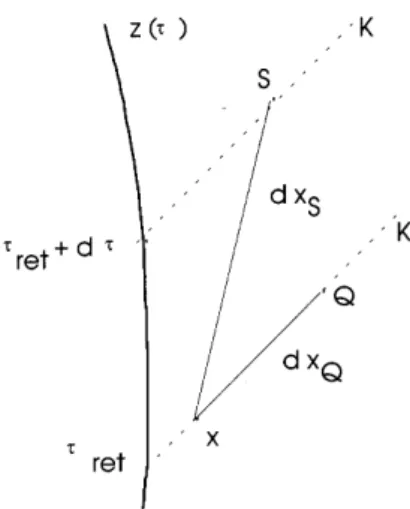
Theeletromagnetield atx+dx anbeseenasthe
sameeld at x that haspropagated to there with the
speedoflight. Ontheotherhand,ifd 6=0thendxis
notollineartoKanditisrelatedto twodistint
ele-tromagnetisignals,emittedatdistint times. Seethe
Fig. 2. Inthisase,theeld atx+dxannotbeseen
as thesameeldat xthat haspropagated tothere. It
isanothereld emittedbythehargeatanothertime.
Thisapparentlyobviousinterpretationoftheonstraint
(11) reveals, however, deepphysial impliations asit
pereives asbeingdistint objetsthe elds F in two
eventsthat are notalong asame four-vetorK. This
omes from extended ausality requiring a F dened
withsupportonaK-light-onegeneratorand
onit-ingwithloalausalityinthedenitionofA(x).
Figure2. TheeldatthepointQmaybeonsideredasthe
same eld at xthat has propagatedto Q,beause dx
Q is
ollineartoK.TheeldsateventsxandSaretwodistint
signalsemittedbythehargeattwodistinttimes
ret and
ret
+d as dx
S
isnotollineartoK.
Buta F dened with support on alightone
gen-erator produes strong and experimentally observable
onsequenes. TheEq. (11)implieson
During thefree propagation of aneletromagneti
ra-diation, the four-vetor K of its light-one-generator
supportmustbeonstant. This isinontradistintion
to the standard (loal ausality) approah where K,
dened by Eq. (12), is a ontinuous funtion of the
spaetime point. With extendedausalityEq. (11)is
replaed by Eq. (3) as K is replaed by f whih by
onstrution is a onstant four-vetordened by x,
aording to Eq. (4). Then, from aderivation of Eq.
(18),(withf replaingk)
f:a=0: (19)
1+f:u=0maybeseen as aovariantnormalization
of f,that inthehargeinstantaneousrestframemust
satisfy
f 0
~ u=0
=j ~
fj
~ u=0
=1:
TheEq. (19)isadynamialonstraintbetweenthe
di-retion f alongwhihthesignalisemitted(absorbed)
andtheinstantaneoushangeinthehargestateof
mo-tionattheretarded(advaned)time. Itimplieson
a
0 =
~a: ~
f
f
0
; (20)
whereasa:u0leadsto
a
0 =
~a:~u
u
0 ;
and so, in the harge instantaneous rest frame at the
limitingemission(absorption)time~aand ~
f are
orthog-onalvetors,
~a: ~
f
~ u=0
=0: (21)
This is an observable onsequene of extended
ausality. For the eletromagneti eld this is an
old well known and experimentally onrmed fat
[10, 11, 13℄. The demonstration, in the standard
for-malismofontinuouselds, that \radiationisemitted
onlyin adiretion orthogonalto anon-vanishing
om-ponentofaeleration"takes[11℄thewhole apparatus
of Maxwell's theory. With extended ausality it an
be demonstrated on verygeneri groundsof ausality
withoutreferenetoanyspeiinteration. Its
exper-imental onrmation validates extended ausality and
makes of it a universal relation, supposedly valid for
all kinds of elds and soures. This same behaviour,
expressedin Eq. (21),is thenexpeted to hold forall
fundamental (strong,weak, eletromagneti and
grav-itational) interations. The standard formalismdeals
with elds as ontinuous and extended objets, likea
wave,and so theirdiretion of propagation K is,
ne-essarily a loal funtion, even for free elds on a at
bakgroundspaetime. In ontradistintion, extended
ausality deals with disrete eld for whih there is a
singleonstantdiretionoffreepropagation. The
on-eptof adisreteradiationasaphotonisnaturaland
inherent,rightafteritsemission(orrightbeforeits
ab-sorption) and does not require taking the eld
large-distanelimitasintheusualapproah.
A.The hypothesis of f being onstant
The relevane of Eq. (19) is on its fous on the
harge-eld interation proess. It is strongly
depen-dent on f being taken as a onstant during the eld
propagation whih implies free propagation between
onseutivedisreteinterationevents. Anon-onstant
f,andsohereitisbeingreplaedbaktoK,would
im-plyon aontinuinginteration and thiswouldhange
theaboveresults. FromEqs. (12)and(15),
K
=
1
(
+K
u
+K
u
K
K
) K
K
a:K=
K
:=K
: (22)
Thenthehypothesisofanon-onstantKwouldnotaetEq. (18)beause
K
x
=K
K
=K
(1+K :u)0; (23)
but Eq. (19)wouldbereplaedbyjustanidentityas
r
(1+K
u
)=K
u
K
K
a
=K
(1+K :u)0: (24)
d
So, it is lear that the validity of Eq. (19) rests on
a free propagation of the eld right after its emission
(or, symmetrially, right before its absorption) whih
indiates noself-interation, adenitivedetahmentof
theeldfromitssoure. Selfinterationfortheemitted
eldwouldalsoimply,bysymmetry,ausalityviolation
for the absorbedeld as it would be interating with
V The double simultaneouslimit
Theaboveonlusions anbemademoreevident
on-sideringthefateofbothEqs. (2)and (11)in thelimit
when the event x approahes the event z(
s
) and its
impliationsto theeldenergy-tensor 1
. Nothing
obvi-ouslyhappenstotherstone;xjustgoestozero. To
theseond onetherestritiononnetingd todx
be-omesindeterminatedbeauseKis notdened in this
limit:
lim
x!z(s)
K= lim
x!z(s) x
u:x =
0
0
? (25)
For a lightlike signal, Eqs. (2) and (11) together
re-quire that the pair of events x and z() belongs to a
samelightonegenerator,sothatEq. (25)anbe
writ-tenas
lim
x!z(s) K
x 2
=0
d+K:dx=0
= lim
x!z(s) x
u:x
x 2
=0
d+K:dx=0 (26)
Thisnotationintendstodenotethatxapproahesz(
s )
through aK-light-onegenerator, i.e. by the straight
line intersetion of the hyperone (x 2
= 0) and its
tangenthyperplane(d +K :dx =0), eliminating any
ambiguity in the denition of the limit in Eq. (25).
Now oneanapplythe L'H^opital'srule forevaluating
Kontheneighbouringeventsofz(
s
)alongtheeletron
worldline, i.e.,at either
s
+d or
s
d:This
orre-spondstoreplaingtheabovesimplelimitofx!z(
s )
byadouble andsimultaneouslimit ofx !z() along
theK-lightonegeneratorwhilez()!z(
s
)alongthe
eletron worldline. This simultaneous double limit is
pitorially best desribedby thesequene ofpointsS,
Q,...,P in the Fig. 3; eah point in this sequene
be-longstoaK-generatorofalightonewithvertexatthe
eletronworldlinez():
Figure 3. The doublelimit x! z(ret) along the SQ...P
line onsists ofx!z() along thelight-onegenerator K
while !retontheeletronworldline.
Then,fromEq. (25),
lim
x!z()
!s K
x 2
=0
d+K:dx=0
= lim
x!z()
!s
x_
(a:x+u:x)_
x 2
=0
d+K:dx=0 =
= lim
x!z()
!s u
u:u
x 2
=0
d+K:dx=0
=u; (27)
asx_ := dx
d =
dz
d
= uand u 2
= 1:SoK
x=z(s)
isindenitebut K
x=z(sd) =u:
The lightlike four-vetor K is replaed by the timelike four-vetor u in the above dened (double) limit of
x!0:Thelimit (27)isstraightforwardand hasverytransparentgeometrialand physial interpretations. Its
validity annotbe disussed. This remark must be made beause Eq. (27)radially hanges theusual vision of
eldtheoryin theshort-distanelimit.
Theeletronself-eldenergytensor,4=F:F
4 F
2
,afterEq. (14)beomes
4 4
=(KW+WK)+KKW 2
+WWK 2
+
2 (1 K
2
W 2
); (28)
asK :u= 1from Eq. (12)andK :W = 1. TheEq. (28),likeEqs. (7)and(17),are allonstrainedbyEq. (2),
i.e. by =
s
; andtheyarevalidonlyfor6=0,regionwhereK 2
=0:So,insteadofEq. (28)onemaywrite
4 4
K 2
=0
=(KW+WK)+KKW 2
+
2
; for >0; =
s
; (29)
1
Thisisdisussedinreferene[1℄butforompleteness,onsideringitsrelevanehere,itsmainstepsandsomefurtheronsiderations
whihorrespondstotheusualexpressionsfoundinthe
literature[3,4,5,6,7,8℄. Theyareequivalent,aslong
as>0. Thefour-vetormomentumassoiatedtothe
eletronself-eldisdenedbytheuxofitsthrough
ahypersurfae ofnormaln:
P = Z
d 3
n:
K 2
=0
; (30)
but ontainsa fator 1
() 4
and this makesP highly
singularat =0, thatis at x=z(
s
):This isthe old
well-known self-energy problem of lassial
eletrody-namiswhihheralds[12℄similarproblemsinits
quan-tumversion. Thisdivergeneat=0isalsotheorigin
of nagging problems onnding alassial equationof
motion for the eletron[3, 4, 5, 6, 7℄. But it is lear
now, after Equation (27), that the standard pratie
of replaing everywhere by
K 2
=0
is not justied
and,morethanthat,itistheauseoftheabove
diver-geneproblemandtherelatedmisoneptionsin
lassi-al eletrodynamis. OnemustuseEq. (28),the
om-pleteexpressionof,in Eq. (30)andrepeatforitthe
samedoublelimitdoneinEq. (27). Thelongbut
om-pleteandexpliitalulationisdoneinreferene[1℄;its
resultsandonlusionsaresummarisedhere:
P
x=z(s)
isundenedbut
P
x=z(s ) =P
x=z(s+)
=0: (31)
There is noinnityat =0! This innity disappears
onlywhenthedoublelimitingproessistakenbeause
the lightone generatorK must then be reognizedas
theatualsupportoftheMaxwelleldF:Themessage
here is that the innities and other inonsistenies of
lassial eletrodynamis are notto beblamed on the
pointeletronbutonthelightonesupportoftheeld
in theEq. (7). Extended ausality annotbeignored
in aniteand onsistenteldtheory.
VI Conlusions
Weansummarizeitallwiththefollowingimpliations
to theharge-elddynamis:
1. Noselfinteration. Afteritsemittiontheeldno
longerinteratswithitssoure.
2. Theemission/absorptionproessisdisrete.
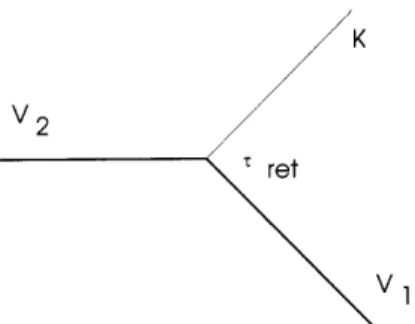
3. Theemission/absorptioneventisanisolated
sin-gularityon the harge worldline; singularin the
sense of disontinuityon its rstderivative. See
theFig. 4.
Figure4. Thesuddenhangeintheeletronstateof
move-mentandeitheritsause(theabsorptionofaphoton,for
ex-ample)oritsonsequene(theemissionofaphoton). There
isnoeletronself-eldimmediatelybeforeorafter
ret .Itis
anisolatedsingularity.
ret
isasingularpoint onthe
ele-tronwordlineonlybeauseitstangentisnotdenedthere;
thereisnoinnity.
Equation(31)onrmsthatz(
s
)isanisolated
sin-gularity. Thisisindiretontraditiontothestandard
viewofalassialontinuouseld,emittedorabsorbed
by the harge in a ontinuous way. Aording to Eq.
(31)thereisnohargeselfeldatz(
s
d),butonly
sharply at z(
s
). It is saying that the Gauss'law, in
thezero-distanelimit,
lim
S!0 Z
S d
~
E:~n=4e;
ismeaningful(intermsofaneetiveontinuouseld)
onlyat z(
s
)and notat z(
retd
)beause ~
E(
s )6=0
but ~
E(
retd )=0:
It implies, in other words, that the eletromagneti
interations are disrete and loalized in time and in
spae. In terms of a disrete eld interation along
a lightone generator, as the one represented in the
Fig. 4, one an understand the physial meaning of
Eqs. (26), (27) and (31). The ontinuous Maxwell
elds are just eetive average desriptions of an
a-tuallydisrete interation eld. The eld disreteness
(or the existene of photons) is masqueraded by this
averaged eld and it takes the zero-distane limit to
be revealed from the Maxwell eld. It is remarkable
that these onlusions have been derived exlusively
fromthesupposedlyexhaustivelyknownlassial
ele-trodynamisbutnothinghasbeenaddedtoormodied
in the old Maxwell's theory, exept anew
interpreta-tion of old well known results. They ome from the
reognitionof theexisteneof twomutually exluding
ausality-implementation modes in the Maxwell's
for-malism. This ouldhavebeentaken,at thebeginning
of the last entury, as a rst indiation of the
quan-tum, or of the disrete nature of the eletromagneti
interation. They areallonsequenesof the
dynami-alonstraintshiddenontherestritions(2)and(11).
Theinitial goalofdisussing theimpliitexistene
oftwodistintmodesofimplementingausalityineld
theoryhasbeenfullled. A ompletelyonsistenteld
abinitiowith extendedausality. Howthis anbe
a-omplished, its onsequenes and how it is related to
thestandardformalismbasedonloalausalityis
dis-ussedinreferene[2℄.
TheFig. representsthesudden hangein the
ele-tron state of movement and either its ause (the
ab-sorption of a photon, for example) or its onsequene
(theemissionof aphoton).
Referenes
[1℄ M. M. deSouza, \Classial Eletrodynamis and the
QuantumNatureofLight".J.ofPhysA:Math. Gen.
30(1997)6565-6585. hep-th/9610028
[2℄ M. M.deSouza, Conformally symmetrimassive
dis-rete elds.Hep-th/0006237.
[3℄ F. Rorhlih Classial Charged Partiles. Reading,
Mass.(1965).
[4℄ D. Jakson Classial Eletrodynamis, 2nd ed., John
Wiley&Sons,NewYork,NY(1975).
[5℄ S.Parrot,RelativistiEletrodynamisandDierential
Geometry, Springer-Verlag,NewYork,1987.
[6℄ C.Teitelboim;D.Villaroel;Ch.G.VanWeert,Rev.del
NuovoCim.,vol3,N.9,(1980).
[7℄ E.G.P. Rowe, Phys.Rev. D12, 1576 (1975) and 18,
3639(1978);NuovoCim.B73,226(1983).
[8℄ A.Lozada,J.Math.Phys.30,1713 (1989).
[9℄ M.M.deSouza,Braz.J.ofPhys.28,250(1999).
Hep-th/9505169
[10℄ See,forexample,hapter14ofreferene [4℄.
[11℄ See,forexample,thereferene[3℄atpage112.
[12℄ J. Shwinger inSeleted papers on Quantum
Eletro-dynamis,J.S.Shwinger(ed.), p.XV-XVIII,Dover,
New-York,NY,(1958).
[13℄ A.A.Sokolov,I.M.Ternov,Radiationfromrelativisti