A NEW SIMPLIFIED SVPWM ALGORITHM BASED ON MODIFIED
CARRIER SIGNAL
Raymundo Cordero García
∗ [email protected]João Onofre Pereira Pinto
∗ [email protected]∗UFMS – Federal University of Mato Grosso do Sul,
Department of Electric Engineering,
CEP 79074-460 – Campo Grande, Mato Grosso do Sul, Brazil.
RESUMO
Um novo algoritmo SVPWM simplificado baseado em si-nal portador modificada
Este artigo apresenta um algoritmo simplificado da modu-lação por largura de pulso por vetores espaciais (SVPWM) para um inversor trifásico de dois níveis, o qual pode ope-rar em submodulação e sobremodulação. Em outras simpli-ficações achadas na literatura, as tensões de referência são modificadas e comparadas com um portador triangular para estimar os estados de comutação do inversor. Não obstante, este artigo propõe a modificação do portador, em lugar das referências. Este procedimento reduz o número de opera-ções matemáticas e aumenta a velocidade de execução do algoritmo SVPWM em DSPs ou FPGAs. As ondas de re-ferência são senoidais, ainda no modo de sobremodulação. Resultados de simulação e experimentais demonstram que a simplificação proposta produz o mesmo padrão de chavea-mento que o SVPWM convencional, é mais simples e rápida que outras simplificações.
PALAVRAS-CHAVE: Inversor trifásico de dois níveis, modu-lação por largura de pulso por vetores espaciais, sinal porta-dor triangular, submodulação, sobremodulação.
ABSTRACT
This paper presents a simplified algorithm of space vector pulse width modulation (SVPWM) for a two-level
three-Artigo submetido em 23/06/2010 (Id.: 01163) Revisado em 21/09/2010, 24/03/2011
Aceito sob recomendação do Editor Associado Prof. José Antenor Pomilio
phase inverter, which can operate in undermodulation and overmodulation modes. In other simplifications founded in literature, the reference voltages are modified and compared with a triangular carrier to estimate the switching states of the inverter. However, this paper proposes the modification of the carrier signal instead of the references. This proce-dure reduces the number of mathematical operations and in-creases the execution speed of SVPWM algorithm in DSPs or FPGAs. The reference voltages are sinusoidal, even for overmodulation mode. Simulation and experimental results proves that the proposed simplification produces the same switching patterns than conventional SVPWM, is simpler and is faster than other simplifications.
KEYWORDS: Two-level three-phase inverter, space vector pulse width modulation, triangular carrier signal, undermod-ulation, overmodulation.
1
INTRODUCTION
Space Vector PWM (SVPWM) is widely used in variable fre-quency drive applications, by its superior harmonic quality, less switching losses and extended linear range of operation (Holtz, 1994; Van der Broecket al., 1988; Yuet al., 2008).
However, its conventional implementation requires a high number of mathematical operations, reducing the maximum speed that SVPWM can be executed in DSPs or FPGAs.
In Lamichet al. (2002), Zhang et al. (2009), the
switch-ing times are defined in terms of the phase references in-stead of using space vectors. According to Blasko (1997), Holmes (1996), SVPWM is equivalent to sinusoidal modu-lation when a zero-sequence component is added to the ref-erence signals. In Pinheiroet al. (2005) SVPWM is easily
implemented when the neutral points of the inverter and the load are connected, establishing the concepts of decomposi-tion matrices.
On the other hand, the SVPWM algorithm must operate in overmodulation mode to generate as high AC voltages as possible for a given DC energy source. Different techniques in literature (Bakhshaiet al., 2000; Filhoet al., 2004; Pinto et al., 2000; Yang et al., 2009) modify the references
sig-nals, adapting the formulas for undermodulation mode to overmodulation mode. Those values are compared with a triangular carrier to establish the switching sequence.
In this paper, the number of mathematical operations to im-plement SVPWM algorithm, even for overmodulation mode, is reduced by the modification of the carrier signal instead of the references voltages.
The modified carrier depends on the zero-sequence compo-nent described in Blasko (1997) and the modulation index. On the other hand, the reference voltages are sinusoidal, even for overmodulation mode. This fact simplifies the implemen-tation of SVPWM.
The proposed technique based on modified carrier is com-pared with conventional SVPWM, Hybrid PWM and the al-gorithm described in Filhoet.al. (2004). Simulation and
ex-perimental results demonstrate that the proposed simplifica-tion based on modified carrier generates the same switching patterns than conventional SVPWM, requires a less number of arithmetic operations and its execution is faster than other simplifications.
2
SPACE VECTOR PWM
2.1
Two-Level Three-Phase Inverter
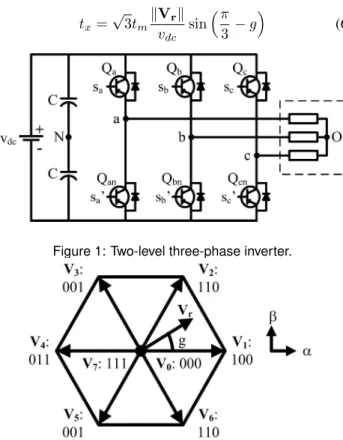
The structure of a two-level three-phase voltage source in-verter is shown in Figure 1. It is composed by six power transistors (MOSFTET, IGBT, GTO)Qa,Qan,Qb,Qbn,Qc andQcn, which are controlled by the digital signalssa,san, sb,sbn,scandscn, respectively. To avoid short circuit in the energy source and indeterminate output voltages, the switch-ing states of the upper transistors (Qa, Qb or Qc) and the lower transistor (Qan,QbnorQcnrespectively) in the same leg are opposite.
Pole voltagesvaN,vbN andvcN are the terminal voltages of each leg respect to the neutral pointN(reference point of the DC supply). These voltages depend of the switching states of the transistors (Yu, 1999), according to equation (1) :
vpN =
0,5vdc; ifsp= 1(switchedon)
−0,5vdc; ifsp= 0(switchedoff) (1)
Wherepdenotes the phase of the inverter (p=a,b,c). Equa-tion 1 indicates that each output of the inverter has two possi-ble values. Therefore, there are 23= 8 switching states, with their respective output voltages.
In general, the phase voltages (vaO,vbO,vcO) of a balanced star-connected load fed by a three phase voltage source, as a two-level inverter, depend on the pole voltages (Bose, 2002):
vaO vbO vcO
=
1 3
2 −1 −1
−1 2 −1
−1 −1 2
vaN vbN vcN
(2)
2.2
Space Vector Representation
A set of balanced three-phase voltages[vavbvc]T can be rep-resented through a space vector, a complex number with a real (vα)and an imaginary(vβ)components defined in the complex plane, according to equation (3) (Rashid, 2001):
V=
vα vβ
=2 3
2va√−(vb+vc) 3 (vb−vc)
(3)
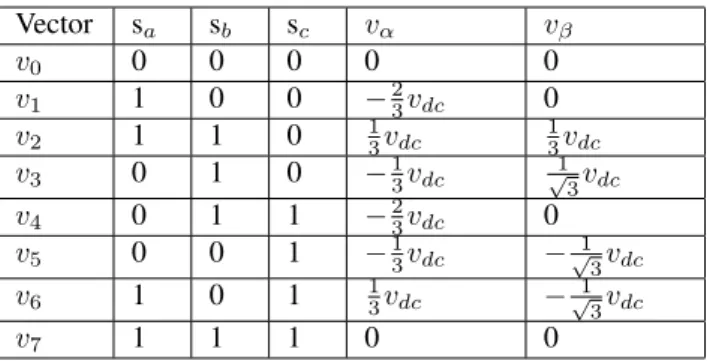
Table 1 shows the space vectors that represents the eight switching states of the two-level inverter. Six non-zero vec-tors (fromV1toV6) divide the complex plane in six sectors of a hexagon, as illustrated in Figure 2. On the other hand, two zero vectors (V0and V7) are located at the center of the hexagon.
Table 1: Output Voltages of the Two-Level Inverter
Vector sa sb sc vα vβ
v0 0 0 0 0 0
v1 1 0 0 −23vdc 0
v2 1 1 0 13vdc 1
3vdc
v3 0 1 0 −1
3vdc
1 √
3vdc
v4 0 1 1 −2
3vdc 0
v5 0 0 1 −13vdc −
1 √
3vdc
v6 1 0 1 13vdc −√1
3vdc
The desired pole voltages [vravrbvrc]T are represented by the vectorVr, using equation (3) . According to equation (2) , if the pole references belong to a balanced system, then they are equal to the load phase references. This vector is approximated with a combination of the space vectorsV0to
V7, during the modulation periodtm, according to equations (4) and (5) :
Vrtm=Vxtx+Vyty (4)
tz=tm−(tx+ty) (5)
Wheretx,tyandtzare the switching times thatVx,Vyand the zero vectorVzare used, respectively. IfVris located in sectors:Vx=VsandVy=Vs+1(except in sector 6, where
Vy=V1).
Conventionally, the switching times are calculated using trigonometric functions, according to equations (6) and (7) (Bose, 2002):
tx=√3tmkVrk vdc sin
π
3 −g
(6)
Figure 1: Two-level three-phase inverter.
Figure 2: Zero and non-zero vectors of the inverter.
ty =√3tmkVrk
vdc sin (g) (7)
Where||Vr||is the magnitude of the reference vector, and g is the angle between Vr andVx, as shown in Figure 2. Trigonometric functions demand many mathematical opera-tions in DSPs or FPGAs. In order to resolve this problem, the switching times can also be calculated using the real and imaginary components of the space vectors. Applying sub-matrix algebra (Cheng, 1999) to equation (4) :
Vrtm= V
x Vy tx ty T
(8)
Figure 2 proves that the vectorsVxandVyare not collinear. Therefore, the matrix [Vx Vy] is invertible (Cheng, 1999). Considering Vr = [vrα vrβ]T, Vx= [vxαvxβ]T andVy =
[vyαvyβ]T, the switching times can be calculated as follows:
tx ty
=
Vx Vy −1Vrtm
tx ty
=
vxα vyα vxβ vyβ
−1
vrα vrβ
tm
(9)
Table 2 shows the values oftx andty for each sector, ac-cording to equation (8) . The value of tz is obtained us-ing equation (5) . After those operations, the sequence of the switching states of the upper transistors must be defined. This arrangement can be done in different ways (Hariram and Marimuthu, 2005). This paper considers the software-determined switching pattern described in Yu (1999) and il-lustrated in Figure 3.
Table 2: Switching Times in Function ofvrαandvrβ
Sector tx ty
1 tm
2vdc 3vrα−
√
3vrβ tm
vdc
√
3vrβ
2 tm
2vdc 3vrα+
√
3vrβ tm
2vdc −3vrα+
√
3vrβ
3 tm
vdc
√
3vrβ tm
2vdc −3vrα−
√
3vrβ
4 tm
2vdc −3vrα+
√
3vrβ tm
vdc −
√
3vrβ
5 tm
2vdc −3vrα−
√
3vrβ tm
2vdc 3vrα−
√
3vrβ
6 tm
vdc −
√
3vrβ tm
2vdc 3vrα+
√
3vrβ
2.3
Operation Modes of SVPWM
The modulation indexmis defined as follows (Holtz, 1994):
m= k2Vrk
πvdc
(10)
• Undermodulation mode (0≤ m <0,907): The refer-ence vector always reminds within the hexagon, while the reference voltages are perfectly sinusoidal.
• Overmodulation mode 1 (0,907≤ m <0,952): The reference vector crosses the hexagon at two points in each sector. When SVPWM operates in overmodula-tion mode, there is a loss in the magnitude of the funda-mental voltage. To compensate this effect, the reference voltages must be modified. In overmodulation mode 1, those references are composed by linear and sinusoidal segments.
• Overmodulation mode 2 (0,952≤ m≤ 1): The refer-ence vector increases even further compared with over-modulation mode 1. The reference voltages are com-posed only by linear segments.
Figures 4, 5 and 6 show the operation region in sector 1 and the reference voltages for the three operation modes of SVPWM.
Figure 3: Software-determined switching sequence.
Figure 4: Operation region in sector 1 and reference voltage for undermodulation mode.
2.4
Turn-on Times
In order to simplify SVPWM algorithm, the turn-on times ta−on,tb−on andtc−onare defined in Filhoet al. (2004) to estimate the state of the upper transistors, to avoid working
Figure 5: Operation region in sector 1 and reference voltage for overmodulation mode 1.
Figure 6: Operation region in sector 1 and reference voltage for overmodulation mode 2.
with the switching timestx,tyandtz. The formulas of the turn-on times for the sectors(from 1 to 6) are presented in equations (11) , (12) and (13) :
ta−on=
tm 2 h
1 + 3fc
2vdc
−vrα−v√rβ
3
i
; s = 1,4
tm
2
h
1 + 3fc
2vdc(−2vrα)
i
; s = 2,5
tm
2
h
1 + 3fc
2vdc
−vrα+vrβ
√ 3
i
; s = 3,6
(11)
tb−on=
tm 2 h
1 + 3fc
2vdc vrα−
√
3vrβi
; s = 1,4
tm
2
h
1 + 3fc
2vdc
−2vrβ
√ 3
i
; s = 2,5
tm
2
h
1 + 3fc
2vdc
vrα−v√rβ
3
i
; s = 3,6
(12)
tc−on=
tm 2 h
1 + 3fc
2vdc
vrα+vrβ
√ 3
i
; s = 1,4
tm
2
h
1 + 3fc
2vdc
2vrβ
√ 3
i
; s = 2,5
tm
2
h
1 + 3fc
2vdc vrα+
√
3vrβi
; s = 3,6
(13)
The factorfccompensates the attenuation of the fundamen-tal voltage in overmodulation mode. This compensation fac-tor can be implemented in a look-up table, and depends on the modulation index: fc is unity in undermodulation mode, and it tends to infinite in overmodulation mode (Filhoet al.,
The advantages of working with turn-on times is that the switching states can be easily determined by a simple com-parison with a triangular carrierc(t), as illustrated in Figure 7 (Pintoet al., 2000). However, the formulas of the turn-on
times require many mathematical operations for each sector and phase. This problem is solved using the concept of mod-ified carrier signal, which is explained in sequence below.
3
PROPOSED ALGORITHM
3.1
Simplified Formulas about Turn-on
Times
In Zhang et al. (2009), the switching timestx andty are
expressed in terms of the reference voltages. In this paper, the same strategy is used, but to express the turn-on times ta−on,tb−onandtc−on. For example, according to equation (11) , the turn-on time for the phaseain sector 1 is:
ta−on= tm
2
1 + 3fc 2vdc
−vrα−vrβ√
3
; s = 1,4 (14)
On the other hand, based on equation (3) :
−vrα−v√rβ
3 =−
2vra−(vrb+vrc)
3 −
1 √ 3
(vrb√−vrc)
3
−vrα−vrβ
√ 3 =
−2(vra−vrc)
3
(15)
As the sum of the three reference voltages is zero in a bal-anced three-phase system (vra+vrb+vrc= 0):
−vrc=vra+vrb (16)
Figure 7: Comparison betweentp
−onand the carrier c(t).
Replacing equations (15) and (16) in equation (14) :
ta−on =t2m
h
1−fc(vra−vrc)
vdc
i
; s = 1,4
ta−on =t2m
h
1−fc(2vra+vrb)
vdc
i
; s = 1,4 (17)
Using the similar procedure to obtain equation (17) , the turn-on times are defined in functiturn-on of the reference voltages:
ta−on=
tm 2 h
1−fc(2vra+vrb)
vdc
i
; s = 1,4
tm
2
h
1−fc(2vra+vra)
vdc
i
; s = 2,5
tm
2
h
1−fc(2vra+vrc)
vdc
i
; s = 3,6
(18)
tb−on=
tm 2 h
1−fc(2vrb+vrb)
vdc
i
; s = 1,4
tm
2
h
1−fc(2vrb+vra)
vdc
i
; s = 2,5
tm
2
h
1−fc(2vrb+vrc)
vdc
i
; s = 3,6
(19)
tc−on=
tm 2 h
1−fc(2vrc+vrb)
vdc
i
; s = 1,4
tm
2
h
1−fc(2vrc+vra)
vdc
i
; s = 2,5
tm
2
h
1−fc(2vrc+vrc)
vdc
i
; s = 3,6
(20)
Equations (18) , (19) and (20) have the following structure:
tp−on= tm
2
1−fc(2vrp+vzs) vdc
(21)
Wherevrpis the reference voltage in phase p, whilevzsis based on the zero-sequence component described in Blasko (1997), and depends on the sectorswhere the reference vec-tor is located:
vzs=
vrb; s = 1,4
vra; s = 2,5
vrc; s = 3,6
(22)
3.2
Modified Carrier Signal
Equation (21) can be expressed as follows:
tp−on= tm
2 −fc
tm
2vdc
(2vrp+vzs) (23)
If the termstm/2 andtm/(2vdc) are considered as constants, then six multiplications are needed to calculate the turn-on times using equation (23) , without considering the estima-tion of the compensaestima-tion factorfc.
Figure 7 indicates that the upper transistorQpis switched on (sp= 1) when the carrierc(t) is greater than the turn-on time:
c(t)≥tp−on (24)
From equations (23) and (24) :
c(t)≥ tm
2
h
1−fc(2vrp+vzs)
vdc
i
2c(t) tm ≥
h
1−fc(2vrp+vzs)
vdc
i
2vrp+vzs≥ vdc
fc
h
1−2c(t)tm
i
2vrp≥ vdc
fc
h
1−2c(t)tm
i
−vzs
(25)
Dividing equation (25) by the amplitude of the reference vec-tor||Vr||:
2vrp
kVrk ≥ vdc
kVrkfc
h
1−2c(t)tm
i
− vzs
kVrk 2vrp
kVrk ≥
2vdc
kVrkπ
π 2fc
h
1−2c(t)tm
i
− vzs
kVrk
(26)
By the definition of modulating index:
1
m =
2vdc
kVrkπ (27)
Replacing equation (27) in equation (26) :
2vrp
kVrk ≥ π
2mfc
1−2ctm(t)
− vzs
kVrk (28)
Four variablesvrpn=vrp/||Vr||,vzsn=vzs/||Vr||,k(t) =
1−[2c(t)/tm]andg(m) =π/(2mfc)are defined as the nor-malized (from -1 to 1) reference voltage in phasep, the nor-malized zero-sequence component, a triangular carrier and a new correction factor, respectively. The waveforms ofg(m)
andk(t)are shown in Figures 8 and 9. Equation (28) can be expressed in function of these new four variables:
2vrpn≥g(m)k(t)−vzsn (29)
The modified carrier signalq(t)is defined as follows:
q(t) =g(m)k(t)−vzsn (30)
The value ofsp(pdenotes the phasea,borcin the inverter) can be expressed in terms of the modified carrierq(t):
sp=
1(switchon),if2vrpn≥q(t)
0(switchoff),otherwise (31)
Figure 8: Correction factor g(m).
Figure 9: Normalized triangular wave k(t).
Sector identification is required to calculate vzsn andq(t). This problem is treated in the next section.
3.3
Sector Identification
In order to identify the sector and estimate the value ofvzpn, variablesb1,b2,b3,b4andb5are defined as follow:
b1=
1; ifvran≥vrbn
0; otherwise (32)
b2=
1; ifvrbn ≥vrcn
0; otherwise (33)
b3=
1; ifvrcn≥vran
0; otherwise (34)
b4=xor(b1, b2) (35)
Table 3: Sector Identification and Selection ofvzsn
Sector Relation b1 b2 b3 b4 b5 vzsn 1 vrcn < vrbn <
vran
1 1 0 0 1 vrbn
2 vrcn < vran < vrbn
0 1 0 1 1 vran
3 vran < vrcn < vrbn
0 1 1 1 0 vrcn
4 vran < vrbn < vrcn
0 0 1 0 1 vrbn
5 vrbn < vran < vrcn
1 0 1 1 1 vran
6 vrbn < vrcn < vran
1 0 0 1 0 vrcn
Table 3 shows the values of these variables for the six sectors, calculated using the relations between the reference signals in each sector described in Zhang et al. (2009). Equation
(39) determines the value ofvzsn, based on Table 3 and the variablesb4andb5.
vzsn=
vrbn; ifb4= 0andb5= 1;
vran; ifb4= 1andb5= 1;
vrcn; otherwise.
(37)
3.4
Complexity of the Proposed
Simplifi-cation
Sector identification requires three comparisons (b1,b2,b3), two XOR functions (b4,b5), two AND functions and two IF
-THEN sentences. Whenvzsnis known, the modified carrier q(t) is calculated using only one multiplication, one subtrac-tion and a look-up table. The terms 2vran, 2vrbnand 2vrcn can be obtained by three additions, to avoid real-number mul-tiplications.
As a result, the proposed simplification of SVPWM requires:
• Three additions;
• One subtraction;
• One multiplication;
• Two IF-THEN sentences;
• Three comparisons;
• Two XOR functions;
• Two AND functions;
• One look-up table forg(m), with its respective opera-tions.
One advantage of the proposed algorithm is thatvran,vrbn andvrcnhave unitary amplitude, independently of the modu-lation index. Only their frequencies change according to the desired electric frequency of the output voltages. Those sig-nals are perfectly sinusoidal, even for overmodulation mode.
3.5
Comparison with other Modulation
Techniques
The proposed technique is compared with the hybrid PWM (HPWM) and the simplification of SVPWM based on turn-on times, respect to their computatiturn-onal complexities (num-ber of mathematical operations), to prove the advantages of the concept of modified carrier in the implementation of SVPWM.
Real-number arithmetic operations complicate the design and increase the execution time of the algorithms imple-mented in DSPs or FPGAs (Tzou and Hsu, 1997). Therefore, an algorithm with a less number of mathematical operations can be executed faster.
It is considered that the generation of the triangular waves, sinusoidal functions and look-up tables have the same com-putational complexity in all cases, while comparisons and Boolean operations are executed in a negligible time.
3.5.1 Comparison with HPWM
HPWM generates the same switching pattern of conventional SVPWM, using a triangle-comparison method (Blasko, 1997). In first place, the reference voltages with amplitude
||Vr||and phaseϕpare produced through equation (40) :
vrp=kVrksin (ϕp) (38)
After that, the zero-sequence voltagevzhis calculated:
vzh= 0,5 [min (vra, vrb, vrc) + max (vra, vrb, vrc)] (39)
From Table 3 and equation (41) :
vzh= 0,5vzs (40)
The switching state in the phasepof the inverter is deter-mined by the comparison established in equation (43) .
sp=
1(switchedon),ifvrp+vzh≥vt(t)
According to Figure 9 and Blasko (1997):
vt(t) = 0,5vdck(t) (42)
As HPWM does not operate in overmodulation mode, the comparison between this modulation technique and the pro-posed simplification of SVPWM will be made only for un-dermodulation mode, wherefc is unity (Filho et al., 2004)
andg(m) is calculated easily:
g(m) = π
2m (43)
Replacing equations (42) , (44) and (45) in equation (30) , the upper transistors of the inverter are switched on (sp= 1) in the proposed technique when the following inequality is satisfied:
2vrpn≥ π
2mk(t)−vzsn
2vrpn≥ vdc
kVrkk(t)−vzsn
kVrkvrpn ≥0,5vdck(t)−0,5kVrkvzsn vrp≥vt(t)−0,5vzs
vrp+vzs≥vt(t)
(44)
As a result, the switching states in the proposed simplifica-tion of SVPWM based on modified carrier signal are deter-mined by equation (47) :
sp =
1(switchedon),ifvrp+vzh≥vt(t)
0(switchedoff),otherwise (45)
Equations (43) and (47) are equal. Therefore, the proposed technique and HPWM produce the same switching pattern, both have a gain of 15% in the use of the DC-link volt-age, their output voltages have the same harmonic distortion (THD) and dead times affect them in the same way.
The use of a look-up table requires many comparisons and mathematical operations. However, if the proposed tech-nique will operate only in undermodulation mode, as HPWM does, the modified carrier is calculated from equations (32) and (45) :
q(t) = 1
m
hπ
2k(t)
i
−vzsn (46)
Consideringr(t) = 0,5πk(t)as a new triangular carrier with the same computational complexity ofvt(t) ork(t), the pro-posed simplification can be implemented using three addi-tions, one subtraction and one division. On the other hand,
Table 4: Number of Arithmetic Operations for HPWM
Procedure Additions Multiplications
Reference voltages 0 3
Estimation of vzh 0 1
Addition of vzh to the reference volt-ages
3 0
Total 3 4
Table 4 indicates that HPWM requires three additions and four multiplications. Equation (15) could be used in both al-gorithms to generate the third reference signal (for balanced three-phase systems). In that case, HPWM requires three multiplications. As a result, the proposed technique has less computational complexity than HPWM in undermodulation mode. It is only necessary a small one-dimensional look-up table to estimateg(m) when overmodulation operation mode is needed.
3.5.2 Comparison with Other Simplifi cations of SVPWM
The proposed simplification based on modified carrier sig-nal was deduced from the algorithm explained in Filhoet al.
(2004): Firstly, the turn-on times were expressed in terms of the reference voltages. In second place, the inequality that controls the switching states was expressed in terms of the modulation index and the zero-sequence voltage vzsn. Fi-nally, the modified carrierq(t) was defined.
The main advantage of the proposed algorithm based on modified carrier signal, respect to other simplifications of SVPWM as the described in Filho et al. (2004), is that it
requires a less number of mathematical operations because it works directly with pole references instead of space vectors. Equations (11) , (12) and (13) can be expressed as follows:
tp−on =k0+fc(k1vrα+k2vrβ) (47)
Wherek0 = 0,5tm, whilek1andk2depend of the sector and the phase. According to equation (??) , the calculus of the three turn-on times requires nine multiplications, six addi-tions and two sinusoidal funcaddi-tions (to representvrαandvrβ).
4
RESULTS
4.1
Simulation Results
The proposed simplification of SVPWM was simulated in MATLAB/SIMULINK, as illustrated in Figure 10. The source voltage vdc and the modulation period tm were set in 200 V and 250 us (1/4 kHz), respectively.
The conventional SVPWM, HPWM and the algorithm de-scribed in Filhoet.al. (2004) were also simulated, as shown
in Figure 11, in order to make comparisons with the proposed technique.
Three simulation tests were made, to cover undermodulation and overmodulation modes:
• Test 1 (Undermodulation mode): m = 0,85 (||Vr|| = 108,23 V) and 60 Hz.;
Figure 10: Simulation diagram of the proposed algorithm.
Figure 11: Simulation diagram for HPWM, conventional SVPWM and the simplification based on turn-on times.
Table 5: Peak Values of the Fundamental Components for the Simulation Tests.
Test Reference (V) Real (V) Error (%)
1 108,23 108,18 0,042
2 119,68 119,57 0,095
3 124,78 124,78 -0,021
Table 6: THD of the Output Voltages for Test 1
Modulation technique THD of pole voltage vaN
THD of phase voltage vaO Conventional
SVPWM
38,58% 22,76%
HPWM 38,58% 22,76%
Turn-on times 38,58% 22,76%
Proposed algorithm 38,58% 22,76%
• Test 2 (Overmodulation mode 1): m = 0,94 (||Vr|| = 119,68 V) and 60 Hz;
• Test 3 (Overmodulation mode 2): m = 0,98 (||Vr|| = 124,78 V) and 60 Hz.
The pole voltages and the line-to-line output voltages for the three tests are shown in Figures 12, 13 and 14. The magnitudes of the fundamental components of the pole volt-ages were founded using the Fourier Analyzer block of SIMULINK. The comparisons between the reference and the obtained pole voltages, presented in Table 6, prove that the proposed simplification can generate the desired voltages.
The total harmonic distortion (THD) of the pole voltagevaN and the load phase voltagevaOfor the mentioned modulation techniques are shown in Tables 7 and 8. The load phase volt-ages were obtained through equation (2) , while THD was measured using the FFT Analysis Tool of MATLAB.
The proposed technique was compared in overmodulation mode only with the algorithm based on turn-on times be-cause HPWM are not defined in this operation mode. The results indicate that the mentioned techniques have the same THD. Small differences in test 3 are produced by the numer-ical precision of the look-up tables.
Table 7: THD of the Output Voltages for Test 2 and 3
Modulation technique THD of pole voltage vaN
THD of phase voltage vaO Turn-on times: test 2 29,94% 16,41%
Proposed: test 2 29,94% 16,41%
Turn-on times: test 3 34,21% 17,35%
Figure 12: Test 1 (m = 0,85): Output voltages.
Figure 13: Test 2 (m = 0,94): Output voltages.
Figure 14: Test 3 (m = 0,98): Output voltages.
4.2
Experimental Results
The simplification of SVPWM based on the modified car-rier signal was implemented in the DSP DSPACE DS1104, which is programmable using SIMULINK block diagrams.
The proposed simplification was applied in the open-loop speed control of an induction motor (3410 RPM, 60 Hz, 220 Vrms, 0,5 HP). The driver IRAMX16UP60A was used as the two-level three-phase inverter.
Three experimental tests were done using the same character-istics of the simulation tests. The line-to-line voltages shown in Figures 15, 16 and 17 are similar to the respective wave-forms obtained in the simulation tests.
Figure 15: Test 1 (m = 0,85): Line-to-line voltage vab. Vertical
scale: 100V/division.
Figure 16: Test 2 (m = 0,94): Line-to-line voltage vab. Vertical
scale: 100V/division.
en-Figure 17: Test 3 (m = 0,98): Line-to-line voltage vab. Vertical
scale: 100V/division.
ergy to the motor are near to the six-step operation (m= 1), where the harmonics of higher energy are concentrated in the low-frequency spectrum.
Figure 18: Test 1 (m = 0,85): Stator current ia. Vertical scale:
200 mA/division.
4.3
Evaluation of Execution Time
The execution times of the proposed simplification and the algorithm presented in Filho et al. (2004) were
com-pared experimentally. Both algorithms were designed in the files “proposed.mdl” and “reference.mdl” respectively. The SIMULINK diagram of the reference algorithm is presented in Figure 21. The MASTER-BIT-OUT blocks transfer the logic signals to the digital output ports of the DSP.
The time required in the execution of an algorithm deter-mines the maximum sampling frequency (fs = 1/ts) that a DSP or FPGA can operate, because all the mathematical op-erations must be done before the beginning of the new sam-pling cycle. Otherwise, the algorithm can not be executed. Figure 22 illustrates this necessary condition.
Figure 19: Test 2 (m = 0,94): Stator current ia. Vertical scale:
200 mA/division.
Figure 20: Test 3 (m = 0,98): Stator current ia. Vertical scale:
200 mA/division.
Both algorithms were tested trying to be loaded in the DSP considering a sampling time of 12,5 us (1/80 kHz). Figures 23 and 24 present their respective loading processes. Only the proposed simplification was successfully loaded in the DSP. This fact proves that the proposed technique can be ex-ecuted faster than the simplification described in Filhoet al.
(2004).
A simpler and faster SVPWM algorithm is suitable in the implementation of closed-loop variable frequency drive ap-plications, because it allows working with higher sampling frequency to acquire information of currents, position or me-chanical speed.
5
CONCLUSIONS
Figure 21: SIMULINK diagram of the SVPWM algorithm used as reference.
Figure 22: Requirement to execute successfully an algorithm in a DSP.
Figure 23: Loading process of the reference SVPWM simpli-fication.
Figure 24: Loading process of the proposed SVPWM simpli-fication.
concept of the modified carrier signal. This technique uses a small set of mathematical operations, while the sector iden-tification is made using reference pole voltages and only re-quires a small one-dimensional look-up table to operate in overmodulation mode. The proposed simplification has a faster execution time in DSPs than other simplifications in literature, making possible the implementation of SVPWM algorithm in DSPs or FPGAs using higher sampling frequen-cies, which is suitable in variable frequency drive applica-tions.
On the other hand, the proposed technique produces the same switching pattern that conventional SVPWM and HPWM. As a result, all these modulation technique produce the same harmonic distortion and are affected for dead times in the same way.
A future work consists in the use of the proposed simplifica-tion in a closed-loop speed control of three-phase motors.
REFERENCES
Bakhshai, A. R., Joos, G., Jain, P. K. and Jin, H. (2000). Incorporation the Overmodulation Range in Space Vec-tor Pattern GeneraVec-tors Using a Classification Algorithm,
IEEE Transactions on Power Electronics, Vol. 15, No.
1, pp. 83-91.
Blasko, V. (1997). A Hybrid PWM Strategy Combining Modified Space Vector and Triangle Comparison Meth-ods”,IEEE Transactions on Industry Applications, Vol.
33, No. 3, pp. 756-764.
Bose, B. K., 2002, Modern Power Electronics and AC Drives, Prentice Hall PTR, New Jersey.
Filho, N. P., Pinto, J. O. P., Borges da Silva, L. E. and Bose, B. K. (2004). A Simple and Ultra-Fast DSP-Based Space Vector PWM Algorithm and its Implemen-tation on a Two-Level Inverter Covering Undermodula-tion and OvermodulaUndermodula-tion, 30thAnnual Conference of IEEE Industrial Electronics Society, Vol. 2, pp. 1224-1229.
Hariram B. and Marimuthu, N. S. (2005). Space Vector Switching Patterns for Different Applications - A Com-parative Analysis,IEEE International Conference on
In-dustrial Technology, pp. 1444-1449.
Holmes, D. G. (1996). The Significance of Zero Space Vec-tor Placement for Carrier-Based PWM Schemes,IEEE
Transactions on Industry Applications, Vol. 32, No. 5, pp. 1122-1129.
Holtz, J. (1994). Pulsewidth Modulation for Electronic Power Conversion, Proceedings of the IEEE, Vol. 82,
No. 8, pp. 1194-1214.
Lamich, M., Balcells, J. and Gonzales, D. (2002). New Method for Obtaining SV-PWM Patterns Following an Arbitrary Reference, 28thAnnual Conference of the In-dustrial Electronics Society, Vol. 1, pp. 18-22.
Pinheiro. H, Botterón, F., Rech, C., Schuch, L., Camargo, R. F., Hey, H. L., Grundling, H. A. and Pinheiro, J. R. (2005). Modulação Space Vector para Inversores Ali-mentados em Tensão: Uma Abordagem Unificada,SBA
Controle e Automação, Vol. 16, No. 1, pp. 13-24.
Pinto, J. O. P., Bose B. K., Borges da Silva, L. E. and Kazmierkowski, M. P. (2000). A Neural-Network Based Space-Vector PWM Controller for Voltage Fed Inverter Induction Motor Drive,IEEE Transactions on
Industry Applications, Vol. 36, No. 6, pp. 1628-1636.
Rashid, M. H., 2001, Power Electronics Handbook, Aca-demic Press.
Shu, Z., Tang, J., Guo, Y. and Lian, J. (2007). An Ef-ficient SVPWM Algorithm With Low Computational Overhead for Three-Phase Inverters,IEEE Transactions
on Power Electronics, Vol. 22, No. 5, pp. 1997-1805.
Tzou, Y., and Hsu, H. (1997). FPGA Realization of Space-Vector PWM Control IC for Three-Phase PWM Invert-ers,IEEE Transactions on Power Electronics, Vol. 12,
No. 6, pp. 953-963.
Van der Broek, H. W., Skudelny, H. C. and Stanke, G. V. (1988). Analysis and Realization of a Pulsewidth Mod-ulator Based on Voltage Space Vectors,IEEE
Transac-tions on Industry ApplicaTransac-tions, Vol. 24, No. 1, pp. 142-150.
Yang, R., Wang, G., Yu, Y., Xu, D. and Chan, C. C. (2009). A Novel Space Vector Area Calculation Based Over-modulation Method,IEEE Vehicle Power and
Propul-sion Conference, pp. 1399–1402.
Yu, Y., Chai, F. and Cheng, S. (2008). Analysis of Modula-tion Pattern and Losses in Inverter for PMSM Drives,
IEEE Vehicle Power and Propulsion Conference, pp.
1–4.
Yu, Z., 1999, Space-Vector PWM with TMS320C24x/F24x Using Hardware and Software Determined Switching Patters. Application Report SPRA524, Texas Instru-ments.
Zhai, L. and Li, H. (2008) Modeling and Simulation of SVPWM Control System of Induction Motor in Electric Vehicle,IEEE International Conference on Automation
and Logistics, pp. 2026–2030.