An Analytial Calulation of the
Magneti Field Using the Biot Savart Law
UmCaluloAnaltiodoCampoMagnetio UsandoaLeideBiotSavart
E.C. Caparelliand D. Tomasi
EsueladeCieniayTenologia,UniversidadNaionaldeGral.
SanMartin, Alem3901,1651,SanAndres,BuenosAires,Argentina
Reebidoem20deJunho2001. Aeitoem6deAgosto2001.
Thisworkpresentsananalytialmethodtoalulatethemagnetieldatanypointofthespae,by
solvingtheBiotSavartequationinthereiproalspae. Thisisappliedtoexpressthemagneti
eld dueto airular urrent distributions as aonvergent series. The omparison between the
proposedmethodwiththestandardnumerialintegrationoftheBiotSavartlawhasshownagood
agreement.
Nestetrabalhoapresentamos ummetodoanaltio paraalularoampomagnetio emqualquer
pontodoespao,resolvendoaequa~aodeBiotSavartnoespaoreproo. Omesmoeapliado
paraexpressaremtermosdeumaserieonvergenteoampomagetiogeradoporumadistribui~ao
deorrenteirular. Aompara~aoentreometodoproposto eaintegra~aonumeriausualdalei
deBiotSavartmostraumasatisfatoriaonord^ania.
I Introdution
TheBiotSavart(BS)lawisawell knownequationused
toalulatethemagnetieldvetoratanypointofthe
spaeforagivenurrentdistribution. Althoughit has
extensiveappliationin manybranhesofphysisand
engineering, analytialsolutions of this integral
equa-tion are available only for someurrent distributions,
whihhavespeialssymmetryonditions.
Usually numerial methods are used to alulate
magneti elds, for example,to design oils and
mag-nets that produe high homogeneous magneti elds
forMagnetiResonaneImaging(MRI)[1℄,tooptimize
toroidalmagneti systems[2℄or to evaluate thestress
in fusion devies [3℄. However, when the alulation
of the magneti eld is performed over a large set of
points,theinreaseintheomputingtimerequiresthe
useofsemi-analytiapproahes[4℄.
Inthisworkweareshowingthatthe BSlawanbe
solvedin thereiproalspae foraplanarurrent
dis-tribution. As an example, we derived analytiallyan
expressionto alulatethemagneti eldat anypoint
ofthe spaefor airularturn ofwirearryinga
ur-II The method
The magneti eld vetor B at a given point in the
spae, r, is related to the urrent distribution j(r 0
)
throughtheBiotSavartlaw[5℄
B(r)=
0
4 Z
j(r 0
)jr r 0
j
jr r 0
j 3
d 3
r 0
; (1)
where
0
isthe permeabilityofthe freespaeand the
integral is performed over the whole spae. This law
an also beexpressed asa funtion of the url of the
vetorpotential,A(r),as
B(r)=
0
4 r
Z
j(r 0
)
jr r 0
j d
3
r 0
=rA(r); (2)
that, usingtheGreen funtionexpansion[6℄
G(r;r 0
)= 1
jr r 0
j =
1
2 2
Z
e ik(r r
0
)
k 2
d 3
k (3)
anbewrittenas
B(r)=
0
8 3
r Z Z
j(r 0
) e
ik(r r 0
)
k 2
d 3
kd 3
r 0
: (4)
Now,onsidering theFouriertransformofj(r 0
)
j(k)= Z
j(r 0
)e ikr
0
d 3
r 0
the url an be arried out, and the Eq. (4) an be expressedas B(r)= i 0 8 3 Z
j(k)k
k 2 e ikr d 3
k: (6)
If the urrent distribution is in the (x;y;0) plane,
theFouriertransformofthisdistributionanbewritten
as
j(k)=j
x (k x ;k y ) ^
i+j
y (k x ;k y ) ^ j (7)
and theontinuityequation,expressed interms ofthe
Fourieromponents,isgivenby[7℄
k x j x (k x ;k y )+k
y j y (k x ;k y
)=0: (8)
Thenthemagnetieldomponentsduetothisurrent
distributionanbeexpressed,usingEq. (6),as
B (r)= Z k k z
f(k;r)d 3
k; =x;y (9)
B z (r)= Z (k 2 x +k 2 y
)f(k;r)d 3
k; (10)
where
f(k;r)= i 0 8 3 j x (k x ;k y ) k y e ikr k 2 : (11)
Therefore,uponintegratingoverk
z
,wenallyhave
B (r)= i 0 8 2 Z 1 1 Z 1 1 e i(kxx+kyy) k y j x (k x ;k y )e jzj p k 2 x +k 2 y dk x dk y
; =x;y;z (12)
d
whih areanalytialexpressionsfor themagnetield
omponentsproduedbyaplanarurrentdistribution.
III Appliation
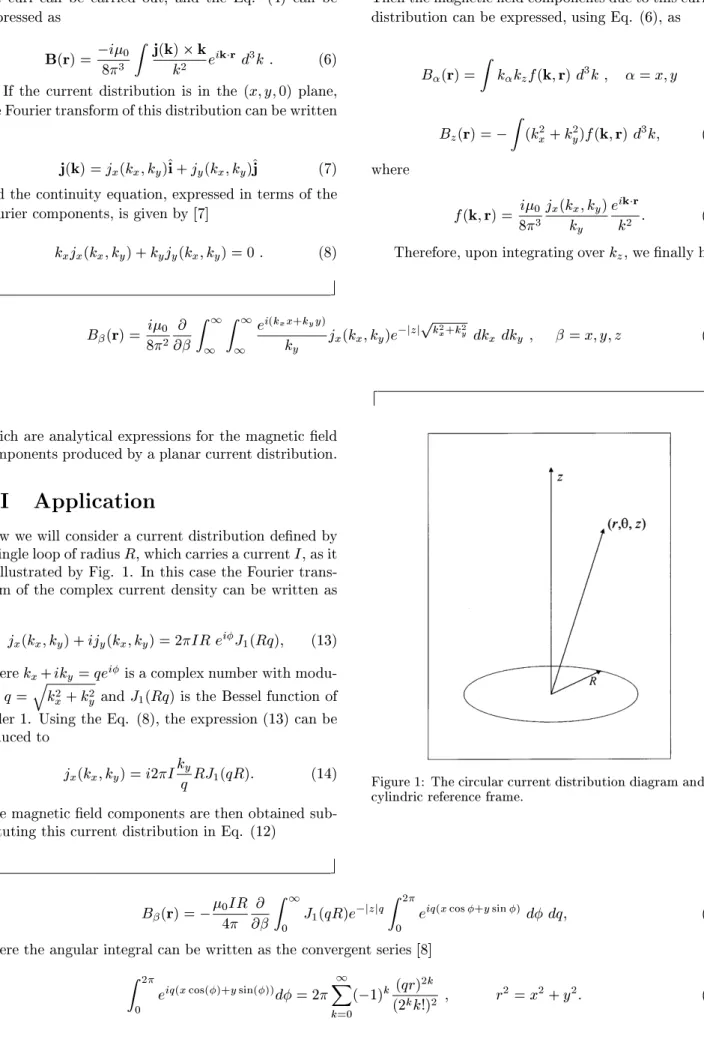
Nowwewillonsider aurrentdistributiondened by
asingleloopofradiusR ,whiharriesaurrentI,asit
is illustratedby Fig. 1. InthisasetheFourier
trans-form ofthe omplexurrentdensityan bewritten as
[7℄ j x (k x ;k y )+ij
y (k
x ;k
y
)=2IRe i
J
1
(R q); (13)
wherek x +ik y =qe i
isaomplexnumberwith
modu-lus q= q k 2 x +k 2 y andJ 1
(R q)is theBesselfuntionof
order 1. UsingtheEq. (8), theexpression(13)anbe
reduedto j x (k x ;k y
)=i2I k
y
q R J
1
(qR ): (14)
Themagnetieldomponentsarethenobtained
sub-stitutingthisurrentdistributioninEq. (12)
Figure1:Theirularurrentdistributiondiagramandthe
ylindrirefereneframe.
B (r)= 0 IR 4 Z 1 0 J 1 (qR )e jzjq Z 2 0 e
iq(xos+ysin)
ddq; (15)
where theangularintegralanbewrittenastheonvergentseries[8℄
Z
2
0 e
iq(xos()+ysin())
Beause of theaxial symmetryof thisproblem wewilluse theylindrialrepresentation ofthemagneti eld
vetor. TheradialomponentB 2
r
(r)=B 2
x (r)+B
2
y
(r)andtheaxialomponentB
z
(r)ofthemagnetield anbe
obtainedfrom Eq. (15)andan bewrittenastheseriesexpansion
B (r)= 0 IR 2 1 X k =0 ( 1) k +1 r 2k (2 k k!) 2 Z 1 0 q 2k e jzjq J 1
(qR )dq ; =r;z: (17)
Theintegraloverqisrelatedtothehypergeometrifuntion,
2 F 1 as[8℄ Z 1 0 q 2k e jzjq J 1
(qR ) dq= R
2 jzj
2(k +1)
[2(k+1)℄
2 F
1
k+1;k+ 3 2 ;2; R 2 z 2 ; (18)
whihisdenedas[8℄
2 F
1
(a;b;;w)= 1 X n=0 (a) n (b) n () n w n n! (19) (d) n =
(d+n)
(d)
for d=a; b; : (20)
Finallythemagneti eldomponentsan bewrittenastheseries
B r (r)= 0 IR 2 2 1 X k =0 ( 1) k +1 kr 2k 1 (2 k k!) 2 z 2(k +1)
[2(k+1)℄
2 F
1
k+1;k+ 3 2 ;2; R 2 z 2 ; (21) B z (r)= 0 IR 2 2 1 X k =0 ( 1) k
(k+1)r 2k (2 k k!) 2 jzj (2k +3)
[2(k+1)℄
2 F 1 k+ 3 2
;k+2;2; R 2 z 2 : (22) d
Intable1,weshowsomeexpressionsofthefuntion
2 F
1 :
Table1: ValuesofHypergeometrifuntion
2 F 1 2 F 1
k+1;k+ 3 2 ;2; R 2 z 2 2 F 1 k+ 3 2
;k+2;2; R
2
z 2
k=0 2 z R 2 1 1+ R z 2 1=2 1+ R z 2 3=2
k=1
1+ R z 2 5=2 1 1 4 R z 2 1+ R z 2 7=2
k=2 1 3 4 R z 2 1+ R z 2 7=2 1 3 2 R z 2 + 1 8 R z 4 1+ R z 2 11=2
Notethat, in theRef. [5℄, themagneti eld for a
single loop is alulated analytially using the vetor
potential,whose solutionsarevalidonlynear theaxis,
near theenter of theloopand farfrom theloop, but
herewegotanalytialexpressionsthatarevalidatany
region.
Analysis
Tostudythequalityoftheaboveresultasafuntion
ofthenumberoftermsN,onsideredin theEqs. (21)
and(22),wealulatedthemagnetieldgeneratedby
aurrentof I =1Aowingin aloopwithR =1m in
twoways: ononehand weusedtheMATHEMATICA
3.0 1
software to arry out theoperationsinvolved in
Eqs. (21) and (22), and onthe other hand we wrote
adoublepreisionFORTRANodeperformingthe
in-tegral in Eq. (1). Inorder to maximize theauray
ofthealulationaomplishedbythenumerial
algo-rithm,wedividedthewirein8192elements.
Figure2omparesthez{omponentofthemagneti
eld obtainedfrom Eq. (22),fordierentvaluesof N,
withthat ahievedbythenumerialintegrationofEq.
(1) (solid line), along the radial diretion at z = 0.
Asanbenotiedtheinreaseinthenumberof terms
in theseriesexpansion(22)resultsin animprovement
of the mathing between the analytial solution and
the numerialalulation of theBS law. Whereas for
r < 0:8R both alulations give similar results, for r
approahingRamismathbetweenthetwomethodsis
observed. Thismismath orrespondsto theutoin
theseriesexpansion(22),whileforr>Rthisbehavior
isdue tothenonenvergene oftheseries(22).
The dierene between the analytial method,
B (An)
(r;z), andthestandardBSmethod, B (BS)
(r;z),
an be analyzed using the relative dierene between
themagnetields(inpartpermillion-ppm)obtained
from bothmethods,
B
(r;z)=10 6
1
B (An)
(r;z)
B (BS)
(r;z)
: (23)
Figure 3showsB
z
(r;z =0)as afuntion of the
ra-dial position in the entral transverse plane. While
for N = 5 both methods dier less than 10 ppm at
r0:4R ,forN =10themathing regionisextended
to r0:6R ,showingtheimportane ofthenumberof
termsintheB
z
(r;z)series.
Figure 2: Bz(r;z = 0) alulated by the standard Biot{
Savartmethodandbythe proposedanalytialmethodfor
dierentvaluesofN,asfuntionoftheradialposition.
Figure3:B
z
(r;z=0)asafuntionoftheradialposition.
Figure4: ContourmapsofB
r;z
(r;z). (A)Radial
ompo-nent;(B)Axialomponent. Sale: logarithmi.
The ontour plots in Fig. 4 are 2R 2R
loga-rithmi mapsof the relative dierenesB
z
(r;z) and
gures the blak-white transitions edges dene
on-tourswhere themagnetield,alulatedwiththeBS
method andwith theproposed method usingN =10,
presentaonstantdierene aordingto 10 k
=B
,
withk=1;;5. Additionallyalogarithmigreysale
was introdued in these gures to inrease resolution,
and the wire position is marked by solid irles. The
extended white regions at the enter of both gures,
whih represent dierenes in magneti eld that are
lessthan10ppm,demonstrates thatthevalityregion
ofthismethod,atz=0,isadiskofradiusR
d
0:6R
but for z6=0 we havedisks with radius that inrease
withz.
IV Conlusion
Inthisworkweproposedananalytialmethodto
al-ulate the magneti eld from the BS law. This was
appliedto getexpressionsforalulatingthemagneti
eldomponentsduetoairularurrentdistributions.
Thisomponentsanbeexpressedasaseriesexpansion
thatonvergesovertheextendedregion. Theauray
ofthemethodinsidetheonvergeneregiondependson
thenumberoftermsonsideredintheseriesexpansion.
Aknowledgement
This researhwaspartially supported byFAPESP
projet96/05437-0.
Referenes
[1℄ S.CrozierandD.M.Doddrell,J.Mag.Reson.127,233
(1997).
[2℄ E. Thomas, Jr., G.E. Sasser, S.F. Knowlton, et al.
Comp.Phys.Comm.100,31(1997).
[3℄ De-man Wang, Guang-mei Wei, Hui-ai Xie, et al.,
IEEETrans.onMagn.31,2228(1995).
[4℄ D.Tomasi,E.C.Caparelli, H.PanepuiandB.
Foer-ster,J.Mag.Reson.140,325(1999).
[5℄ J.D. Jakson, ClassialEletrodynamis, (Wiley,New
York,1975).
[6℄ K.Yoda,J.ApplPhys.67,4349(1990).
[7℄ E.C. Caparelli, D. Tomasi and H. Panepui,
J.Mag.Reson.Imag.9,725(1999).
[8℄ I.S. Gradshteyn and I.M. Ryzhik, Table of Integrals,