REVISTA
BRASILEIRA
DE
ANESTESIOLOGIA
PublicaçãoOficialdaSociedadeBrasileiradeAnestesiologiawww.sba.com.br
SCIENTIFIC
ARTICLE
Post-operative
pain
after
ultrasound
transversus
abdominis
plane
block
versus
trocar
site
infiltration
in
laparoscopic
nephrectomy:
a
prospective
study
夽
Ana
M.
Araújo
a,1,
Joana
Guimarães
a,∗,1,
Catarina
S.
Nunes
b,c,
Paula
S.
Couto
a,
Eduarda
Amadeu
aaCentroHospitalardoPorto,DepartamentodeAnestesiologia,EmergênciaeCuidadosIntensivos,Porto,Portugal bUniversidadeAberta,DepartamentodeCiênciaseTecnologia,Porto,Portugal
cCentroHospitalardoPorto,CentrodeInvestigac¸ãoemAnestesiologiaClínica,Porto,Portugal
Received16March2016;accepted10August2016 Availableonline28August2016
KEYWORDS
Multimodalanalgesia; Laparoscopic
nephrectomy; Ultrasound Transversus abdominisplane block
Abstract
Background: Transversusabdominisplane(TAP)blockisusefulinreducingpost-operativepain inlaparoscopic nephrectomycomparedtoplacebo. Thepurposeofthisworkistocompare post-operativepainandrecoveryafterTAPblockortrocarsiteinfiltration(TSI)inthissurgery.
Methods:Aprospective,singleblindedstudyonpatientsscheduledforlaparoscopic nephrec-tomy.Patientswereassignedtotwogroups:TSIGroup:trocarsiteinfiltrationattheendof surgery; TAPGroup:unilateralultrasound-guidedTAPblockafter induction.Sevofluraneand remifentanil, ina target controlled infusionmode, were used for maintenance of general anesthesia.Beforetheendofsurgeryparacetamol,tramadolandmorphinewereadministered. Visualanaloguescale(VAS0---100mm)atrestandwithcoughwasappliedinthreemoments: inrecoveryroom(T1atadmissionandT2beforedischarge)and24haftersurgery(T3).Pain scoreswithincentivespirometerwerealsoevaluatedatT3.Inrecovery,morphinewas adminis-teredasarescuedrugwheneverVAS>30mm.Timetooralintake,chairsitting,ambulationand lengthofhospitalstaywereevaluated24haftersurgery.Statisticalanalysis:Student’st-test andChi-squaretest,andlinearregressionmodels.Ap-value<0.05wasconsideredsignificant. Dataarepresentedasmean(SD).
Results:Forty patients were enrolled in the study. The primary outcome variable, VAS pain scores did not show a statistical significant difference between groups (p>0.05). VAS at rest (TAP vs. TSI groups) was: T1=33± 29 vs. 39± 32, T2=10± 9 vs. 17±18 and T3=7±12 vs. 10±18. VAS with cough (TAP vs. TSI groups) was: T1=51±34 vs. 45±32, T2=24±24 vs. 33±23 and T3=20±23 vs. 23±23. VAS with incentive spirometer (TAP vs. TSI groups) was: T3=21± 27 vs. 21± 25. Intraoperative
夽 ThisstudywasconductedatCentroHospitalardoPorto(CHP),Porto,Portugal.
∗Correspondingauthor.
E-mail:[email protected](J.Guimarães). 1 Bothauthorscontributedequallytothiswork.
http://dx.doi.org/10.1016/j.bjane.2016.08.004
remifentanil consumption was similar between TAP (0.16± 0.07mcg.kg−1.min−1) and TSI
(0.18±0.9mcg.kg−1.min−1)groups.Therewerenodifferencesinopioidconsumptionbetween
TAP(4.4± 3.49mg)andTSI(6.87± 4.83mg)groupsduringrecovery.Functionalrecovery param-eterswerenotstatisticallydifferentbetweengroups.
Conclusions:Multimodal analgesiawithTAPblock didnotshow asignificantclinical benefit comparedwithtrocarsiteinfiltrationinlaparoscopicnephrectomies.
©2016SociedadeBrasileiradeAnestesiologia.PublishedbyElsevierEditoraLtda.Thisisan openaccessarticleundertheCCBY-NC-NDlicense( http://creativecommons.org/licenses/by-nc-nd/4.0/).
PALAVRAS-CHAVE
Analgesia multimodal; Nefrectomia laparoscópica; BloqueioTAPguiado porultrassom
Dornoperíodopós-operatóriodenefrectomialaparoscópicacombloqueiodoplano transversoabdominalguiadoporultrassomversusinfiltrac¸ãodosítiodotrocarte:um estudoprospectivo
Resumo
Justificativa:Obloqueiodoplanotransversoabdominal(TAP)éútilparareduziradorno pós-operatóriodenefrectomialaparoscópicacomparadoaoplacebo.Oobjetivodesteestudofoi compararadornopós-operatórioearecuperac¸ãoapósbloqueioTAPouinfiltrac¸ãodosítiodo trocarte(TSI)nessetipodecirurgia.
Métodos: Estudoprospectivoecegocompacientesagendadosparanefrectomialaparoscópica. Ospacientesforamdivididosemdoisgrupos:GrupoTSI:infiltrac¸ãodosítiodotrocarteaofinal dacirurgia;GrupoTAP:bloqueioTAPunilateralguiadoporultrassomapósainduc¸ão. Sevoflu-ranoeremifentaniladministradoemperfusãoalvo-controladaforamusadosparaamanutenc¸ão daanestesiageral.Paracetamol,tramadolemorfinaforamadministradosantesdofimda cirur-gia.Escalaanalógicavisual(VAS0---100mm),paraavaliaradoremrepousoeduranteatosse, foiaplicadaemtrêsmomentos:nasaladerecuperac¸ão[naadmissão(T1)eantesdaalta(T2)] e24horasapósacirurgia(T3).Osescoresdedorcomespirômetrodeincentivotambémforam avaliadosemT3.Durantearecuperac¸ão,morfinafoiadministradacomomedicamentode res-gate,semprequeVAS>30mm.Ostemposatéaingestãooral,sentaremcadeira,deambulac¸ãoe depermanênciahospitalarforamavaliados24horasapósacirurgia.Análiseestatística:
teste-tdeStudent,testedoqui-quadradoemodelosderegressãolinear.Umvalordep<0,05foi consideradosignificativo.Osdadosforamexpressosemmédia(DP).
Resultados: Quarentapacientesforamincluídosnoestudo.Osescoresdodesfechoprimário e daVASnão apresentaram diferenc¸a estatística significativaentre osgrupos (p>0,05).Os escores VASemrepouso(TAP vs.TSI)foram:T1=33±29vs. 39±32;T2=10±9vs.17±18 eT3=7± 12vs.10± 18.OsescoresVASduranteatosse(TAPvs.TSI)foram: T1=51± 34vs.
45±32; T2=24±24 vs. 33±23 eT3=20±23vs. 23±23.Os escoresVAS comespirômetro de incentivo (TAP vs. TSI) foram: T3=21± 27 vs. 21± 25. O consumo de remifentanil no intraoperatório foi semelhante entre os grupos TAP (0,16±0,07 mcg.kg−1.min−1) e TSI
(0,18± 0,9 mcg.kg−1.min−1). Nãohouve diferenc¸a noconsumo de opioides entreos grupos
TAP(4,4±3,49mg)eTSI(6,87±4,83mg)durantearecuperac¸ão.Osparâmetrosfuncionaisde recuperac¸ãonãoforamestatisticamentediferentesentreosgrupos.
Conclusões:AanalgesiamultimodalcombloqueioTAPnãomostroubenefícioclínico significa-tivocomparadoàinfiltrac¸ãodosítiodotrocarteemnefrectomialaparoscópica.
©2016SociedadeBrasileiradeAnestesiologia.PublicadoporElsevierEditoraLtda.Este ´eum artigoOpen Accesssobumalicenc¸aCCBY-NC-ND( http://creativecommons.org/licenses/by-nc-nd/4.0/).
Introduction
Laparoscopictechniques arewidely usedin different
uro-logicproceduressince1990s1withprovedpatientsbenefits
including less post-operative pain. A multimodal pain
managementapproachwithnon-steroidalanti-inflammatory
drugs,opioidsandloco-regionaltechniqueshavebeen
rec-ommendedforlaparoscopicsurgery.2
The transversusabdominis plane (TAP)block is a
loco-regionalanesthetictechniquethat blocksneural afferents
oftheanterolateralabdominalwall(fromT6toL1).Local
anestheticsareinjectedintothetransversusabdominis
fas-cia plane guided by ultrasound or anatomical landmark
guidance.Thistechniquehasbeenusedforpost-operative
paincontrolaftergynaecologicandabdominalsurgery.3The
controlled trials for colorectal, caesarean,
cholecystec-tomy,hysterectomy,inguinalherniasurgery,appendectomy,
nephrectomy,gastrectomyandbariatricsurgery.4
Concerning urologic procedures, two randomized
con-trolled trials in living-donor nephrectomy compared TAP
withplacebo.Inbothstudies,lowermeanopioid
consump-tioninthefirst24handlowerpostoperativevisualanalogue
scale (VAS) scores were demonstrated.5,6 However, these
studiesdidnotcompareTAPblockwithotherloco-regional
technique,theydidnotmeasuredintraoperativeopioid
con-sumptionandtheydidnotevaluatethequalityofrecovery.
The aim of this study was to compare post-operative
painscoresinlaparoscopic nephrectomiesusingTAPblock
ortrocarsiteinfiltration.Additionally, thisstudyintended
toevaluateperioperativeopioidconsumptionandqualityof
functionalrecoverywithbothloco-regionaltechniques.
Methods
Ethicalissues
Thestudy wasperformed afterHospitalReviewBoardand
Ethical Committee approvals IRB: N/REF.
2014.013(011-DEFI/013-CES). Either TAP block or trocarsite infiltration
isstandardpracticeinthehospital.
Ropivacaine was the local anesthetic of choice; it is
approved for perineural administration by United States
FoodandDrugAdministration(FDA)andNationalAuthority
ofMedicinesandHealthProducts(INFARMED).
On the day before surgery all patients received both
writtenandoralinformationregardingthetrialandsigned
informedconsent.Patientswerealsoinstructedintheuse
of an ungraded 100mm VAS and trained in the use of an
incentivespirometer.
Anestheticprotocolandsurgicaltechnique
PatientswereassignedtoreceiveaTAPblock (TAPgroup)
ortrocarsiteinfiltration(TSIgroup)bytheprincipal
investi-gator,accordingtotheexpertiseofallocatedanesthetistin
TAPblocksperformance.Thepatientsandtheinvestigator
providing postoperativeevaluation were blinded to group
assignments.
Adultpatients,ASAphysicalstatusItoIII,18yearsofage
or older,scheduled forelective laparoscopic nephrectomy
were included. Exclusion criteriawere as follows:
inabil-itytounderstandPortuguese,relevantdrugallergy,alcohol
or drug abuse, daily opioids intake, consumption of pain
medicationwithin24hbeforesurgeryandinfectionat the
injectionsite.
Allpatientsreceivedastandardizedanestheticprotocol:
inductionofgeneralanesthesiawithpropofol1---2mg.kg−1,
rocuronium 0.6mg.kg−1 and remifentanil using a target
controlledinfusion device (Orchestra® Base Primea ---
Fre-seniusKabi),withMinto’smodelconsideringaneffect-site
concentrationof2.5ng.mL−1.Afterorotrachealintubation,
remifentanil effect-site target decreased to 1.5ng.mL−1
and,priortoincision,remifentanileffect-siteconcentration
wasincreased to 3.5ng.mL−1. Anesthesia was maintained
withsevofluraneandremifentanilinordertokeep
bispec-tralindexvaluesbetween40and60,meanarterialpressure
and heart rate in a 10---20% interval in relation to
pre-operative values. During surgery, remifentanil effect-site
target wasadjusted by 0.5ng.mL−1 changes according to
physiologicparameters.Remifentanilinfusionwasstopped
immediately after the end of surgery and
neuromus-cular blockade was reversed according to train-of-four
monitoring.
Thirty minutes before the end of surgery intravenous
paracetamol 1000mg, tramadol 100mg and morphine
0.05mg.kg−1wereadministeredtoallpatients.
Thelaparoscopicprocedurewasperformedwith4ports
forleftnephrectomy(three5mmportsandone10mmport)
and5portsforrightnephrectomy(three5mmportsandtwo
10mmports).Inbothsituations,a10mmportwasextended
to60---70mm for kidney removal.Pneumoperitoneum was
maintainedaround12mmHgforallprocedure.
Inthepost-anesthesiacareunit,intravenousbolusdose
of 2mg morphine was administered every 10min if VAS
scoreswerehigherthan30mm.
In the ward, postoperativeanalgesic regimen included
intravenousparacetamol1000mgevery8handintravenous
tramadol100mg every 6h. For nauseaand vomiting
pro-phylaxis, intravenous ondansetron (4mg) wasgiven every
8h.
Interventions
IntheTAPgroup,aunilateralTAPblockwasperformedby
an anesthesiologist after anesthesiainduction. The
ultra-soundprobewasplacedinthemidaxillarylinebetweenthe
iliaccrestandcostalmargin.Theexternaloblique,internal
obliqueand transversus abdominis muscles and their
fas-ciawereidentified.A21gauge,50mmneedle(Echoplex®,
Vygon,UnitedKingdom)wasintroducedanteriorlyinplane
withtheultrasoundprobeandropivacaine0.375%inatotal
volumeof30mLwasinjectedafterconfirming thecorrect
needlepositioning.
IntheTSIgroup,theportsiteinfiltrationwasperformed
by the surgeon immediately before port site suture. The
skin,subcutaneoustissueanddeepabdominalfasciaofeach
port site edge were infiltrated with 30mL of ropivacaine
0.375%,accordingtoportsitesize.
Outcomes
Primaryoutcomes wereVAS painscores at rest and while
coughing at admission in post-anesthesia care unit (T1),
immediatelybeforepost-anesthesiacareunitdischarge(T2)
and 24h after the surgery (T3) and VAS pain scores with
incentivespirometerefforts24hafterthesurgery(T3).
Secondary outcomes wereremifentanil consumption in
theintraoperative period,morphineadministrationin the
post-anesthesiacareunitandqualityoffunctionalrecovery
24hafterthesurgeryconsideringtimetooralintake,chair
sitting,ambulationandlengthofhospitalstay.
Samplesize
Webasedoursamplesizecalculationinaprevious
Table1 Patientdemographic characteristicsand periop-erativedata.
Variables TAPgroup TSIgroup
Localanesthetic techniquea
TAPblock TSI
Age(years)a 53.21(16.32) 53.10(13.72)
Gendera
Female 11 16
Male 8 4
Weight(kg)a 69.47(12.10) 71.15(15.92)
Height(cm) 164.63(9.27) 162.80(6.48) LBM(kg) 49.86(7.97) 48.26(7.37) ASAclassificationa
ASAI 7 6
ASAII 11 12
ASAIII 1 2
Durationofsurgery (min)a
156.05(47.84) 154.30(35.47)
Dataarepresentedasfrequencyormean(SD). aInputvariablesformultivariatelinearmodel.
ASA,AmericanSocietyofAnesthesiology;LBM,leanbodymass; TAP,transverseabdominalplane;TSI,trocarsiteinfiltration.
TAP versus placebo.5 In this study, the anticipated VAS
scoreat 24hwas19mm(SD15mm).Weconsidereda20%
reduction in VAS pain scores to be of clinical relevance.
Consideringan ˛error of0.05 anda 1−ˇerror of 0.8,a
samplesizecalculationhasdetermined20patientsineach
group.
Statisticalmethodology
StatisticalanalysiswasperformedusingIBMSPSSstatistics
version21.Categoricalvariablesarepresentedasfrequency
andpercentageandcontinuous variablesarepresented as
mean±standard deviation (SD). For comparison between
groups, the Student’s t-test and Chi-squared test were
used for continuous variables and categorical variables,
respectively. Multivariate linear modelling was used to
identify independent risk factors for VAS scores (at rest,
with cough and with incentive spirometer), including
patientbaseline characteristics (age,gender, weight,ASA
classification),morphineconsumptionandtimeofsurgery.
ThePearsoncorrelationcoefficient(r)wasusedtoanalyze
the correlations between remifentanil consumption and
timeofsurgeryandVASscoreatrecoveryroomadmission.A
p-value<0.05wasconsideredtobestatisticallysignificant.
Results
Forty-two patients were eligible for participation in the
studyfromFebruary2014toNovember2014.Twopatients
were excluded because of pain medication consumption
within24hbeforesurgery and40patients wererecruited
and assigned to their treatment group. One patient with
a surgical complication initiated patient controlled
anal-gesia with morphine in the recovery room and was later
excludedfromfinalanalysis,resultingin39patientsinthe
final analyses.All ultrasoundguidedTAP blockswere
per-formedwithoutcomplications.Patient’sdemographicsand
perioperativedataarepresentedinTable1;therewereno
differences between groups. The primaryoutcome
varia-bles, VAS pain scores at rest and while coughing in the
recoveryroomatadmission(T1)andbeforedischarge(T2)
and24haftersurgery(T3)shownostatisticallysignificant
differencebetweenTAPandTSIgroups.VASpainscoreswith
incentive spirometer 24h after surgery (T3) also showed
nostatisticallysignificant differencebetween TAPandTSI
groups.VASpainscoresateachtimepoint(T1,T2andT3)
aredepictedinTable2.
Additionally,remifentanilconsumptionintraoperatively,
morphine administration in the recovery room and
func-tionalrecoveryvariablesdidnotdemonstrateany
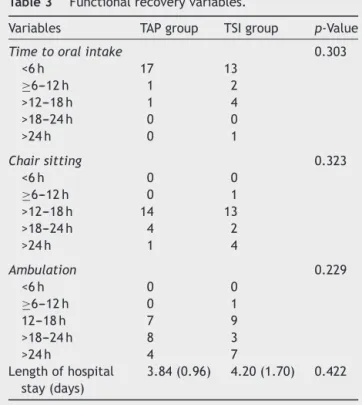
statisti-callysignificantdifferencebetweengroups(Tables2and3).
Time to oral intake was <6h in the majority of patients
in both groups (TAP 89%; TSI 65%); time to chair
sit-ting occurredmostly between12hand 18h (TAP74%; TSI
65%)andtimetoambulationwasinitiatedmorefrequently
Table2 Primaryandsecondaryoutcomes.
Variables TAPgroup TSIgroup p-Value
VAS-RT1(mm)a 32.79(29.45) 39.40(32.23) 0.509
VAS-RT2(mm)a 10.11(9.57) 16.75(18.08) 0.159
VAS-RT3(mm)a 7.21(12.35) 10.45(18.05) 0.519
VAS-CT1(mm)a 44.63(31.89) 50.95(33.60) 0.551
VAS-CT2(mm)a 23.74(23.81) 32.90(22.78) 0.227
VAS-CT3(mm)a 20.16(23.23) 22.75(23.24) 0.730
VAS-ST3(mm)a 21.06(26.67) 20.63(25.23) 0.962
Remifentanilconsumption(mcg) 1247.11(630.27) 1284.05(583.91) 0.854 Remifentanilconsumption(mcg.MCM−1.min−1) 0.16(0.07) 0.18(0.09) 0.541
Morphineconsumptionatrecoveryroom(mg)b 4.40(3.49) 6.87(4.83) 0.077
Dataarepresentedasmean(SD).
aOutputvariablesformultivariatelinearmodel. b Inputvariablesformultivariatelinearmodel.
Table3 Functionalrecoveryvariables.
Variables TAPgroup TSIgroup p-Value
Timetooralintake 0.303
<6h 17 13
≥6---12h 1 2
>12---18h 1 4
>18---24h 0 0
>24h 0 1
Chairsitting 0.323
<6h 0 0
≥6---12h 0 1
>12---18h 14 13
>18---24h 4 2
>24h 1 4
Ambulation 0.229
<6h 0 0
≥6---12h 0 1
12---18h 7 9
>18---24h 8 3
>24h 4 7
Lengthofhospital stay(days)
3.84(0.96) 4.20(1.70) 0.422
Dataarepresentedasnominalvaluesormean(SD). TAP,transverseabdominalplane;TSI,trocarsiteinfiltration.
between12hand24h(TAP79%;TSI60%).Therewerealso nosignificantdifferencesinlengthofhospitalstaybetween groups(TAP≈TSI≈4days).
The multivariate linearregression did not identify any significantindependentfactoramongpatientdemographic characteristicsandVASscoreat restintherecovery room admission.However,themultivariate linearregressionfor VASscoresrevealedthatmorphineconsumptionwasan inde-pendentpredictorofincentivespirometerVASscore.
With respect to the correlation analysis, it has been observed that remifentanil consumption and VAS score at rest in recovery room admission was correlated at a significantlevel(r=0.472;p=0.003).Additionally,the cor-relation analysis identified that morphine consumption in therecoveryroomandincentivespirometerVASscoreswere correlatedatasignificantlevel(r=0.373,p=0.035).
NoadverseeffectsorcomplicationsrelatedtoTAPblock ortrocarsiteinfiltrationwerereported.
Discussion
Laparoscopicsurgerymaybeassociatedwithreduced sur-gical trauma responseandshortened convalescence when compared with open procedures. However, early post-operative pain is a frequent complaint among patients. Accordingly, peripheral loco-regional techniques for post-operative pain relief are an attractive approach which may improve early pain control and minimize the need for opioids.7 Although the use of incisionaland
intraperi-toneallocalanestheticsisacommonpractice,TAPblockhas
recentlybecomemorepopularowingtotheultrasound
guid-ancepractice.Actually,theultrasound-guidedTAPblockhas
beenusedandevaluatedinrandomizedcontrolledtrialsfor
varioustypesof surgery.4 Nonetheless,theseresults
high-lightthesubstantialheterogeneityfromavailabletrials.8
OurstudyshowsthatVASscoreshadnostatistically
sig-nificantdifferencebetweenTAPandtrocarsiteinfiltration
groups. Additionally, our results show that intraoperative
remifentanilconsumption and morphineadministration in
therecoveryroomdidnotdemonstrateanystatistically
sig-nificant difference between groups. These results do not
disagreewiththepreviouspublishedtrialsindonor
laparo-scopic nephrectomies, which stated that TAP block was
associatedwithalowerpostoperativeVASscoreandalower
meanopioid consumption in the first 24h since the
men-tionedtrialswere placebo-controlledand port infiltration
withlocalanestheticwasnotaccomplished.
OurresultscanbeexplainedconsideringthatTAPblock
providesanalgesiatotheskin,tosubcutaneoustissueandto
parietalperitoneum.Asaresult,TAPblockisnoteffectivein
thecontrolofvisceralpainanditshouldbealwaysexecuted
asan additional component within multimodalanalgesia.
When trocar site infiltration is correctly performed, the
sameanatomicplaneswillbecoveredbylocalanesthetic.
In fact,it has already been discussed in a previous trial3
evaluatingTAPblockincholecystectomysurgeriesthatTAP
blockmaybeunnecessaryconsidering painlevelsandport
infiltrationwithlocalanestheticmaybeabetteroption.
Fur-thermore,thereisnoagreementaboutthelocalanesthetic
distributionafterasingle-injection TAP block,sincesome
studiesestablishanextensionfromT7toL1andothers,an
extensionfromT10toL1.Thehighest spreadingobserved
withtheultrasound-guidedtechniquewasT7byoblique
sub-costalTAPblock, T9 bythe mid-axillary approachandT4
toL1bytheposterior approach.Actually, therandomized
clinicaltrialsarepoorlycorrelatedtotheanticipated
exten-sionandconsequentlytheTAPblocksarenotallequivalent.
Thetechnicalapproachsignificantly modifiesthe
pharma-codynamicsandthesubsequentanalgesiccharacteristics.4
Inaddition,despitelocalanesthetichasbeen usedto
pre-ventsensitizationofnociceptors beforesurgicalincision,2
ourresults didnot showa significant differencein opioid
consumptionbetweenTAPblockperformedbeforesurgical
incisionandport siteinfiltration performed at theend of
surgery.
Inthisstudymorphineconsumptionwasanindependent
predictorofincentivespirometerVASscores.Althoughthe
regressiononlyhadaccuracycloseto30%,itidentifiedan
importantcorrelation betweenVASandthemorphine
con-sumption,suggestingthatsomepatientswithsuperioropioid
requirementsintherecoveryroommaybenefitfromother
analgesicstrategiesinordertoreducepainwithrespiratory
effortsinthedayaftersurgery.
Our results also show no differences in time to oral
intake, chair sitting and ambulation between groups.
According to the literature, functional recovery after
laparoscopicnephrectomieshasbeenevaluatedin
compar-isontoopenprocedures.Acaretal.9 evaluatedfunctional
recoveryusingpethidinepatient-controlledanalgesia.They
showedthatmeantimetooral intakeinthe laparoscopic
groupwas19hand ambulationstarted 14h after surgery.
In our study the majority of patients started oral intake
in less than 6h which may be associated withan overall
reductionin opioid consumption and its side effects. Our
effectivenessofTAPblockhasalreadybeenevaluatedonly
aftergynaecologiclaparoscopicsurgery.DeOliveiraetal.10
concludedTAP block providedearlier discharge readiness
thatwasassociatedwithbetter qualityofrecovery.
How-ever,thisstudywasplacebo-controlled.
Therearepotentiallimitationsassociatedtoourstudy.
Firstly, although the TAP blocks were performed under
ultrasoundguidancebyanexperienceanesthetist,pinprick
sensationwasnotusedtoassesssensoryblockageandthe
effectivenessofTAPblock.However,thiswascircumvented
inthepresenttrialtoattainpatientblinding.Additionally,
theanesthetistallocatedtotheurologicsurgeryoperative
roomwasnot blind tothe studied group. Simultaneously,
the TAP blocks were performed by different operators
whichalsointroducevariabilitytotheeffectivenessofthe
technique.
Inthisstudy,multimodalanalgesiawithTAPblockorwith
trocarsiteinfiltrationwasaneffectivetechniquefor
post-operativeanalgesiainlaparoscopicnephrectomies.
Conflicts
of
interest
Theauthorsdeclarenoconflictsofinterest.
References
1.GrecoF,HodaMR,AlcarazA,etal.Laparoscopicliving-donor nephrectomy: analysis of the existing literature. Eur Urol. 2010;58:498---509.
2.OrtizJ,RajagopalanS.Areviewoflocalanesthetictechniques foranalgesiaafterlaparoscopicsurgery.JMinimInvasiveSurg Sci.2014;3:e11310.
3.Petersen PL, Mathiesen O, Torup H, et al. The transversus abdominis plane block: a valuable option for postopera-tive analgesia? A topical review. Acta Anaesthesiol Scand. 2010;54:529---35.
4.RipollésJ,MezquitaSM,AbadA,etal.Analgesicefficacyofthe ultrasound-guidedblockadeofthetransversusabdominisplane --- asystematicreview.BrazJAnesthesiol.2015;65:255---80. 5.HosgoodSA, Thiyagarajan UM,Nicholson HF, et al.
Random-izedclinicaltrialoftransversusabdominisplaneblockversus placebo control in live-donor nephrectomy. Transplantation. 2012;94:520---5.
6.ParikhBeenaKWVT,ShahVR,MehtaT,etal.Theanalgesic effi-cacyofultrasound-guidedtransversusabdominisplaneblockfor retroperitoneoscopicdonornephrectomy: arandomized con-trolledstudy.SaudiJAnaesth.2013;7:43---7.
7.MoinicheS,JorgensenH,WetterslevJ,etal.Localanesthetic infiltrationfor postoperativepain reliefafterlaparoscopy: a qualitative and quantitative systematic review of intraperi-toneal, port-site infiltration and mesosalpinx block. Anesth Analg.2000;90:899---912.
8.Boddy AP,Mehta S,Rhodes M. Theeffectof intraperitoneal localanesthesiainlaparoscopiccholecystectomy:asystematic reviewandmeta-analysis.AnesthAnalg.2006;103:682---8. 9.AcarC, BilenC, BayazitY, et al. Quality oflife survey
fol-lowing laparoscopic and open radical nephrectomy. Urol J. 2014;11:1944---50.